
Pulp Fiction, 1934 · page 141 of 147
Western Story Magazine, May 12, 1934 — page 141: what you’re looking at
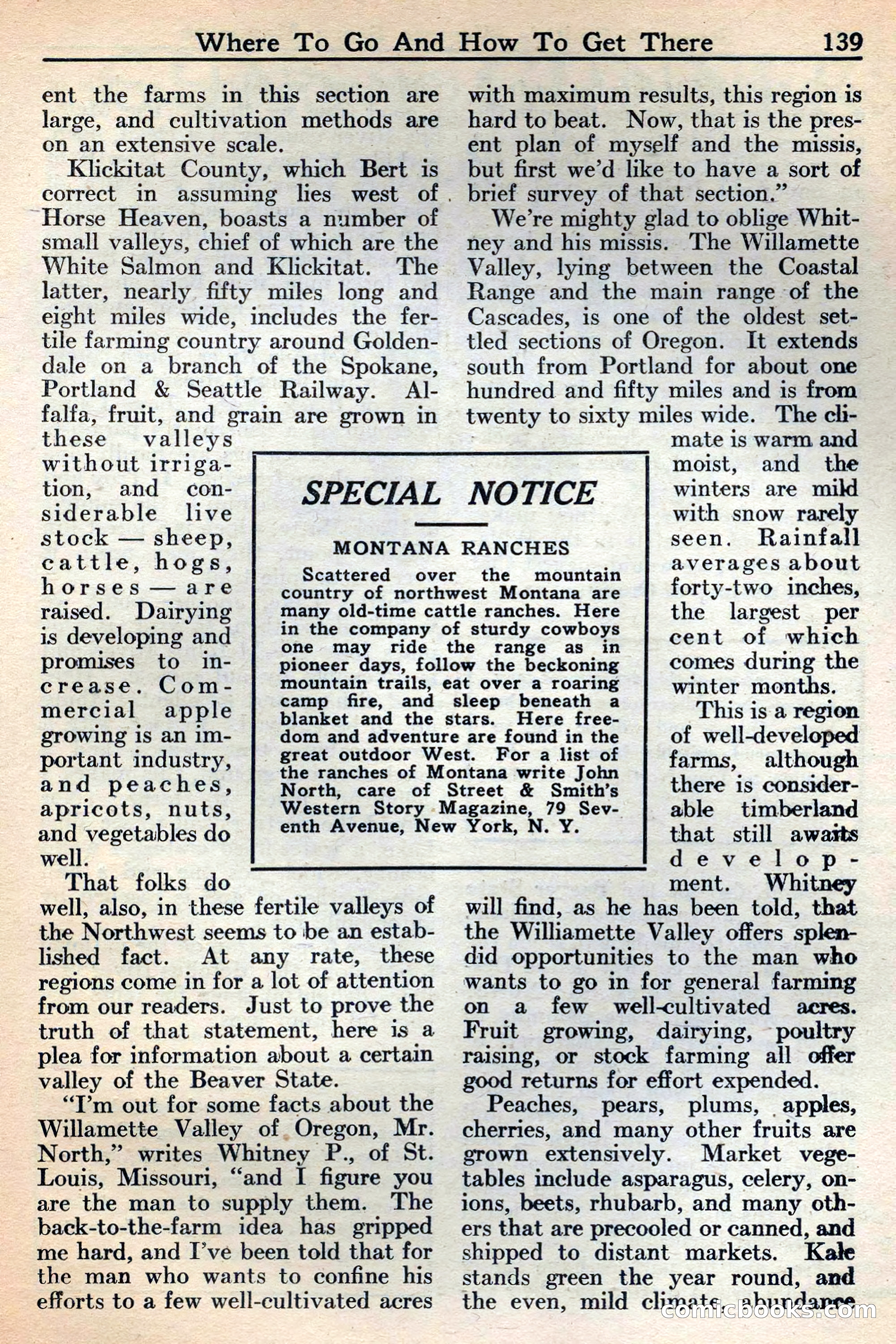
A restored page from Pulp Fiction, 1934. Page through the whole issue in the reader above.
📄 Transcribed text from this page (OCR, searchable)
Machine-transcribed from the original scan — historical spelling and the odd misread are preserved.
Where To Go And How To Get There ent the farms in this section are large, and cultivation methods are on an extensive scale. Klickitat County, which Bert is correct in assuming lies west of . ~Horse Heaven, boasts a number of small valleys, chief of which are the White Salmon and Klickitat. The latter, nearly fifty miles long and eight miles wide, includes the fer- tile farming country around Golden- dale on a branch of the Spokane, Portland & Seattle Railway. Al- falfa, fruit, and grain are grown in these valleys without irriga- tion, and con- siderable live stock — sheep, cattle, hogs, horses —are raised. Dairying is developing and SPECIAL Scattered over country of northwest Montana are many old-time cattle ranches. Here in the company of sturdy cowboys one may ride the range as 139 with maximum results, this region is hard to beat. Now, that is the pres- ent plan of myself and the missis, but first we’d like to have a sort of brief survey of that section.” We’re mighty glad to oblige Whit- ney and his missis. The Willamette Valley, lying between the Coastal Range and the main range of the Cascades, is one of the oldest set- tled sections of Oregon. It extends south from Portland for about one hundred and fifty miles and is from twenty to sixty miles wide. The chi- mate is warm and moist, and the winters are mild with snow rarely seen. Rainfall averages about forty-two inches, the largest per cent of which NOTICE MONTANA RANCHES the mountain in pr omises to in- pioneer days, follow the beckoning comes during the erease. Com- Scape trails, eat Se roaring winter months. : | camp fire, and sleep beneath a - ° mercial apple blanket and the stars. Here free- This is a region growing is an im- dom and adventure are found in the of well-developed : 7 great outdoor West. For a list of rms h. portant industry ‘ the ranches of Montana write John fa : although and peaches, apricots, nuts, and vegetables do well. That folks do well, also, in these fertile valleys of the Northwest seems to be an estab- lished fact. At any rate, these regions come in for a lot of attention from our readers. Just to prove the truth of that statement, here is a plea for information about a certain valley of the Beaver State. “I’m out for some facts about the Willamette Valley of Oregon, Mr. North,” writes Whitney P., of St. Louis, Missouri, “and I figure you are the man to supply them. The back-to-the-farm idea has gripped me hard, and I’ve been told that for the man who wants to confine his efforts to a few well-cultivated acres North, care of Street & Smith’s Western Story Magazine, 79 Sev- enth Avenue, New York, N. there is consider- able timberland that still awarts develop- ment. Whitney will find, as he has been told, that the Williamette Valley offers splen- did opportunities to the man who Ma wants to go in for general farming on a few well-cultivated acres. Fruit growing, dairying, ~ poultry raising, or stock farming all offer good returns for effort expended. Peaches, pears, plums, apples, cherries, and many other fruits are grown extensively. tables include asparagus, celery, on- ions, beets, rhubarb, and many oth- ers that are precooled or canned, and shipped to distant markets. Kale stands green the year round, and the even, mild climete,.ahpndarre. Market vege- (LI