
Pulp Fiction, 1934 · page 106 of 147
Western Story Magazine, May 12, 1934 — page 106: what you’re looking at
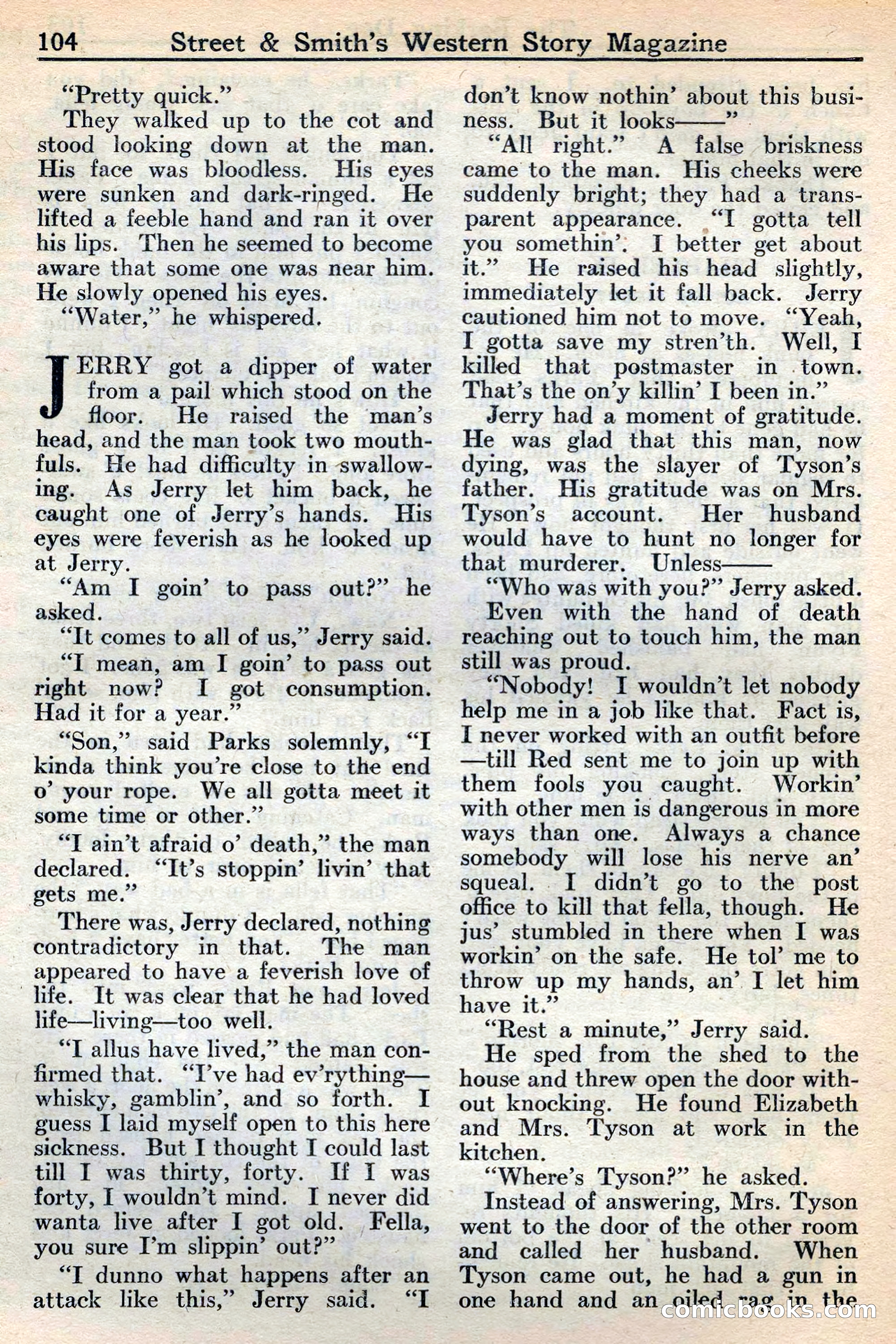
A restored page from Pulp Fiction, 1934. Page through the whole issue in the reader above.
📄 Transcribed text from this page (OCR, searchable)
Machine-transcribed from the original scan — historical spelling and the odd misread are preserved.
104. “Pretty quick.” They walked up to the cot and stood looking down at the man. His face was bloodless. His eyes were sunken and dark-ringed. He lifted a feeble hand and ran it over his lips. Then he seemed to become aware that some one was near him. He slowly opened his eyes. “Water,” he whispered. ERRY got a dipper of water from a pail which stood on the floor. He raised the man’s head, and the man took two mouth- fuls. He had difficulty in swallow- ing. As Jerry let him back, he caught one of Jerry’s hands. His eyes were feverish as he looked up at Jerry. “Am I goin’ to pass out?” he asked. “It comes to all of us,” Jerry said. “J mean, am I goin’ to pass out right now? I got consumption. Had it for a year.” “Son,” said Parks solemnly, “I kinda think you’re close to the end o your rope. We all gotta meet it some time or other.” “T ain’t afraid o’ death,” the man declared. “It’s stoppin’ livin’ that gets me.” There was, Jerry declared, nothing contradictory in that. The man appeared to have a feverish love of —djife. It was clear that he had loved life—living—too well. *T allus have lived,” the man con- firmed that. “I’ve had ev’rything— whisky, gamblin’, and so forth. I guess I laid myself open to this here sickness. But I thought I could last till I was thirty, forty. If I was forty, I wouldn’t mind. I never did wanta live after I got old. | Fella, you sure I’m slippin’ out?” “T dunno what happens after an attack like this,” Jerry said. “I Street & Smith’s Western Story Magazine don’t know nothin’ about this busi- ness. But it looks se “All right.” A false briskness came to the man. His cheeks were suddenly bright; they had a trans- parent appearance. “I gotta tell you somethin’: [ better get about it.’ He raised his head slightly, immediately let it fall back. Jerry cautioned him not to move. “Yeah, I gotta save my stren’th. Well, I killed that postmaster in . town. That’s the on’y killin’ I been in.” Jerry had a moment of gratitude. He was glad that this man, now dying, was the slayer of Tyson’s father. His gratitude was on Mrs. Tyson’s account. Her husband would have to hunt no longer for that murderer. Unless “Who was with you?” Jerry asked. Even with the hand of death reaching out to touch him, the man still was proud. “Nobody! I wouldn’t let nobody help me in a job like that. Fact is, I never worked with an outfit before —till Red sent me to join up with them fools you caught. Workin’ with other men is dangerous in more ways than one. Always a chance somebody will lose his nerve an’ squeal. I didn’t go to the post office to kill that fella, though. He jus’ stumbled in there when I was workin’ on the safe. He tol’ me to throw up my hands, an’ [ let him have it.” “Rest a minute,” Jerry said. He sped from the shed to the house and threw open the door with- out knocking. He found Elizabeth and Mrs. Tyson at work in the kitchen. ““Where’s Tyson?” he asked. Instead of answering, Mrs. Tyson went to the door of the other room and called her husband. When Tyson came out, he had a gun in one hand and an oiled r9g. in. the,