
Pulp Fiction, 1934 · page 134 of 147
Western Story Magazine, May 12, 1934 — page 134: what you’re looking at
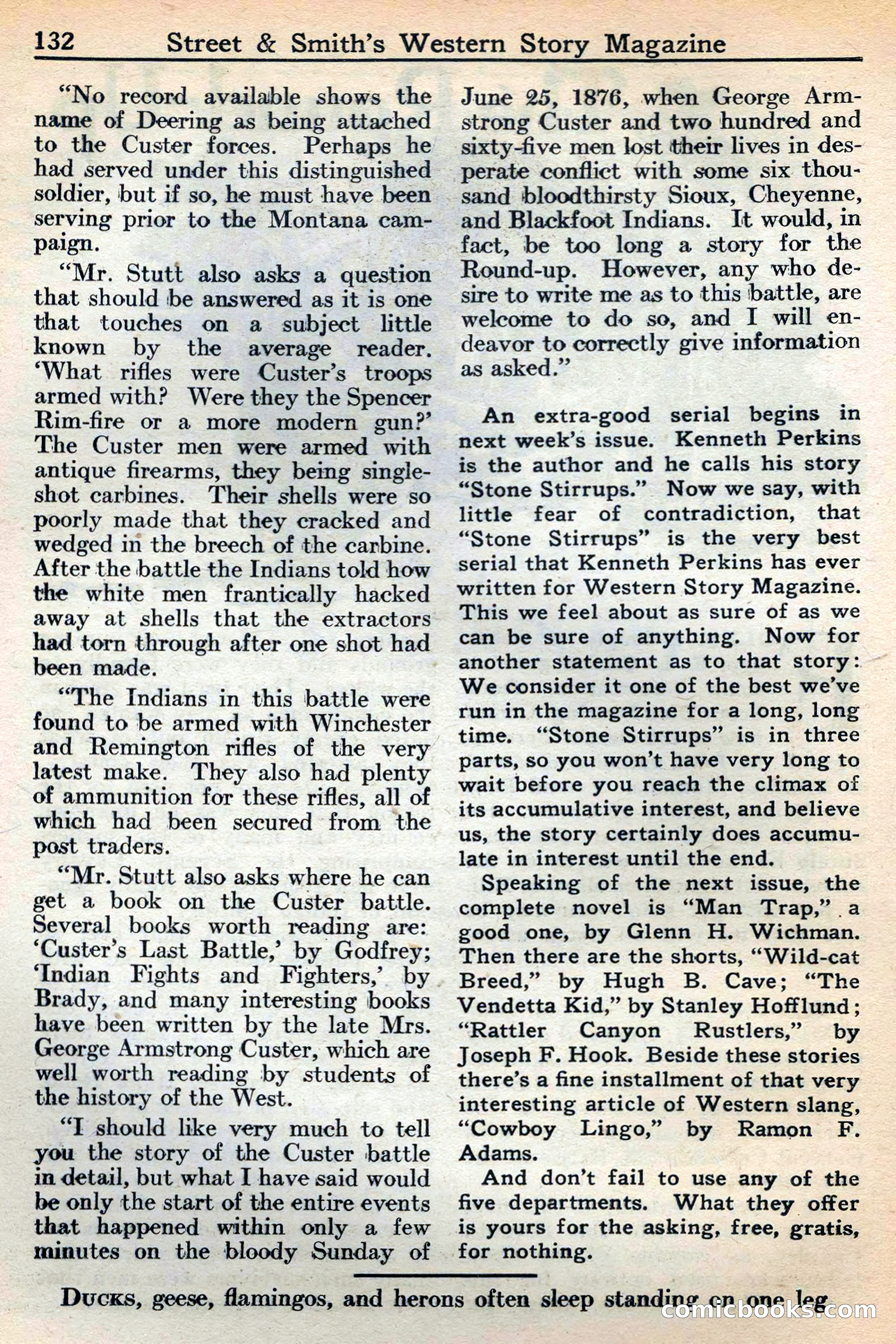
A restored page from Pulp Fiction, 1934. Page through the whole issue in the reader above.
📄 Transcribed text from this page (OCR, searchable)
Machine-transcribed from the original scan — historical spelling and the odd misread are preserved.
132 “No record available shows the name of Deering as being attached to the Custer forces. Perhaps he had served under this distinguished soldier, but if so, he must have been serving prior to the Montana cam- paign. eo “Mr. Stutt also asks a question that should be answered as it is one that touches on a subject little known by the average reader. “What rifles were Custer’s troops armed with? Were they the Spencer Rim-fire or a more modern gun?’ The Custer men were armed with antique firearms, they being single- shot carbines. Their shells were so poorly made that they cracked and wedged in the breech of the carbine. After the battle the Indians told how the white men frantically hacked away at shells that the extractors had torn through after one shot had been made. “The Indians in this battle were found to be armed with Winchester and Remington rifles of the very latest make. They also had plenty of ammunition for these rifles, all of which had been secured from the post traders. “Mr. Stutt also asks where he can get a book on the Custer battle. Several books worth reading are: ‘Custer’s Last Battle,’ by Godfrey; ‘Indian Fights and Fighters,’ by. Brady, and many interesting books have been written by the late Mrs. George Armstrong Custer, which are well worth reading by students of the history of the West. “YT should like very much to tell you the story of the Custer battle in detail, but what I have said would be only the start of the entire events that happened within only a few minutes on the bloody Sunday of Ducxs, geese, flamingos, and herons often sleep standing ¢n Street & Smith’s Western Story Magazine June 25, 1876, when George Arm- strong Custer and two hundred and sixty-five men lost their lives in des- perate conflict with some six thou- sand bloodthirsty Sioux, Cheyenne, and Blackfoot Indians. It would, in fact, be too long a story for the Round-up. However, any who de- sire to write me as to this battle, are welcome to do so, and I will en- deavor to correctly give information as asked.” An extra-good serial begins in next week’s issue. Kenneth Perkins is the author and he calls his story “Stone Stirrups.” Now we say, with little fear of contradiction, that “Stone Stirrups” is the very best serial that Kenneth Perkins has ever written for Western Story Magazine. This we feel about as sure of as we can be sure of anything. Now for another statement as to that story: We consider it one of the best we’ve run in the magazine for a long, long time. “Stone Stirrups” is in three parts, so you won’t have very long to wait before you reach the climax of its accumulative interest, and believe us, the story certainly does accumu- late in interest until the end. Speaking of the next issue, the complete novel is “Man Trap,” a good one, by Glenn H. Wichman. Then there are the shorts, “Wild-cat Breed,” by Hugh B. Cave; “The Vendetta Kid,” by Stanley Hofflund; “Rattler Canyon Rustlers,” by Joseph F. Hook. Beside these stories there’s a fine installment of that very interesting article of Western slang, “Cowboy Lingo,” by Ramon F. Adams. And don’t fail to use any of the five departments. What they offer is yours for the asking, free, gratis, for nothing. one leg.