
Pulp Fiction, 1934 · page 109 of 147
Western Story Magazine, May 12, 1934 — page 109: what you’re looking at
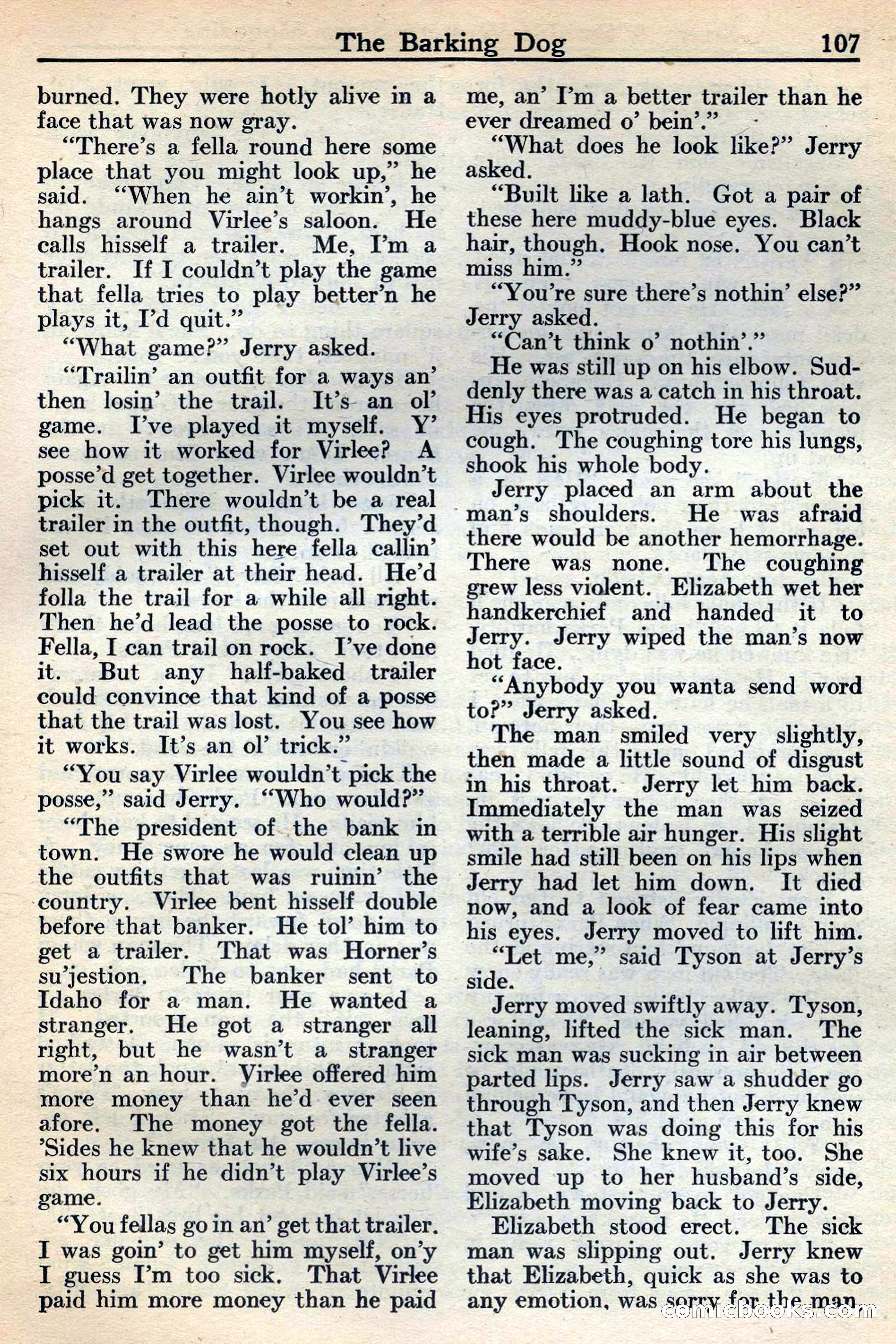
A restored page from Pulp Fiction, 1934. Page through the whole issue in the reader above.
📄 Transcribed text from this page (OCR, searchable)
Machine-transcribed from the original scan — historical spelling and the odd misread are preserved.
The Barking Dog burned. They were hotly alive in a face that was now gray. “There’s a fella round here some place that you might look up,” he said. ‘“‘When he ain’t workin’, he hangs around Virlee’s saloon. He calls hisself a trailer. Me, [Pm a trailer. If I couldn’t play the game that fella tries to play better’n he plays it, Vd quit.” “What game?” Jerry asked. “Trailin’ an outfit for a ways an’ then losin’ the trail. It’s- an ol’ game. I’ve played it myself. Y’ see how it worked for Virlee? A posse’d get together. Virlee wouldn’t pick it. There wouldn’t be a real trailer in the outfit, though. They’d set out with this here fella callin’ hisself a trailer at their head. He’d folla the trail for a while all right. Then he’d lead the posse to rock. Fella, I can trail on rock. I’ve done it. But any half-baked trailer could convince that kind of a posse that the trail was lost. You see how it works. It’s an ol’ trick.” “You say Virlee wouldn’t pick the posse,” said Jerry. “Who would?” “The president ofthe bank in town. He swore he would clean up the outfits that was ruinin’ the ‘country. Virlee bent hisself double before that banker. He tol’ him to get a trailer. That was Horner’s sujestion. The banker sent to Idaho for a man. He wanted a stranger. He got a stranger all right, but he wasn’t a_ stranger more’n an hour. Virlee offered him more money than he’d ever seen afore. The money got the fella. *Sides he knew that he wouldn’t live six hours if he didn’t play Virlee’s game. “You fellas goin an’ get that trailer. I was goin’ to get him myself, on’y I guess I’m too sick. That Virlee paid him more money than he paid “man’s shoulders. 107 me, an’ I’m a better trailer than he ever dreamed o’ bein’.” | “What does he look like?” Jerry asked. “Built like a lath. Got a pair of these here muddy-blue eyes. Black hair, though, Hook nose. You can’t miss him.” “You’re sure there’s nothin’ else?” Jerry asked. ~“Can’t think o’ nothin’.” He was still up on his elbow. Sud- denly there was a catch in his throat. His eyes protruded. He began to cough. The coughing tore his lungs, shook his whole body. Jerry placed an arm about the He was afraid there would be another hemorrhage. There was none. The coughing grew less violent. Elizabeth wet her handkerchief and handed it to Jerry. Jerry wiped the man’s now hot face. _ “Anybody you wanta send word tor” Jerry asked. The man smiled very slightly, then made a little sound of disgust in his throat. Jerry let him back. Immediately the man was seized with a terrible air hunger. His slight smile had still been on his lips when Jerry had let him down. It died now, and a look of fear came into his eyes. Jerry moved to lift him. “Let me,” said Tyson at Jerry’s side. Jerry moved swiftly away. Tyson, leaning, lifted the sick man. The sick man was sucking in air between parted lips. Jerry saw a shudder go through Tyson, and then Jerry knew that Tyson was doing this for his wife’s sake. She knew it, too. She moved up to her husband’s side, Elizabeth moving back to Jerry. Elizabeth stood erect. The sick man was slipping out. Jerry knew that Elizabeth, quick as she was to any emotion, was serry for the man,