
Pulp Fiction, 1934 · page 110 of 147
Western Story Magazine, May 12, 1934 — page 110: what you’re looking at
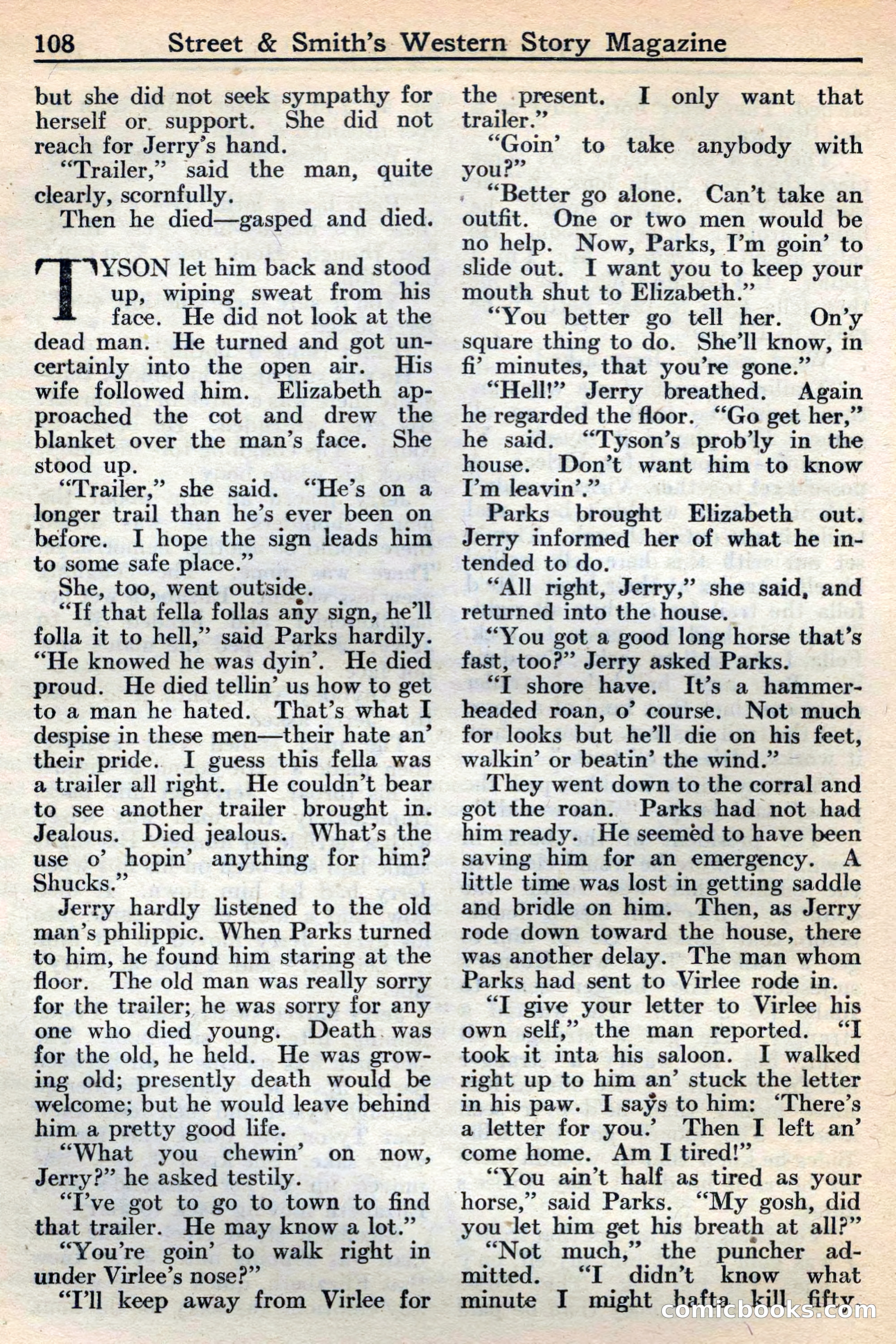
A restored page from Pulp Fiction, 1934. Page through the whole issue in the reader above.
📄 Transcribed text from this page (OCR, searchable)
Machine-transcribed from the original scan — historical spelling and the odd misread are preserved.
| 108 but she did not ek sympathy for herself or. support. She did not reach for Jerry's hand. ‘Trailer,’ said the man, quite ~ clearly, scornfully. - Then he died—gasped and died. f “VYSON let him back and stood up, wiping sweat from his face. He did not look at the dead man. He turned and got un- certainly into the open air. His wife followed him. Elizabeth ap- proached the cot and drew the blanket over the man’s face. She stood up. “Trailer,” she said. ‘“‘He’s on a longer trail than he’s ever been on before. I hope the sign leads him - to some safe place.” She, too, went outside. “Tf that fella follas any sign, he’ll folla it to hell,” said Parks hardily. “He knowed he was dyin’. He died proud. He died tellin’ us how to get to a man he hated. That’s what I despise in these men—their hate an’ their pride. I guess this fella was a trailer all right. He couldn’t bear to see another trailer brought in. Jealous. Died jealous. What’s the use o’ hopin’ anything for him? Shucks.” Jerry hardly listened to the old man’s philippic. When Parks turned to him, he found him staring at the floor. The old man was really sorry for the trailer; he was sorry for any one who died young. Death. was for the old, he held. He was grow- ing old; presently death would be welcome; but he would leave behind him. a pretty good life. “What you chewin’ - Jerry?” he asked testily. “T’ve got to go to town to find that trailer. He may know a lot.” “You're goin’ to walk right in under Virlee’s nose?” “T’ll keep away from Virlee for on now, outfit. horse, Street & Smith’s- Western Story Magazine the . present. trailer.” | “Goin’ to take anybody with you?” “Better go alone. I only want that Can’t take an One or two men would be no help. Now, Parks, ’'m goin’ to slide out. I want you to keep your mouth shut to Elizabeth.” “You better go tell her. On’y square thing to do. She'll know, in fi? minutes, that you’re gone.” “Hell!” Jerry breathed. Again he regarded the floor. “Go get her,” he said. “Tyson’s prob’ly in the house. Don’t want him to know I’m leavin’.” Parks brought Elizabeth out. Jerry informed her of what he in- tended to do. “All right, Jerry,” she said, and returned into the house. “You got a good long horse that’s fast, too?” Jerry asked Parks. “I shore have. It’s a hammer- headed roan, o’ course. Not much for looks but he’ll die on his feet, walkin’ or beatin’ the wind.” They went down to the corral and got the roan. Parks had not had him ready. He seemed to have been saving him for an emergency. A little time was lost in getting saddle and bridle on him. Then, as Jerry rode down toward the house, there was another delay. The man ‘whom Parks had sent to Virlee rode in. “I give your letter to Virlee his own self,’ the man reported. “I took it inta his saloon. I walked right up to him an’ stuck the letter in his paw. I says to him: ‘There’s a letter for you.’ Then [I left an’ come home. Am [I tired!” “You ain’t half as tired as your ” said Parks. ‘My gosh, did you Jet him get his breath at all?” “Not much,” the puncher ad- mitted. “I didn’t know what minute I might hafta. boo com