
A complete issue · 44 pages · 1928
Life — November 16, 1928
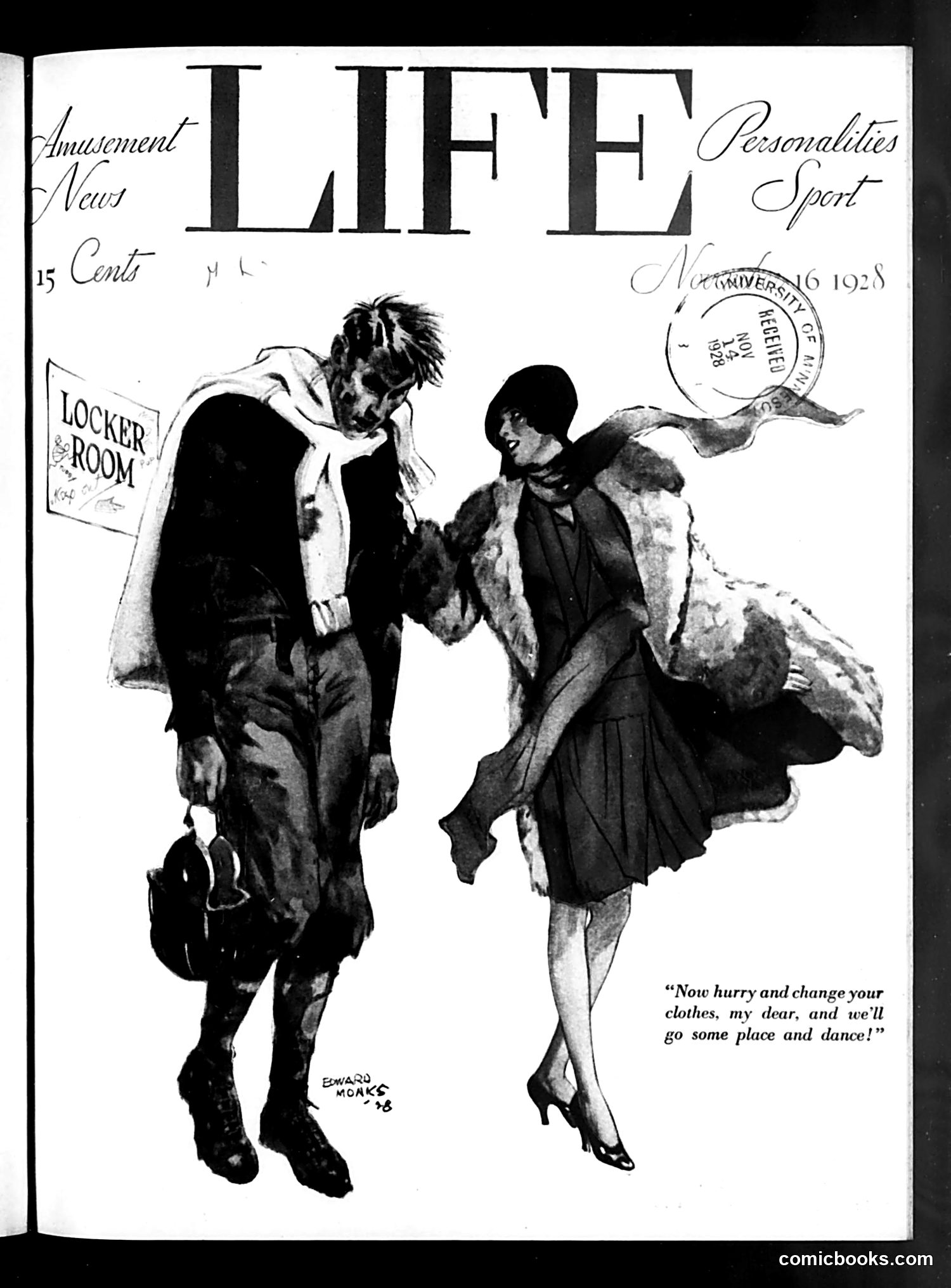
This satirical magazine cover depicts a man and woman in evening wear leaving a locker room, with the man appearing disheveled and exhausted. The caption reads: "Now hurry and change your clothes, my dear, and we'll go some place and dance!" The joke targets the era's social dancing culture and gender dynamics. The man's exhausted appearance suggests he's been worn out by athletic activity (likely sports), while the woman appears fresh and eager for more nightlife. The satire plays on 1920s social expectations: women's increasing independence and appetite for entertainment versus traditional male roles. The humor derives from the role reversal—the woman pushing for continued activity while the man is depleted, inverting typical gender stereotypes of the Jazz Age.
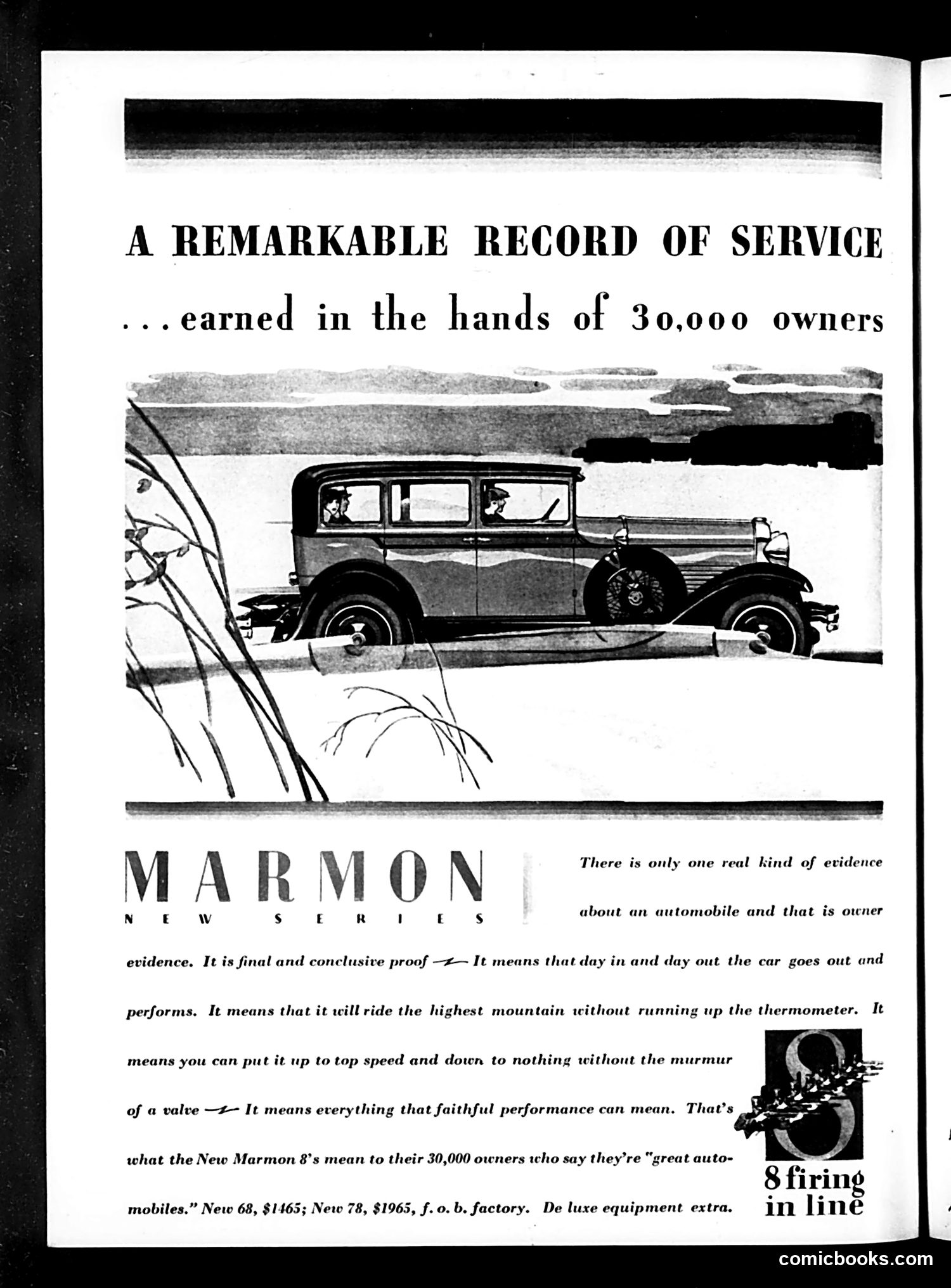
This is **not a political cartoon but an automobile advertisement** for Marmon automobiles, circa 1920s-1930s based on the vehicle styling. The ad's headline claims "A Remarkable Record of Service...earned in the hands of 30,000 owners." The body text argues that real proof of an automobile's quality is owner evidence—how reliably it performs daily. The ad emphasizes the Marmon 8's capabilities: climbing mountains without overheating, reaching top speeds smoothly, and running quietly. It concludes that 30,000 owners calling it a "great automobile" proves its reliability through faithful performance. The small illustration labeled "8 firing in line" shows the engine's eight cylinders—a technical selling point emphasizing the vehicle's modern engineering.
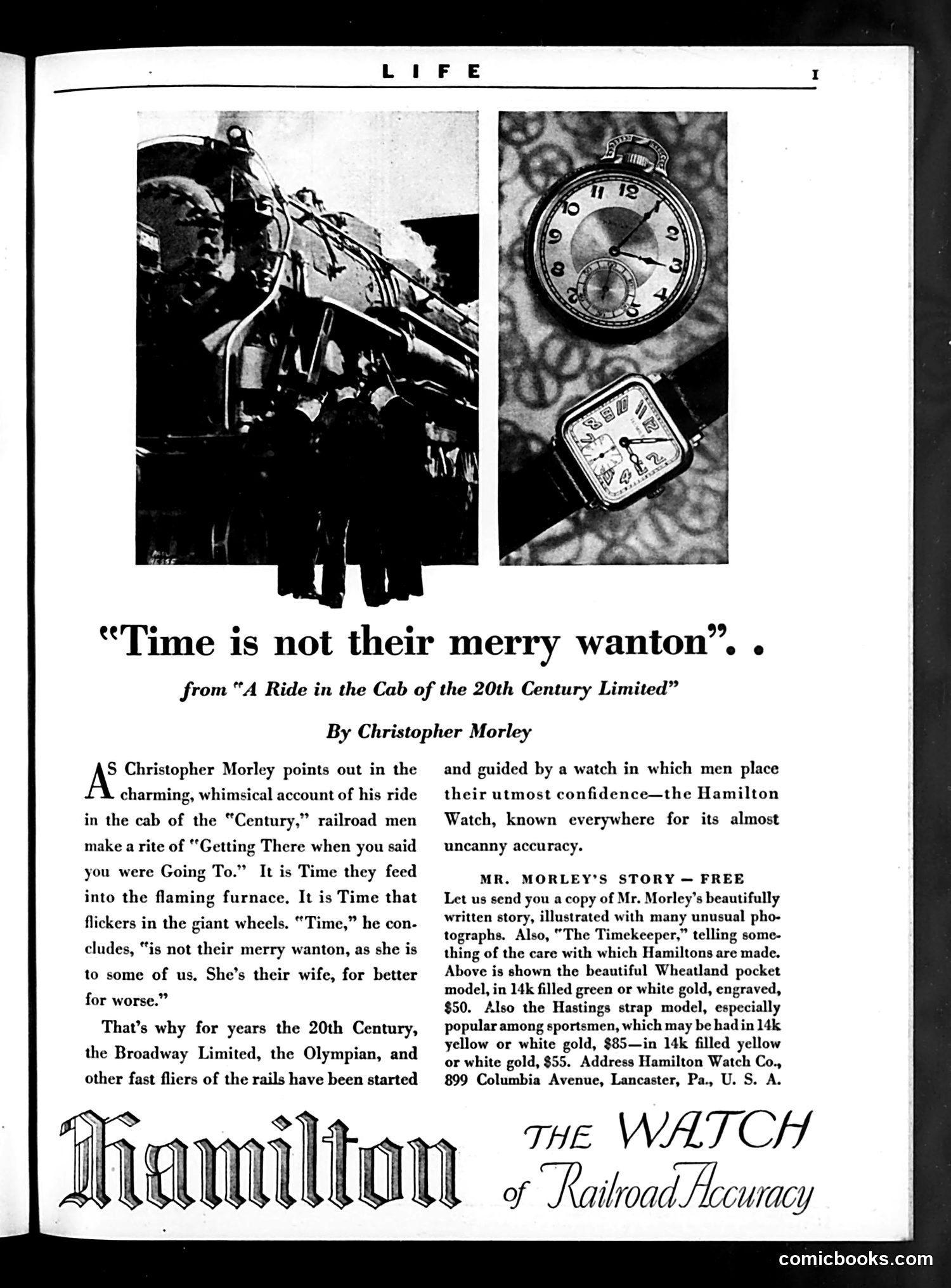
This page is primarily **advertising content**, not satire or political commentary. It features a Hamilton Watch advertisement using a literary tie-in. The ad references Christopher Morley's story "A Ride in the Cab of the 20th Century Limited"—a real train. The copy humorously claims that railroad workers treat time with utmost seriousness ("Time is not their merry wanton"), personifying time as a wife figure who demands respect. The left photograph shows a locomotive and workers; the right displays two Hamilton watches (a pocket watch and wristwatch model). The advertisement promotes Hamilton's reputation for accuracy by associating it with railroad operations, where precise timekeeping was genuinely critical for safety and scheduling. This is vintage advertising that emphasizes product reliability through professional endorsement rather than satire.
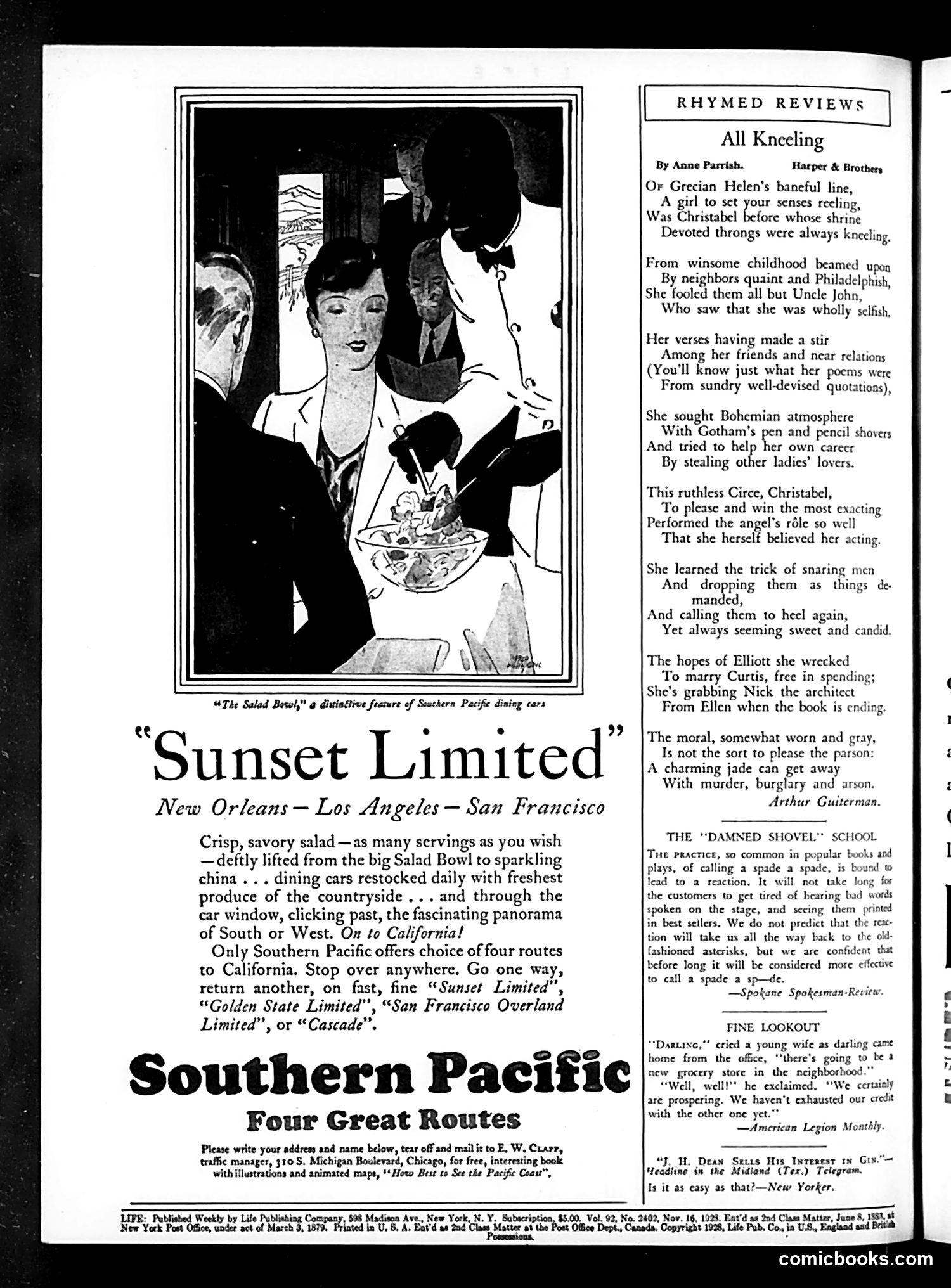
This page is **primarily advertising** for Southern Pacific Railroad's dining cars and four California routes (Sunset Limited, Golden State Limited, etc.). The main illustration depicts elegantly dressed passengers dining in a fine dining car, showcasing the luxury travel experience. The right column contains **"Rhymed Reviews,"** book critiques in verse form. The featured review is "All Kneeling" by Anne Parrish, which satirizes a character named Christabel—described as selfish, manipulative, and ruthless in her romantic pursuits. The poem mocks her literary pretensions and moral failings. Below are brief book/periodical reviews commenting on contemporary fiction and magazines. The page reflects 1920s leisure culture and literary commentary rather than political satire.

This is primarily a **product advertisement**, not a political cartoon. It promotes the Kolster Model K22, a six-tube floor radio, featuring an illustration of the wooden cabinet-style receiver typical of late 1920s design. The ad uses a persuasive sales technique: it suggests readers ask experienced friends about Kolster radios, predicting they'll hear it's a "fine set." The copy emphasizes "ideal radio reception," addressing a significant consumer concern of the era when radio quality varied considerably. The decorative branch illustration at top and the small radio transmission graphic at bottom are purely ornamental design elements. The copyright date (1928) and mention of the "Columbia Chain" indicate this targets affluent listeners interested in quality home entertainment technology.
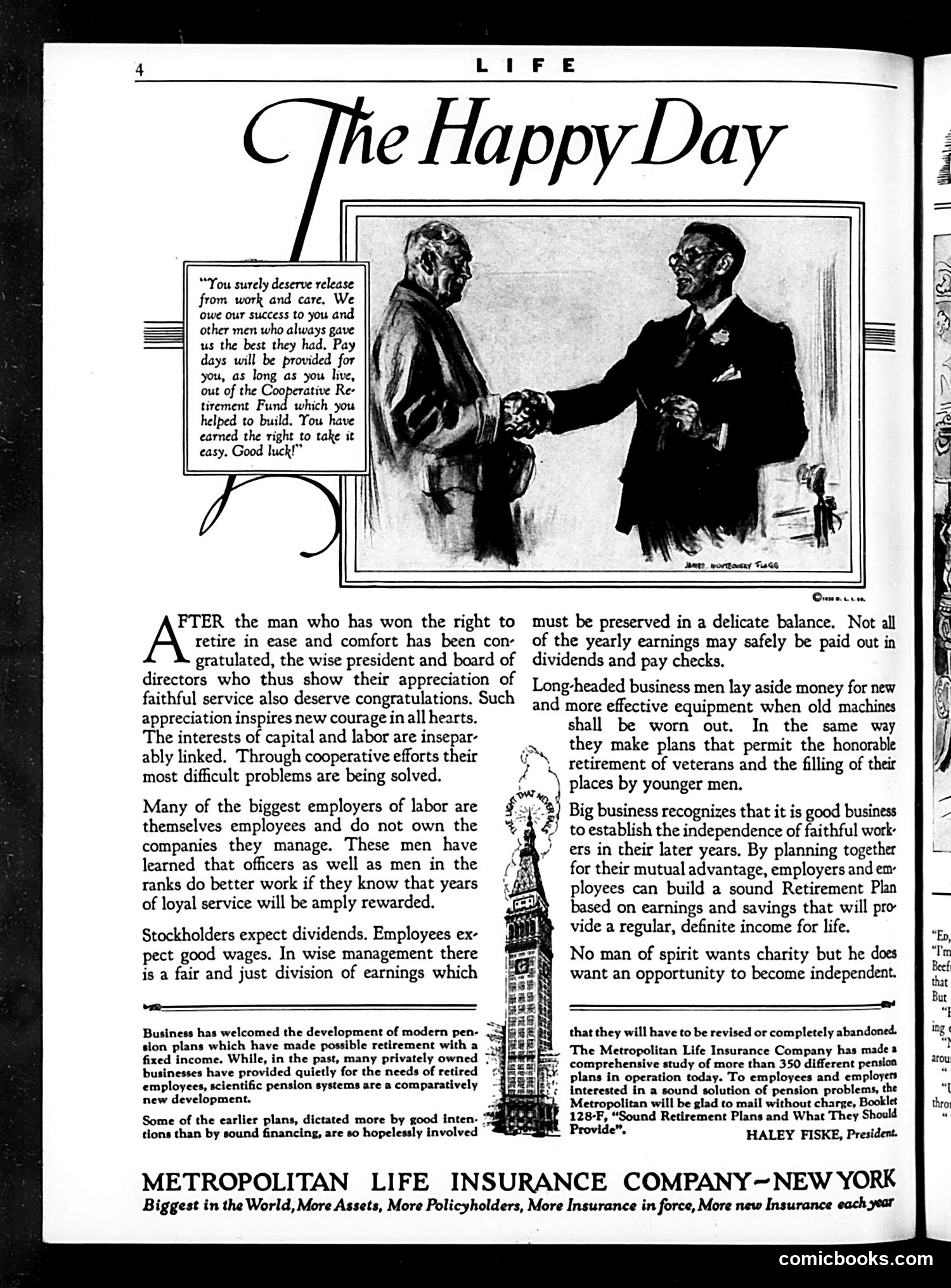
This appears to be primarily **advertising content**, not satire or political commentary. The page features a Metropolitan Life Insurance Company advertisement titled "The Happy Day." The illustration shows two businessmen shaking hands—likely representing an employer congratulating a retiring worker. The speech bubble thanks the retiree for his service and promises him "pay days...as long as you live, out of the Cooperative Retirement Fund." The accompanying text discusses **retirement security and pension plans**, advocating that businesses establish formal retirement systems to provide workers independence and dignity. The article presents this as enlightened business practice benefiting both capital and labor. This reflects early-20th-century concerns about worker welfare and represents Metropolitan Life's pitch for comprehensive pension planning—framed as a progressive, mutually beneficial business solution rather than charity.
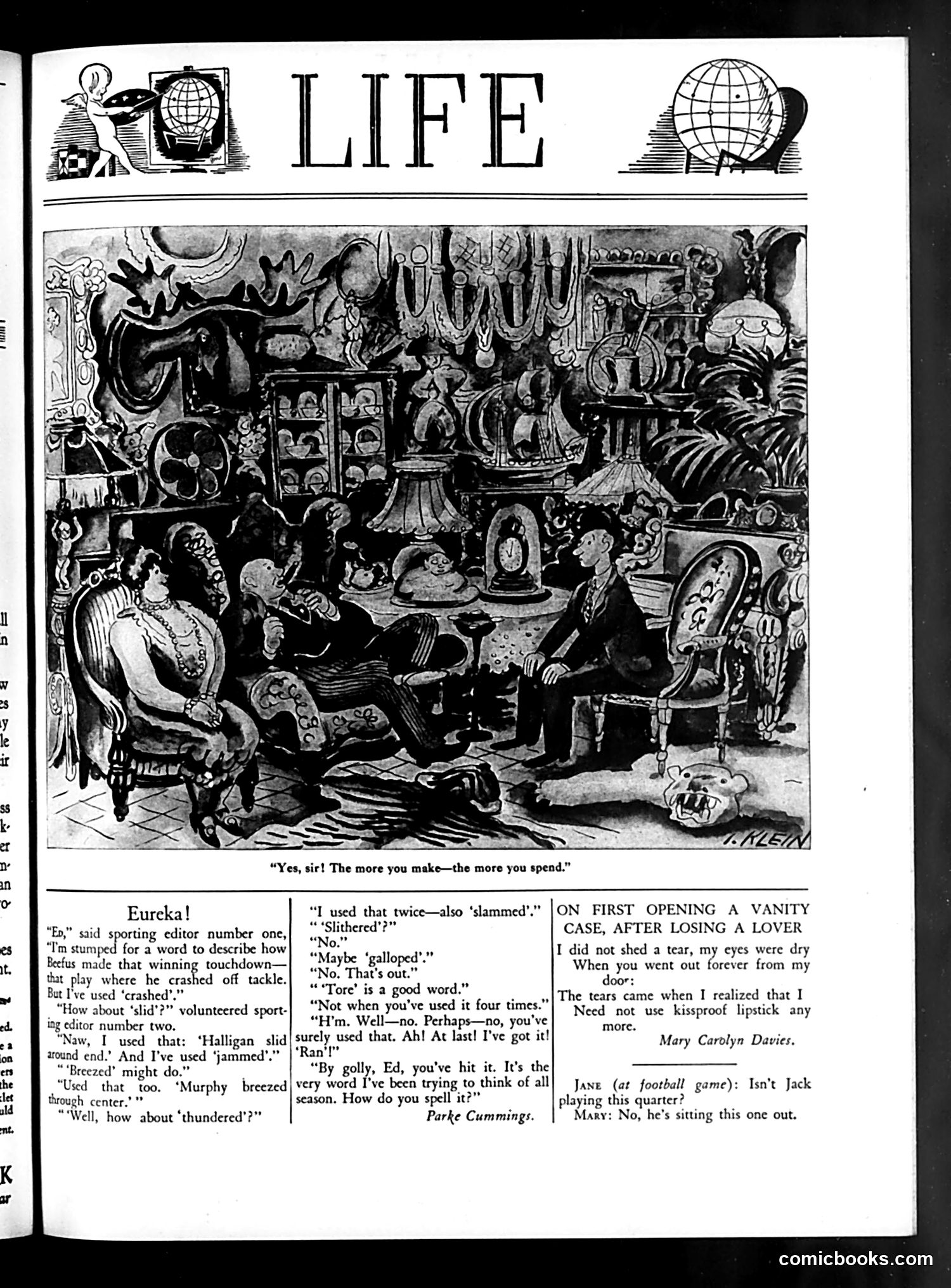
**Main Cartoon:** The large illustration depicts a lavish interior scene with wealthy patrons surrounded by luxury goods and servants. The caption reads: "Yes, sir! The more you make—the more you spend." This is social satire about consumer excess and wealth inequality, showing how affluent people accumulate possessions and maintain expensive lifestyles. The opulent setting with decorative items, fine furnishings, and attendants satirizes conspicuous consumption. **Sidebar Content:** "Eureka!" is a humorous piece about sports terminology, with contributors competing to identify slang words and their proper usage (words like "halligan," "breezed," and "hundredth"). Below are brief personal anecdotes about vanity and relationships. The overall page targets 1920s-era materialism and leisure-class excess through both visual and textual satire.
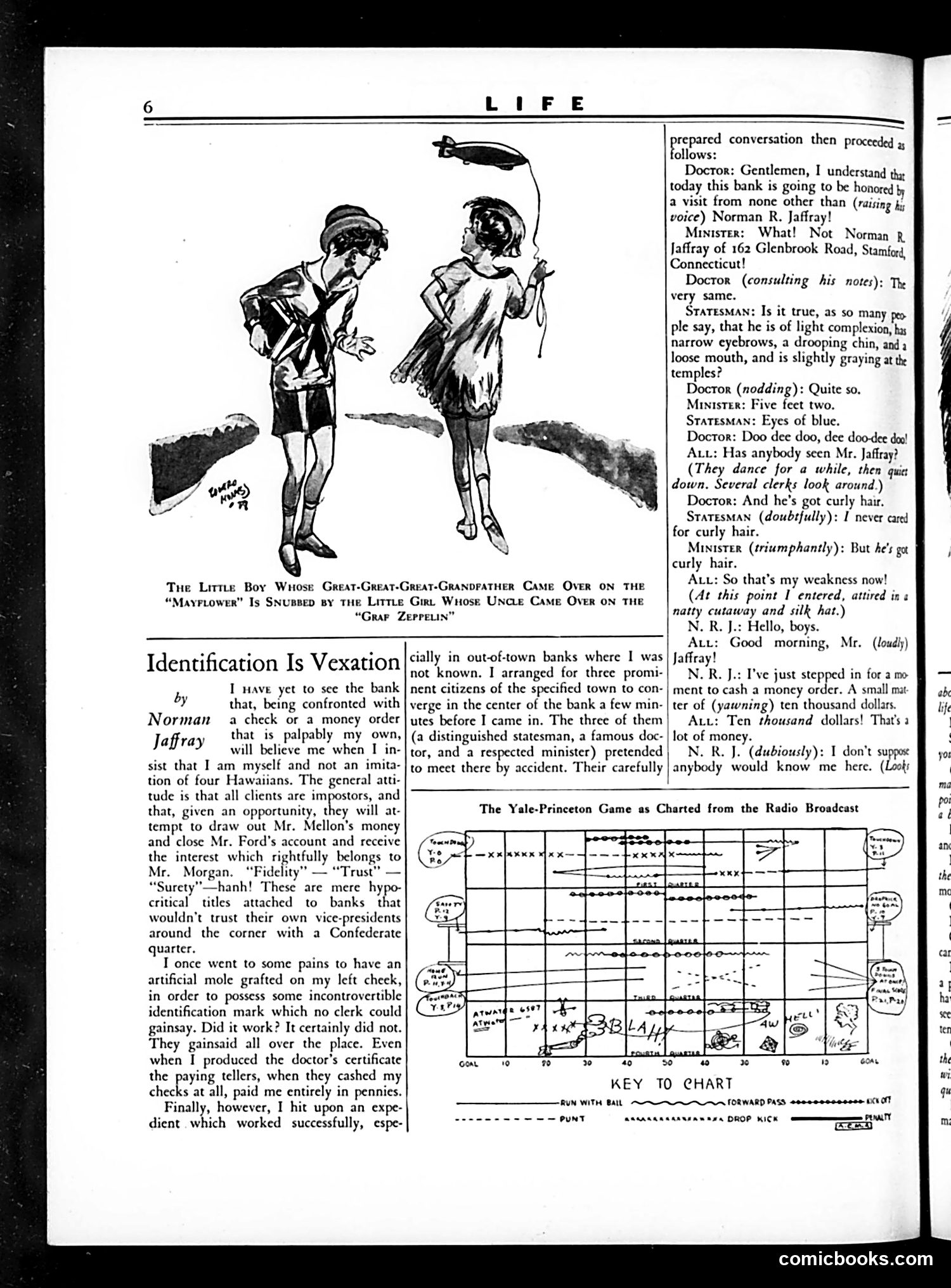
This satirical piece mocks the banking industry's obsession with verification procedures. The author describes attempting to cash a check at unfamiliar banks, where he faced elaborate identity-verification requirements despite being an honest depositor. The humor lies in the absurd lengths banks went to confirm his identity—requiring distinguished witnesses and detailed physical descriptions—while simultaneously accepting obviously fraudulent credentials and paying out in pennies as obstruction. The cartoon above illustrates two young women playing with a toy zeppelin, visualizing the concept of frivolous distraction (the "Mayflower" being snubbed by a smaller "Graf Zeppelin"). The Yale-Princeton football diagram below charts the radio broadcast of that game, translating play-by-play commentary into visual strategy.
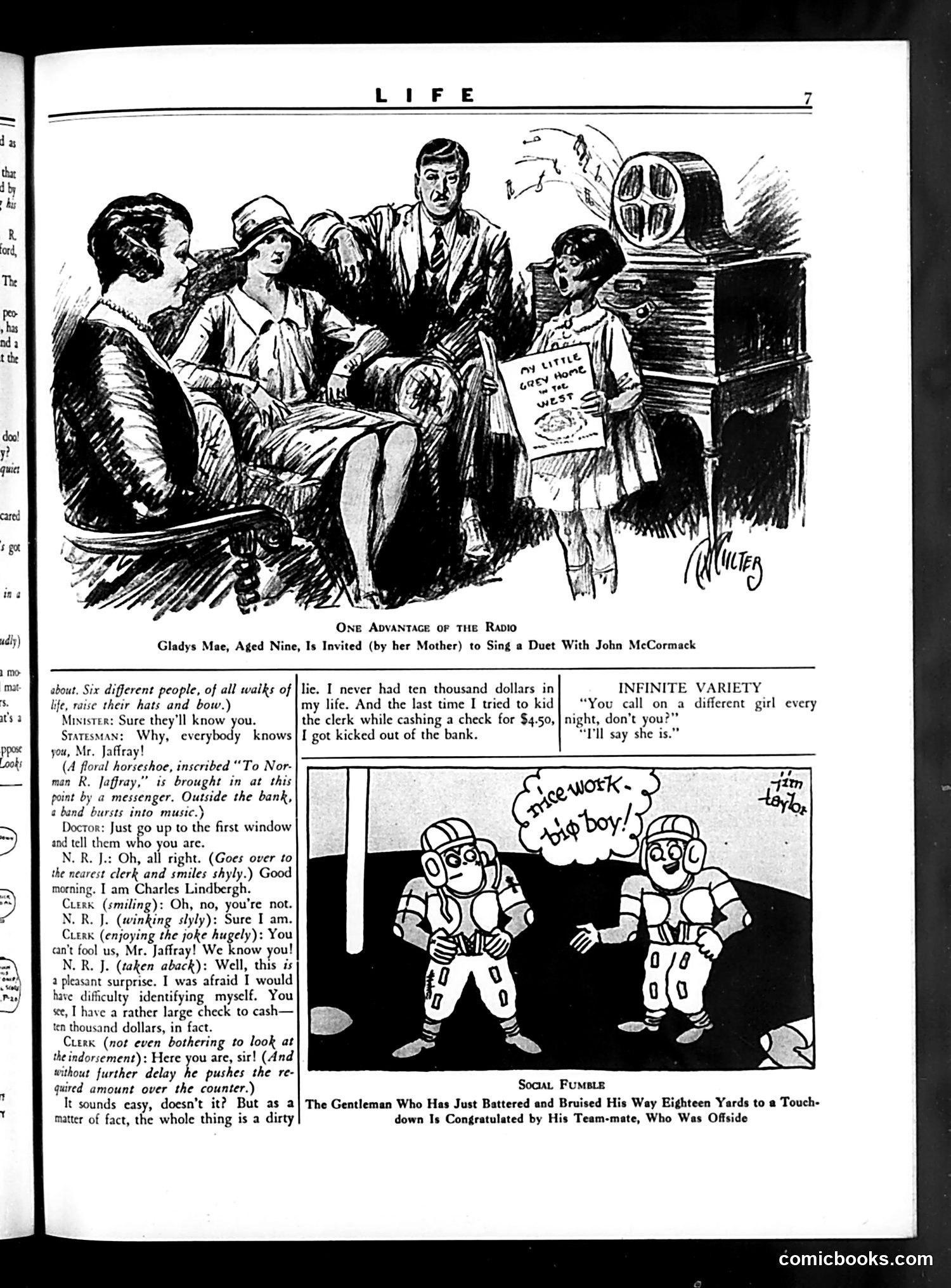
This page contains two satirical pieces from *Life* magazine: **Top illustration**: Shows a radio studio scene where a child named Gladys Mae (age nine) is invited to sing a duet with performer John McCormack. The caption "One Advantage of the Radio" is ironic—the joke appears to mock radio's novelty by showing an awkwardly formal setup where a child performer is presented as entertainment. **Bottom cartoon ("Social Fumbler")**: Depicts two football players in uniforms. One congratulates his teammate who just scored a touchdown but was offside, making the score invalid. The humor lies in the teammate's obliviousness to the rule violation—he celebrates what technically didn't count. Both pieces use gentle satire typical of 1920s *Life*: poking fun at modern technology adoption and social/sporting mishaps rather than harsh political commentary.
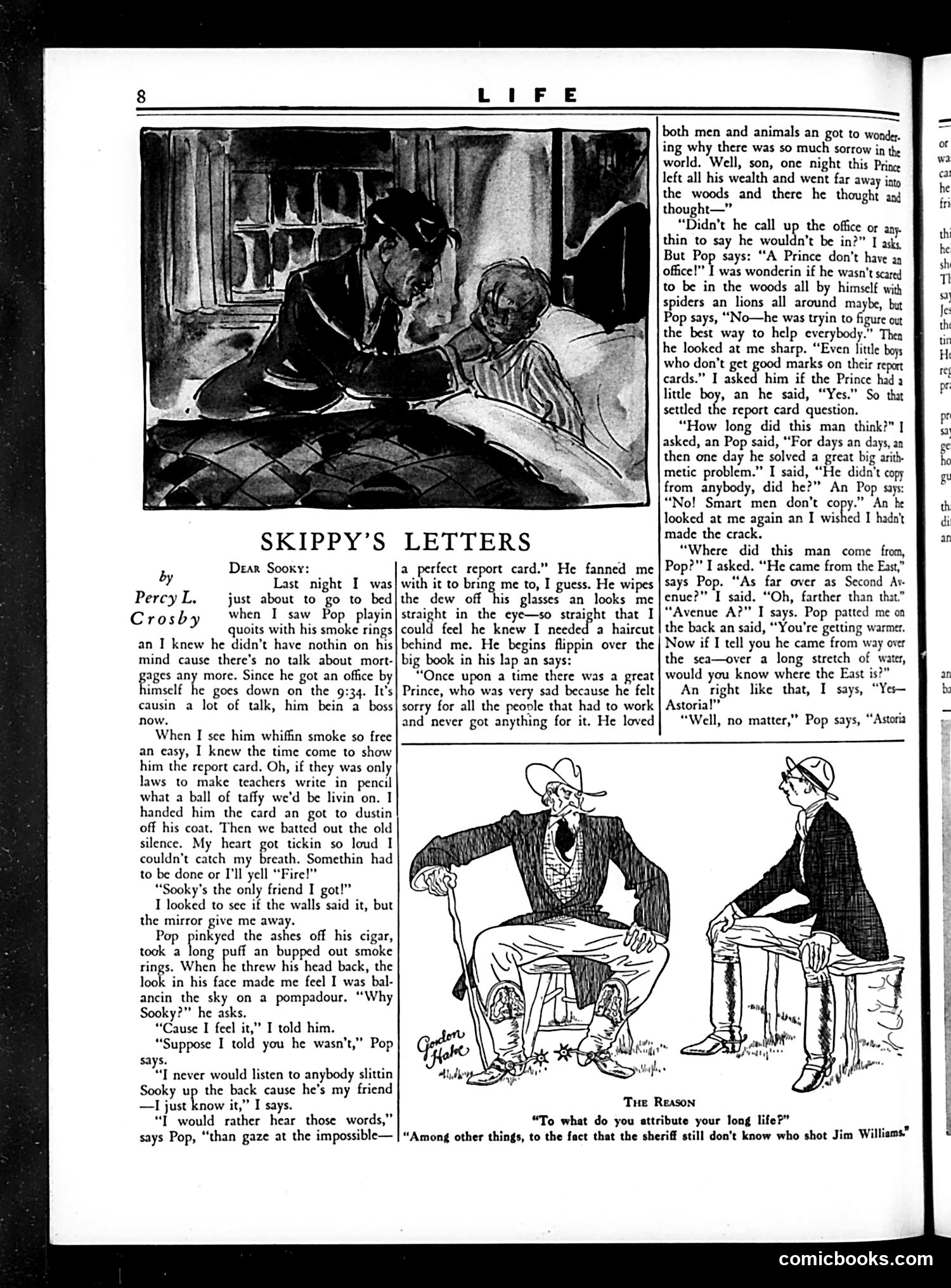
This is a humorous fiction piece by Percy L. Crosby featuring a character named "Skippy" writing to "Dear Sooky." The narrative is a sentimental story about a Prince who abandons his wealth to live in the woods, eventually solving life's problems through simple living. The accompanying cartoon at bottom shows two boys in casual conversation outdoors, captioned "The Reason," with a joke about attributing long life to "the fact that the sheriff still don't know who shot Jim Williams"—a reference to unsolved frontier violence. The satire appears aimed at sentimental moralizing tales popular in the era, while the cartoon makes light of rural lawlessness and unpunished crime as a dark comic aside.
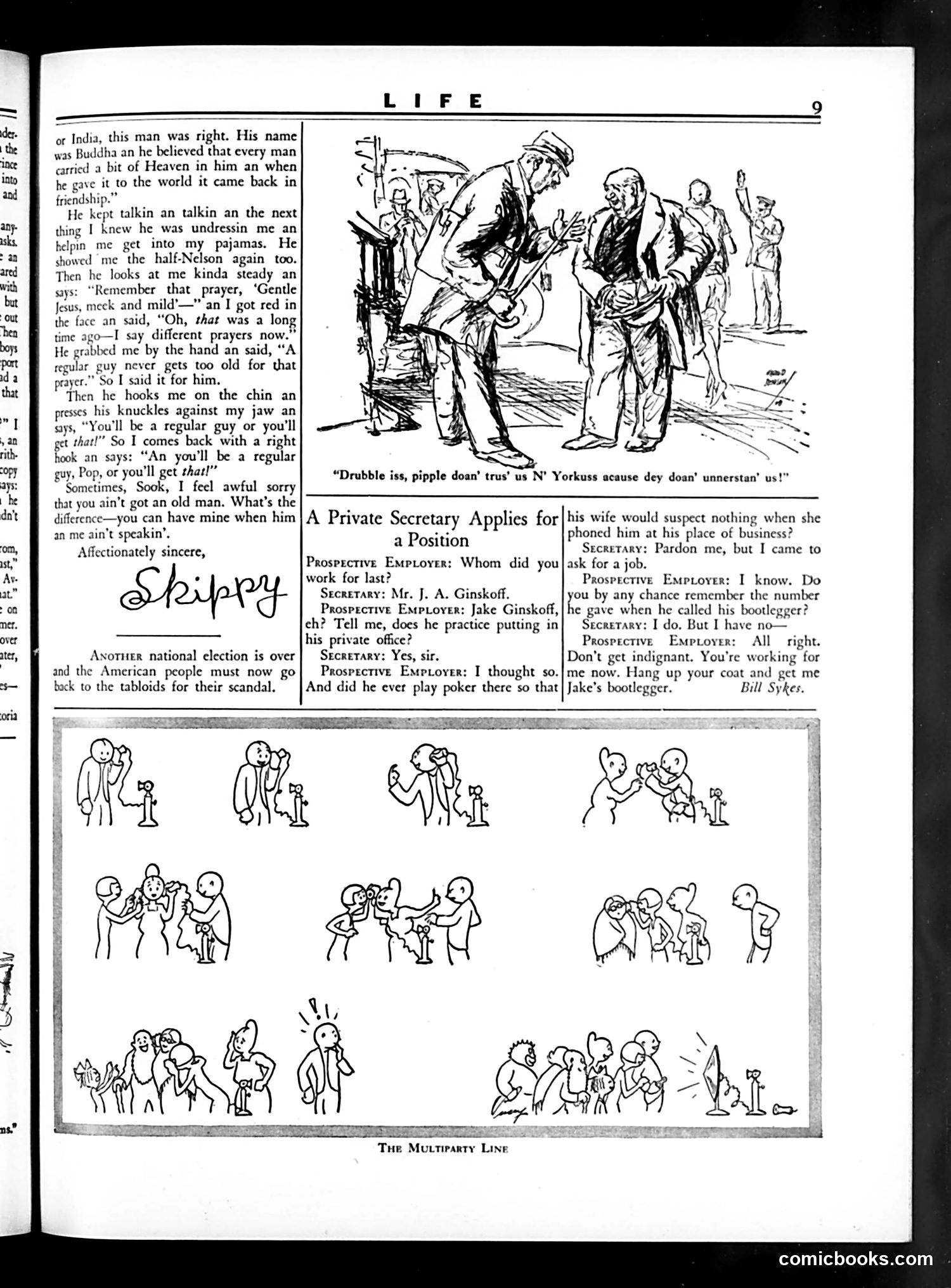
This page contains two unrelated pieces: **Top Section:** A signed column by "Shippy" describing an encounter with an elderly man who corrects the author's prayer language, insisting on using old-fashioned religious phrasing. The man lectures about maintaining traditional devotional practices. A brief editorial note follows about the upcoming national election. **Main Content:** "A Private Secretary Applies for a Position"—a satirical dialogue between a prospective employer and secretary. The employer asks probing questions about the candidate's background (prior employment with "Jake Ginkskoff"), testing his discretion and work ethic. The joke appears to be about whether someone can be trusted as a discreet employee. **Bottom Cartoon:** "The Multiparty Line" depicts various stick-figure scenarios showing adults and children in different social situations, though the specific satirical message remains unclear without additional context.
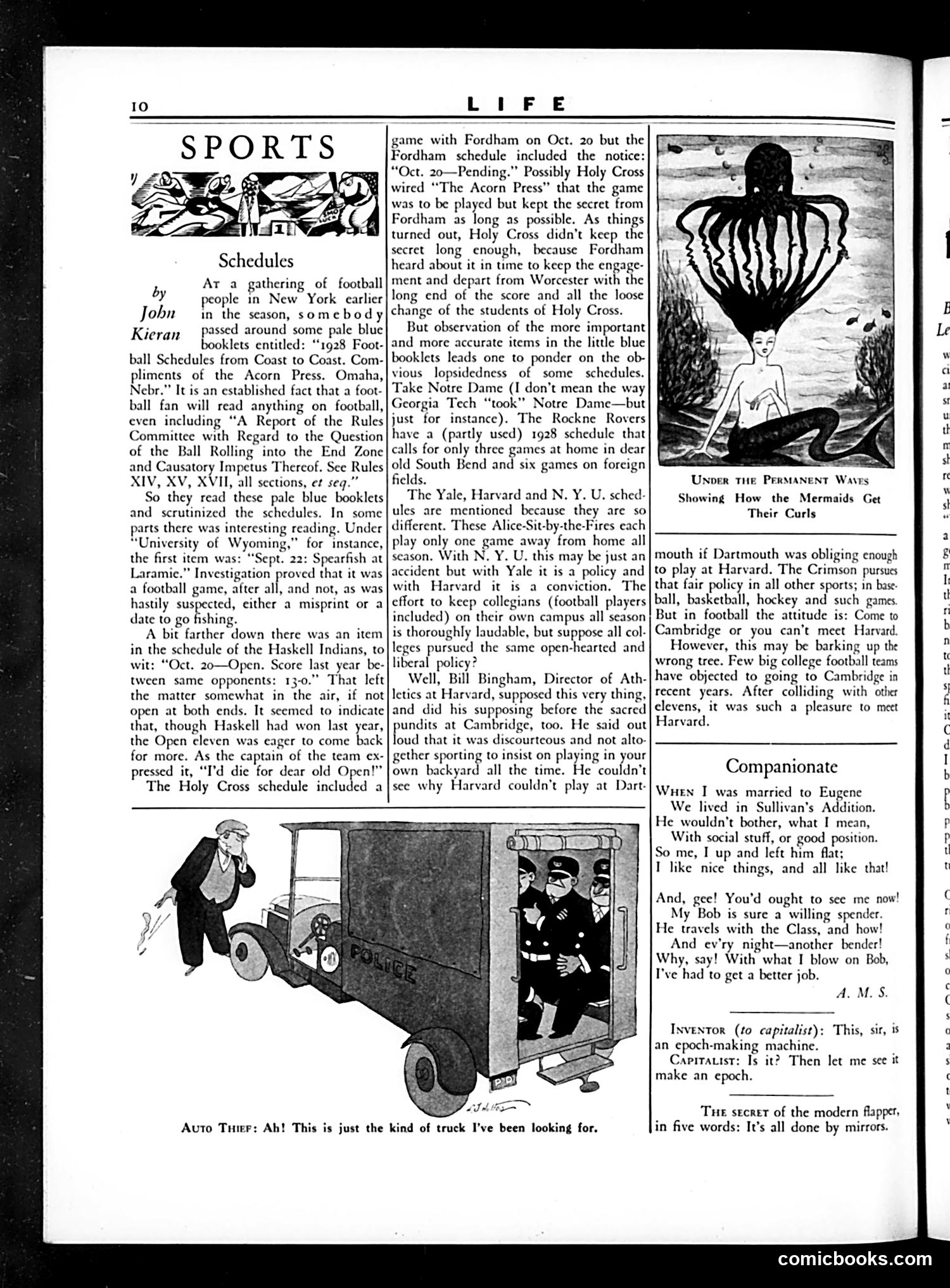
This cartoon depicts a common theft scenario of the 1920s era. A criminal is shown stealing an automobile by loading it into a covered truck—a method of vehicle theft that was apparently widespread enough to warrant satirical attention in *Life* magazine. The joke's punch line, "Ah! This is just the kind of truck I've been looking for," suggests the irony that the thief has found the perfect tool for committing his crime. The cartoon mocks both automobile theft as a growing social problem and the brazen attitude of criminals during this period. The illustration style and magazine placement suggest this reflected genuine contemporary concerns about car theft in an era when automobiles were still relatively new luxury items worth stealing.
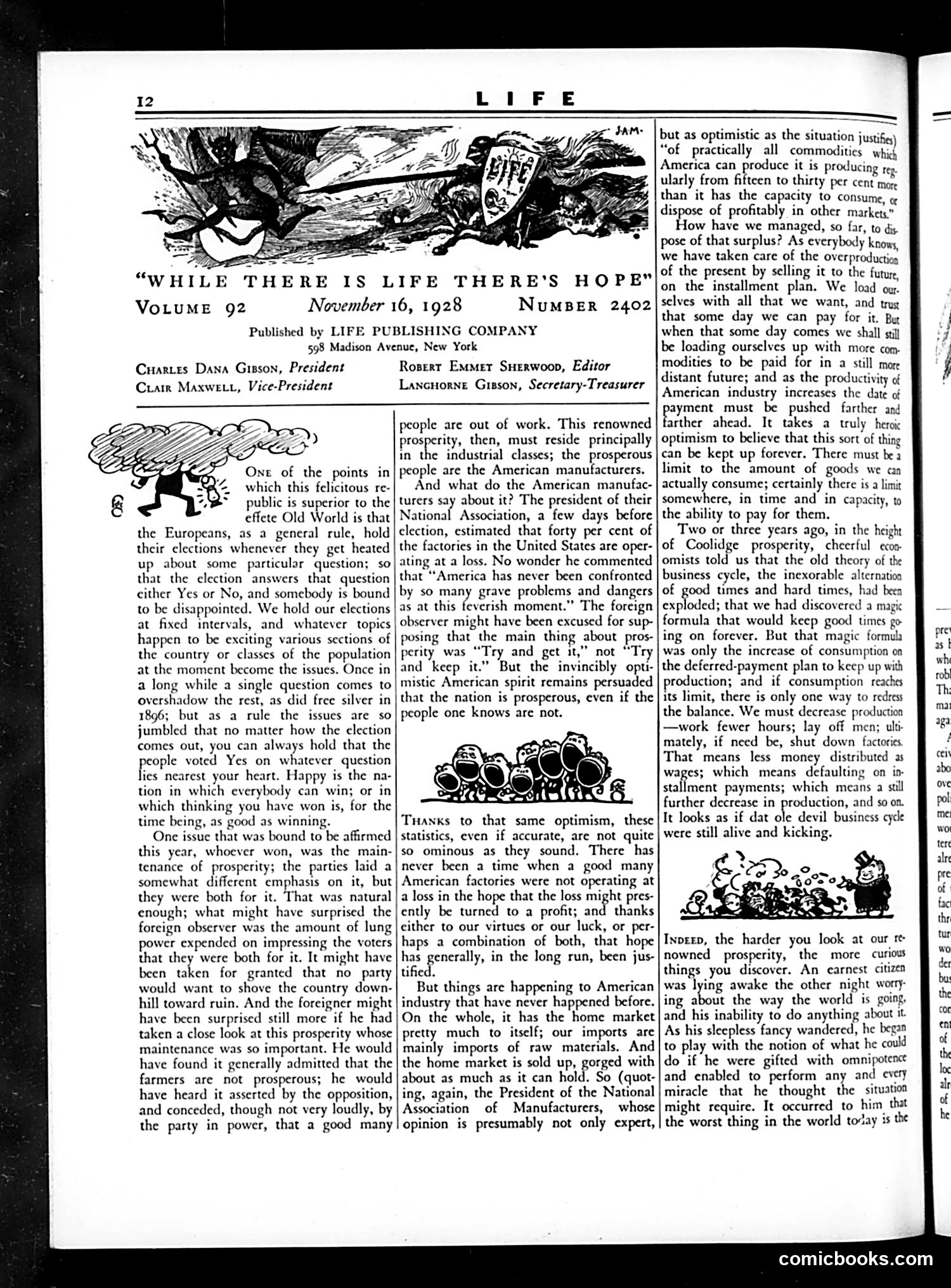
This editorial page contains a lead article titled "While There Is Life There's Hope," discussing American economic prosperity and manufacturing capacity. Two small cartoons appear: 1. **Upper cartoon**: Shows a figure labeled "JAM" (likely representing a traffic jam or congestion) with a pipe, illustrating problems with commodity distribution or transportation bottlenecks during the economic boom. 2. **Lower cartoon**: Depicts what appear to be factory workers or industrial laborers, likely referencing labor issues or working conditions in American manufacturing. The editorial argues that despite current prosperity, Americans must address overproduction and manage consumption wisely. The cartoons seem to critique infrastructure problems and labor conditions that accompany rapid industrial expansion, suggesting that prosperity masks underlying structural challenges in the economy.
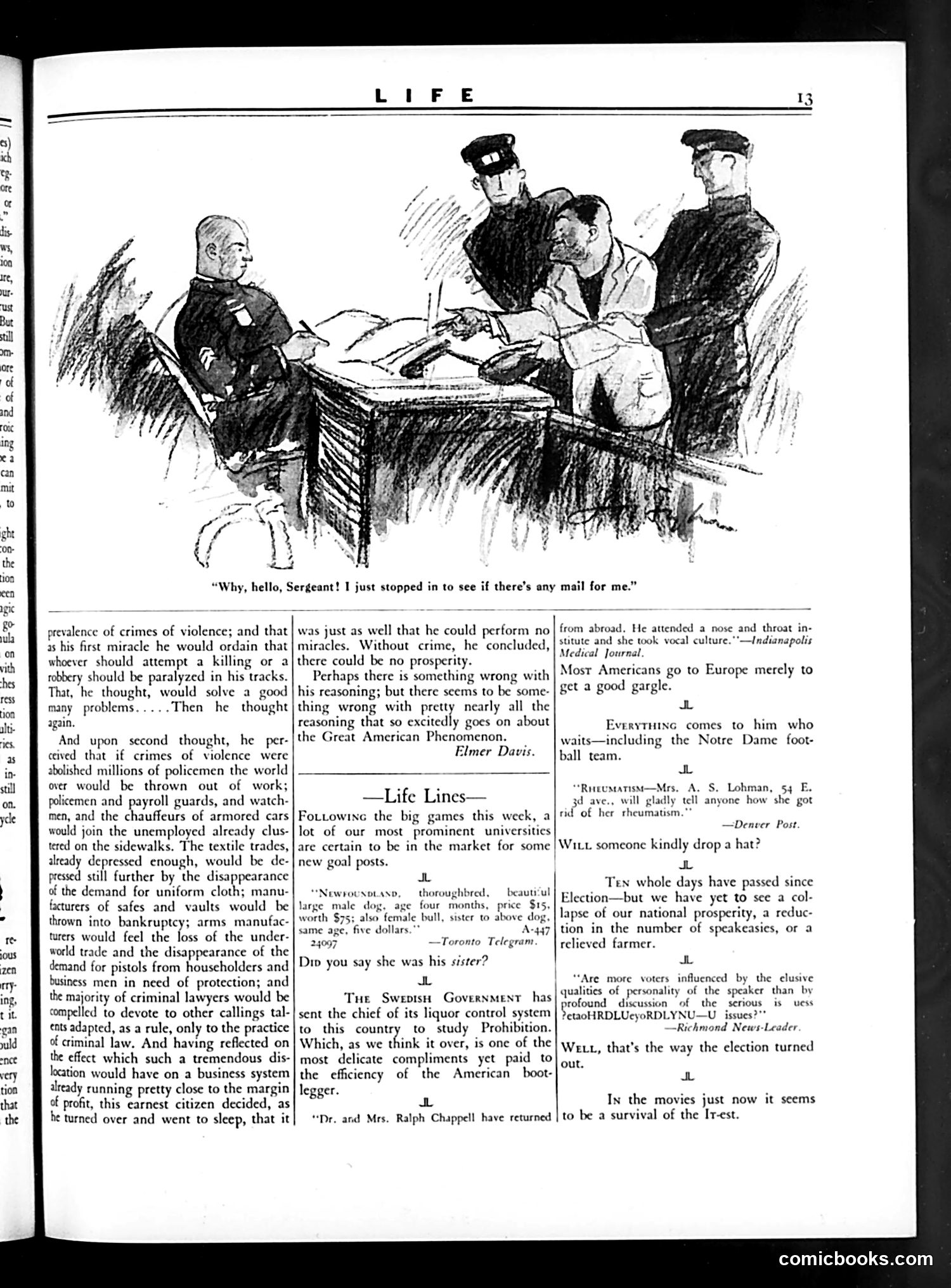
**The Main Cartoon:** The sketch shows a man at a desk speaking to military or official figures, with the caption "Why, hello, Sergeant! I just stopped in to see if there's any mail for me." The joke appears to target bureaucratic inefficiency or military red tape—a civilian visiting an office (possibly military or governmental) interrupting official business merely to check for personal mail, treated as worthy of formal attention from multiple uniformed officials. This satirizes the absurdity of minor personal matters receiving disproportionate official resources or ceremony. **Page Content:** The remainder consists of "Life Lines"—brief humorous observations and social commentary typical of the magazine's satirical format, including quips about American travelers, election rhetoric, and contemporary social issues. The specific date and political context remain unclear without additional publication information.
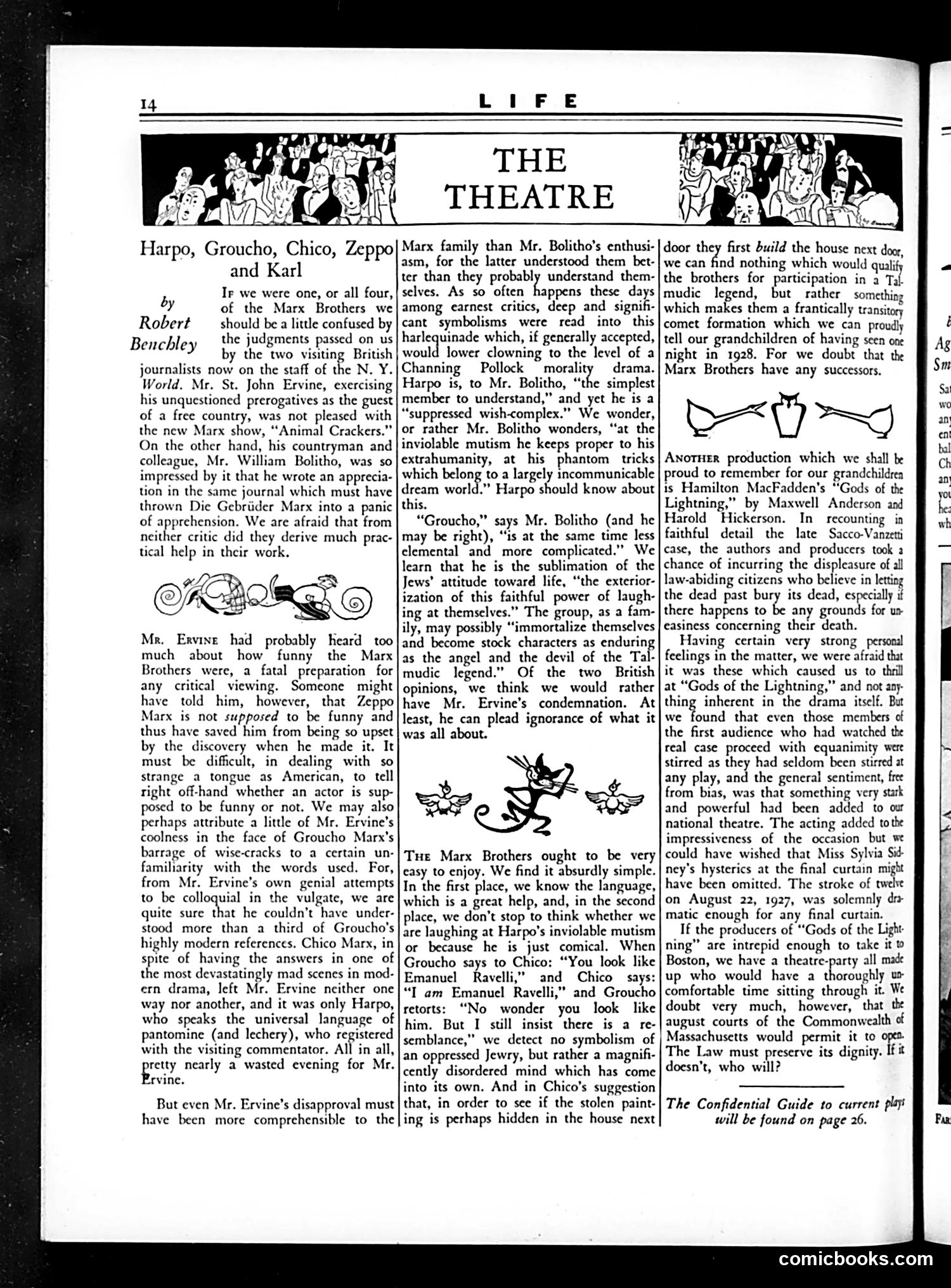
This page reviews Marx Brothers theatrical performances, specifically "Animal Crackers." The article by Robert Benchley discusses the comedic styles of Harpo, Groucho, Chico, and Zeppo Marx, comparing them favorably to other contemporary performers like William Boilito. The small cartoon illustrations show figures in exaggerated poses—likely caricatures of the Marx Brothers themselves, capturing their physical comedy style. The critique celebrates the Marx Brothers' ability to generate genuine laughter while dismissing concerns from "earnest critics" who worry their comedy lacks sophistication. Benchley argues their humor and "immortalize themselves" through their performances. The review also mentions a production of "Gods of the Lightning" and criticizes censorship concerns regarding theatrical content in Massachusetts.
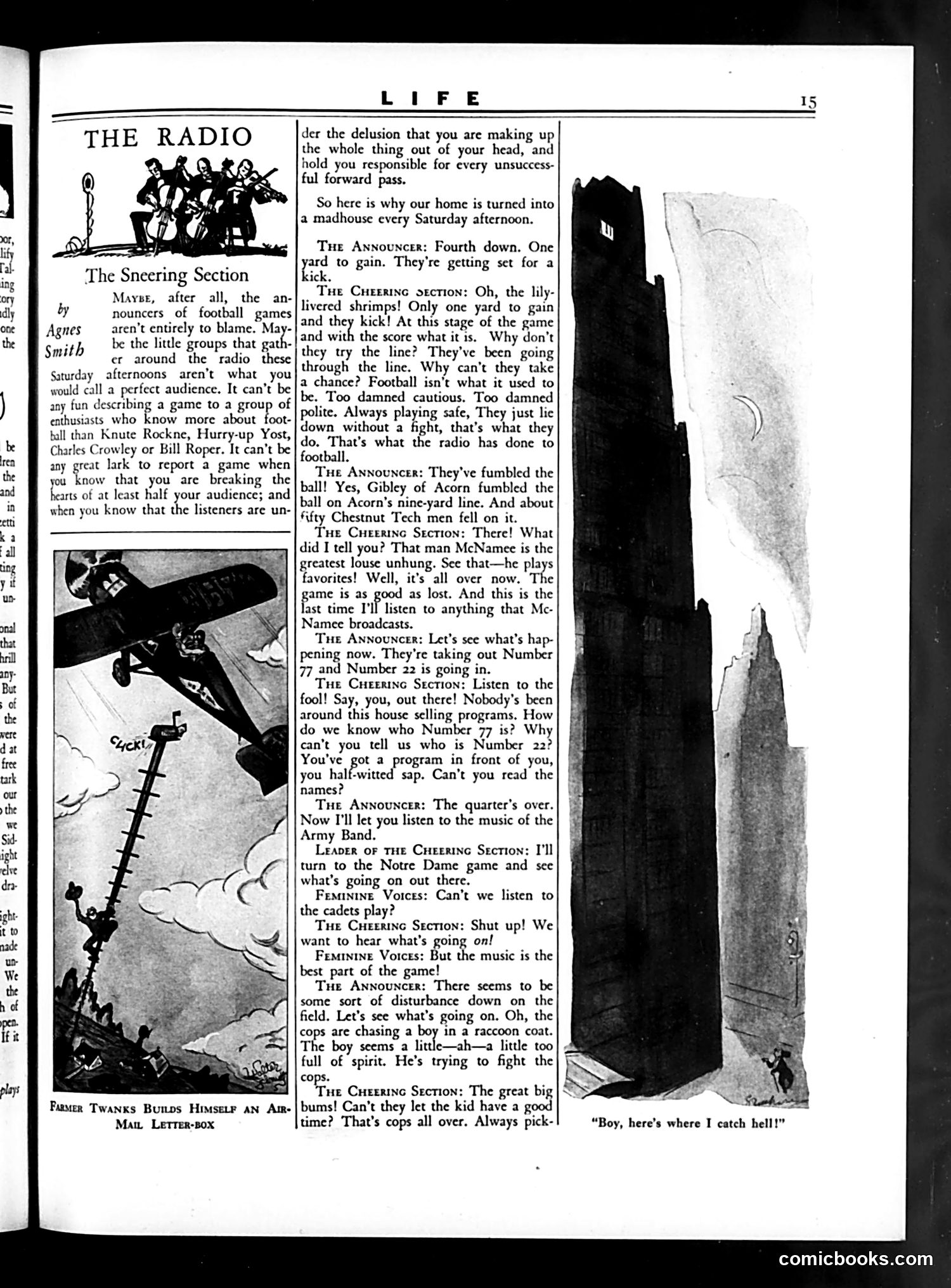
This satirical piece by Harry Smith mocks radio broadcasters covering college football games. The article describes an imaginary radio play-by-play between an overly enthusiastic "Announcer" and a "Cheering Section" (likely fans gathered around a radio) that devolves into chaos—the cheering section complains about cautious play, demands risky tactics, second-guesses the team's strategy, and argues about which broadcast to follow. The left cartoon shows Farmer Twainks building an air-mail letterbox—a visual gag unrelated to the radio content. The right image captioned "Boy, here's where I catch hell!" depicts a boy in what appears to be a tower or confined space, likely illustrating radio-broadcast chaos or domestic disruption from Saturday afternoon football broadcasts mentioned in the article.
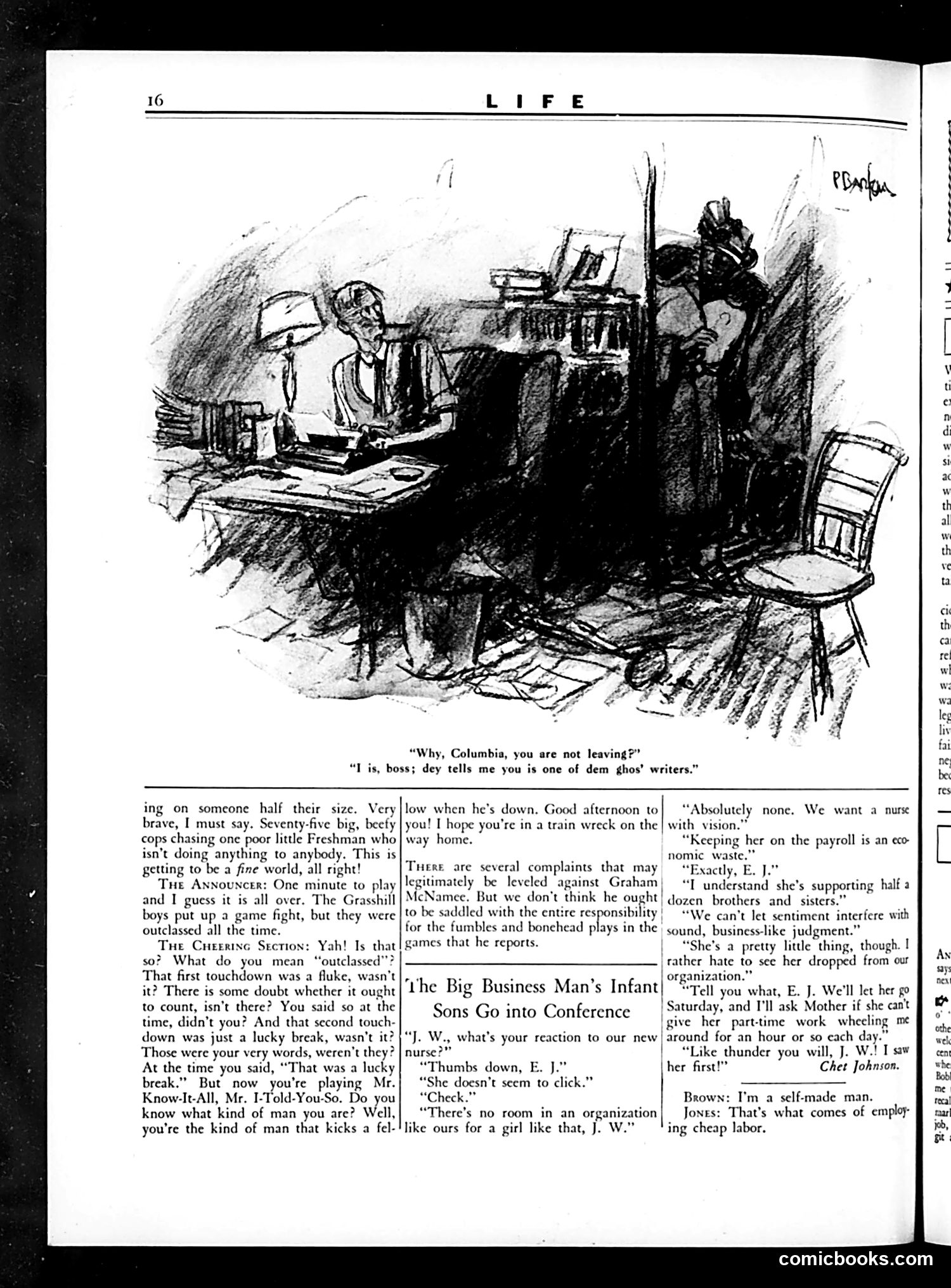
This page features a cartoon and accompanying dialogue about workplace dynamics. The cartoon depicts an office scene where a boss addresses an employee named Columbia, questioning why she's not leaving. The boss states: "I is, boss; dey tells me you is one of dem 'ghost' writers." The satire concerns **ghostwriting**—the practice of writing work credited to someone else, typically a high-profile figure. The joke plays on the boss's broken dialect (suggesting a working-class character) and Columbia's role as an uncredited writer. The surrounding text discusses various workplace complaints and business practices, including mentions of Graham McNamee and issues about employee contributions going unrecognized. The humor targets both exploitation of ghostwriters and class-based power dynamics in publishing and media industries of that era.
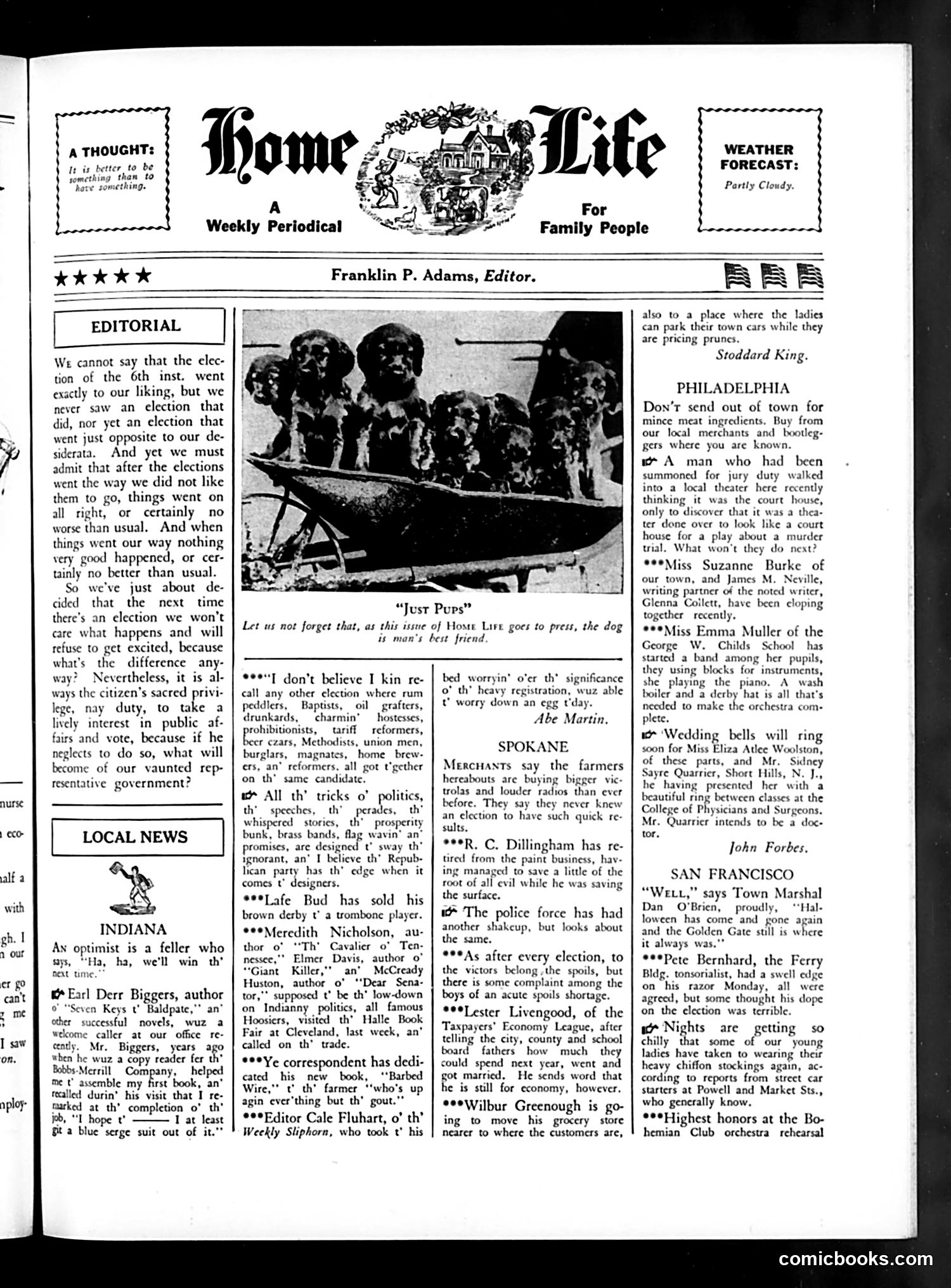
The image shows a large dog sitting in a boat filled with smaller puppies, captioned "Just Pups." The accompanying text reads: "Let us not forget that, at this time of House Life goes to press, the dog is man's best friend." This appears to be gentle satirical commentary on the 1916 election period (referenced in the editorial). Rather than directly mocking political figures, the cartoon uses dogs as metaphor—the "pups" likely represent naive voters or political novices, while the larger dog may represent established political leadership or institutions guiding them. The satire's point seems to be that despite election turmoil and disappointed expectations, citizens remain loyal followers ("man's best friend"), unquestioningly accepting political direction. It's social commentary on voter passivity during contentious elections.
This page from Life magazine contains brief humorous local social gossip organized by city (Cleveland, Boston, Portland, Chicago, Detroit, New York). Rather than a political cartoon, it features satirical commentary on everyday civic life and personalities. Key satirical points include: - **Cleveland politics**: Mocking voting officials for refusing to allow voting at a golf course, and making light of a woman refusing political office because "politics makes strange bedfellows" - **Baseball commentary**: Poking fun at Rogers Hornsby taking a lower-paying Chicago job, described sarcastically as him being "tired of being a good loser" - **Theater myth-busting**: Debunking the notion that the Tremont Theater in Boston ever had an "S.R.O." (Standing Room Only) sign - **Local boosterism**: Gentle ribbing of prominent citizens' travels and activities The tone is light, gossipy social satire typical of Life's "Talk of the Town" style—mock-serious commentary on minor local events and notable residents. The boxed "The Week" calendar provides context for current events (elections, sports games, holidays).
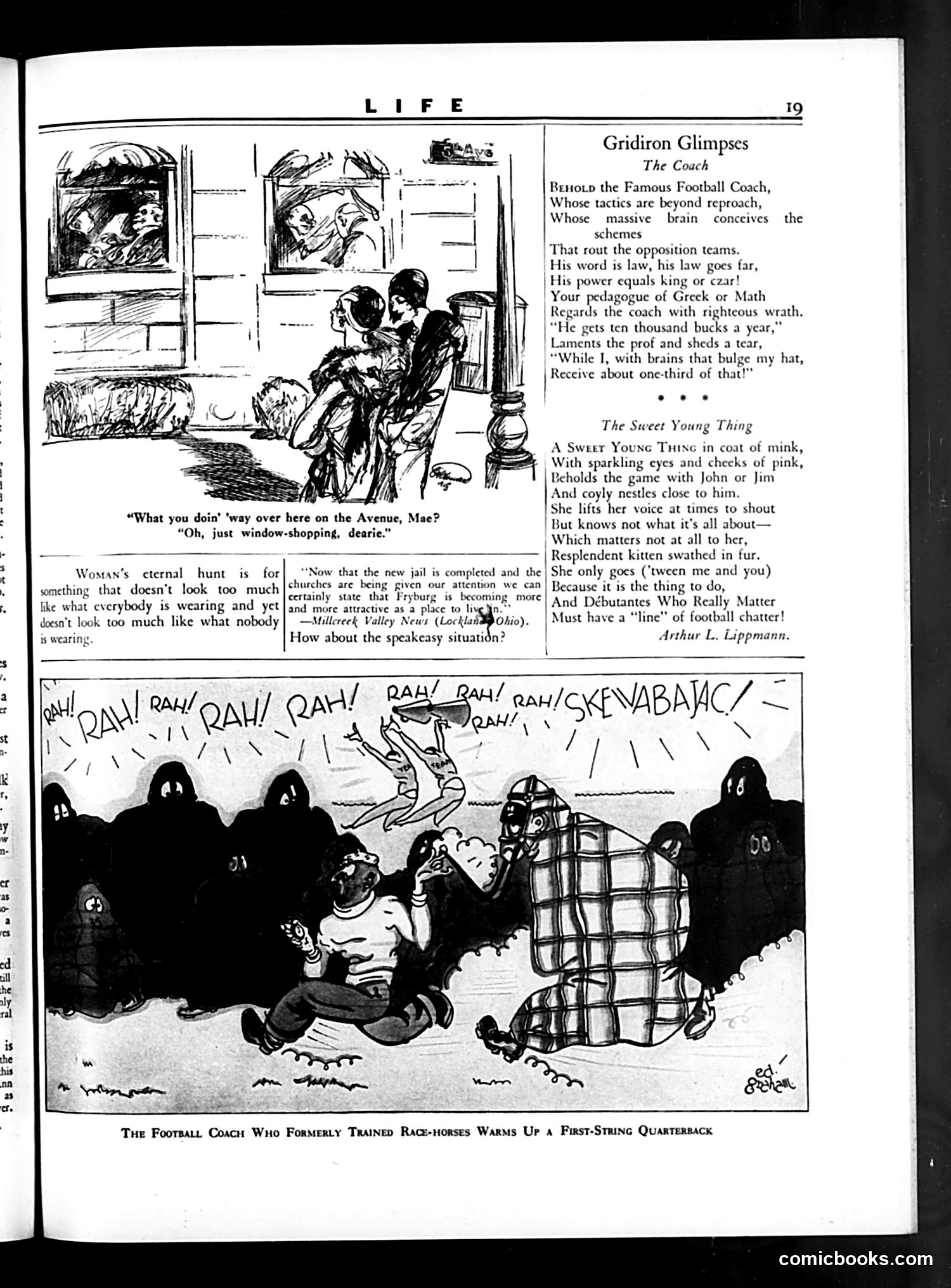
This page contains three satirical pieces mocking 1920s American culture: **"The Coach"** lampoons the inflated status and salary of football coaches compared to academics. The poem ironically elevates the coach to near-royal power while professors—despite their intellectual credentials—earn one-third his salary and resent it bitterly. **"The Sweet Young Thing"** ridicules wealthy young women who attend football games not out of genuine interest but as social obligation. She knows nothing about the sport but performs enthusiasm to maintain status among her peer group. **The main cartoon** jokes about a football coach who previously trained race horses now "warming up" a quarterback using the same aggressive techniques suited for animals—suggesting coaches treat players like beasts rather than people. The "speakeasy situation" reference alludes to Prohibition-era illegal bars, while the jail/church comment mocks small-town hypocrisy about morality.
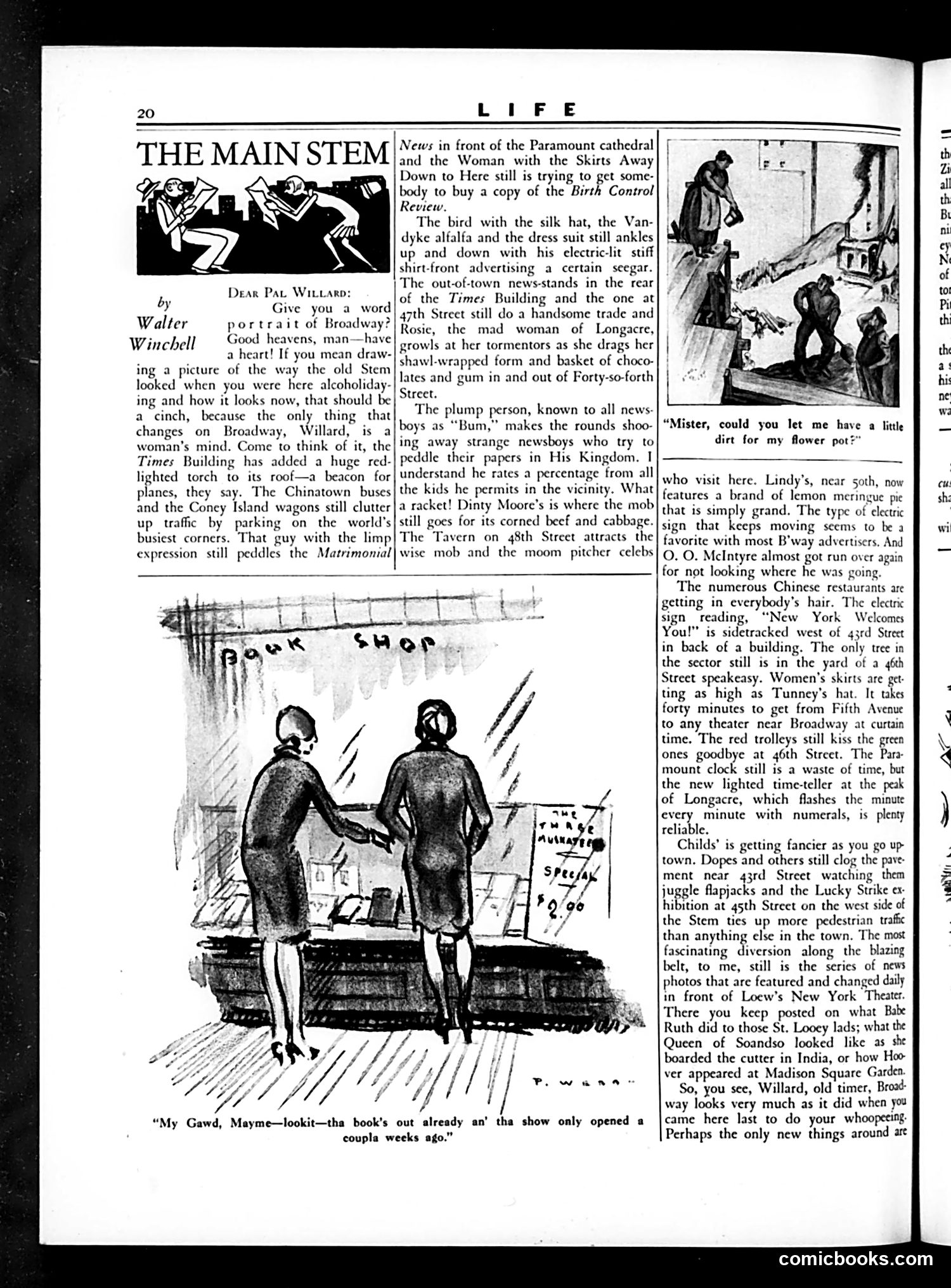
This page satirizes Broadway in the 1920s through columnist Walter Winchell's response to a reader's request for a portrait of how Broadway has changed. **The Satire:** Winchell humorously argues that *nothing* has actually changed on Broadway—only women's minds change. He catalogs the permanent fixtures: the Times Building, the Paramount theater, Lindy's restaurant, Dinty Moore's, the Tavern on 48th Street, Chinese restaurants, Loew's New York Theater, and street characters like "the mad woman of Longacre" and the newsboy called "Bum." **The lower cartoon** shows two women at a pork shop, commenting that a book is already out despite the show opening weeks ago—mocking the speed of Broadway exploitation and tie-in merchandise. **Context for modern readers:** This captures 1920s Broadway's tourist economy, nightlife culture, speakeasies (Prohibition era), and the personality-driven celebrity gossip that Winchell pioneered. The piece is essentially saying Broadway's commercial machinery—not genuine cultural change—defines the street.
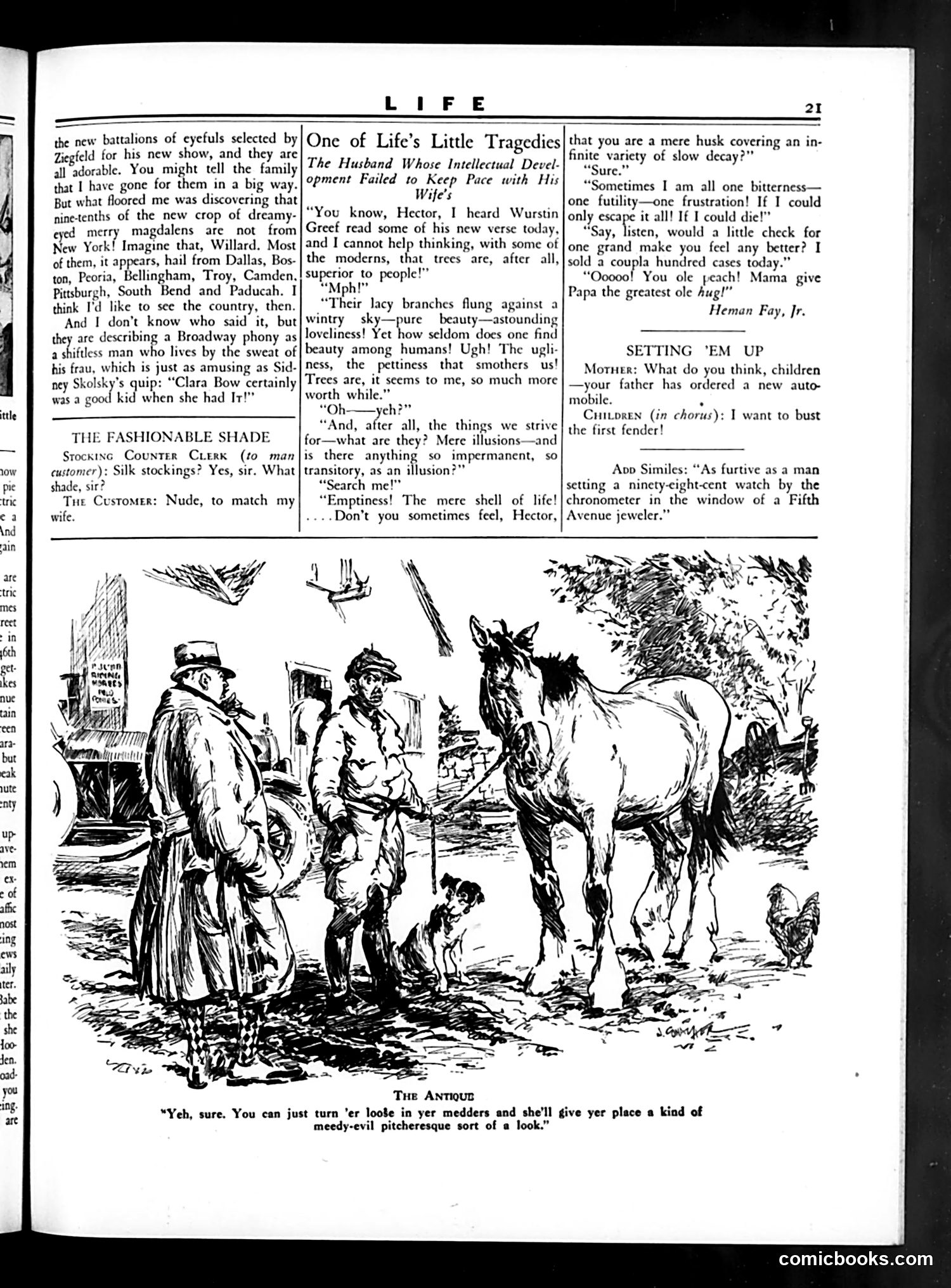
This page contains three satirical pieces typical of Life's humor circa the 1920s-30s: **"The Fashionable Shade"** is a brief quip about a customer ordering "nude" stockings to match his wife—a double entendre playing on both hosiery fashion and marital commentary. **"One of Life's Little Tragedies"** depicts intellectual incompatibility. A wife quotes modernist poetry about nature's superiority to humanity, expressing existential despair and emptiness. Her husband responds with monosyllabic indifference ("Mph," "Yeh?," "Search me!"). The satire's punch: her philosophical anguish instantly vanishes when he mentions selling "a coupla hundred cases"—implying she's materially motivated, not genuinely intellectual. The mockery targets both pretentious modern philosophy and women's supposed superficiality. **"The Antique"** (cartoon) shows rural figures examining a horse, with one noting it will give their property a "meedy-evil pitcheresque" look—satirizing rustic affectation and fractured speech patterns. These pieces reflect period attitudes toward modernism, gender roles, and class.
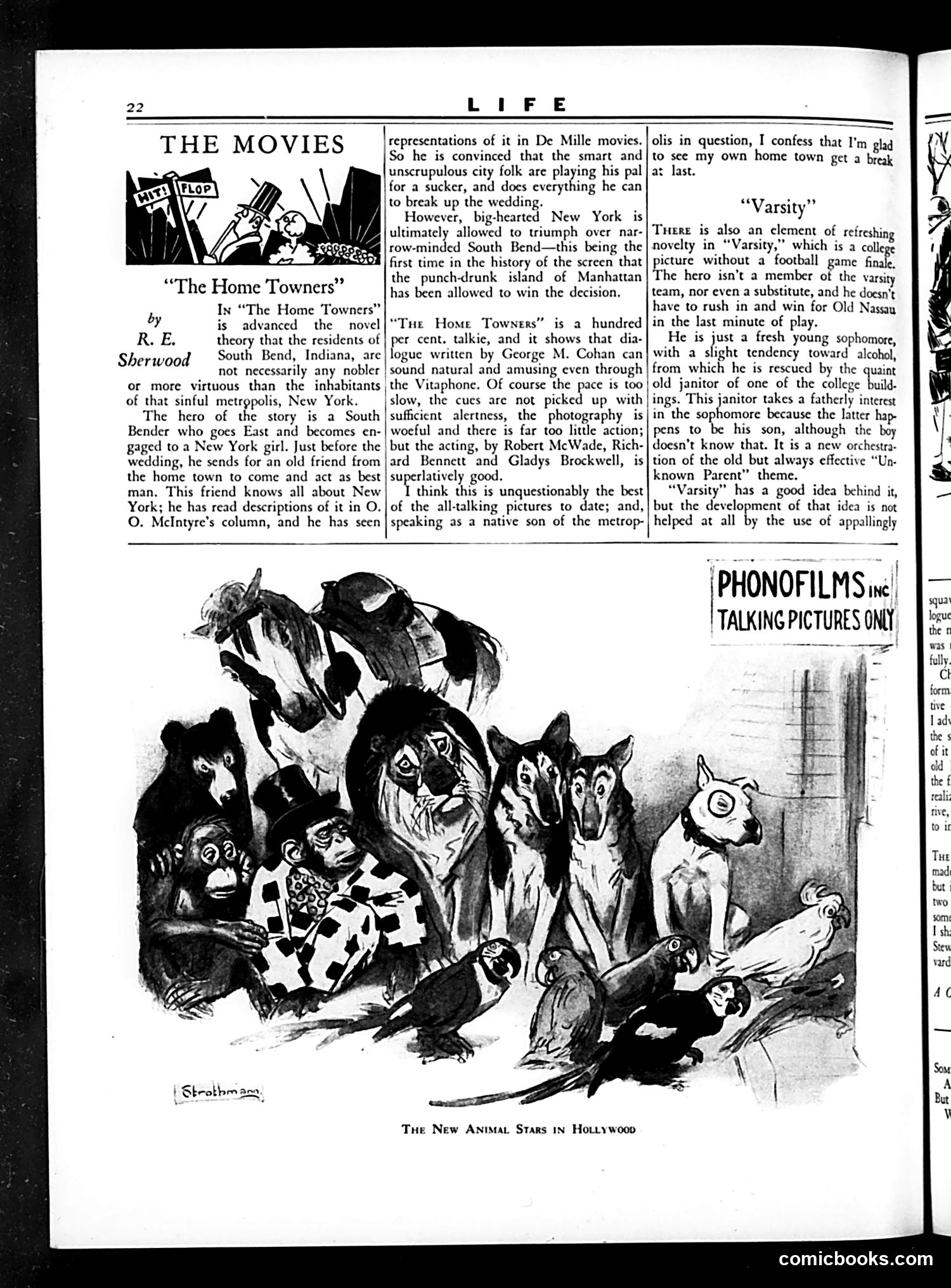
This page reviews early "talking pictures" (talkies)—films with synchronized sound, a new technology circa late 1920s. The cartoon at bottom, captioned "The New Animal Stars in Hollywood," depicts various animals wearing costume jewelry and formal dress, satirizing how the film industry was promoting animal performers as celebrities. This reflects Hollywood's novelty-driven approach to early sound films. The text reviews two movies: "The Home Towners" (praised as the best talkie yet, with dialogue by George M. Cohan) and "Varsity" (a college film without the expected climactic football game). Key context: The reviews mention O.O. McIntyre's newspaper column and Cecil B. DeMille movies—references to how Americans' perceptions of New York were shaped by media rather than direct experience. The satire gently mocks small-town prejudices about cities while grudgingly admitting New York's superiority on screen.
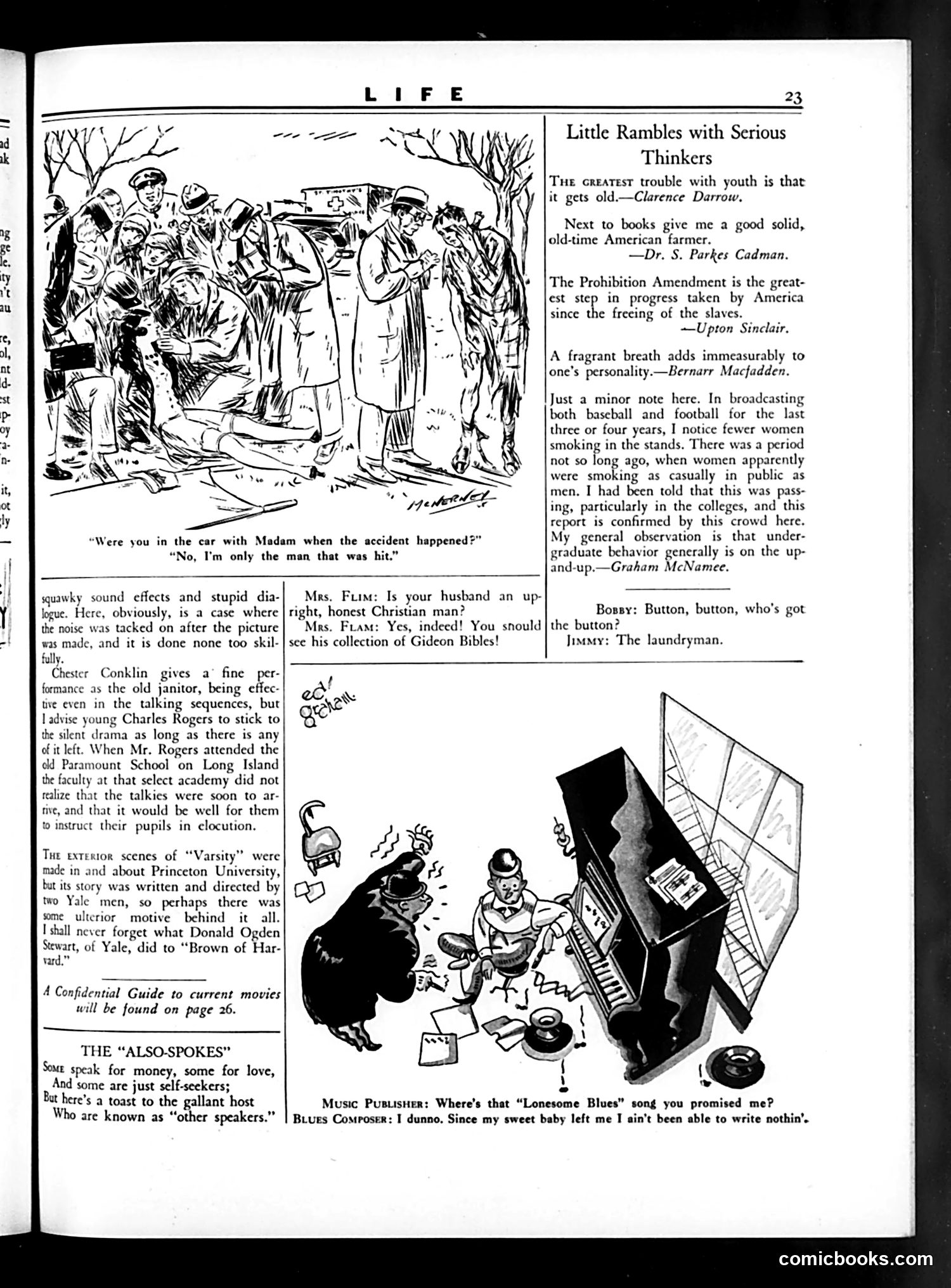
This page contains satirical quotes and cartoon humor typical of 1920s Life magazine. **Top cartoon**: Shows a car accident scene with the caption joke playing on literal vs. figurative meaning—"Were you in the car with Madam when the accident happened?" / "No, I'm only the man that was hit." The humor relies on misunderstanding whether the questioner meant being present or being struck. **Bottom cartoon**: Depicts a music publisher confronting a blues composer about a promised song. The composer claims he cannot write because "my sweet baby left me I ain't been able to write nothin'"—satirizing the blues genre's reliance on romantic heartbreak as creative inspiration. It's gentle mockery of blues tropes. The page also features "Little Rambles with Serious Thinkers"—attributed quotes from public figures (Clarence Darrow, Upton Sinclair, etc.) on contemporary topics like youth, Prohibition, and smoking habits. These appear to be genuine or plausibly attributed statements, presented without obvious satirical commentary, reflecting the magazine's mix of humor and social observation.
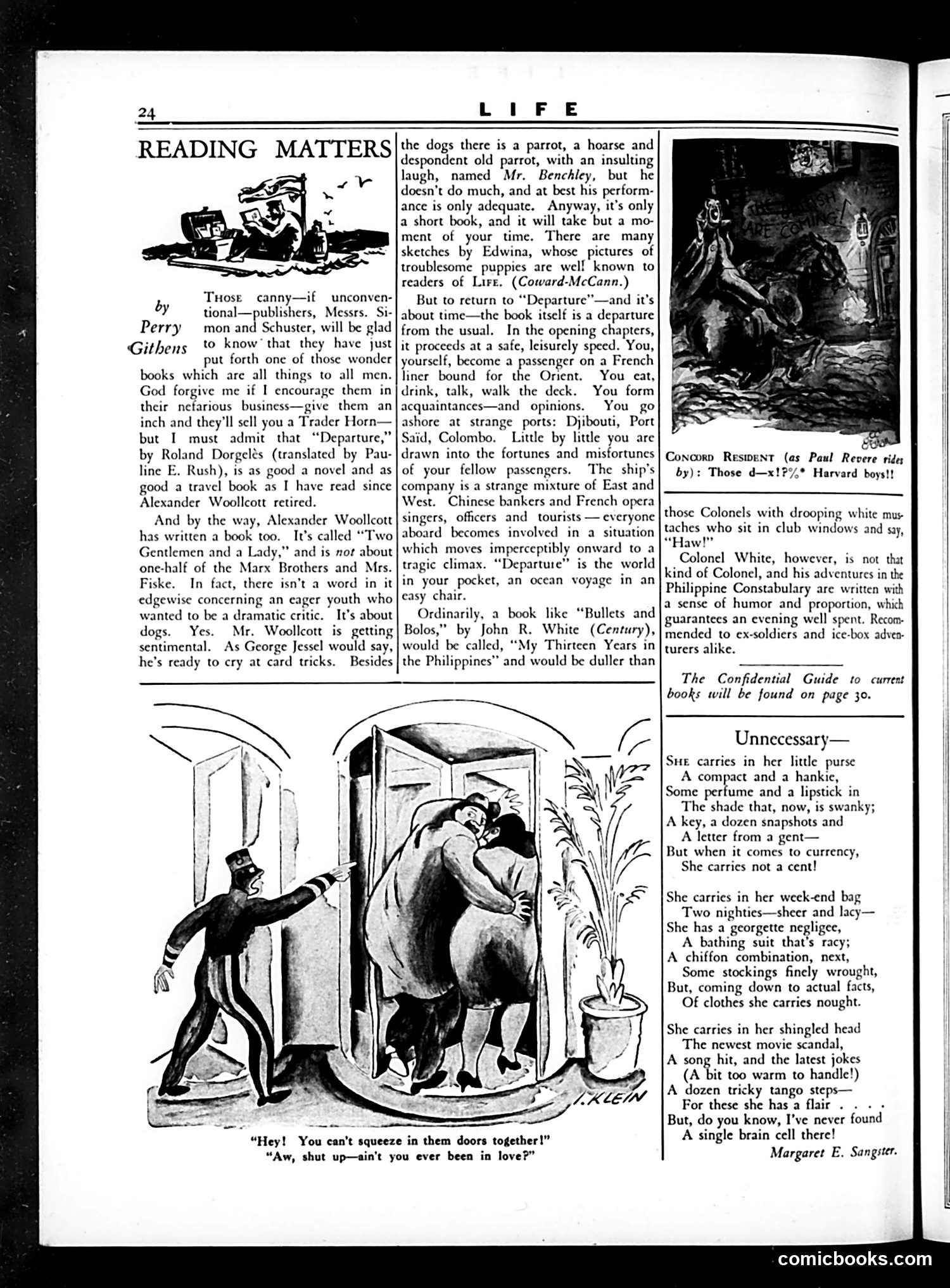
This page from *Life* magazine contains book reviews and satirical humor typical of the 1920s literary culture. **"Reading Matters" Column (by Perry Githens):** Reviews new books including Roland Dorgelés's *Departure* (a novel/travel book about a French ocean liner voyage) and Alexander Woollcott's *Two Gentlemen and a Lady* (a humorous book about dogs, featuring a parrot mockingly named "Mr. Benchley"). **Cartoon:** The lower illustration satirizes urban overcrowding on public transportation or in elevators—a common modern inconvenience. The man's defensive response ("ain't you ever been in love?") jokes that close quarters might be romantically excusable. **"Unnecessary" Poem (by Margaret E. Sangster):** Gentle satire on women's excessive packing: women carry frivolous items (cosmetics, clothes, gossip, dance steps) but paradoxically carry no actual money. This reflects 1920s attitudes about women's materialism and financial dependency. The page captures upper-class literary interests and gentle social commentary typical of *Life's* educated readership.
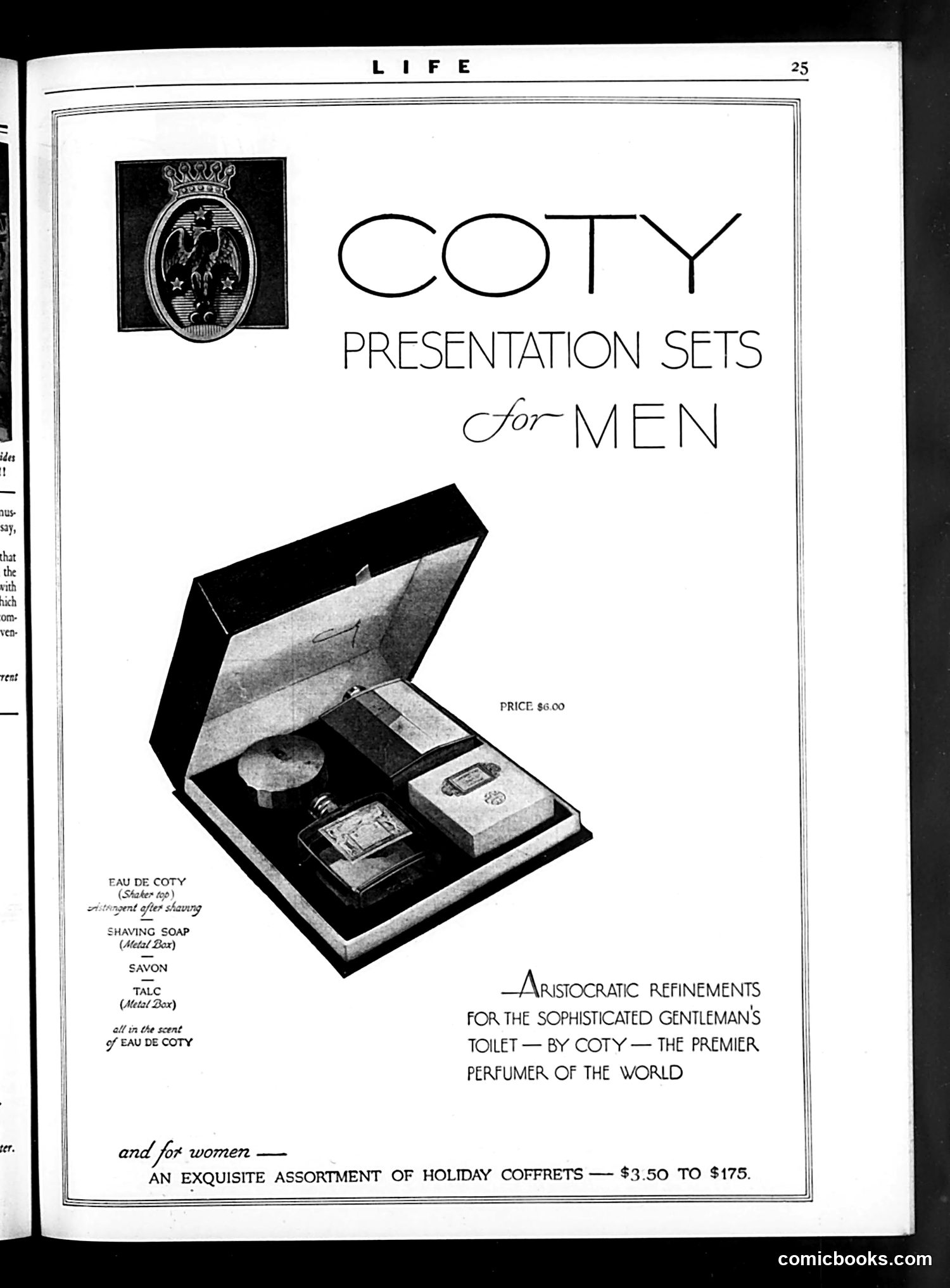
This is primarily a **product advertisement**, not political satire. It promotes Coty brand men's grooming products—eau de cologne, shaving soap, and talc powder—packaged in an elegant presentation set priced at $6.00. The ad targets affluent male consumers by emphasizing "aristocratic refinements" and "sophisticated gentleman's toilet," positioning Coty as "the premier perfumer of the world." The ornate crest logo reinforces luxury positioning. The secondary mention notes women's holiday gift options ranging $3.50–$175, suggesting gift-giving for the Christmas season (the page appears from a holiday-themed Life magazine issue). This reflects early-to-mid 20th century marketing that gendered grooming as a luxury concern and positioned personal refinement as a class marker for gentlemen. There is no apparent satire or political commentary—it's straightforward commercial advertising.
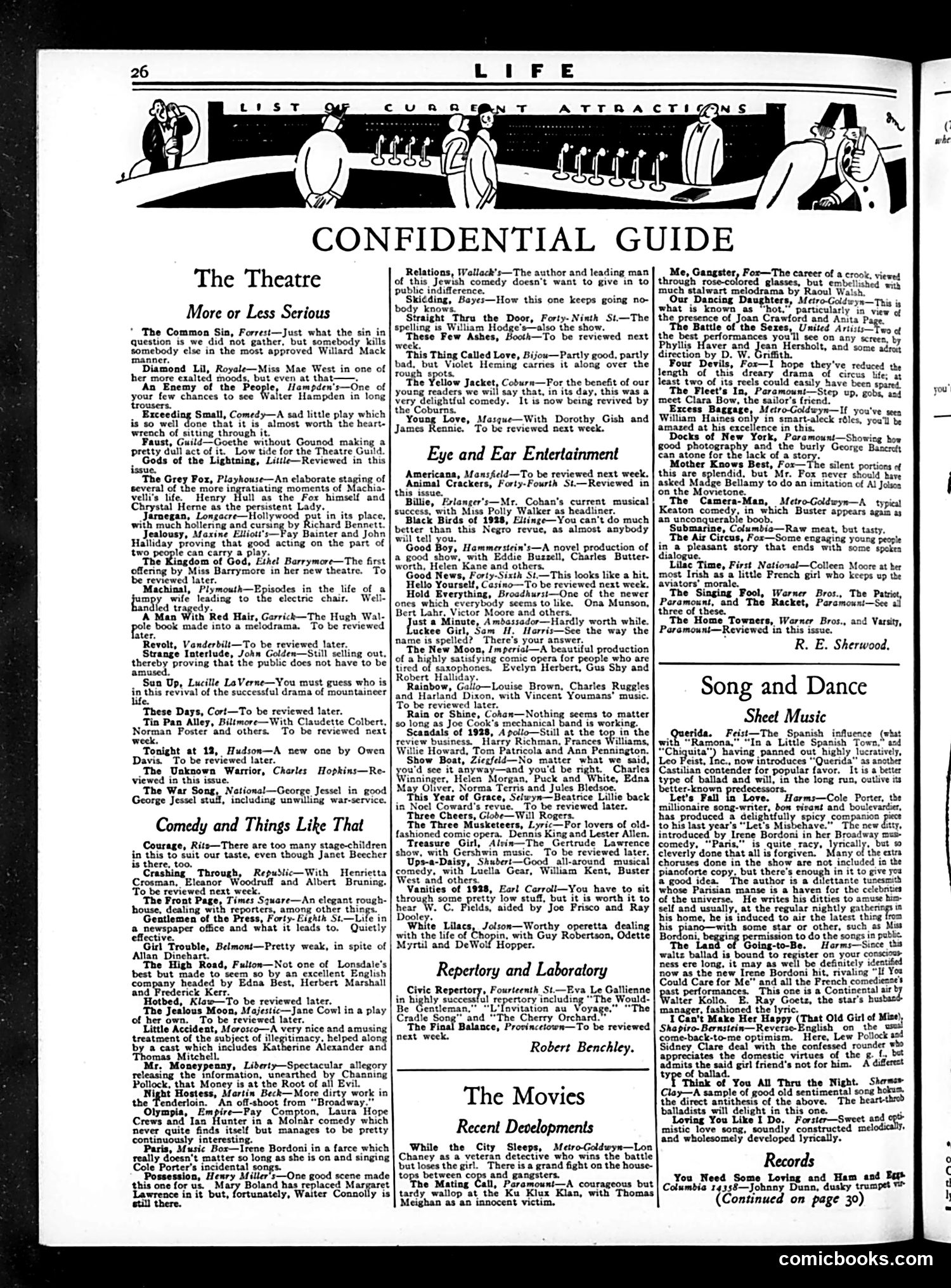
This page is a **theater review guide**, not a political cartoon. It's a "Confidential Guide" listing current Broadway productions with brief, often sarcastic critiques. The humor is theatrical criticism rather than political satire. Examples of the satirical tone include: - **"Diamond Lil"** (Mae West): Dismissive mid-sentence ("but even at that—") - **"Strange Interlude"**: Mocked for selling out despite being boring ("proving that the public does not have to be amused") - **"Faust"**: Criticized as "pretty dull" staging of Goethe - **"The War Song"** (George Jessel): Described as "unwilling war-service" The reviews employ typical 1920s-era Life magazine wit—backhanded compliments and cynicism about Broadway's commercial nature. The satire targets theatrical pretension and audience taste rather than politics or social issues. The page also includes sections on **movies, music, and recordings**, making it an entertainment roundup rather than political commentary.
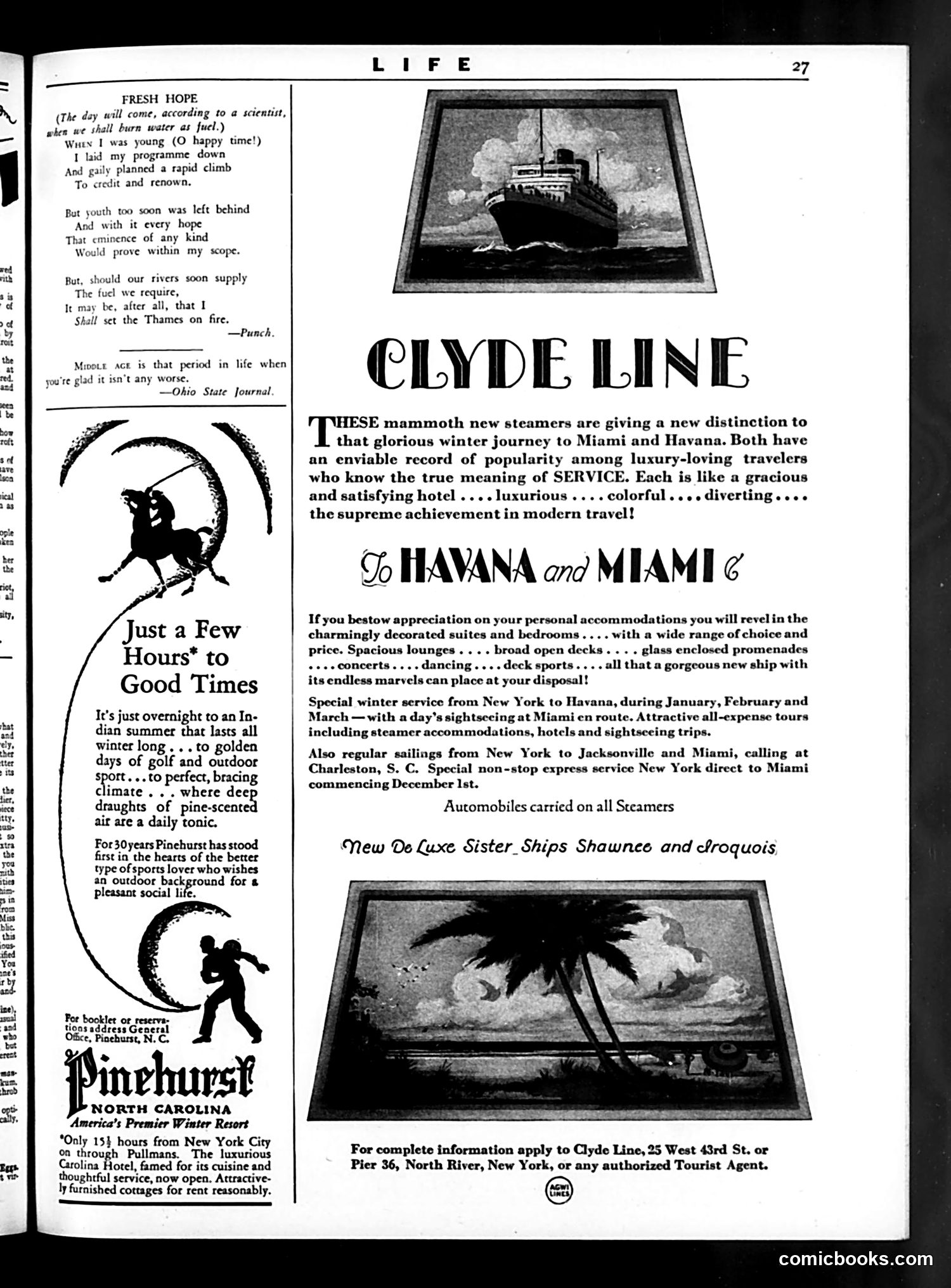
This page combines poetry and advertisements typical of 1920s-era Life magazine. **"Fresh Hope" Poem:** A self-deprecating verse about youthful ambition that faded with age. The speaker jokes that if scientists succeed in burning water as fuel, he might finally achieve something noteworthy—"set the Thames on fire" (a British idiom meaning to accomplish something remarkable). The humor lies in the absurdity: his last hope for success depends on an impossible scientific breakthrough. **Advertisements:** The page features two travel promotions—Pinehurst, a North Carolina golf resort marketing "Indian summer" leisure, and the Clyde Line steamship company advertising luxury voyages to Havana and Miami. Both target wealthy travelers seeking winter escapes, reflecting the prosperity and leisure culture of the era. The juxtaposition of the melancholic poem against cheerful ads about escape and leisure creates subtle irony about class and aspiration typical of Life's satirical approach.
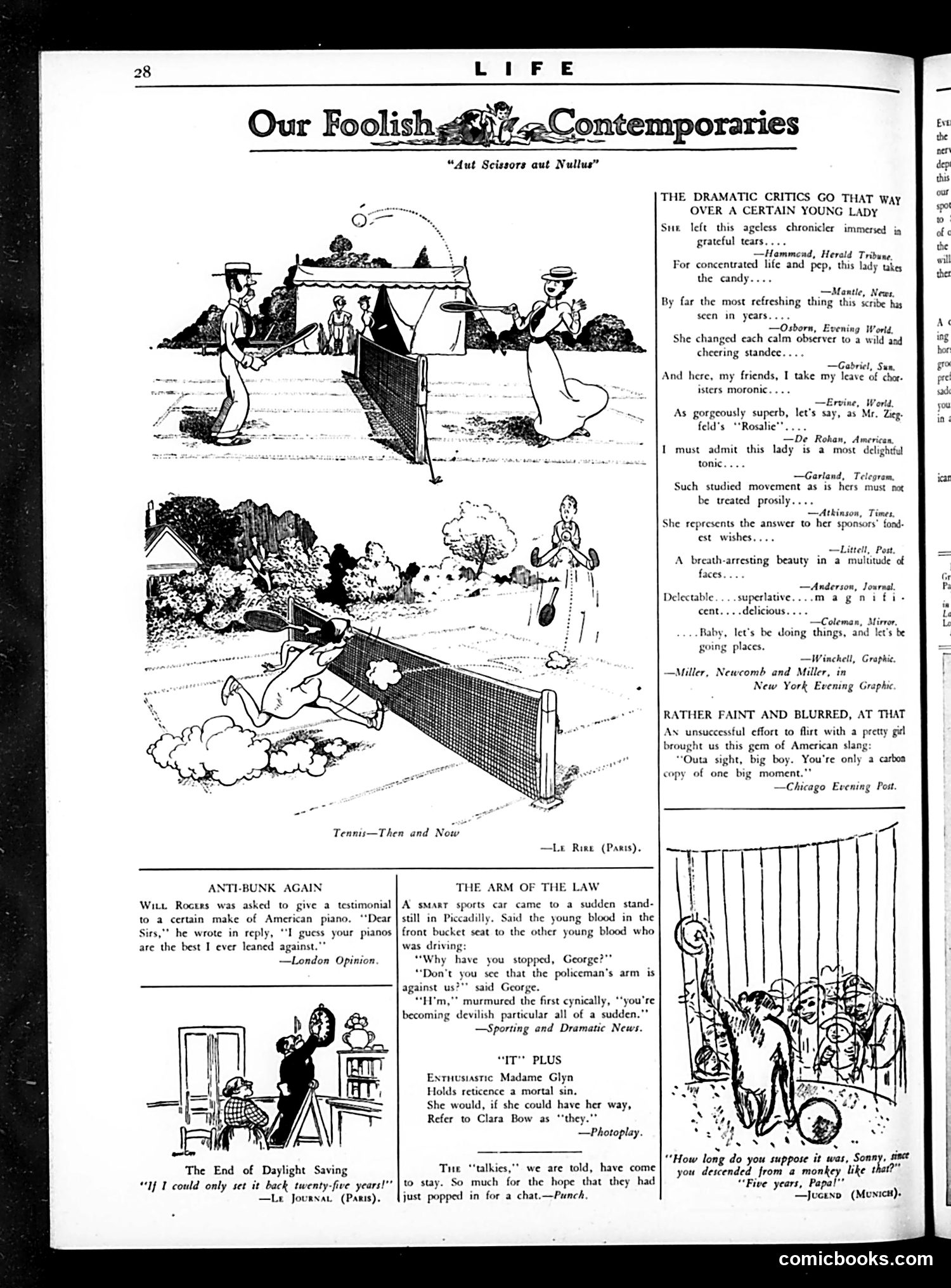
This page collects brief satirical items mocking contemporary culture and figures. Key features: **Tennis cartoons** contrast modern athletic play with historical versions, satirizing how sports have evolved. **Will Rogers anecdote** mocks testimonial advertising—Rogers supposedly praised a piano he'd only "leaned against," exposing the dishonesty of celebrity endorsements. **"The Arm of the Law"** jokes about British police using hand signals to stop traffic; young drivers find this authority irritating and "devilish particular." **Madame Glyn critique** references the famous silent film personality known for frank sexual commentary; the satire suggests she'd be indiscreet about actress Clara Bow if given the chance. **The "talkies" joke** implies talking pictures were expected to be a temporary fad; Punch sarcastically notes they're apparently here to stay. **Dramatic critics section** parodies excessive theater reviews of an unnamed young actress, collecting hyperbolic praise to mock critical overenthusiasm. The page's overall tone: sophisticated mockery of celebrities, advertising, and cultural pretension.
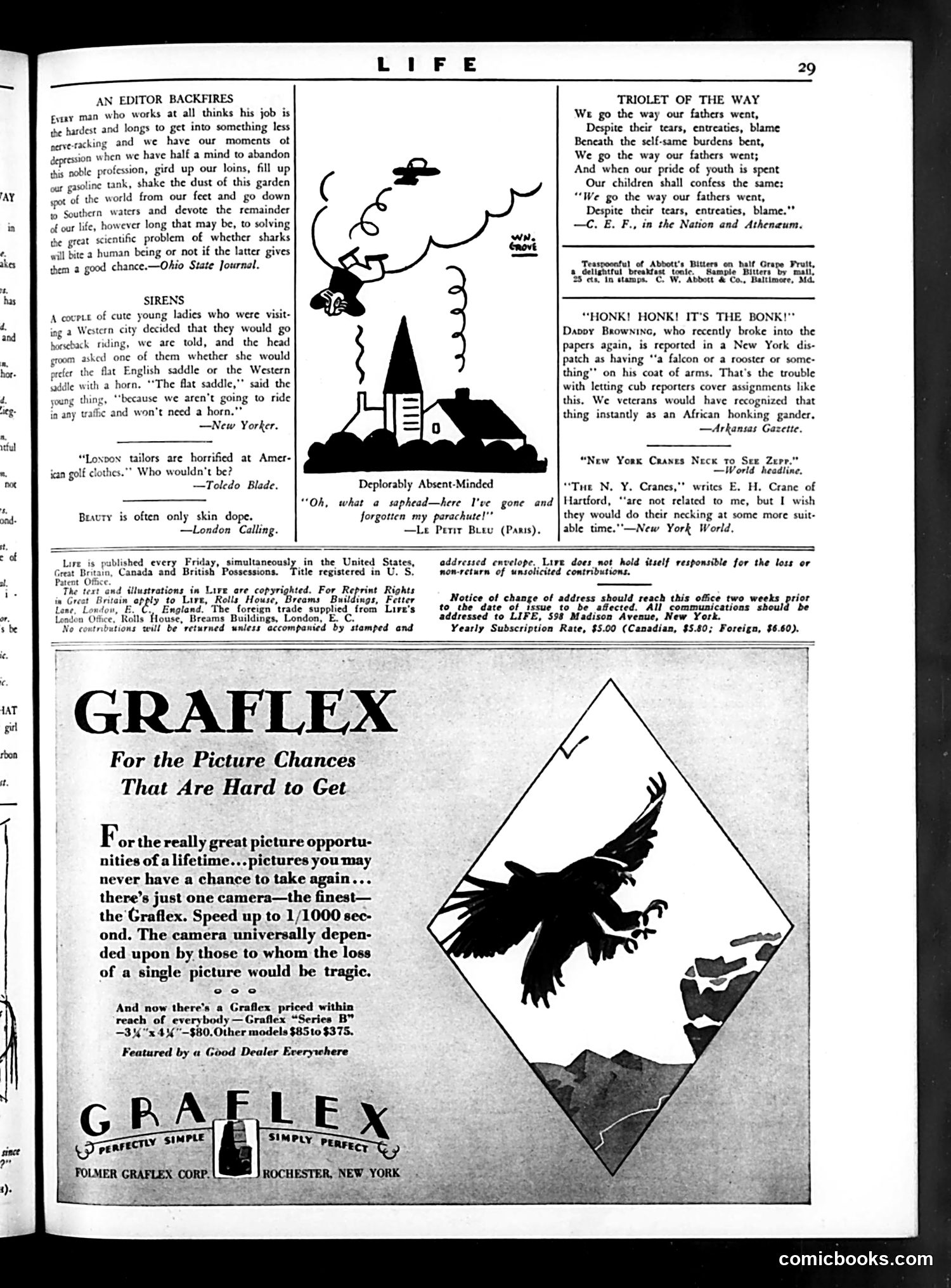
This page contains satirical commentary and jokes typical of Life's editorial style. The main cartoon shows a silhouetted figure falling from the sky, apparently having forgotten their parachute—a visual gag captioned "Deplorably Absent-Minded" from *Le Petit Bleu* (Paris). The joke relies on the obvious danger: the figure's casual comment about the forgotten parachute is darkly humorous precisely because it's a fatal oversight. The surrounding text consists of brief satirical observations from various newspapers. These mock absent-mindedness, fashion choices, newspaper reporting errors (a cub reporter mistaking a gander for more exotic birds), and social pretensions. The "Triolet of the Way" poem comments on generational cycles of hardship. The Graflex camera advertisement dominates the lower half, emphasizing the camera's speed and reliability for capturing irreplaceable moments. Overall, this represents Life's characteristic blend of political-social satire, wordplay, and advertising.
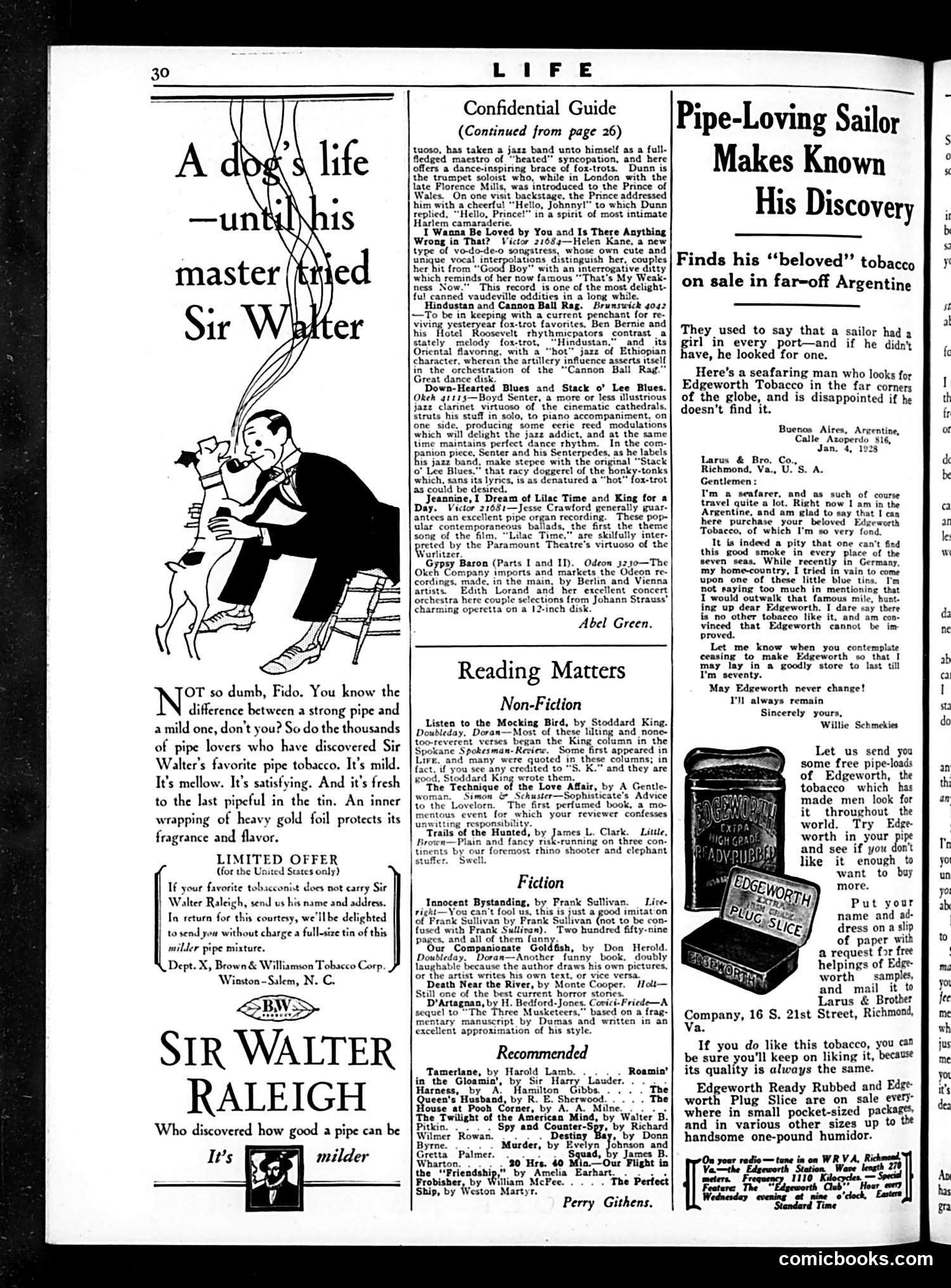
This page contains a Sir Walter Raleigh pipe tobacco advertisement featuring a cartoon dog and man. The ad plays on a common advertising tactic: the dog (named Fido) is depicted as having sophisticated taste in tobacco, understanding the difference between strong and mild varieties. The humor relies on the absurdity of attributing refined palate judgment to a pet to sell the product's mildness and quality to consumers. The joke is straightforward: if even a dog can appreciate this tobacco's superiority, any human smoker should recognize it too. The "Limited Offer" encourages distribution by promising free samples to customers whose local tobacconists don't stock it. The rest of the page contains music and book reviews typical of *Life* magazine's cultural coverage from this era (1920s), including jazz records and literary recommendations—unrelated to the advertisement.
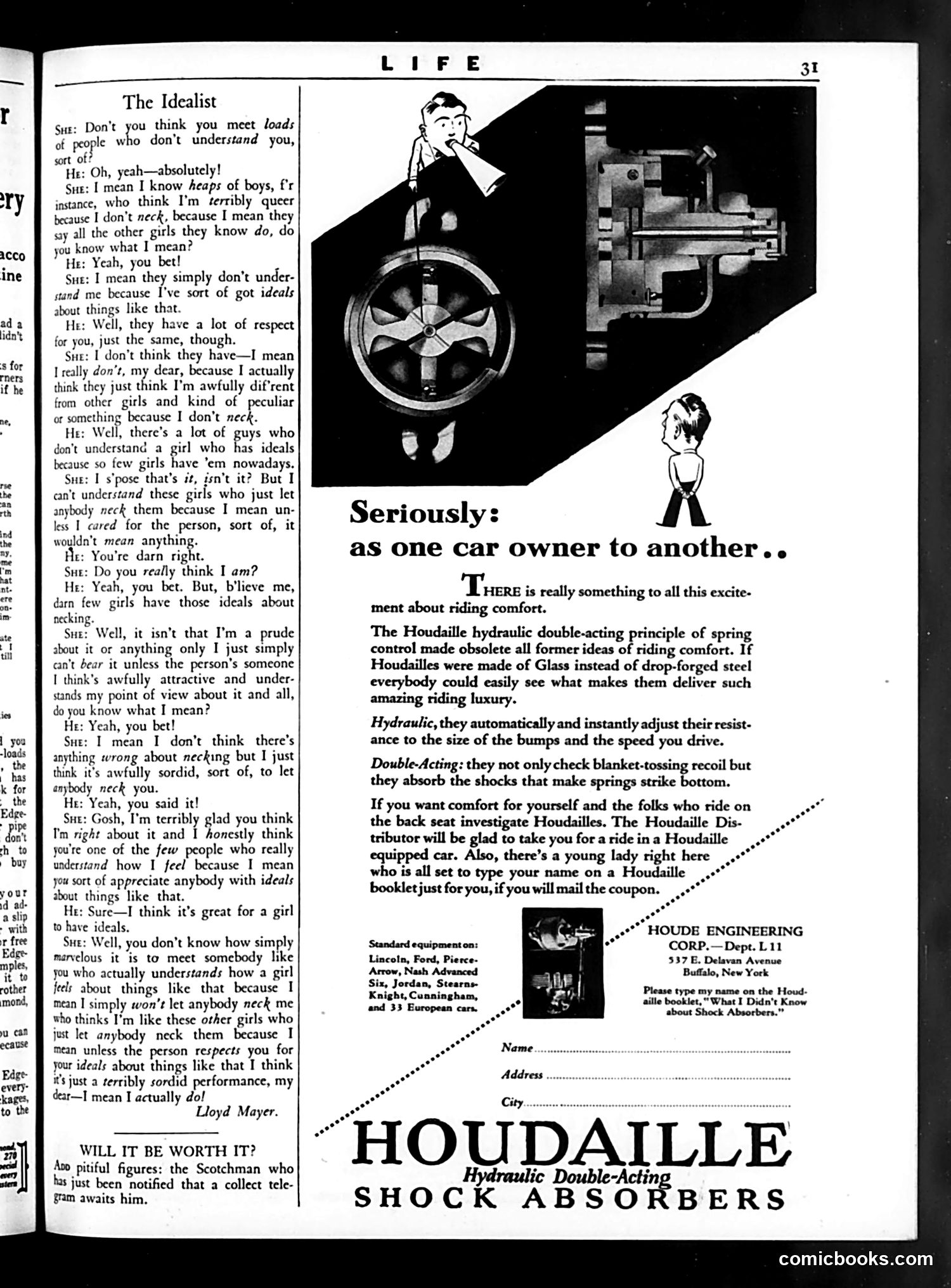
This dialogue-driven cartoon satirizes young women who claim to have moral "ideals" about necking (kissing/petting), a common dating practice in the 1920s. The female character, Sue, repeatedly insists she won't neck casually and positions herself as principled—yet her argument becomes circular and self-contradictory, revealing the performance of virtue rather than genuine conviction. The satire targets Sue's narcissism: she frames her refusal to neck as special sensitivity, expects admiration for it, and keeps circling back to how unique and misunderstood she is. The male character's responses ("Yeah, you bet!") suggest he's merely agreeing to flatter her, not genuinely listening. The joke is that Sue's elaborate moral posturing masks vanity. By modern standards, this mocks performative femininity and the social pressure on women to balance appearing desirable while claiming sexual restraint—a contradiction the cartoon exposes through her exhausting self-repetition.
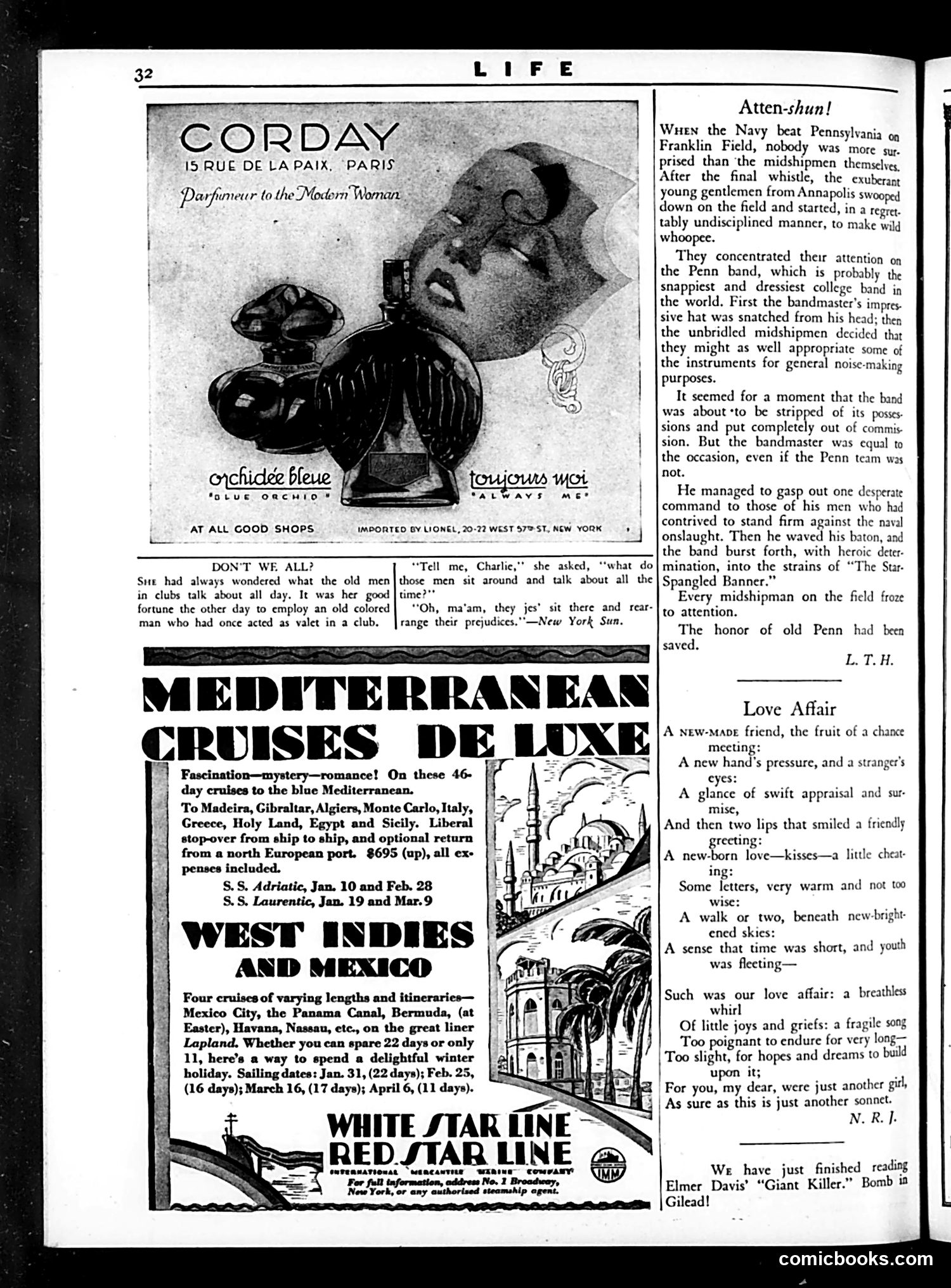
This satirical piece recounts a real 1926 Navy-Pennsylvania football game at Franklin Field. After Navy's upset victory, exuberant midshipmen stormed the field and began rowdily dismantling the Penn band—snatching the bandmaster's hat and grabbing instruments for "noise-making purposes." The humor lies in the contrast between the midshipmen's undisciplined chaos and the Penn bandmaster's composure. Despite the onslaught, he commanded his musicians to stand firm, then conducted them into "The Star-Spangled Banner." The patriotic melody immediately froze every midshipman to attention, restoring order through national pride rather than authority. The satire mocks both military youth's rowdy excess and the symbolic power of American patriotism to instantly enforce discipline—suggesting that even exuberant victors cannot resist the call of the national anthem. "The honor of old Penn had been saved" through musical-patriotic intervention, not through the team's actual victory.
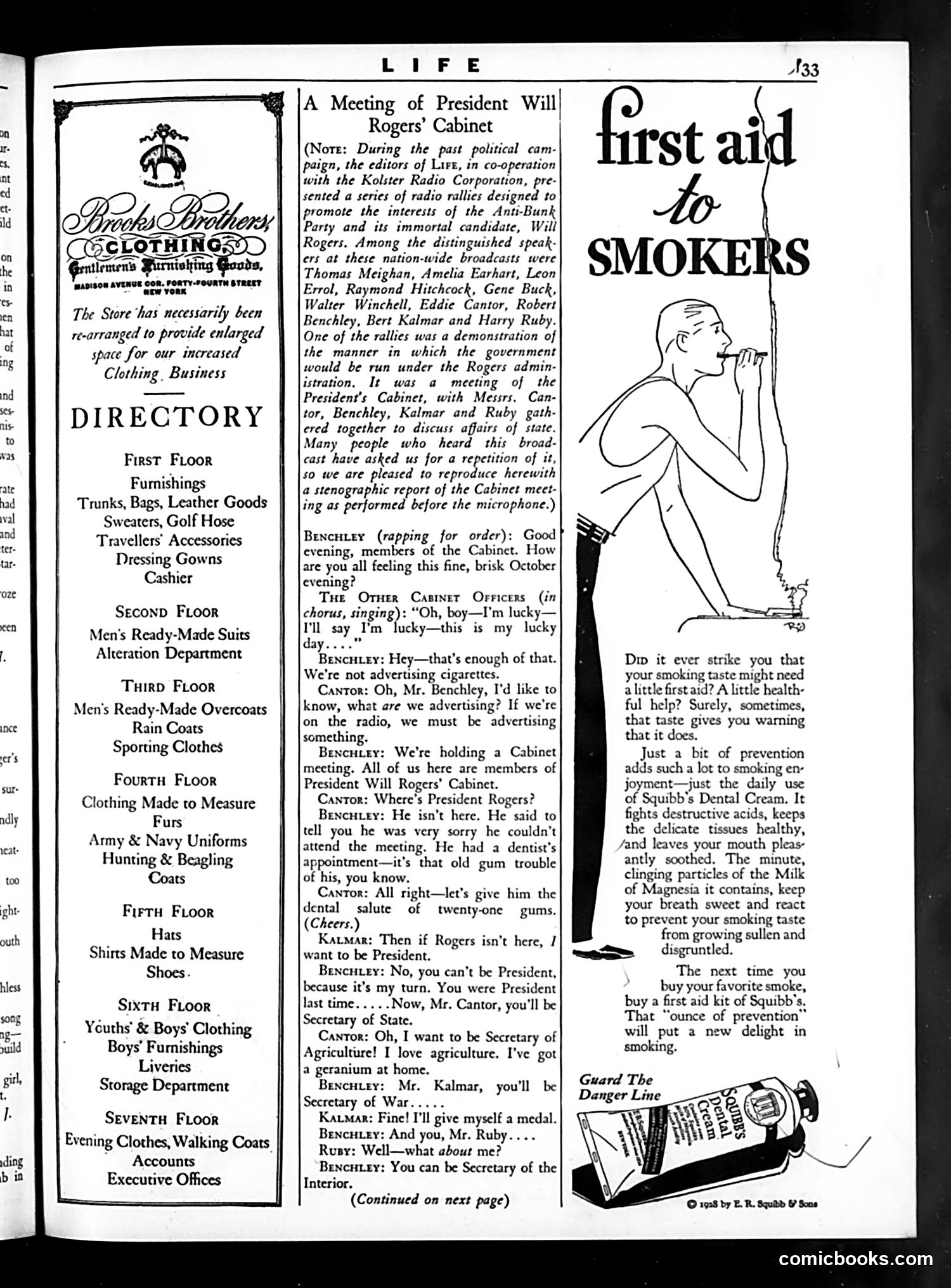
This page satirizes President Will Rogers (the famous humorist and entertainer), imagining how he'd run the government. The "Cabinet meeting" features real comedians of the era—Robert Benchley, Eddie Cantor, Bert Kalmar, and Harry Ruby—performing a radio skit mocking government incompetence. The joke: Rogers himself is absent due to a dental appointment, and his cabinet members immediately squabble over positions like children, with Cantor wanting Agriculture (because he owns a geranium) and Kalmar demanding a medal for being Secretary of War. The satire targets bureaucratic absurdity and self-interest. The advertisement for Squibb's Dental Cream uses a cartoon smoker as a segue—a humorous transition exploiting the dental theme from the cabinet sketch's "gum trouble" joke. This reflects 1920s-30s political humor treating government as fundamentally ridiculous.
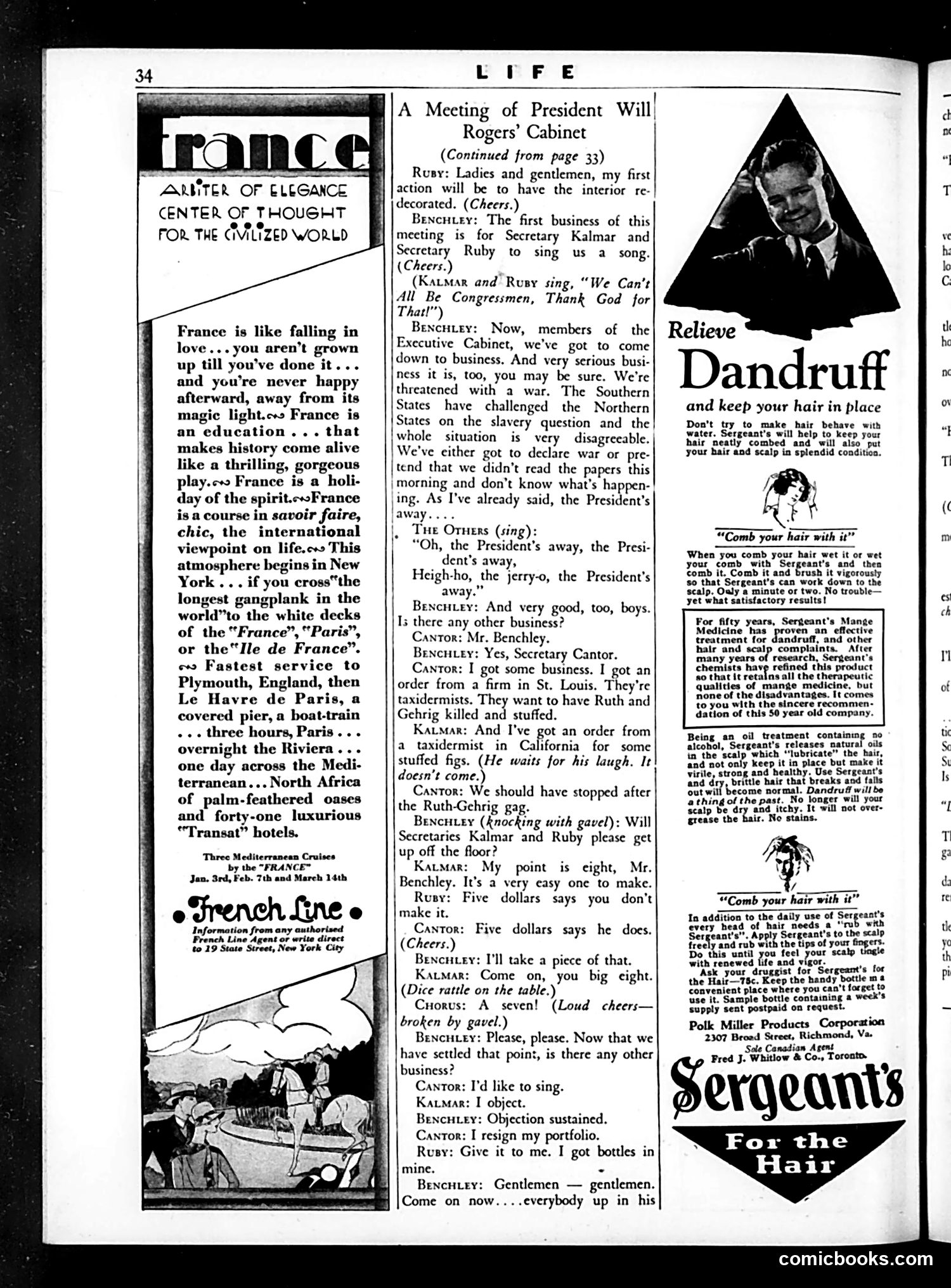
This page contains a satirical sketch titled "A Meeting of President Will Rogers' Cabinet," featuring real entertainers of the era (Benchley, Kalmar, Ruby, Cantor, Ruth, Gehrig) playing themselves as cabinet members in a mock government meeting. The humor relies on: 1. **The absurd premise**: Treating entertainers as serious government officials discussing a civil war crisis over slavery 2. **Comic avoidance**: When presented with genuine national crisis, they ignore it entirely, gamble with dice, and sing songs instead 3. **Topical references**: Mentions of Ruth and Gehrig (baseball stars) being "stuffed" by taxidermists, and California figs—wordplay reflecting 1920s-30s vaudeville humor 4. **Period satire**: Mocking government incompetence and politicians' tendency to ignore serious problems The piece suggests politicians are as frivolous and unqualified as entertainers—a common satirical critique of the era. The left side features a French shipping line advertisement, unrelated to the sketch.
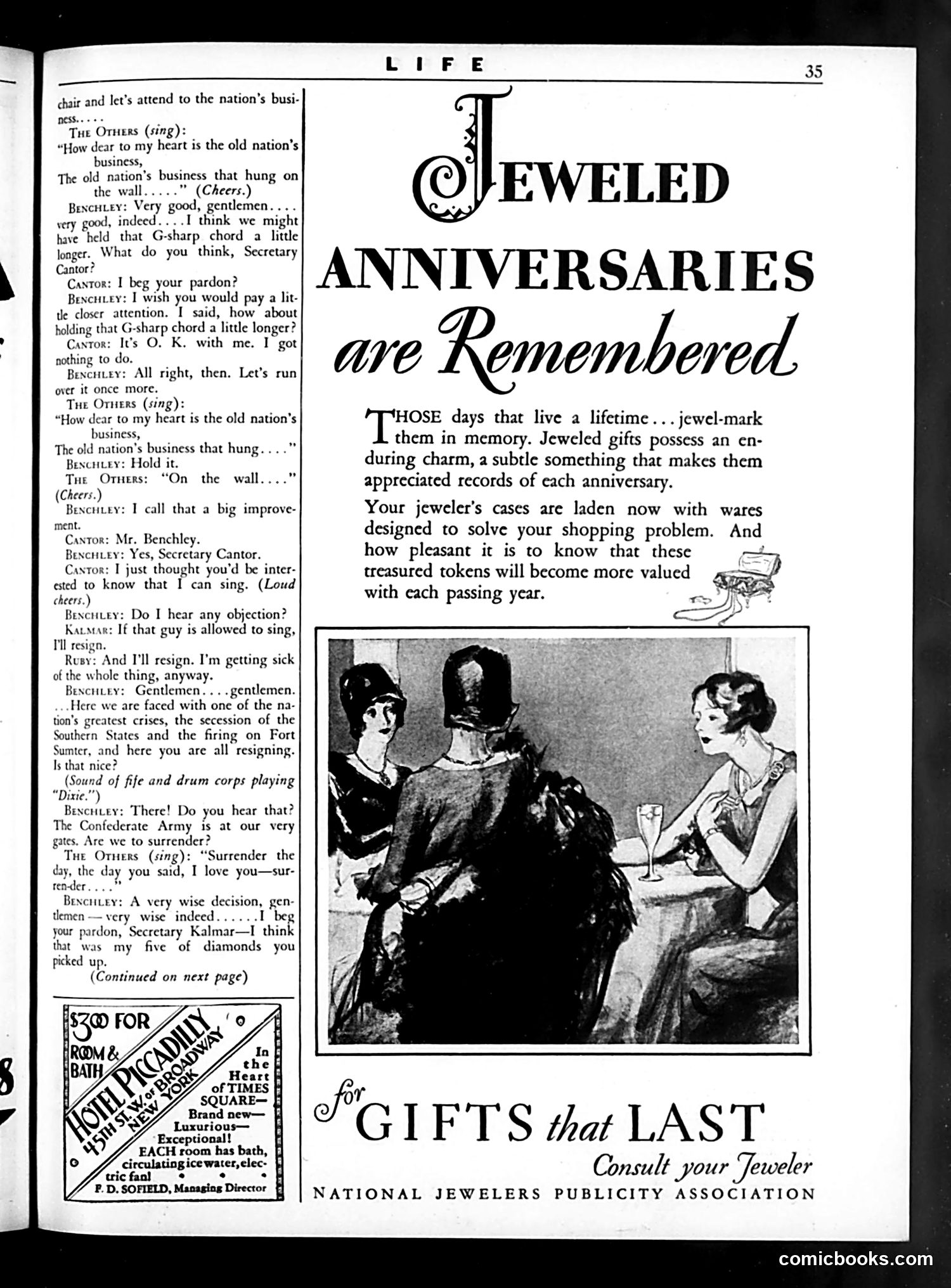
This page contains a satirical sketch by Robert Benchley mocking government incompetence during the American Civil War's outbreak. The scene depicts cabinet members rehearsing a patriotic song ("How dear to my heart is the old nation's business") while the Confederacy fires on Fort Sumter and threatens the capital. The humor targets officials' trivial concerns—obsessing over musical chord length and card games—amid existential national crisis. Secretary Cantor's announcement that he can sing, followed by multiple resignations, exemplifies the portrayed bureaucratic dysfunction. When Confederate forces approach, the ministers respond by singing "Surrender" rather than acting decisively. The satire suggests government leadership is distracted, incompetent, and emotionally unstable when the nation most needs serious action. It's a cutting critique of how personal ego and petty office politics override patriotic duty during America's gravest constitutional emergency. The page's other content is a jewelry advertisement unrelated to the sketch.
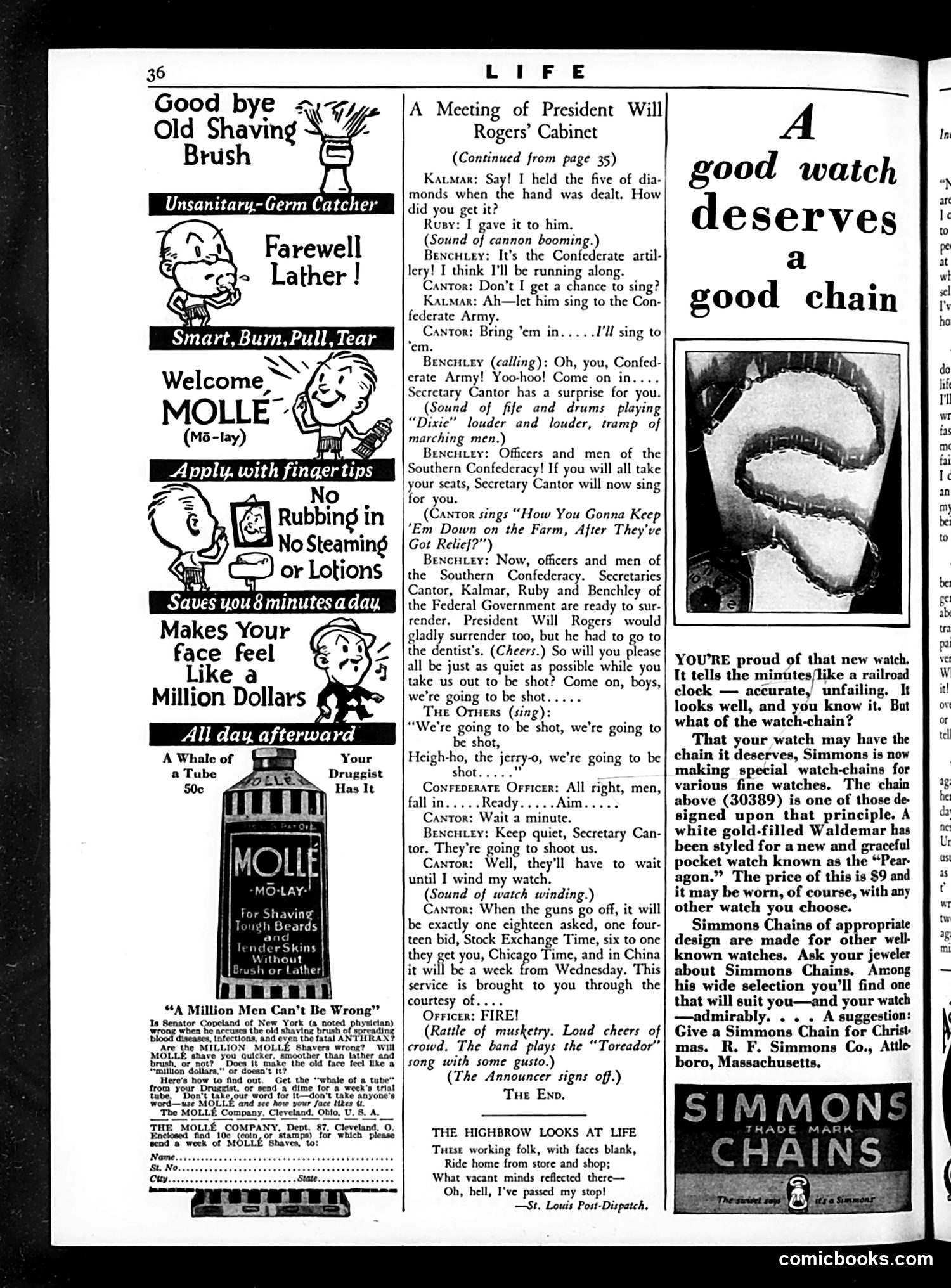
This page mixes **advertisements** with **political satire**. The left side features product ads for Mollé shaving cream and other toiletries. The dominant content is a humorous fictional sketch titled "A Meeting of President Will Rogers' Cabinet." The sketch satirizes the **Coolidge administration** by imagining Will Rogers (a popular humorist and social critic of the 1920s) as president, with performers Eddie Cantor and Benny Benchley as cabinet members. The comedy derives from these entertainers incompetently conducting government business—card games, impromptu singing performances, and comical surrender during a mock "Confederate Army" attack. The sketch mocks government inefficiency and the absurdity of unqualified people holding office. A brief poem at bottom ("The Highbrow Looks at Life") adds commentary on working-class life, with dark humor about distracted commuters. Overall, the page reflects 1920s satirical humor about American politics and consumer culture.
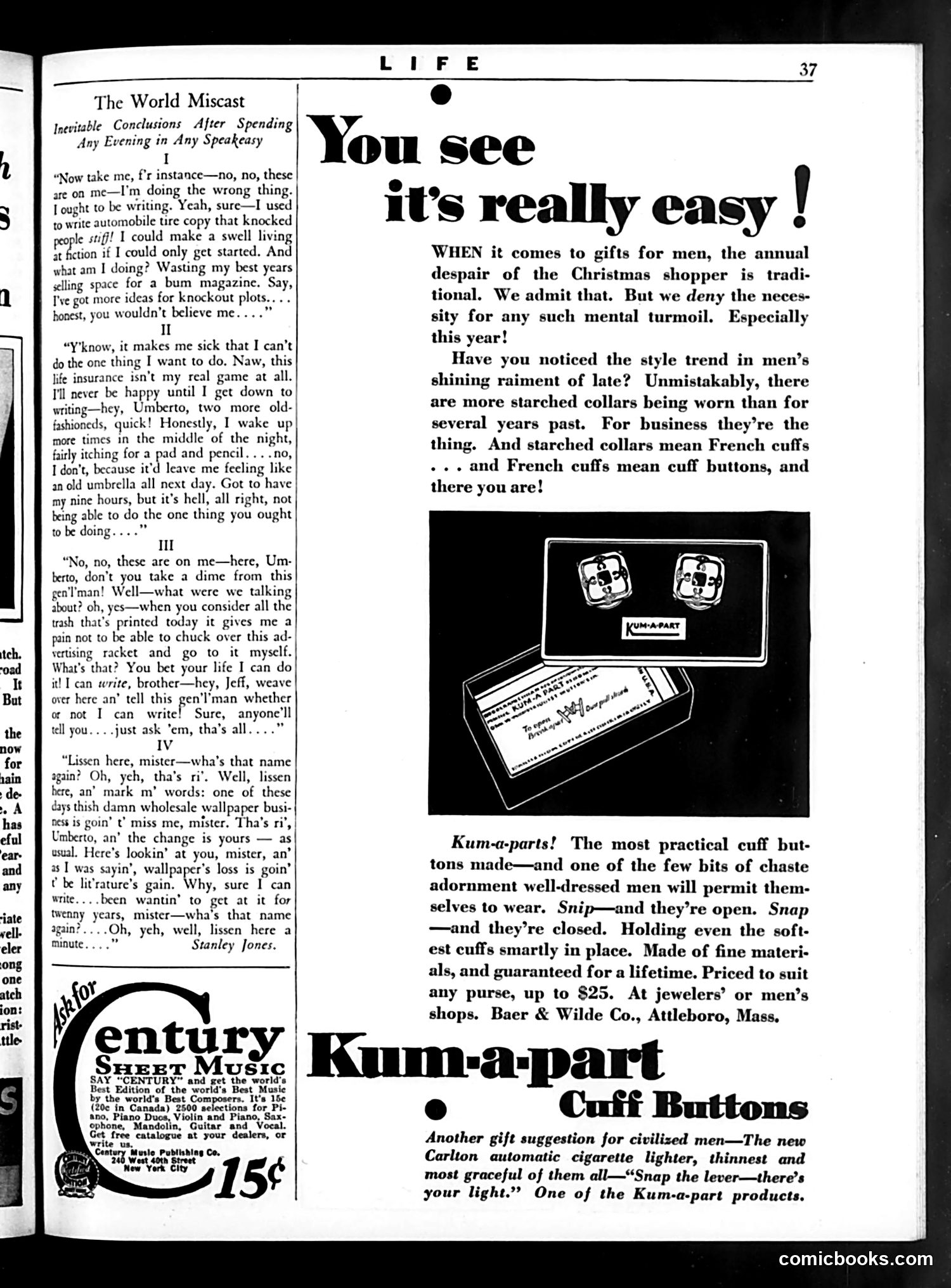
This cartoon satirizes a common type encountered in Prohibition-era speakeasies: the perpetually frustrated wannabe writer. Through four numbered scenes, different men (all appearing to be the same archetype, named "Umberto" as the bartender) repeatedly claim they're wasting their talents in mundane jobs—advertising, insurance, wallpaper sales—when they could be writing if only circumstances permitted. The joke targets self-deluding men who blame external circumstances for unfulfilled ambitions rather than acknowledging their own lack of follow-through. Each monologue becomes progressively drunker and more contradictory (one admits waking up comfortable, another claims twenty years of postponement). The title "World Miscast" suggests these men are suited for literary greatness but trapped in ordinary work—yet the humor implies they're simply making excuses over drinks they can't afford to buy. The satire gently mocks both male vanity and the speakeasy culture of 1920s America.
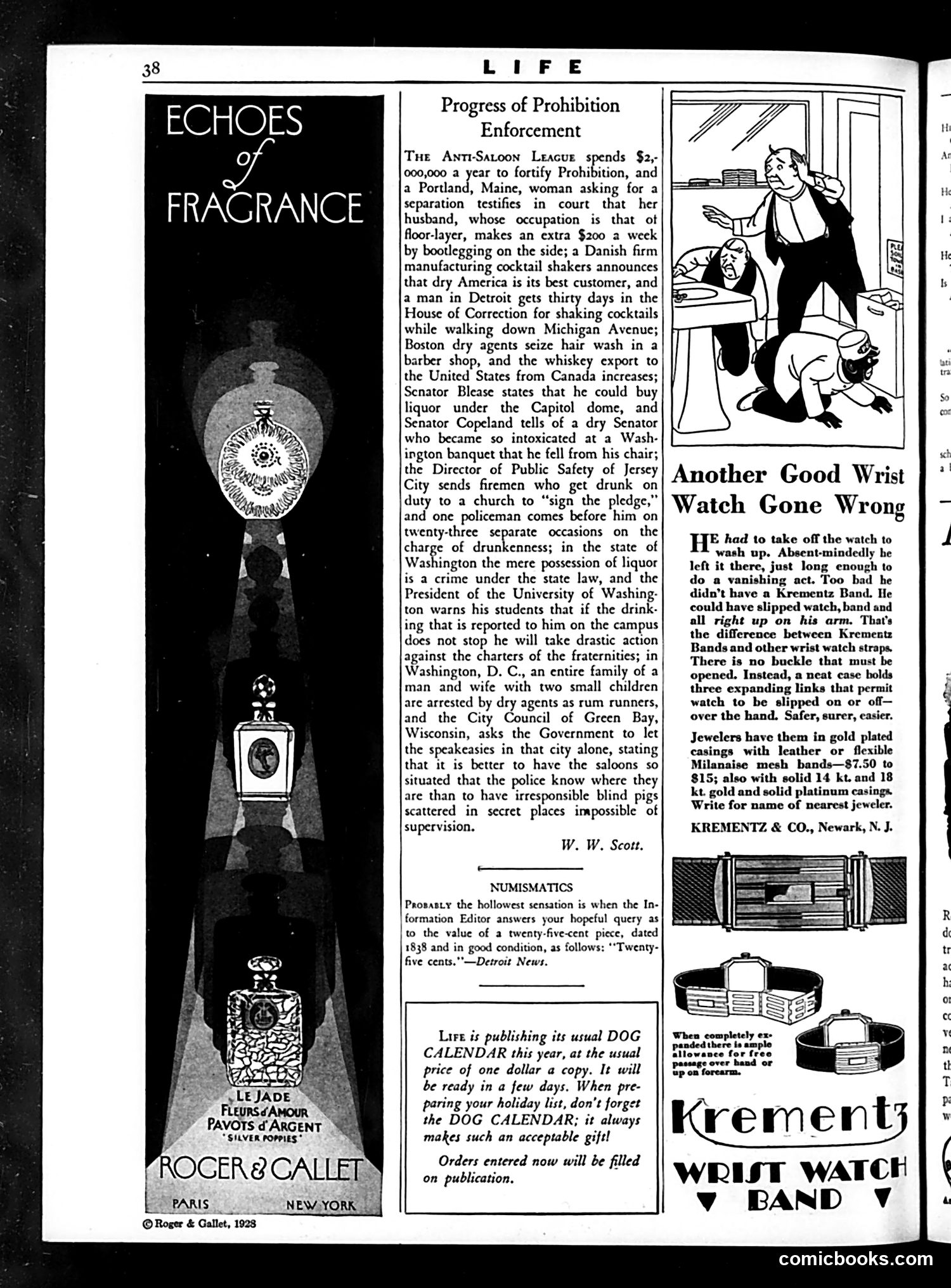
This page satirizes **Prohibition's failure** through a compilation of absurd enforcement contradictions. The central text, "Progress of Prohibition Enforcement," is intentionally ironic—listing enforcement efforts that paradoxically demonstrate Prohibition's ineffectiveness. The satire includes: bootleggers earning extra income legally, Danish firms profiting from American cocktail shaker sales, senators buying liquor under the Capitol, intoxicated firemen, and authorities admitting speakeasies are preferable to uncontrolled illegal drinking. Each anecdote highlights the law's incompetence and the hypocrisy of officials who break it. The cartoonist (bylined W. W. Scott) exposes how Prohibition created crime, corruption, and economic absurdity rather than eliminating alcohol use. The accumulated examples suggest the entire enterprise is futile—a pointed critique during the Prohibition era (1920-1933). The rest of the page contains period advertisements unrelated to this satire.
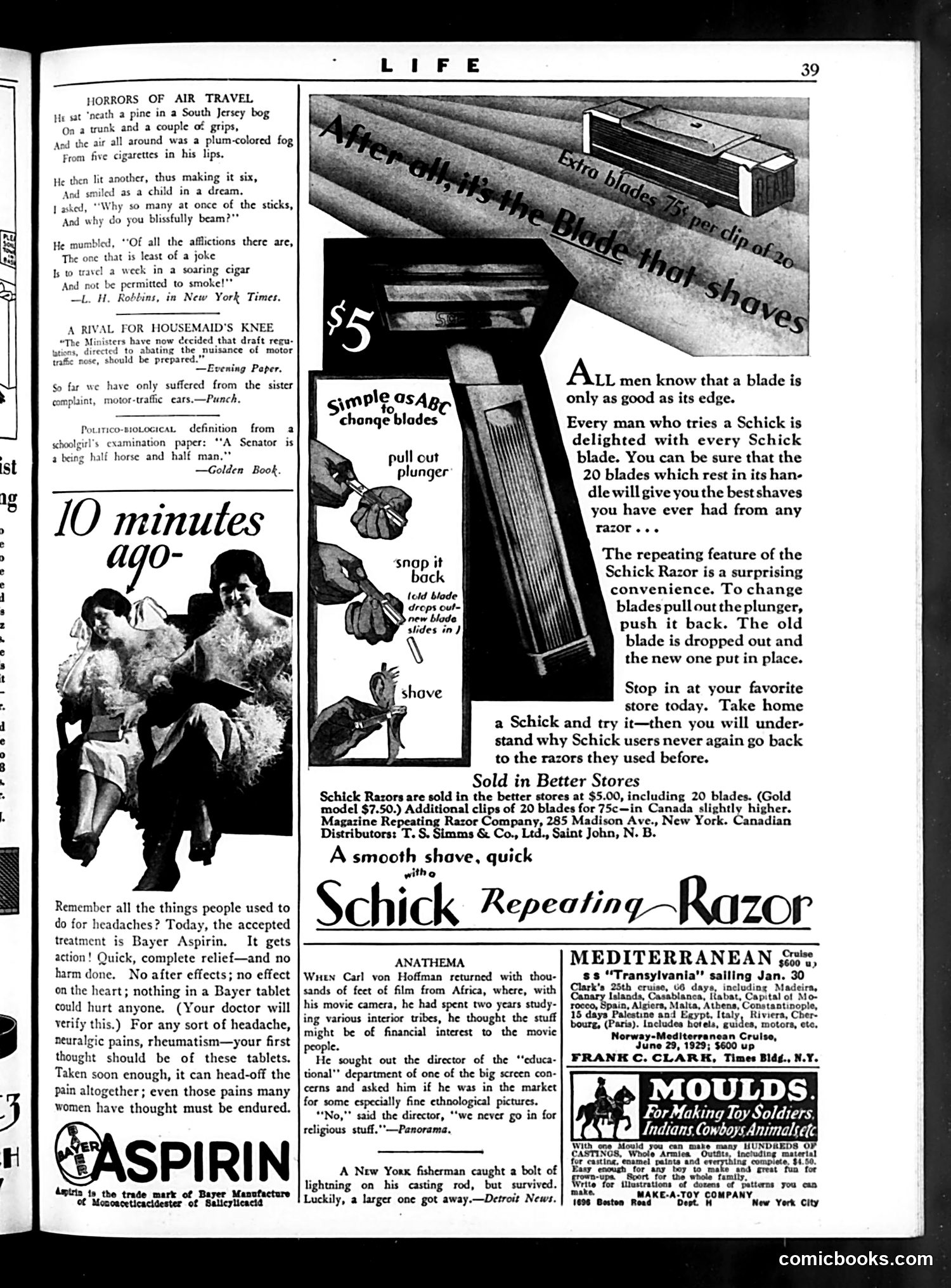
This is primarily an **advertising page** from Life magazine (circa 1929, based on dates visible). The satirical content is minimal: **"Horrors of Air Travel"** is a humorous poem about a man chain-smoking five cigarettes in a bog because he cannot smoke during airplane travel. The joke reflects early aviation anxiety—flying was novel and uncomfortable, and cabin restrictions on smoking were an unexpected indignity for smokers of that era. **Other brief satirical items** include: - A quip about senators being "half horse and half man" (standard political mockery) - A joke about a filmmaker pitching "ethnological" African footage rejected as "religious stuff" (unclear reference) - A fishing anecdote about catching lightning **The page is dominated by advertisements** for Bayer Aspirin, Schick Repeating Razors, Mediterranean cruises, and toy molds—reflecting 1920s consumer culture and leisure travel. The satire is gentle and topical rather than politically pointed.
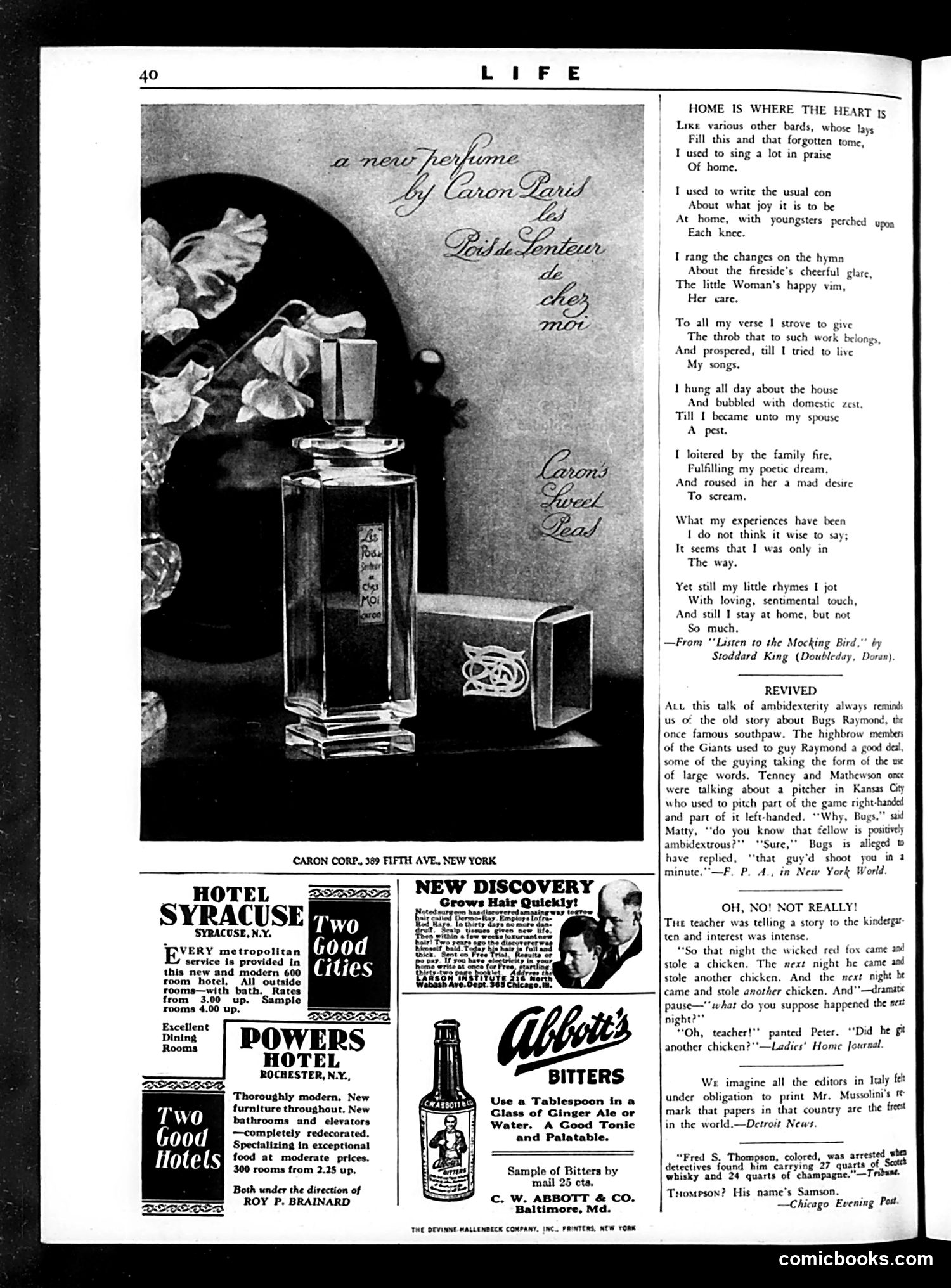
This page is primarily **advertising and humor content** rather than political satire. The main feature is a poem titled "Home Is Where the Heart Is" by Stoddard King, which humorously subverts domestic sentimentality. The poet describes writing romantic verses *praising* home life, then discovering that actually *living* at home full-time made him insufferable to his wife—he became "a pest" lounging by the fireside. The joke is the gap between idealized literary domesticity and domestic reality. Below are three separate humor anecdotes: one about baseball player Bugs Raymond being called "ambidextrous" (he allegedly misunderstood it as a threat); one about a kindergarten teacher's chicken-theft story; and one about a man arrested with alcohol named Thompson—the joke being his name contradicts the absurd quantity of liquor. The remainder consists of hotel and patent medicine advertisements typical of the era (hair growth tonic, Abbott's Bitters tonic).
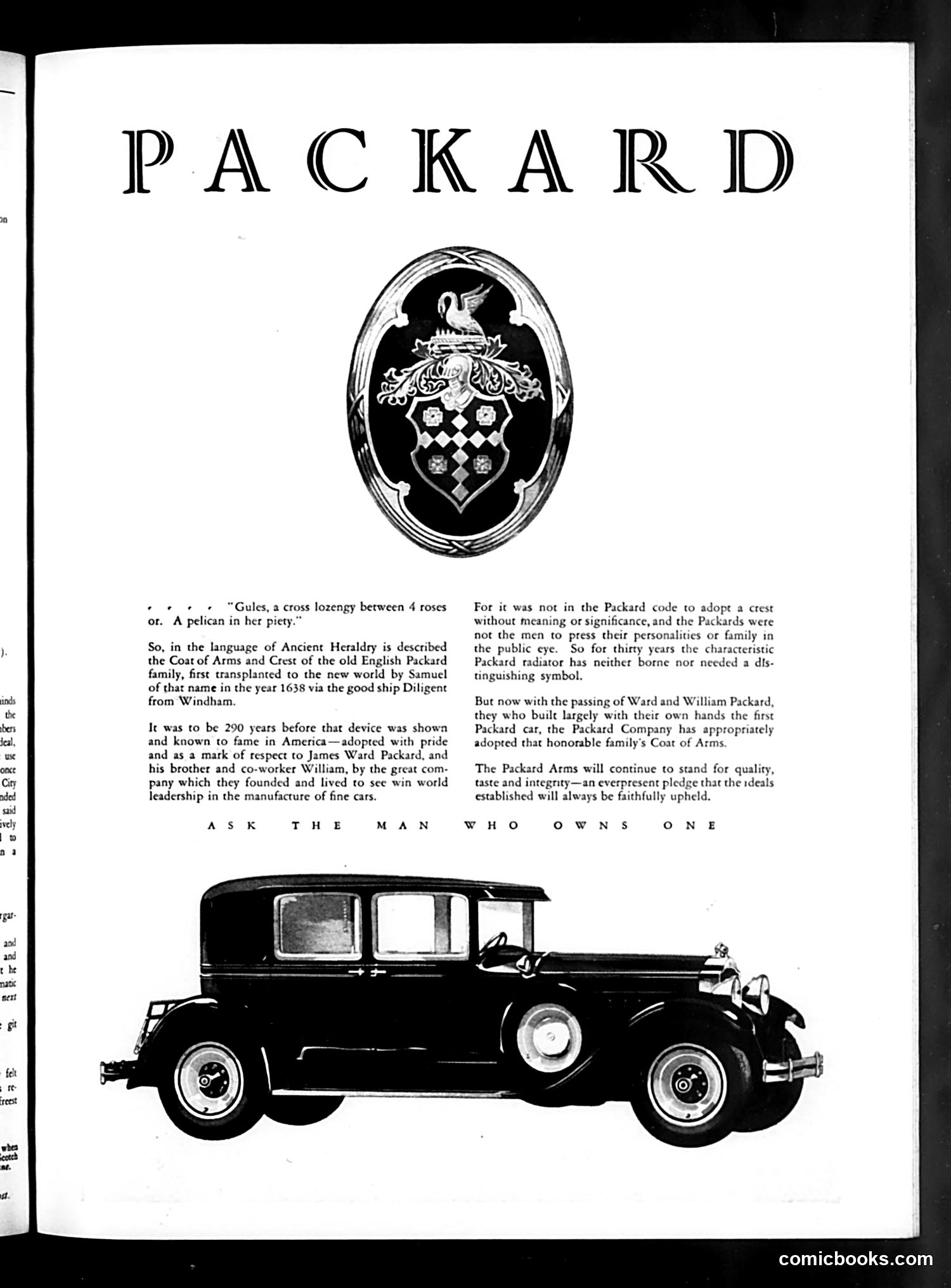
This is **not a cartoon or satire**—it's a corporate advertisement for Packard automobiles. The page uses heraldic imagery and historical narrative to market the car brand. The ad traces the Packard family lineage from 1638 England to the American automobile founders James Ward and William Packard. It argues that the company has now adopted the family's traditional coat of arms (featuring a pelican and cross design) following the founders' deaths, signifying continuity and legitimacy. The appeal is to **class and pedigree**: by connecting a luxury car manufacturer to aristocratic heritage and family honor, the ad positions Packard vehicles as symbols of quality and refined taste. The message suggests that Packard's adoption of ancestral heraldry represents not vanity but respect for established values—"quality, taste and integrity." This was marketing strategy for a high-end automobile brand targeting wealthy, status-conscious buyers of the early 20th century.
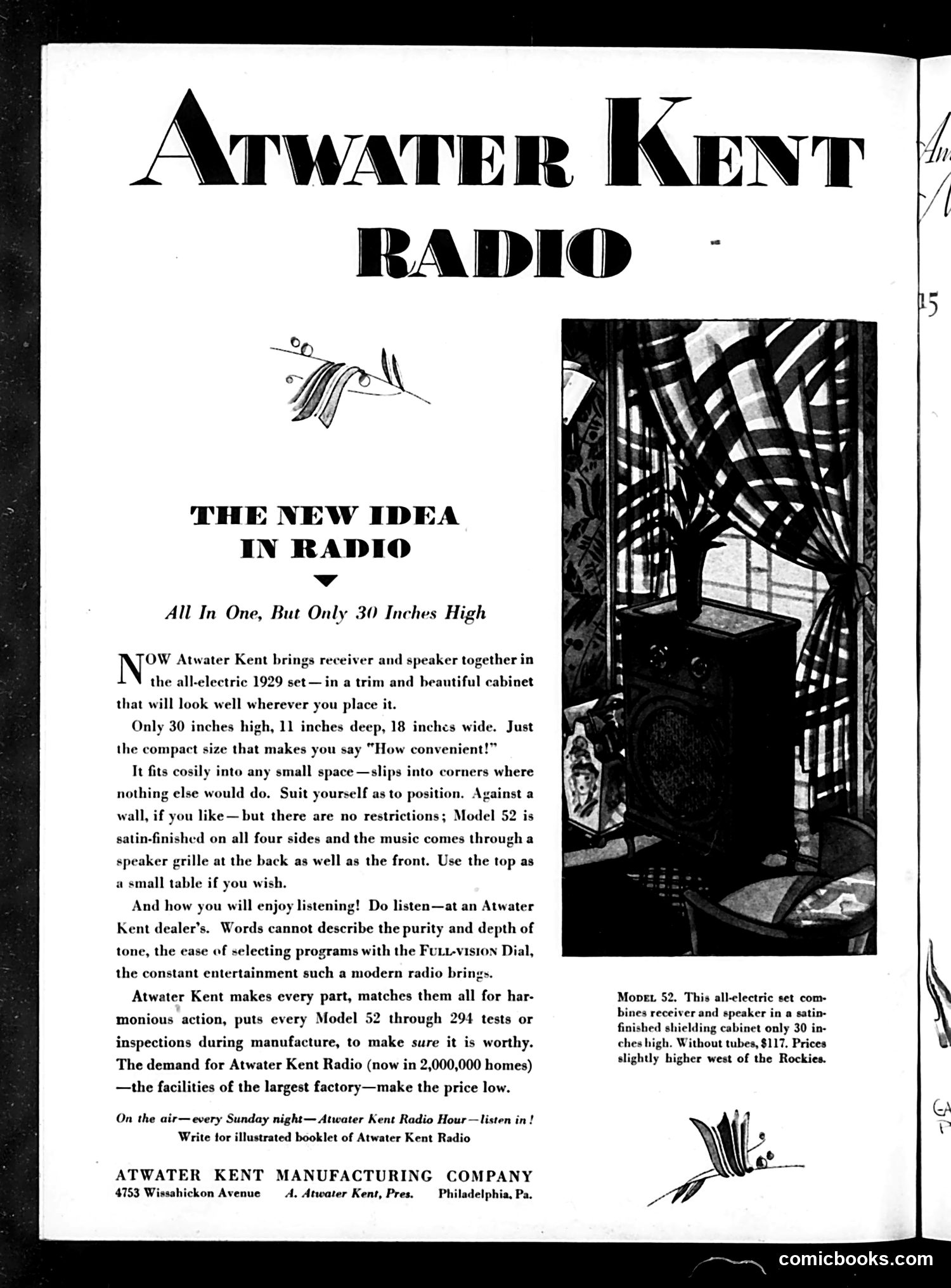
This is a straightforward **product advertisement**, not satire or political commentary. It promotes the Atwater Kent Model 52 radio, marketed as "the new idea in radio" for 1929. The pitch emphasizes convenience and compact design: only 30 inches high, fitting into small spaces and corners. The ad highlights the integrated all-electric design (receiver and speaker combined), quality construction (294 manufacturing tests), and broad appeal (already in 2,000,000 homes). The accompanying photograph shows the radio's elegant cabinet design in an interior setting. The small decorative illustrations of a fish and plant are typical period design flourishes. The radio's $117 price is positioned as affordable due to the manufacturer's large factory capacity. An on-air promotion—the "Atwater Kent Radio Hour" Sunday nights—encouraged listeners to experience the product's sound quality firsthand. This represents 1920s consumer advertising targeting middle-class households during the radio boom era.