
Life, 1928-11-16 · page 16 of 44
Life — November 16, 1928 — page 16: what you’re looking at
What you’re looking at
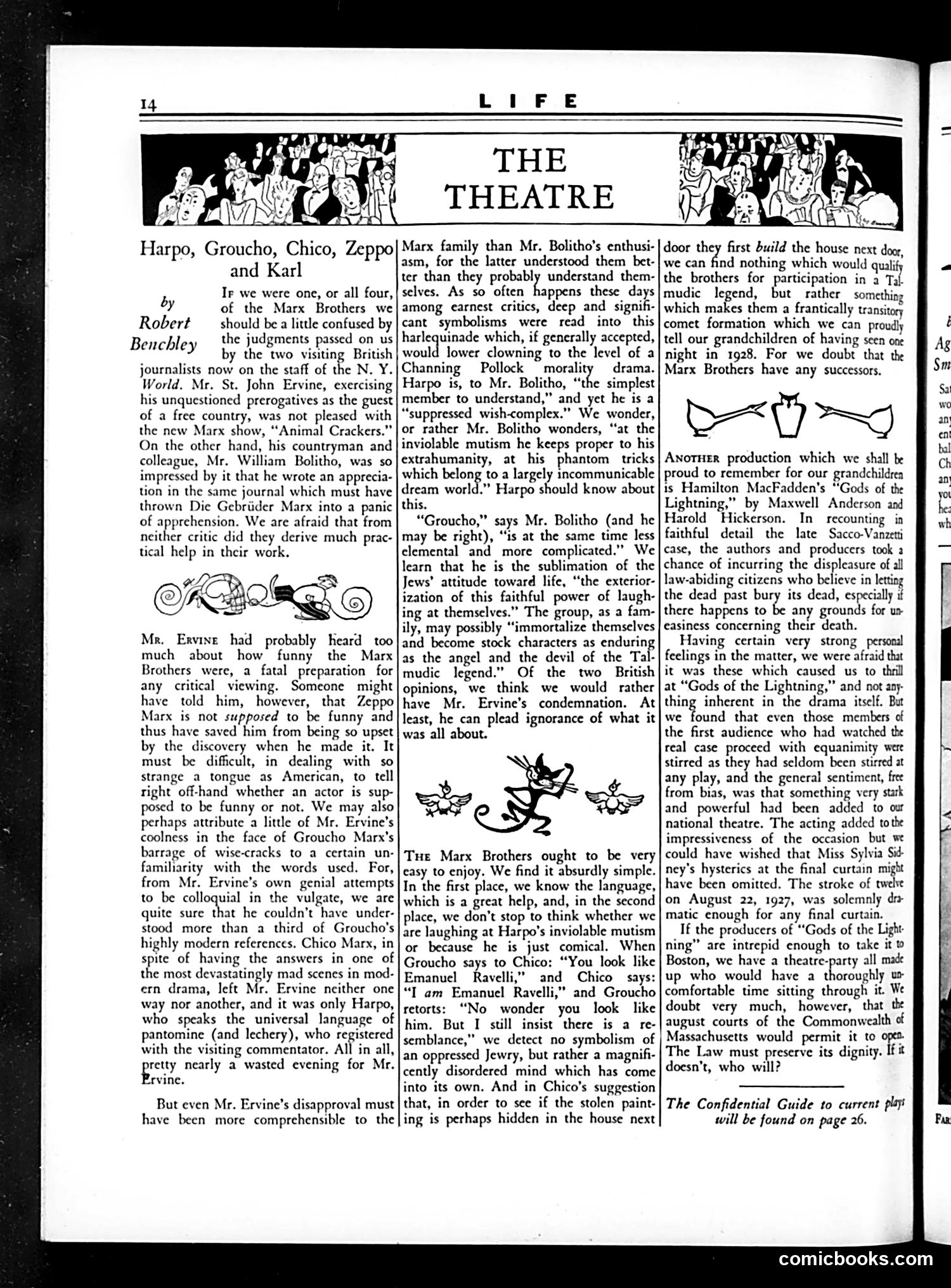
This page reviews Marx Brothers theatrical performances, specifically "Animal Crackers." The article by Robert Benchley discusses the comedic styles of Harpo, Groucho, Chico, and Zeppo Marx, comparing them favorably to other contemporary performers like William Boilito. The small cartoon illustrations show figures in exaggerated poses—likely caricatures of the Marx Brothers themselves, capturing their physical comedy style. The critique celebrates the Marx Brothers' ability to generate genuine laughter while dismissing concerns from "earnest critics" who worry their comedy lacks sophistication. Benchley argues their humor and "immortalize themselves" through their performances. The review also mentions a production of "Gods of the Lightning" and criticizes censorship concerns regarding theatrical content in Massachusetts.
📄 Transcribed text from this page (OCR, searchable)
Machine-transcribed from the original scan — historical spelling and the odd misread are preserved.
ESOS Harpo, Groucho, Chico, Zeppo and Karl b Ir we were one, or all four, y of the Marx Brothers we Robert should be a little confused by Benchley the judgments passed on us by the two visiting British journalists now on the staff of the N. Y. World. Mr. St. John Ervine, exercising his unquestioned prerogatives as the guest of a free country, was not pleased with the new Marx show, “Animal Crackers.” On the other hand, his countryman and colleague, Mr. William Bolitho, was so impressed by it that he wrote an apprecia- tion in the same journal which must have thrown Die Gebriider Marx into a panic of apprehension. We are afraid that from neither critic did they derive much prac- tical help in their work. Mr. Ervine had probably heard too much about how funny the Marx Brothers were, a fatal preparation for any critical viewing. Someone might have told him, however, that Zeppo Marx is not supposed to be funny and thus have saved him from being so upset by the discovery when he made it. It must be difficult, in dealing with so strange a tongue as American, to tell right off-hand whether an actor is sup- posed to be funny or not. We may also perhaps attribute a little of Mr. Ervine’s coolness in the face of Groucho Marx's barrage of wise-cracks to a certain un- familiarity with the words used. For, from Mr. Ervine’s own genial attempts to be colloquial in the vulgate, we are quite sine thae he couldn’t have under- stood more than a third of Groucho’s highly modern references. Chico Marx, in spite of having the answers in one of the most devastatingly mad scenes in mod- ern drama, left Mr. Ervine neither one way nor another, and it was only Harpo, who speaks the universal language of pantomine (and lechery), who registered with the visiting commentator. All in all, retty nearly a wasted evening for Mr. rvine, But even Mr. Ervine’s disapproval must have been more comprehensible to the Marx family than Mr. Bolitho’s enthusi- asm, for the latter understood them bet- ter than they probably understand them- selves. As so often happens these days among earnest critics, deep and signifi- cant symbolisms were read into this harlequinade which, if generally accepted, would lower clowning to the level of a Channing Pollock — morali drama. Harpo is, to Mr. Bolitho, ‘the simplest member to understand,” and yet he is a “suppressed wish-complex.” We wonder, or rather Mr. Bolitho wonders, ‘tat the inviolable mutism he keeps proper to his extrahumanity, at his phantom tricks which belong to a largely incommunicable dream world.” Harpo should know about this. “Groucho,” says Mr. Bolitho (and he may be right), “is at the same time less elemental and more complicated.” We learn that he is the sublimation of the Jews’ attitude toward life, “the exterior- ization of this faithful power of laugh- ing at themselves.” The group, as a fam- ily, may possibly “immortalize themselves and become stock characters as endurin, as the angel and the devil of the Tal- mudic legend.” Of the two British opinions, we think we would rather have Mr. Ervine’s condemnation. At least, he can plead ignorance of what it was all about. Tue Marx Brothers ought to be very casy to enjoy. We find it absurdly simple. In the first place, we know the language, which is a great help, and, in the second place, we don’t stop to think whether we are laughing at Harpo's inviolable mutism or because he is just comical. When Groucho says to Chico: “You look like Emanuel Ravel,” and Chico says: “I am Emanuel Ravelli,” and Groucho retorts: “No wonder you look like him. But I still insist there is a re- semblance,” we detect no symbolism of an oppressed Jewry, but rather a magnifi- cently disordered mind which has come into its own. And in Chico’s suggestion that, in order to see if the stolen paint- ing is perhaps hidden in the house next door they first build the house next door, we can find nothing which would qualify the brothers for participation in a Ta mudic legend, but rather something which makes them a frantically transitory comet formation which we can proudly tell our grandchildren of having seen one night in 1928. For we doubt that the Marx Brothers have any successors. b= Anotuer production which we shall be proud to remember for our grandchildren is Hamilton MacFadden’s “Gods of the Lightning,” by Maxwell Anderson and Harold Hickerson. In recounting in faithful detail the late Sacco-Vanzetti case, the authors and producers took 2 chance of incurring the displeasure of all law-abiding citizens who believe in letting the dead past bury its dead, especially if there happens to be any grounds for us- easiness concerning their death. Having certain very strong personal feelings in the matter, we were afraid that it was these which caused us to thrill at “Gods of the Lightning,” and not any- thing inherent in the drama itself. But we found that even those members of the first audience who had watched the real case proceed with equanimity were stirred as they had seldom been stirred at any play, and the general sentiment, free from bias, was that something very stark and powerful had been added to our national theatre. The acting added tothe impressiveness of the occasion but we could have wished that Miss Sylvia Sid- ney's hysterics at the final curtain might have been omitted. The stroke of twelve on August 22, 1927, was solemnly dre matic enough for any final curtain. If the producers of “Gods of the Light- ning” are intrepid enough to take it » Boston, we have a theatre-party all ma up who would have a thoroughly un comfortable time sitting through it. We doubt very much, however, that the august courts of the Commonwealth of Massachusetts would permit it to opea- The Law must preserve its dignity. If it doesn’t, who will? The Confidential Guide to current plays will be found on page 26. comicbooks.com