
Life, 1928-11-16 · page 37 of 44
Life — November 16, 1928 — page 37: what you’re looking at
What you’re looking at
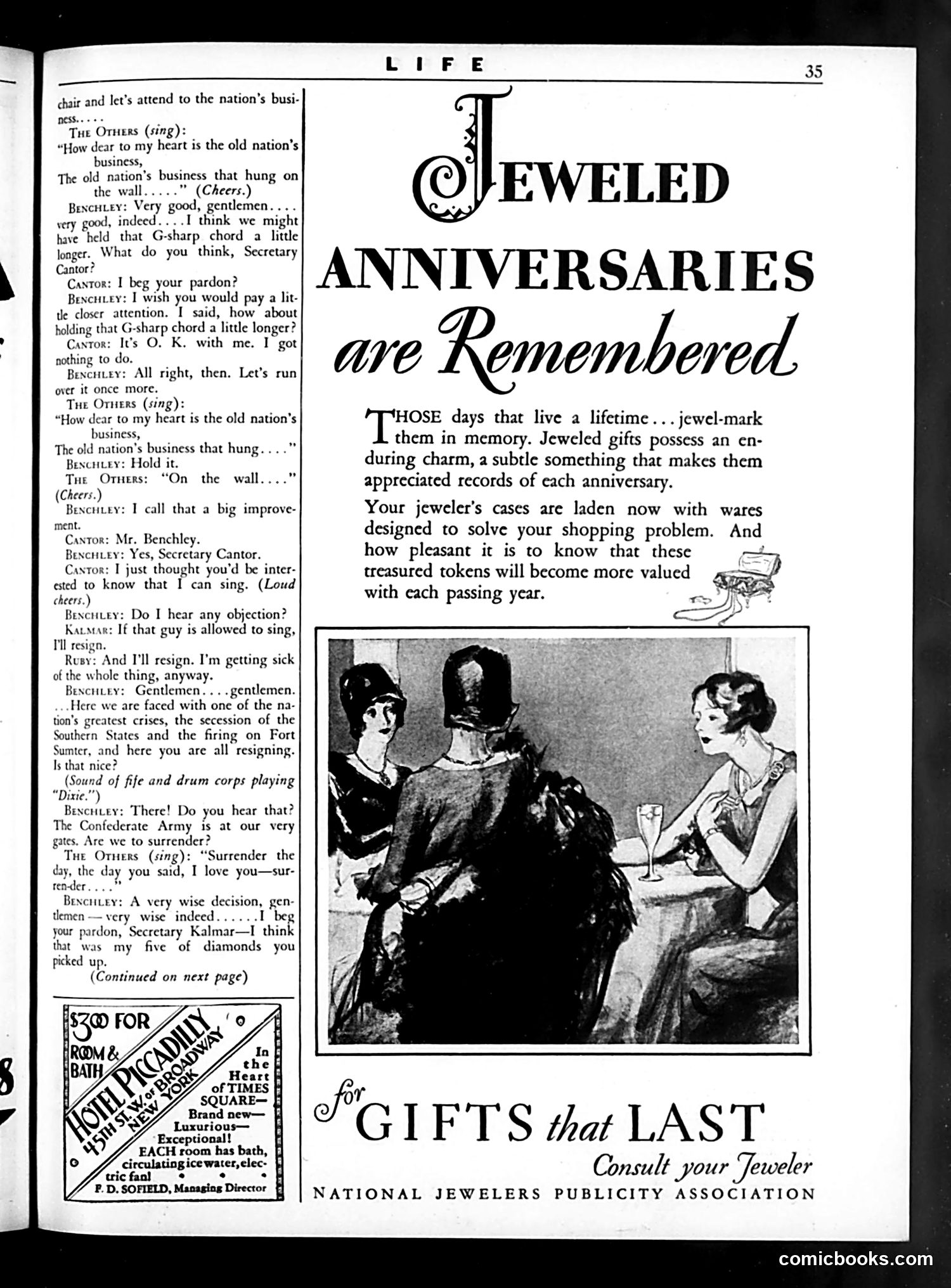
This page contains a satirical sketch by Robert Benchley mocking government incompetence during the American Civil War's outbreak. The scene depicts cabinet members rehearsing a patriotic song ("How dear to my heart is the old nation's business") while the Confederacy fires on Fort Sumter and threatens the capital. The humor targets officials' trivial concerns—obsessing over musical chord length and card games—amid existential national crisis. Secretary Cantor's announcement that he can sing, followed by multiple resignations, exemplifies the portrayed bureaucratic dysfunction. When Confederate forces approach, the ministers respond by singing "Surrender" rather than acting decisively. The satire suggests government leadership is distracted, incompetent, and emotionally unstable when the nation most needs serious action. It's a cutting critique of how personal ego and petty office politics override patriotic duty during America's gravest constitutional emergency. The page's other content is a jewelry advertisement unrelated to the sketch.
📄 Transcribed text from this page (OCR, searchable)
Machine-transcribed from the original scan — historical spelling and the odd misread are preserved.
chair and let’s attend to the nation’s busi- Tue Orners (sing): “How dear to my heart is the old nation’s business, ; taf b old nation’s business that hung on a the wall " (Cheers.) . Bexcutey: Very good, gentlemen... . very good, indeed... -T think we might have held that G-sharp chord a little longer. What do you think, Secretary Cantor? Cantor: I beg your pardon? Bencuey: I wish you would pay a lit- tle closer attention. I said, how about holding that G-sharp chord a little longer? Cantor: It’s O. K. with me. I got nothing to do. Bexcutey: All right, then. Let’s run over it once more. Tue Orners (sing): “How dear to my heart is the old nation’s business, The old nation’s business that hung... . Bexcuitey: Hold it. Tue Orners: “On the wall....” (Cheers.) Bencuey: I call that a big improve- ment. Cantor: Mr. Benchley. Bencuitty: Yes, Secretary Cantor. Cantor: I just thought you'd be inter- ested to know that I can sing. (Loud cheers.) Bexcutey: Do I hear any objection? Katatar: If that guy is allowed to sing, Ill resign. Rusy: And I'll resign. I'm getting sick of the whole thing, anyway. Bexcuiey: Gentlemen... .gentlemen. -Here we are faced with one of the na- tion's greatest crises, the secession of the Southern States and the firing on Fort Sumter, and here you are all resigning. Is that nice? (Sound of fife and drum corps playing “Dixie.”’) Beycutey: There! Do you hear that? The Confederate Army is at our very gates. Are we to surrender? Tue Orners (sing): “Surrender the day, the day you said, I love you—sur- ren-der. wore” Bencuiey: A very wise decision, gen- tlemen — very wise indeed I_ beg your pardon, Secretary Kalmar—I think that was my five of diamonds you picked up. (Continued on next page) Luxurious— Exceptional! EACH room has bath, circulating ice water, elec- uicfanl ¢ : : P. D. SOFIELD, Managing Director ANNIVERSARIES are kemembered. IHOSE days that live a lifetime... jewel-mark them in memory. Jeweled gifts possess an en- during charm, a subtle something that makes them appreciated records of each anniversary. Your jeweler’s cases are laden now with wares designed to solve your shopping problem. And how pleasant it is to know that these : treasured tokens will become more valued with each passing year. SCGLETS that LAST Consult your Jeweler NATIONAL JEWELERS PUBLICITY ASSOCIATION comicbooks.com