
Life, 1928-11-16 · page 24 of 44
Life — November 16, 1928 — page 24: what you’re looking at
What you’re looking at
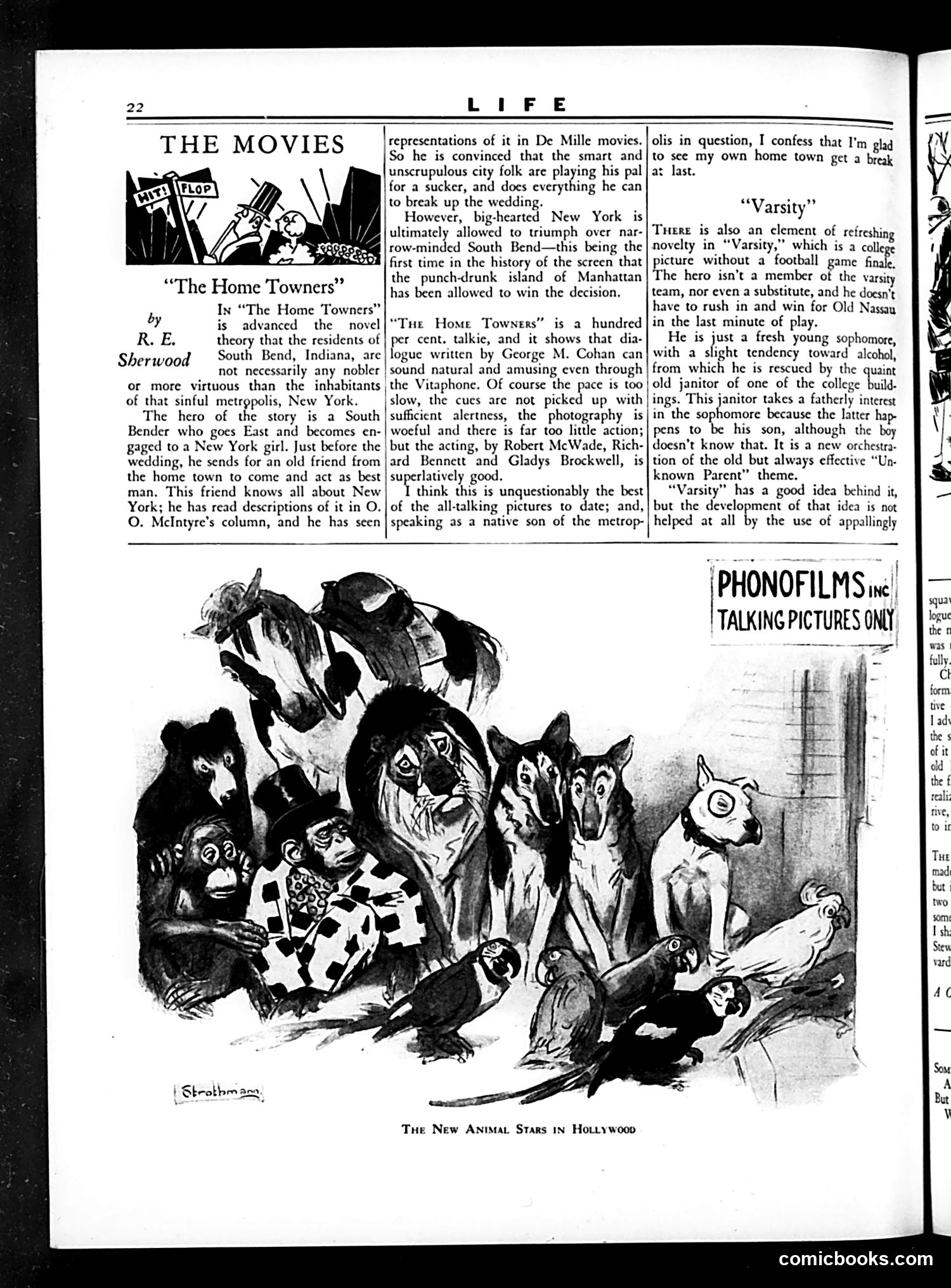
This page reviews early "talking pictures" (talkies)—films with synchronized sound, a new technology circa late 1920s. The cartoon at bottom, captioned "The New Animal Stars in Hollywood," depicts various animals wearing costume jewelry and formal dress, satirizing how the film industry was promoting animal performers as celebrities. This reflects Hollywood's novelty-driven approach to early sound films. The text reviews two movies: "The Home Towners" (praised as the best talkie yet, with dialogue by George M. Cohan) and "Varsity" (a college film without the expected climactic football game). Key context: The reviews mention O.O. McIntyre's newspaper column and Cecil B. DeMille movies—references to how Americans' perceptions of New York were shaped by media rather than direct experience. The satire gently mocks small-town prejudices about cities while grudgingly admitting New York's superiority on screen.
📄 Transcribed text from this page (OCR, searchable)
Machine-transcribed from the original scan — historical spelling and the odd misread are preserved.
22 LIFE - THE MOVIES yy “The Home Towners” In “The Home Towners” is advanced the novel R. E. theory that the residents of Sherwood South Bend, Indiana, are not necessarily any nobler or more virtuous than the inhabitants of that sinful metropolis, New York. The hero of the story is a South Bender who goes East and becomes en- gaged to a New York girl. Just before the wedding, he sends for an old friend from the home town to come and act as best man, This friend knows all about New York; he has read descriptions of it in O. O. McIntyre’s column, and he has seen by | representations of it in De Mille movies. So he is convinced that the smart and unscrupulous city folk are playing his pal for a sucker, and does everything he can to break up the wedding. However, big-hearted New York is ultimately allowed to triumph over nar- row-minded South Bend—this being the first time in the history of the screen that the punch-drunk island of Manhattan has been allowed to win the decision. “Tue Home Towners” is a hundred per cent. talkie, and it shows that dia- logue written by George M. Cohan can }sound natural and amusing even through j the Vitaphone. Of course the pace is too slow, the cues are not picked up with sufficient alertness, the photography is woeful and there is far too little action; but the acting, by Robert McWade, Rich- jard Bennett and Gladys Brockwell, is | superlatively good. I think this is unquestionably the best of the all-talking pictures to date; and, speaking as a native son of the metrop- olis in question, I confess that I'm glad to see my own home town get a break at last. “Varsity” Tuere is also an clement of refreshing novelty in “Varsity,” which is a college picture without a football game finale, The hero isn’t a member of the varsity team, nor even a substitute, and he doesn't have to rush in and win for Old Nassau in the last minute of play. He is just a fresh young sophomore, with a slight tendency toward alcohol, from which he is rescued by the quaint old janitor of one of the college build- ings. This janitor takes a fatherly interest in the sophomore because the latter hap- pens to be his son, although the boy doesn’t know that. It is a new orchestra- tion of the old but always effective “Un- known Parent” theme. “Varsity” has a good idea behind it, but the development of that idea is not helped at all by the use of appallingly / tas i 4 fi ~—Y a, | Skrothm an. cae al Tue New Animat Stars 1N HoLtywooo | PHONOFILMS ne! TALKING PICTURES ONY aes comicbooks.com