
Life, 1928-11-16 · page 12 of 44
Life — November 16, 1928 — page 12: what you’re looking at
What you’re looking at
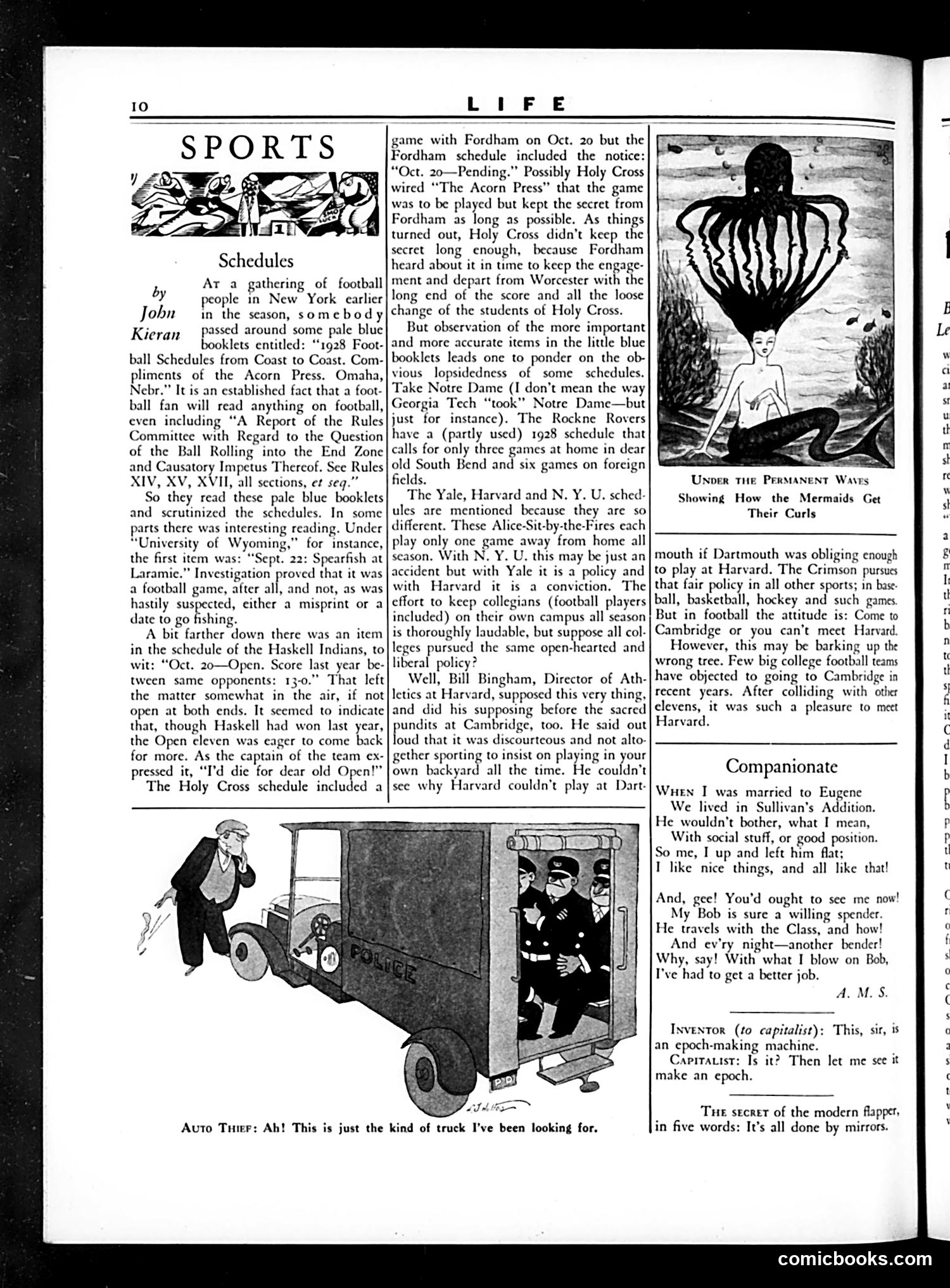
This cartoon depicts a common theft scenario of the 1920s era. A criminal is shown stealing an automobile by loading it into a covered truck—a method of vehicle theft that was apparently widespread enough to warrant satirical attention in *Life* magazine. The joke's punch line, "Ah! This is just the kind of truck I've been looking for," suggests the irony that the thief has found the perfect tool for committing his crime. The cartoon mocks both automobile theft as a growing social problem and the brazen attitude of criminals during this period. The illustration style and magazine placement suggest this reflected genuine contemporary concerns about car theft in an era when automobiles were still relatively new luxury items worth stealing.
📄 Transcribed text from this page (OCR, searchable)
Machine-transcribed from the original scan — historical spelling and the odd misread are preserved.
Ar a gathering of football people in New York earlier in the season, somebody passed around some pale blue booklets entitled: ‘1928 Foot- ball Schedules from Coast to Coast. Com- pliments of the Acorn Press. Omaha, Nebr.” It is an established fact that a foot- ball fan will read anything on football, even including “A Report of the Rules Committee with Regard to the Question of the Ball Rolling into the End Zone and Causatory Impetus Thereof. See Rules XIV, XV, XVII, all sections, et seq.” So they read these pale blue booklets and scrutinized the schedules. In some parts there was interesting reading. Under “University of Wyoming,” for instance, the first item was: “Sept. 22: Spearfish at Laramie.” Investigation proved that it was a football game, after alt and not, as was Kieran hastily suspected, either a misprint or a date to go fishing. A bit farther down there was an item in the schedule of the Haskell Indians, to wit: “Oct. 20—Open. Score last year be- tween same opponents: 13-0." That left the matter somewhat in the air, if not open at both ends. It seemed to indicate that, though Haskell had won last year, the Open cleven was eager to come back for more. As the captain of the team ex- pressed it, “I'd die for dear old Open!” The Holy Cross schedule included a LIFE game with Fordham on Oct. 20 but the Fordham schedule included the notice: “Oct. 2o—Pending.” Possibly Holy Cross wired “The Acorn Press” that the game was to be played but kept the secret from Fordham as long as possible. As things turned out, Holy Cross didn’t keep the secret long enough, because Fordham heard about it in ume to keep the engage- ment and depart from Worcester with the long end of the score and all the loose change of the students of Holy Cross. But observation of the more important and more accurate items in the little blue booklets leads one to ponder on the ob- vious lopsidedness of some schedules. Take Notre Dame (I don’t mean the way Georgia Tech “took”? Notre Dame—but just for instance). The Rockne Rovers have a (partly used) 1928 schedule that calls for only three games at home in dear old South Bend and six games on foreign fields. The Yale, Harvard and N. Y. U. sched- ules are mentioned because they are so different. These Alice-Sit-by-the-Fires each play only one game away from home all season. With N. Y. U. this may be just an accident but with Yale it is a policy and with Harvard it is a conviction, The effort to keep collegians (football players included) on their own campus all season is thoroughly laudable, but suppose all col- leges pursued the same open-hearted and liberal policy? Well, Bill Bingham, Director of Ath- letics at Harvard, supposed this very thing, and did his supposing before the sacred pundits at Cambridge, too. He said out oud that it was discourtcous and not alto- gether sporting to insist on playing in your own backyard all the time. He couldn't sec why Harvard couldn't play at Dart- Auto Tuer: Ah! This is just the kind of truck I’ve been looking for. Unper THe PERMANENT Waves Showing How the Mermaids Get Their Curls mouth if Dartmouth was obliging enough to play at Harvard. The Crimson pursues that fair policy in all other sports; in base- ball, basketball, hockey and such games. But in football the attitude is: Come to Cambridge or you can’t mect Harvard. However, this may be barking up the wrong tree. Few big college football teams have objected to going to Cambridge in recent years. After colliding with other elevens, it was such a pleasure to mect Harvard, Companionate Wuen I was married to Eugene We lived in Sullivan’s Addition. He wouldn't bother, what I mean, With social stuff, or good position. So me, I up and left him flat; I like nice things, and all like that! And, gee! You'd ought to see me now! My Bob is sure a willing spender. He travels with the Class, and how! And ev'ry night—another bender! Why, say! With what I blow on Bob, I've had to get a better job. A. M. S. Inventor (to capitalist): This, sir, is an epoch-making machine. Caprrauist: Is it? Then let me see it make an epoch. Tue secret of the modern flapper, in five words: It’s all done by mirrors. comicbooks.com