
Life, 1928-11-16 · page 28 of 44
Life — November 16, 1928 — page 28: what you’re looking at
What you’re looking at
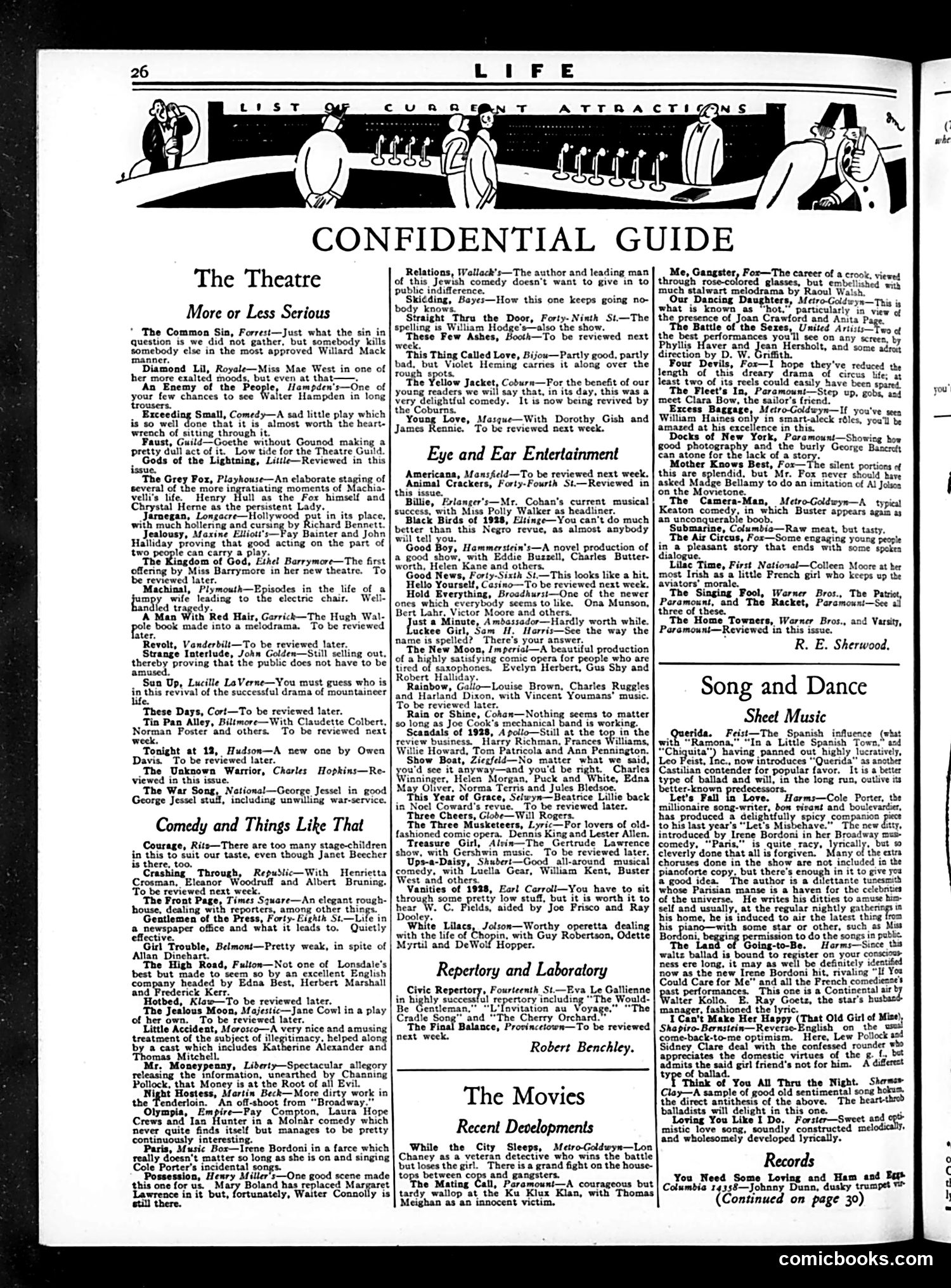
This page is a **theater review guide**, not a political cartoon. It's a "Confidential Guide" listing current Broadway productions with brief, often sarcastic critiques. The humor is theatrical criticism rather than political satire. Examples of the satirical tone include: - **"Diamond Lil"** (Mae West): Dismissive mid-sentence ("but even at that—") - **"Strange Interlude"**: Mocked for selling out despite being boring ("proving that the public does not have to be amused") - **"Faust"**: Criticized as "pretty dull" staging of Goethe - **"The War Song"** (George Jessel): Described as "unwilling war-service" The reviews employ typical 1920s-era Life magazine wit—backhanded compliments and cynicism about Broadway's commercial nature. The satire targets theatrical pretension and audience taste rather than politics or social issues. The page also includes sections on **movies, music, and recordings**, making it an entertainment roundup rather than political commentary.
📄 Transcribed text from this page (OCR, searchable)
Machine-transcribed from the original scan — historical spelling and the odd misread are preserved.
CONFIDENTIAL GUIDE The Theatre More or Less Serious * The Common Sin, Forrest—Just what the sin in question is we did not gather, but somebody kills somebody else in the most approved Willard Mack manner. Diamond Lil, Royale—Miss Mae West in one of her more exalted moods, but even at that—. Enemy of the People, Hampden's—One of your few chances to see Walter Hampden in long trousers. _ Exceeding Small, Comedy—A sad little play which is so well done that it is almost worth the heart- wrench of sitting through it. Faust, Guild—Goethe without Gounod making a pretty dull act of it. Low tide for the Theatre Guild. | Gods of the Lightning, Litt—Reviewed in this issue. The Grey For, Playhouse—An elaborate staging of several of the more ingratiating moments of fae ia velli's life. Henry Hull as the Fox himself and thrystal Herne as the persistent Lady. Jarnegan, Longacre—Hollywood put in its place, with much hollering and carne, by Richard Bennett. Jealousy, Maxine Eltiott's—Pay Bainter and John Halliday proving that good acting on the pait of two The offering by Miss Barrymore in her new theatre. be reviewed later. . . Machinal, Plymouth—Episodes in the life fompy trie leading to t ‘A le can carry a play. ingdom of God, Ethel Barrymore—The Srst ‘0 of a je electric chair, W. led tragedy. Man With Red Hair, Garrich—The Hugh Wal- Pole, book made into a melodrama, To be reviewed ater. ts Revolt, Vanderbilt—To be reviewed later. Strange Interlude, John Golden—Still selling out, thereby proving that the public does not have to be amused. Sun Up, Lucille LaVerne—You must guess who is in this revival of the successful drama of mountaineer fc. These Days, Cor!—To be reviewed later. Tin Pan Alley, Bilimore—With Claudette Colbert, Norman Poster and others, To be reviewed next week. Tonight at 12, Hudson—A new one by Owen Davis. To be reviewed later. The Unknown Warrior, Charles Hopkins—Re- viewed in this issue. The War Song, National—George Jessel in good George Jessel stuf, including unwilling war-service. Comedy and Things Like That Courage, Rits—There are too many stage-children in this to suit our taste, even though Janet Beecher is there, too. Crashing Through, Crosman, Eleanor ‘To be reviewed next week. The Front Page, Times Square—An elegant rough- house, dealing with reporters, among other things. Gentle: Press, Forty- Eighth St.—Life in a newspaper office and what it leads to, Quietly effective. Girl Trouble, Belmoni—Pretty weak, in spite of Allan Dinehart. The High Road, Fulton—Not one of Lonsdale's best but made to seem so by an excellent English company headed by Edna Best, Herbert Marshall and Frederick Kerr. . Hotbed, Kisw—To be reviewed later. The Jealous Moon, Majestic—Jane Cowl in a play of her own. To be reviewed later. _ Little Accident, Morosco—A very nice and amusing treatment of the subject of illegitimacy, helped along by a cast which includes Katherine Alexander and Min Moncypes Lib Si 1. Mh it, Moneypenny, Liberty—Spectacular allegory releasing the Intormation, unearthed by Channing Pollock, that Money is at the Root of all Evil. Night Hostess, Martin Beck—More dirty work in the Tenderloin. An off-shoot from “Broadway.” Olympia, Empire—Pay Compton, Laura Hope Crews and Ian Hunter in a Molndr comedy which never quite finds itself but manages to be pretty continuously interesting. : s ic Box—Irene Bordoni in a farce which really doesn't matter so long as she is on and singing Cole Porter's incidental songs. Possession, Henry Miller's—One good scene made quis one for us. Mary Boland has replaced Margaret Lawrence in it but, fortunately, Waiter Connolly is still there. RepuSlic—With Henrietta @ and Albert Bruning. Relations, Wallack’s—The author and leading man of this Jewish comedy doesn’t want to give in to public indifference. Ski¢ding, Bayes—How this one keeps going no- body knows, Straight Thru the Door, Forty-Ninth St.—The spelling is William Hodge’s—also the show. These Few Ashes, Booth—To be reviewed next week. This Thing Called Love, Bijow—Partly good, partly bad, but Violet Heming’ carries it along over the rough spots. ‘The Yellow Jacket, Coburn—Por the benefit of our young readers we will say that, in its day, this was a very delightful comedy. It is now being revived by the Coburns. Young Love, Masgue—With Dorothy Gish and James Rennie.’ To be reviewed next week. Eye and Ear Entertainment Americana, Mansfeld—To be reviewed next week. Animal Crackers, Forty-Fourth St.—Reviewed in this issue. ; Billie, Erlanger's—Mr. Cohan’s current musical success, with Miss Polly Walker as headliner. Black Birds of 1928, Elsinge—You can't do much better than this Negro revue, as almost anybody will tell you, Good Boy, Hammerstcin's—A novel production of a good show, with Eddie Buzzell, Charles Butter- worth, Helen Kane and others. . Good News, Forty-Sixth St—This looks like a hit. Hello Yourself, Casino—To be reviewed neat week. Hold Everything, Broadhurst—One of the newer ones which everybody seems to like. Ona Munson, Bert Lahr, Victor Moore and others. just a Minute, Ambassador—Hardly worth while. uckee Girl, Som H, Horris—See the way the name is spelled? There's your answer. The New Moon, /mperiai—A beautiful production of a highly satisfying comic opera for people who are tired of saxophones, Evelyn Herbert, Gus Shy and Robert, Halliday. : Rainbow, Gallo—Louise Brown, Charles Ruggles and Harland Dixon, with Vincent Youmans’ music. To be reviewed later. Rain or Shine, Cohen—Nothing seems to matter 80 long as Joe Cook's mechanical band is working. Scandals of 1928, A pollo—Still at the top in the review business. Harry Richman, Frances Williams, Willie Howard, Tom Patricola and Ana Pennington. Show Boat, Ziesfeld—No matter what we said, you'd. sce it anyway—and you'd be right. Charles Winninger, Helen Morgan, Puck and White, Edna May Oliver, Norma Terris and Jules Bledsoe. “This Year of Grace, Selwyn—Beatrice Lillie back in Noel Coward's reve. To be reviewed later. Three Cheers, Globe—Will Rogers. The Three Musketeers, Lyric—Por lovers of old- fashioned comic opera. Dennis King and Lester Allen. Treasure Girl, Alrin—The Gertrude Lawrence show, with Gershwin music, To be reviewed later. Ups-a-Daisy, Shuberi—Good all-around musicai comedy, with ‘Luella Gear, William Kent, Buster West and others Vanities of 1928, Ear! Carroll—You have to sit through some pretty low stuff, but it is worth it to hear |W. C. Fields, aided by‘ Joe Frisco and Ray ooley. White Lilacs, Jolson—Worthy operetta dealing with the life of Exopin. with Guy Robertson, Odette Myrtil and DeWolf Hopper. Repertory and Laboratory Civic Repertory, Fourteenth St.—Eva Le Gallienne in highly successful repertory including “The Would- Be Gentleman. ‘Invitation au Voyage,” “The Cradle Song” and “The Cherry Orchard.” The Fi Balance, Provincetown—To be reviewed next week. Robert Benchley. The Movies Recent Developments While the City Sleeps, Metro-Goldwyn—Lon Chaney as a veteran detective who wins the battle but loses the girl. There is a grand fight on the house- om between cops and gangsters. he Mating Call, Paramount—A courageous but tardy wallop at the Ku Klux Klan, with Thomas Meighan as an innocent victim, Me, Gangster, For—The career of a croo' through rose-colored glasses, but embellaked ent much stalwart melodrama by Raoul Walsh, Our Dancing Daughters, Metro-Goldwyn—This i what is known as ‘hot.”’ particularly in vee @ the presence of Joan Crawford and Anita Page @ Battle of the Sexes, United Artists Teo of the best performances youl see on any screen, ty yilis Haver and Jean olt, ditetion by B. W. Enh " sae soe wea ‘our Devils, Fox—| 10} ‘ length. of this dreary drama ef Crees inks ot east two of ita resis, could easily have been spared @ Fleet's In, Paramount—St. 12. mest Clara Bow, the sailor's triends Sos sad cess Baggage, Mciro-Goldwyn—If you've sea William Haines only in smart-alcek 01 amazed at his excellence in thie seReR TORT Se of New York, Paramount—Showicg how good photography and the burly George Basch fan atone for the lack ofa story. Mother Knows Best, For The silent portions of this are splendid. but” Mr. For never sould bare asked Madge Bellamy to do an imitation of Al Joss n,the Movietone 17 je Camera-Man, Metro-Goldwyn—A typical Keaton comedy, in which Buster appears agate an unconquerable boob. pears ea os Submarine, Columbio—Raw meat, but tasty. __ The Air Circus, Fos—Some engaging young people in a pleasant story that ends with some Spokes dialogue. Lilac Time, First National—Colleen Moore at ber most Irish as a little Prench girl who keeps up the “The ‘Singing Fool, Warner Brot., The P e |. Werner Bros., The Patrict, Paramount, and The Racket, Poramount—See a1 three of thse. ‘arn e Home Towners, Warner Bros., and Varsity, Poromount—Reviewed in this issue. “ R. E. Sherwood, Song and Dance Sheet Music Querida. Feist—The Spanish influence (what with “Ramona,” “In a Little Spanish Town,” and rohigate) having panned out highly lucratively, Leo Feist, Inc., now introduces “Querida” as another Castilian contender for popular favor. It is a better type of ballad and will, in the long run, outlive its better-known predecessors. Let's Fall In Love. Harms—Cole Porter, the millionaire song-writer, box virant and boulevanter, has produced a delightfully spicy companion Bs to his last year's “Let's Misbehave.” The new ditty, introduced by Irene Bordoni in her Broadway mu- comedy, “Paris,” is quite racy, lyrically, but cleverly done that all is forgiven. ry of the extra choruses done in the show are not included io the of the universe. He writes his ditties to amuse hin- self and usually, at the regular nightly gatherings i his home, he is induced to air the latest thing from his piano—with some star or other, such as Mis Bordoni, permission to do the songs in publ. The Lan Going-to-Be. Harms—Since ths waltz ballad is bound to register on your conscious ness ere long, it may as well be definitely identified now as the new Irene Bordoni hit, rivaling “If You Could Care for Me” and all the Prench comediense’s st performances. This one is a Continental air alter Kollo. E. Ray Goetz, the star's hus manager, fashioned the lyric. 1 Can't Make Her Happy (That Old Girl of Mize), Shapiro-Bernstein—Reverse-English_ on the css) come-back-to-me optimism. Here, Lew Pollock sa4 Sidney, Clare deal with, the. confessed pounder io appreciates t! lomestic virtues the g. f admits the said girl friend's not for him. A differest type of ballad. ect ytt Tree Me See y—A sample of old sentimental song the direct antithesis of the above. The heart-thr> balladists will delight in this one. 4 Loving You Like I Do. Forster—Sweet a mistic love song, soundly constructed mel and wholesomely developed lyrically. Records You Need So: Le 4 Ham and Eos Colimbie tyysdejohany Dune, dusky teampet (Continued on page 30) comicbooks.com Po poi, Pen