
Life, 1928-11-16 · page 26 of 44
Life — November 16, 1928 — page 26: what you’re looking at
What you’re looking at
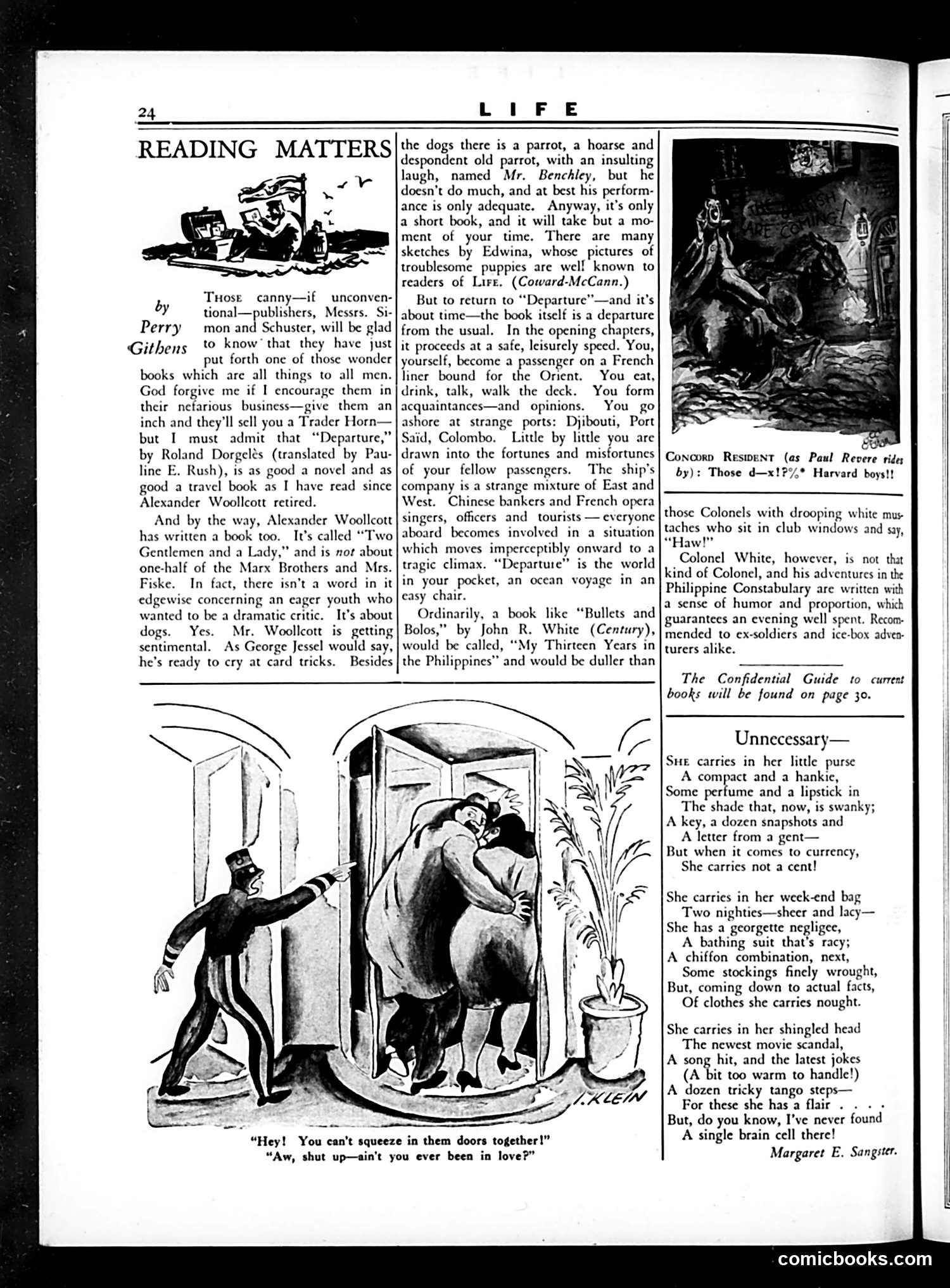
This page from *Life* magazine contains book reviews and satirical humor typical of the 1920s literary culture. **"Reading Matters" Column (by Perry Githens):** Reviews new books including Roland Dorgelés's *Departure* (a novel/travel book about a French ocean liner voyage) and Alexander Woollcott's *Two Gentlemen and a Lady* (a humorous book about dogs, featuring a parrot mockingly named "Mr. Benchley"). **Cartoon:** The lower illustration satirizes urban overcrowding on public transportation or in elevators—a common modern inconvenience. The man's defensive response ("ain't you ever been in love?") jokes that close quarters might be romantically excusable. **"Unnecessary" Poem (by Margaret E. Sangster):** Gentle satire on women's excessive packing: women carry frivolous items (cosmetics, clothes, gossip, dance steps) but paradoxically carry no actual money. This reflects 1920s attitudes about women's materialism and financial dependency. The page captures upper-class literary interests and gentle social commentary typical of *Life's* educated readership.
📄 Transcribed text from this page (OCR, searchable)
Machine-transcribed from the original scan — historical spelling and the odd misread are preserved.
24 LIFE READING MATTERS Tuose canny—if _unconven- tional—publishers, Messrs. Si- Perry mon and Schuster, will be glad Githens ‘© know’ that they have just put forth one of those wonder books which are all things to all men. God forgive me if I encourage them in their nefarious business—give them an inch and they'll sell you a Trader Horn— but I must admit that “Departure,” by Roland Dorgelés (translated by Pau- line E. Rush), is as good a novel and as good a travel book as I have read since Alexander Woollcott retired. And by the way, Alexander Woollcott has written a book too. It’s called “Two Gentlemen and a Lady,” and is not about one-half of the Marx Brothers and Mrs. Fiske. In fact, there isn’t a word in it edgewise concerning an eager youth who wanted to be a dramatic critic. It’s about dogs. Yes. Mr. Woollcott is getting sentimental. As George Jessel would say, he’s ready to cry at card tricks. Besides the dogs there is a parrot, a hoarse and despondent old parrot, with an insulting laugh, named Mr. Benchley, but he doesn’t do much, and at best his perform- ance is only adequate. Anyway, it’s only a short book, and it will take but a mo- ment of your time, There are many sketches by Edwina, whose pictures of troublesome puppies are wel! known to readers of Lire. (Coward-McCann.) But to return to “Departure’’—and it’s about time—the book itself is a departure from the usual. In the opening chapters, it proceeds at a safe, leisurely speed. You, yourself, become a passenger on a French liner bound for the Orient. You cat, drink, talk, walk the deck. You form acquaintances—and opinions. You go ashore at strange ports: Djibouti, Port Said, Colombo. Little by little you are drawn into the fortunes and misfortunes of your fellow passengers. The ship's company is a strange mixture of East and West. Chinese bankers and French opera singers, officers and tourists — everyone aboard becomes involved in a situation which moves imperceptibly onward to a tragic climax. “Departure” is the world in your pocket, an ocean voyage in an easy chair. Ordinarily, a book like “Bullets and Bolos,” by John R. White (Century), would be called, “My Thirteen Years in the Philippines” and would be duller than “Hey! You can’t squeeze in them doors together!” “Aw, shut up—ain’t you ever been in love?” Conoorp Reswwent (as Paul Revere rides by): Those d—x!?%,* Harvard boys!! those Colonels with drooping white mus taches who sit in club windows and say, “Haw!” Colonel White, however, is not that kind of Colonel, and his adventures in the Philippine Constabulary are written with a sense of humor and proportion, which guarantees an evening well spent. Recom- mended to ex-soldiers and ice-box adven- turers alike. The Confidential Guide to current books will be found on page 30. Unnecessary — | Sue carries in her little purse A compact and a hankie, Some perfume and a lipstick in The shade that, now, is swanky; A key, a dozen snapshots and A letter from a gent— But when it comes to currency, She carries not a cent! She carries in her week-end bag Two nighties—sheer and lacy— She has a georgette negligee, A bathing suit that’s racy; A chiffon combination, next, | Some stockings finely wrought, | But, coming down to actual facts, | Of clothes she carries nought. | She carries in her shingled head | The newest movie scandal, A song hit, and the latest jokes (A ‘it too warm to handle!) | A dozen tricky tango steps— For these she has a flair . . - + But, do you know, I’ve never found A single brain cell there! Margaret E. Sangster. comicbooks.com