
A complete issue · 40 pages · 1928
Life — October 19, 1928
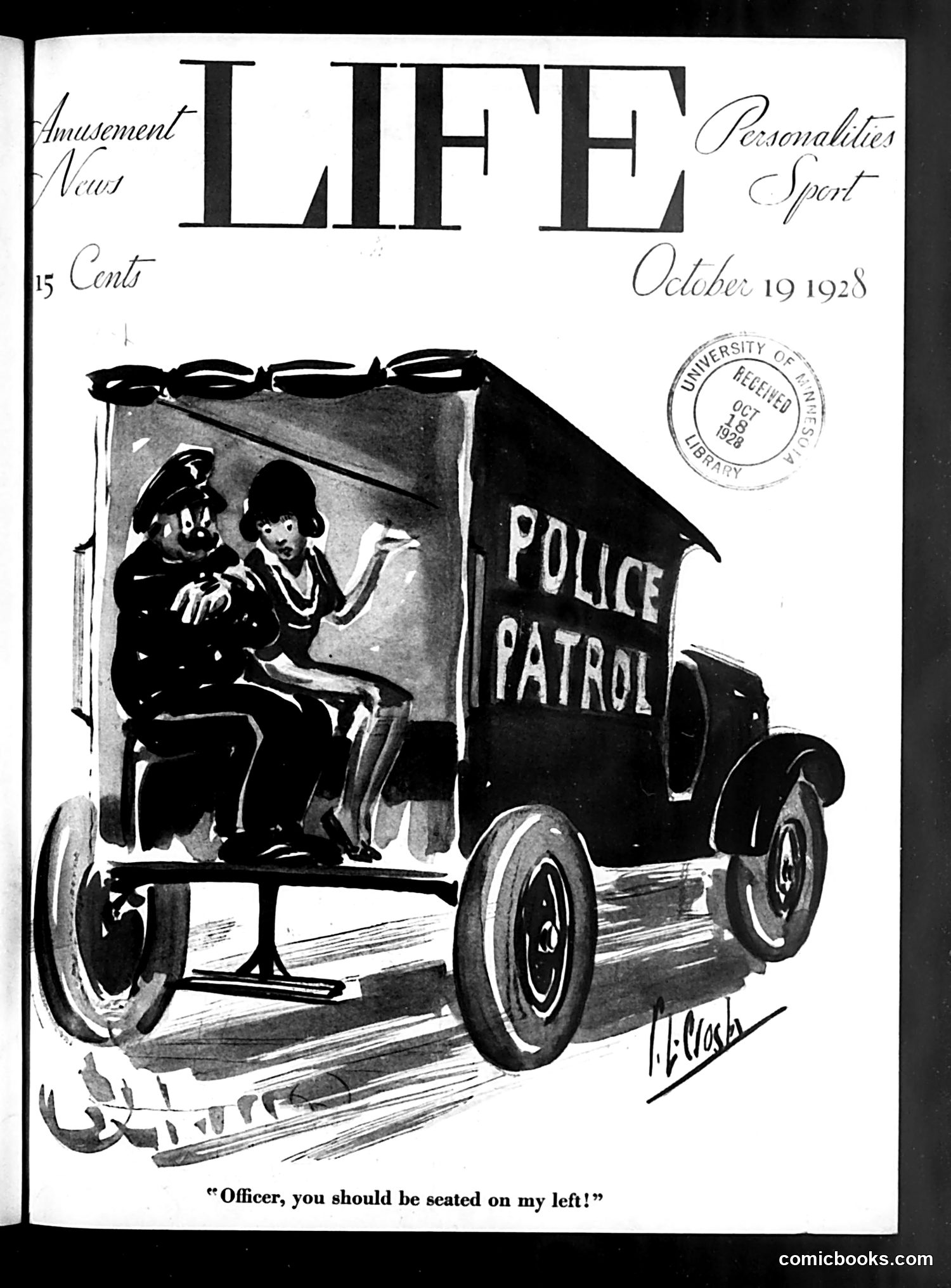
This is a humorous cover illustration depicting a police patrol vehicle with two figures inside—apparently a police officer and a woman passenger. The woman's caption reads, "Officer, you should be seated on my left!" The joke appears to reference 1920s social etiquette and gender dynamics. The woman is directing the officer on proper seating arrangements, inverting the expected power dynamic where an officer would give orders. This satirizes contemporary debates about changing social conventions and women's increased independence during the Jazz Age and post-suffrage era. The "Police Patrol" vehicle itself may reference Prohibition-era law enforcement, a major political issue in 1928. The humor lies in the woman's audacious attempt to control the authority figure through social protocol.
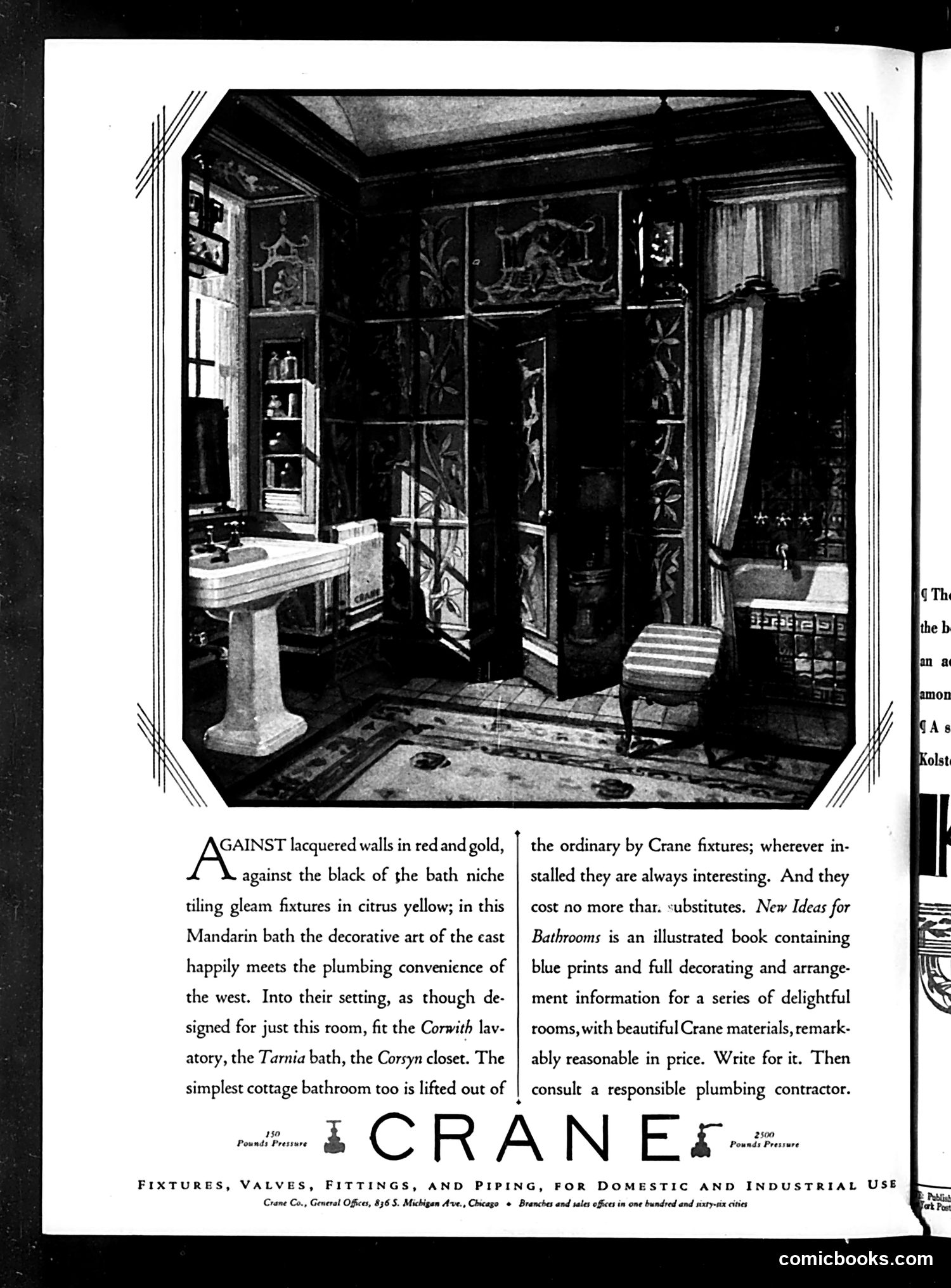
This is **not a political cartoon or satirical content**—it's a straightforward **advertisement for Crane plumbing fixtures**, circa early-to-mid 20th century. The image shows a luxurious bathroom display featuring the "Mandarin" design style, with lacquered walls in red and gold, decorative Asian-inspired panels, and yellow-tinted fixtures. The ad text describes Crane's bathroom products (the Corwith lavatory, Tamia bath, Corryn closet) as affordable alternatives to expensive custom design. The copy emphasizes that quality plumbing fixtures "cost no more than substitutes" and promotes an illustrated book, *New Ideas for Bathrooms*, encouraging readers to consult professional contractors. This is a standard luxury goods advertisement, not satire.
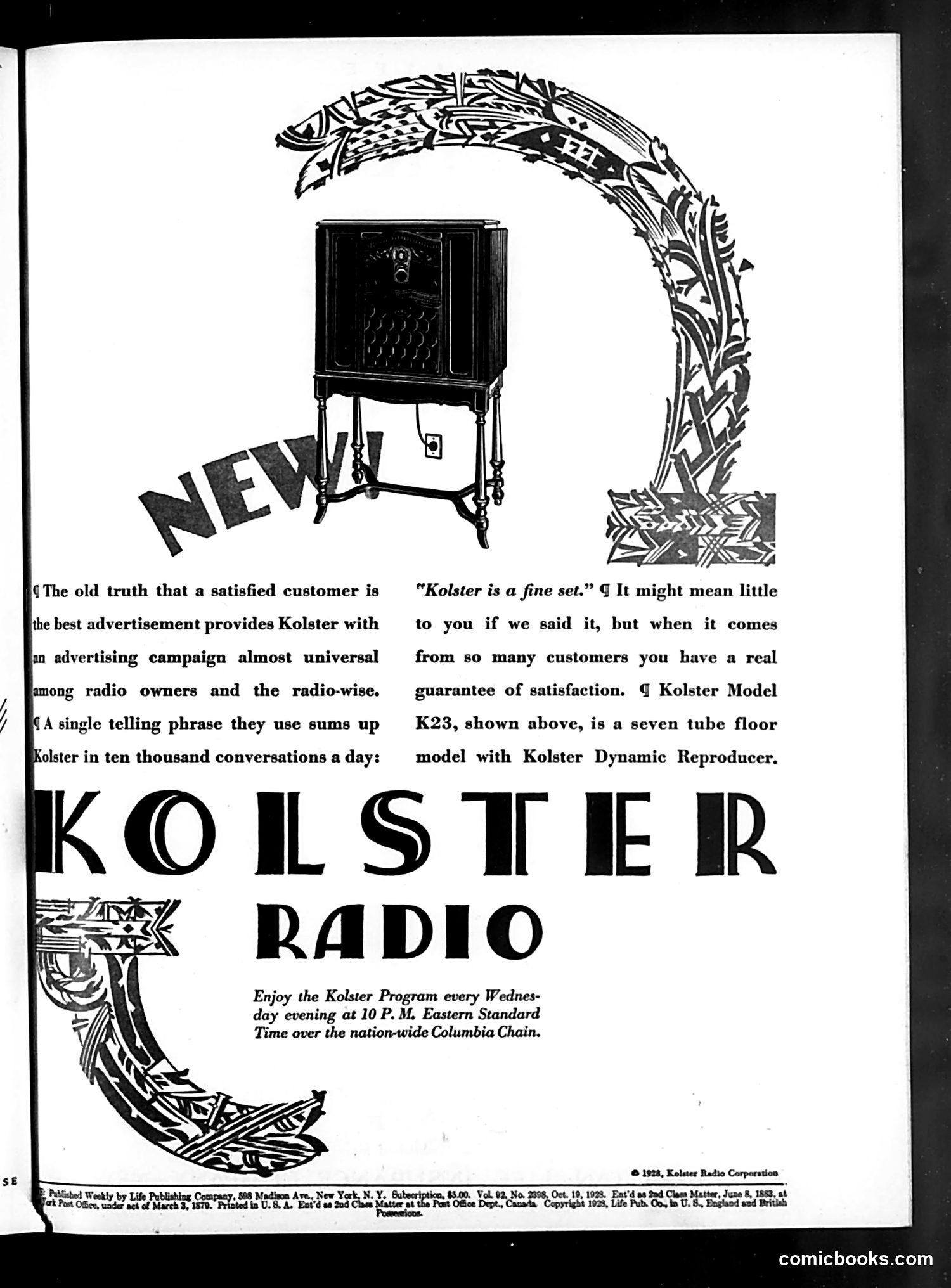
This page is primarily a **product advertisement**, not political satire. It promotes the Kolster Model K23 radio, a seven-tube floor model with "Dynamic Reproducer." The ad employs **decorative Art Deco framing** (the ornamental curved borders) typical of 1920s design. The key marketing message: "Kolster is a fine set" — emphasizing that satisfied customers provide the best advertising through word-of-mouth recommendation. The advertisement highlights that the Kolster Program airs **Wednesday evenings at 10 P.M. Eastern Standard Time over the nation-wide Columbia Chain**, positioning radio programming itself as a product feature. The ornate lettering and styling reflect the **modernist aesthetic** popular during this era of early radio manufacturing and consumer marketing.
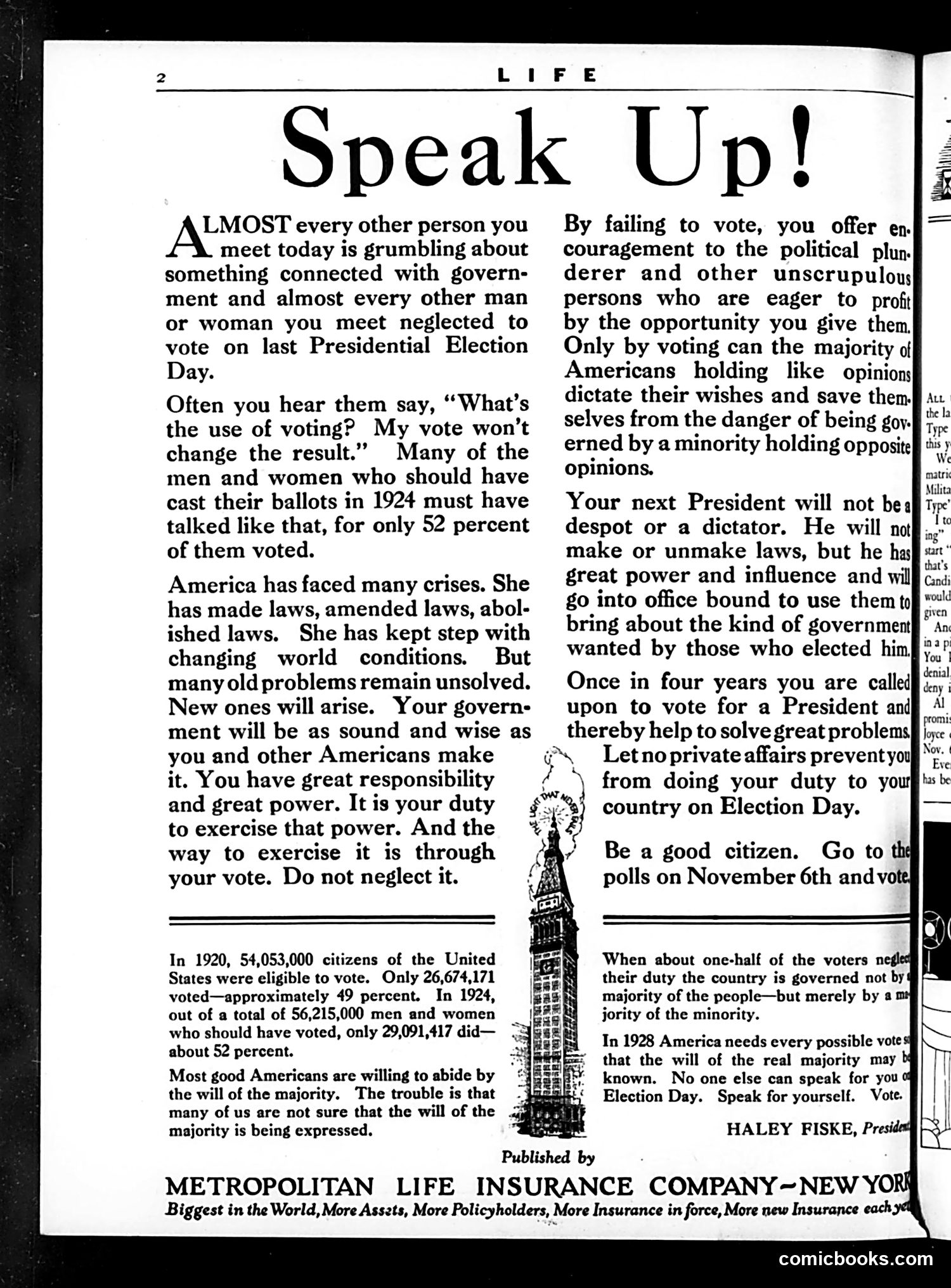
This is a **public service advertisement**, not satire. Published by Metropolitan Life Insurance Company, it urges Americans to vote in the 1928 presidential election (November 6th). The **central image is the Statue of Liberty**, symbolizing democratic duty and American citizenship. **The argument:** Only 49% of eligible voters participated in 1920. The text shames non-voters, claiming that low turnout allows unscrupulous politicians to seize power. It warns that "one-half of the voters" allowing a minority to govern is dangerous—the majority's will becomes unrepresented. The piece frames voting as a civic **responsibility and patriotic obligation**, not merely a right. It's essentially a "get out the vote" campaign emphasizing that democracy requires participation.
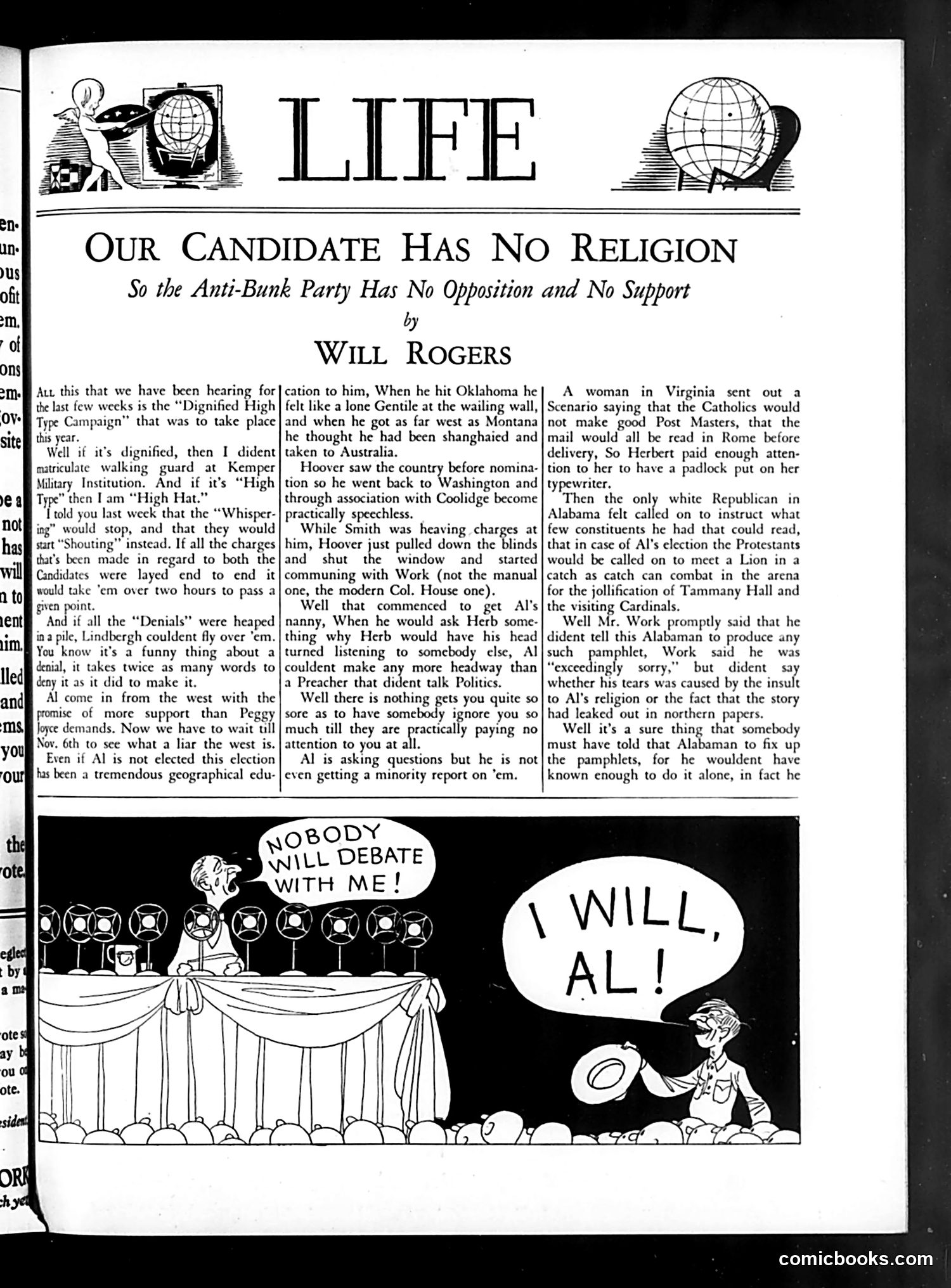
This 1920s-era Life magazine page by Will Rogers satirizes the Anti-Bank Party's presidential candidate, who Rogers notes has "no religion." Rogers uses this absurdity to argue the party lacks any real platform or distinction—religion being a political litmus test of that era. The accompanying cartoon mocks the candidate's weakness: at a debate podium, he declares "Nobody will debate with me!" while a heckler responds "I will, Al!"—likely referencing Al Smith, a prominent Democratic politician of the period. Rogers's satire suggests the candidate is so unremarkable and powerless that even opponents won't engage him seriously. The humor hinges on the embarrassment of a politician unable to attract legitimate political opposition or debate.
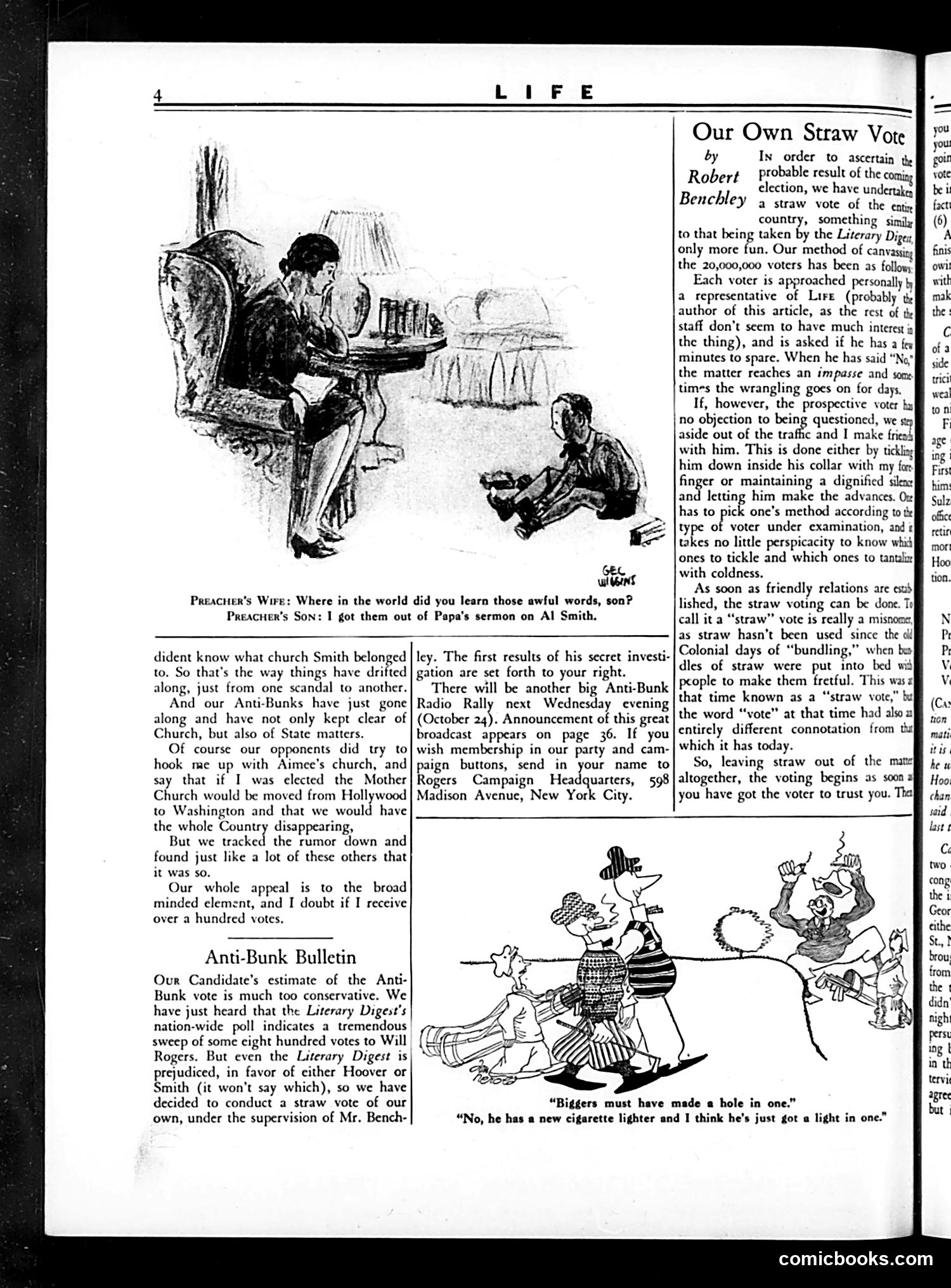
**Top Cartoon:** Shows a preacher's wife asking her son where he learned "awful words," and he replies he got them from "Papa's sermon on Al Smith." This references Al Smith, the 1928 Democratic presidential candidate. The joke satirizes how religious figures' political attacks on Smith (likely regarding his Catholicism) contained harsh language that children were repeating. **"Our Own Straw Vote" Article:** Life magazine conducted a humorous nationwide poll by personally asking 20 million voters their voting preference for the upcoming election. The article describes their methodology for canvassing voters. **Bottom Cartoon:** The joke about "Bidgers" making a hole and the cigarette lighter/hole reference appears to be wordplay-based humor, though the precise meaning is unclear without additional context.
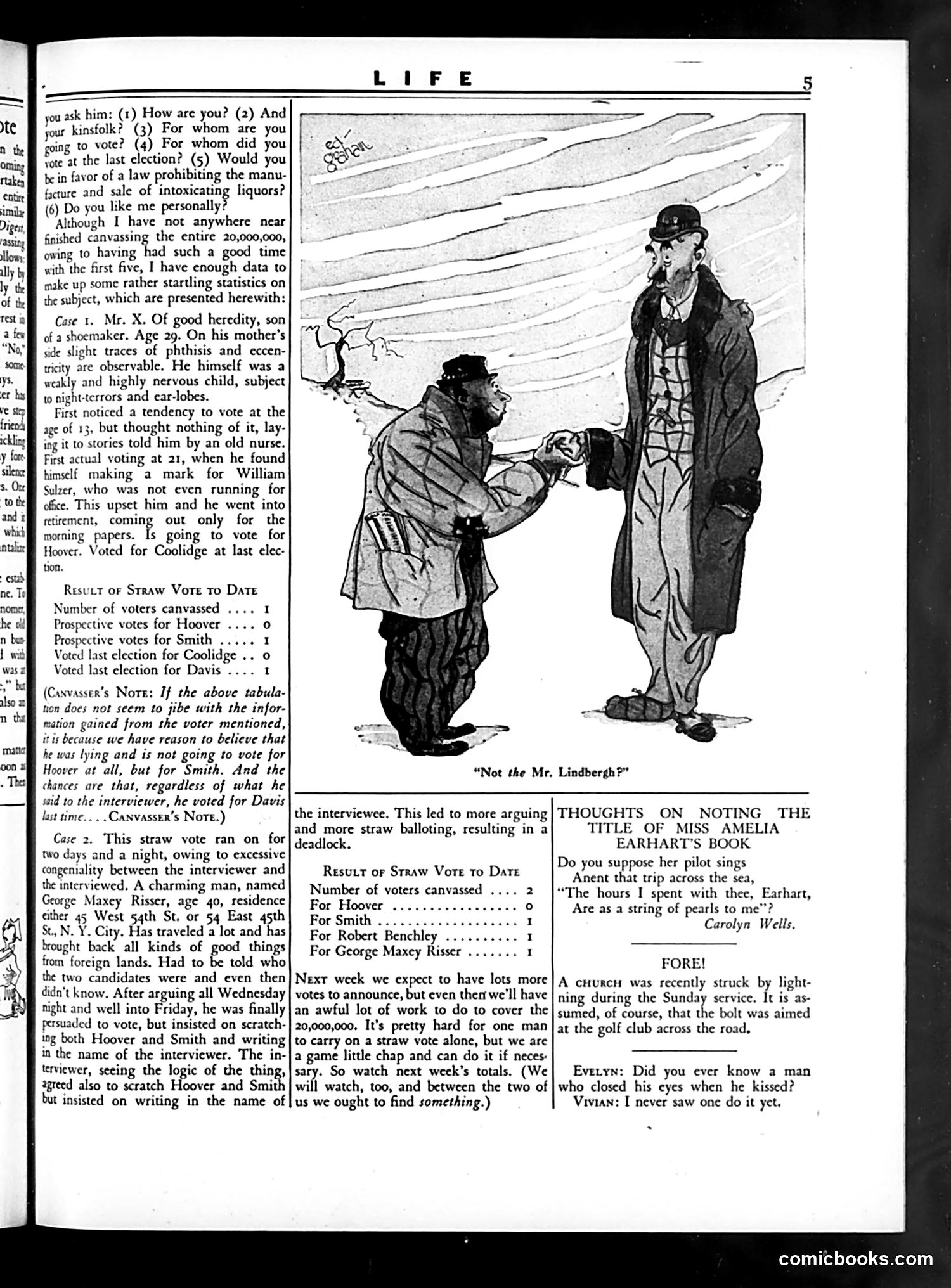
This cartoon illustrates a humorous encounter between two men, with the caption asking "Not the Mr. Lindbergh?" The joke appears to reference Charles Lindbergh's fame following his 1927 transatlantic flight. One figure seems to be a working-class or shabby character confronting what may be a more distinguished-looking gentleman, suggesting a case of mistaken identity or the absurdity of encountering a celebrity unexpectedly. The cartoon satirizes the phenomenon of celebrity recognition in modern America—how a famous person might be approached by ordinary citizens, or conversely, how someone might be mistaken for a famous person. This reflects 1920s cultural fascination with aviation heroes and popular celebrity worship that characterized the era.
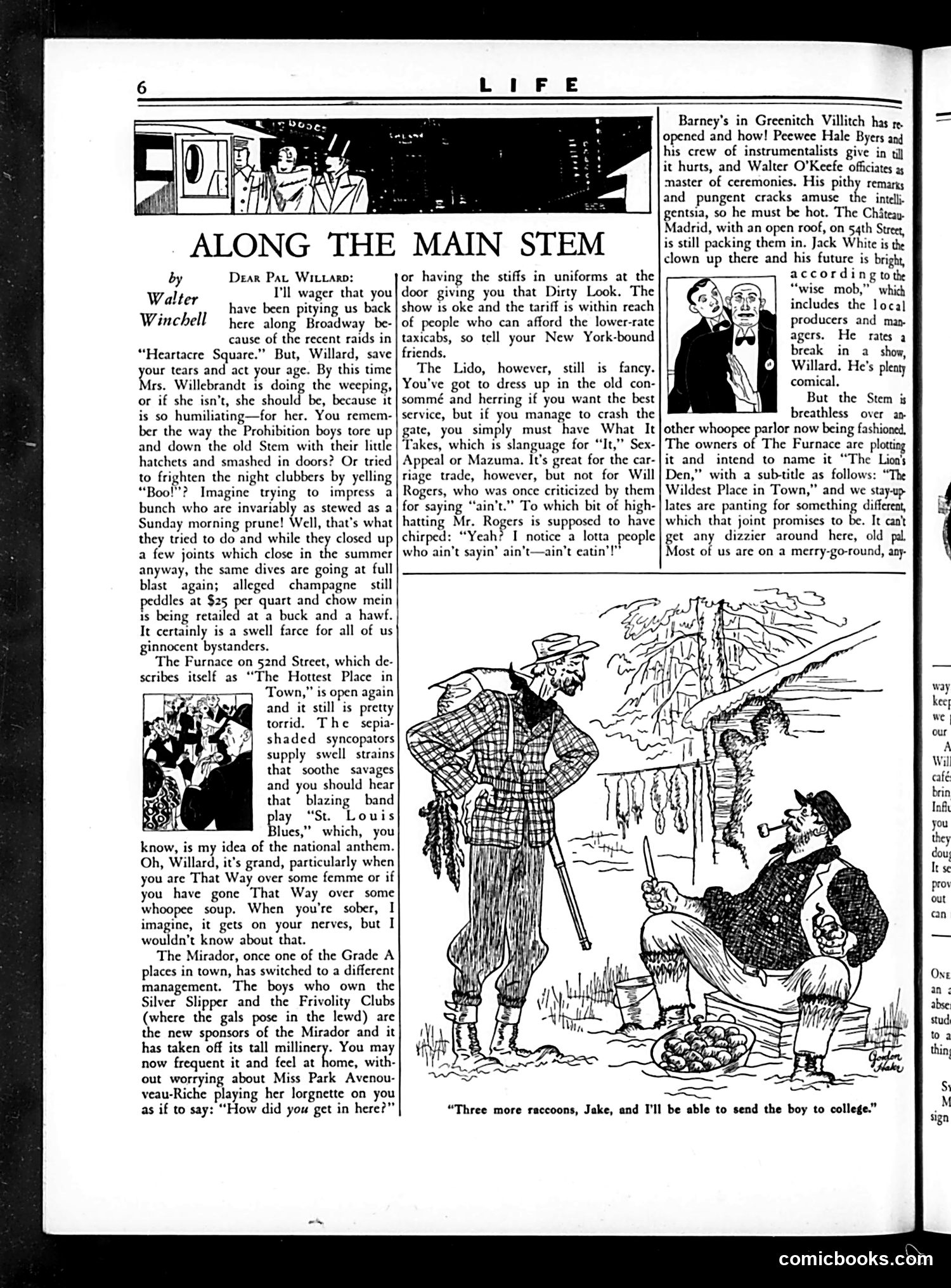
This is a satirical column by Walter Winchell discussing New York nightlife and entertainment venues. The text references: - **"Heartache Soup"** at a nightclub where Mrs. Willebrandt (likely referring to Mabel Walker Willebrandt, Prohibition enforcement official) is mentioned, connecting nightclub culture to Prohibition enforcement raids. - **The Lido and Furnace** — competing nightclubs competing for clientele with different entertainment offerings. - **"The Mirador"** — a Grade A establishment that switched management, now sponsored by the "Silver Slipper" and "Frivolity Club." The accompanying cartoon shows a rural figure (possibly representing a bootlegger or moonshiner) telling another that "Three more raccoons, Jake, and I'll be able to send the boy to college"—likely satirizing how Prohibition created profitable criminal enterprises that even rural figures benefited from financially.
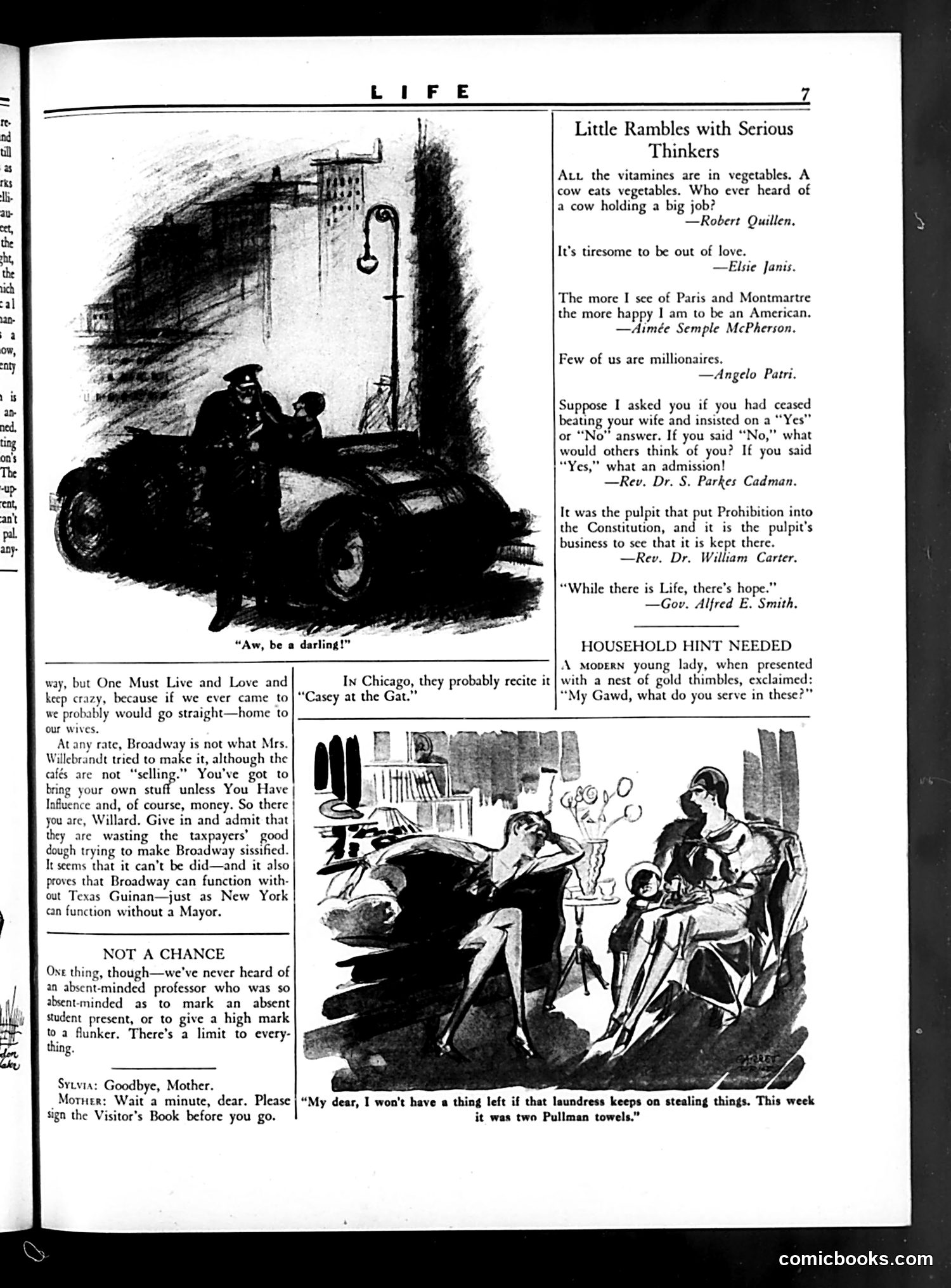
This page from *Life* magazine contains two separate satirical pieces: **Top cartoon** ("Aw, be a darling!"): Shows a man and woman in a car beneath a gallows. The joke appears to reference marital coercion—the woman is pressuring the man to do something dangerous or illegal, hence the gallows imagery. The satire targets romantic relationships where one partner manipulates the other. **Bottom cartoon** ("Household Hint Needed"): Depicts a wealthy woman complaining to guests that her laundress keeps stealing items—this week, two Pullman towels. The satire mocks upper-class complaints about servant theft while casually referencing expensive railroad (Pullman) linens, suggesting the woman's obliviousness to her own extravagance. Both pieces use humor to critique social hypocrisy and gender dynamics of the era.
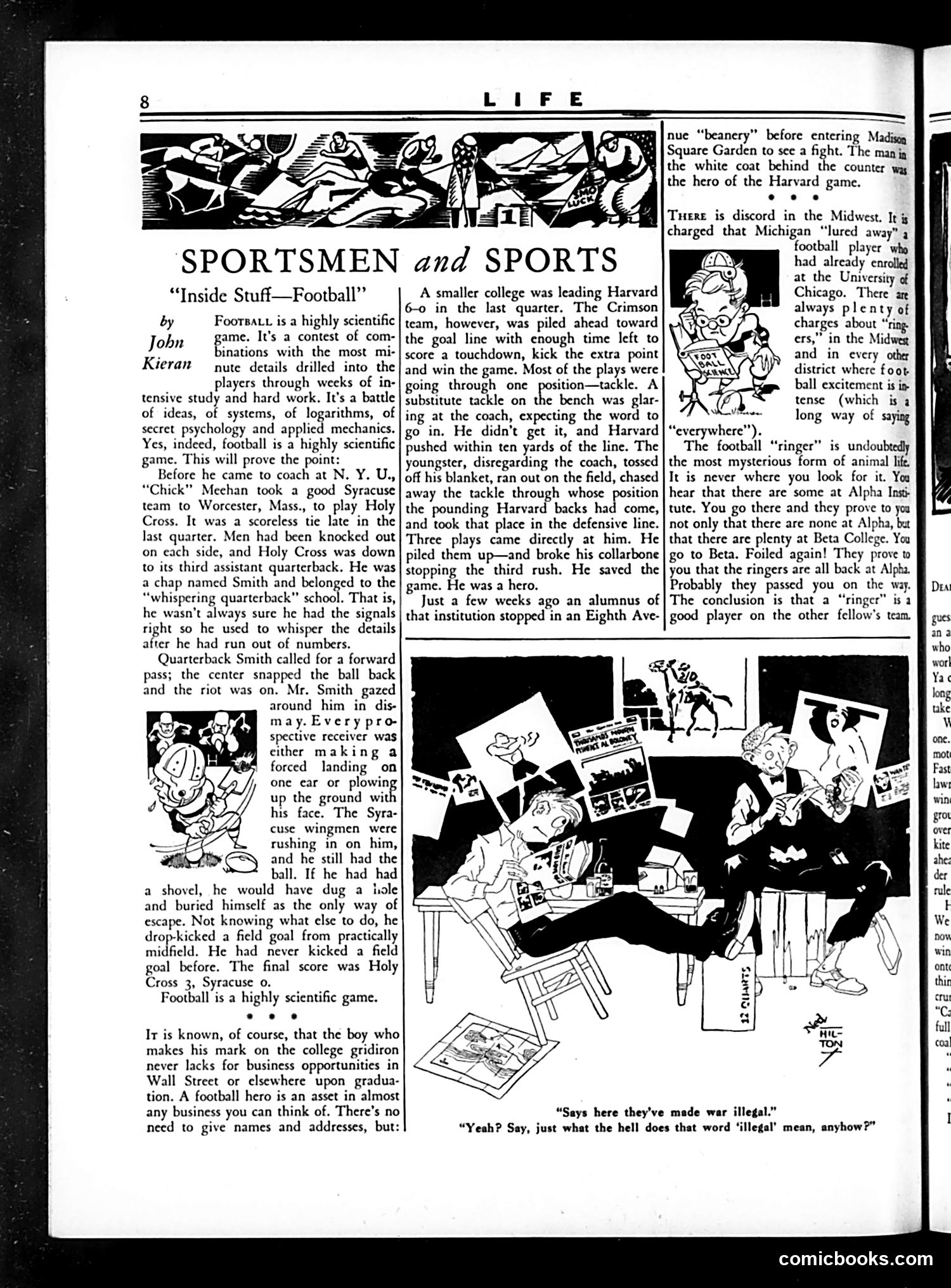
This page contains an article by John Kieran about football titled "Inside Stuff—Football," accompanied by illustrations and a cartoon. The main cartoon depicts two men in an office setting examining what appears to be sports-related documents and photographs spread across furniture. One figure says "Says here they've made war illegal," to which the other responds "Yeah? Say, just what the hell does that word 'illegal' mean, anyhow?" The satire appears to reference the contrast between international peace efforts (likely the Kellogg-Briand Pact outlawing war) and the ongoing rough nature of American college football. The joke suggests that if war itself is illegal, college football—with its violent collisions and aggressive tactics—should logically be illegal too, highlighting the sport's brutality through dark humor.
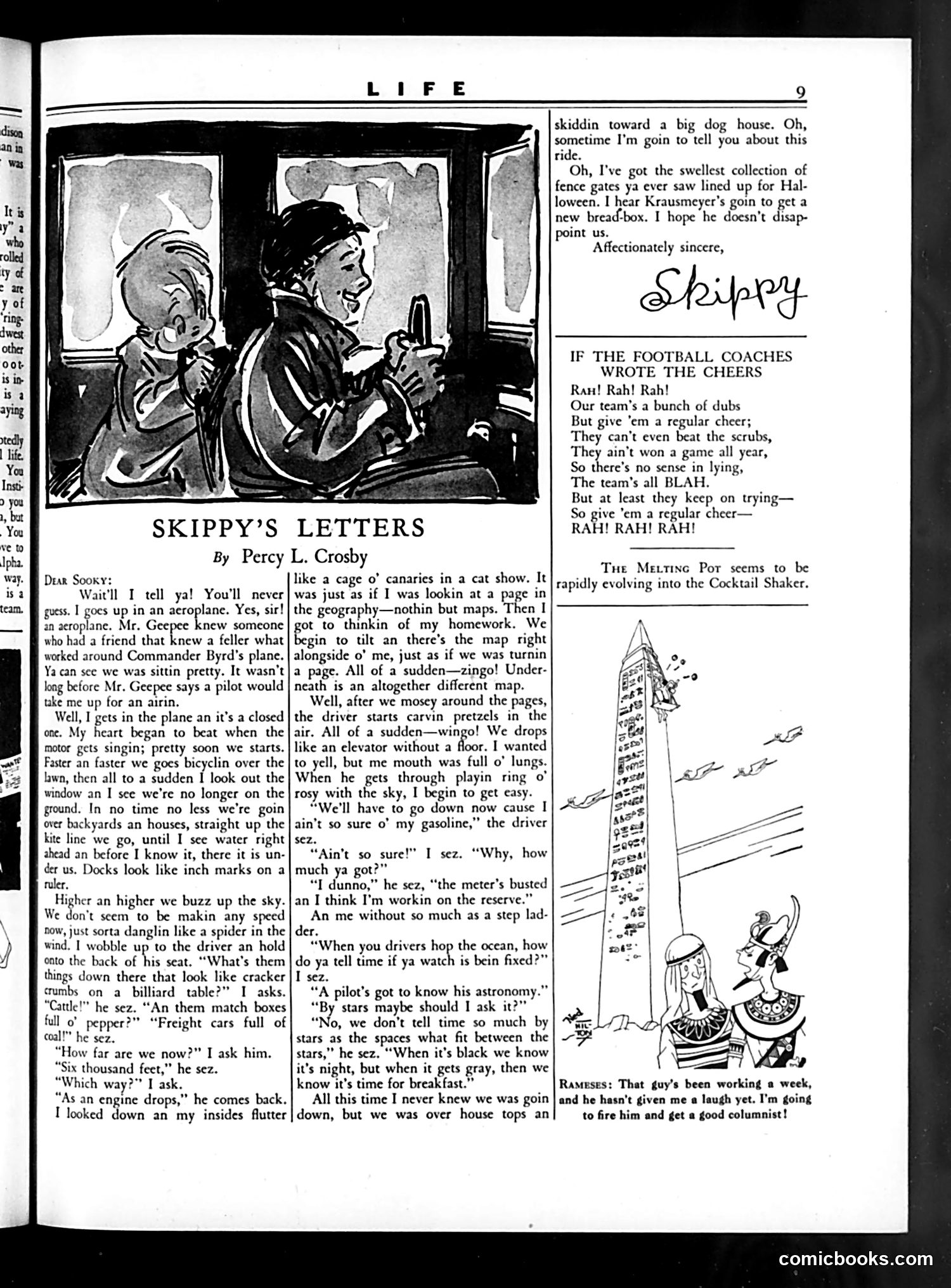
This page features "Skippy's Letters" by Percy L. Crosby, a satirical humor column. The illustration shows two men in an airplane cockpit, depicting a comedic aviation anecdote. Skippy recounts a plane ride where he observes the pilot's bewildering navigation methods. The humor centers on the pilot's casual, illogical explanations for flying procedures—claiming to navigate by looking at maps through the plane's windows, using landmarks, and making arbitrary decisions about altitude and direction. The satire mocks early aviation's improvised nature and pilots' sometimes questionable expertise. The page also includes a poem mocking weak football teams and their cheerleaders, and a brief note about cocktail culture evolving into "The Melting Pot." These represent typical Light entertainment content from this era of *Life* magazine.
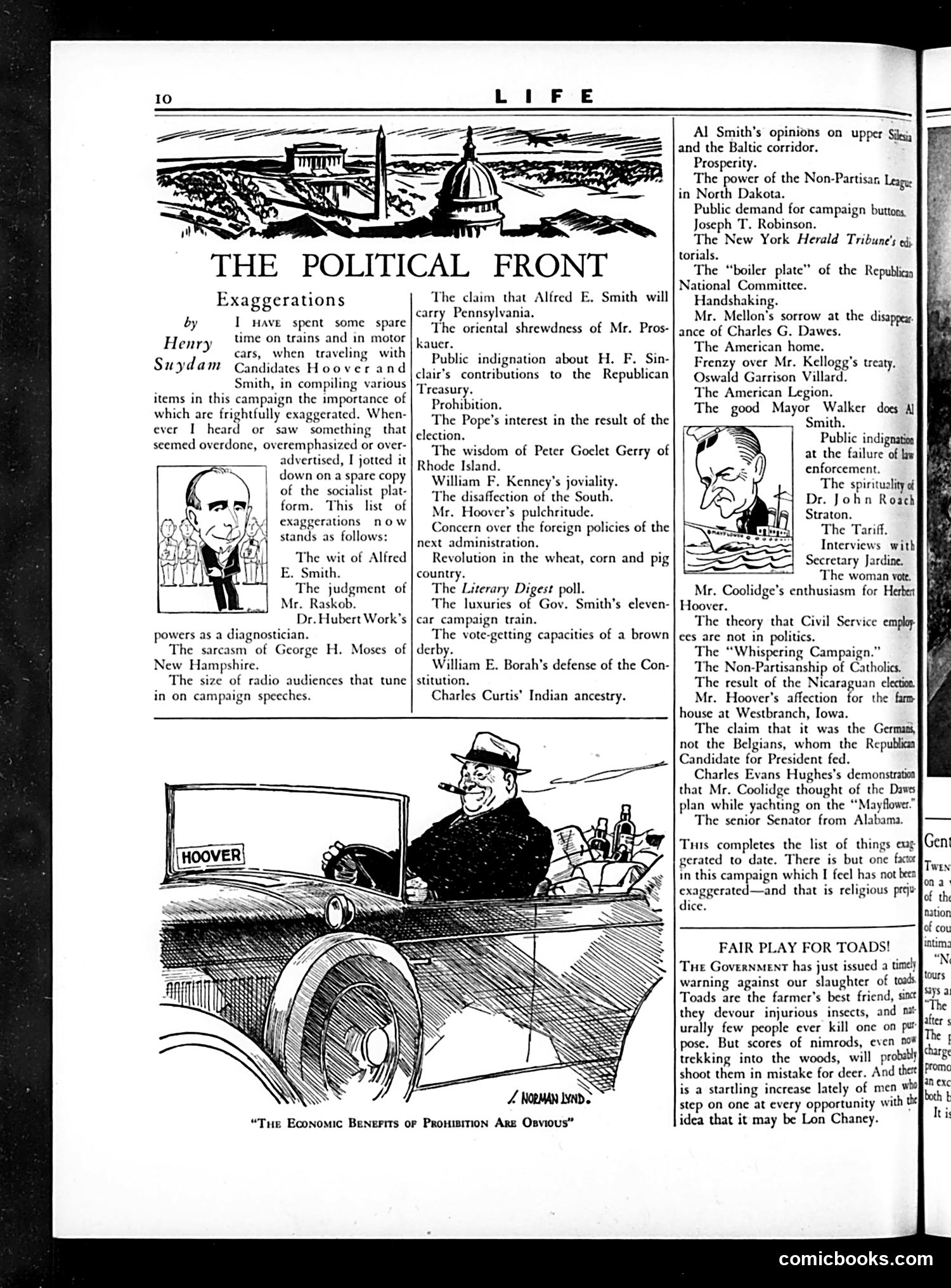
This page from Life magazine presents political satire by Henry Snyder critiquing campaign hyperbole. The left column lists exaggerations he observed while traveling during a campaign, ranging from claims about candidate Alfred E. Smith's abilities to various political controversies. The prominent cartoon below, captioned "The Economic Benefits of Prohibition Are Obvious," depicts a caricatured figure (likely a political leader) in a car labeled "Hoover," surrounded by bottles—clearly mocking claims that Prohibition brought economic prosperity. The artist (Norman Ladd) sarcastically illustrates the opposite: illegal alcohol production thriving, suggesting Prohibition's actual economic consequences contradicted official rhetoric. The right column lists additional campaign claims considered exaggerated or false by the magazine's editors.
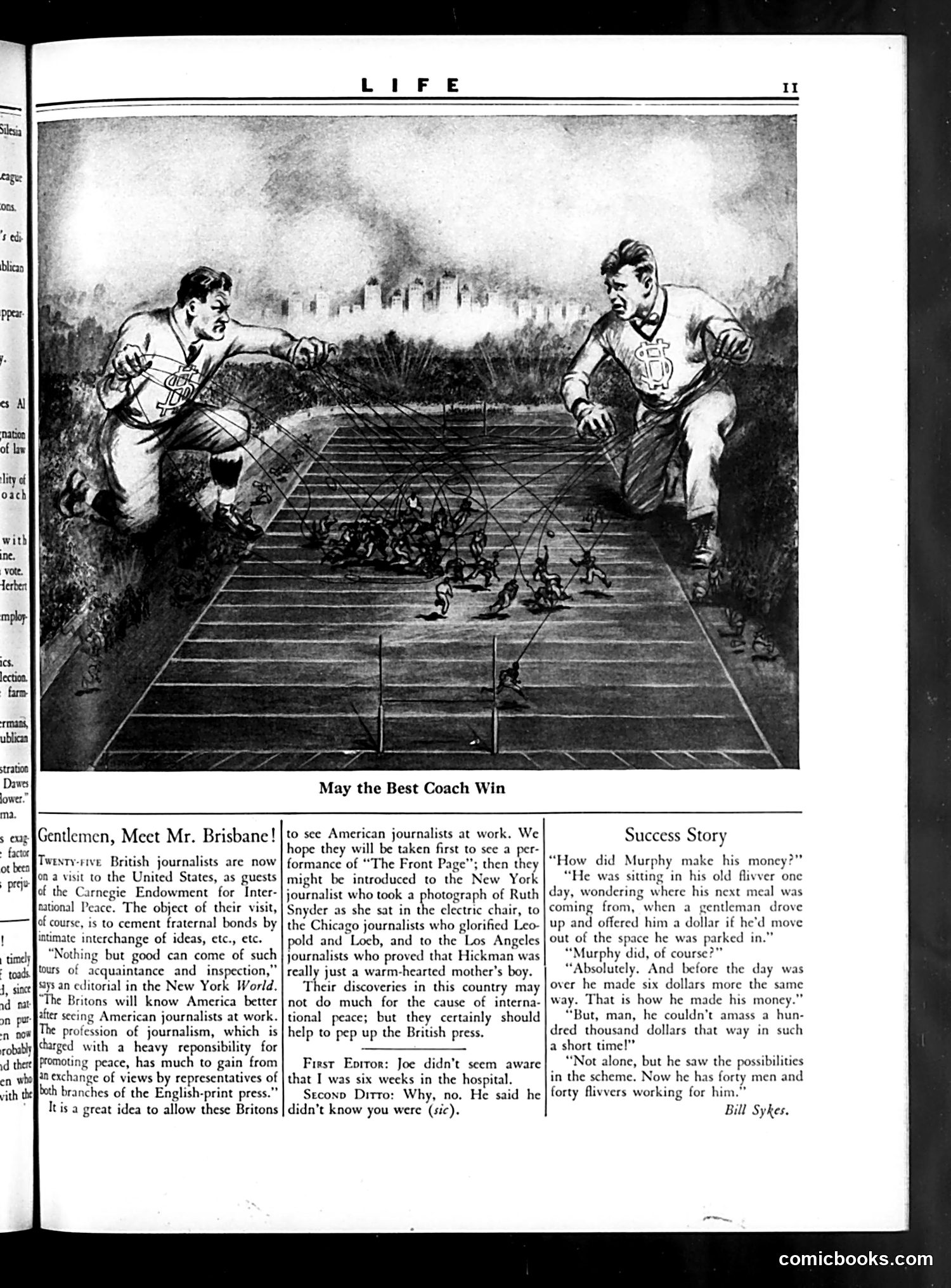
This cartoon satirizes competition between American and British journalism. Two giant coaches (representing their respective nations' press) loom over a football field where tiny journalists scramble like players. The accompanying text discusses British journalists visiting the U.S. as guests of the Carnegie Endowment. It humorously suggests they'll witness American journalism in action—mentioning specific incidents involving journalists photographing Ruth Snyder (a famous 1920s crime case), Chicago journalists covering Leopold and Loeb, and Los Angeles journalists' coverage of Hickman (another notorious case). The satire critiques American sensationalism: British visitors will see American journalists "at work," implying their aggressive, competitive coverage of scandals and crimes represents a stark contrast to (presumably more restrained) British press standards. The "coaches" framing positions journalism as a competitive sport.
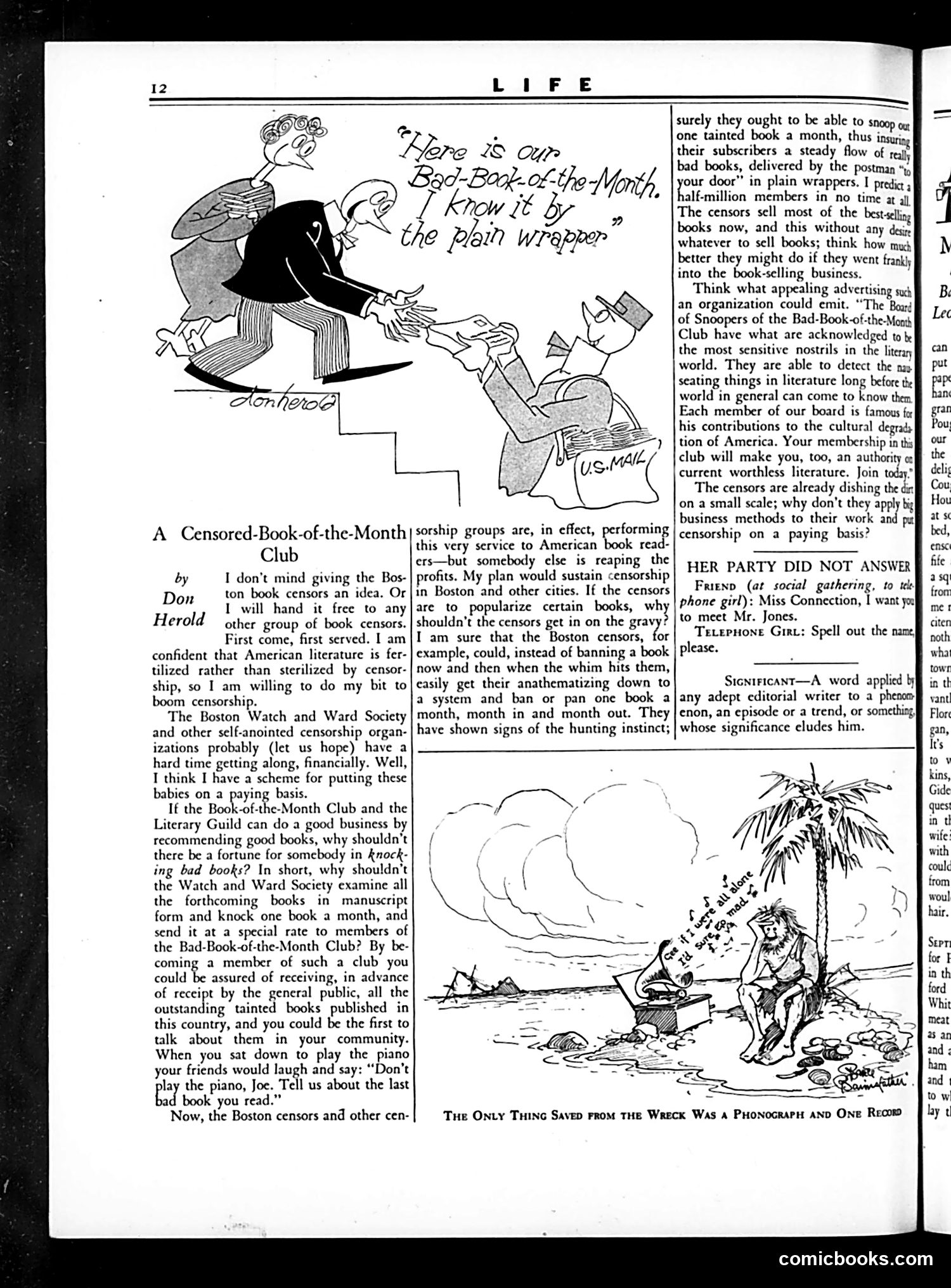
This cartoon satirizes book censorship organizations, particularly Boston's Watch and Ward Society. The top cartoon shows a character representing censorship attacking books being delivered by the U.S. Mail. Herold argues that censorship groups claiming to protect literature actually harm it. He proposes a counterintuitive solution: a "Bad-Book-of-the-Month Club" that would publicize censored works, giving them free advertising. His logic: if censors want to suppress certain books, let them profit from promoting them instead—turning censorship into a paying business venture. The satire attacks the hypocrisy of censorship organizations while mocking their financial struggles, suggesting their real motivation is profit rather than moral protection.
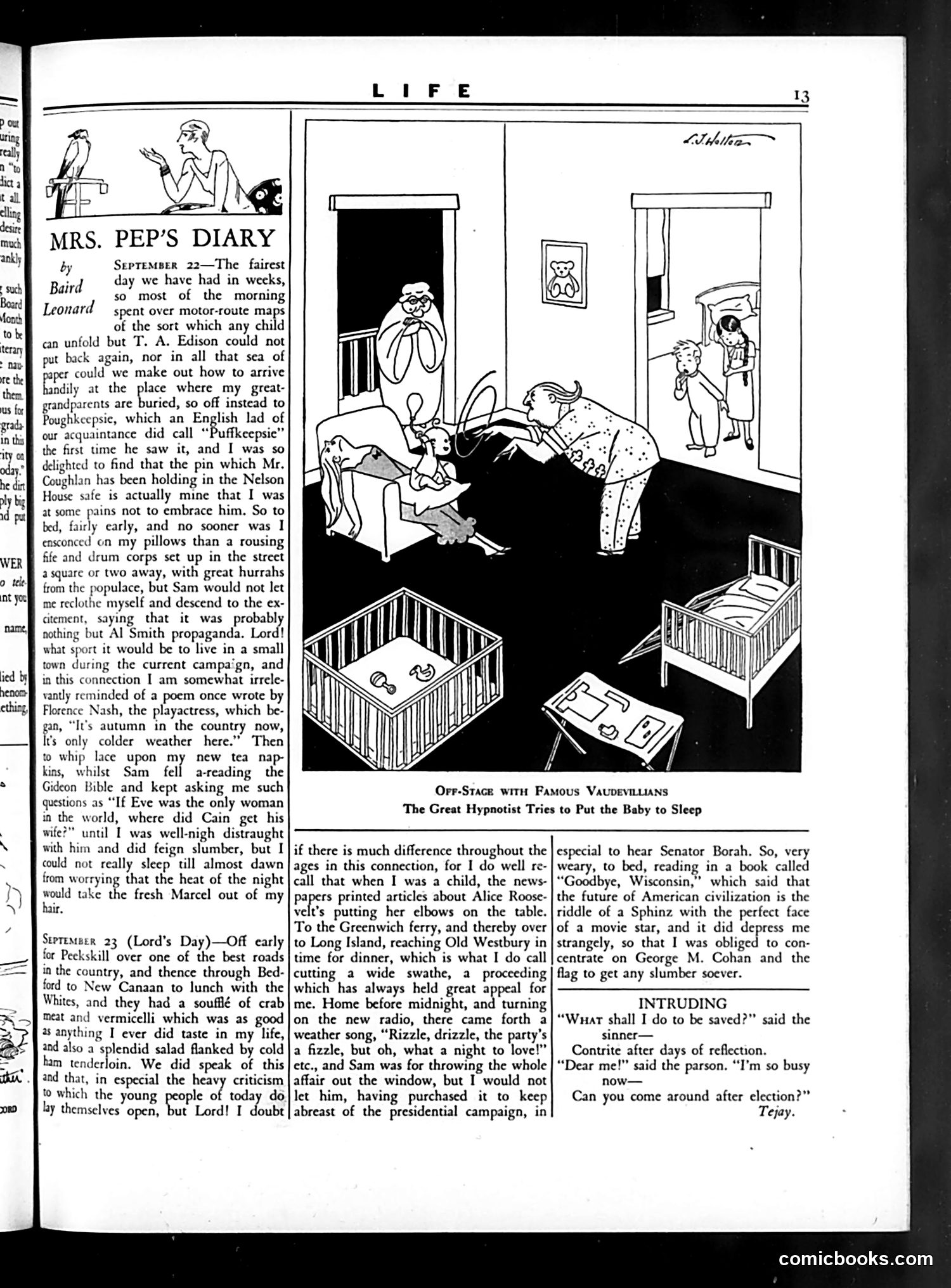
This page from *Life* magazine contains two humor pieces. "Mrs. Pep's Diary" by Baird Leonard satirizes domestic life, recounting September entries about housekeeping challenges—motor-route maps, a noisy street band, and domestic servants (notably "Sam") whose behavior frustrates the diarist. The main illustration, "Off-Stage with Famous Vaudevillians: The Great Hypocritist Tries to Put the Baby to Sleep," depicts a vaudeville performer attempting to use his stage hypnotic skills on an infant. The joke mocks the disconnect between theatrical talents and real-world parenting—what works entertaining audiences fails entirely with a crying baby. Both pieces target turn-of-the-century domestic frustrations and the pretensions of entertainers.
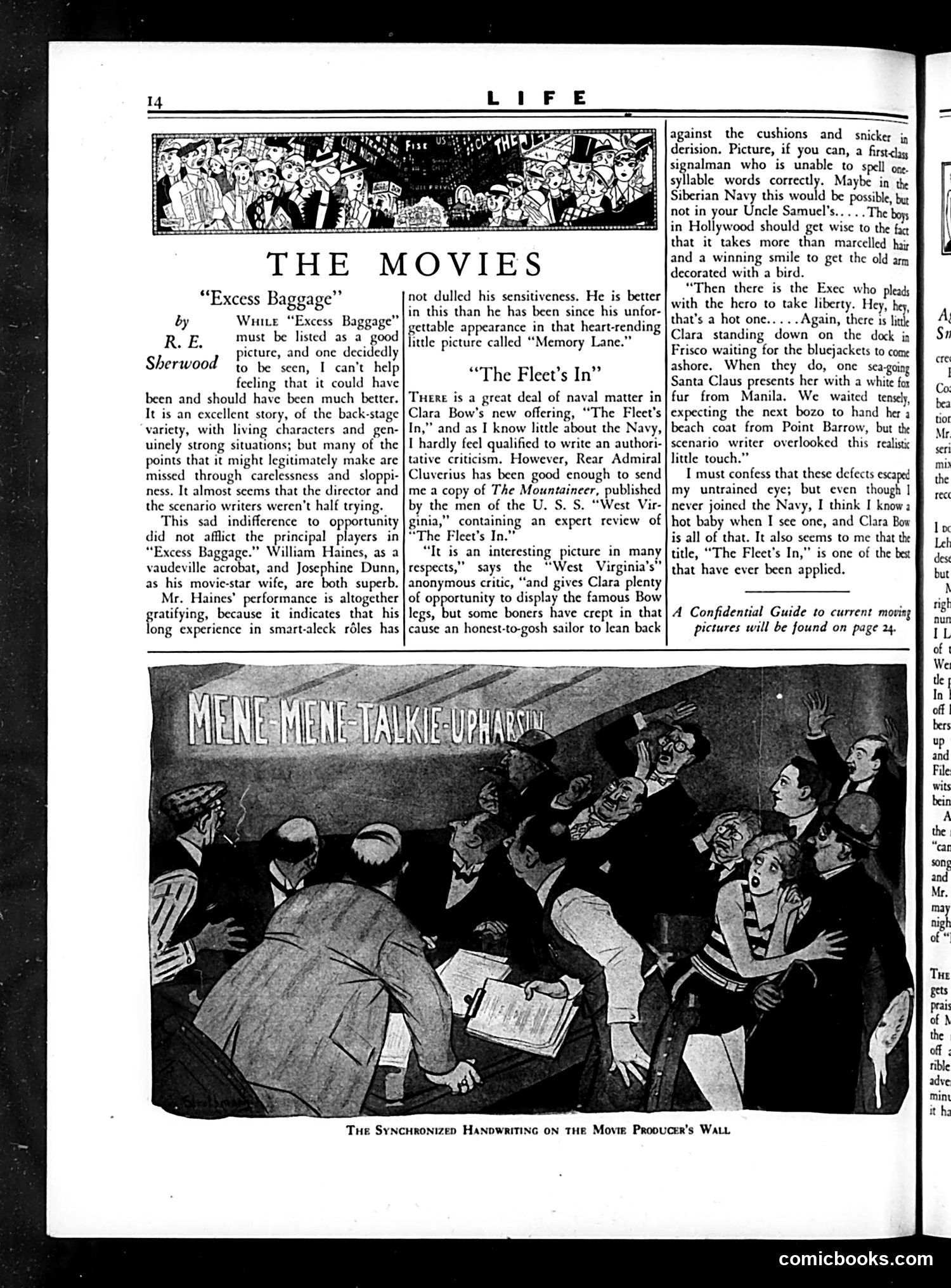
This page reviews two films: "Excess Baggage" and "The Fleet's In." The main illustration depicts a chaotic scene labeled "The Synchronized Handwriting on the Movie Producer's Wall"—a visual pun referencing the Biblical "writing on the wall" (prophecy of doom). The image shows multiple men in business attire crowding around, examining documents, appearing agitated or concerned. The satire critiques the film industry's tumultuous state, likely commenting on production chaos, financial instability, or internal disputes among producers and executives. The "synchronized handwriting" suggests ironic harmony masking underlying conflict—a commentary on Hollywood's dysfunction during this early sound-film era. The reviews themselves offer film criticism rather than political commentary, focusing on narrative and performance quality.
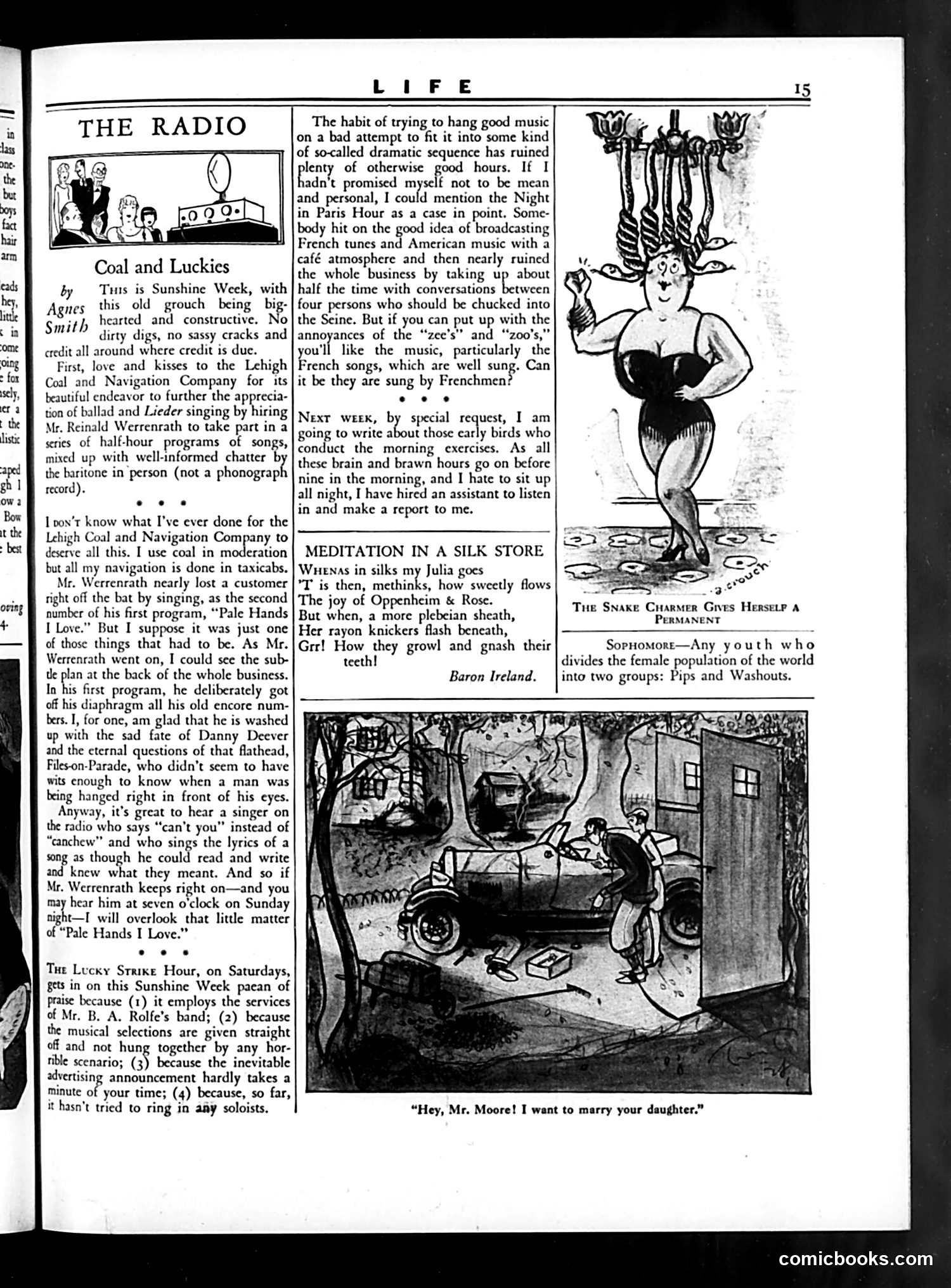
This page contains radio criticism and humor pieces from the 1920s. The main cartoon shows a woman with an elaborate hairstyle topped by flowers, labeled "The Snake Charmer Chutes Herself a Permanent"—a joke about permanent wave hairstyles, which were fashionable and expensive at the time. The radio section reviews programs on the Lehigh Coal and Navigation Company's broadcasts. The critic praises singer Reinald Werrenrath but critiques the "Lucky Strike Hour" for its advertising announcements interrupting the music. A small cartoon at bottom depicts a suitor proposing to a girl by a car, with the caption "Hey, Mr. Moore! I want to marry your daughter"—humor about courtship rituals and automobile culture. The magazine treats radio broadcasting as a novel entertainment medium worthy of serious critical attention.
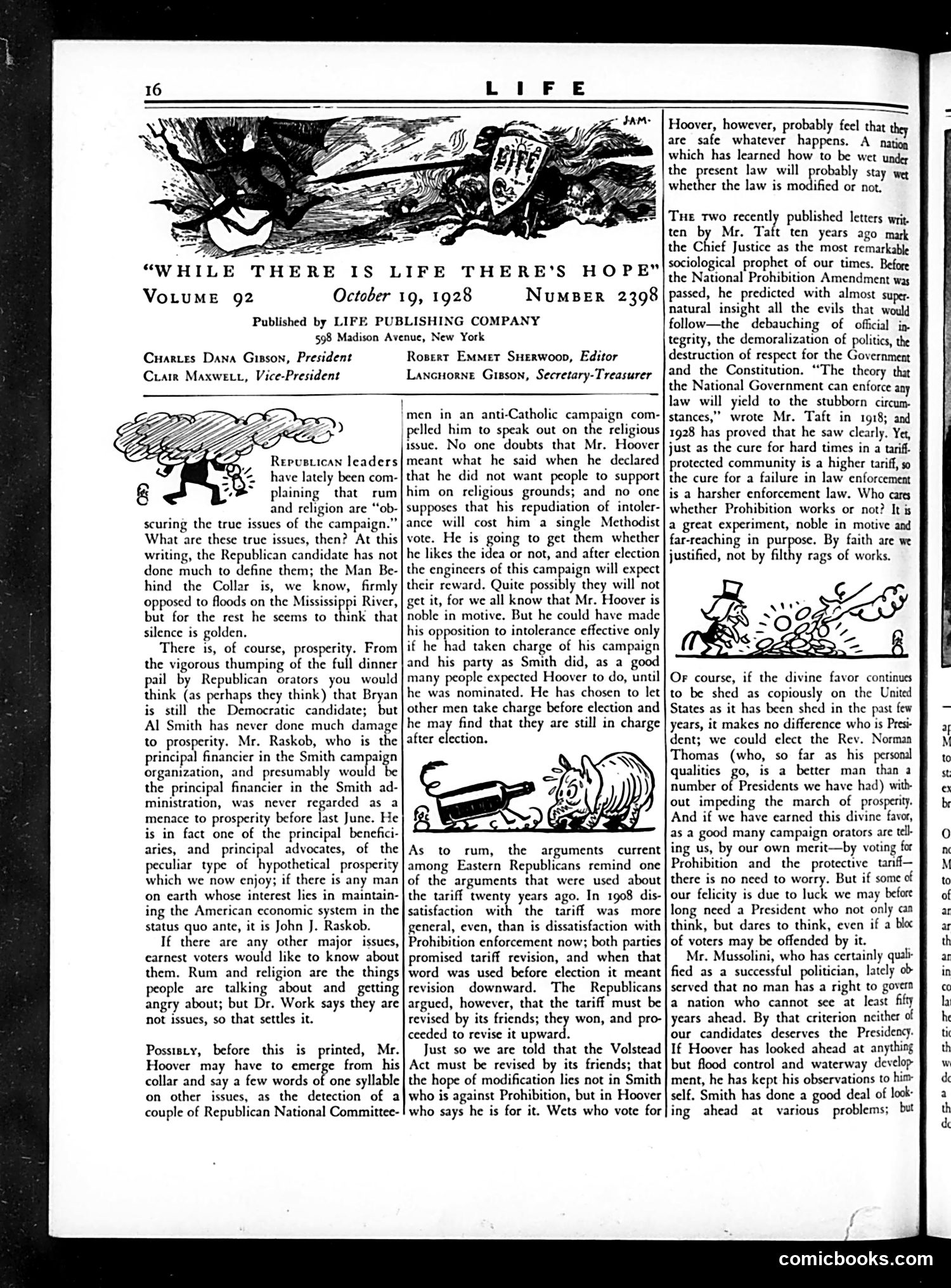
This page critiques Republican campaign tactics before the 1928 presidential election. The article discusses how GOP leaders are using religion and anti-Catholicism as campaign issues, likely referencing opposition to Catholic candidate Al Smith. The cartoons illustrate the hypocrisy: one shows a figure being struck down (suggesting consequences of dirty tactics), another depicts someone falling or being defeated. The text argues Republicans are exploiting religious prejudice rather than addressing substantive issues like the tariff or prohibition enforcement. The article defends Herbert Hoover's measured response, suggesting he could have campaigned more aggressively on religion but chose not to—implying moral superiority. The satire criticizes both parties' manipulation of voters through manufactured controversies rather than genuine policy debate.
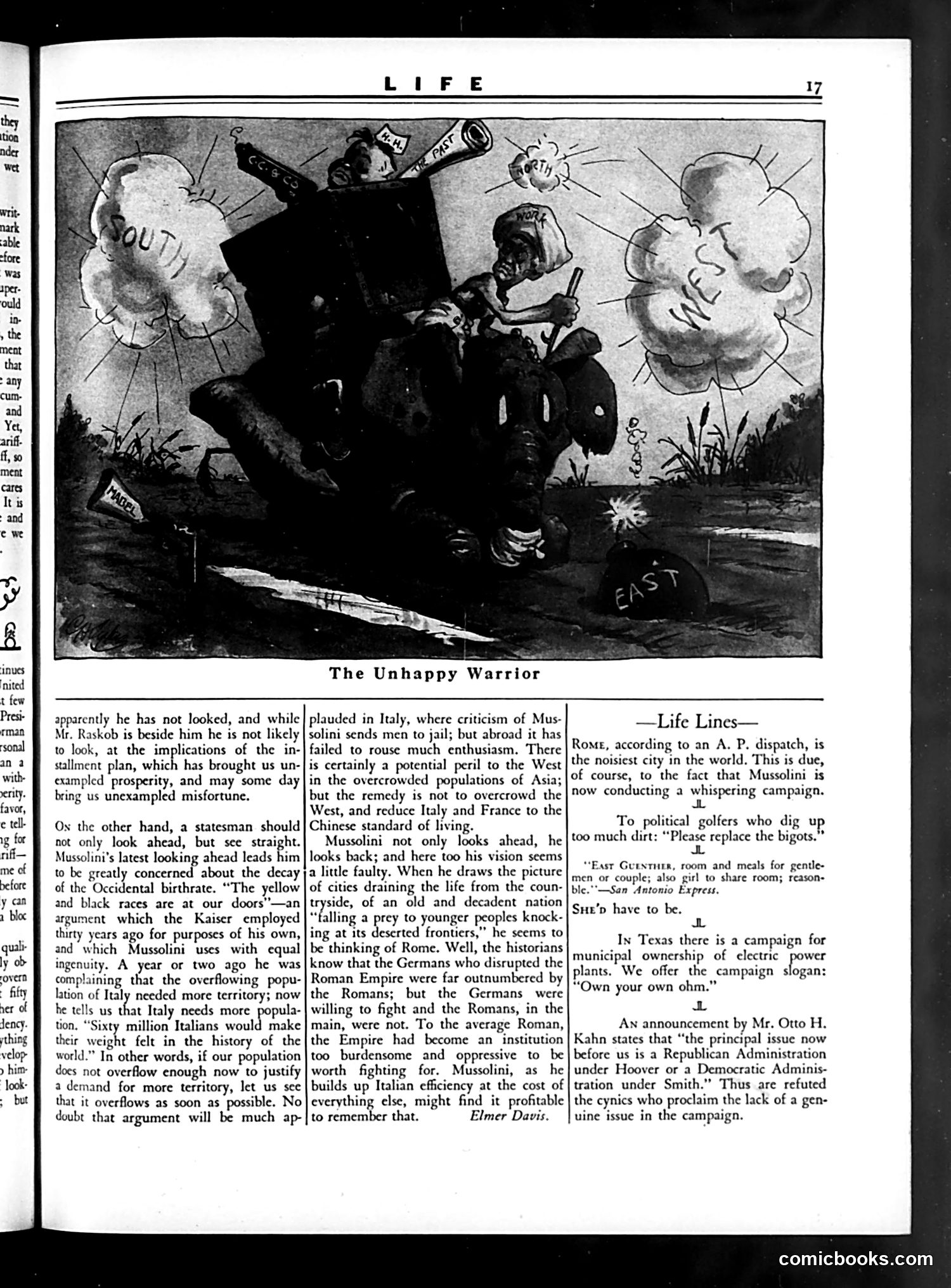
This political cartoon depicts a dark figure (likely representing Mussolini, given the accompanying article's focus on Italian leadership) being tormented by allegorical figures labeled "South," "West," and "East." The cartoon satirizes Italy's difficult geopolitical position and internal challenges. The article discusses Mussolini's forward-looking policies but critiques his vision as potentially dangerous. It argues that while Mussolini seeks territorial expansion and national efficiency, Italy lacks the population and resources to sustain such ambitions. The "unhappy warrior" title suggests the futility of his aggressive stance. The surrounding text references Italy's overcrowded populations, colonial ambitions, and the tension between Mussolini's grand vision and Italy's actual capabilities—a prescient commentary on the tensions that would define fascist Italy's trajectory.
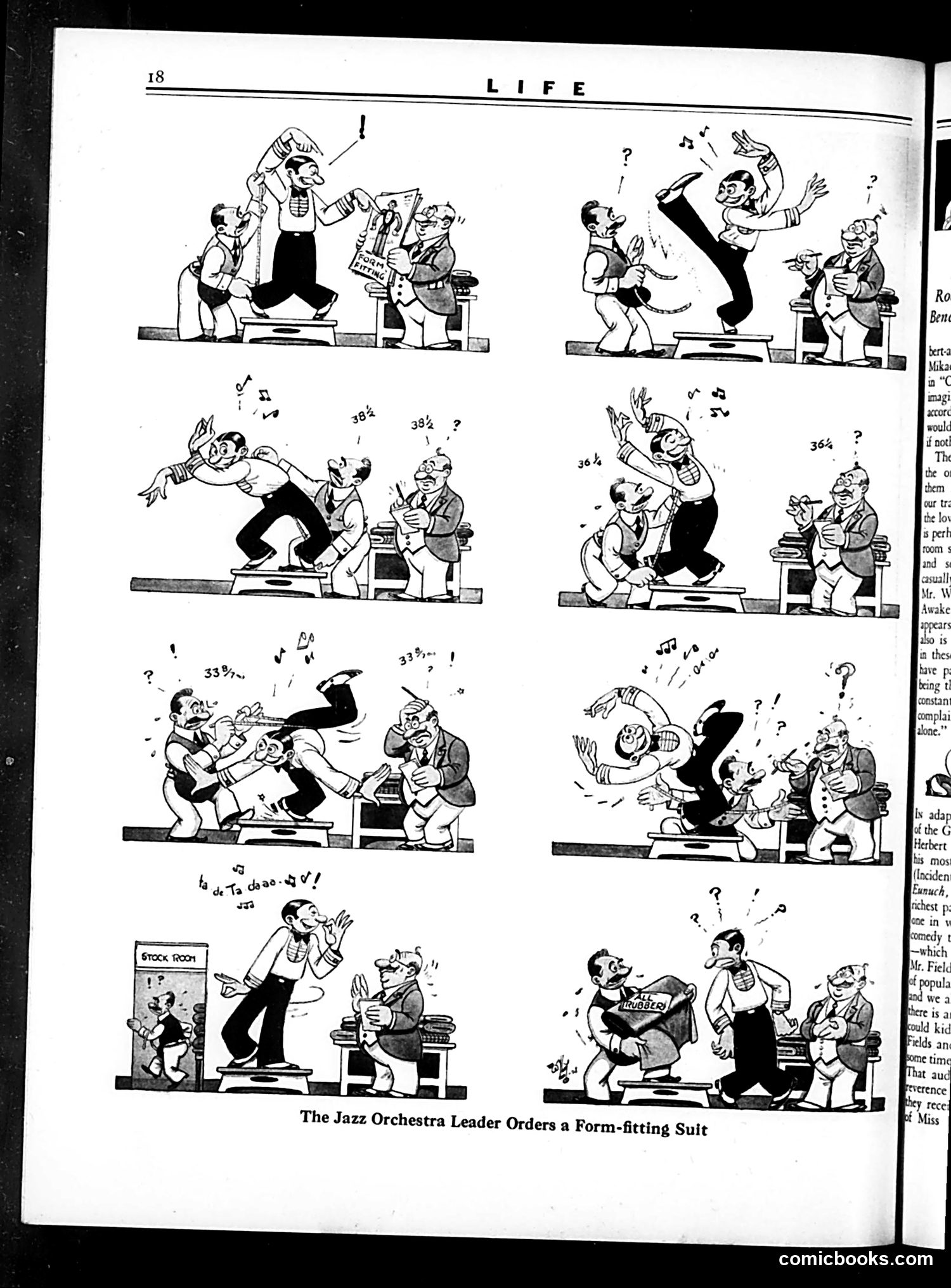
This comic strip satirizes jazz musicians and tailoring culture of the 1920s-30s. The sequence shows a Jazz Age orchestra conductor visiting a tailor for a custom suit, with escalating physical comedy as he demonstrates exaggerated conducting movements—jumping, kicking, and wildly gesticulating. The humor targets both jazz culture (then considered somewhat disreputable and overly physical) and the challenge tailors face fitting clients with extreme, unpredictable body movements. The conductor's increasingly wild antics contrast with the tailor's confusion and concern, shown through question marks and musical note symbols indicating bewilderment. The joke reflects period attitudes viewing jazz musicians as undisciplined performers whose flamboyant movements wouldn't accommodate conventional tailoring—a satirical commentary on both the music genre and fashion expectations of the era.
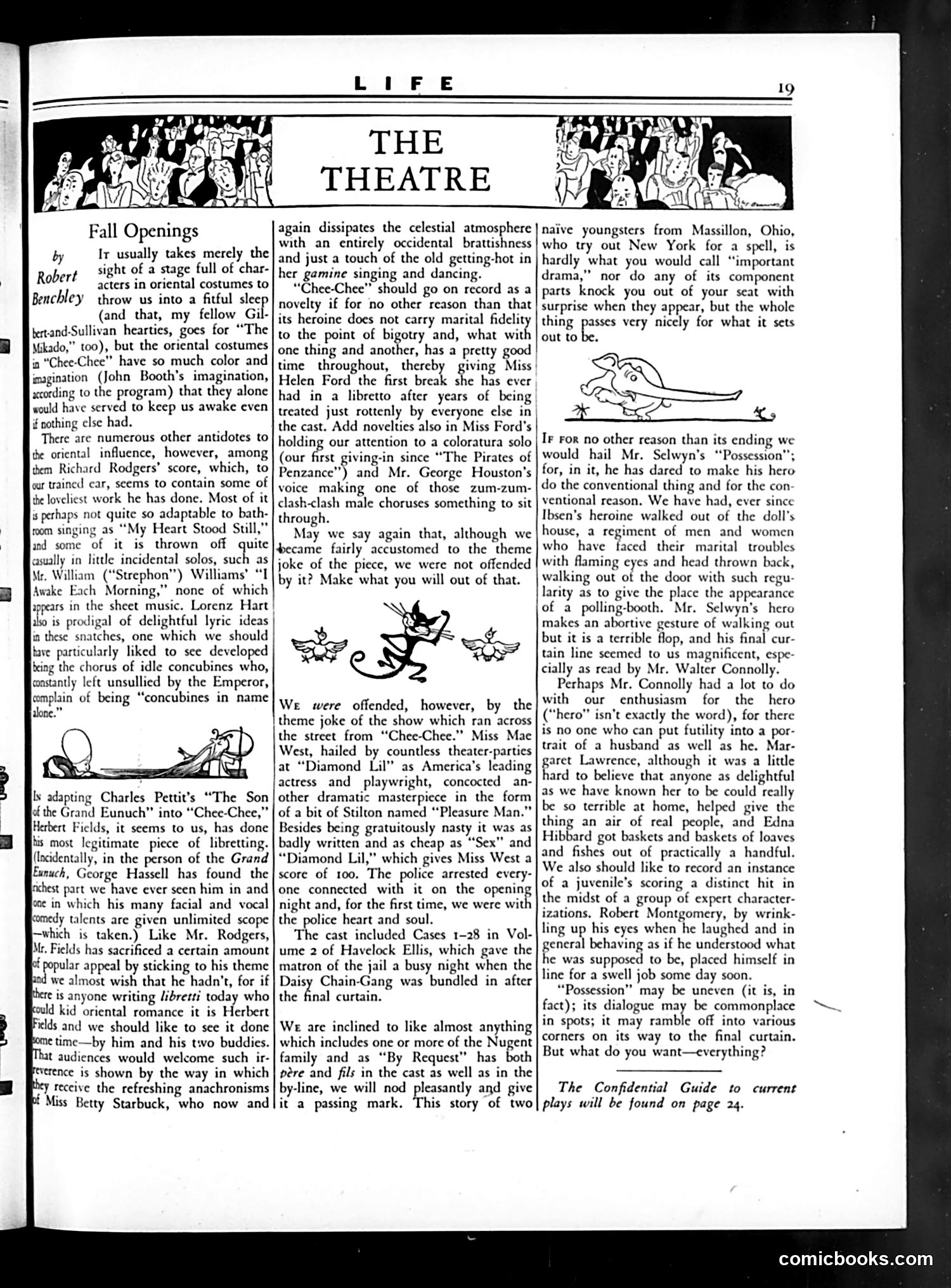
This is a theatre review column by Robert Benchley critiquing two Broadway productions: "Chee-Chee" (an Oriental-themed musical with score by Richard Rodgers and lyrics by Lorenz Hart) and Mae West's "Pleasure Man." **"Chee-Chee"** receives qualified praise—Benchley admires the colorful costumes, Rodgers' music, and Hart's witty lyrics. He notes the show's novelty in depicting its heroine without excessive moral prudishness, and praises actress Helen Ford's rare good role. **"Pleasure Man"** is harshly condemned. Benchley calls it gratuitously vulgar, poorly written, and cheap—grouping it with West's earlier controversial plays "Sex" and "Diamond Lil." He notes police arrested everyone involved on opening night and expresses rare approval of police action, indicating the content was considered extremely obscene by 1928 standards. The illustrations show stylized theatrical figures and a dancing cat character, typical of the era's magazine design. Benchley's tone is witty but moralistic regarding West's work.
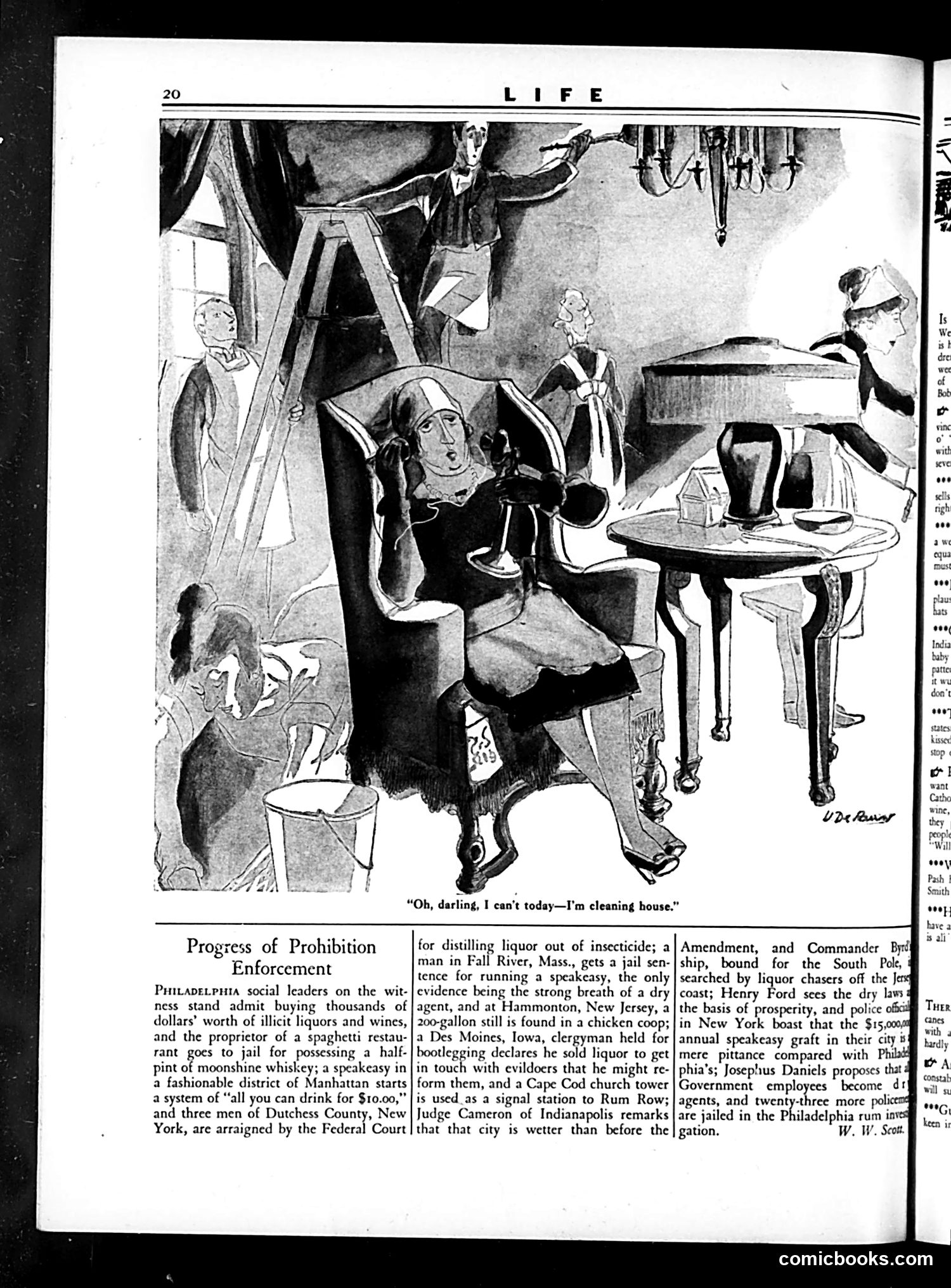
This satirical cartoon and article mock the failure of Prohibition enforcement during the 1920s-early 1930s. The cartoon shows a woman refusing a social engagement because she's "cleaning house"—a transparent excuse, likely implying she's actually drinking illicitly at home. The accompanying text catalogs absurd contradictions in Prohibition enforcement: wealthy socialites buy expensive illegal liquor without prosecution, while poor people face jail time for minor infractions. Enforcement is revealed as hypocritical and ineffective—speakeasies operate openly with subscription pricing, clergy bootleg alcohol claiming moral purposes, church towers signal smugglers, and police themselves profit from graft. The overall point: Prohibition has failed completely. Rather than eliminating drinking, it's created widespread lawbreaking, corruption among enforcers, and a justice system punishing the poor while the wealthy operate with impunity. The satire exposes how unenforceable and socially divisive the law has become.
This page contains **humorous local gossip and anecdotes** from various American cities (Indiana, Spokane, Cleveland, Boston, Chicago), written in a folksy, dialect-heavy style characteristic of Life's satirical approach. **Key references:** - **Political**: mentions of Herbert Hoover and Al Smith (1928 presidential candidates); Gene Tunney (famous boxer); William Jennings Bryan (three-time presidential candidate) - **Social satire**: jokes about women's fashion choices ("barelegged fer Hoover"), regional provincial attitudes, and the hypocrisy of politicians - **Cultural humor**: pokes fun at kissing babies for votes, campaign speeches, and people name-dropping their presence in "Who's Who" The writing style—attributed to "Kin Hubbard (Abe Martin)"—mimics rural/small-town dialect to mock both provincial life and political pretension. The page's humor relies on readers recognizing contemporary public figures and understanding early-20th-century social anxieties about modernization and political theater.
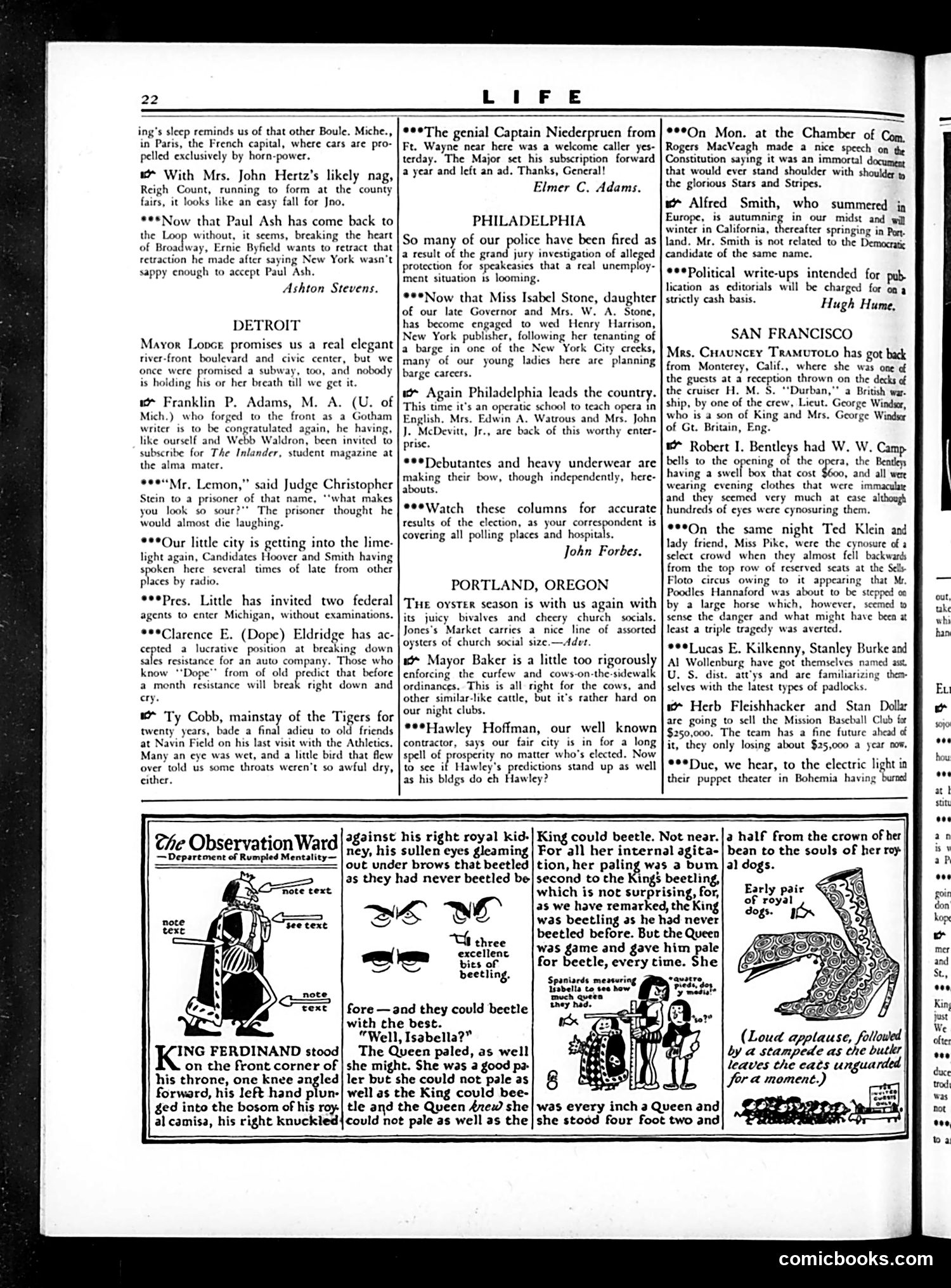
This page features **"The Observation Ward,"** a satirical cartoon about **King Ferdinand** (likely Ferdinand I of Romania, given the 1920s timeframe). The cartoon depicts Ferdinand standing awkwardly, with his knee angled forward and plumbed into his royal robe's bosom—a physical deformity rendered absurdly exaggerated for comic effect. The joke plays on Ferdinand's actual physical limitations while mocking the pretense of royal dignity. The accompanying text humorously describes how Queen Isabella must accommodate his condition, unable to "pale as well as the King could beetle" and forced to accept his inferior bearing. The cartoon ridicules both Ferdinand's physical shortcomings and the absurdity of maintaining royal protocol despite obvious physical impediments. The satirical point: even monarchs possess undignified, ungainly bodies that undermine their elevated status—a democratizing jab at aristocratic pretense through physical humor typical of 1920s Life magazine's irreverent style.
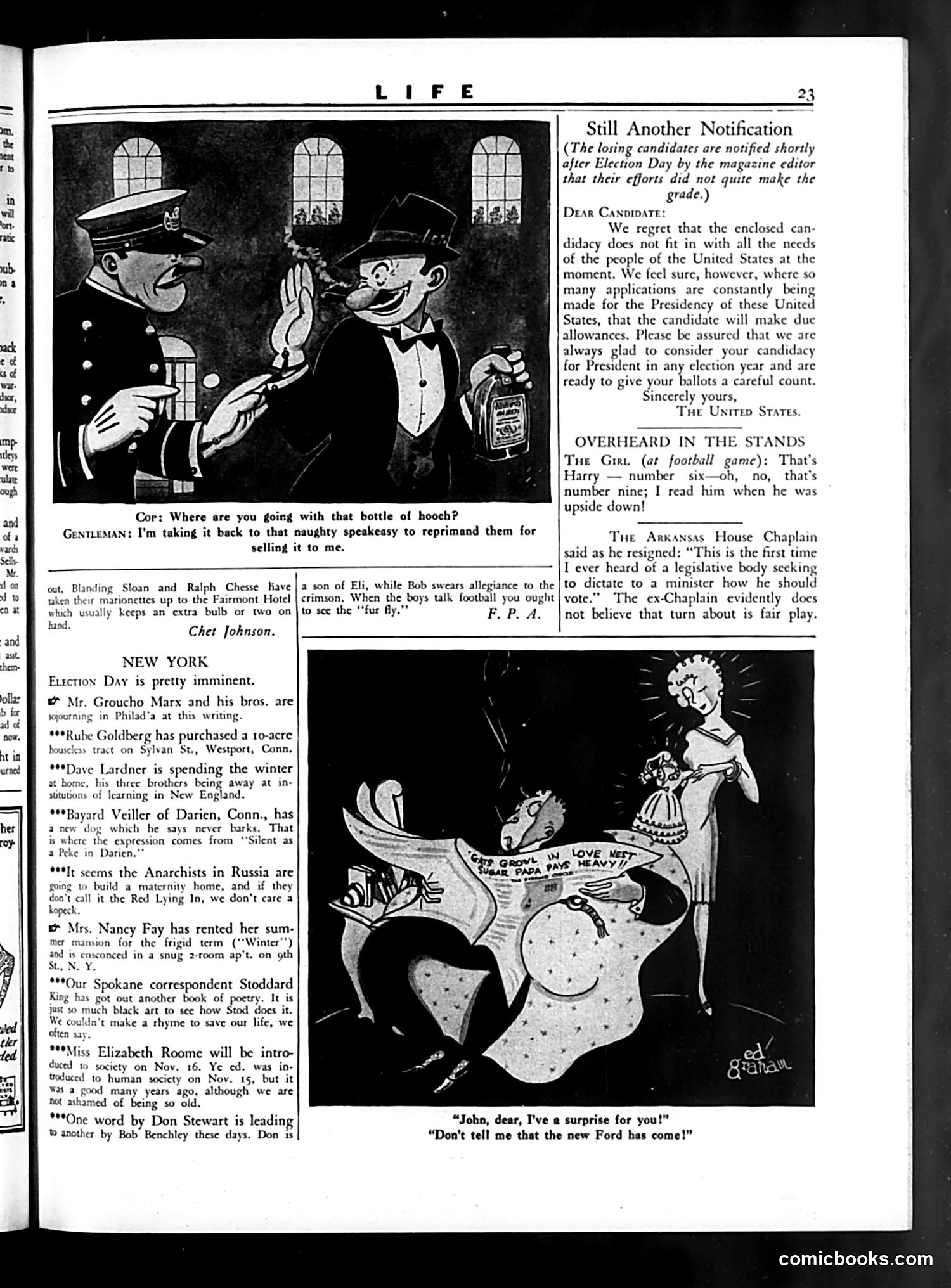
This page contains Prohibition-era humor and social commentary from 1920s America. **Top cartoon**: A cop confronts a gentleman carrying a bottle of "hooch" (illegal liquor). The gentleman claims he's returning it to the speakeasy to "reprimand them for selling it to me"—absurdist satire on Prohibition's hypocrisy. Citizens openly frequented illegal bars while authorities theoretically enforced the alcohol ban. **"Still Another Notification"**: Mock rejection letter to losing presidential candidates, satirizing the constant flood of aspiring candidates seeking the presidency. **Bottom cartoon**: A woman at a football game mishears a player's number, having "read him when he was upside down"—gentle humor about distracted female spectators. **Arkansas House Chaplain anecdote**: A chaplain resigned after the legislature tried dictating his voting behavior, sarcastically noting the irony of telling a minister how to vote. The **"New York" gossip section** references celebrities (Groucho Marx, Rube Goldberg) and contains light satirical jabs at poets and society figures, typical of Life's humor style.
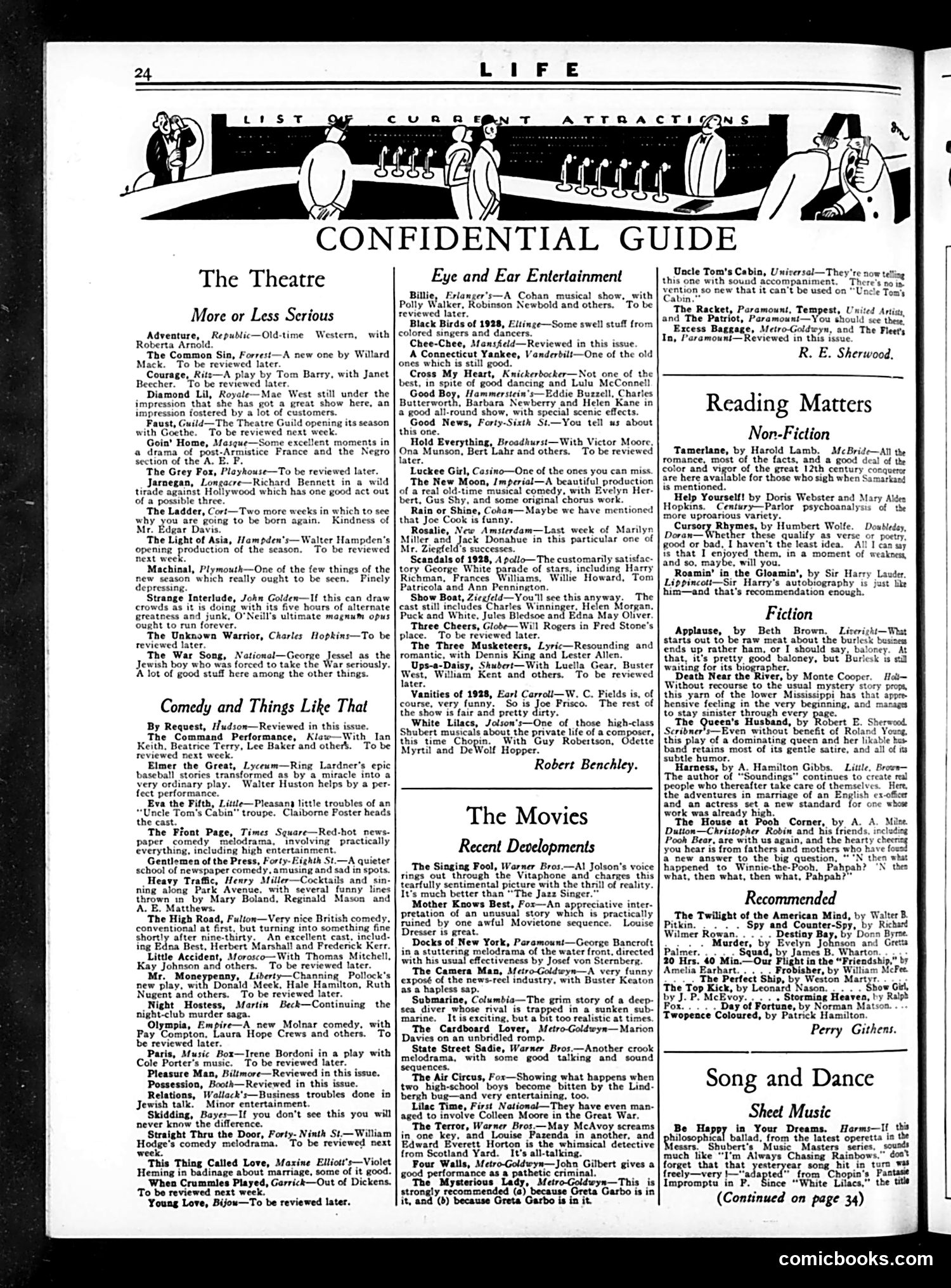
This page is a **"Confidential Guide"** — Life's satirical reviews of current Broadway shows and movies. The humor works through **irreverent, dismissive commentary** rather than visual cartoons. Key examples of the satire: - **Mae West** (*Diamond Lil*): Described as having an inflated sense of her own show's quality, "fostered by a lot of customers" — mocking both her ego and her audience. - **Eugene O'Neill** (*Strange Interlude*): Called "alternate greatness and junk" yet predicted to "run forever" — satirizing critics' ambivalence toward modernist excess. - **Ring Lardner adaptation** (*Elmer the Great*): Transformed from "epic baseball stories" into "a very ordinary play" — lampooning theatrical mediocrity. The reviews mock theatrical pretension, hack adaptations, and performers' inflated reputations. The "confidential" framing suggests insider gossip—Life presents itself as the knowing critic exposing Broadway's true quality behind polite hype.
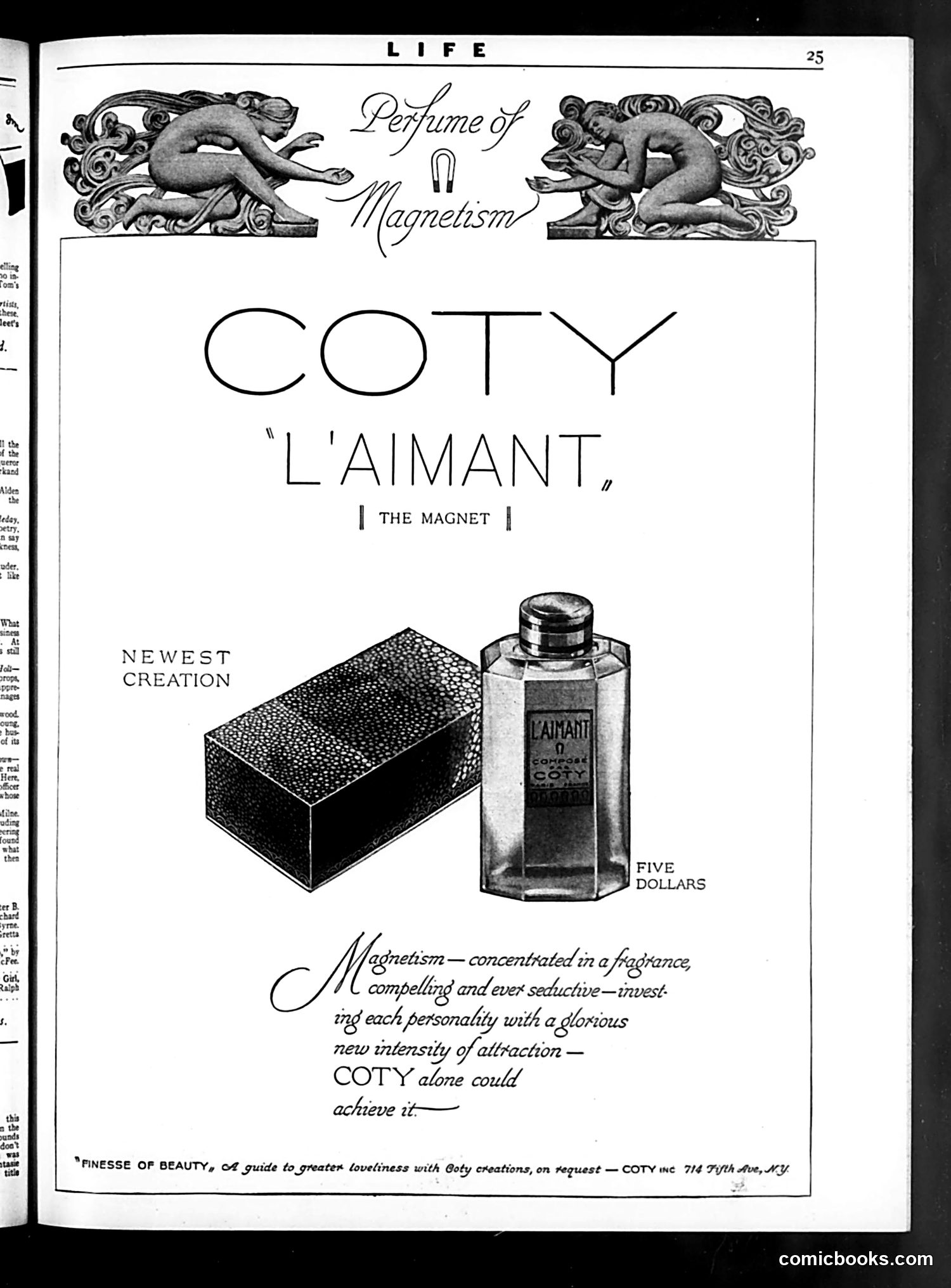
This is a perfume advertisement for "Coty L'Aimant" (French for "The Lover"), not political satire. The page promotes a fragrance called "The Magnet," priced at five dollars—a substantial sum in this era. The ad employs the pseudo-scientific language of "magnetism" as a marketing metaphor, promising the perfume will increase personal attraction and appeal. The ornamental cherubs at the top and the decorative box packaging suggest luxury and sophistication. The copy claims only Coty could achieve such concentrated "magnetism" in fragrance form. This reflects early-20th-century advertising's tendency to use fashionable scientific concepts (magnetism, psychology) to sell consumer goods, particularly cosmetics and perfumes marketed to women seeking enhanced attractiveness.
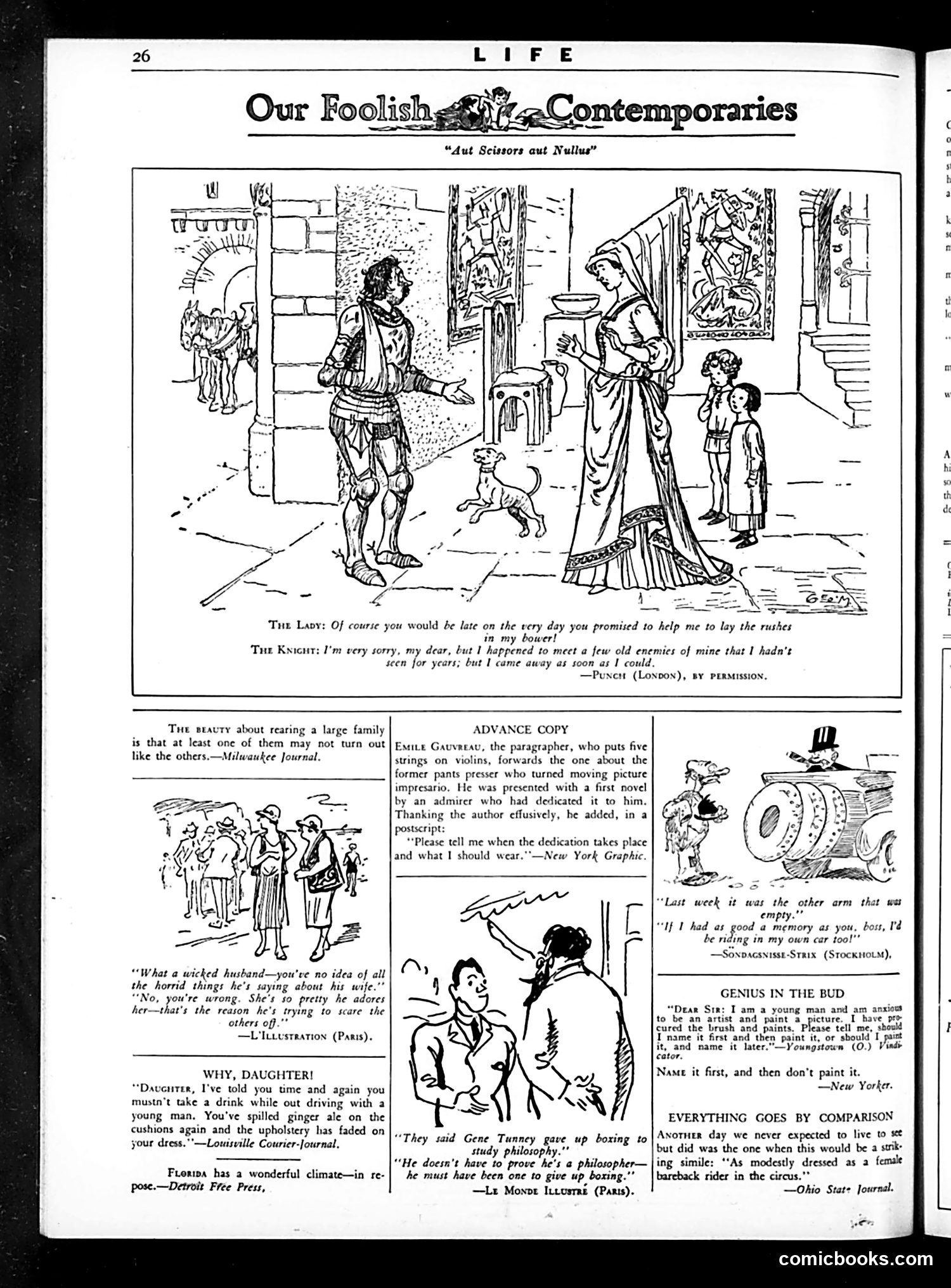
This page reprints satirical cartoons and jokes from international publications. The main cartoon—credited to *Punch* (London)—depicts a medieval knight apologizing to a lady for being late to help with laying rushes (floor coverings), claiming he stopped to fight "old enemies." The joke mocks chivalric excuses: the knight prioritizes combat over domestic duties. Below are brief humorous submissions from American and European newspapers. Topics include: a wicked husband who actually adores his pretty wife (so talks badly about her to discourage rivals); warnings against drinking while driving with young men; Florida's climate; Gene Tunney giving up boxing; and a young artist unsure whether to name or paint first. The page's title, "Aut Scissores aut Nullus" (Latin: "Either scissors or nothing"), suggests satirizing pretentious or foolish contemporary attitudes through published humor.
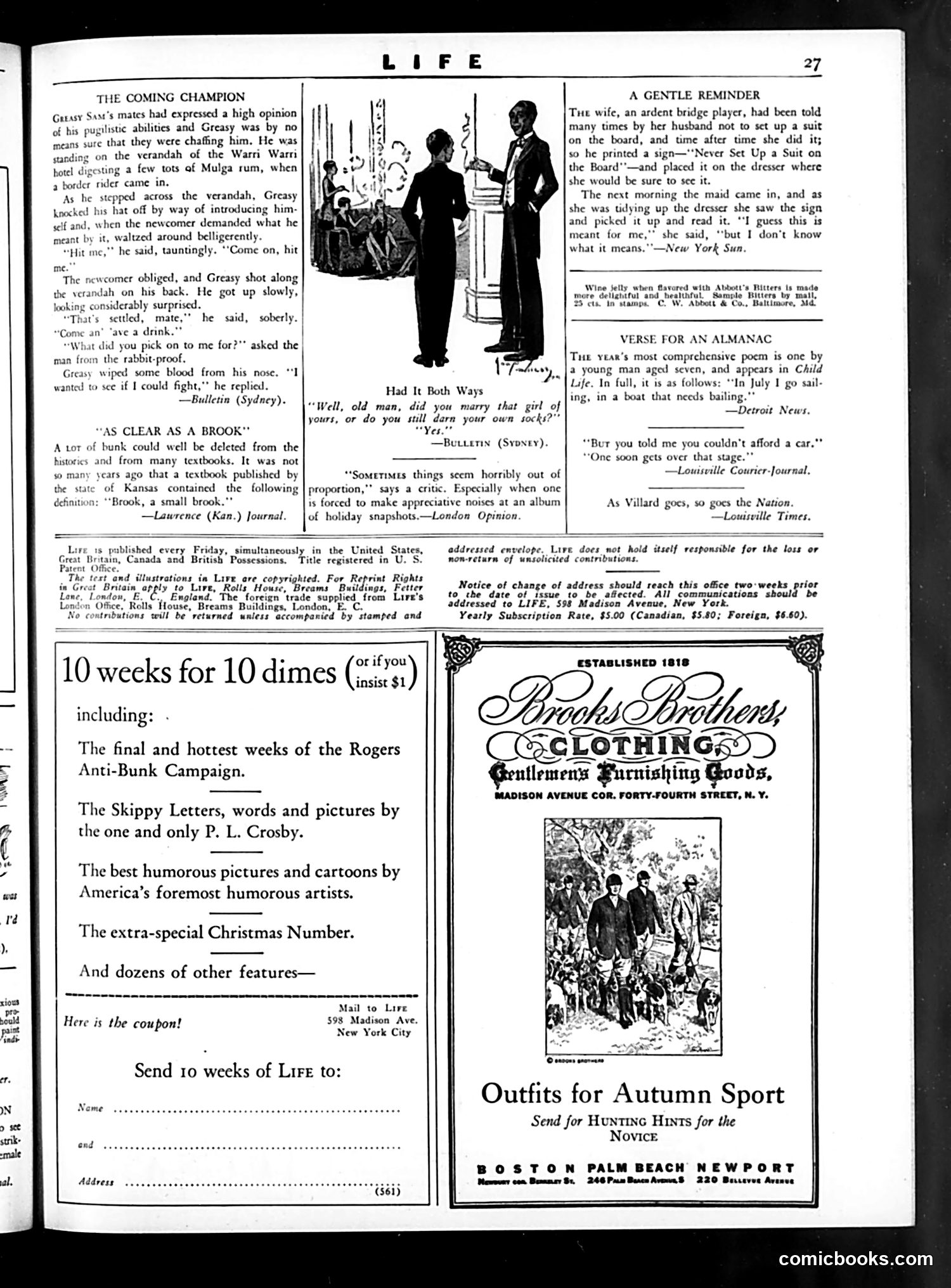
This page contains **three brief humorous anecdotes** rather than political cartoons: 1. **"The Coming Champion"** (Sydney Bulletin reprint): An Australian bush worker challenges a stranger to hit him to test his fighting ability—then gets knocked down immediately. The joke is his comical misjudgment of his own toughness. 2. **"Had It Both Ways"**: A man asks an older man if he married a girl or still darns his own socks. The implication is that married men do domestic chores—a common satirical jab at marriage domesticity. 3. **"A Gentle Reminder"**: A husband posts a sign on the bedroom dresser telling his bridge-playing wife not to set up card suits there. The maid finds it and misunderstands it as directed at her. The humor relies on the maid's confusion. These are light domestic/social satire pieces typical of *Life* magazine's humor tradition—poking fun at marriage, domestic life, and miscommunication rather than politics. The page also contains period advertisements.
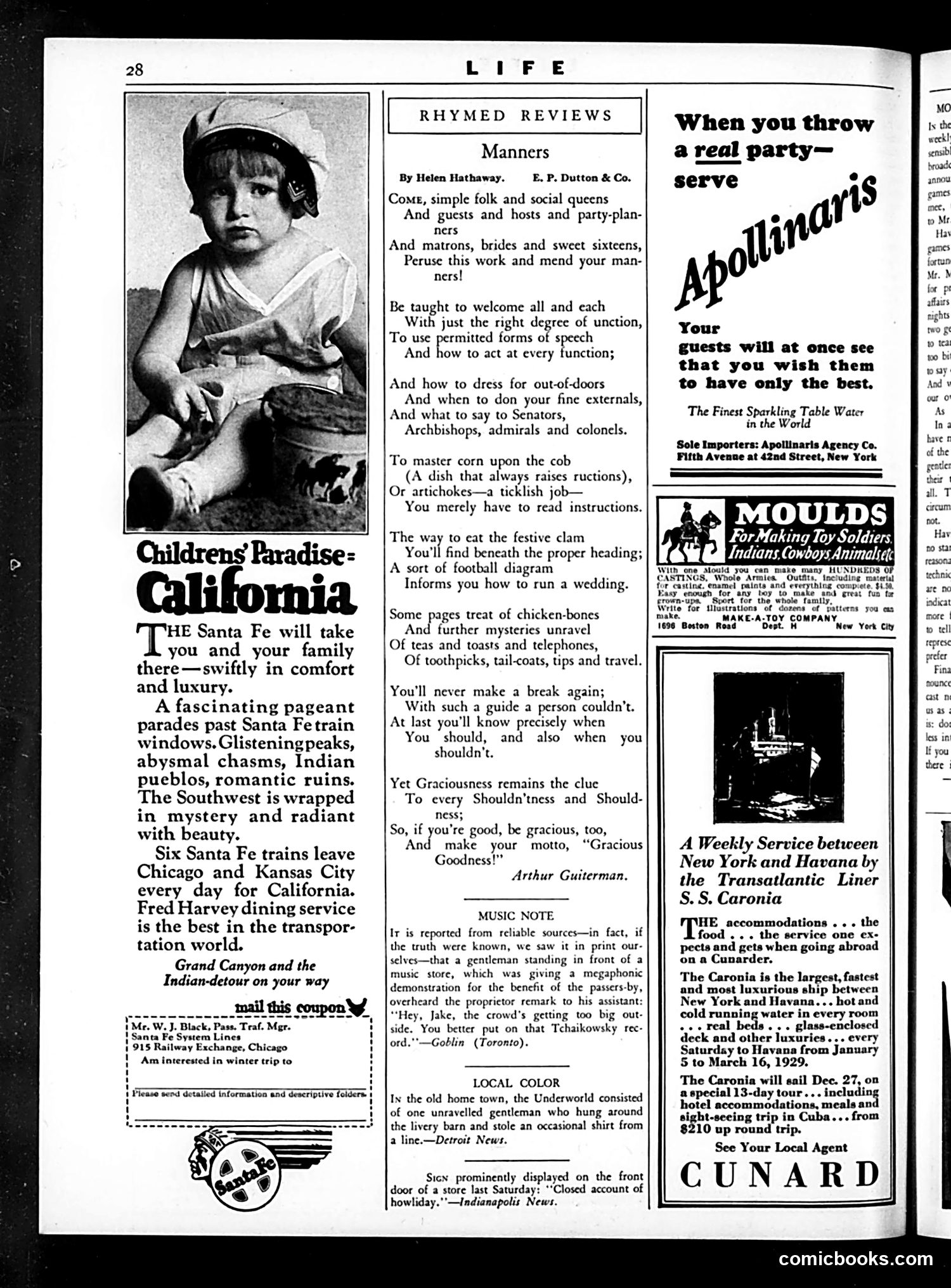
This is a 1920s-era **Life magazine page** mixing editorial content with advertisements. The main feature is a **humorous book review in verse** by Arthur Guiterman of a etiquette manual titled *Manners*. The satire mocks the obsessive detail of modern manners guides—suggesting they offer instructions for everything from eating corn on the cob to running weddings like "football diagrams." The joke: despite all these rules, true graciousness comes down to simply being good-natured ("Gracious Goodness"). The page also includes **filler content**: brief "Music Note" and "Local Color" humor pieces poking fun at contemporary absurdities (a store owner playing Tchaikovsky to disperse crowds; a sign misspelling "holiday" as "howliday"). The **advertisements**—Santa Fe trains, Apollinaris sparkling water, and the Cunard cruise ship—target affluent readers taking leisure trips, matching the magazine's upper-class audience concerned with proper manners and travel refinement.
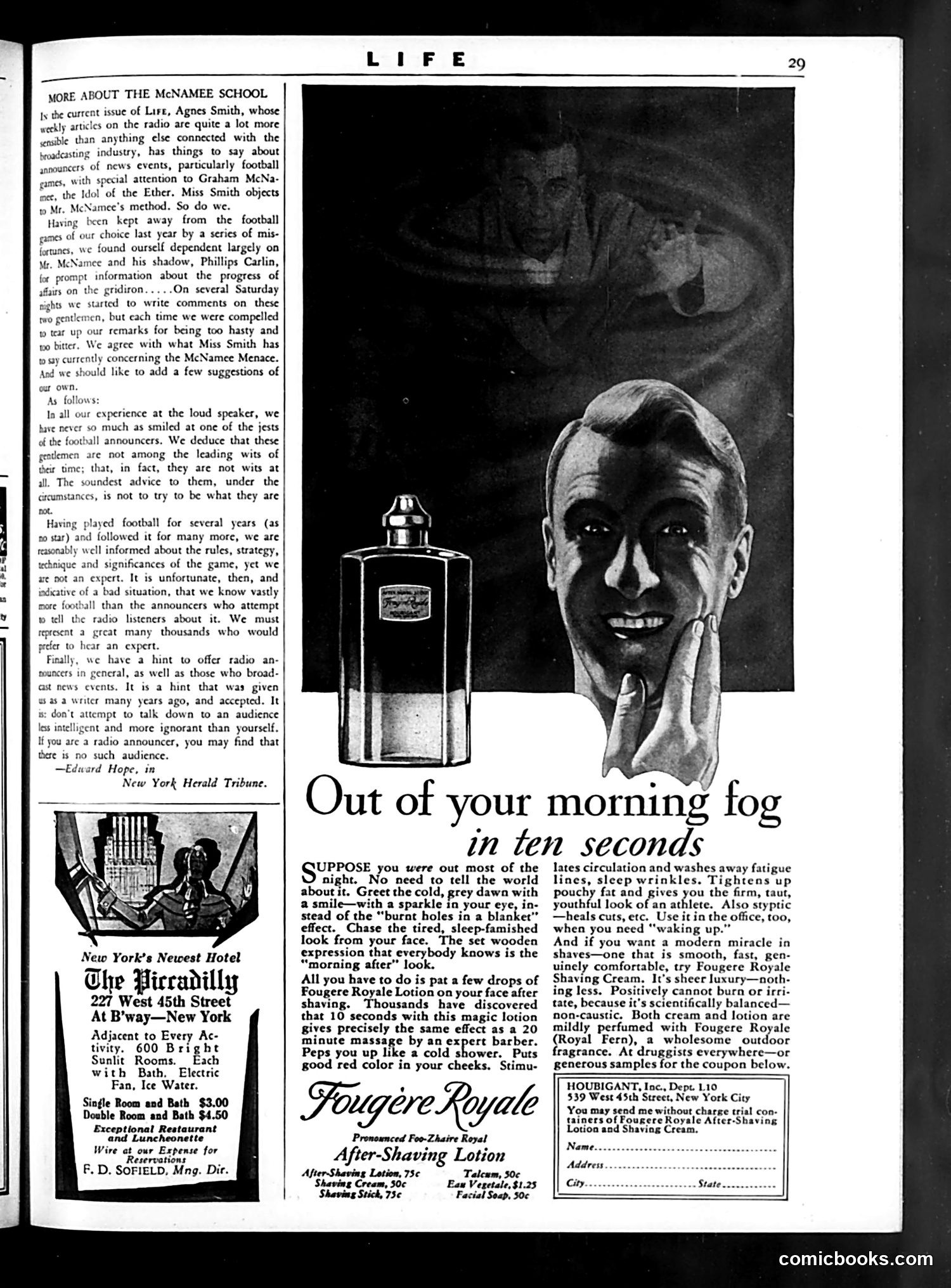
This page contains two distinct elements: **The Editorial Content (left):** A critique of Graham McNamee, a famous 1920s-30s radio football announcer. The article, citing Agnes Smith's radio column, attacks McNamee and his colleague Phillips Carlin for poor announcing—specifically for attempting humor they're unqualified to deliver and for lacking football expertise. The author argues radio announcers should be experts, not entertainers trying to "talk down" to audiences. This reflects early radio's growing pains and debates over professionalism in broadcasting. **The Advertisement (right):** A Fougere Royale after-shaving lotion ad featuring a smiling man's face, promoting the product as a quick "morning after" remedy that eliminates fatigue, wrinkles, and tired appearance in seconds. The copy humorously acknowledges hangovers ("suppose you were out most of the night") while selling rejuvenation—a typical 1920s-30s masculine grooming appeal blending practicality with vanity.
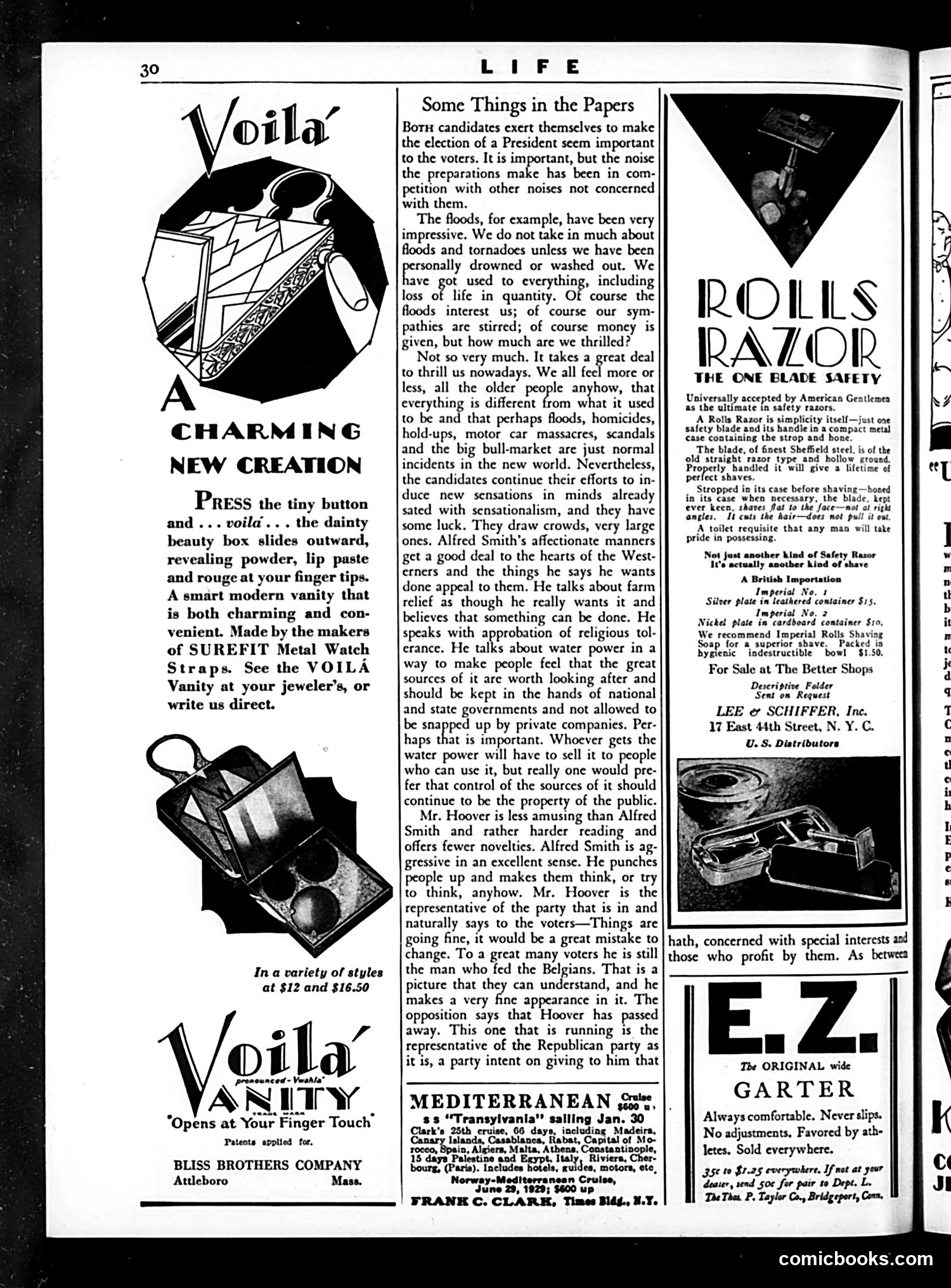
This page is primarily **advertising** for consumer products (Voila vanity compacts, Rolls Razor safety razors, Mediterranean cruises), with a substantial editorial column titled "Some Things in the Papers." The editorial discusses the **1928 U.S. Presidential election** between Alfred Smith (Democratic) and Herbert Hoover (Republican). The author argues that despite candidates' efforts to generate excitement, Americans have become desensitized to sensational news—floods, homicides, scandals are now routine. Smith is portrayed as engaging and passionate, especially on farm relief and public water-power control. Hoover represents the incumbent Republican party offering continuity ("Things are going fine, it would be a great mistake to change") and still benefits from his reputation feeding Belgians during WWI. The piece suggests Hoover's Republican Party is beholden to special interests rather than the public good—a critique of corporate influence in politics. The tone is weary about modern American political apathy.
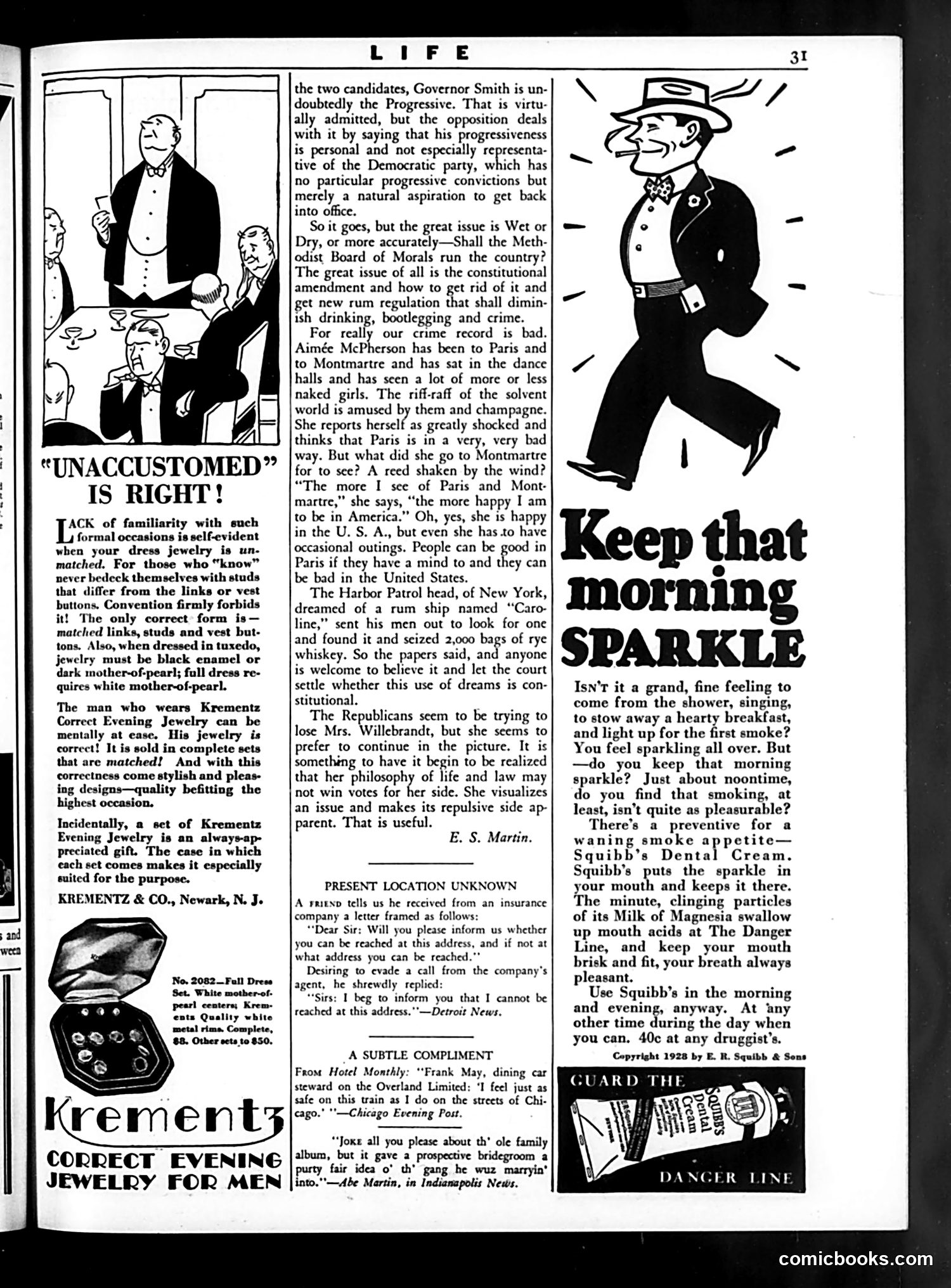
This page contains editorial commentary on the 1928 U.S. presidential election, likely by E.S. Martin. The text criticizes both major candidates while focusing on Prohibition as the dominant election issue. The piece mocks the "Methodist Board of Morals" controlling the country—a reference to anti-alcohol crusaders who pushed Prohibition. It sarcastically discusses Aimée McPherson, the famous evangelist who visited Paris's Montmartre district and returned shocked by its decadence, while the author questions why she went there seeking such sights. The commentary also references Mabel Willebrandt, Prohibition's chief enforcer under Hoover, suggesting her unpopularity may cost Republicans votes despite her anti-crime efforts. The left side contains a Krementz jewelry advertisement using the phrase "Unaccustomed is Right!"—likely referencing Al Smith (the Democratic candidate), a Catholic New Yorker whose working-class background and accent made him seem "unaccustomed" to formal society to some voters.
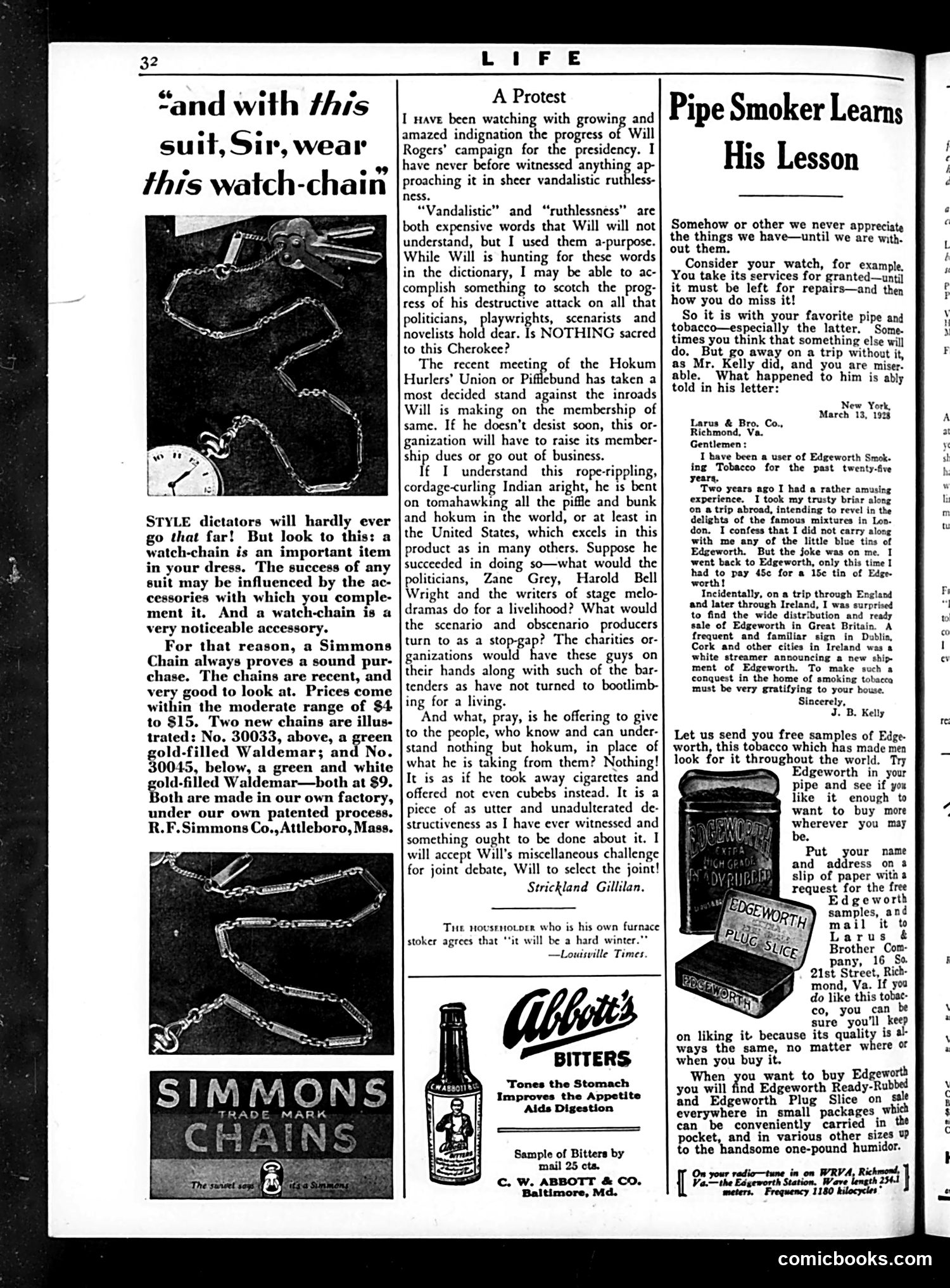
This page contains a satirical protest letter (center column) mocking Will Rogers' 1928 presidential campaign. The anonymous author, writing as "Strickland Gillilan," sarcastically complains that Rogers—described as a "Cherokee" vaudeville performer—is destructively attacking "piffle and bunk" that politicians, novelists, and scenario writers depend upon for their livelihoods. The satire works by pretending outrage: Rogers is accused of "vandalism" and "ruthlessness" for exposing hokum and dishonesty. The author darkly jokes that if Rogers succeeds in eliminating nonsense from public discourse, these professionals will have no work. The surrounding advertisements (Simmons watch chains, Abbott's Bitters, Edgeworth pipe tobacco) are period commercial content, not political commentary. The page illustrates how Life magazine mixed political satire with consumer advertising in the 1920s.
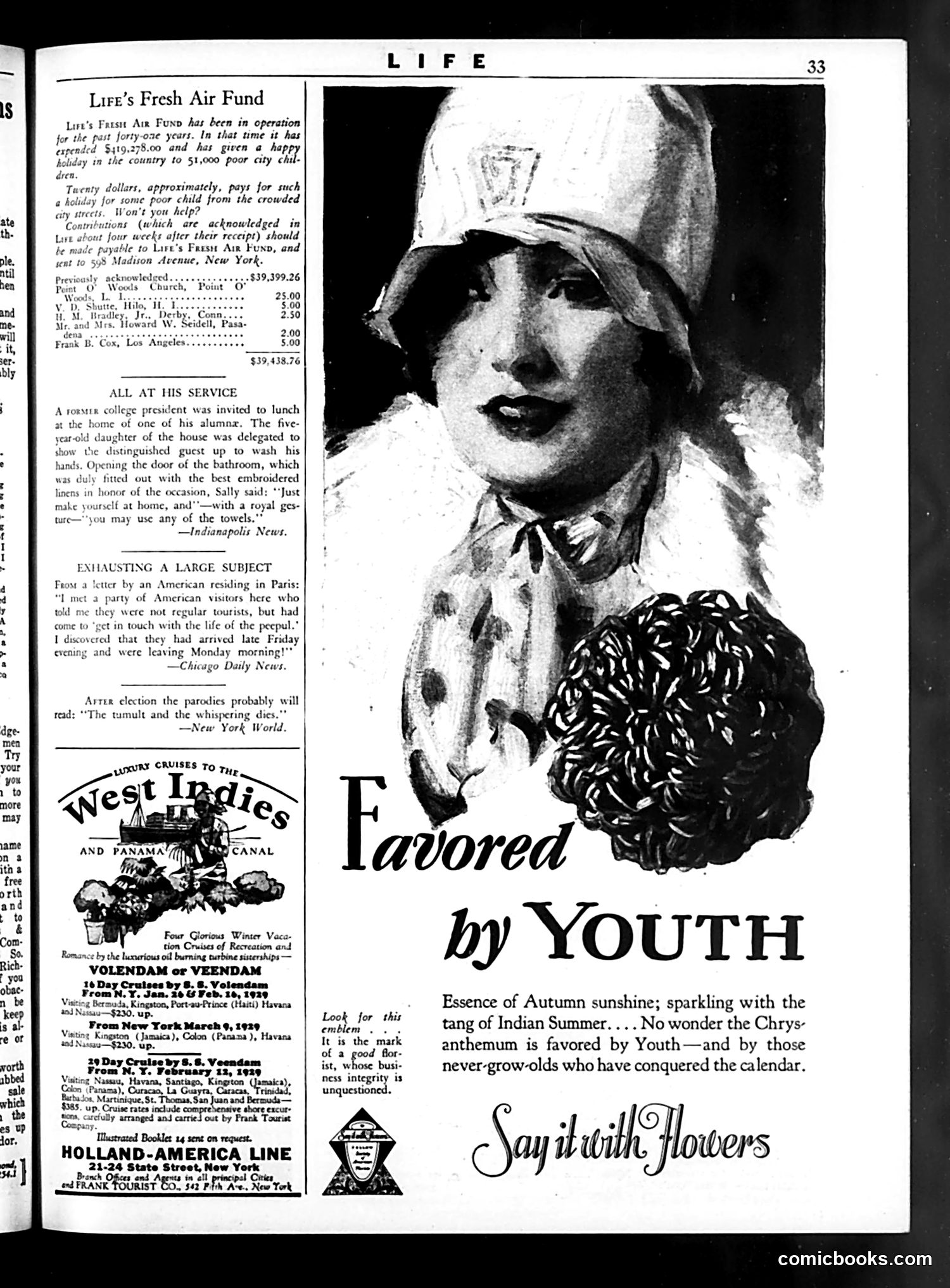
This page mixes charitable appeals, humorous anecdotes, and advertisements typical of 1920s Life magazine. **Main Content:** - **Life's Fresh Air Fund**: A charity campaign asking readers to donate $20 to send poor city children on country holidays. This reflects Progressive Era concerns about urban poverty and child welfare. - **Three brief humorous anecdotes** satirizing American social pretension and tourism: 1. A college president's daughter offers a bathroom to a guest with affected politeness 2. American tourists claiming to experience "real" local life while only staying Friday-to-Monday 3. A reference to election-season political rhetoric **Advertising:** The right side features a large chrysanthemum advertisement ("Favored by Youth") and cruise line advertisements for the Holland-America Line, typical luxury travel marketing of the era. The page reflects 1920s middle-class anxieties about propriety, authenticity, and consumption, while promoting charitable giving and leisure travel.
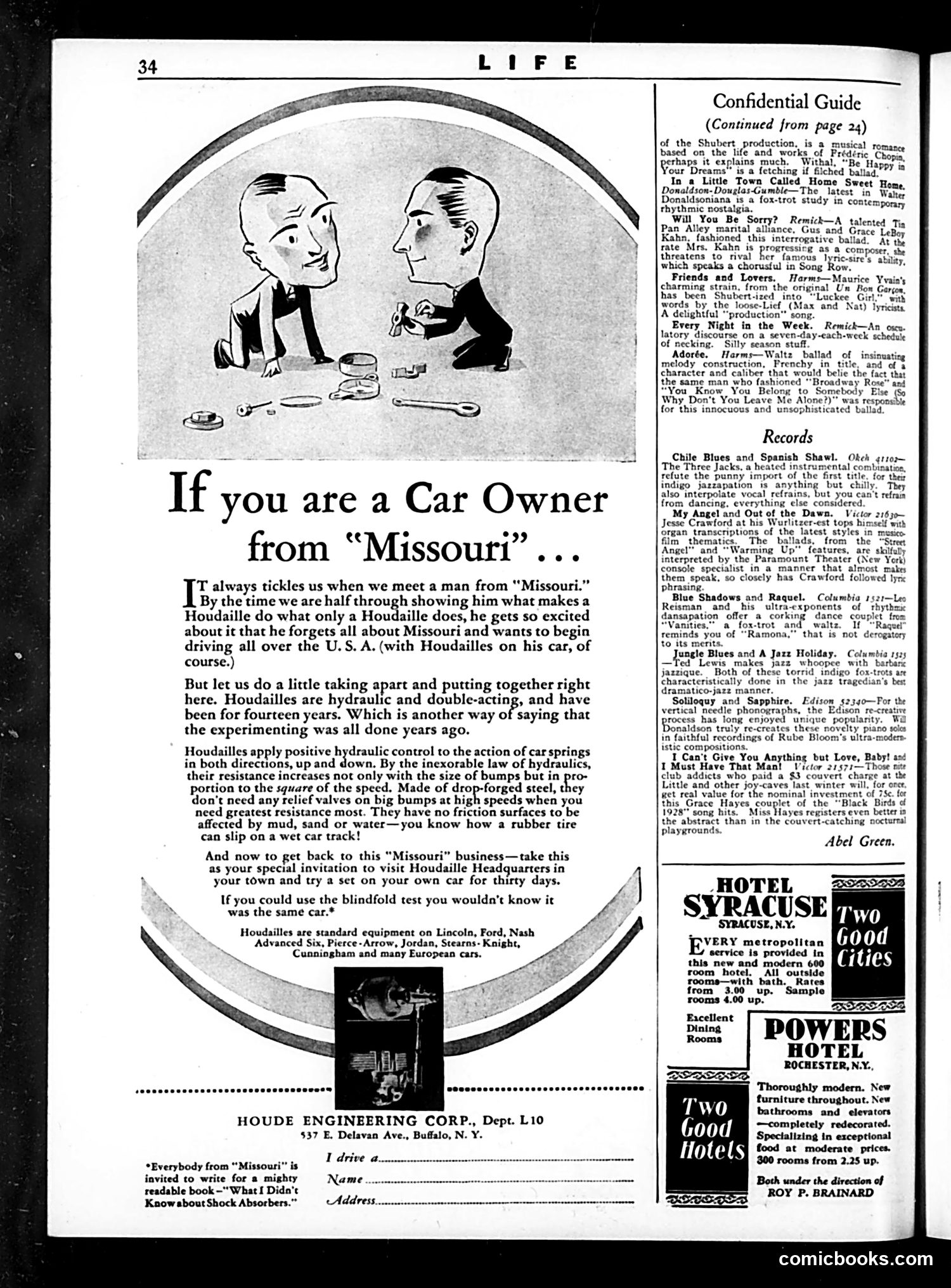
This page contains a **Houdaille automobile shock absorber advertisement** disguised as editorial content, alongside record reviews and hotel ads. The cartoon shows two men in formal wear appearing to have a conversation—likely representing a "Missouri" car owner being impressed by a Houdaille representative explaining the vehicle's suspension system. **The "joke":** The ad claims people from Missouri get so excited about Houdaille shock absorbers that they forget about their home state and want to drive everywhere in the U.S. showcasing the product. It's gentle, corny advertising humor. **The technical pitch:** Houdailles are hydraulic, double-acting shocks that resist bumps proportionally to speed—presented as decades-old proven technology. **Context:** This reflects 1920s automotive advertising when shock absorbers were competitive selling points. The page also includes music record reviews (typical Life magazine content of the era) and hotel advertisements, showing this was a general-interest publication mixing editorial, reviews, and paid advertising.
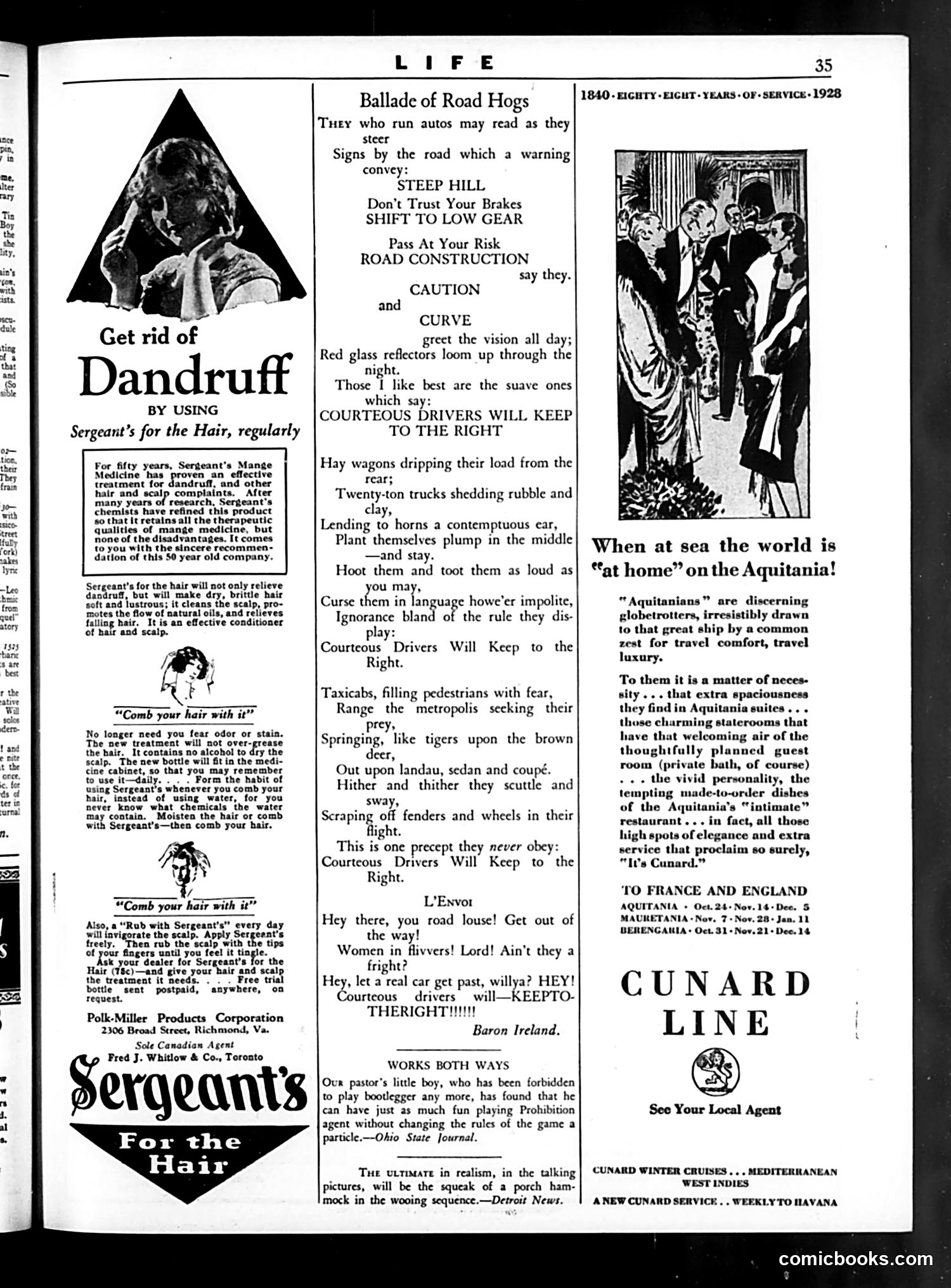
This poem satirizes the reckless driving habits of 1920s motorists, particularly targeting those who ignore road safety signs advocating "Courteous Drivers Will Keep to the Right." The satire identifies specific offenders: hay wagons and trucks blocking the road, taxi drivers aggressively weaving through traffic "like tigers," and women in "flivvers" (cheap cars). The poem mocks how these drivers brazenly disregard basic courtesy rules despite warning signs everywhere. The "L'Envoi" (closing stanza) captures the aggressive, profane attitude of impatient drivers yelling at these obstructionists—highlighting the road rage and dangerous behavior plaguing 1920s streets during the automobile boom. The final note about a pastor's boy playing "Prohibition agent" jokes about Prohibition enforcement (1920-1933), suggesting children mimic adult authority figures, turning rule-breaking into a game—paralleling how drivers treat traffic laws. The satire reflects genuine anxiety about automobile safety and the clash between new motoring culture and pedestrian safety.
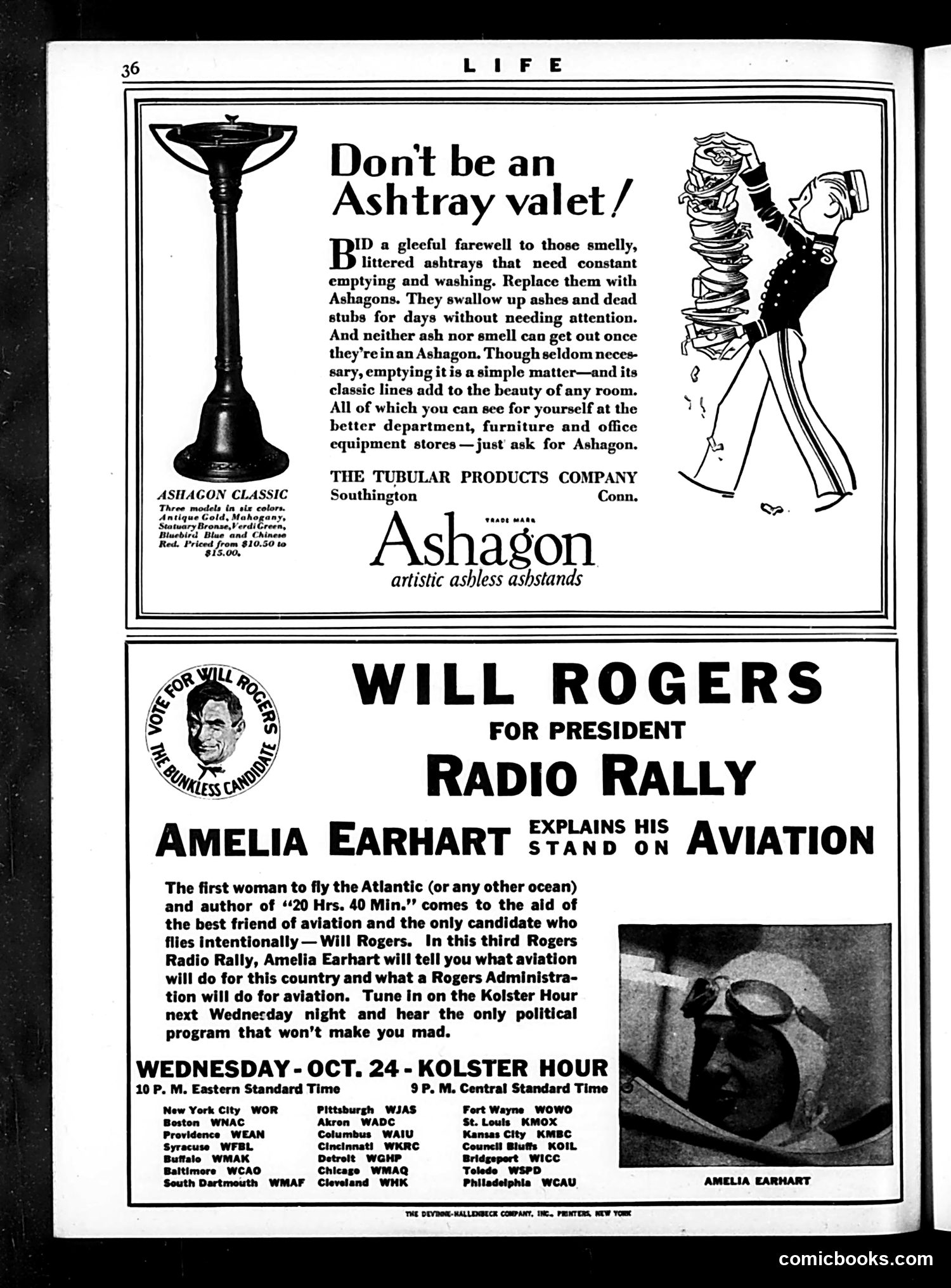
This page contains two distinct items: **Top half:** An advertisement for "Ashagon" ashtrays by The Tubular Products Company. The ad uses humorous copy mocking traditional ashtrays as "smelly, littered" nuisances requiring constant maintenance, positioning Ashagons as sealed containers that eliminate odor and mess. The cartoon illustration shows a frustrated person drowning in overflowing ash. It's straightforward product advertising with satirical humor about household inconvenience. **Bottom half:** A political advertisement promoting Will Rogers for President, featuring aviator Amelia Earhart. The text presents Rogers as "the only candidate who flies intentionally" and "the best friend of aviation." Earhart, famous for her 1928 transatlantic flight, endorses Rogers and will speak on his behalf during a radio rally broadcast October 24 across multiple stations. This appears to be a satirical/humorous presidential campaign (Rogers was known for political humor), with aviation positioned as a campaign issue.
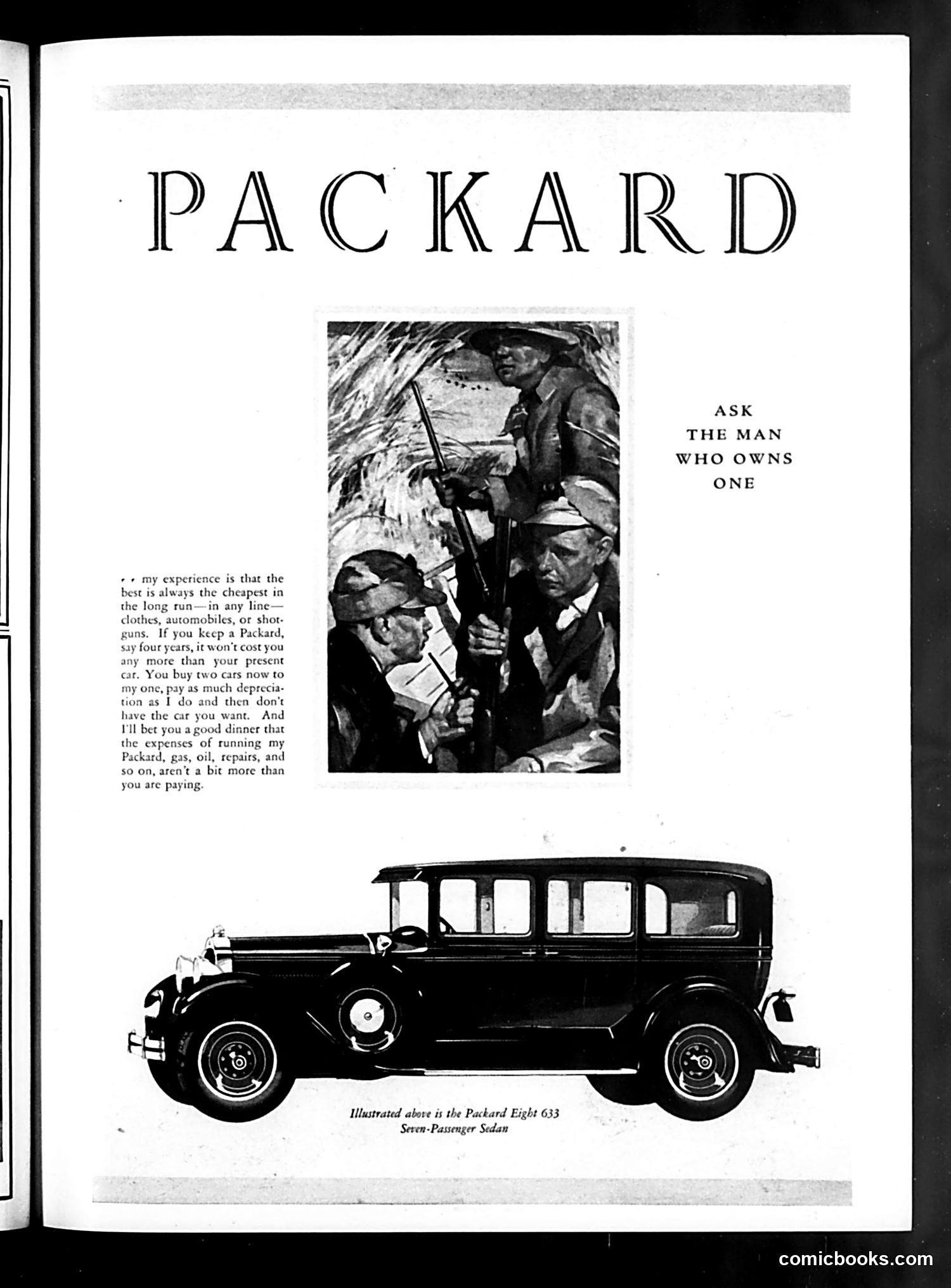
This is a **Packard automobile advertisement**, not political satire. The page promotes the Packard Eight 633 luxury sedan through a testimonial format. The advertisement uses a common early 20th-century sales technique: the "Ask the Man Who Owns One" slogan (visible top right). The text presents an affluent owner's argument that Packards, while expensive initially, prove economical long-term because they require fewer replacements and minimal maintenance compared to cheaper cars. The photograph shows well-dressed men examining or discussing the vehicle, reinforcing the aspirational, upper-class positioning. The illustration displays the elegant seven-passenger sedan. For modern readers: this represents pre-Depression era luxury marketing that emphasized reliability and value-retention—appealing to wealthy buyers justifying premium prices through total cost-of-ownership logic rather than mere prestige.
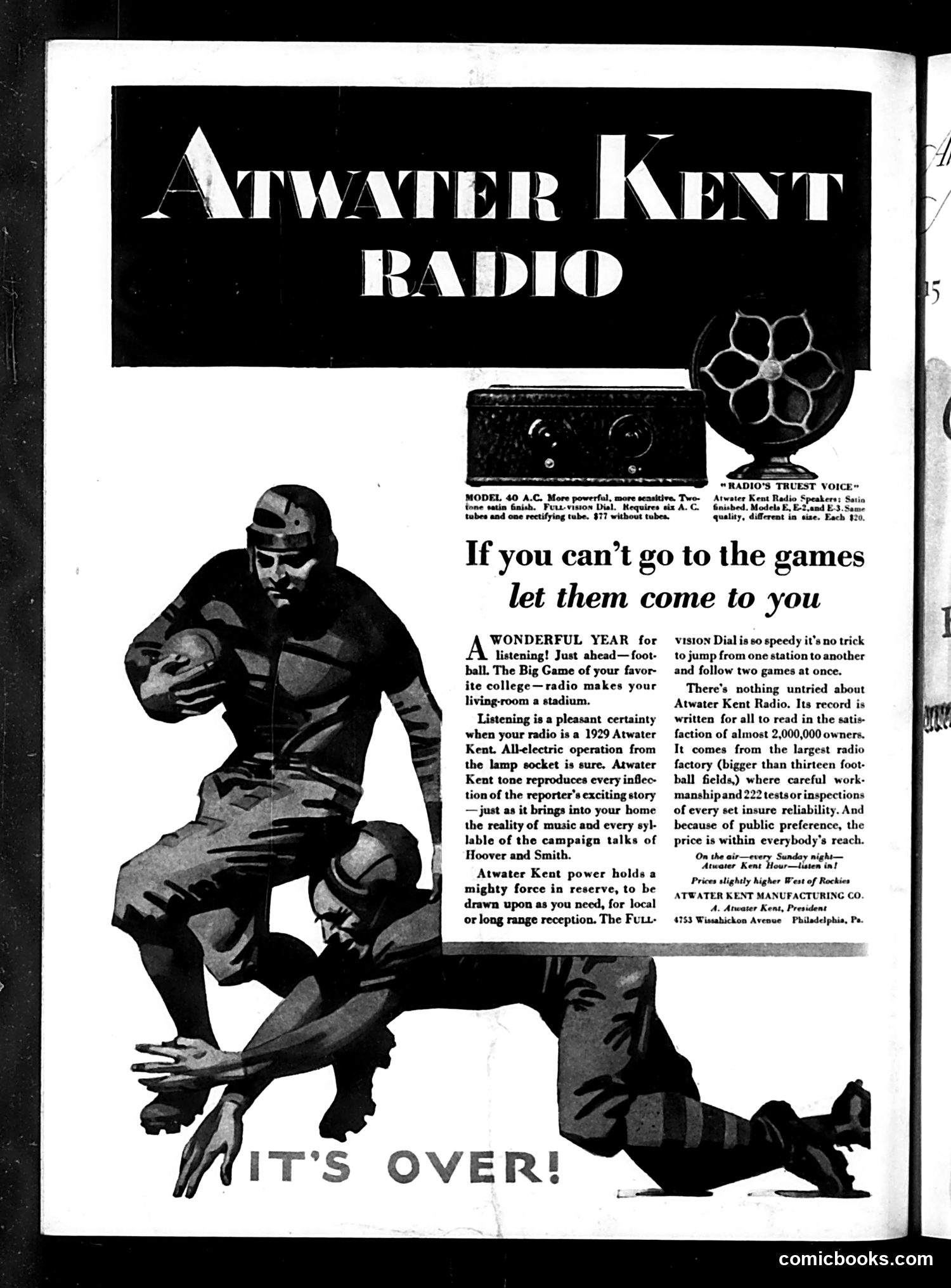
This is primarily a **radio advertisement**, not political satire. It promotes Atwater Kent radios by emphasizing their ability to bring live sports broadcasts into the home. The image shows a **football player in action** with the tagline "If you can't go to the games let them come to you." The "IT'S OVER!" caption refers to the football play depicted, not any larger event. The ad references **"the Big Game of your favorite college"** and mentions **Hoover and Smith**—the 1928 presidential candidates—to highlight the radio's capability to broadcast major events live. This was novel technology: radio transmission of sporting events and political speeches was still relatively recent and exciting to consumers. The advertisement emphasizes the radio's reliability (2,000,000 owners), manufacturing quality (222 tests per unit), and affordability, positioning the Atwater Kent as the superior choice for home entertainment during this emerging broadcast era.