
Life, 1928-10-19 · page 18 of 40
Life — October 19, 1928 — page 18: what you’re looking at
What you’re looking at
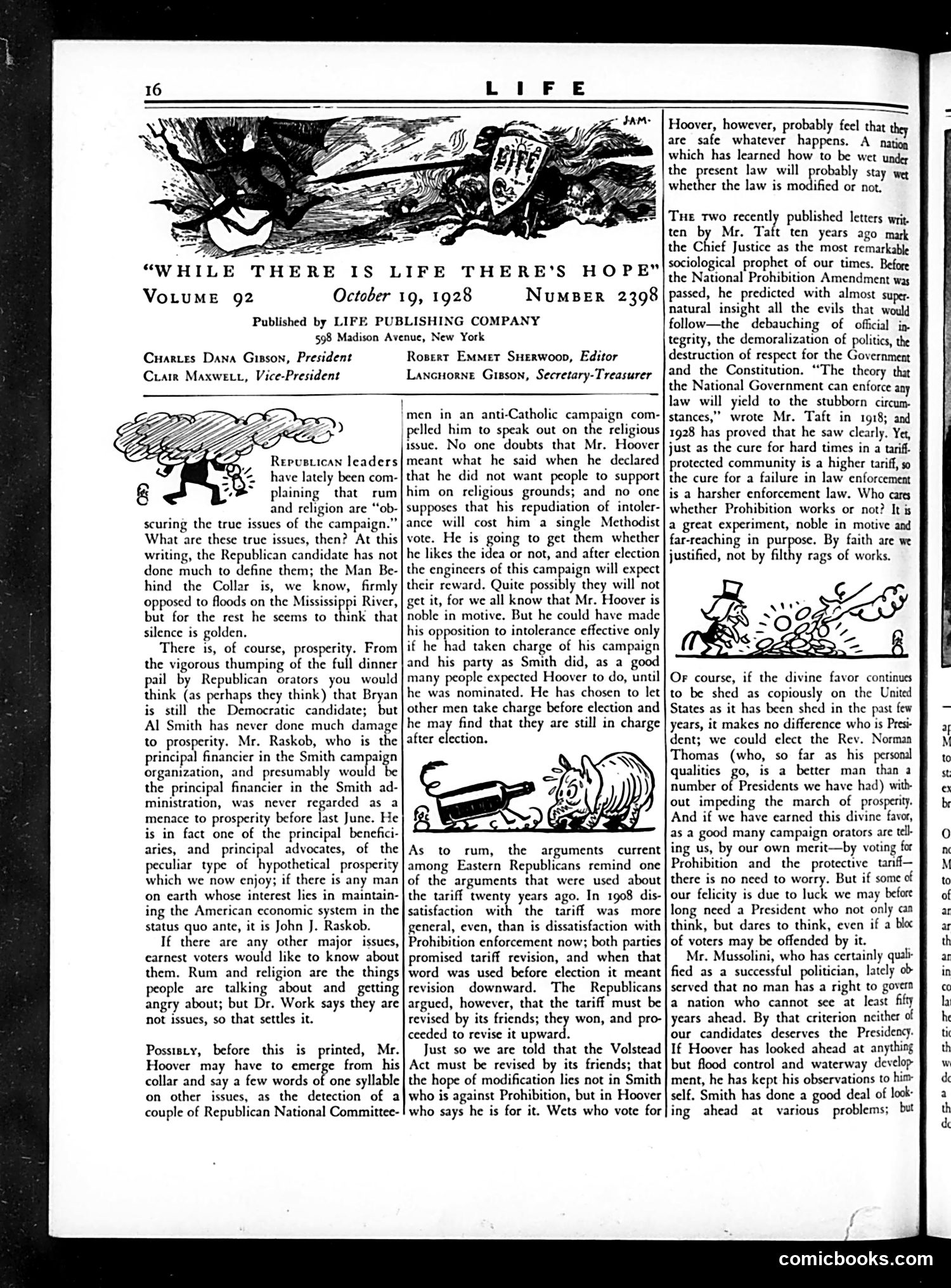
This page critiques Republican campaign tactics before the 1928 presidential election. The article discusses how GOP leaders are using religion and anti-Catholicism as campaign issues, likely referencing opposition to Catholic candidate Al Smith. The cartoons illustrate the hypocrisy: one shows a figure being struck down (suggesting consequences of dirty tactics), another depicts someone falling or being defeated. The text argues Republicans are exploiting religious prejudice rather than addressing substantive issues like the tariff or prohibition enforcement. The article defends Herbert Hoover's measured response, suggesting he could have campaigned more aggressively on religion but chose not to—implying moral superiority. The satire criticizes both parties' manipulation of voters through manufactured controversies rather than genuine policy debate.
📄 Transcribed text from this page (OCR, searchable)
Machine-transcribed from the original scan — historical spelling and the odd misread are preserved.
VoLUME 92 October 19, 1928 NuMBER 2398 Published by LIFE PUBLISHING COMPANY 598 Madison Avenue, New York Cuartes Dana Gisson, President Crain Maxwett, Vice-President Rosert Emmet SHerwoon, Editor Lancuorne Gipson, Secretary-Treasurer Repvstican leaders have lately been com- plaining that rum and religion are ‘‘ob- scuring the true issues of the campaign.” What are these true issues, then? At this writing, the Republican candidate has not done much to define them; the Man Be- hind the Collar is, we know, firmly opposed to floods on the Mississippi River, but for the rest he seems to think that silence is golden. There 1s, of course, prosperity. From the vigorous thumping of the full dinner pail by Republican orators you would think (as perhaps they think) that Bryan is still the Democratic candidate; but Al Smith has never done much damage to prosperity. Mr. Raskob, who is the principal financier in the Smith coal tg organization, and presumably would the principal financier in the Smith ad- ministration, was never regarded as a menace to prosperity before last June. He is in fact one of the principal benefici- aries, and principal advocates, of the peculiar type of hypothetical prosperity which we now enjoy; if there is any man on earth whose interest lies in maintain- ing the American economic system in the status quo ante, it is John J. Raskob. If there are any other major issues, carnest voters would like to know about them. Rum and religion are the things people are talking about and getting angry about; but Dr. Work says they are Not issues, so that settles it. Possisty, before this is printed, Mr. Hoover may have to emerge from his collar and say a few words of one syllable on other issues, as the detection of a couple of Republican National Committee- men in an anti-Catholic campaign com- pelled him to speak out on the religious issue. No one doubts that Mr. Hoover meant what he said when he declared that he did not want people to support him on religious grounds; and no one supposes that his repudiation of intoler- ance will cost him a single Methodist vote. He is going to get them whether he likes the idea or not, and after election the engincers of this campaign will expect their reward. Quite possibly they will not get it, for we all know that Mr. Hoover is noble in motive. But he could have made his opposition to intolerance effective only if he had taken charge of his campaign and his party as Smith did, as a good many people expected Hoover to do, until he was nominated. He has chosen to let other men take charge before election and he may find that they are still in charge after election. As to rum, the arguments current among Eastern Republicans remind one of the arguments that were used about the tariff twenty years ago. In 1908 dis- satisfaction with the tariff was more general, even, than is dissatisfaction with Prohibition enforcement now; both parties promised tariff revision, and when that word was used before election it meant revision downward. The Republicans argued, however, that the tariff must be revised by its friends; they won, and pro- ceeded to revise it pears. Just so we are told that the Volstead Act must be revised by its friends; that the hope of modification lies not in Smith who is against Prohibition, but in Hoover who says he is for it. Wets who vote for Hoover, however, probably feel that are safe whatever happens. A Nation which has learned how to be wet under the present law will probably stay wet whether the law is modified or not. Tue two recently published letters writ. ten by Mr. Tatt ten years ago mark the Chief Justice as the most remarkable sociological prophet of our times. Before the National Prohibition Amendment was passed, he predicted with almost super. natural insight all the evils that would follow—the debauching of official in. tegrity, the demoralization of politics, the destruction of respect for the Government and the Constitution. “The theory tha the National Government can enforce any law will yield to the stubborn circum. stances,” wrote Mr. Taft in 1918; and 1928 has proved that he saw clearly. Yet, just as the cure for hard times in a tariff. protected community is a higher tariff, so the cure for a failure in law enforcement is a harsher enforcement law. Who cares whether Prohibition works or not? It is a great experiment, noble in motive and far-reaching in purpose. By faith are we justified, not by filthy rags of works. Or course, if the divine favor continues to be shed as copiously on the United States as it has been shed in the past few years, it makes no difference who is Pres- dent; we could elect the Rev. Norman Thomas (who, so far as his personal qualities fe is a better man than a number of Presidents we have had) with out impeding the march of prosperity. And if we have earned this divine favor, as a good many campaign orators are tell ing us, by our own merit—by voting for Prohibition and the protective tanfi— there is no need to worry. But if some of our felicity is due to luck we may before long need a President who not only can think, but dares to think, even if a ble of voters may be offended by it. Mr. Mussolini, who has certainly quali fied as a successful politician, lately ob served that no man has a right to govern a nation who cannot sce at least fifty years ahead. By that criterion neither of our candidates deserves the Presidency. If Hoover has looked ahead at anything but flood control and waterway develop ment, he has kept his observations to him- self, Smith has done a good deal of look- ing ahead at various problems; but comicbooks.com