
Life, 1928-10-19 · page 22 of 40
Life — October 19, 1928 — page 22: what you’re looking at
What you’re looking at
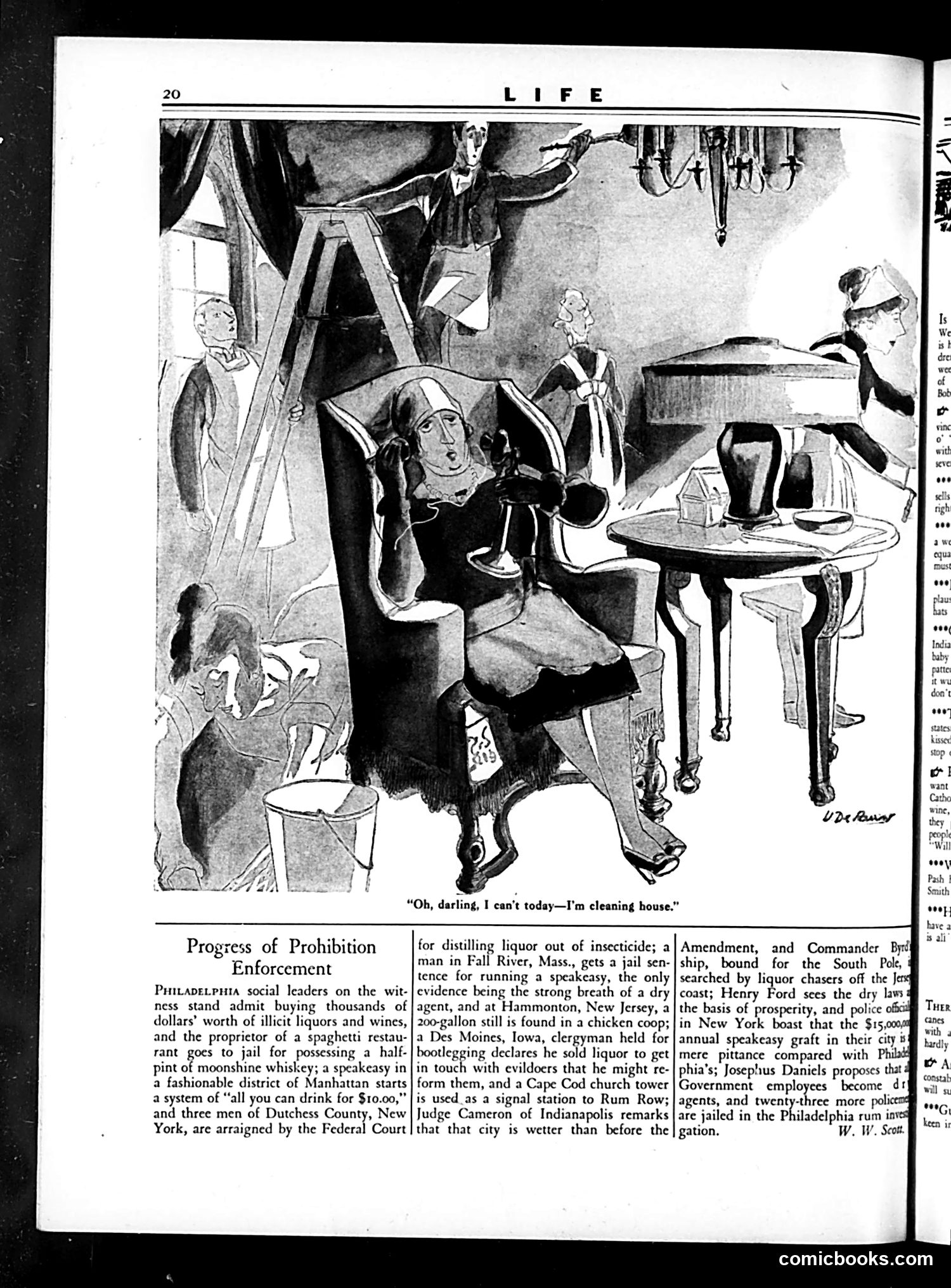
This satirical cartoon and article mock the failure of Prohibition enforcement during the 1920s-early 1930s. The cartoon shows a woman refusing a social engagement because she's "cleaning house"—a transparent excuse, likely implying she's actually drinking illicitly at home. The accompanying text catalogs absurd contradictions in Prohibition enforcement: wealthy socialites buy expensive illegal liquor without prosecution, while poor people face jail time for minor infractions. Enforcement is revealed as hypocritical and ineffective—speakeasies operate openly with subscription pricing, clergy bootleg alcohol claiming moral purposes, church towers signal smugglers, and police themselves profit from graft. The overall point: Prohibition has failed completely. Rather than eliminating drinking, it's created widespread lawbreaking, corruption among enforcers, and a justice system punishing the poor while the wealthy operate with impunity. The satire exposes how unenforceable and socially divisive the law has become.
📄 Transcribed text from this page (OCR, searchable)
Machine-transcribed from the original scan — historical spelling and the odd misread are preserved.
“Oh, darling, I can't today—I'm cleaning house.” Progress of Prohibition Enforcement Privapecputa social leaders on the wit- ness stand admit buying thousands of dollars’ worth of illicit liquors and wines, and the proprietor of a spaghetti restau- rant goes to jail for possessing a half- pint of moonshine whiskey; a speakeasy in a fashionable district of Manhattan starts a system of “all you can drink for $10.00," and three men of Dutchess County, New York, are arraigned by the Federal Court for distilling liquor out of insecticide; a man in Fall River, Mass., gets a jail sen- tence for running a speakeasy, the only evidence being the strong breath of a dry agent, and at Hammonton, New Jersey, a 200-gallon still is found in a chicken coop; a Des Moines, Iowa, clergyman held for bootlegging declares he sold liquor to get in touch with evildoers that he might re- form them, and a Cape Cod church tower is used_as a signal station to Rum Row; Judge Cameron of Indianapolis remarks that that city is wetter than before the Amendment, and Commander Bytl ship, bound for the South Pole, searched by liquor chasers off the J coast; Henry Bord sees the dry laws 4 the basis of prosperity, and police o in New York boast that the $15, annual speakeasy graft in their city 6 mere pittance compared with Phila phia’s; Josephus Daniels proposes that Government employees become dt agents, and twenty-three more policen4 are jailed in the Philadelphia rum inves gation. W. W. Scot. comicbooks.com