
Life, 1928-10-19 · page 13 of 40
Life — October 19, 1928 — page 13: what you’re looking at
What you’re looking at
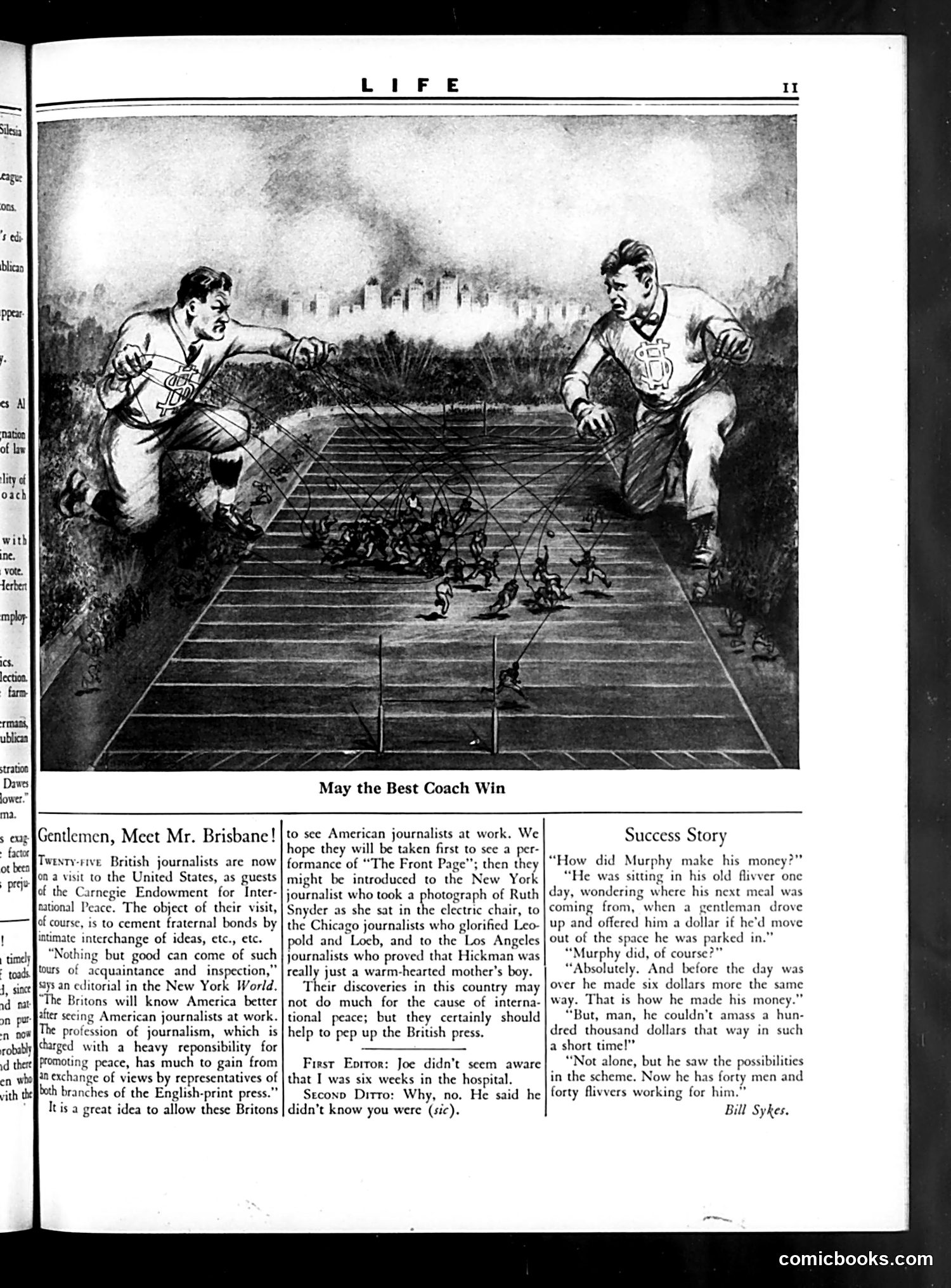
This cartoon satirizes competition between American and British journalism. Two giant coaches (representing their respective nations' press) loom over a football field where tiny journalists scramble like players. The accompanying text discusses British journalists visiting the U.S. as guests of the Carnegie Endowment. It humorously suggests they'll witness American journalism in action—mentioning specific incidents involving journalists photographing Ruth Snyder (a famous 1920s crime case), Chicago journalists covering Leopold and Loeb, and Los Angeles journalists' coverage of Hickman (another notorious case). The satire critiques American sensationalism: British visitors will see American journalists "at work," implying their aggressive, competitive coverage of scandals and crimes represents a stark contrast to (presumably more restrained) British press standards. The "coaches" framing positions journalism as a competitive sport.
📄 Transcribed text from this page (OCR, searchable)
Machine-transcribed from the original scan — historical spelling and the odd misread are preserved.
-|Gentlemen, Meet Mr. Brisbane! Twenty-Five British journalists are now Jo a visit to the United States, as guests jof the Carnegie Endowment for Inter- tational Peace. The object of their visit, lof course, is to cement fraternal bonds by imate interchange of ideas, etc., etc. “Nothing but good can come of such spurs of acquaintance and inspection,” says an editorial in the New York World. “The Britons will know America better .pelter seeing American journalists at work. profession of journalism, which is charged with a heavy reponsibility for .d thee Promoting peace, has much to gain from on who” exchange of views by representatives of vith the °oth branches of the English-print press.” Itis a great idea to allow these Britons WN ew, io aah) May the Best Coach Win a to see American journalists at work. We hope they will be taken first to see a per- formance of “The Front Page"; then they might be introduced to the New York journalist who took a photograph of Ruth Snyder as she sat in the electric chair, to the Chicago journalists who glorified Leo- pold and Loeb, and to the Los Angeles journalists who proved that Hickman was really just a warm-hearted mother’s boy. Their discoveries in this country may not do much for the cause of interna- tional peace; but they certainly should help to pep up the British press. First Eprror: Joe didn’t seem aware that I was six weeks in the hospital. Seconp Ditro: Why, no. He said he didn’t know you were (sic). Success Story “How did Murphy make his money?” “He was sitting in his old flivver one day, wondering where his next meal was coming from, when a gentleman drove up and offered him a dollar if he'd move out of the space he was parked in.” “Murphy did, of course?” “Absolutely. And before the day was over he made six dollars more the same way. That is how he made his money.” “But, man, he couldn't amass a hun- dred thousand dollars that way in such a short time!” “Not alone, but he saw the possibilities in the scheme. Now he has forty men and forty flivvers working for him.” Bill Sykes. comicbooks.com