
Life, 1928-10-19 · page 21 of 40
Life — October 19, 1928 — page 21: what you’re looking at
What you’re looking at
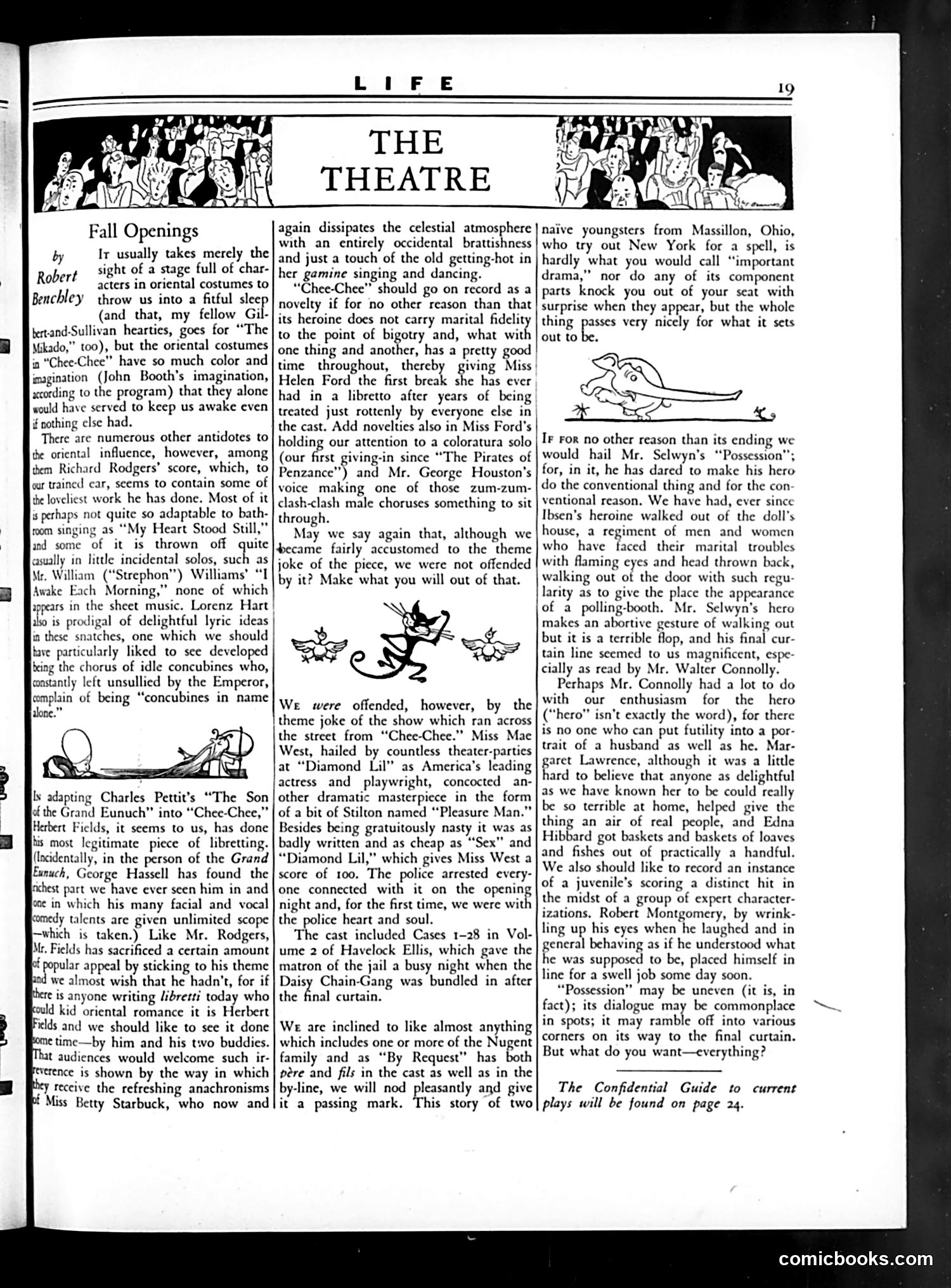
This is a theatre review column by Robert Benchley critiquing two Broadway productions: "Chee-Chee" (an Oriental-themed musical with score by Richard Rodgers and lyrics by Lorenz Hart) and Mae West's "Pleasure Man." **"Chee-Chee"** receives qualified praise—Benchley admires the colorful costumes, Rodgers' music, and Hart's witty lyrics. He notes the show's novelty in depicting its heroine without excessive moral prudishness, and praises actress Helen Ford's rare good role. **"Pleasure Man"** is harshly condemned. Benchley calls it gratuitously vulgar, poorly written, and cheap—grouping it with West's earlier controversial plays "Sex" and "Diamond Lil." He notes police arrested everyone involved on opening night and expresses rare approval of police action, indicating the content was considered extremely obscene by 1928 standards. The illustrations show stylized theatrical figures and a dancing cat character, typical of the era's magazine design. Benchley's tone is witty but moralistic regarding West's work.
📄 Transcribed text from this page (OCR, searchable)
Machine-transcribed from the original scan — historical spelling and the odd misread are preserved.
Ir usually takes merely the sight of a stage full of char- acters in oriental costumes to throw us into a fitful slee; (and that, my fellow cil. tertand-Sullivan hearties, goes for “The Mikado,” too), but the oriental costumes in “Chee-Chee” have so much color and imagination (John Booth’s imagination, xcording to the program) that they alone would have served to keep us awake even f nothing else had. There are numerous other antidotes to the oriental influence, however, among them Richard Rodgers’ score, which, to car trained car, seems to contain some of the loveliest work he has done. Most of it is perhaps not quite so adaptable to bath- rom singing as “My Heart Stood Still,” and some of it is thrown off quite casually in little incidental solos, such as Mr. William (“Strephon”) Williams’ “I Awake Each Morning,” none of which appears in the sheet music. Lorenz Hart} ako is prodigal of delightful lyric ideas in these snatches, one which we should tave particularly liked to see developed being the chorus of idle concubines who, constantly left unsullied by the Emperor, complain of being “concubines in name lone.” ls adapting Charles Pettit’s “The Son of the Grand Eunuch”’ into “Chee-Chee,” Herbert Fields, it seems to us, has done his most legitimate piece of libretting. (lncidentally, in the person of the Grand Ewnuch, George Hassell has found the Hnchest part we have ever seen him in and ae in which his many facial and vocal comedy talents are given unlimited scope which is taken.) Like Mr. Rodgers, Mr. Fields has sacrificed a certain amount popular appeal by sticking to his theme d we almost wish that he hadn't, for if fhere is anyone writing libretti today who wuld kid oriental romance it is Herbert Fields and we should like to see it done ome time—by him and his t:vo buddies. t audiences would welcome such ir- erence is shown by the way in which my receive the refreshing anachronisms PE Miss Betty Starbuck, who now and THE THEATRE again dissipates the celestial atmosphere with an entirely occidental brattishness and just a touch of the old getting-hot in her gamine singing and dancing. “Chee-Chee” should go on record as a novelty if for no other reason than that its heroine does not carry marital fidelity to the point of bigotry and, what with one thing and another, has a pretty good time throughout, thereby Helen Ford the first break she has ever had in a libretto after years of being treated just rottenly by everyone else in the cast. Add novelties also in Miss Ford's holding our attention to a coloratura solo (our first giving-in since “The Pirates of Penzance?) and Mr. George Houston's voice making one of those zum-zum- clash-clash male choruses something to sit through. May we say again that, although we ecame fairly accustomed to the theme joke of the piece, we were not offended by it? Make what you will out of that. = We were offended, however, by the theme joke of the show which ran across the street from “‘Chee-Chee.” Miss Mae West, hailed by countless theater-parties at “Diamond Lil” as America’s leading actress and playwright, concocted an- other dramatic masterpiece in the form of a bit of Stilton named “Pleasure Man.” Besides being gratuitously nasty it was as badly written and as cheap as “Sex” and “Diamond Lil,” which gives Miss West a score of 100, The police arrested every- one connected with it on the openin night and, for the first time, we were wit the police heart and soul. The cast included Cases 1-28 in Vol- ume 2 of Havelock Ellis, which gave the matron of the jail a busy night when the Daisy Chain-Gang was bundled in after the final curtain. ie We are inclined to like almost anything which includes one or more of the Nugent family and as “By Request” has both pere and fils in the cast as well as in the by-line, we will nod pleasantly and give it a passing mark. This story of two giving Miss | naive youngsters from Massillon, Ohio, who try out New York for a spell, is hardly what you would call “important drama,” nor do any of its component parts knock you out of your seat with surprise when they appear, but the whole thing Ee very nicely for what it sets out to be, Ir For no other reason than its ending we would hail Mr. Selwyn’s “Possession”; for, in it, he has dared to make his hero do the conventional thing and for the con- ventional reason. We have had, ever since Ibsen's heroine walked out of the doll’s house, a regiment of men and women who have faced their marital troubles with flaming eyes and head thrown back, walking out of the door with such regu- larity as to give the place the appearance of a polling-booth. Mr. Selwyn’s hero makes an abortive gesture of walking out but it is a terrible flop, and his final cur- tain line seemed to us magnificent, espe- cially as read by Mr. Walter Connolly. Perhaps Mr. Connolly had a lot to do with our enthusiasm for the hero (“hero” isn’t exactly the word), for there is no one who can put futility into a por- trait of a husband as well as he. Mar- paret Lawrence, although it was a little ard to believe that anyone as delightful as we have known her to be could really be so terrible at home, helped give the thing an air of real people, and Edna Hibbard got baskets and baskets of loaves and fishes out of practically a handful. We also should like to record an instance of a juvenile’s scoring a distinct hit in the midst of a group of expert character- izations, Robert Montgomery, by wrink- ling up his eyes when he laughed and in general behaving as if he understood what he was supposed to be, placed himself in line for a swell job some day soon. “Possession” may be uneven (it is, in fact); its dialogue may be commonplace in spots; it may tumble off into various corners on its way to the final curtain. But what do you want—everything? The Confidential Guide to current plays will be found on page 24. comicbooks.com