
A complete issue · 36 pages · 1928
Life — July 26, 1928
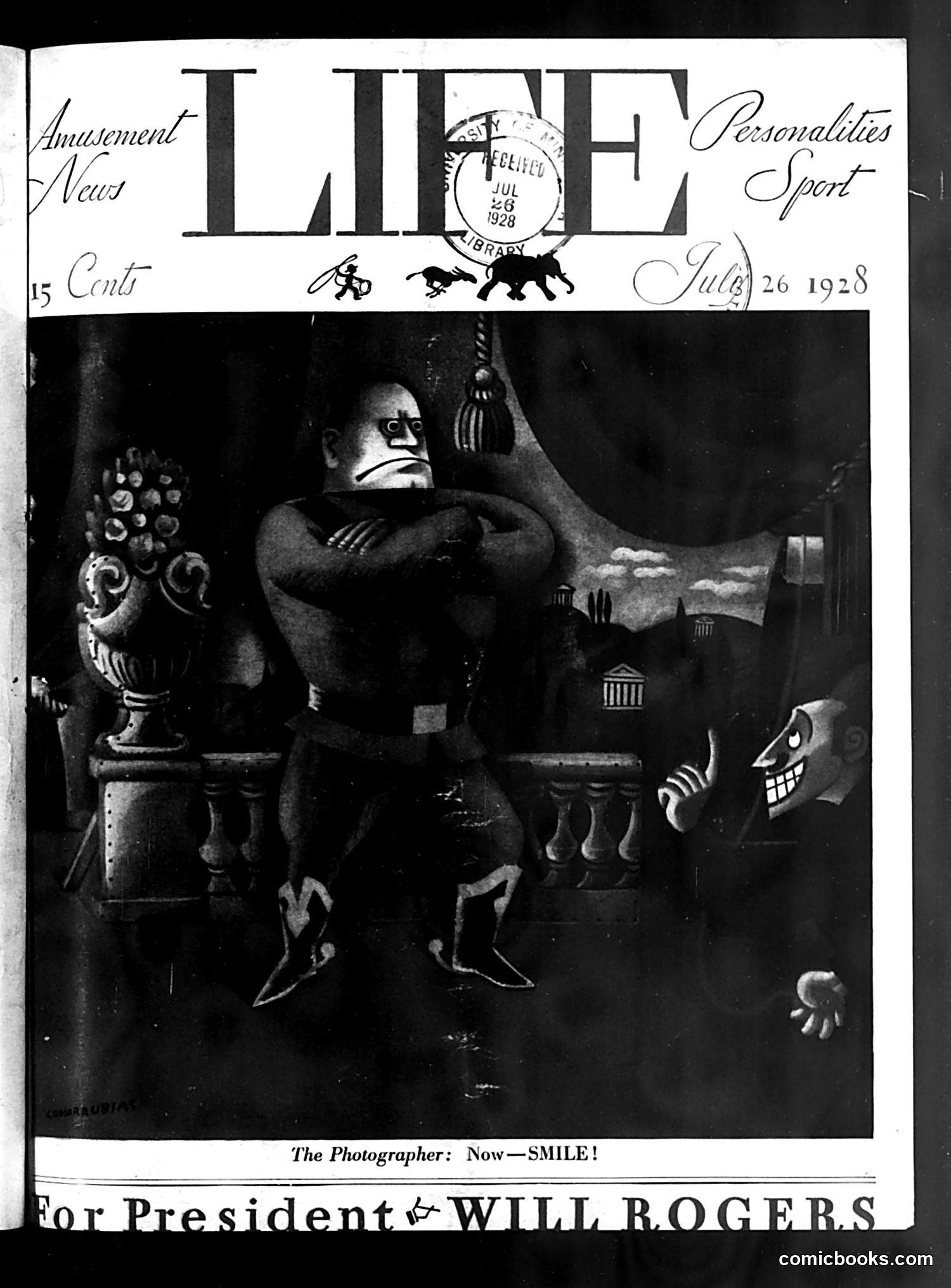
This July 26, 1928 *Life* magazine cover satirizes the 1928 U.S. presidential election, promoting Will Rogers as a humorous alternative candidate. The cartoon depicts a strongman in classical theatrical costume holding a rope, with the caption "The Photographer: Now—SMILE!" This appears to be political satire about controlling or manipulating public perception during campaigns—the "strongman" suggests authoritarian control, while the photographer's demand for a smile references image management in politics. The other figures visible (including what appears to be a grinning character on the right) likely represent competing political figures or public opinion. The classical/theatrical setting emphasizes the performative nature of politics. Rogers was a famous humorist; this cover presents his candidacy as satirical commentary on the 1928 election, mocking the manufactured aspects of presidential campaigns and public relations.
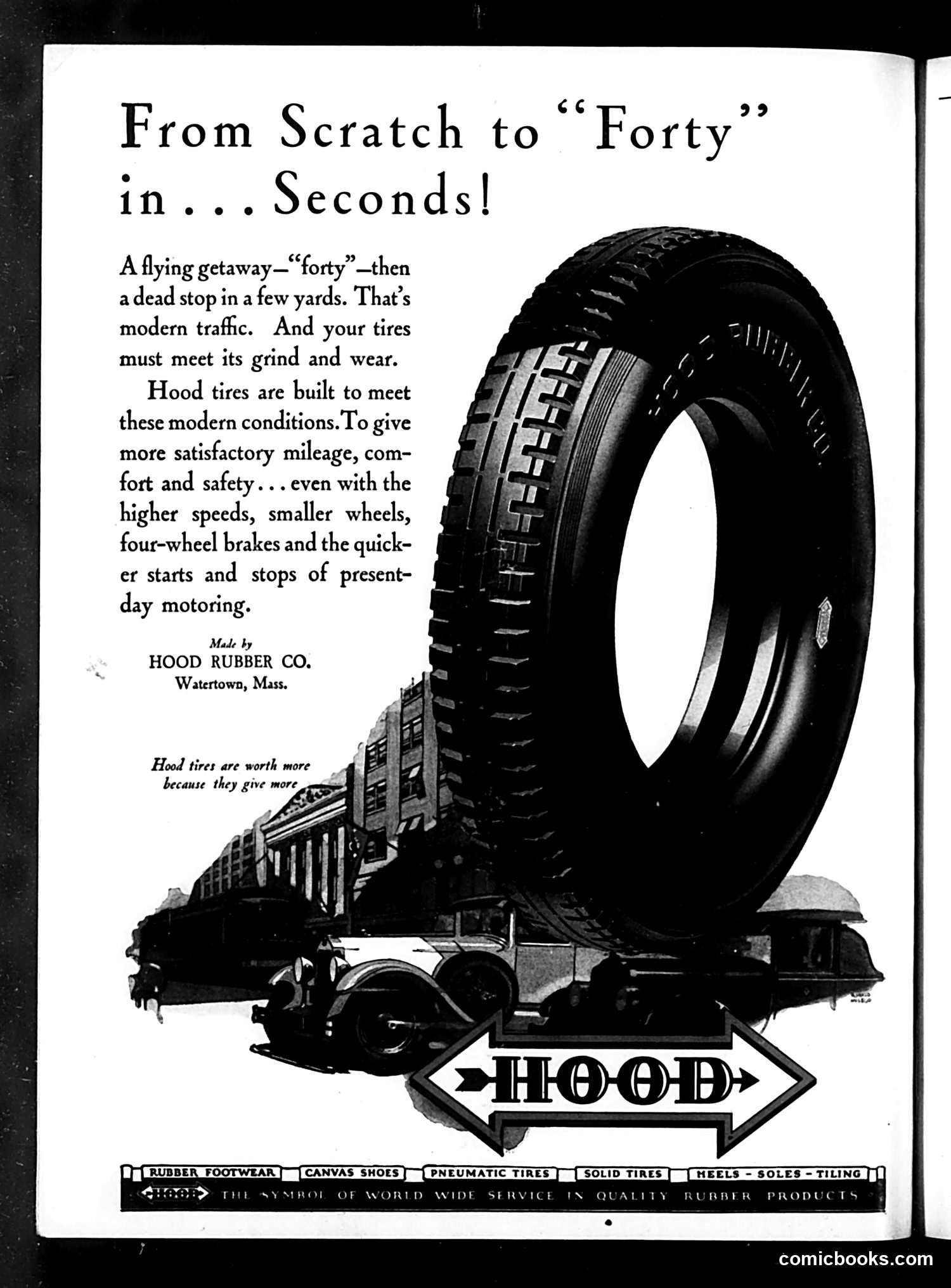
This is not a cartoon or satire—it's a **straightforward advertisement** for Hood Rubber Company tires, based in Watertown, Massachusetts. The ad uses visual drama to market modern tires by contrasting a tiny 1920s automobile dwarfed beneath an enormous tire. The accompanying text emphasizes that Hood tires are engineered for contemporary driving conditions: high speeds, quick acceleration, frequent braking, and smaller wheels. The phrase "From Scratch to 'Forty' in...Seconds!" refers to rapid acceleration (0-40 mph), promoting the tires' performance capability for modern motoring. The slogan "Hood tires are worth more because they give more" is the core sales pitch. This represents early automotive advertising that positioned tire quality as essential to the new, faster pace of American life.
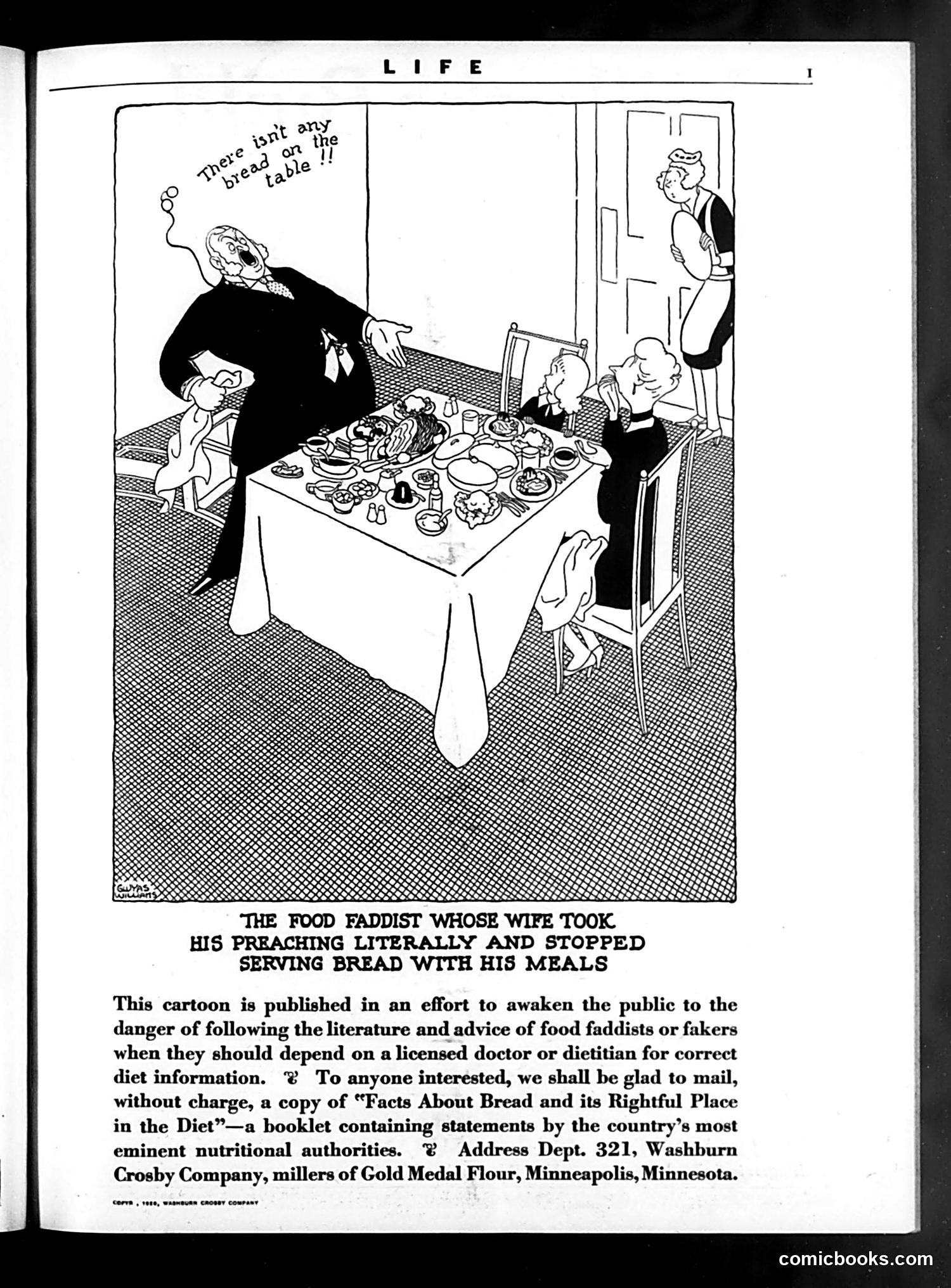
This page is an advertisement masquerading as editorial content. The cartoon satirizes "food faddists"—people promoting unorthodox dietary theories popular in early 20th-century America. The joke depicts a man complaining at a dinner table that there's no bread served, while his wife preaches against serving bread with meals. The caption identifies him as a "food faddist whose wife took his preaching literally and stopped serving bread." The advertisement below, from Washburn Crosby Company (makers of Gold Medal Flour), uses this satire to mock anti-bread dietary movements while promoting bread as essential nutrition. The company offers a free booklet citing "eminent nutritional authorities" to counter such fads. This reflects genuine early-1900s anxieties about competing nutritional advice and consumer confusion over proper diet.
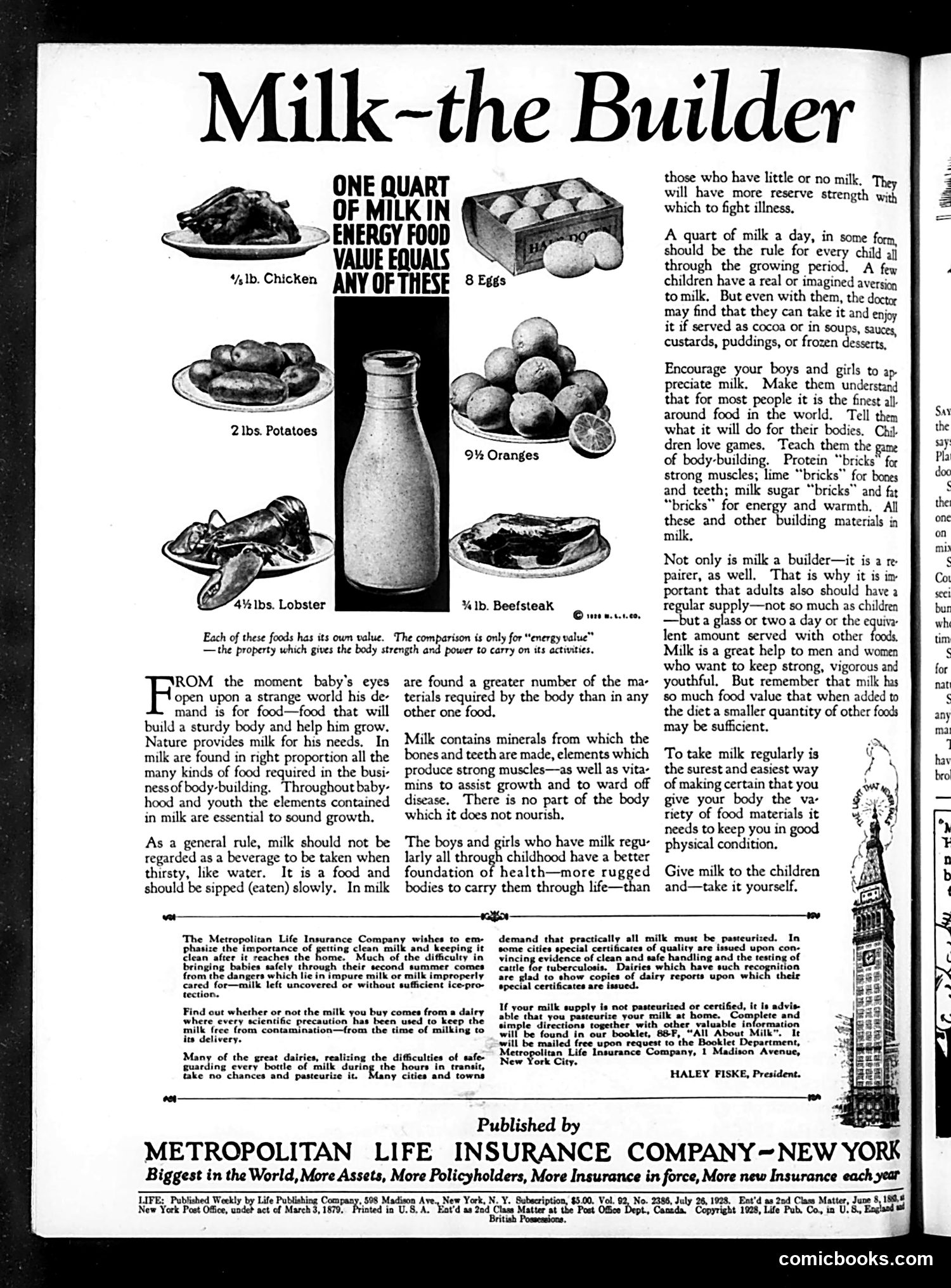
This is **not a political cartoon** but rather a **public health advertisement** by the Metropolitan Life Insurance Company promoting milk consumption to children and families. The page uses visual comparison showing that one quart of milk daily provides equivalent nutritional "energy food value" to foods like chicken, eggs, potatoes, lobster, beefsteak, and oranges. The text emphasizes milk's role in building strong bodies—containing proteins ("bricks for muscles"), minerals for bones and teeth, and lactose for energy. The advertisement targets parents, encouraging them to ensure children drink milk regularly and to model healthy milk consumption themselves. This reflects early-20th-century public health messaging promoting pasteurized milk as essential nutrition, likely responding to concerns about milk safety and child welfare prevalent at the time.
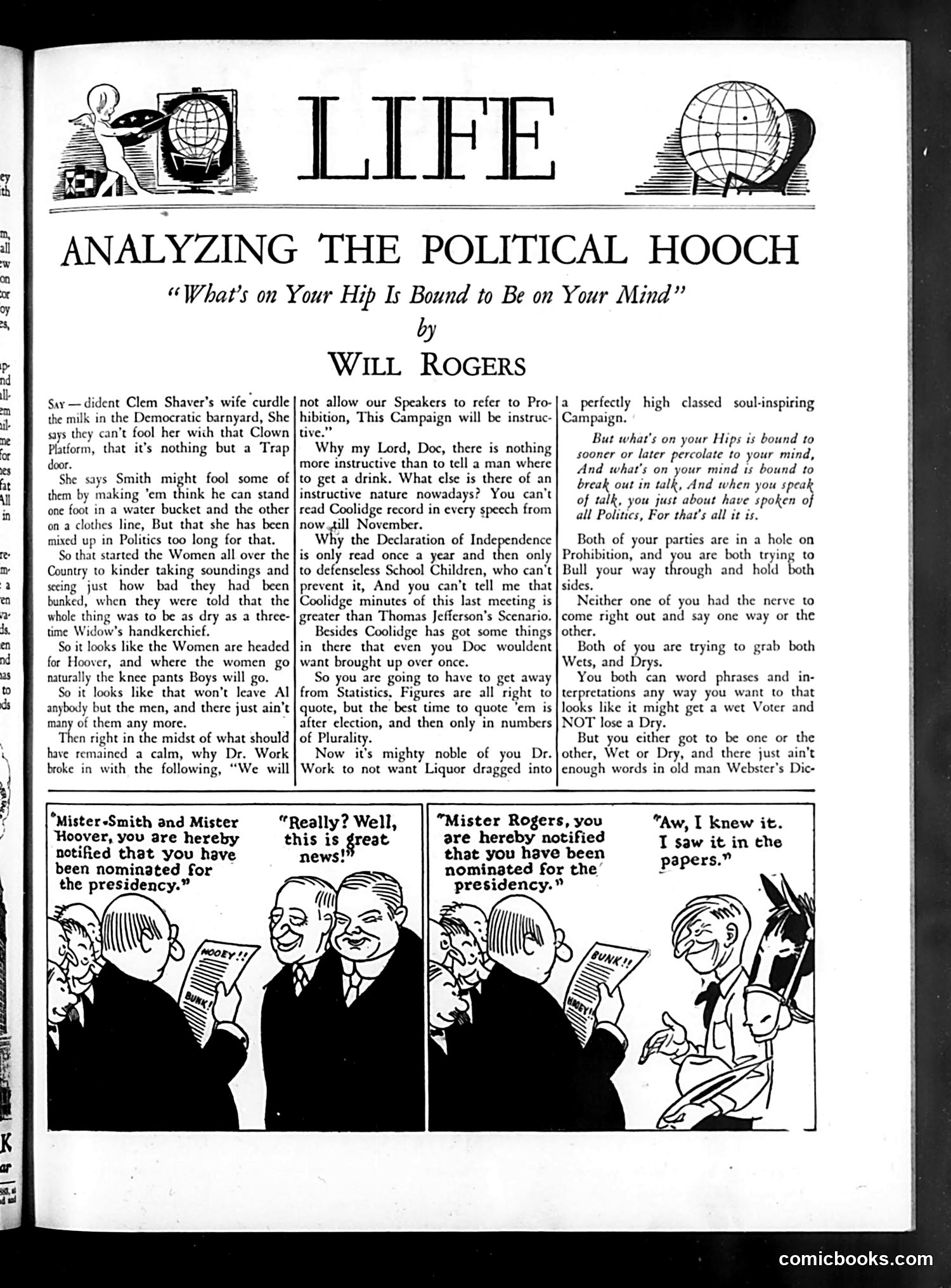
This Will Rogers satire mocks the 1928 U.S. presidential campaign, specifically targeting the competing parties' inconsistency on Prohibition. Rogers critiques both Democrats and Republicans for trying to simultaneously appeal to "wet" (anti-Prohibition) and "dry" (pro-Prohibition) voters—an impossible political balancing act. The comic panels show Smith and Hoover (the Democratic and Republican nominees) being notified of their presidential nominations. Rogers's point: both candidates must eventually choose a clear position on alcohol rather than offering contradictory statements to different audiences. The satire highlights how Prohibition had become a divisive political issue where candidates couldn't honestly address voters' genuine concerns without alienating crucial voting blocs.
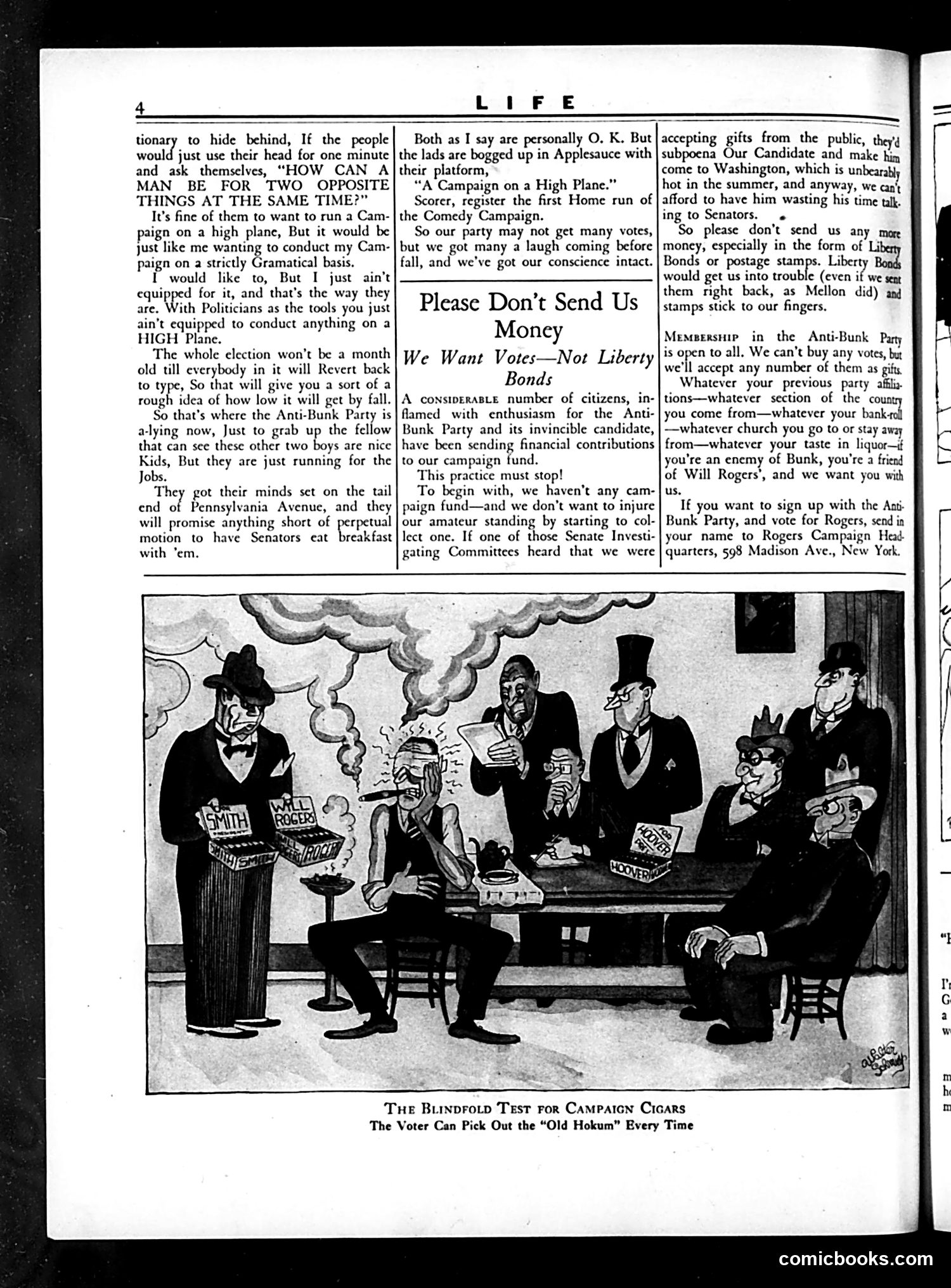
This cartoon satirizes **campaign financing corruption** during an early 20th-century election. The caption claims "The Voter Can Pick Out the 'Old Hokum' Every Time"—but the image shows the opposite: a blindfolded man sits while well-dressed politicians hand him various cigars labeled with candidate names (visible: "SMITH," "ROGERS"). The joke is **ironic**: voters claim they can discern honest candidates from fraudulent ones, yet the cartoon suggests they cannot—they're literally blindfolded. The politicians surrounding him appear to be offering indistinguishable "campaign cigars" (likely representing campaign promises or bribes). The accompanying text criticizes candidates accepting money from the public while pursuing their own agenda, and urges readers to support the Anti-Bunk Party instead of traditional candidates.
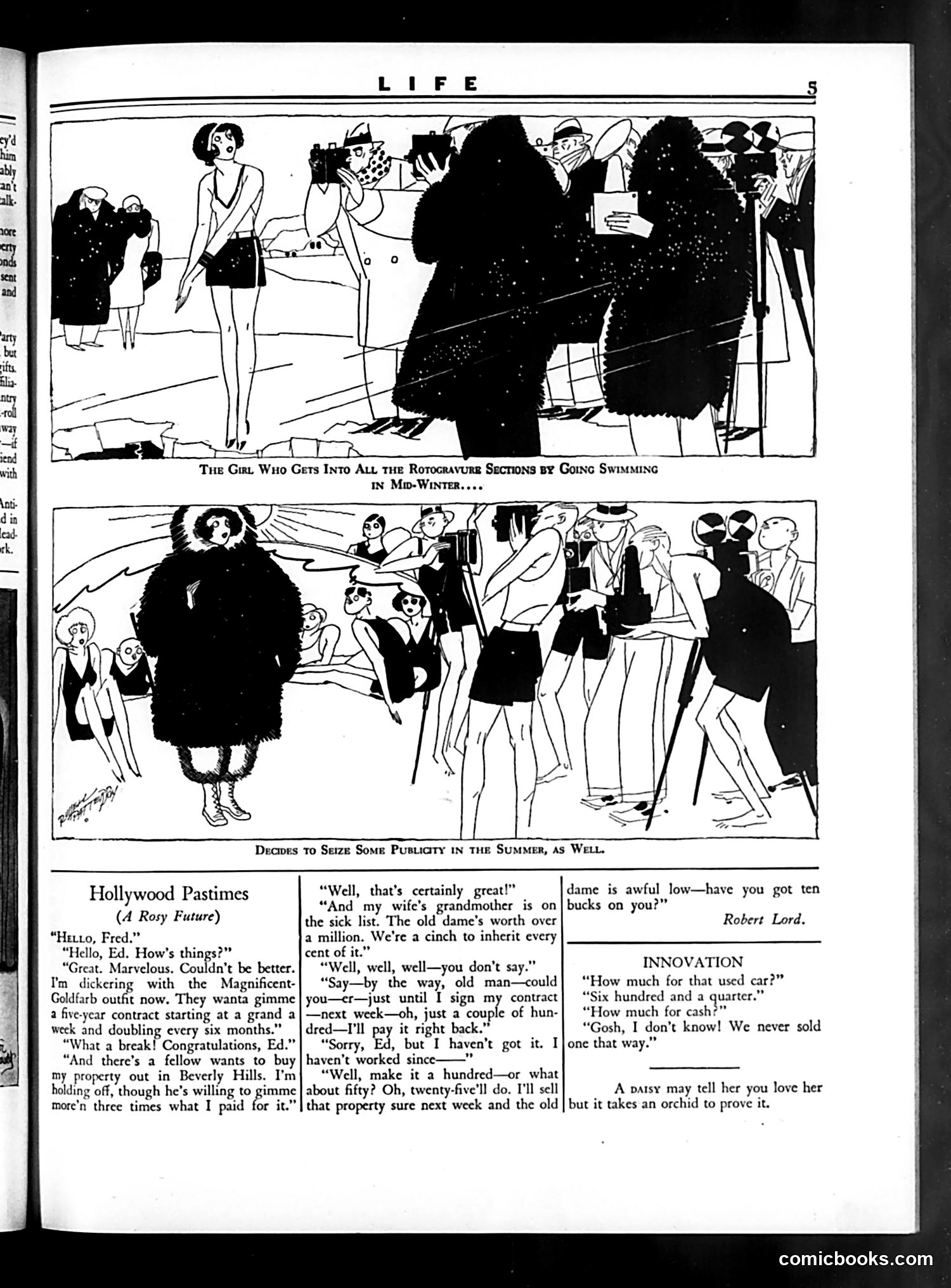
This page contains two satirical cartoon panels about social behavior and publicity-seeking. **Top panel:** "The Girl Who Gets Into All the Rotogravure Sections by Going Swimming in Mid-Winter" shows a woman in swimwear surrounded by photographers and observers in winter conditions. The satire targets attention-seeking behavior—how young women deliberately perform unusual stunts (like winter swimming) to gain newspaper photo coverage in the rotogravure (photo) sections that were popular in 1920s-30s publications. **Bottom panel:** "Decides to Seize Some Publicity in the Summer, as Well" depicts the same woman now mobbed by crowds during summer, suggesting her winter stunt's success prompted further publicity-seeking behavior. The cartoons mock both the women who crave newspaper attention and the public's fascination with such manufactured spectacles—a commentary on emerging celebrity culture and media sensationalism of the era.
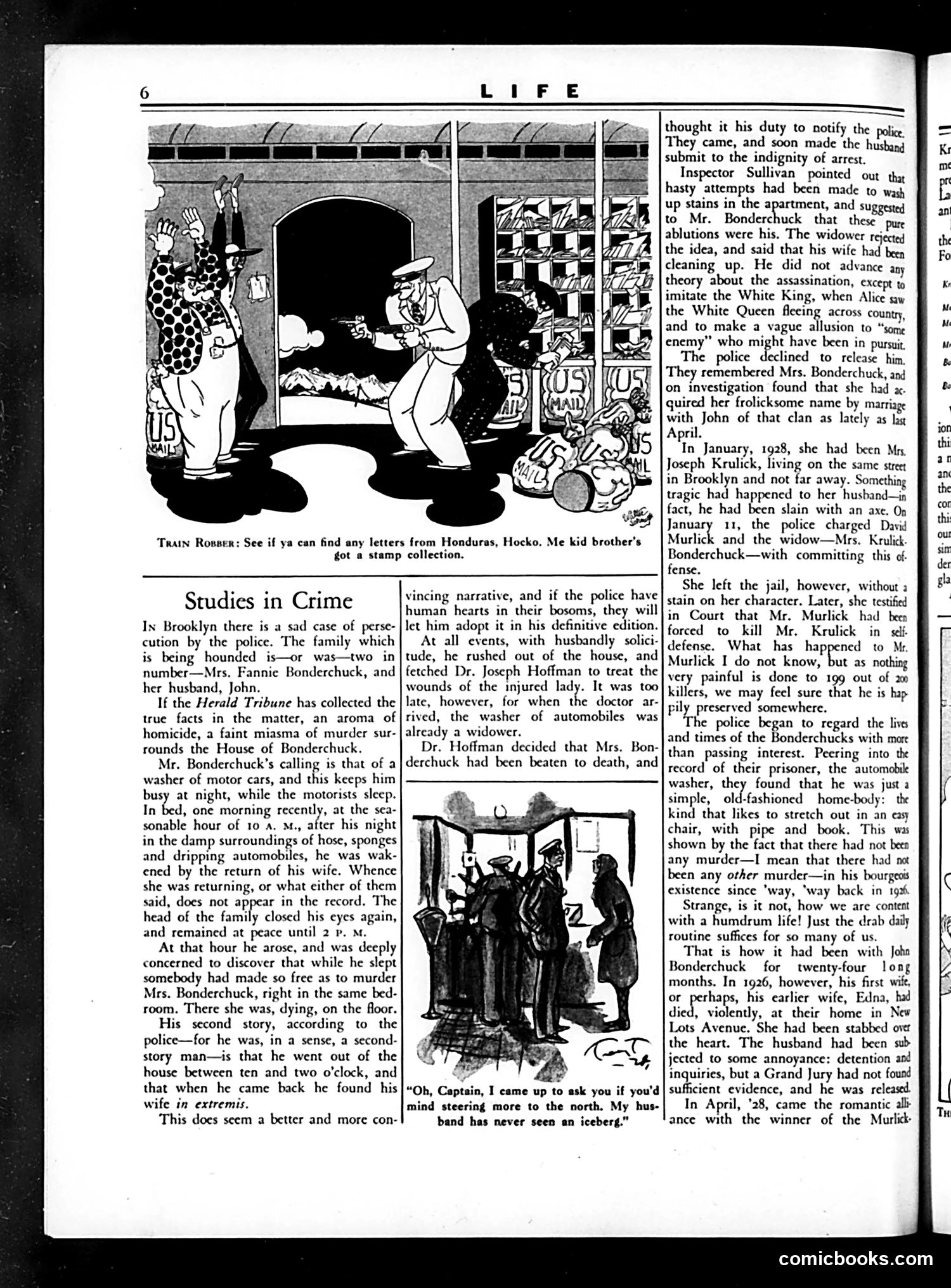
The top cartoon depicts a train robbery scene. One figure holds up another at gunpoint while mail sacks labeled "US MAIL" are visible, referencing the common crime of robbing mail trains—a genuine American phenomenon from the late 1800s through early 1900s. The caption jokes that the robber should search for "letters from Honduras" to find a stamp collection, playing on the absurdity of looking for valuable postage among stolen mail. Below, the "Studies in Crime" article describes an actual Brooklyn murder case involving Mrs. Fannie Bonderchuck, whose husband John was killed. The text discusses police investigation and suggests possible domestic tragedy rather than criminal conspiracy, presenting it as a sad case of domestic violence with suspicious circumstances.
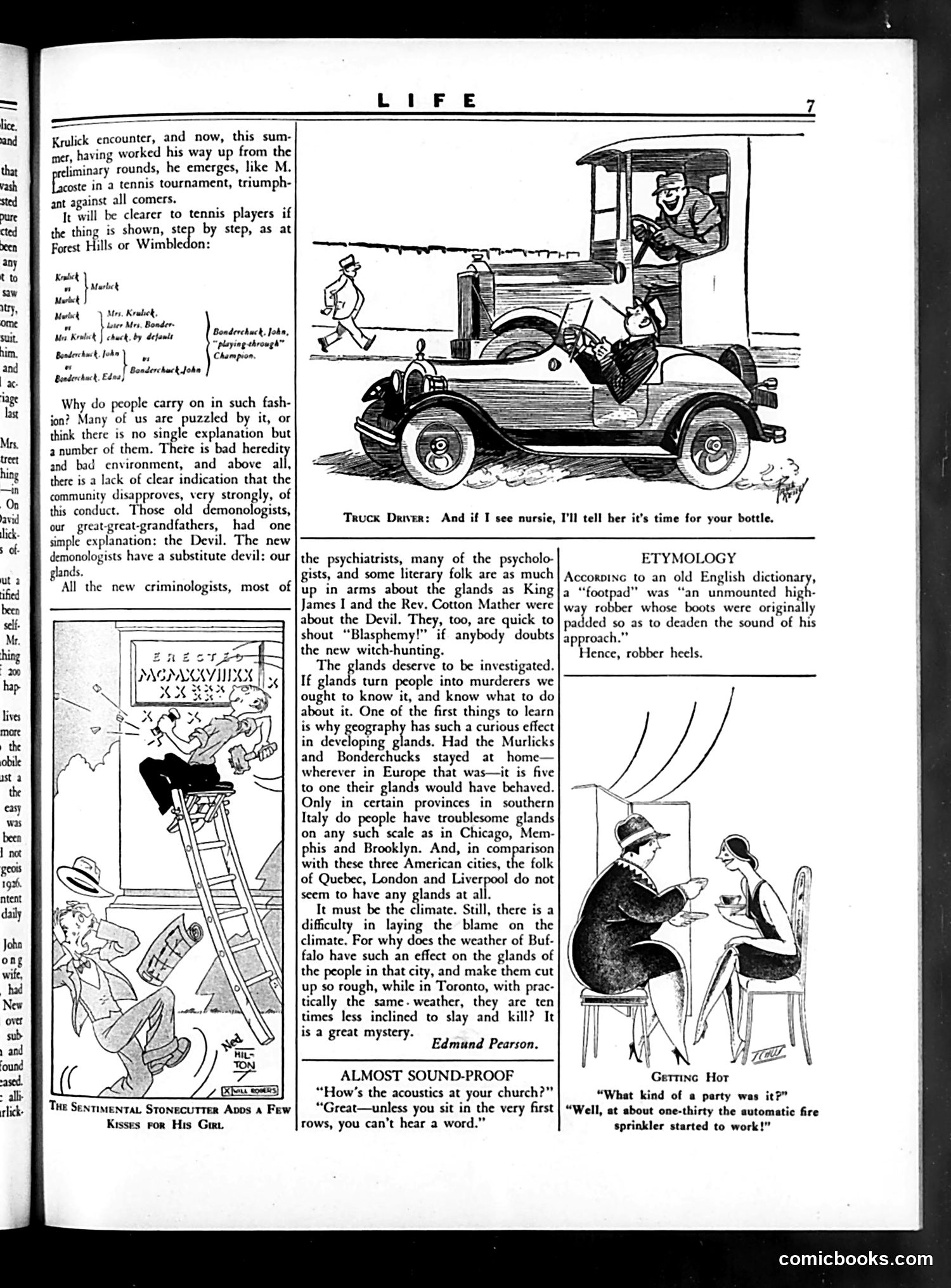
This page contains three separate humorous cartoons and an article about criminal behavior and heredity. **Main Cartoon (top):** A truck driver warns a motorist that "if I see nurse, I'll tell her it's time for your bottle"—mocking the motorist's reckless driving as childish behavior. **Left Cartoon:** "The Sentimental Stonecutter Ands a Few Kisses for His Girl" depicts a gravestone carver kissing his girlfriend among tombstones—dark humor about his morbid profession. **Bottom Cartoons:** Two brief joke panels about church acoustics and an automatic fire sprinkler malfunction at a party. The accompanying article discusses theories about criminality, heredity, and environmental factors—typical early-20th-century pseudoscience attempting to explain human behavior through "glands" rather than morality.
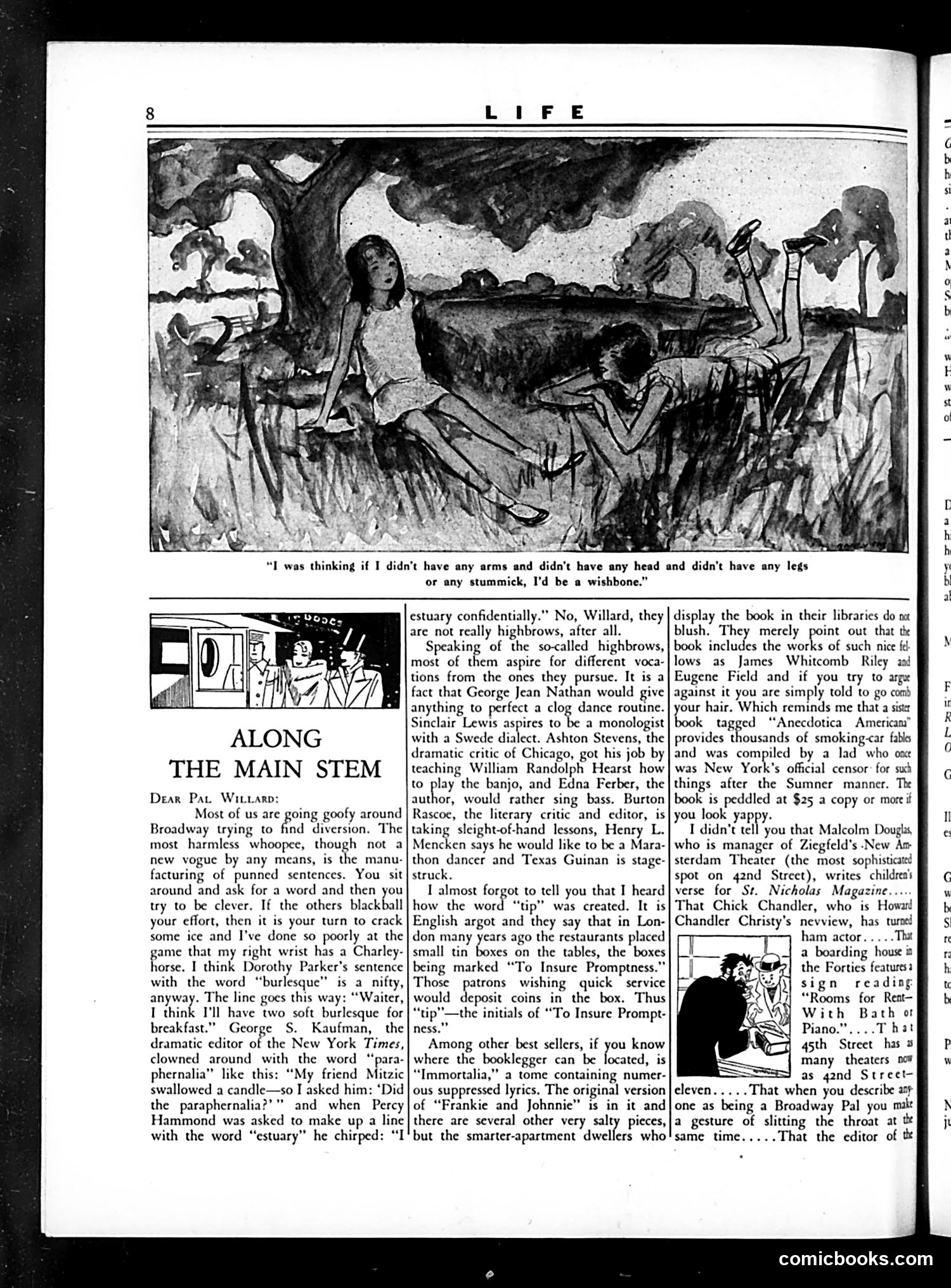
This page from *Life* magazine contains a humor column titled "Along the Main Stem" by "Dear Pal Willard." The column uses wordplay and Broadway theater anecdotes as satire. The main cartoon at top depicts people lounging under a tree, with the caption: "I was thinking if I didn't have any arms and didn't have any head and didn't have any legs or any stomach, I'd be a wishbone." This is absurdist humor—the joke being that removing virtually everything from a person leaves only a wishbone, a trivial object. The text discusses various theatrical personalities and publishing matters, including references to book sales and literary critics. The satire mocks both Broadway pretension and publishing industry affectations, using exaggerated anecdotes about highbrow aspirations and popular entertainment.
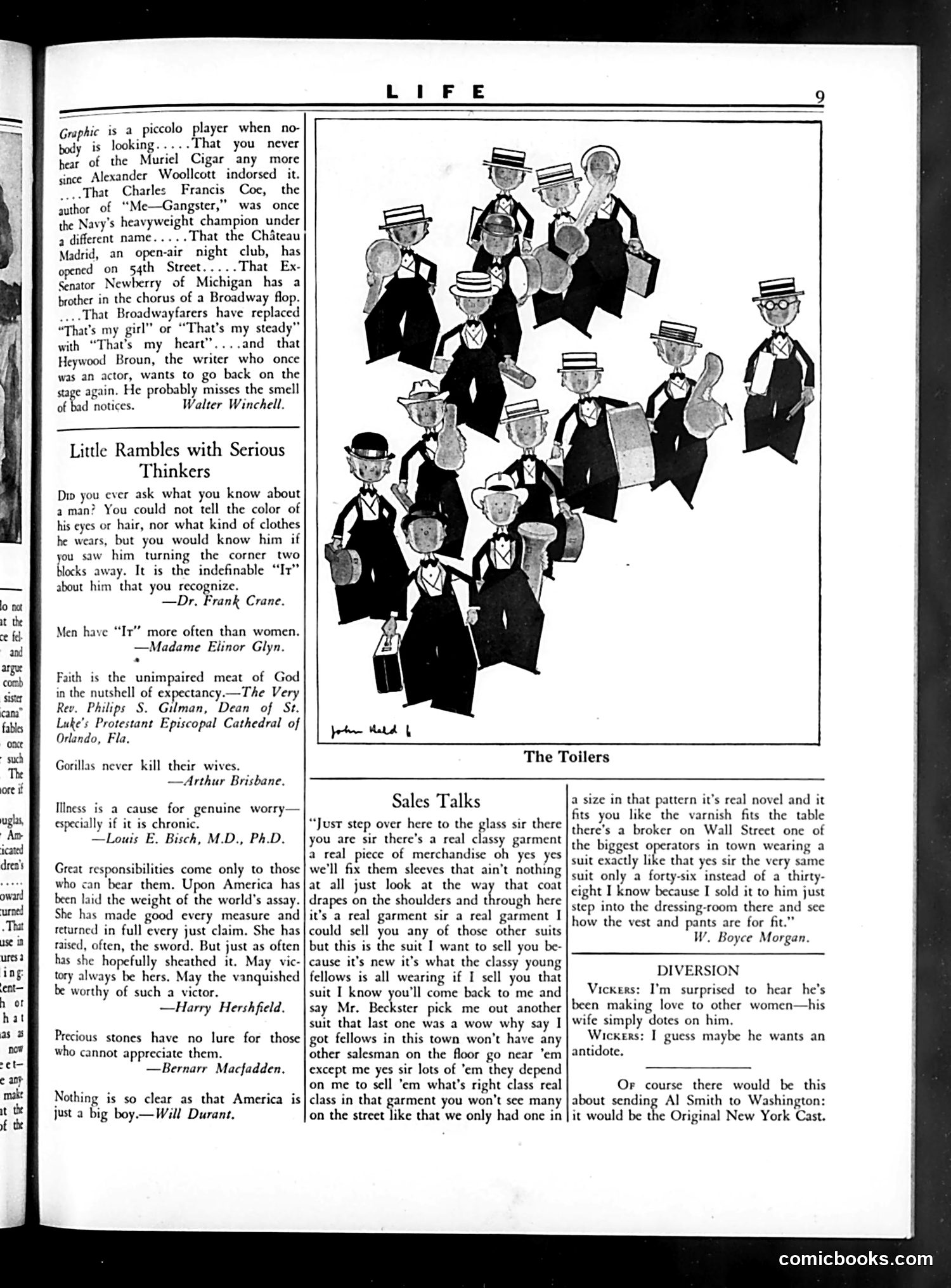
This cartoon depicts well-dressed businessmen—identified as "The Tollers" (a pun on "toilers," working men)—carrying briefcases and wearing identical straw hats. The illustration satirizes traveling salesmen or commercial agents of the era, particularly those selling clothing or merchandise. The accompanying "Sales Talks" section mocks their pitch techniques, with a salesman explaining high-pressure sales tactics about garment quality and fit. The humor lies in portraying these working-class salesmen as uniform, interchangeable figures, despite their self-importance about selling "classy" goods. The cartoon ridicules both the salesmen's pretensions and the consumer culture they represent—suggesting these workers are merely cogs in a commercialized system, defined entirely by their profession rather than individual identity.
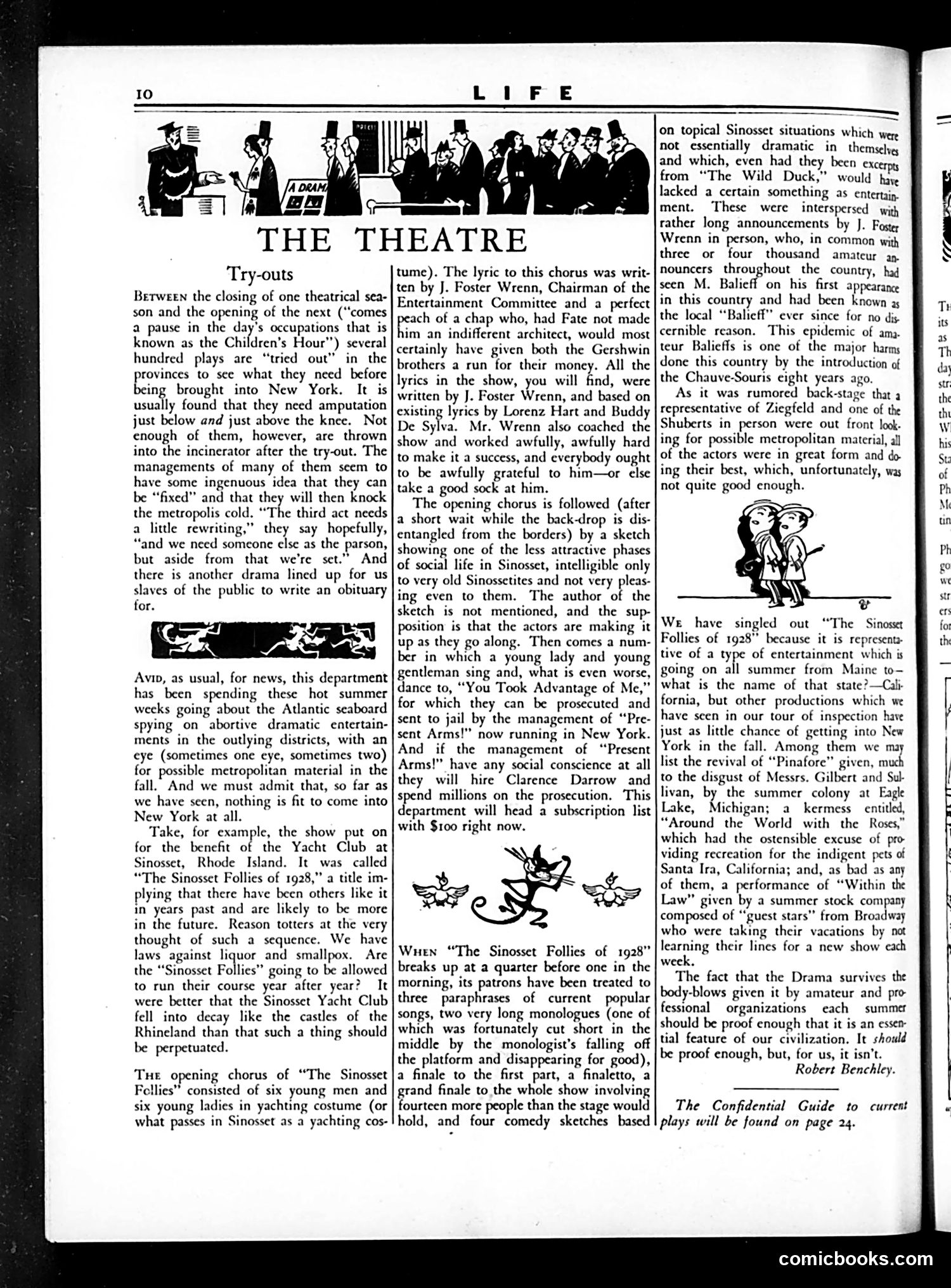
This page discusses theatrical tryouts and reviews, focusing on "The Sinosset Follies of 1928," a summer theatrical production at a yacht club in Rhode Island. The small cartoon illustrations at the top show theatrical figures in various poses—likely representing actors, directors, and producers involved in theatrical productions. The main text critiques amateur theatrical productions, noting that tryouts often reveal "ingratiating" ideas and knockabout farce. The author discusses how "The Sinosset Follies" featured young performers in yachting costumes performing sketches and monologues, observing that the production was "not quite good enough." The satire targets the aspirations and modest quality of amateur summer theatrical productions, poking fun at their pretensions while acknowledging theater's cultural importance. The tone is gently mocking rather than harsh—typical of Life's sophisticated humor.
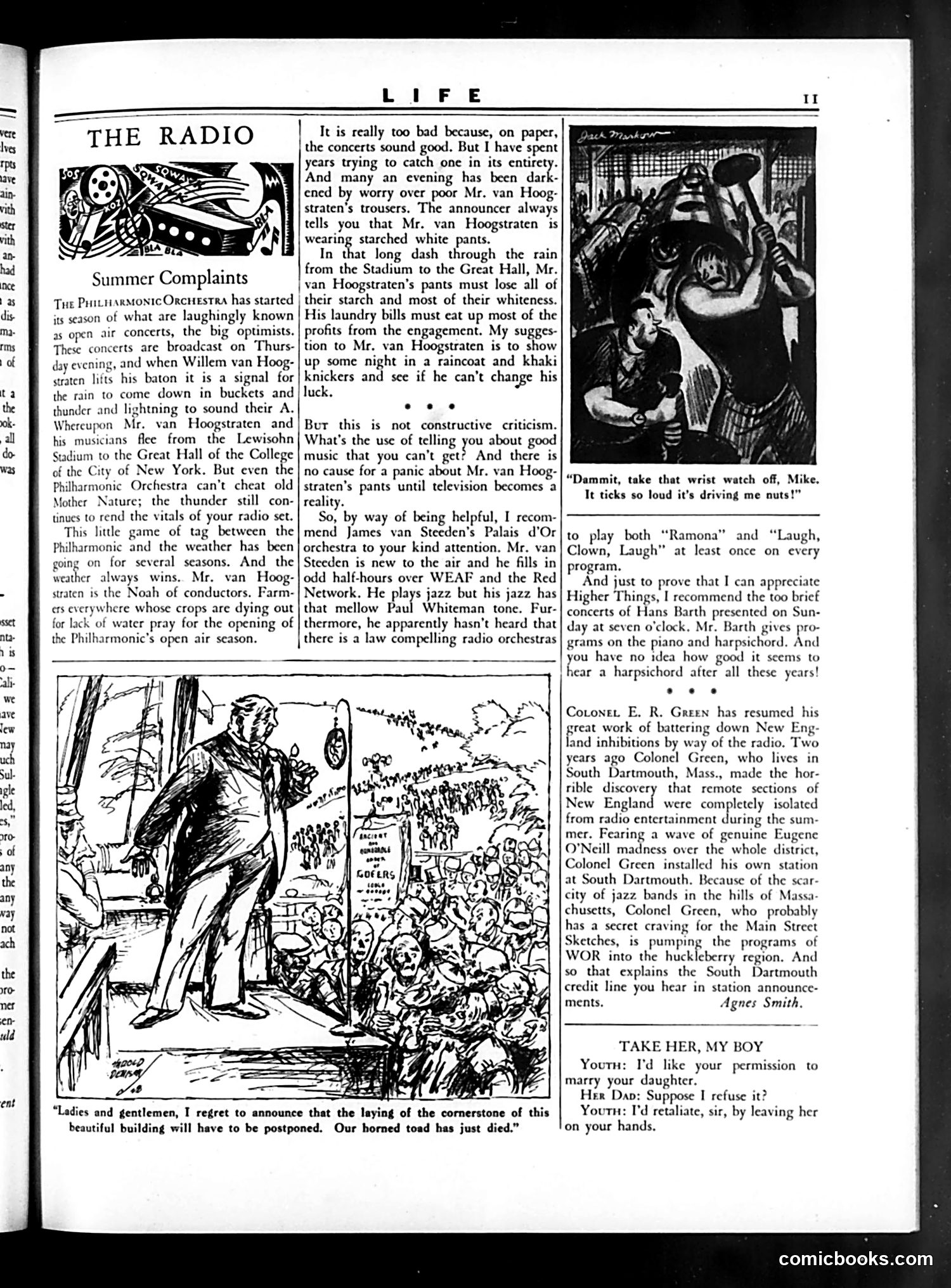
This page satirizes the Philharmonic Orchestra's open-air summer concert series and radio broadcasting challenges of the era. The main cartoon jokes that despite the orchestra's efforts to perform outdoors at venues like the Stadium and Great Hall, bad weather—particularly rain—constantly threatens performances. The text humorously complains that conductor Willem van Hoogstraten's trousers lose their starch during rainy dashes between venues, suggesting the absurdity of maintaining formal concert standards in unpredictable weather. The second cartoon appears to mock radio announcers delivering bad news (a toad's death preventing a building cornerstone ceremony), reflecting listener frustration with radio's entertainment limitations. The page criticizes both weather-dependent outdoor concerts and the limitations of early radio programming compared to live performance quality.
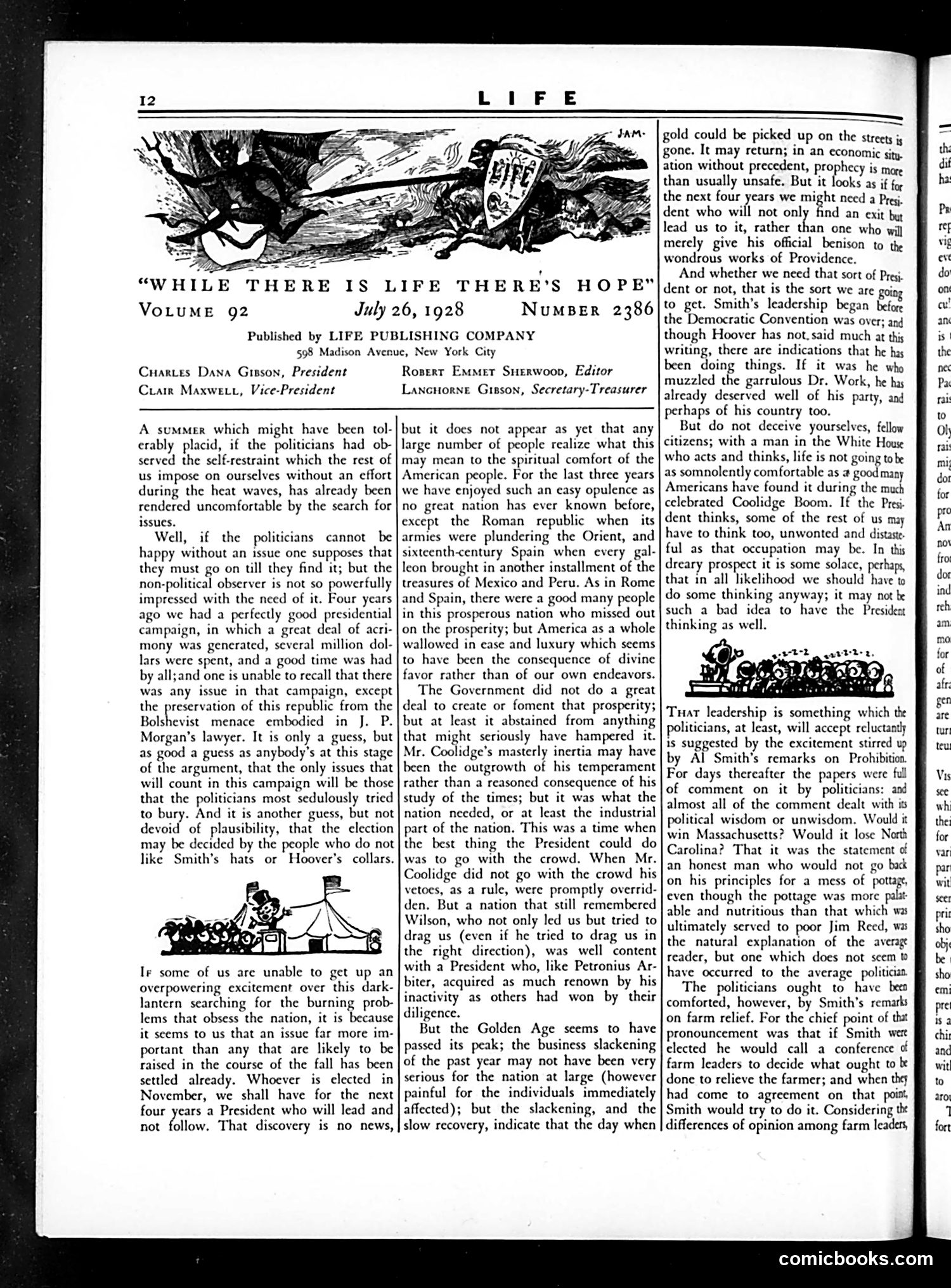
This editorial page discusses the 1928 presidential election and Herbert Hoover's candidacy. The text critiques politicians' avoidance of substantive issues, noting that whether Hoover is elected "may be decided by the people who do not like Smith's hats or Hoover's collars." The page references Al Smith's remarks on Prohibition and farm relief as campaign issues. It suggests that politicians often focus on trivial matters rather than serious policy, and questions whether the nation's leadership during the economic prosperity of the "Coolidge Boom" will effectively transition leadership. The cartoons (small illustrations visible) appear to satirize the superficiality of political campaigns and voter decision-making, though specific figures are difficult to identify clearly in this reproduction.
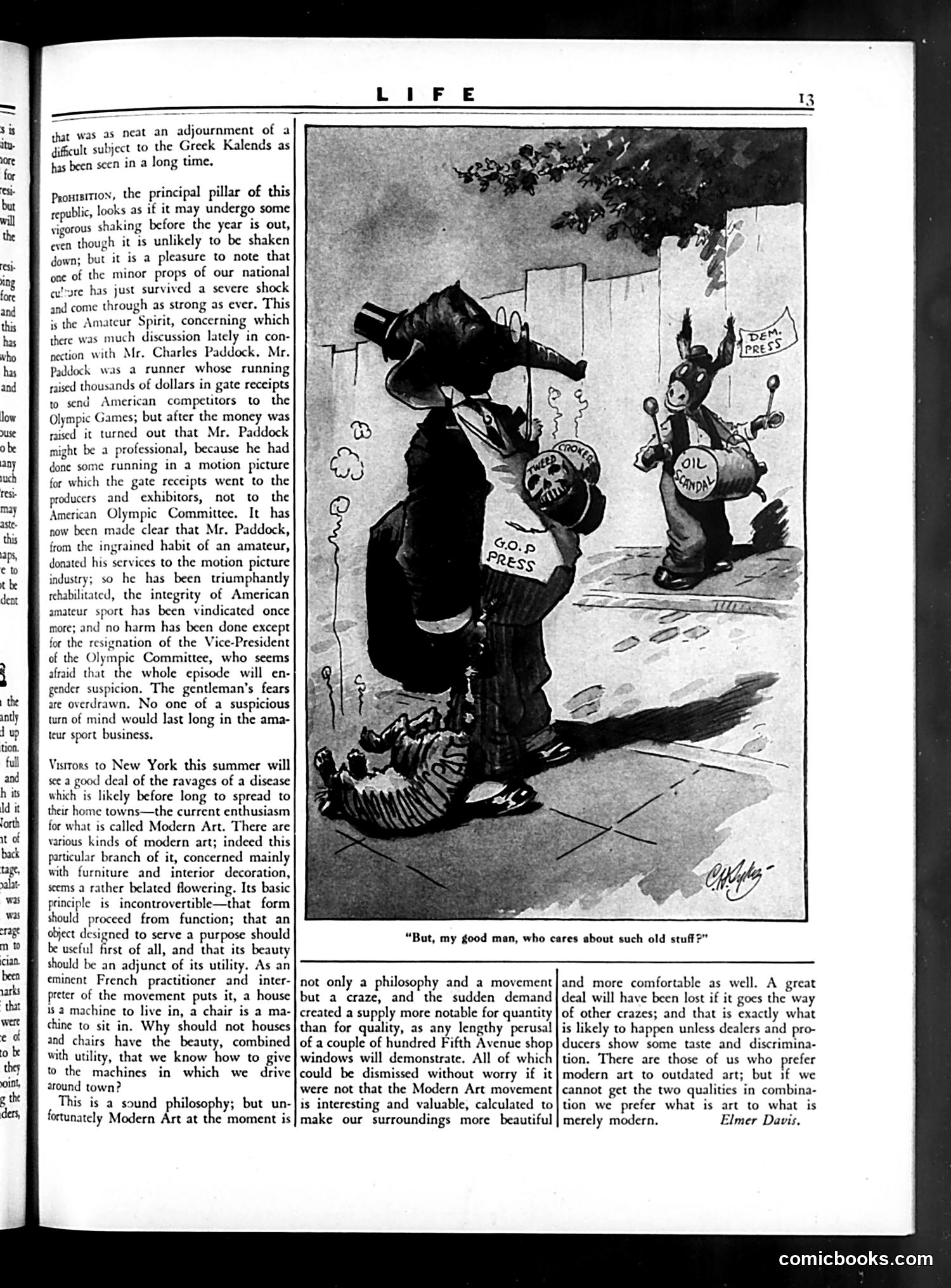
This cartoon satirizes the **Amateur Athletic Union (AAU)** and Olympic Committee controversy. The text discusses Charles Paddock, a runner whose gate receipts from a motion picture were disputed—whether they should go to producers/exhibitors or to the American Olympic Committee. The cartoon depicts **Prohibition-era figures** (labeled "Oil Company," "G.O.P. Press," and others) as suspicious characters watching money fall into a pot, with the caption "But, my good man, who cares about such old stuff?" The satire targets the **hypocrisy of sports organizations** claiming amateur integrity while actually profiting from athletes. It also suggests **corruption** involving Republican interests ("G.O.P. Press") and commercial entities controlling amateur sports—a contrast between stated principles and actual practice during the Prohibition era.
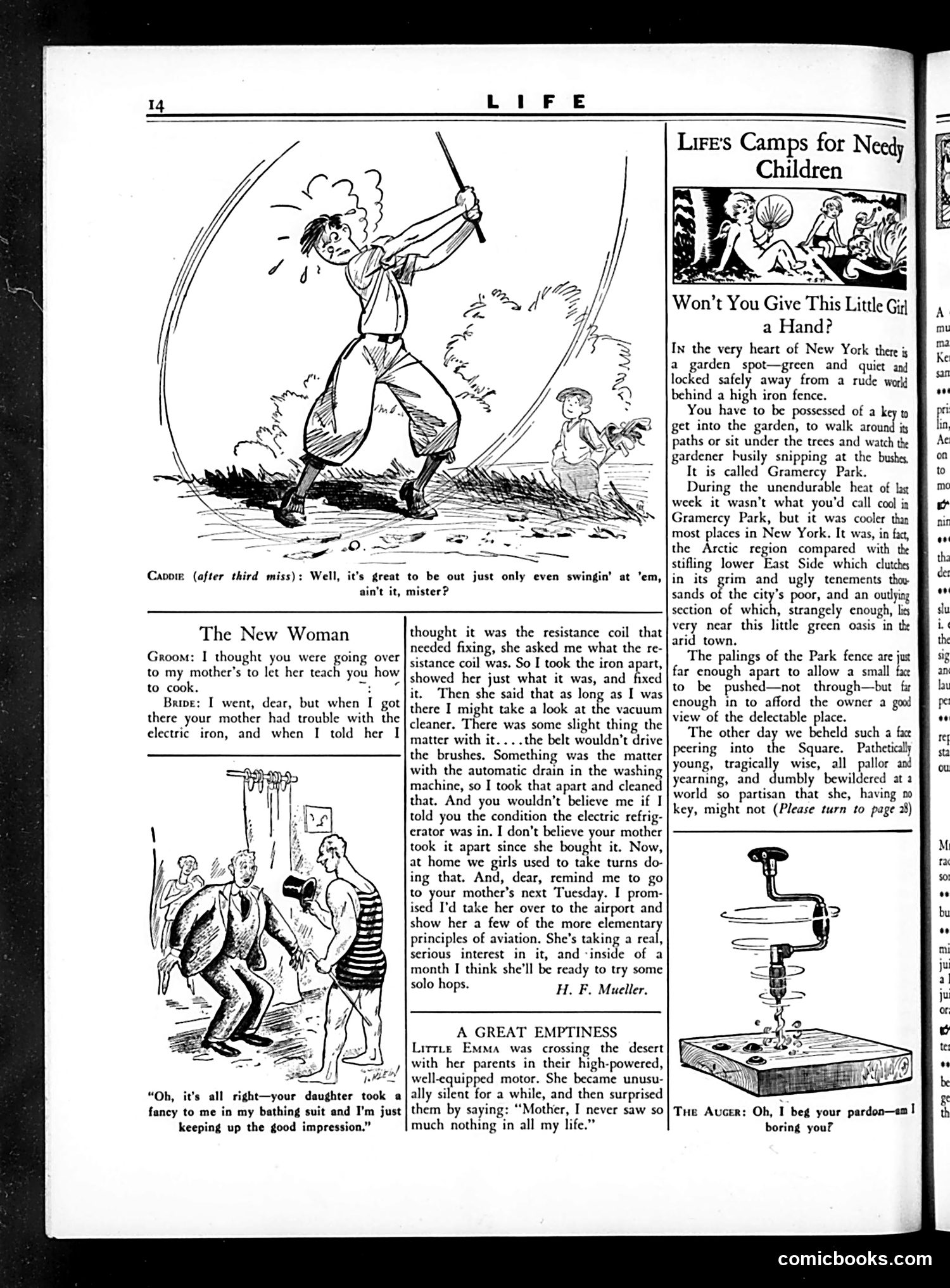
This page contains three satirical pieces about domestic life and gender roles in early 20th-century America. **"The New Woman"** cartoon and accompanying text mock a husband's frustration with his wife's growing independence. She's taking flying lessons and has mechanical interests, challenging traditional domestic expectations. The joke hinges on the husband's bewilderment at her autonomy and his mother's inability to teach her "how to cook." **"Caddie"** cartoon depicts a golf caddie commenting on a poor swing, offering working-class perspective on leisure activities. **"A Great Emptiness"** anecdote satirizes wealthy motorists' obliviousness—Little Emma crossing a desert notices nothing despite the dramatic landscape, embodying satirical commentary on the insulated, incurious nature of the wealthy. The overall theme critiques evolving gender dynamics and class blindness in American society.
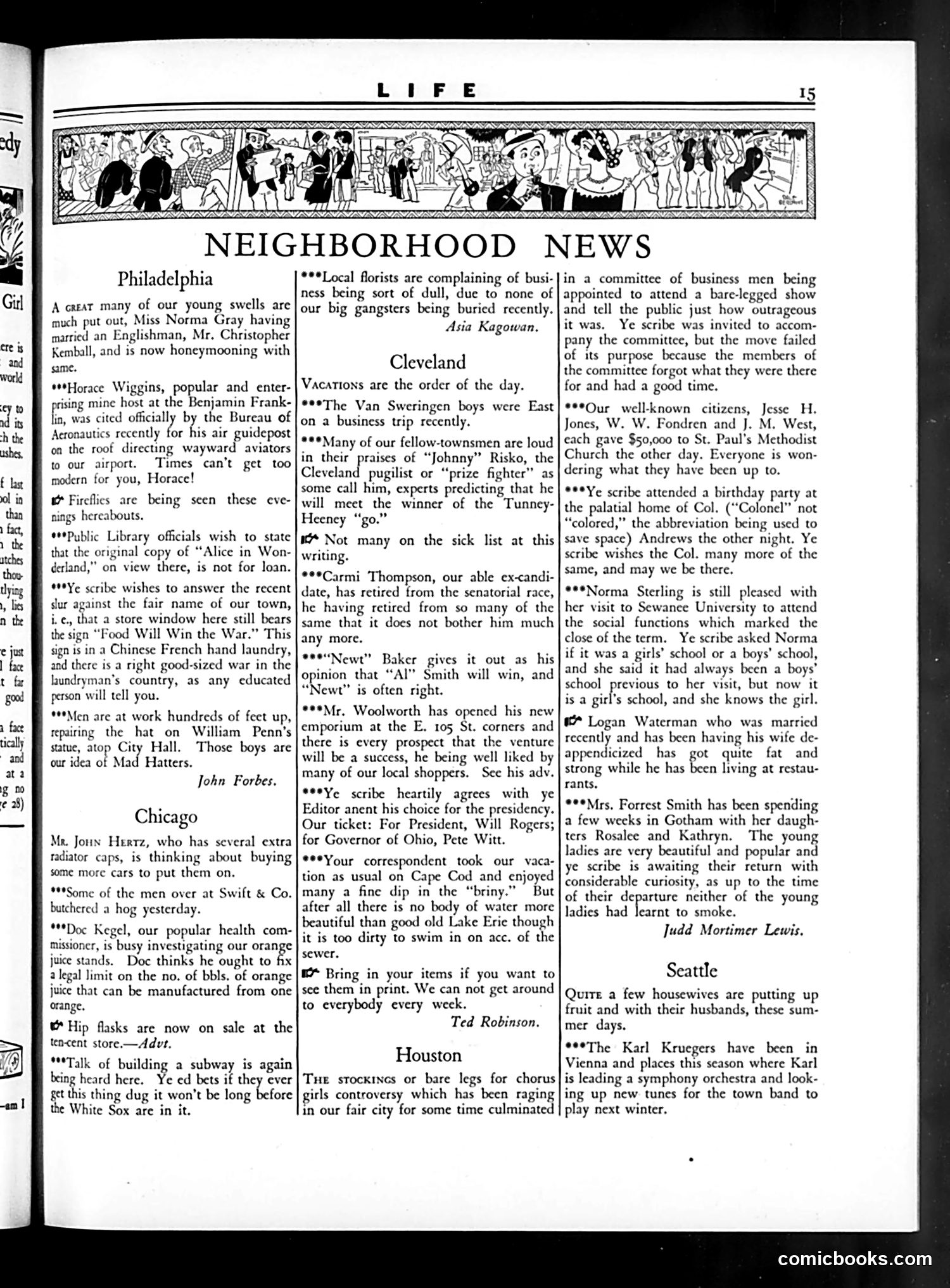
This is a **gossip/social commentary section** rather than a political cartoon. The page features humorous local news items from various American cities (Philadelphia, Cleveland, Chicago, Houston, Seattle). The content uses gentle satire about everyday life: complaints from florists about gangster funerals, vacation habits, local civic improvements, and social pretensions. References include a Cleveland "prize fighter" named "Johnny" Risko, and mentions of whether "Al" Smith (unclear if political figure) will win something. The humor relies on **local recognition**—readers would know these people and places. The tone is gossipy and mildly mocking of bourgeois concerns (hats, social clubs, bathing suit controversies), typical of Life magazine's satirical approach to middle-class American society during this era.
This page contains **no cartoons or satirical illustrations**—it's entirely text, consisting of gossipy social notes organized by city (Kansas City, Boston, Detroit, Newport, San Francisco). The content reports on local happenings: conventions, vacations, new infrastructure (Seattle Airport named after Boeing), romantic gossip about politicians, and minor scandals. A reference to "Fifi" concerns efforts to prevent selling bonds to seniors. The only "satire" is subtle and embedded in the writing itself—gentle mockery of small-town social pretensions and romantic entanglements among society figures. This reflects *Life* magazine's early 20th-century function as a publication satirizing American manners and social life through witty commentary rather than visual means. The page is primarily **society column content**, not political cartooning.
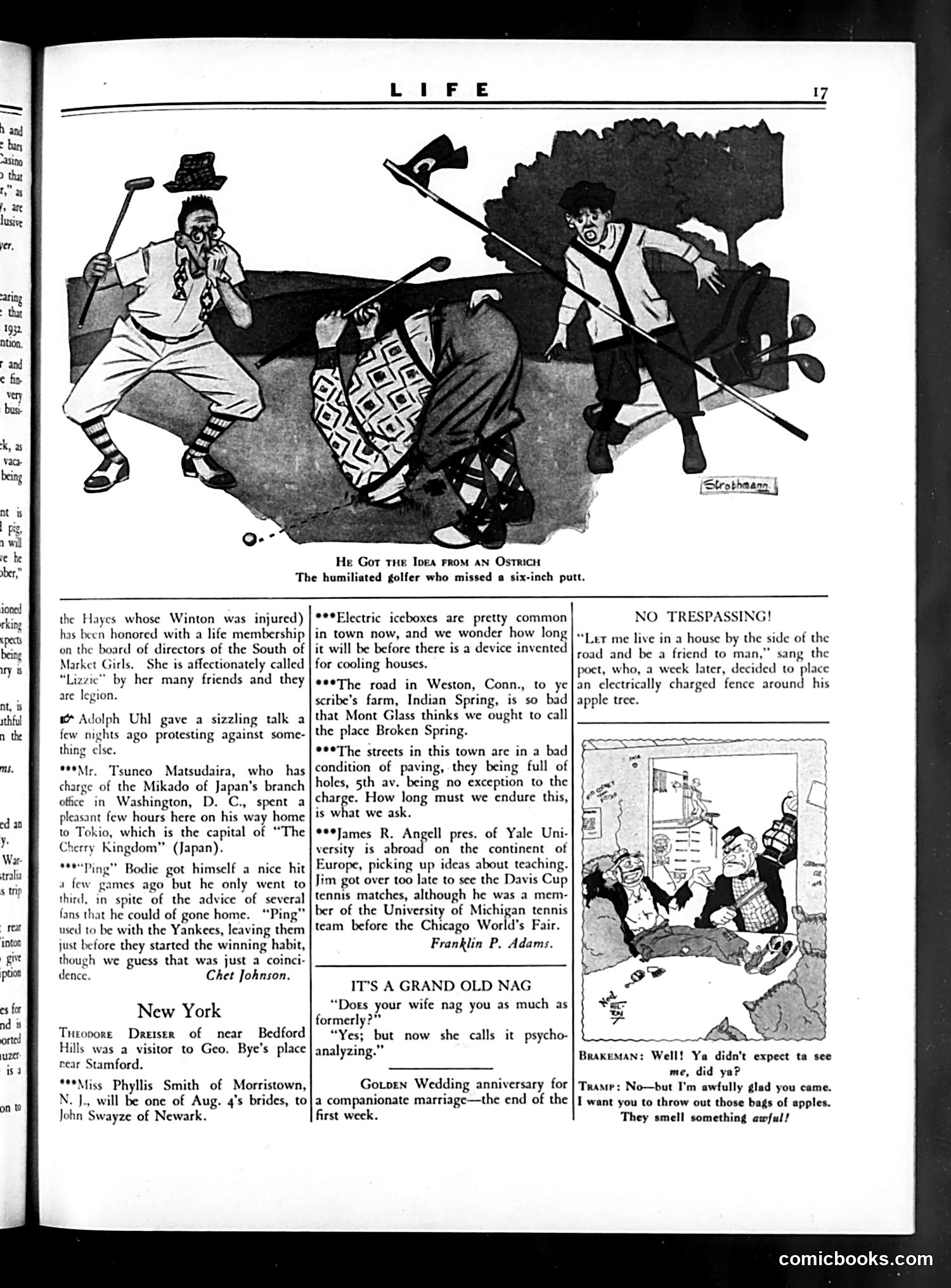
This cartoon satirizes a golfer who missed a six-inch putt—a laughably easy shot. The humor lies in the caption's implication that the golfer adopted the ostrich's famous (though mythical) strategy of burying its head in sand when faced with difficulty. The two figures on either side react with exaggerated shock and dismay at this absurd approach to golf. The cartoon mocks not just poor golf performance, but the human tendency to respond to minor embarrassments or failures by metaphorically "hiding"—a universal comedic target that remains relevant today. The satirical point: sometimes we handle small defeats poorly through avoidance rather than acceptance.
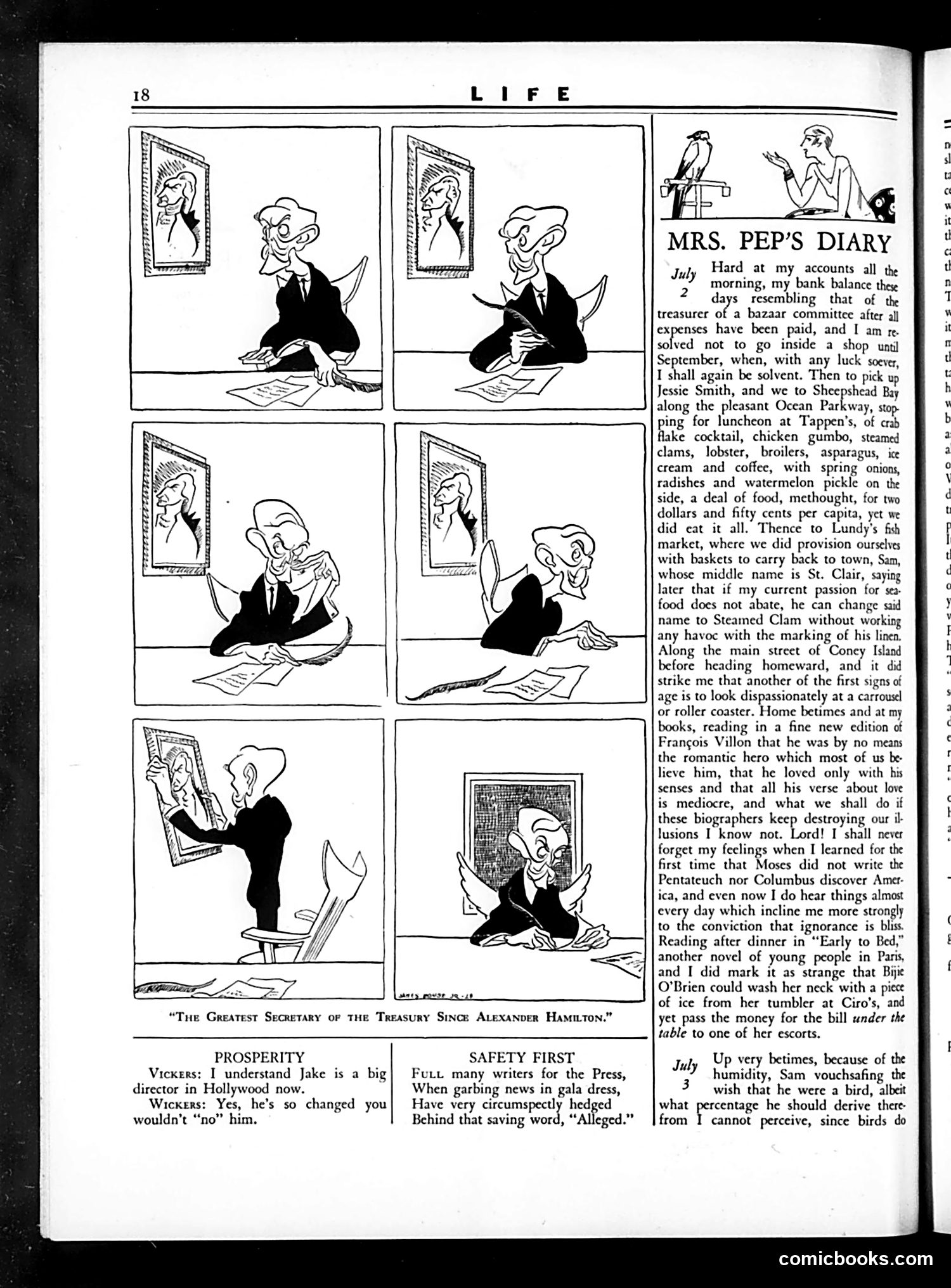
This 1920s *Life* magazine page contains three satirical pieces: **Main Cartoon**: A six-panel sequence mocking a Treasury Secretary (likely Andrew Mellon, serving under Harding/Coolidge). The caption ironically compares him to Alexander Hamilton. The panels show a man increasingly distressed by financial documents, culminating in him buried under papers—satirizing his management of national finances during the prosperous 1920s, likely critiquing either fiscal policy or personal integrity. **"Prosperity" Joke**: A brief quip about someone named Jake becoming a Hollywood director and changing so much he's unrecognizable—mocking the nouveau riche pretensions of early film industry figures. **"Safety First" Verse**: Criticizes journalists for using "alleged" excessively when reporting scandals, protecting subjects legally while avoiding truth-telling. **"Mrs. Pep's Diary"**: A humorous diary entry satirizing upper-middle-class women's anxieties about spending, food obsessions, and intellectual pretensions (mourning the loss of romantic heroes like Villon and Columbus after learning historical facts).
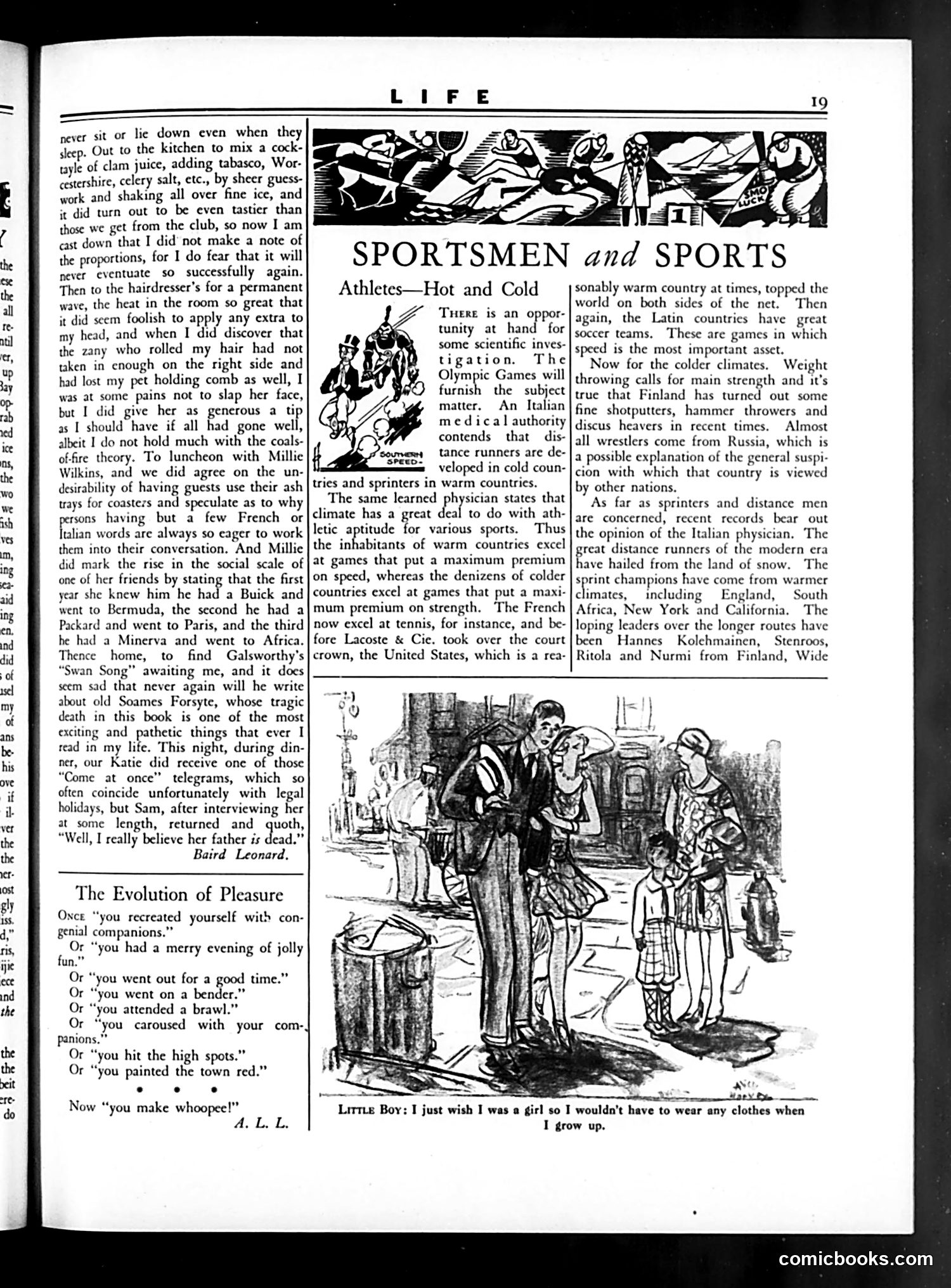
This page contains two distinct pieces of satirical content: **"Athletes—Hot and Cold"** discusses an Italian physician's theory that climate determines athletic aptitude: warm-country inhabitants excel at speed sports (sprinting, tennis, soccer), while cold-country inhabitants excel at strength sports (weight throwing, wrestling). The article uses this pseudo-scientific framework to examine Olympic performance patterns, referencing specific athletes like French tennis player Lacoste and noting Finland's success in throwing events and Russia's dominance in wrestling. **"The Evolution of Pleasure"** (lower section) satirizes how language describing socializing has degraded over time. It traces the phrase's evolution from genteel ("recreated yourself with congenial companions") through increasingly crude variations, culminating in the modern slang "make whoopee"—suggesting 1920s society's casual attitude toward pleasure and moral decline. The cartoon below shows a street scene with adults and children, illustrating changing social attitudes toward gender and clothing norms.
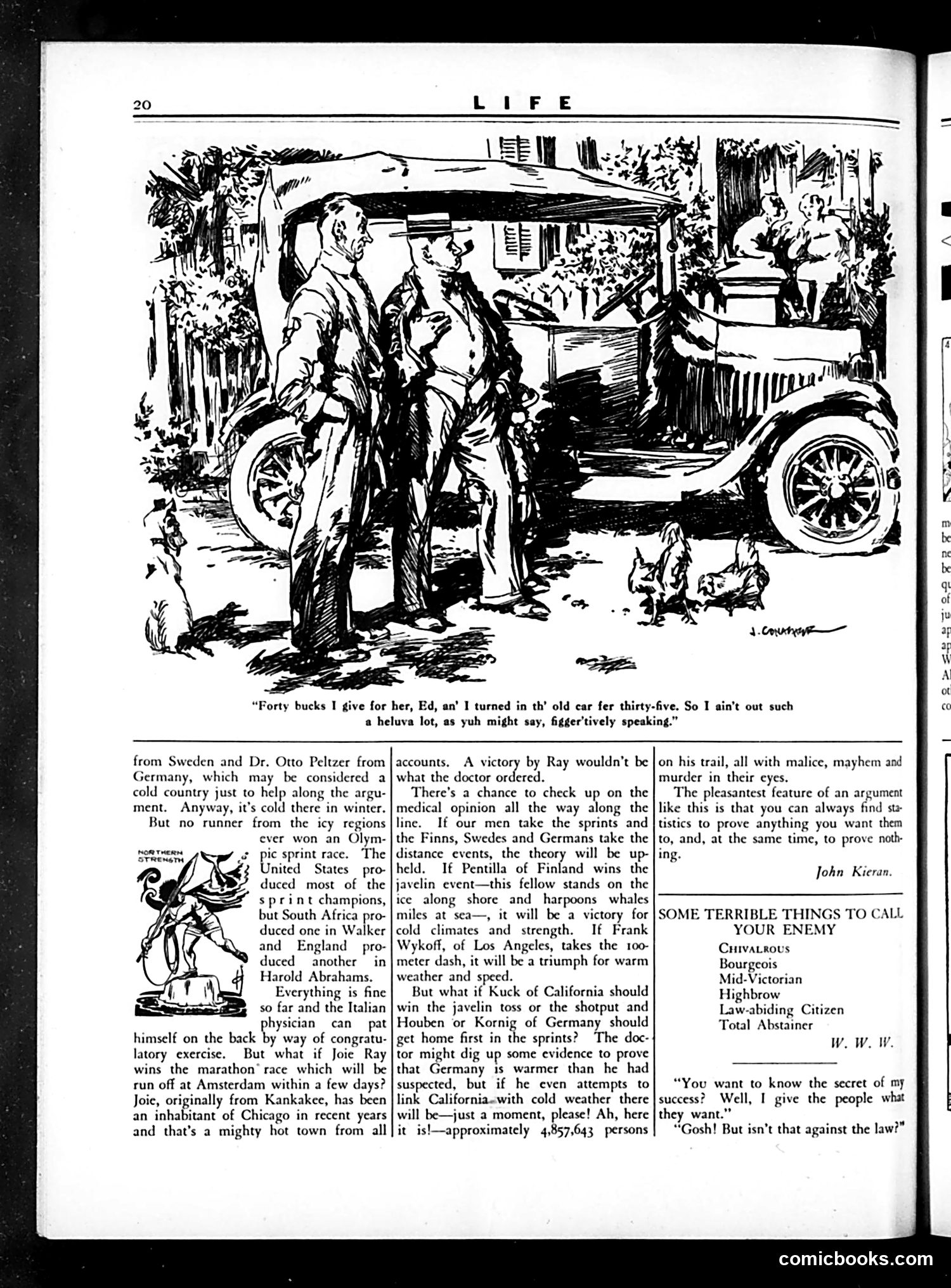
This cartoon satirizes working-class attitudes toward automobile trading and depreciation. Two men discuss swapping cars—one paid $40 for "her" (the new car) after trading in an old vehicle for $35, so he claims minimal net loss. The humor targets the common rationalization men use to justify car purchases to themselves and others, treating a vehicle acquisition as shrewdly financial when the arithmetic is dubious. The accompanying article by John Kieran discusses Olympic sprint records and climate theory, arguing that statistics can "prove anything you want them to, and, at the same time, to prove nothing"—a theme that mirrors the cartoon's satirical point about how people selectively use numbers to justify their decisions. The lower section lists insulting terms for enemies, suggesting broader social commentary on argument tactics and class divisions of the era.
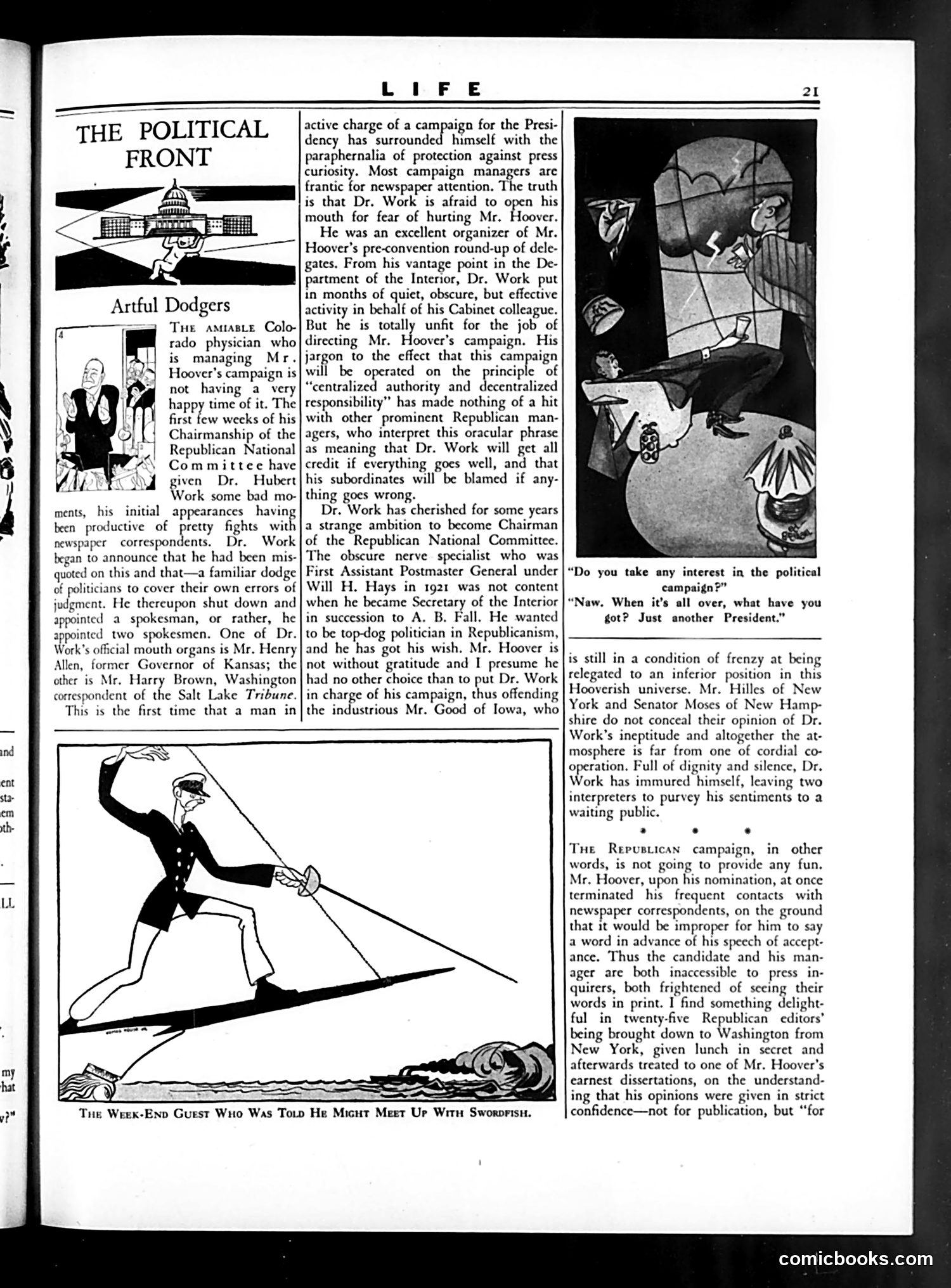
This page satirizes Dr. Hubert Work, the Colorado physician managing Herbert Hoover's 1928 presidential campaign. The article mocks Work for being overly cautious and media-averse, hiring two official spokesmen (Henry Allen and Harry Brown) to shield both himself and Hoover from press scrutiny—unprecedented for a campaign manager. The satire's core complaint: Work is incompetent at politics despite successfully organizing Hoover's pre-convention delegate-gathering. His vague corporate-speak about "centralized authority and decentralized responsibility" alienates other Republican leaders (Messrs. Good, Hilles, and Senator Moses), creating internal discord. The bottom cartoon shows a voter dismissing the entire campaign as pointless: "Just another President." The piece argues Hoover's campaign will be joyless—both candidate and manager avoiding press interactions, depriving the election of public engagement or entertaining political theater.
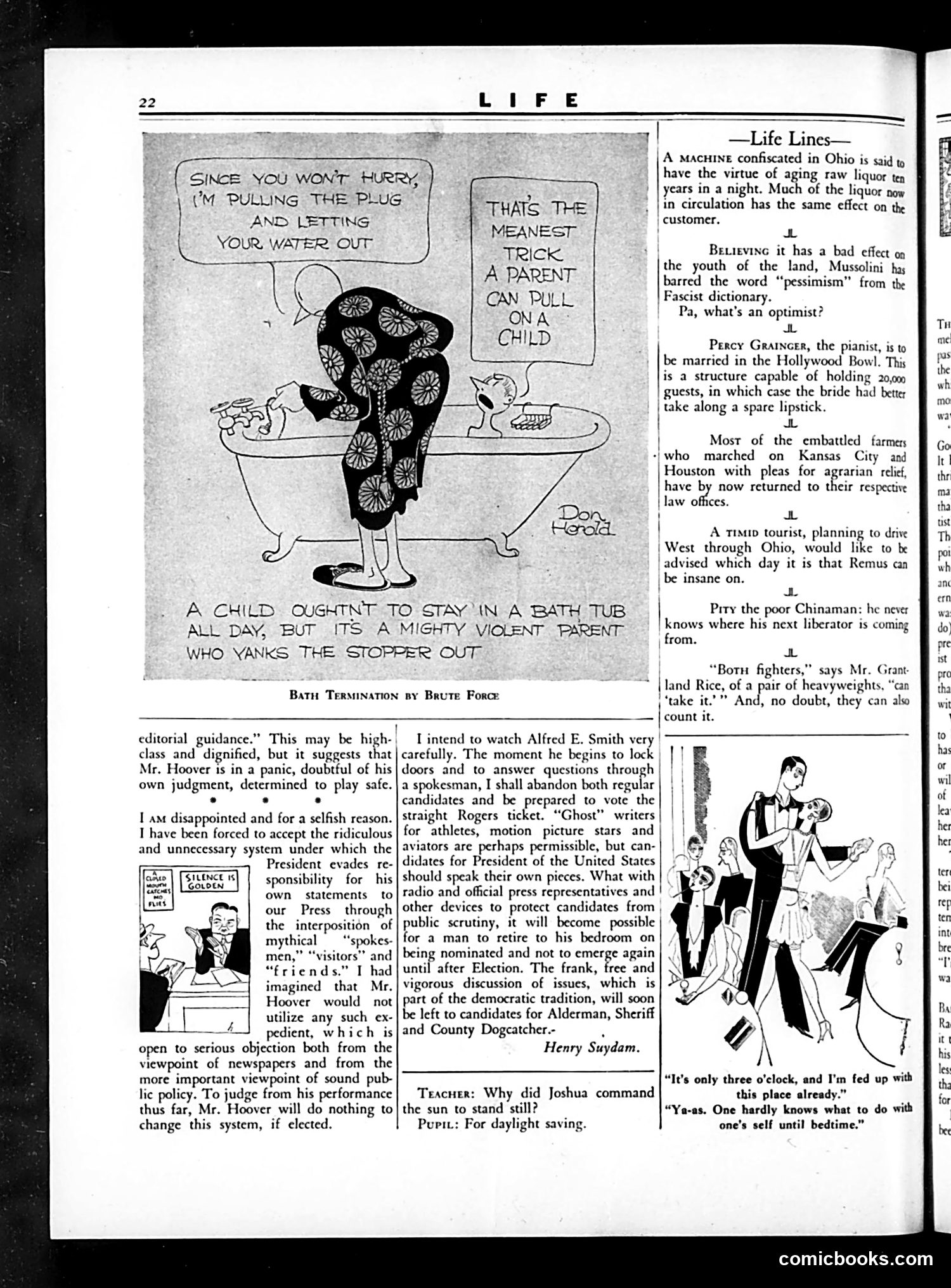
This cartoon satirizes parental discipline through an exaggerated domestic scene. A parent threatens to drain a child's bathwater as punishment for dawdling, while the child protests this is the "meanest trick" a parent can employ. The caption argues the real problem is parental impatience: children naturally want to stay in baths, but only "violent" parents resort to yanking the stopper. The satire works through absurdist escalation—treating bath-draining as a disproportionate parental weapon. It gently mocks both excessive parental force and children's resistance to leaving comfortable situations. The page also contains political commentary by Henry Suydam criticizing President Hoover's use of spokespersons and intermediaries rather than speaking directly to the press, contrasting this unfavorably with Alfred E. Smith's approach. Suydam argues this undermines democratic principles of direct public discourse.
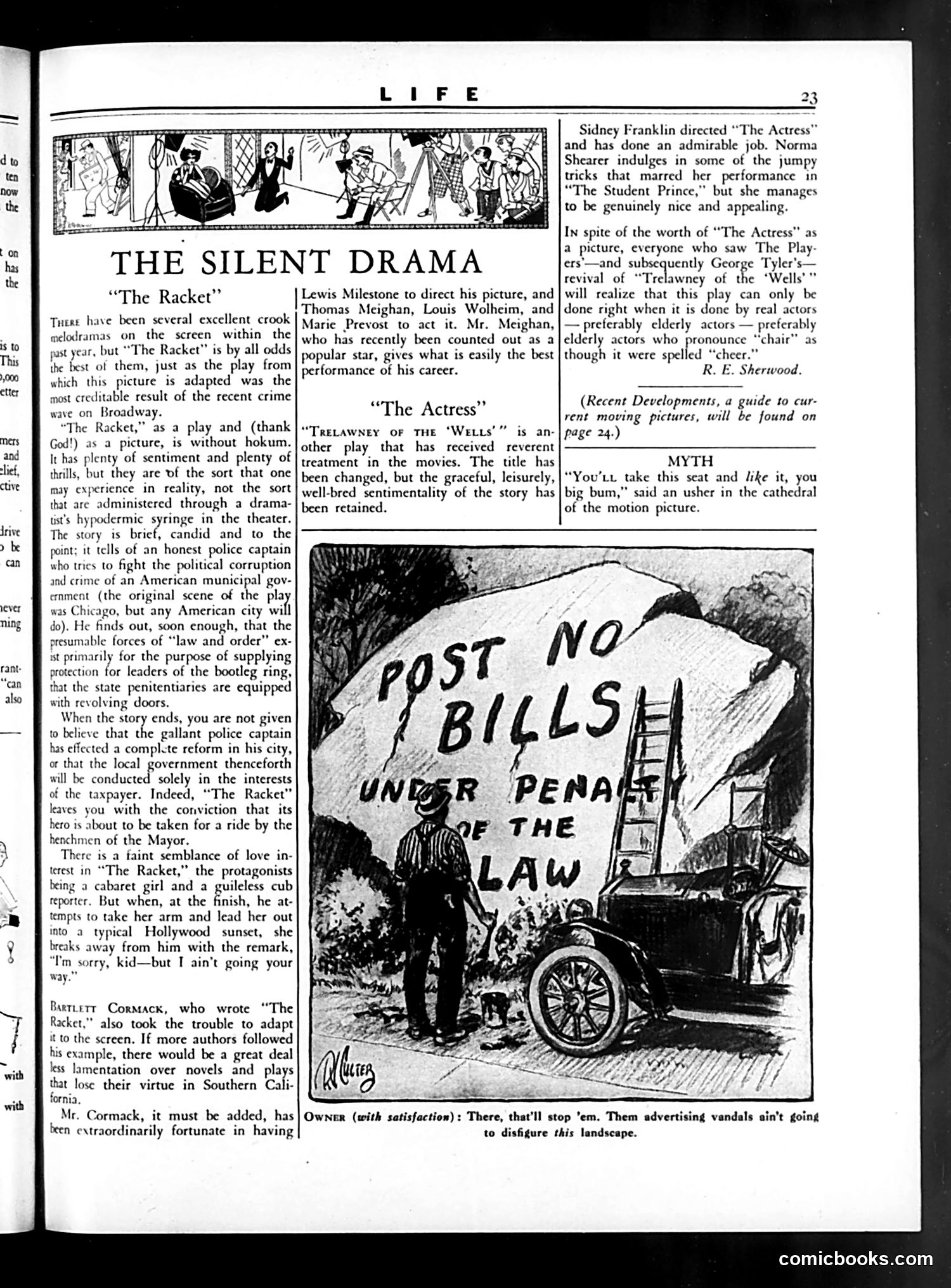
This page reviews two silent films and includes one political cartoon. The cartoon depicts a car owner posting a sign reading "POST NO BILLS! UNDER PENALTY OF THE LAW" on what appears to be a roadside billboard or wall. The owner congratulates himself, believing this will stop advertisers from defacing the landscape with ads. The satire is ironic: the owner thinks his sign will prevent "advertising vandals" from littering the landscape, yet he's essentially created his own advertisement—a large sign that itself defaces the natural scenery. The cartoon mocks the hypocrisy of fighting visual pollution through methods that perpetuate it. The page's film reviews discuss "The Racket" and "The Actress," praising their adaptation from stage to screen and their realistic treatment of subject matter, particularly regarding corruption in municipal government.
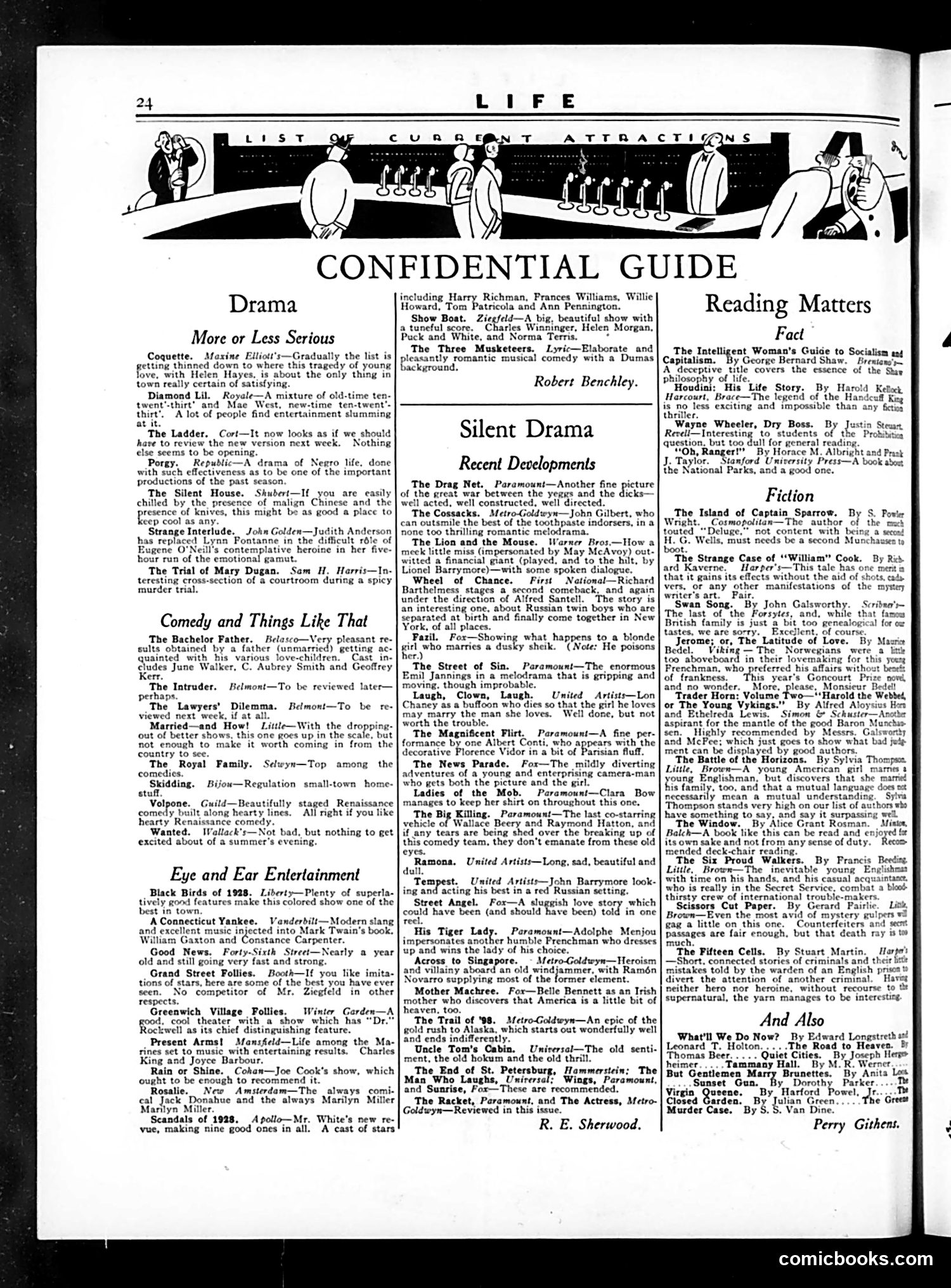
This is a theater and entertainment review page, not a political cartoon. It's a **guide to current Broadway shows and films** circa 1928, organized by genre (Drama, Comedy, Silent Drama, Fiction, Reading Matters). **What it is:** Robert Benchley and other critics provide brief, witty assessments of current productions—plays at theaters like the Cort, Republic, and Shubert, plus films from studios like Paramount and Metro-Goldwyn. Notable performers mentioned include Helen Hayes, Mae West, Marilyn Miller, and John Gilbert. **The tone:** Sardonic and gossipy. Reviews mix praise with snark (e.g., "Diamond Lil"—"A lot of people find entertainment slumming at it"). **Historical context:** This captures New York's vibrant 1920s entertainment scene during the transition from silent to sound film and theater's golden age. Shows like *Show Boat* and *Good News* were major productions. The page reflects elite Manhattan cultural consumption—expensive, Broadway-focused entertainment for Life's affluent readers.
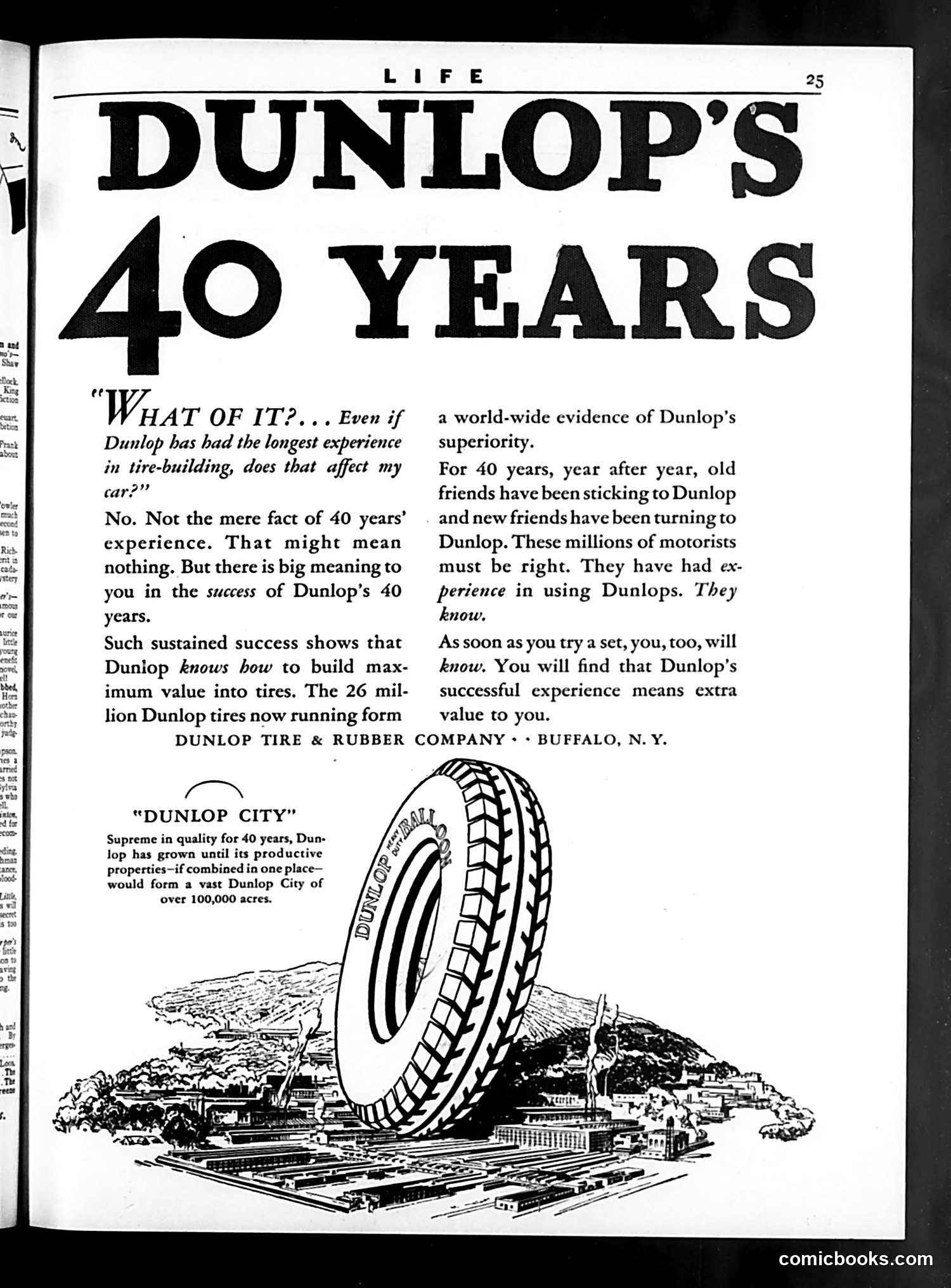
This is not a cartoon or satire—it's a straightforward **advertisement for Dunlop tires** from Life magazine. The page features: **The Advertisement's Argument:** Dunlop claims 40 years of tire-manufacturing experience, with 26 million tires in use worldwide. The ad argues this longevity proves the company knows how to build quality. The tagline "They know" repeatedly emphasizes that millions of satisfied customers validate Dunlop's superiority. **Visual Element:** A large illustration of a Dunlop tire dominates the lower half, with an exaggerated "Dunlop City" imagined beneath it—a satirical reference claiming the company's combined factories would cover 100,000 acres if consolidated. **The Rhetorical Strategy:** The ad addresses consumer skepticism ("What of it?") head-on, arguing that mere experience means nothing *unless* it demonstrates success. It appeals to social proof: if millions of drivers choose Dunlop, you should too. This reflects early-20th-century advertising tactics emphasizing brand longevity and consumer testimony as markers of reliability.
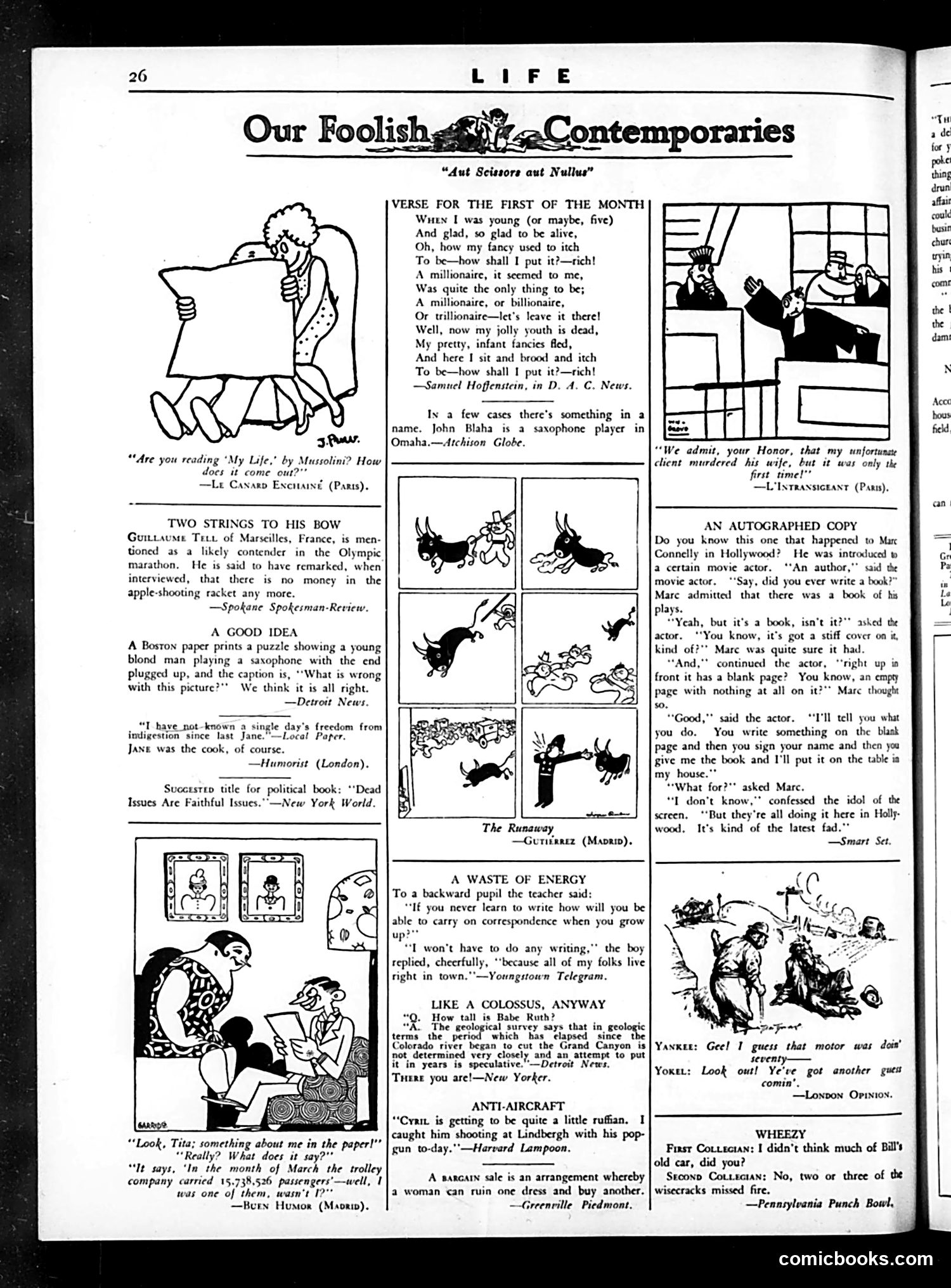
This page collects brief satirical humor items mocking contemporary absurdities. Key pieces include: **"Verse for the First of the Month"**: A sardonic poem about how youthful ambitions for wealth persist into adulthood despite disillusionment—capturing the futility of perpetual striving. **"Two Strings to His Bow"**: Mocks a French Olympic marathoner who claimed he abandoned competitive apple-shooting because there's no money in it—absurd reasoning presented as fact. **"A Good Idea"**: Joke about a puzzle showing a saxophone with its end plugged up, captioned "What's wrong?" The humor: nothing's wrong—the plugged instrument is finally silent, implying saxophones are inherently unpleasant. **"Anti-Aircraft"**: References Charles Lindbergh, the famous aviator, with a joke about a child shooting at him with a pop-gun, treating the aviation celebrity as a comical target. **"An Autographed Copy"**: Hollywood satire where a movie actor asks playwright Marc Connelly to autograph a blank page in his book—mocking superficial celebrity culture and empty status-seeking. The page epitomizes *Life*'s satirical mission: exposing contemporary pretension and foolishness.
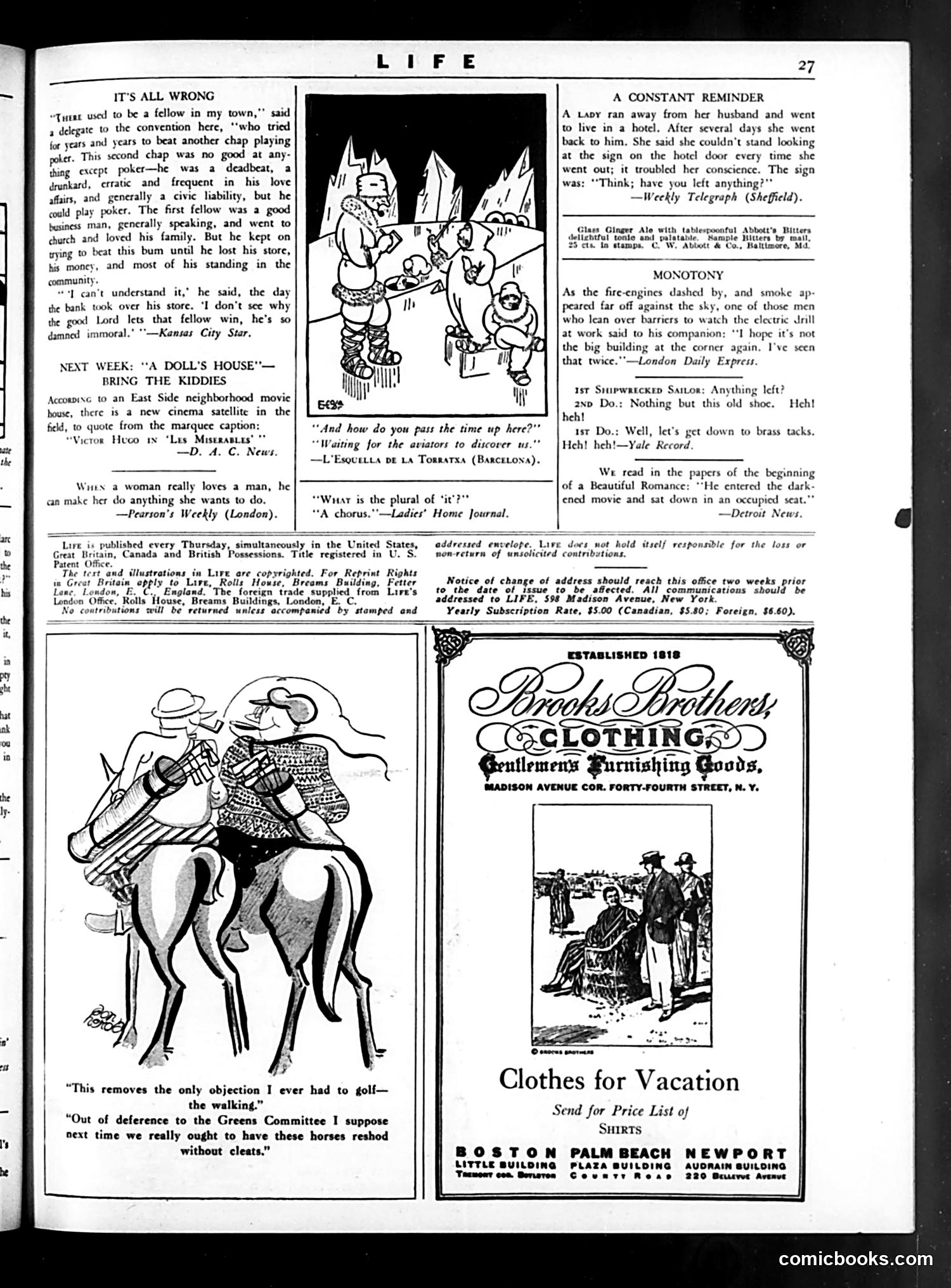
This page contains several short humorous anecdotes and two advertisements, typical of Life's satirical format. **"It's All Wrong"** presents a moral paradox: a virtuous businessman loses everything trying to beat a worthless poker player at cards, questioning why God allows the immoral man to win. The joke critiques both gambling's allure and the unfairness of chance. **"A Constant Reminder"** is a brief joke about a wife who abandons her husband after seeing a hotel sign reading "Think; have you left anything?"—the reminder of her conscience drives her back. **The golf cartoon** satirizes upper-class etiquette concerns: golfers object to horses on greens because they might leave prints, yet seem unconcerned about the horses' welfare (no cleats). It mocks prioritizing aesthetic complaints over practical ethics. The page also includes advertisements for Brooks Brothers clothing and various short comic observations about cinema, romance, and daily life—all characteristic of Life's mix of satire, advertising, and miscellaneous humor from this era.
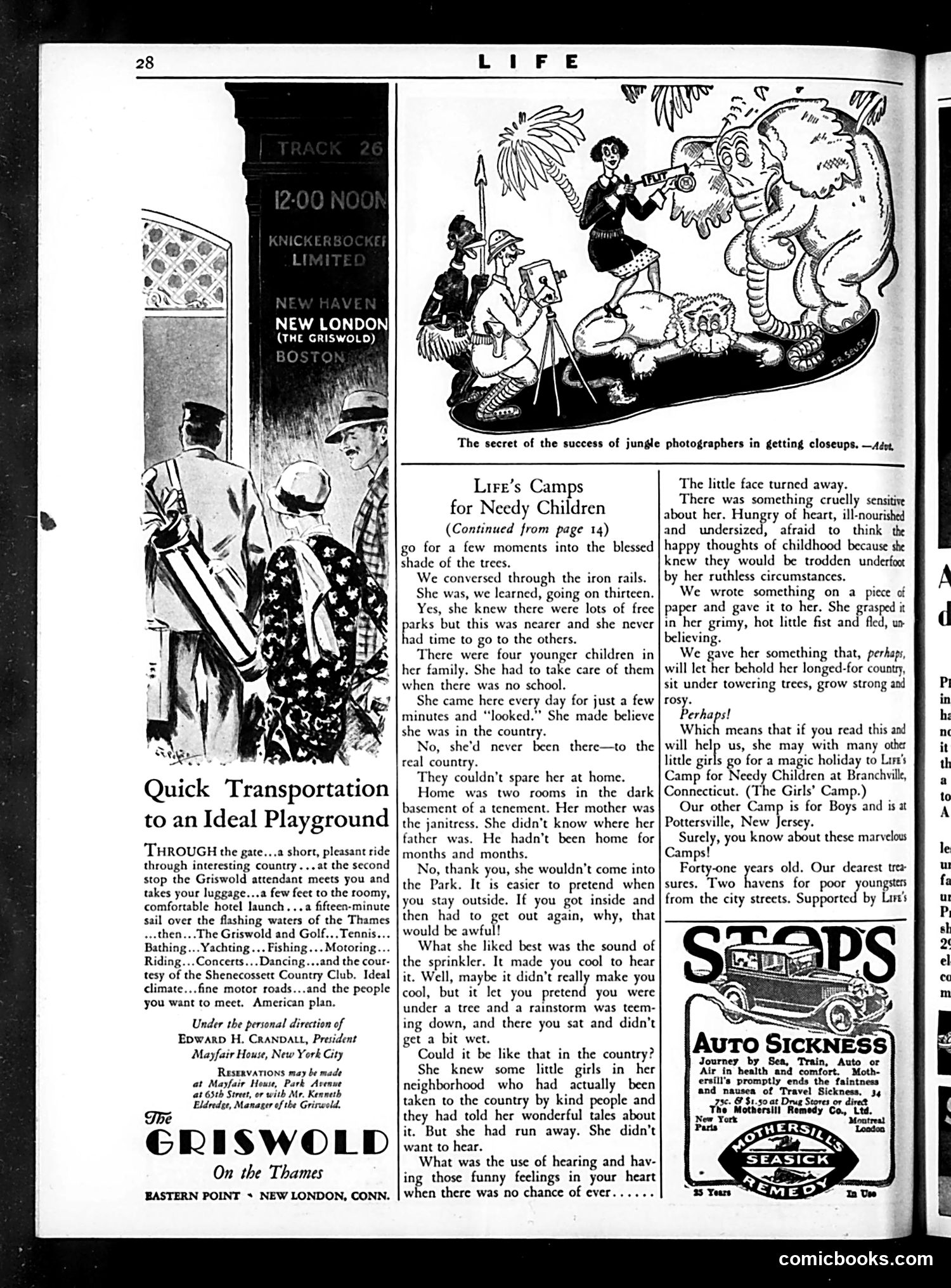
This page combines a satirical cartoon with advocacy journalism for charity camps. **The Cartoon** (top right): Shows jungle photographers using elaborate equipment and techniques to photograph wild animals. The joke is that photographers achieve "closeups" by essentially staging or tricking the animals—a commentary on how difficult and contrived wildlife photography actually was in this era. **Main Content**: The bulk of the page promotes Life's Camps for Needy Children through a touching narrative about a poverty-stricken girl in New London, Connecticut. She lives in a tenement basement with her janitress mother, cares for four younger siblings, has never visited the real countryside, and can only pretend by listening to sprinkler sounds. The article aims to move readers to donate so poor urban children can experience a country holiday. **Advertisement**: The Griswold hotel ad (lower left) ironically bookends the charity appeal—promoting leisure travel for the wealthy while the editorial pleads for basic nature experiences for impoverished children. This juxtaposition likely highlights class disparity and appeals to readers' conscience. The page exemplifies Life magazine's role as both satirical publication and social advocate.
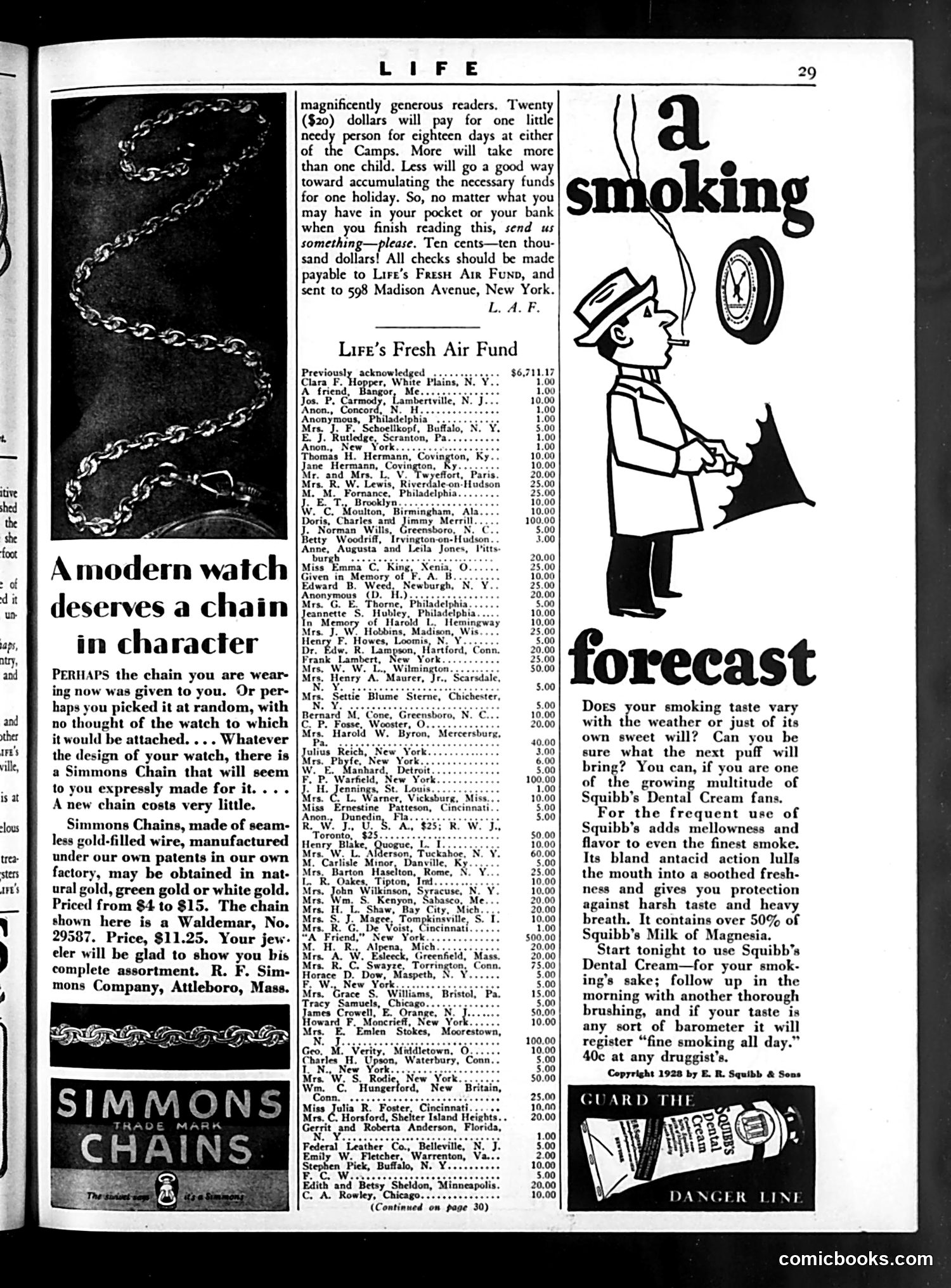
This page contains primarily **advertising and charitable fundraising**, not political satire. **Main Content:** - A Simmons Chains advertisement (left) promoting watch chains as gifts, with the tagline "A modern watch deserves a chain in character" - Life's Fresh Air Fund appeal (center), soliciting donations ($20 suggested) to provide camping holidays for poor children - A Squibb's Dental Cream advertisement (right) featuring a cartoon man smoking, claiming the toothpaste improves smoking experience by adding "mellowness and flavor" **Historical Context:** The Fresh Air Fund was a genuine charitable cause providing summer camps for underprivileged urban children. The Squibb's ad is notable for openly promoting tobacco use without health warnings—standard for the 1928 era before smoking's dangers were publicly acknowledged. The page reflects early 20th-century magazine culture: consumer advertising mixed with progressive charitable appeals. The only minor "cartoon" element is the cheerful smoker illustration, used to sell toothpaste to smokers.
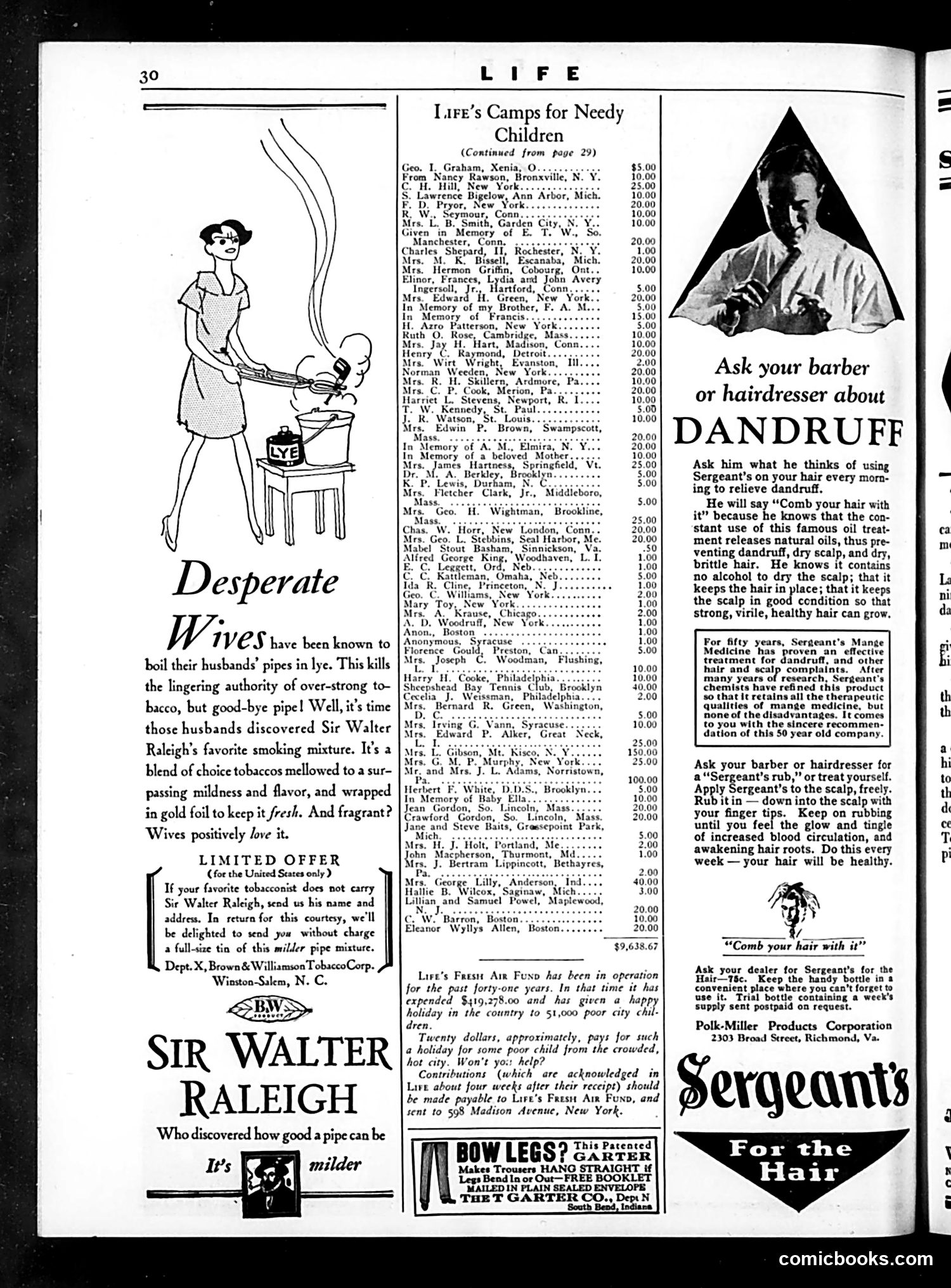
This page is primarily **advertising and charity notices** rather than satirical content. The main advertisement features **Sir Walter Raleigh pipe tobacco**, using a humorous appeal to wives. The cartoon shows a desperate wife considering boiling her husband's pipe in lye to eliminate the strong tobacco smell—a domestic complaint apparently common enough to warrant this marketing angle. The joke targets both nagging wives and stubborn husbands, positioning the milder Sir Walter Raleigh blend as a marital peace offering. The reference to Sir Walter Raleigh (the historical tobacco introducer) gives the product pseudo-historical credibility. Secondary ads promote **Sergeant's hair treatment for dandruff** and a leg-straightening device. The bulk of the page lists donors to **Life's Camps for Needy Children**—a charitable fund supporting poor urban children's summer camps, operating for 41 years. This reflects 1920s-30s Progressive-era philanthropy. There is **no political satire** on this page; it's a commercial/charitable mixed-content issue.
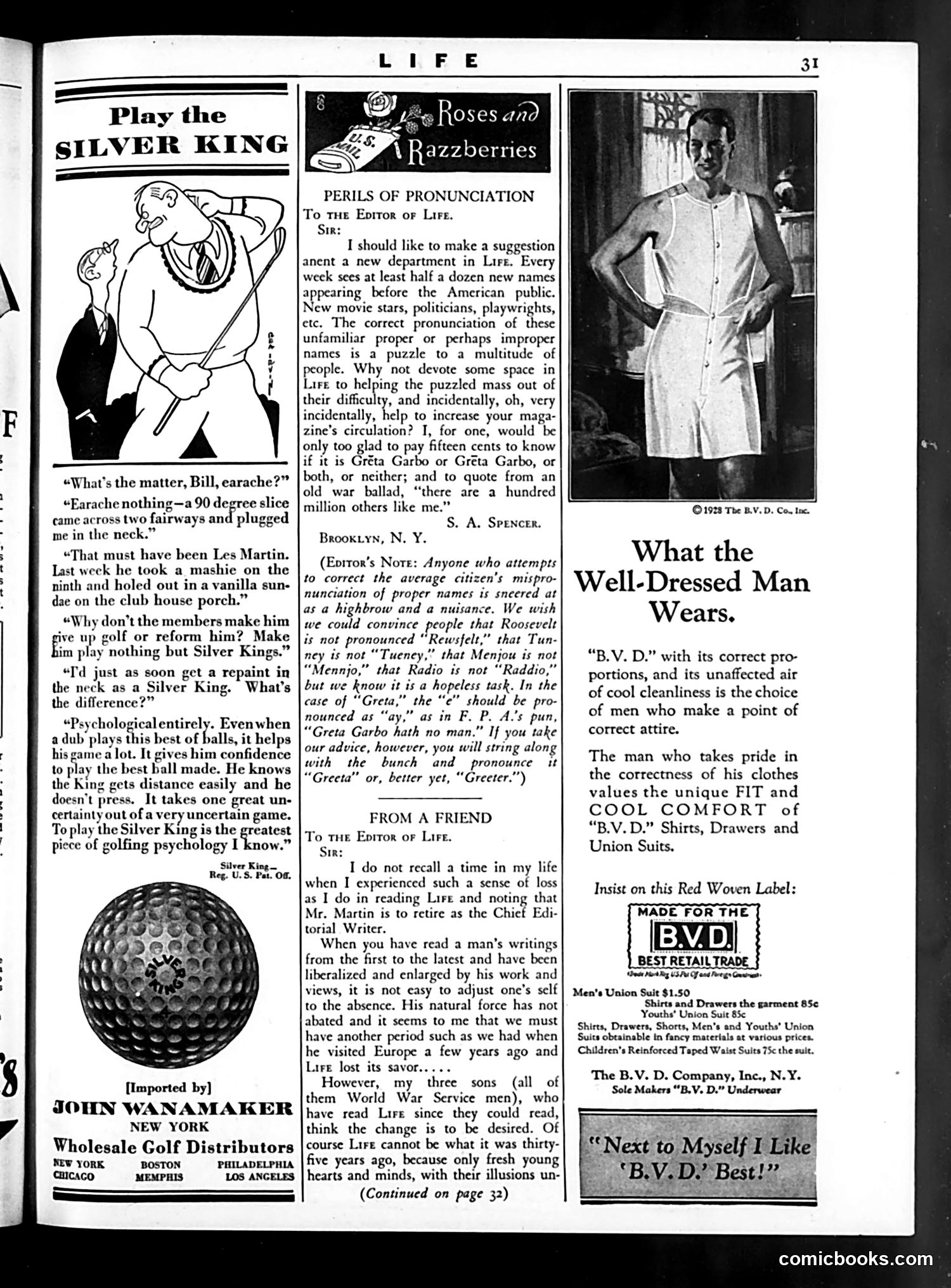
**The "Silver King" Golf Cartoon** (left): A humorous ad disguised as editorial content. Two golfers discuss poor shots, with one blaming his opponent "Les Martin." The punchline argues that playing with Silver King golf balls provides psychological confidence—even a mediocre player performs better believing he's using quality equipment. It's satire on marketing psychology and placebo effects in sports. **"Perils of Pronunciation"** (center): Readers complain about celebrity and public figure name mispronunciations—specifically Greta Garbo, but also mentioning politicians and entertainers. The editor acknowledges this is futile; Americans will mispronounce regardless. It satirizes both the public's indifference to proper pronunciation and celebrity culture's explosion in the 1920s. **"From a Friend"** (lower center): A nostalgic letter mourning the retirement of Life's chief editorial writer, contrasting older readers' reverence for his work with younger (WWI veteran) sons who embrace change. Reflects generational shifts post-1920s. The page is primarily **advertising** (B.V.D. underwear dominates the right side), wrapped in editorial content.
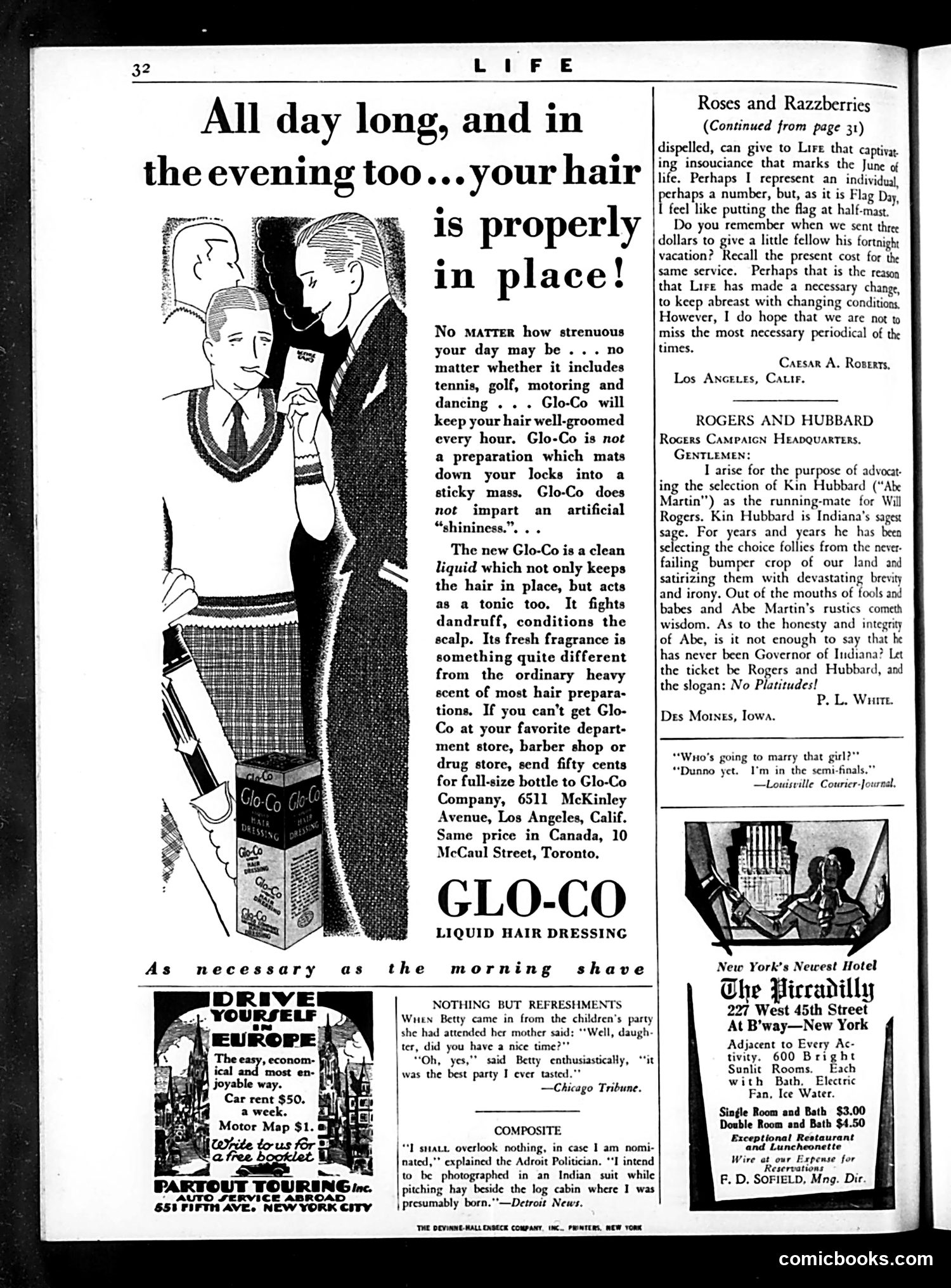
This page from *Life* magazine is primarily **advertising and reader letters**, not political cartoons. The main content is a **Glo-Co hair product advertisement** featuring an illustration of well-groomed men. The ad promises the product keeps hair in place throughout active days (golf, motoring, dancing) without looking artificial—a pitch to men concerned about appearance. Below are three brief **humorous anecdotes**: - A child confuses a party with something she "tasted" (wordplay on "attended") - A cynical politician plans staged photos in rural settings to appear authentic - A young man jokes about being in "semi-finals" of courtship The page also includes **reader letters** discussing Indiana politics and nominations, and hotel/tourism advertisements. The satire is mild social humor typical of 1920s *Life*—poking fun at politicians' inauthenticity and everyday absurdities—rather than sharp political commentary. The page reflects how magazines of this era mixed advertising, light jokes, and reader correspondence.
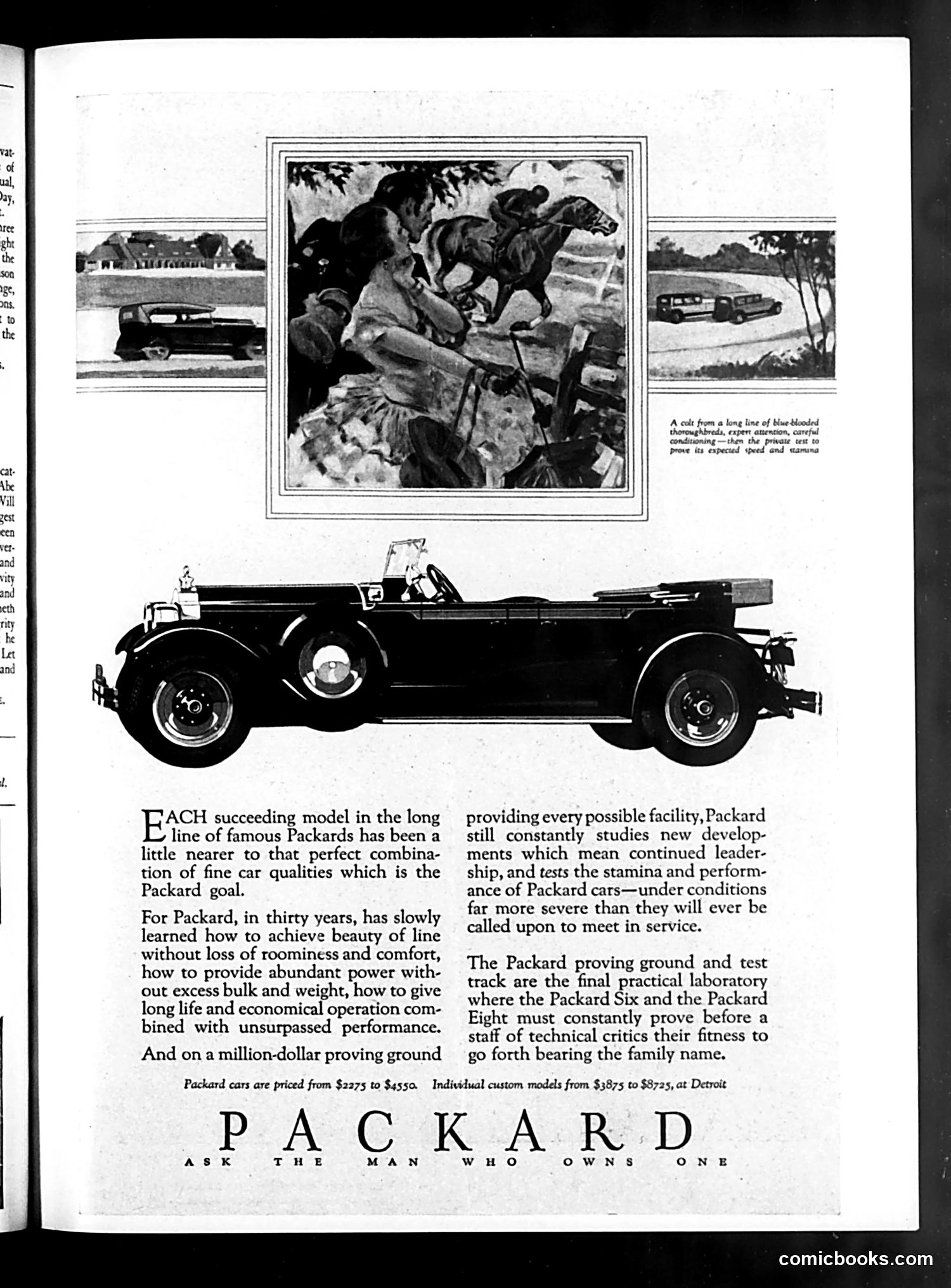
This is a **Packard automobile advertisement**, not political satire. The page promotes luxury cars through messaging about quality engineering and rigorous testing. The central image depicts a **horse racing scene**—a thoroughbred being tested for speed and stamina. This is a **metaphor**: just as breeders condition champion racehorses, Packard conditions its automobiles through "million-dollar proving ground" testing. The accompanying smaller photos show Packard vehicles in various settings (driving, parked). The ad's tagline—"Ask the Man Who Owns One"—was Packard's famous slogan, positioning the car as luxury-class transportation. The price range ($2,275–$8,725) indicates this was high-end, aspirational advertising for 1920s-era wealthy consumers. The horse metaphor suggests **prestige and breeding**: owning a Packard meant possessing something as refined and carefully developed as a thoroughbred racehorse. There is no political commentary here—this is purely corporate marketing using equestrian metaphor to convey automotive excellence.
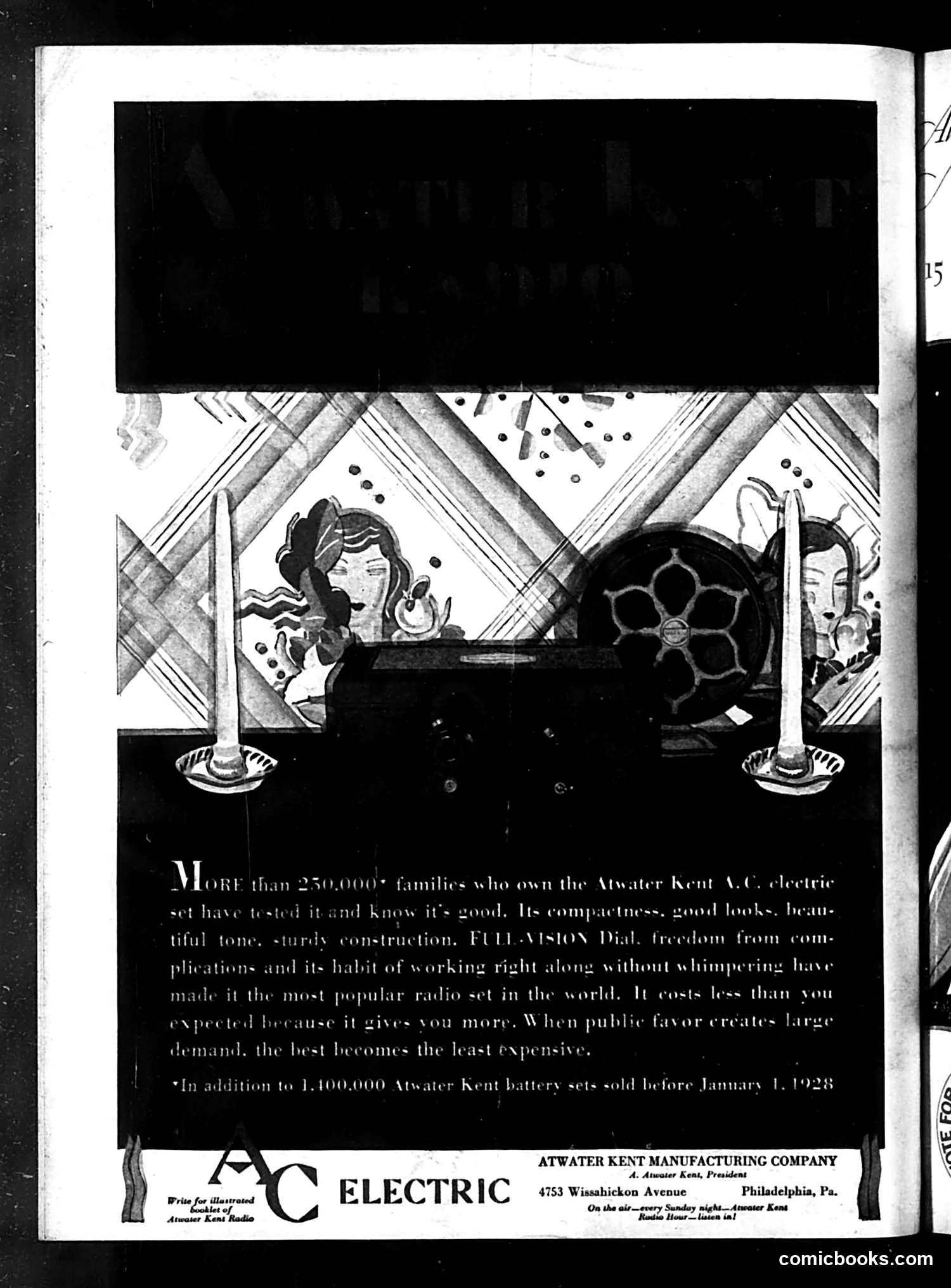
This is primarily a **radio advertisement**, not a political cartoon. It promotes the Atwater Kent A.C. electric radio set, claiming over 250,000 families own it. The decorative illustration above the text shows **two stylized female faces** in Art Deco style, flanking **candles in candlesticks** and what appears to be a large flower or geometric design—imagery evoking elegance and modernity rather than satire. The advertisement's argument is straightforward marketing: the radio's popularity proves its quality, and mass demand has lowered its price. The tagline "When public favor creates large demand, the best becomes the least expensive" attempts to make affordability seem like a natural consequence of superiority. There is **no political satire evident** on this page. This is a straightforward 1920s commercial promoting consumer electronics, using Art Deco aesthetic design to associate the product with sophistication and modernity—standard advertising strategy of the era.