
Life, 1928-07-26 · page 22 of 36
Life — July 26, 1928 — page 22: what you’re looking at
What you’re looking at
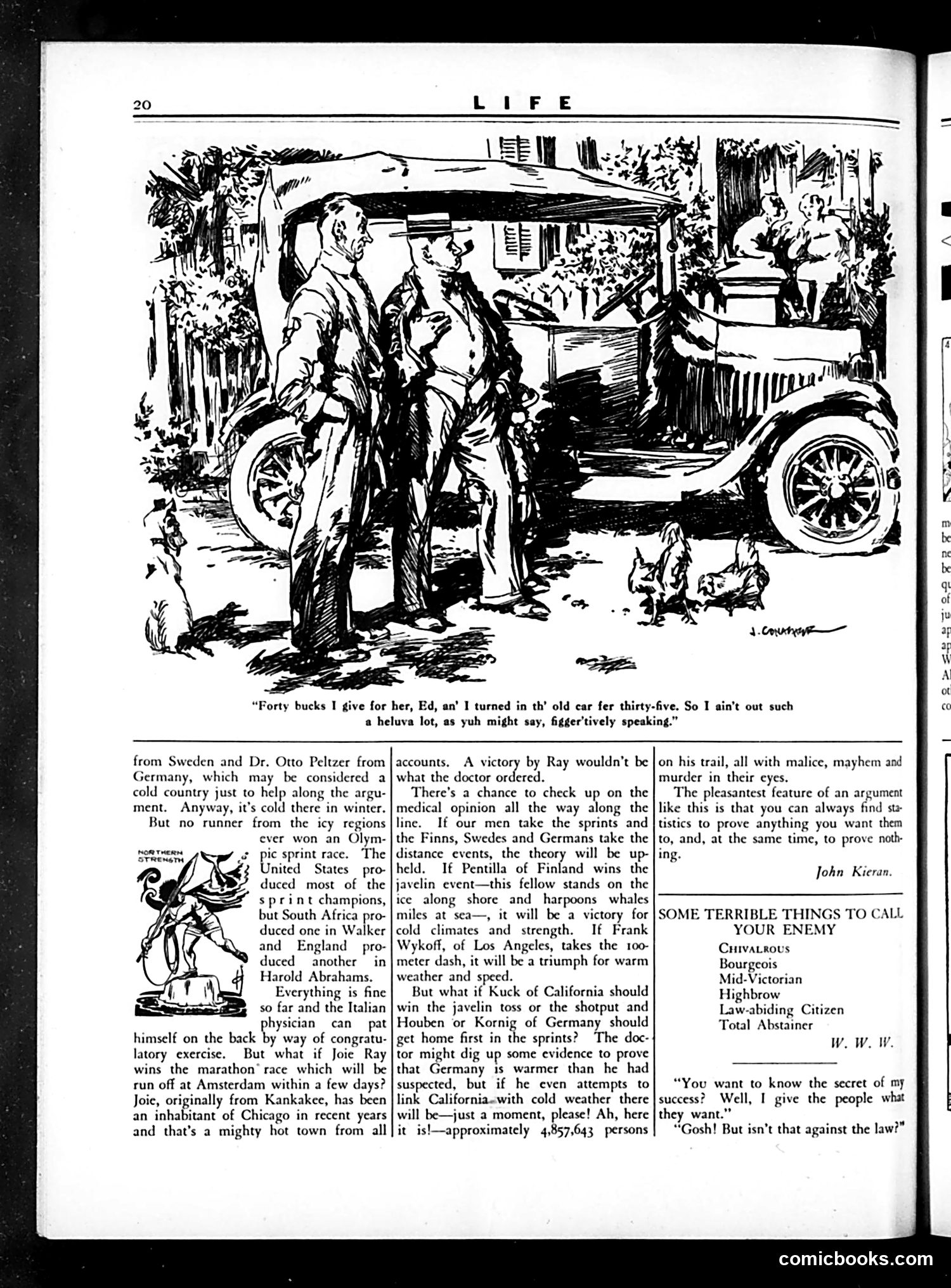
This cartoon satirizes working-class attitudes toward automobile trading and depreciation. Two men discuss swapping cars—one paid $40 for "her" (the new car) after trading in an old vehicle for $35, so he claims minimal net loss. The humor targets the common rationalization men use to justify car purchases to themselves and others, treating a vehicle acquisition as shrewdly financial when the arithmetic is dubious. The accompanying article by John Kieran discusses Olympic sprint records and climate theory, arguing that statistics can "prove anything you want them to, and, at the same time, to prove nothing"—a theme that mirrors the cartoon's satirical point about how people selectively use numbers to justify their decisions. The lower section lists insulting terms for enemies, suggesting broader social commentary on argument tactics and class divisions of the era.
📄 Transcribed text from this page (OCR, searchable)
Machine-transcribed from the original scan — historical spelling and the odd misread are preserved.
“Forty bucks I give for her, Ed, an’ I turned in th’ old car fer thirty-five. So I ain't out such a heluva lot, as yuh might say, figger'tively speaking.” from Sweden and Dr. Otto Peltzer from Germany, which may be considered a cold country just to help along the argu- ment. Anyway, it’s cold there in winter. But no runner from the icy regions ever won an Olym- pic sprint race. The United States _ pro- duced most of the sprint champions, but South Africa pro- duced one in Walker and England _ pro- duced another in Harold Abrahams. Everything is fine so far and the Italian physician can pat himself on the back by way of congratu- latory exercise. But what if Joie Ray wins the marathon’ race which will be run off at Amsterdam within a few days? Joie, originally from Kankakee, has been an inhabitant of Chicago in recent years and that’s a mighty hot town from all hom THERM accounts. A victory by Ray wouldn’t be what the doctor ordered. There's a chance to check up on the medical opinion all the way along the line. If our men take the sprints and the Finns, Swedes and Germans take the distance events, the theory will be up- held. If Pentilla of Finland wins the javelin event—this fellow stands on the ice along shore and harpoons whales miles at sea—, it will be a victory for cold climates and strength. If Frank Wykoff, of Los Angeles, takes the 100- meter dash, it will be a triumph for warm weather and speed. But what if Kuck of California should win the javelin toss or the shotput and Houben ‘or Kornig of Germany should get home first in the sprints? The doc- tor might dig up some evidence to prove that Germany 1s warmer than he had suspected, but if he even attempts to link California-with cold weather there will be—just a moment, please! Ah, here it is!—approximately 4,857,643 persons on his trail, all with malice, mayhem and murder in their eyes. The pleasantest feature of an argument like this is that you can always find ste tistics to prove anything you want them to, and, at the same time, to prove noth- ing. John Kieran. SOME TERRIBLE THINGS TO CALL YOUR ENEMY Cuivacrous Bourgeois Mid-Victorian Highbrow Law-abiding Citizen Total Abstainer W.W. W. “You want to know the secret of my success? Well, I give the people what they want.” “Gosh! But isn’t that against the law?” comicbooks.com YW