
Life, 1928-07-26 · page 13 of 36
Life — July 26, 1928 — page 13: what you’re looking at
What you’re looking at
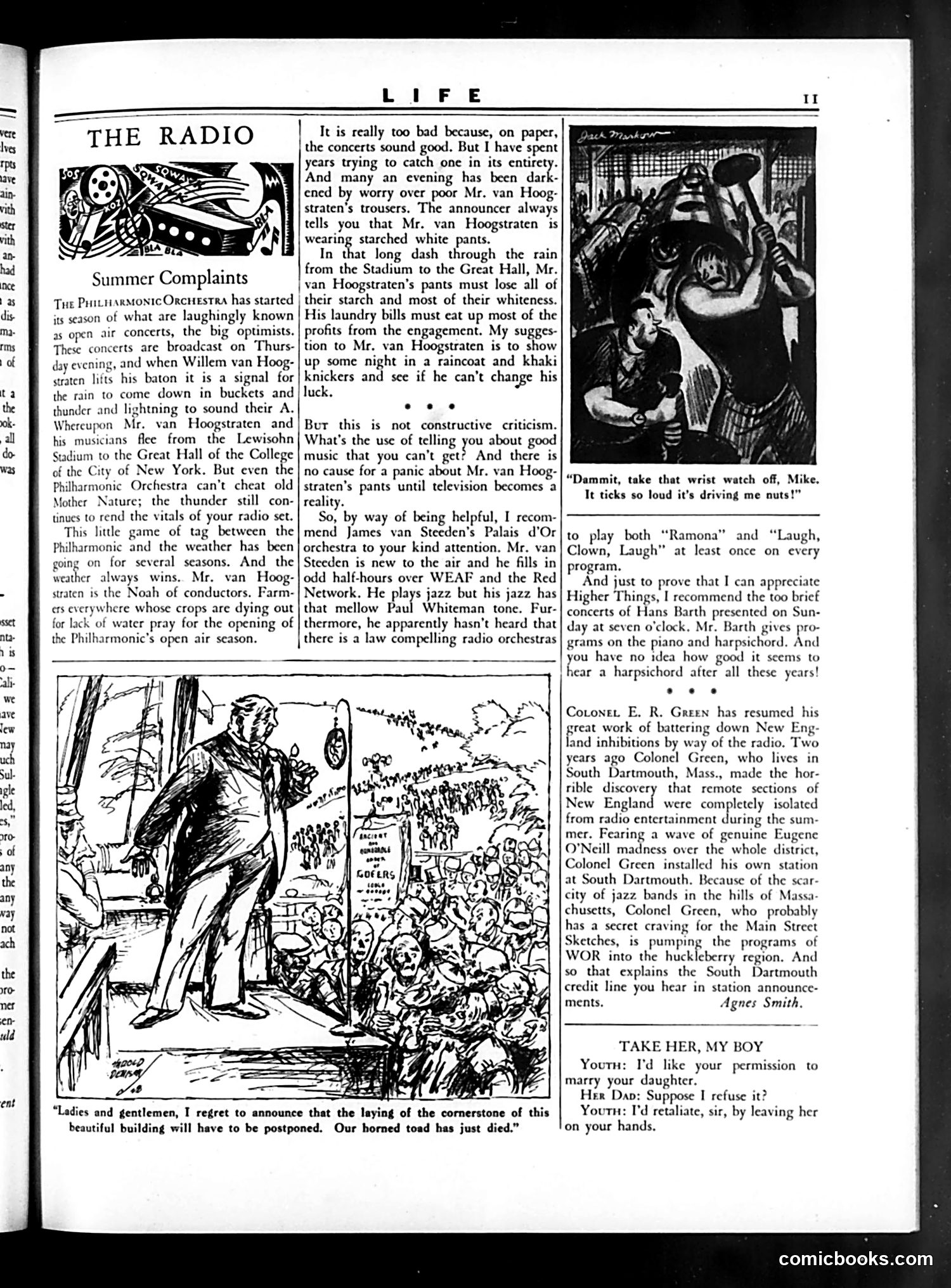
This page satirizes the Philharmonic Orchestra's open-air summer concert series and radio broadcasting challenges of the era. The main cartoon jokes that despite the orchestra's efforts to perform outdoors at venues like the Stadium and Great Hall, bad weather—particularly rain—constantly threatens performances. The text humorously complains that conductor Willem van Hoogstraten's trousers lose their starch during rainy dashes between venues, suggesting the absurdity of maintaining formal concert standards in unpredictable weather. The second cartoon appears to mock radio announcers delivering bad news (a toad's death preventing a building cornerstone ceremony), reflecting listener frustration with radio's entertainment limitations. The page criticizes both weather-dependent outdoor concerts and the limitations of early radio programming compared to live performance quality.
📄 Transcribed text from this page (OCR, searchable)
Machine-transcribed from the original scan — historical spelling and the odd misread are preserved.
LIFE Summer Complaints Tue PrittiarMonic ORCHESTRA has started | its season of what are laughingly known as open air concerts, the big optimists. These concerts are broadcast on Thurs- day evening, and when Willem van Hoog- straten lifts his baton it is a signal for the rain to come down in buckets and thunder and lightning to sound their A. Whereupon Mr. van Hoogstraten and his musicians flee from the Lewisohn Stadium to the Great Hall of the College of the City of New York. But even the Philharmonic Orchestra can’t cheat old Mother Nature; the thunder still con- tinues to rend the vitals of your radio set. This little game of tag between the Philharmonic and the weather has been going on for several seasons. And the weather always wins. Mr. van Hoog- straten is the Noah of conductors. Farm- ers everywhere whose crops are dying out for lack of water pray for the opening of the Philharmonic’s open air season. It is really too bad because, on paper, the concerts sound good. But I have spent years trying to catch one in its entirety. And many an evening has been dark- ened by worry over poor Mr. van Hoog- straten’s trousers. The announcer always tells you that Mr. van Hoogstraten is wearing starched white pants. In that long dash through the rain from the Stadium to the Great Hall, Mr. van Hoogstraten’s pants must lose all of their starch and most of their whiteness. His laundry bills must eat up most of the profits from the engagement. My sugges- tion to Mr. van Hoogstraten is to show up some night in a raincoat and khaki knickers and sce if he can’t change his luck. eee Bur this is not constructive criticism. What's the use of telling you about good music that you can’t get? And there is no cause for a panic about Mr. van Hoog- straten’s pants until television becomes a reality. So, by way of being helpful, I recom- mend James van Steeden’s Palais d’Or orchestra to your kind attention. Mr. van Steeden is new to the air and he fills in odd half-hours over WEAF and the Red Network. He plays jazz but his jazz has that mellow Paul Whiteman tone. Fur- thermore, he apparently hasn't heard that | there is a law compelling radio orchestras 22 “Ladies and gentlemen, I regret to announce that the laying of the cornerstone of this beautiful building will have to be postponed. Our horned toad has just died.” “Dammit, take that wrist watch off, Mike. It ticks so loud it’s driving me nuts!” to play both “Ramona” and “Laugh, Clown, Laugh” at least once on every program. And just to prove that I can appreciate Higher Things, I recommend the too brief concerts of Hans Barth presented on Sun- day at seven o'clock. Mr. Barth gives pro- grams on the piano and harpsichord. And you have no idea how good it seems to hear a harpsichord after all these years! eee Coronet E. R. Green has resumed his great work of battering down New Eng- land inhibitions by way of the radio. Two years ago Colonel Green, who lives in South Dartmouth, Mass., made the hor- rible discovery that remote sections of New England were completely isolated from radio entertainment during the sum- mer. Fearing a wave of genuine Eugene O'Neill madness over the whole district, Colonel Green installed his own. station at South Dartmouth. Because of the scar- city of jazz bands in the hills of Massa- chusetts, Colonel Green, who probably has a secret craving for the Main Street Sketches, is pumping the programs of WOR into the huckleberry region. And so that explains the South Dartmouth credit line you hear in station announce- ments, Agnes Smith. TAKE HER, MY BOY Youtu: I'd like your permission to marry your daughter. Her Dan: Suppose I refuse it? Youtn: I'd retaliate, sir, by leaving her on your hands. comicbooks.com