
Life, 1928-07-26 · page 15 of 36
Life — July 26, 1928 — page 15: what you’re looking at
What you’re looking at
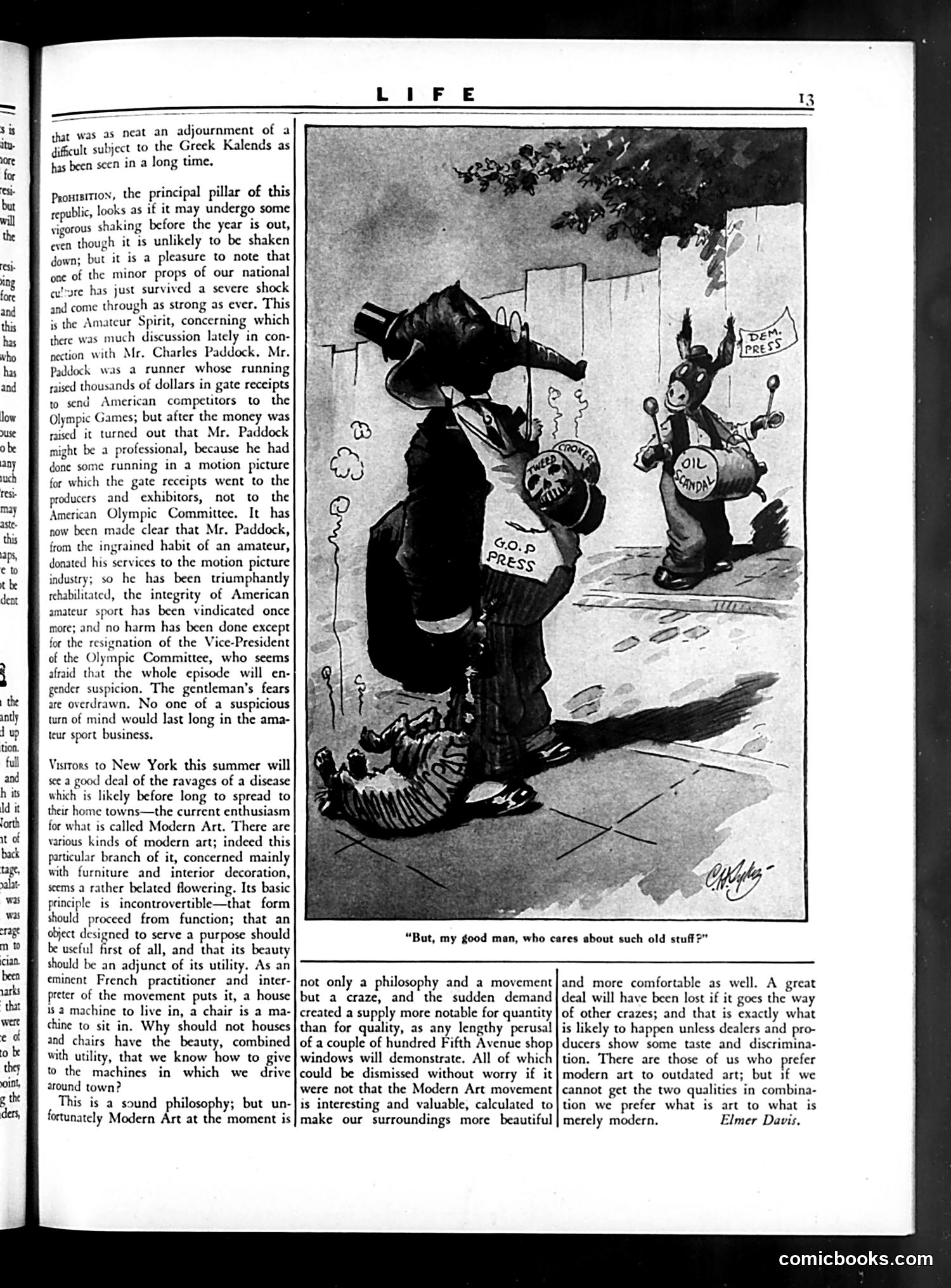
This cartoon satirizes the **Amateur Athletic Union (AAU)** and Olympic Committee controversy. The text discusses Charles Paddock, a runner whose gate receipts from a motion picture were disputed—whether they should go to producers/exhibitors or to the American Olympic Committee. The cartoon depicts **Prohibition-era figures** (labeled "Oil Company," "G.O.P. Press," and others) as suspicious characters watching money fall into a pot, with the caption "But, my good man, who cares about such old stuff?" The satire targets the **hypocrisy of sports organizations** claiming amateur integrity while actually profiting from athletes. It also suggests **corruption** involving Republican interests ("G.O.P. Press") and commercial entities controlling amateur sports—a contrast between stated principles and actual practice during the Prohibition era.
📄 Transcribed text from this page (OCR, searchable)
Machine-transcribed from the original scan — historical spelling and the odd misread are preserved.
as neat an adjournment of a that was dificult subject to the Greek Kalends as has been seen in a long time, Promsition, the principal pillar of this republic, looks as if it may undergo some vigorous shaking before the year is out, even though it is unlikely to be shaken down; but it is a pleasure to note that one of the minor props of our national quivre has just survived a severe shock and come through as strong as ever. This js the Amateur Spirit, concerning which there was much discussion lately in con- nection with Mr. Charles Paddock. Mr. Paddock was a runner whose running raised thousands of dollars in gate receipts to send American competitors to the Olympic Games; but after the money was raised it turned out that Mr. Paddock might be a professional, because he had done some running in a motion picture for which the gate receipts went to the producers and exhibitors, not to the American Olympic Committee. It has now been made clear that Mr. Paddock, from the ingrained habit of an amateur, donated his services to the motion picture industry; so he has been triumphandy rehabilitated, the integrity of American amateur sport has been vindicated once more; and no harm has been done except for the resignation of the Vice-President of the Olympic Committee, who seems afraid that the whole episode will en- gender suspicion. The gentleman's fears are overdrawn. No one of a suspicious turn of mind would last long in the ama- teur sport business. Visrrors to New York this summer will see a good deal of the ravages of a disease which is likely before long to spread to their home towns—the current enthusiasm for what is called Modern Art. There are various kinds of modern art; indeed this particular branch of it, concerned mainly with furniture and interior decoration, seems a rather belated flowering. Its basic principle is incontrovertible—that form should proceed from function; that an object designed to serve a purpose should be useful first of all, and that its beauty should be an adjunct of its utility. As an eminent French practitioner and_ inter- preter of the movement puts it, a house 18a machine to live in, a chair is a ma- chine to sit in. Why should not houses and chairs have the beauty, combined with utility, that we know how to give to the machines in which we drive around town? This is a sound philosophy; but un- fortunately Modern Art at the moment is “But, my good man, who cares about such old stuff?” not only a philosophy and a movement but a craze, and the sudden demand created a supply more notable for quantity than for quality, as any lengthy perusal of a couple of hundred Fifth Avenue sho windows will demonstrate. All of which could be dismissed without worry if it were not that the Modern Art movement is interesting and valuable, calculated to make our surroundings more beautiful and more comfortable as well. A great deal will have been lost if it goes the way of other crazes; and that is exactly what is likely to happen unless dealers and pro- ducers show some taste and discrimina- tion. There are those of us who prefer modern art to outdated art; but if we cannot get the two qualities in combina- tion we prefer what is art to what is merely modern. Elmer Davis. comicbooks.com