
Life, 1928-07-26 · page 21 of 36
Life — July 26, 1928 — page 21: what you’re looking at
What you’re looking at
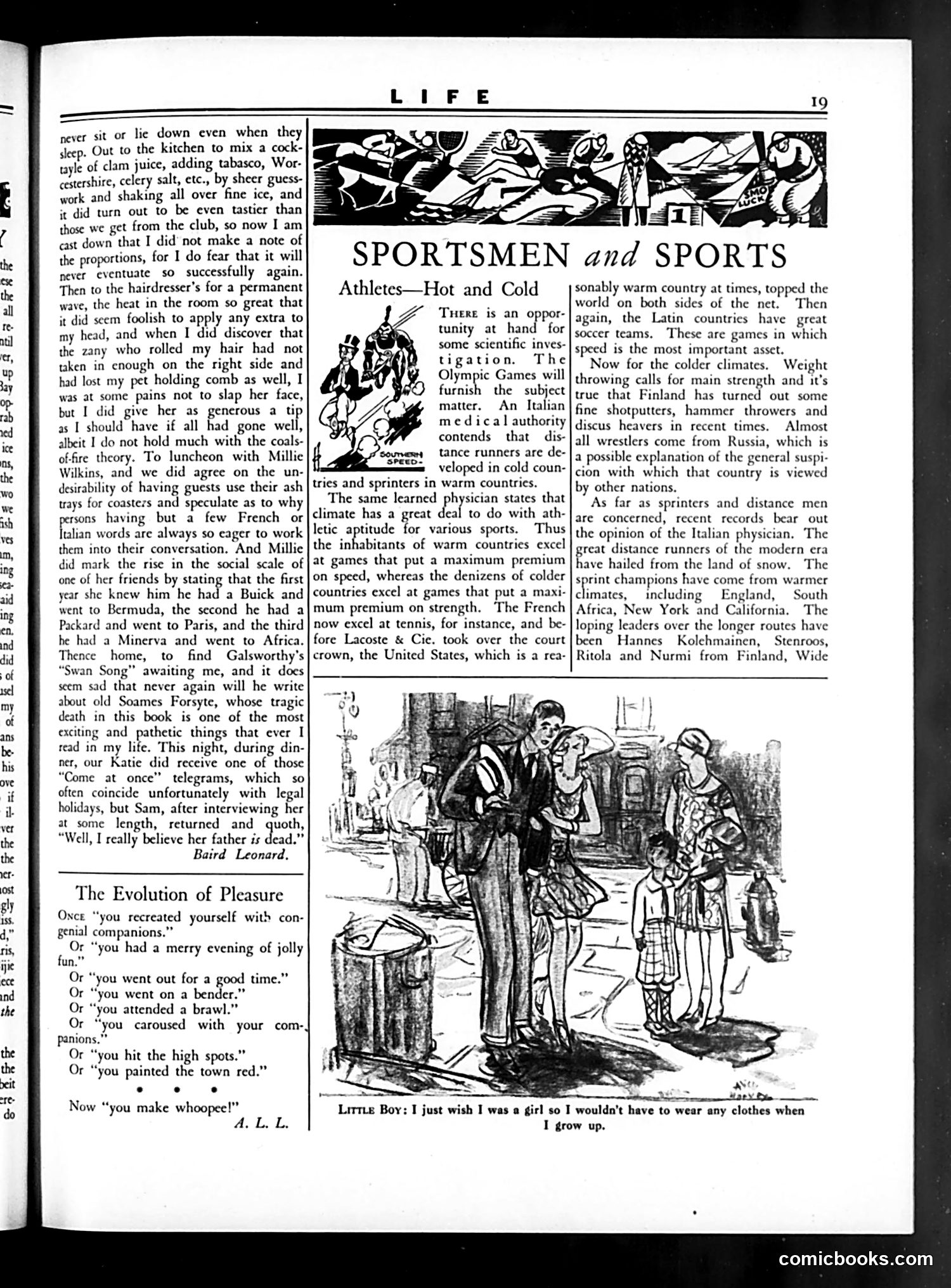
This page contains two distinct pieces of satirical content: **"Athletes—Hot and Cold"** discusses an Italian physician's theory that climate determines athletic aptitude: warm-country inhabitants excel at speed sports (sprinting, tennis, soccer), while cold-country inhabitants excel at strength sports (weight throwing, wrestling). The article uses this pseudo-scientific framework to examine Olympic performance patterns, referencing specific athletes like French tennis player Lacoste and noting Finland's success in throwing events and Russia's dominance in wrestling. **"The Evolution of Pleasure"** (lower section) satirizes how language describing socializing has degraded over time. It traces the phrase's evolution from genteel ("recreated yourself with congenial companions") through increasingly crude variations, culminating in the modern slang "make whoopee"—suggesting 1920s society's casual attitude toward pleasure and moral decline. The cartoon below shows a street scene with adults and children, illustrating changing social attitudes toward gender and clothing norms.
📄 Transcribed text from this page (OCR, searchable)
Machine-transcribed from the original scan — historical spelling and the odd misread are preserved.
never sit or lie down even when they sleep. Out to the kitchen to mix a cock- uyle of clam juice, adding tabasco, Wor- cestershire, celery salt, etc., by sheer guess- work and shaking all over fine ice, and it did turn out to be even tastier than those we get from the club, so now I am ast down that I did’ not make a note of the proportions, for I do fear that it will never eventuate so successfully again. ‘Then to the hairdresser’s for a permanent wave, the heat in the room so great that it did seem foolish to apply any extra to my head, and when I did discover that the zany who rolled my hair had not taken in enough on the right side and had lost my pet holding comb as well, I was at some pains not to slap her face, but I did give her as generous a up as I should have if all had gone well, albeit I do not hold much with the coals- of-fire theory. To luncheon with Millie Wilkins, and we did agree on the un- desirability of having guests use their ash uays for coasters and speculate as to why persons having but a few French or Italian words are always so eager to work them into their conversation. And Millie did mark the rise in the social scale of one of her friends by stating that the first year she knew him he had a Buick and went to Bermuda, the second he had a Packard and went to Paris, and the third he had a Minerva and went to Africa. Thence home, to find Galsworthy's “Swan Song” awaiting me, and it does seem sad that never again will he write about old Soames Forsyte, whose tragic death in this book is one of the most exciting and pathetic things that ever I read in my life. This night, during din- ner, our Katie did receive one of those “Come at once” telegrams, which so often coincide unfortunately with legal holidays, but Sam, after interviewing her at some length, returned and quoth, “Well, I really believe her father is dead.” Baird Leonard, The Evolution of Pleasure Oxce “you recreated yourself with con- genial companions.” f Or “you had a merry evening of jolly fun.” Or “you went out for a good time.” Or “you went on a bender.” Or “you attended a brawl.” Or “you caroused with your com- panions.” Or “you hit the high spots.” Or “you painted the town red.” . e e Now “you make whoopee!” AL. L, Athletes—Hot and Cold Tuere is an oppor- tunity at hand for some scientific inves- tigation. The Olympic Games will furnish the subject matter. An Italian medica] authority contends that dis- tance runners are de- veloped in cold coun- tries and sprinters in warm countries. The same learned physician states that climate has a great deal to do with ath- letic aptitude for various sports. Thus the inhabitants of warm countries excel at games that put a maximum premium on speed, whereas the denizens of colder countries excel at games that put a maxi- mum premium on strength. The French now excel at tennis, for instance, and be- fore Lacoste & Cie. took over the court crown, the United States, which is a rea- ws sonably warm country at times, topped the world on both sides of the net. Then again, the Latin countries have great soccer teams. These are games in which speed is the most important asset. Now for the colder climates. Weight throwing calls for main strength and it's true that Finland has turned out some fine shotputters, hammer throwers and discus heavers in recent times. Almost all wrestlers come from Russia, which is a possible explanation of the general suspi- cion with which that country is viewed by other nations. As far as sprinters and distance men are concerned, recent records bear out the opinion of the Italian physician, The reat distance runners of the modern era ave hailed from the land of snow. The sprint champions have come from warmer climates, including England, South Africa, New York and California. The loping leaders over the longer routes have been Hannes Kolehmainen, Stenroos, Ritola and Nurmi from Finland, Wide Lire Boy: I just wish I was a girl so I wouldn't have to wear any clothes when I grow up. comicbooks.com