
Life, 1928-07-26 · page 12 of 36
Life — July 26, 1928 — page 12: what you’re looking at
What you’re looking at
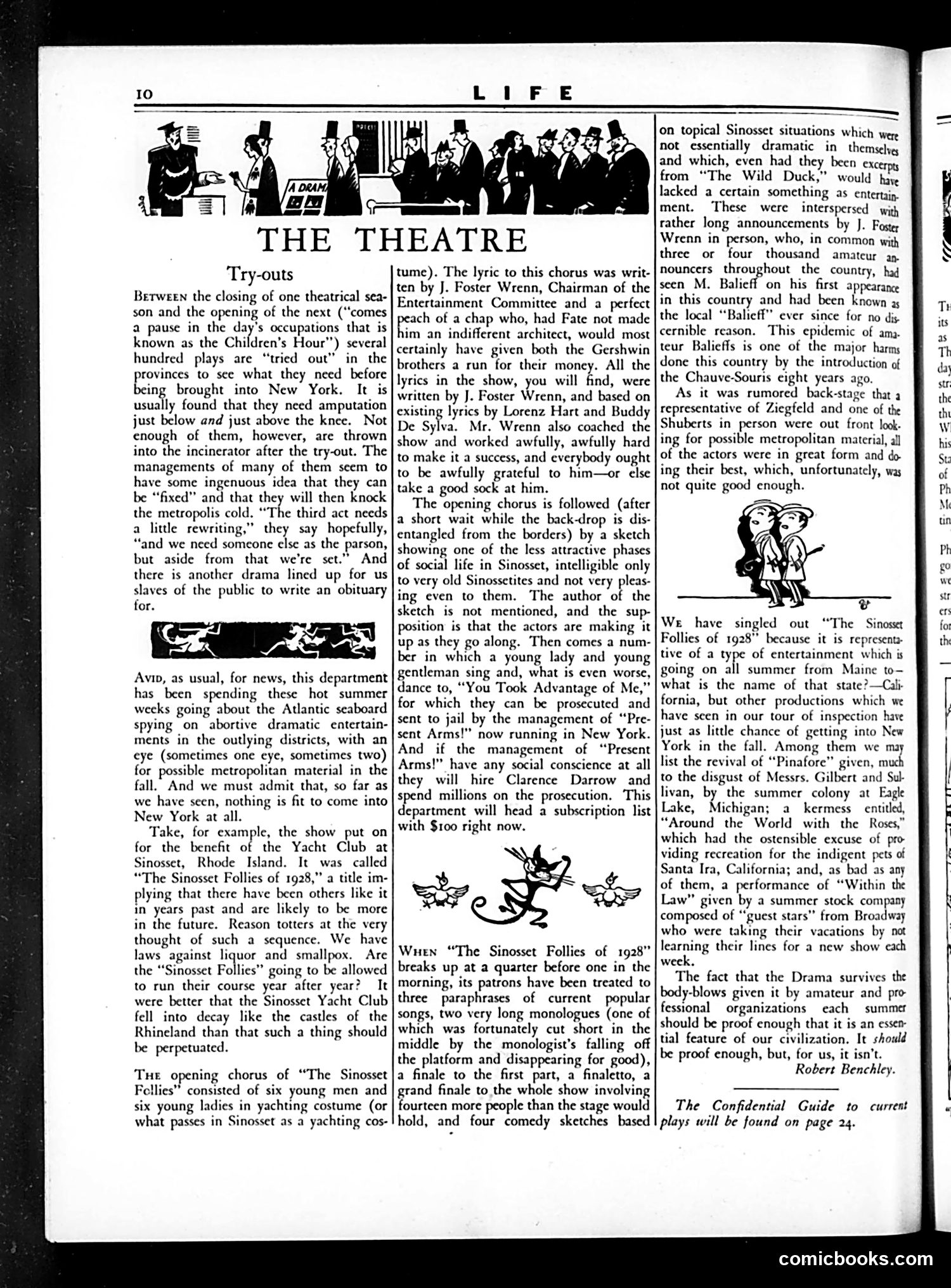
This page discusses theatrical tryouts and reviews, focusing on "The Sinosset Follies of 1928," a summer theatrical production at a yacht club in Rhode Island. The small cartoon illustrations at the top show theatrical figures in various poses—likely representing actors, directors, and producers involved in theatrical productions. The main text critiques amateur theatrical productions, noting that tryouts often reveal "ingratiating" ideas and knockabout farce. The author discusses how "The Sinosset Follies" featured young performers in yachting costumes performing sketches and monologues, observing that the production was "not quite good enough." The satire targets the aspirations and modest quality of amateur summer theatrical productions, poking fun at their pretensions while acknowledging theater's cultural importance. The tone is gently mocking rather than harsh—typical of Life's sophisticated humor.
📄 Transcribed text from this page (OCR, searchable)
Machine-transcribed from the original scan — historical spelling and the odd misread are preserved.
TH Try-outs Between the closing of one theatrical sea- son and the opening of the next (“comes a pause in the day's occupations that is known as the Chikiten’s Hour’) several hundred plays are “tried out” in the provinces to see what they need before being brought into New York. It is sully found that they need amputation just below and just above the knee. Not enough of them, however, are thrown into the incinerator after the try-out. The managements of many of them seem to have some ingenuous idea that they can be “fixed” and that they will then knock the metropolis cold. “The third act needs a little rewriting,” they say hopefully, “and we need someone else as the parson, but aside from that we're set.” And there is another drama lined up for us slaves of the public to write an obituary for. ob ae N Avip, as usual, for news, this department has been spending these hot summer weeks going about the Atlantic seaboard spying on abortive dramatic entertain- ments in the outlying districts, with an eye (sometimes one eye, sometimes two) for possible metropolitan material in the fall. And we must admit that, so far as we have seen, nothing is fit to come into New York at all. Take, for example, the show put on for the benefit of the Yacht Club at Sinosset, Rhode Island. It was called “The Sinosset Follies of 1928," a tite im- plying that there have been others like it in years past and are likely to be more in the future. Reason totters at the very thought of such a sequence. We have laws against liquor and smallpox. Are the “‘Sinosset Follies” going to be allowed to run their course year after year? It were better that the Sinosset Yacht Club fell into decay like the castles of the Rhineland than that such a thing should be perpetuated. Tue opening chorus of “The Sinosset Follies” consisted of six young men and six young ladies in yachting costume (or what passes in Sinosset as a yachting cos- THEATRE tume). The lyric to this chorus was writ- ten by J. Foster Wrenn, Chairman of the Entertainment Committee and a_ perfect ach of a chap who, had Fate not made im an indifferent architect, would most certainly have given both the Gershwin brothers a run for their money. All the lyrics in the show, you will find, were written by J. Foster Wrenn, and based on existing lyrics by Lorenz Hart and Buddy De Sylva. Mr. Wrenn also coached the show and worked awfully, awfully hard to make it a success, and everybody ought to be awfully grateful to him—or else take a good sock at him. The opening chorus is followed (after a short wait while the back-drop is dis- entangled from the borders) by a sketch showing one of the less attractive phases of social life in Sinosset, intelligible only to very old Sinossetites and not very pleas- ing even to them. The author of the sketch is not mentioned, and the sup- position is that the actors are making it up as they go along. Then comes a num- ber in which a young lady and young gentleman sing and, what is even worse, dance to, “You Took Advantage of Me,” for which they can be prosecuted and sent to jail by the management of “Pre- sent Arms!”” now running in New York. And if the management of ‘Present Arms!” have any social conscience at all they will hire Clarence Darrow and spend millions on the prosecution. This department will head a subscription list with $100 right now. Wuen “The Sinosset Follies of 1928” breaks up at a quarter before one in the morning, its patrons have been treated to three paraphrases of current popular songs, two very long monologues (one of which was fortunately cut short in the middle by the monologist’s falling off the platform and disappearing for good), a finale to the first part, a finaletto, a grand finale to the whole show involving fourteen more people than the stage would hold, and four comedy sketches based on topical Sinosset situations which were not essentially dramatic in themselyg and which, even had they been exc from “The Wild Duck,” would have lacked a certain something as entertain. ment. These were interspersed with rather long announcements by J. Foster Wrenn in person, who, in common with three or four thousand amateur ap. nouncers throughout the country, had seen M. Baliefl’ on his first appearance in this country and had been known as the local “Balieff” ever since for no dis cernible reason. This epidemic of ama. teur Balieffs is one of the major harms done this country by the introduction of the Chauve-Souris eight years ago. As it was rumored back-stage that a representative of Ziegfeld and one of the Shuberts in person were out front look- ing for possible metropolitan material, al] of the actors were in great form and do- ing their best, which, unfortunately, was not quite good enough. We have singled out “The Sinosset Follies of 1928” because it is represents tive of a type of entertainment which is going on all summer from Maine to— what is the name of that state?—Cali- fornia, but other productions which we have seen in our tour of inspection have just as little chance of getting into New York in the fall. Among them we may list the revival of “Pinafore” given, much to the disgust of Messrs. Gilbert and Sul- livan, by the summer colony at Eagle Lake, Michigan; a kermess entitled, “Around the World with the Roses,” which had the ostensible excuse of pro viding recreation for the indigent pets of Santa Ira, California; and, as bad as any of them, a performance of “Within the Law” given by a summer stock company composed of “guest stars” from Broadway who were taking their vacations by not learning their lines for a new show cach week. The fact that the Drama survives the body-blows given it by amateur and pro fessional organizations each summer should be proof enough that it is an essen- tial feature of our civilization. It should be proof enough, but, for us, it isn’t. Robert Benchley. The Confidential Guide to current plays will be found on page 24. comicbooks.com