
Life, 1928-07-26 · page 8 of 36
Life — July 26, 1928 — page 8: what you’re looking at
What you’re looking at
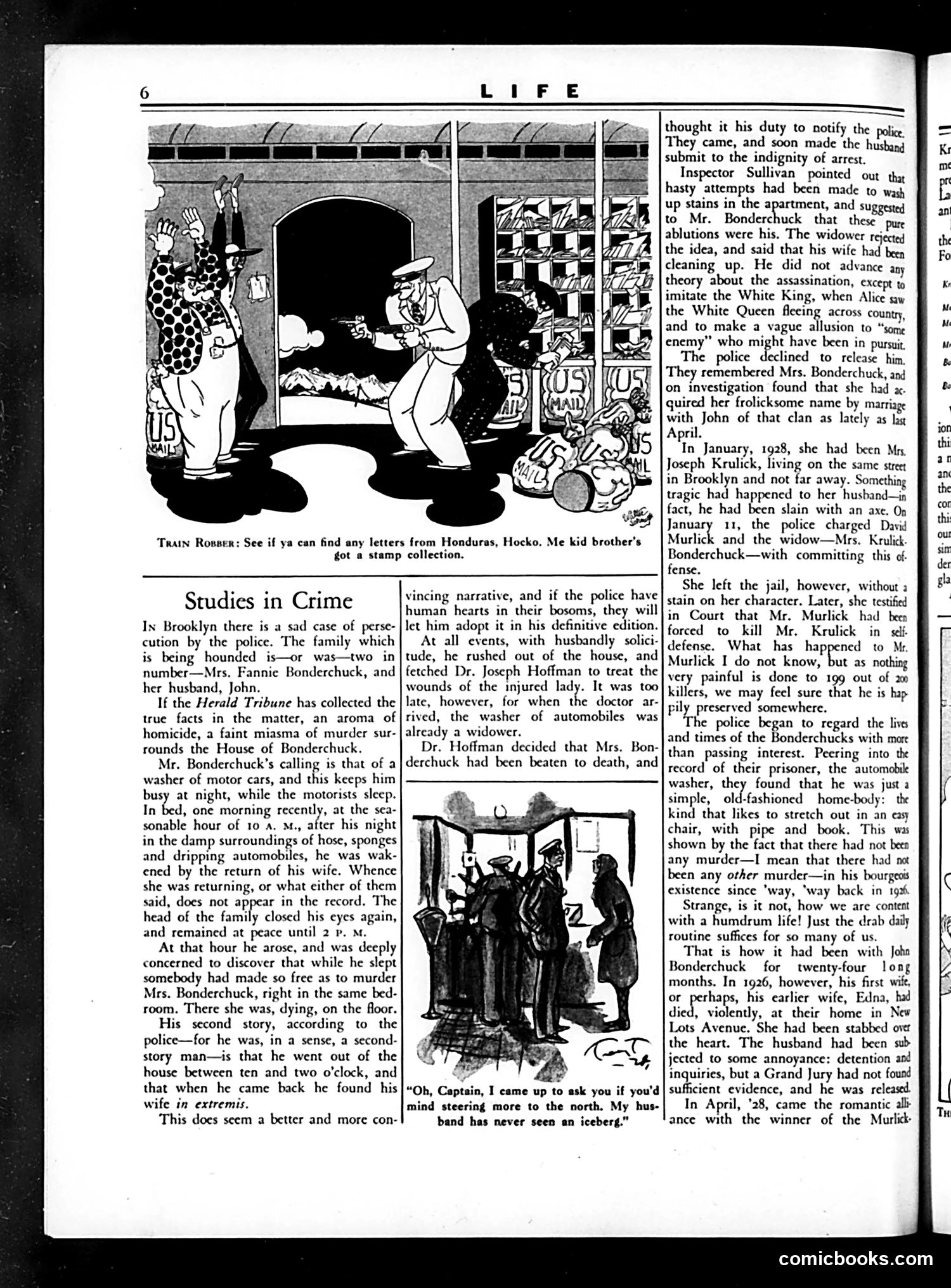
The top cartoon depicts a train robbery scene. One figure holds up another at gunpoint while mail sacks labeled "US MAIL" are visible, referencing the common crime of robbing mail trains—a genuine American phenomenon from the late 1800s through early 1900s. The caption jokes that the robber should search for "letters from Honduras" to find a stamp collection, playing on the absurdity of looking for valuable postage among stolen mail. Below, the "Studies in Crime" article describes an actual Brooklyn murder case involving Mrs. Fannie Bonderchuck, whose husband John was killed. The text discusses police investigation and suggests possible domestic tragedy rather than criminal conspiracy, presenting it as a sad case of domestic violence with suspicious circumstances.
📄 Transcribed text from this page (OCR, searchable)
Machine-transcribed from the original scan — historical spelling and the odd misread are preserved.
Train Rosser: See if ya can find any letters from Honduras, Hocko. Me kid brother's got a stamp collection. Studies in Crime Ix Brooklyn there is a sad case of perse- cution by the police. The family which is being hounded is—or was—two in number—Mrs. Fannie Bonderchuck, and her husband, John. If the Herald Tribune has collected the true facts in the matter, an aroma of homicide, a faint miasma of murder sur- rounds the House of Bonderchuck. Mr. Bonderchuck’s calling is that of a washer of motor cars, and this keeps him busy at night, while the motorists sleep. In bed, one morning recently at the sea- sonable hour of 10 a. M., after his night in the damp surroundings of hose, sponges and dripping automobiles, he was wak- ened by the return of his wife. Whence she was returning, or what either of them said, does not appear in the record. The head of the family closed his eyes again, and remained at peace until 2 P.M. At that hour he arose, and was deeply concerned to discover that while he slept somebody had made so free as to murder Mrs. Bonderchuck, right in the same bed- room. There she was, dying, on the floor. His second story, according to the police—for he was, in a sense, a second- story man—is that he went out of the house between ten and two o'clock, and that when he came back he found his wife in extremis. This does seem a better and more con- vincing narrative, and if the police have human hearts in their bosoms, they will let him adopt it in his definitive edition. At all events, with husbandly solici- tude, he rushed out of the house, and fetched Dr. Joseph Hoffman to treat the wounds of the injured lady. It was too late, however, for when the doctor ar- rived, the washer of automobiles was already a widower. Dr. Hoffman decided that Mrs. Bon- derchuck had been beaten to death, and “Oh, Captain, I came up to ask you if you'd mind steering more to the north. My hus- band has never seen an iceberg.” thought it his duty to notify the poli They came, and See made “he oe submit to the indignity of arrest. Inspector Sullivan pointed out that hasty attempts had been made to wash up stains in the apartment, and su to Mr. Bonderchuck that these ablutions were his. The widower rejected the idea, and said that his wife had been cleaning up. He did not advance any theory about the assassination, except to imitate the White King, when Alice sw the White Queen fleeing across country, and to make a vague allusion to “some enemy” who might have been in pursuit, The police declined to release him. They remembered Mrs. Bonderchuck, and on investigation found that she had x. quired her frolicksome name by marriage with John of that clan as lately as hs April. In January, 1928, she had been Mrs. Joseph Krulick, living on the same street in Brooklyn and not far away. Something tragic had happened to her husband—in fact, he had been slain with an axe. On January 11, the police charged David Murlick and the widow—Mrs. Krulick- Bonderchuck—with committing this of- fense. She left the jail, however, without 2 stain on her character. Later, she testified in Court that Mr. Murlick had been forced to kill Mr. Krulick in sdf. defense. What has happened to Mr. Murlick I do not know, but as nothing very painful is done to 199 out of 2» killers, we may feel sure that he is hap pily preserved somewhere. The police began to regard the live and times of the Bonderchucks with more than passing interest. Peering into the record of their prisoner, the automobik washer, they found that he was just a simple, old-fashioned home-body: the kind that likes to stretch out in an easy chair, with pipe and book. This was shown by the fact that there had not bees any murder—I mean that there had not been any other murder—in his bourgeois existence since ‘way, ‘way back in 193. Strange, is it not, how we are content with a humdrum life! Just the drab daily routine suffices for so many of us. That is how it had been with John Bonderchuck for twenty-four long months. In 1926, however, his first wife, or perhaps, his earlier wife, Edna, had died, violently, at their home in New Lots Avenue. She had been stabbed over the heart. The husband had been sub jected to some annoyance: detention and inquiries, but a Grand Jury had not found sufficient evidence, and he was released. In April, '28, came the romantic allt ance with the winner of the Murlick comicbooks.com Tu