
Life, 1928-07-26 · page 14 of 36
Life — July 26, 1928 — page 14: what you’re looking at
What you’re looking at
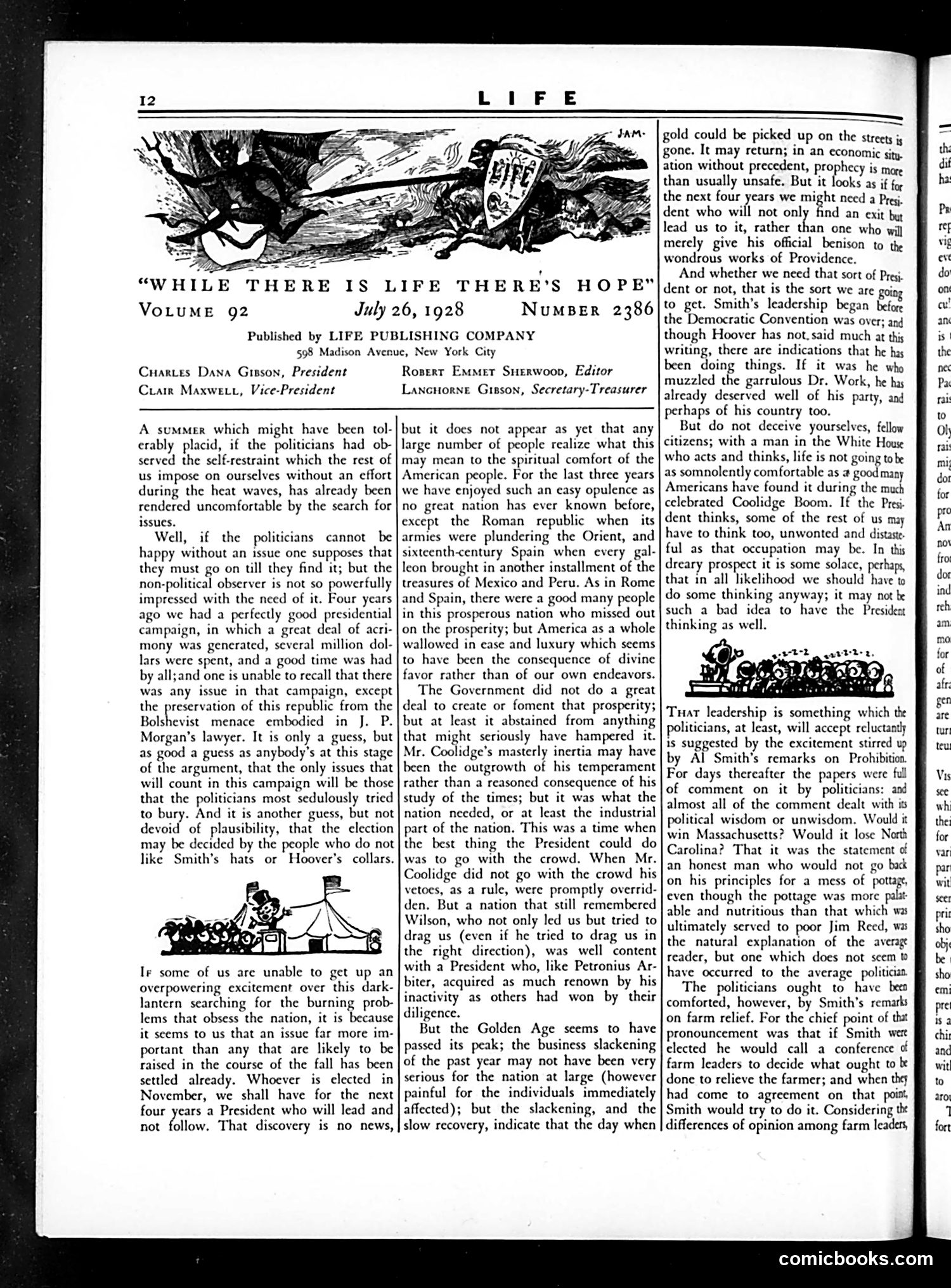
This editorial page discusses the 1928 presidential election and Herbert Hoover's candidacy. The text critiques politicians' avoidance of substantive issues, noting that whether Hoover is elected "may be decided by the people who do not like Smith's hats or Hoover's collars." The page references Al Smith's remarks on Prohibition and farm relief as campaign issues. It suggests that politicians often focus on trivial matters rather than serious policy, and questions whether the nation's leadership during the economic prosperity of the "Coolidge Boom" will effectively transition leadership. The cartoons (small illustrations visible) appear to satirize the superficiality of political campaigns and voter decision-making, though specific figures are difficult to identify clearly in this reproduction.
📄 Transcribed text from this page (OCR, searchable)
Machine-transcribed from the original scan — historical spelling and the odd misread are preserved.
VOLUME 92 Published by LIFE July 26, 1928 PUBLISHING COMPANY NuMBER 2386 598 Madison Avenue, New York City Cuarces Dana Gipson, President Cram Maxwe t, Vice-President A summer which might have been tol- erably placid, if the politicians had ob- served the self-restraint which the rest of us impose on ourselves without an effort during the heat waves, has already been rendered uncomfortable by the search for issues. Well, if the politicians cannot be happy without an issue one supposes that they must go on till they find it; but the non-political observer is not so powerfully impressed with the need of it. Four years ago we had a perfectly good presidential campaign, in which a great deal of acri- mony was generated, several million dol- lars were spent, and a good time was had by all;and one is unable to recall that there was any issue in that campaign, except the preservation of this republic from the Bolshevist_ menace embodied in J. P. Morgan’s lawyer. It is only a guess, but as good a guess as anybody’s at this stage of the argument, that the only issues that will count in this campaign will be those that the politicians most sedulously tried to bury. And it is another guess, but not devoid of plausibility, that the election may be decided by the people who do not like Smith's hats or Hoover's collars. Ie some of us are unable to get up an overpowering excitement over this dark- lantern searching for the burning prob- lems that obsess the nation, it is because it seems to us that an issue far more im- portant than any that are likely to be raised in the course of the fall has been settled already. Whoever is elected in November, we shall have for the next four years a President who will lead and not follow. That discovery is no news, Rosert Emmet Suerwoop, Editor Lancuorne Gison, Secretary-Treasurer but it does not appear as yet that any large number of people realize what this may mean to the spiritual comfort of the American people. For the last three years we have enjoyed such an easy opulence as no great nation has ever known before, except the Roman republic when its armies were plundering the Orient, and sixteenth-century Spain when every gal- leon brought in another installment of the treasures of Mexico and Peru. As in Rome and Spain, there were a good many people in this prosperous nation who missed out on the prosperity; but America as a whole wallowed in case and luxury which seems to have been the consequence of divine favor rather than of our own endeavors. The Government did not do a great deal to create or foment that prosperity; but at least it abstained from anything that might seriously have hampered it. Mr. Coolidge’s masterly inertia may have been the outgrowth of his temperament rather than a reasoned consequence of his study of the times; but it was what the nation needed, or at least the industrial part of the nation. This was a time when the best thing the President could do was to go with the crowd. When Mr. Coolidge did not go with the crowd his vetoes, as a rule, were promptly overrid- den, But a nation that still remembered Wilson, who not only led us but tried to drag us (even if he tried to drag us in the right direction), was well content with a President who, like Petronius Ar- biter, acquired as much renown by his inactivity as others had won by their diligence. But the Golden Age seems to have passed its peak; the business slackening of the past year may not have been very serious for the nation at large (however painful for the individuals immediately affected); but the slackening, and the slow recovery, indicate that the day when gold could be picked up on the streets is gone. It may return; in an economic situ. ation without precedent, Prophecy is more than usually unsafe. But it looks as if for the next four years we might need a Presi dent who will not onl End an exit but lead _us to it, rather than one who wil] merely give his official benison to the wondrous works of Providence. And whether we need that sort of Pres. dent or not, that is the sort we are goin to get. Smith’s leadership began before the Democratic Convention was over; and though Hoover has not, said much at this writing, there are indications that he has been doing things. If it was he who muzzled the garrulous Dr. Work, he has already deserved well of his party, and perhaps of his country too. But do not deceive yourselves, fellow citizens; with a man in the White House who acts and thinks, life is not going tobe as somnolently comfortable as @ good many Americans have found it during the much celebrated Coolidge Boom. If the Pres- dent thinks, some of the rest of us may have to think too, unwonted and distaste. ful as that occupation may be. In this dreary prospect it is some solace, perha that at Mikelihood we should ee do some thinking anyway; it may not be such a bad idea to have the Presidest thinking as well. Tuat leadership is something which the politicians, at least, will accept reluctantly 1s suggested by the excitement stirred up by Al Smith's remarks on Prohibition. For days thereafter the papers were full of comment on it by politicians: and almost all of the comment dealt with is political wisdom or unwisdom. Would it win Massachusetts? Would it lose North Carolina? That it was the statement of an honest man who would not go bac on his principles for a mess of pottage, even though the pottage was more palit able and nutritious than that which wa ultimately served to poor Jim Reed, was the natural explanation of the average reader, but one which does not seem ® have occurred to the average politician The politicians ought to have bees comforted, however, by Smith's remarks on farm relief. For the chief point of tht pronouncement was that if Smith wer elected he would call a conference ¢ farm leaders to decide what ought to te done to relieve the farmer; and when the had come to agreement on that point Smith would try to do it. Considering th differences of opinion among farm leaders, comicbooks.com