
Life, 1928-07-26 · page 25 of 36
Life — July 26, 1928 — page 25: what you’re looking at
What you’re looking at
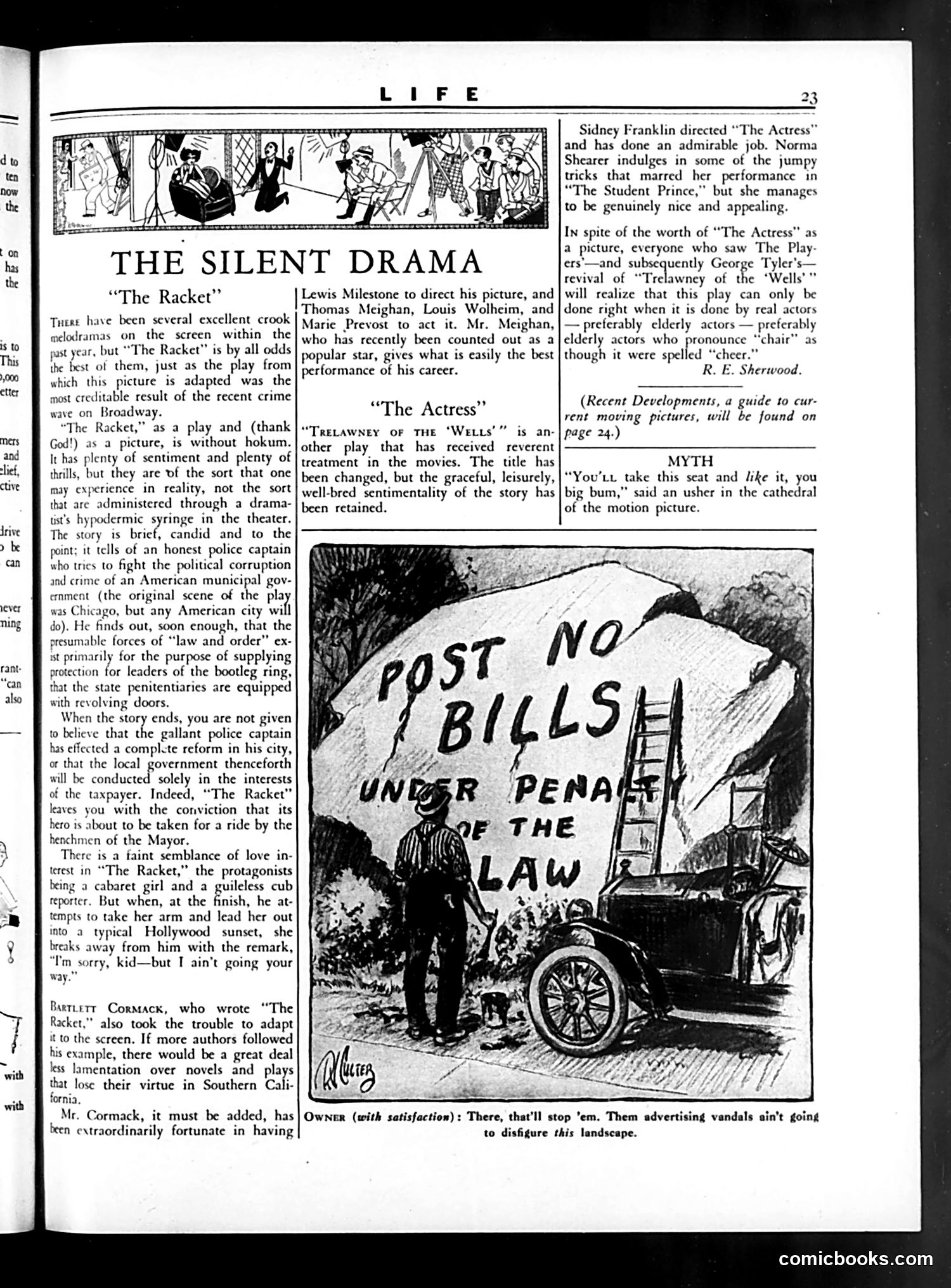
This page reviews two silent films and includes one political cartoon. The cartoon depicts a car owner posting a sign reading "POST NO BILLS! UNDER PENALTY OF THE LAW" on what appears to be a roadside billboard or wall. The owner congratulates himself, believing this will stop advertisers from defacing the landscape with ads. The satire is ironic: the owner thinks his sign will prevent "advertising vandals" from littering the landscape, yet he's essentially created his own advertisement—a large sign that itself defaces the natural scenery. The cartoon mocks the hypocrisy of fighting visual pollution through methods that perpetuate it. The page's film reviews discuss "The Racket" and "The Actress," praising their adaptation from stage to screen and their realistic treatment of subject matter, particularly regarding corruption in municipal government.
📄 Transcribed text from this page (OCR, searchable)
Machine-transcribed from the original scan — historical spelling and the odd misread are preserved.
THE SILENT DRAMA “The Racket” Tuert have been several excellent crook melodramas on the screen within the past year, but “The Racket” is by all odds the best of them, just as the play from which this picture is adapted was the most creditable result of the recent crime wave on Broadway. “The Racket,” as a play and (thank God!) as a picture, is without hokum. It has plenty of sentiment and plenty of thrills, but they are vf the sort that one may experience in reality, not the sort that are administered through a drama- tist’s hypodermic syringe in the theater. The story is brief, candid and to the point; it tells of an honest police captain who tries to fight the political corruption and crime of an American municipal gov- enment (the original scene of the play was Chicago, but any American city will do). He finds out, soon enough, that the presumable forces of “law and order” ex- st primarily for the purpose of supplying protection for leaders of the bootleg ring, that the state penitentiaries are equipped with revolving doors. When the story ends, you are not given to believe that the gallant police captain has effected a complete reform in his city, or that the local government thenceforth will be conducted solely in the interests of the taxpayer. Indeed, “The Racket” kaves you with the conviction that its hero is about to be taken for a ride by the henchmen of the Mayor, There is a faint semblance of love in- terest in “The Racket,” the protagonists being a cabaret girl and a guileless cub reporter. But when, at the finish, he at- tempts to take her arm and lead her out into a typical Hollywood sunset, she breaks away from him with the remark, “Tm sorry, kid—but T ain’t going your way.” Baetuerr Cormack, who wrote “The Racket,” also took the trouble to adapt it to the screen. If more authors followed his example, there would be a great deal ess lamentation over novels and plays that lose their virtue in Southern Cali fornia. Mr. Cormack, it must be added, has teen extraordinarily fortunate in having Lewis Milestone to direct his picture, and Thomas Meighan, Louis Wolheim, and Marie Prevost to act it. Mr. Meighan, who has recently been counted out as a popular star, gives what is easily the best performance of his career. “The Actress” “TRELAWNEY OF THE ‘Wexts’” is an- other play that has received reverent treatment in the movies. The title has been changed, but the graceful, leisurely, well-bred sentimentality of the story has been retained. AMA: Sidney Franklin directed “The Actress” and has done an admirable job. Norma Shearer indulges in some of the jumpy icks that marred her performance in ‘The Student Prince,” but she manages to be genuinely nice and appealing. In spite of the worth of “The Actress” as a picture, everyone who saw The Play- ers'—and subsequently George Tyler's— revival of “Trelawney of the “Wells’” will realize that this play can only be done right when it is done by real actors — preferably elderly actors — preferably elderly actors who pronounce “chair” as though it were spelled “cheer.” R. E. Sherwood. (Recent Developments, a guide to cur- rent moving pictures, will be found on page 24.) MYTH “You'tt take this seat and /ike it, you big bum,” said an usher in the cathedral of the motion picture. Owner (with satisfaction): There, that'll stop ‘em. Them advertising vandals ain't going to disfigure this landscape. comicbooks.com