
A complete issue · 43 pages · 1928
Life — April 19, 1928
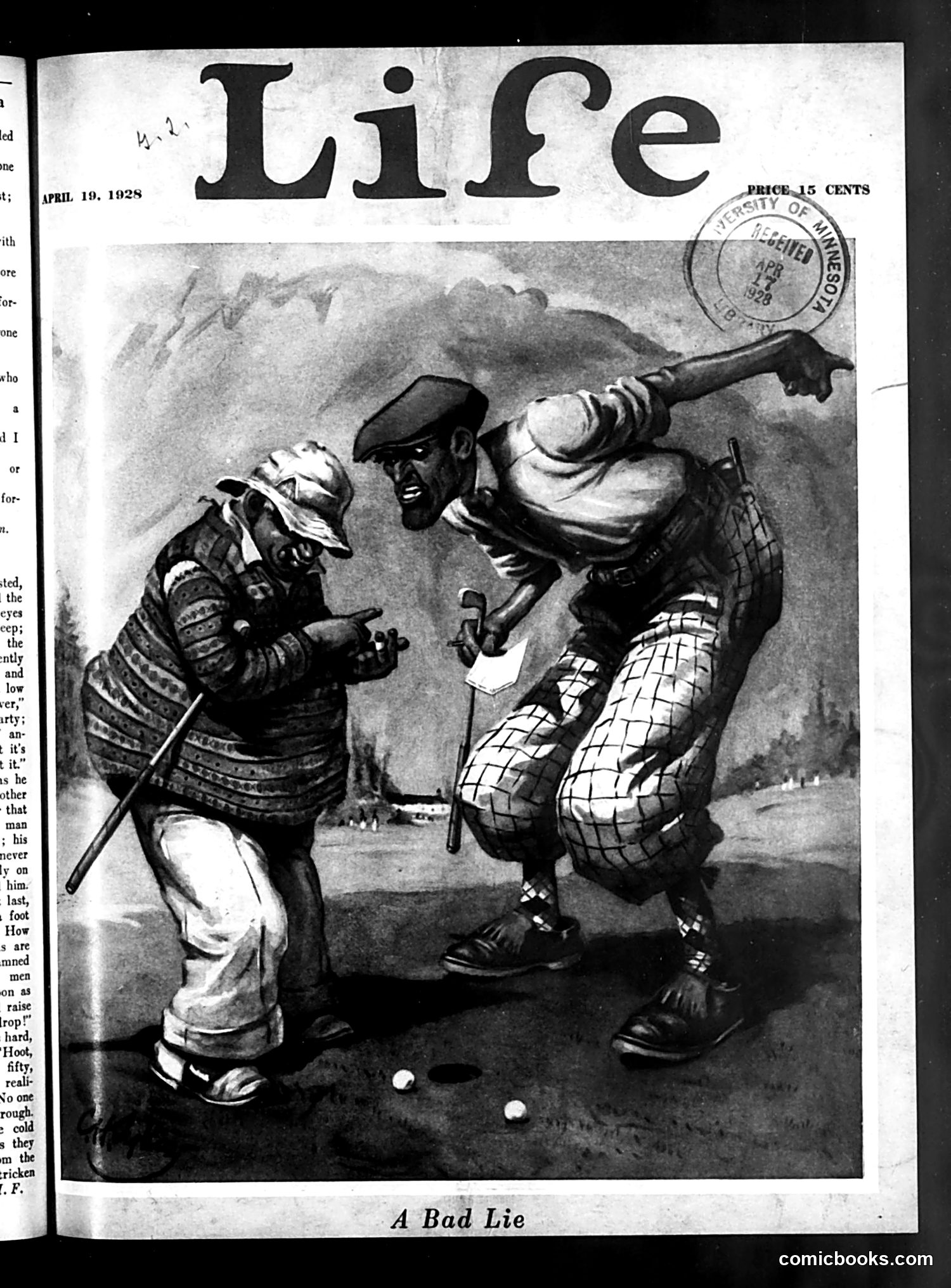
This cartoon satirizes golf through caricatured ethnic stereotypes common to 1920s humor. The image shows two golfers in an apparent dispute over the ball's position on the course. The figure on the left appears to be making an excuse or false claim about his shot ("a bad lie"—golfer's slang for poor ball placement). The exaggerated facial features and dress of both figures reflect the crude stereotyping typical of the era's popular magazines. The joke plays on the double meaning of "lie"—both the golf term and the accusation of dishonesty in the players' argument. Without additional context from the OCR'd text (which appears incomplete), the specific political or social commentary beyond the golf-humor premise remains unclear.
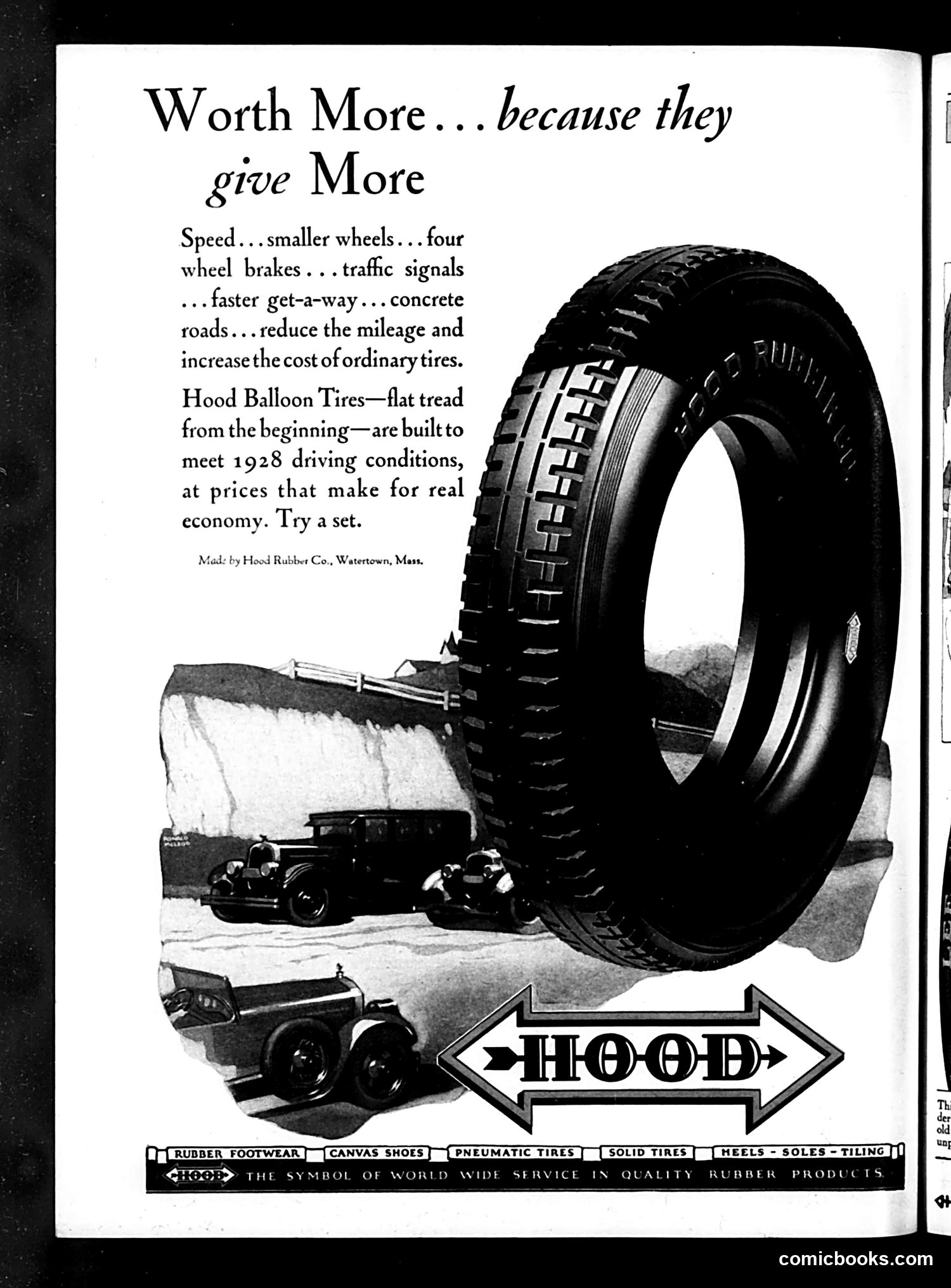
This is **not a political cartoon or satire**—it's a straightforward advertisement for Hood Balloon Tires, manufactured by Hood Rubber Co. in Watertown, Massachusetts. The ad uses hyperbole common to 1920s marketing: a giant tire is shown towering over several small automobiles to emphasize the product's superior construction and value. The "Worth More...because they give More" headline promotes Hood tires as economical despite initial cost, citing features like "flat tread," four-wheel brakes, and reduced mileage wear. The bottom banner identifies Hood as "the symbol of world wide service in quality rubber products" and lists their product range: rubber footwear, canvas shoes, pneumatic tires, solid tires, and heels/soles. This appears to be from a 1928 magazine issue based on the text's reference to "1928 driving conditions."
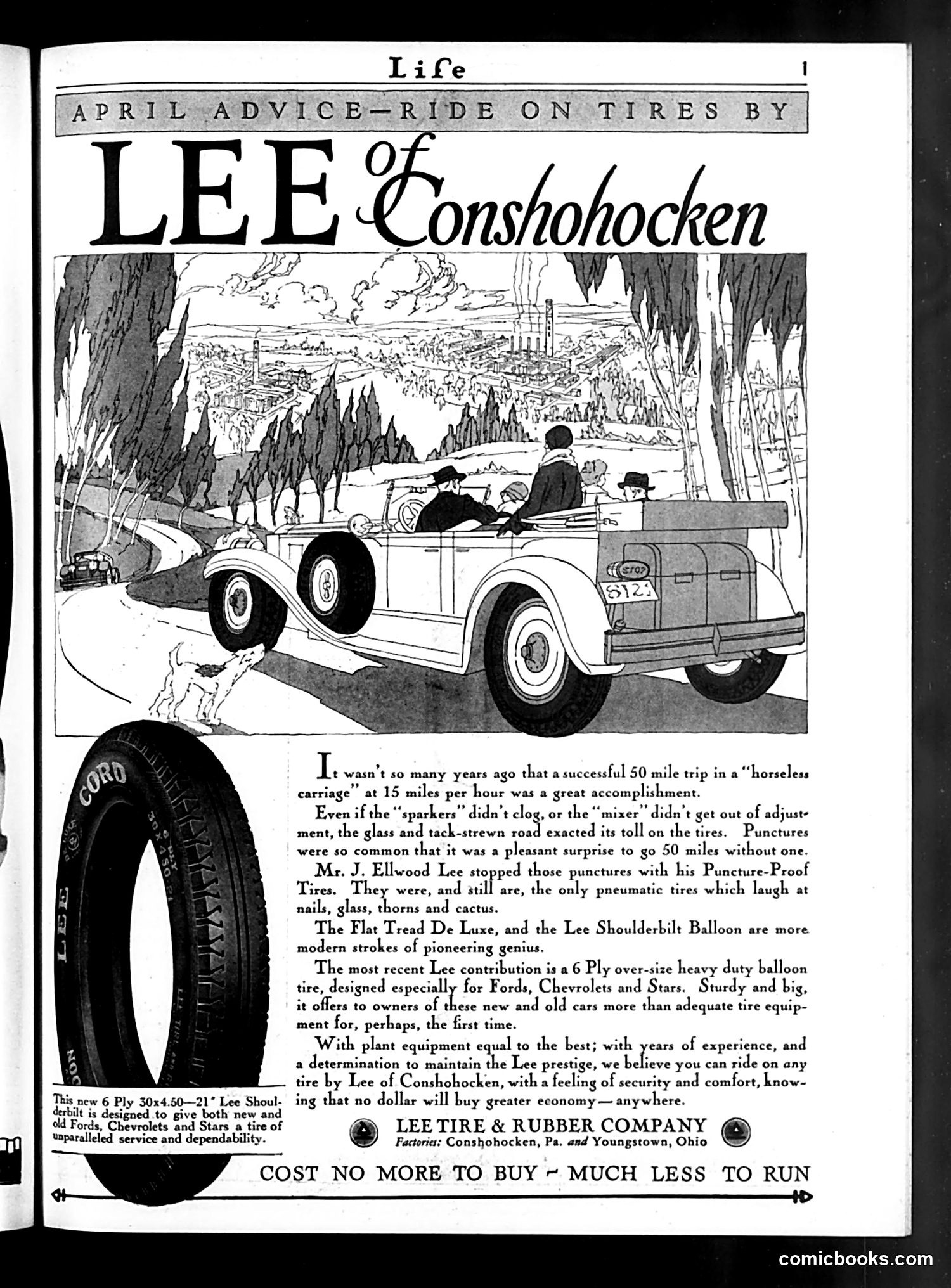
This page is primarily **advertising, not satire or editorial content**. It's a Lee Tire & Rubber Company advertisement from their Conshohocken, Pennsylvania factory. The ad depicts a leisurely automobile outing (showing what appears to be 1920s-era cars) to promote Lee tires. The text emphasizes how tire technology has improved: punctures were once common, but Lee's "Puncture-Proof Tires" with pneumatic construction resist nails, glass, and thorns. The advertisement contrasts past automotive challenges with present reliability, positioning Lee tires as enabling confident, comfortable driving. The tagline "Cost No More to Buy—Much Less to Run" emphasizes value proposition. There is no political commentary or satire present—this is straightforward consumer advertising.
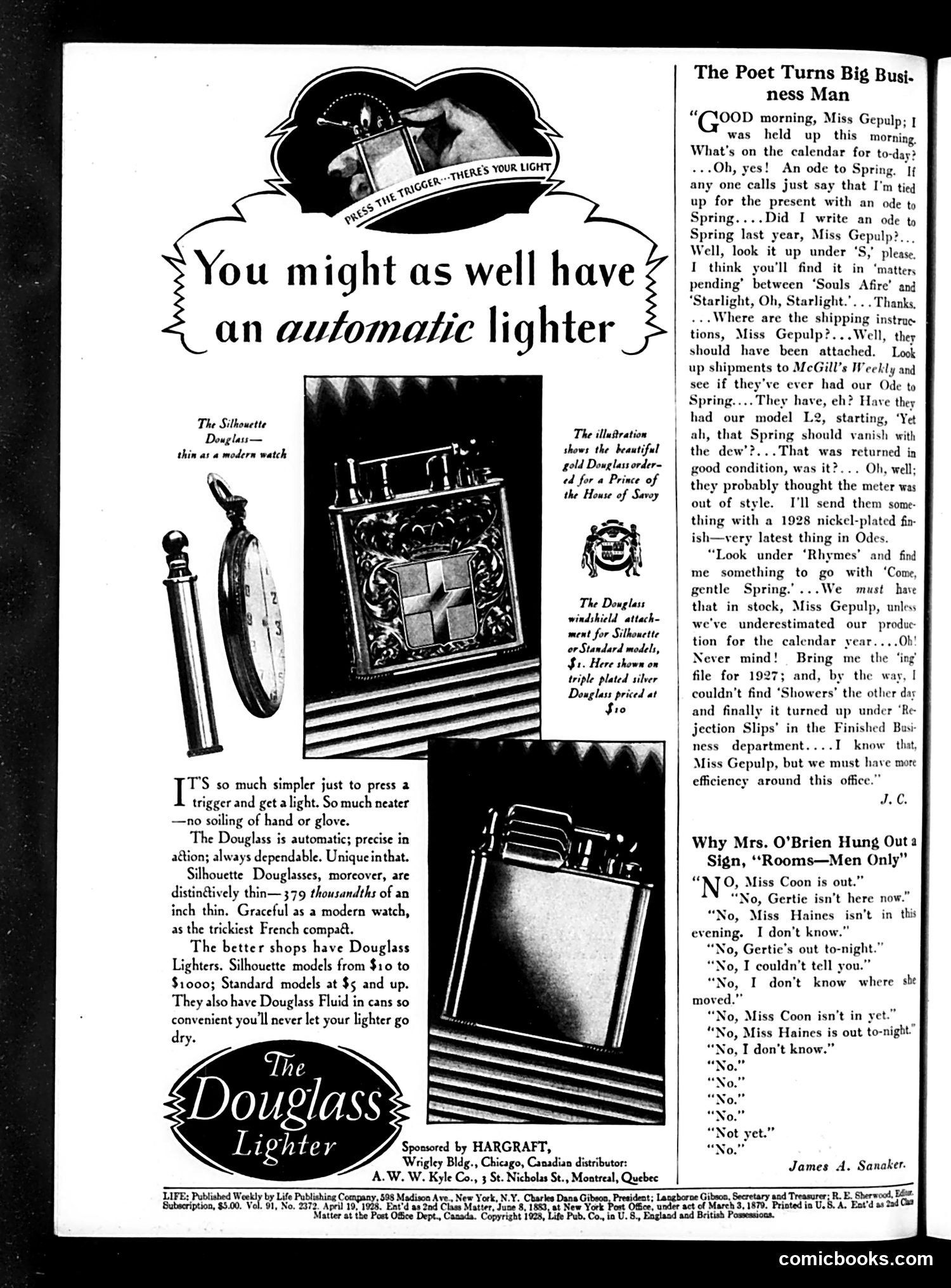
This page is primarily a **product advertisement** for the Douglass Lighter, emphasizing its automatic mechanism—you simply press a trigger to produce light without soiling hands or gloves. The ad highlights its precision engineering and sleek design, positioning it as a modern luxury item. The right side contains **"The Poet Turns Big Business Man,"** a humorous office dialogue. A character named J.C. complains to Miss Gepulp about an unorganized poetry submission system—an Ode to Spring got misfiled under "Rejection Slips" instead of being published. The joke satirizes the clash between poetic creativity and bureaucratic business efficiency, suggesting that creative work gets lost in corporate disorganization. It's light workplace humor rather than political commentary.
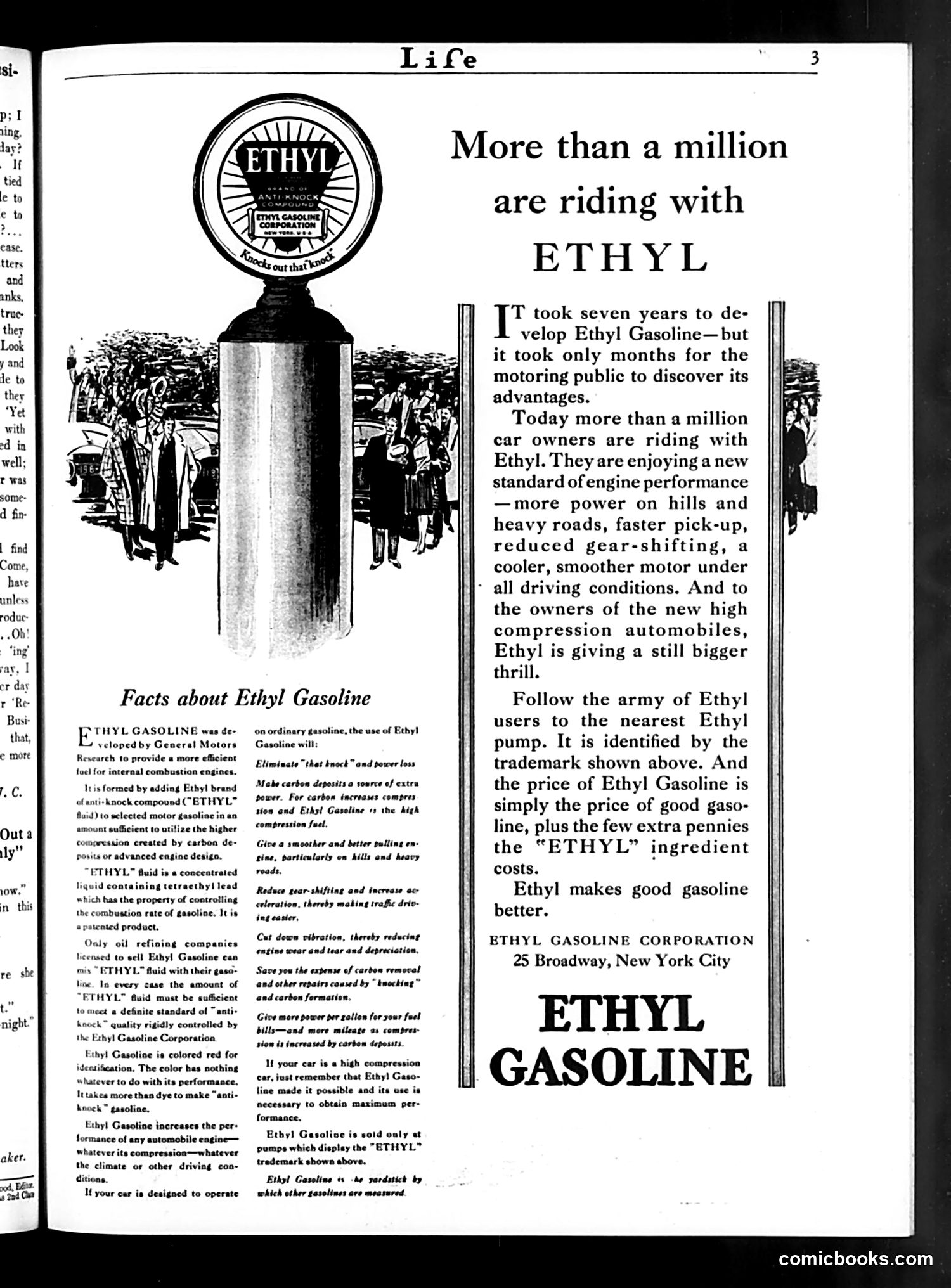
This is **not satire or political commentary** — it's a straightforward advertisement for Ethyl Gasoline, disguised as editorial content in Life magazine. The page promotes Ethyl, an early gasoline additive (tetraethyl lead) developed by General Motors Research. The central image shows a large fuel pump surrounded by crowds, symbolizing widespread adoption. The ad claims Ethyl provides superior engine performance: more power, smoother operation, and better fuel economy. It took "seven years to develop" but "more than a million" drivers now use it. Modern readers should know: **Ethyl gasoline contained lead, later proven catastrophically toxic**. This advertisement exemplifies how corporations once marketed harmful products as modern innovations, with no safety warnings — an early case of corporate deception about public health.
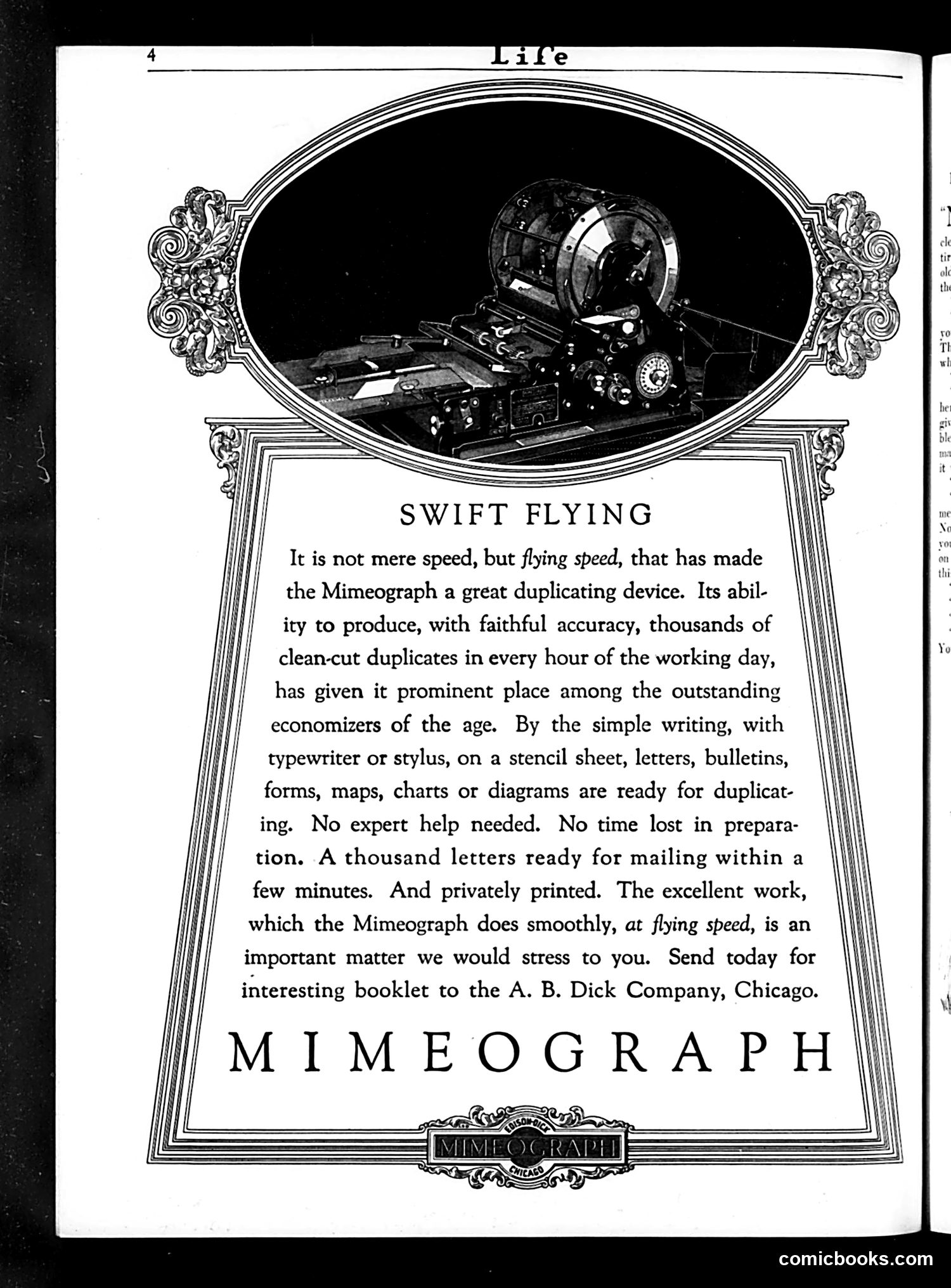
This page is **primarily advertising**, not satire or editorial cartoon. It's a full-page advertisement for the Mimeograph machine, manufactured by the A.B. Dick Company of Chicago. The ad emphasizes the machine's speed and efficiency for business duplication. The oval photograph shows the mechanical device itself. The headline "SWIFT FLYING" uses speed metaphorically to describe the Mimeograph's rapid copying capability—producing "thousands of clean-cut duplicates in every hour." The text targets business managers by highlighting labor savings: no expert help needed, minimal preparation time, and quick production of letters, forms, and documents for mailing. This reflects early 20th-century business concerns about office efficiency and cost reduction. There is no political or social satire present—it's straightforward commercial promotion.
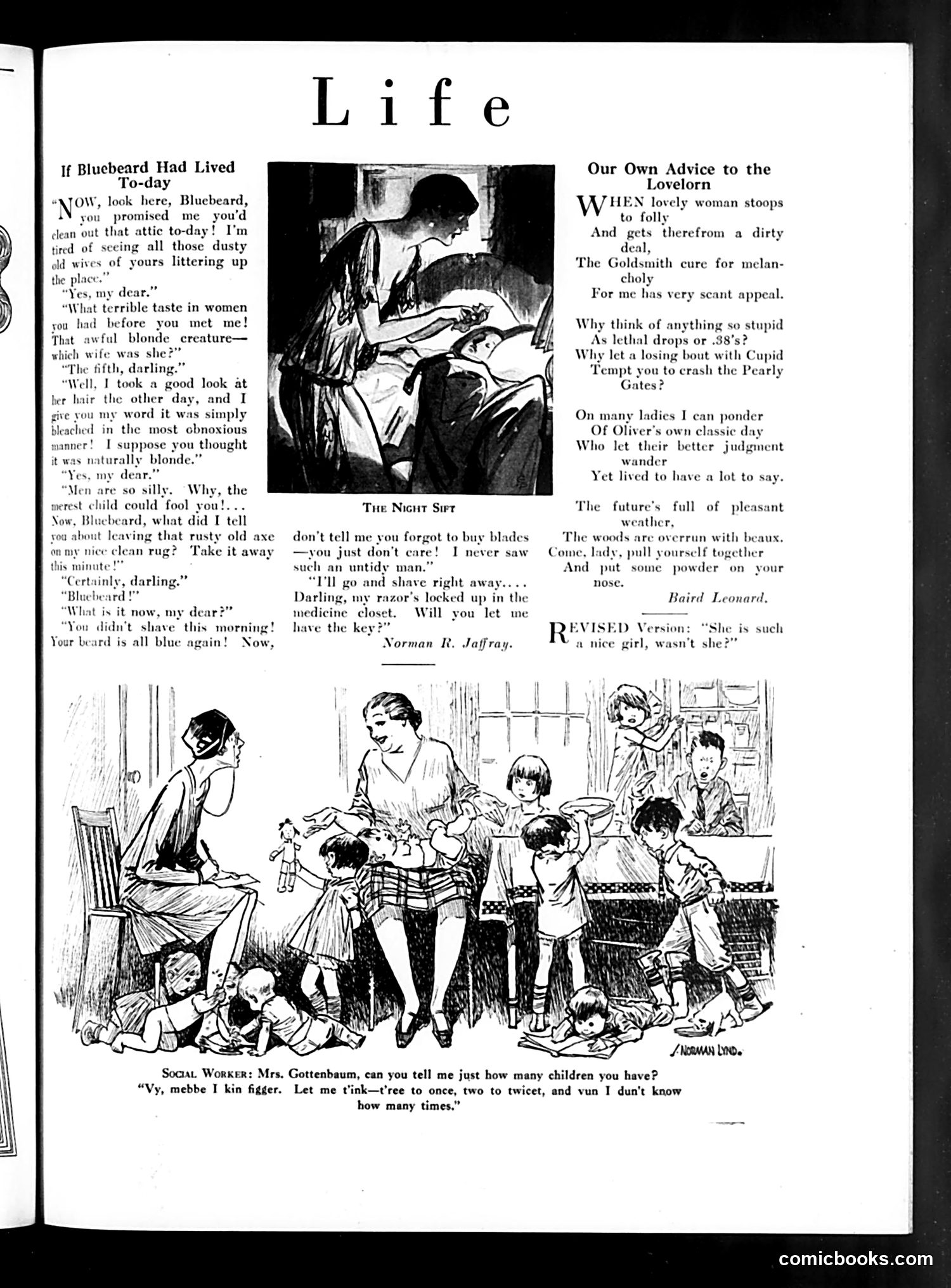
This page contains satirical humor pieces typical of early 20th-century Life magazine. **"If Bluebeard Had Lived To-day"** (left) is a dialogue mocking marital nagging. It reimagines the legendary serial killer Bluebeard complaining about his wife's complaints—she finds his beard unkempt and his habits disgusting. The satire targets domestic friction and wives' criticism of husbands' appearances. **"The Night Shift"** (center illustration) depicts an intimate scene, likely making commentary on marital relations. **"Our Own Advice to the Lovelorn"** (right) offers tongue-in-cheek relationship guidance, mocking romantic desperation and women's susceptibility to flattery. **The bottom cartoon** by Norman Ling shows a social worker asking a harried mother how many children she has—she's lost count, having "run" so many times she's uncertain. This satirizes large families and overwhelmed mothers. All pieces use humor to comment on domestic life and gender relations.
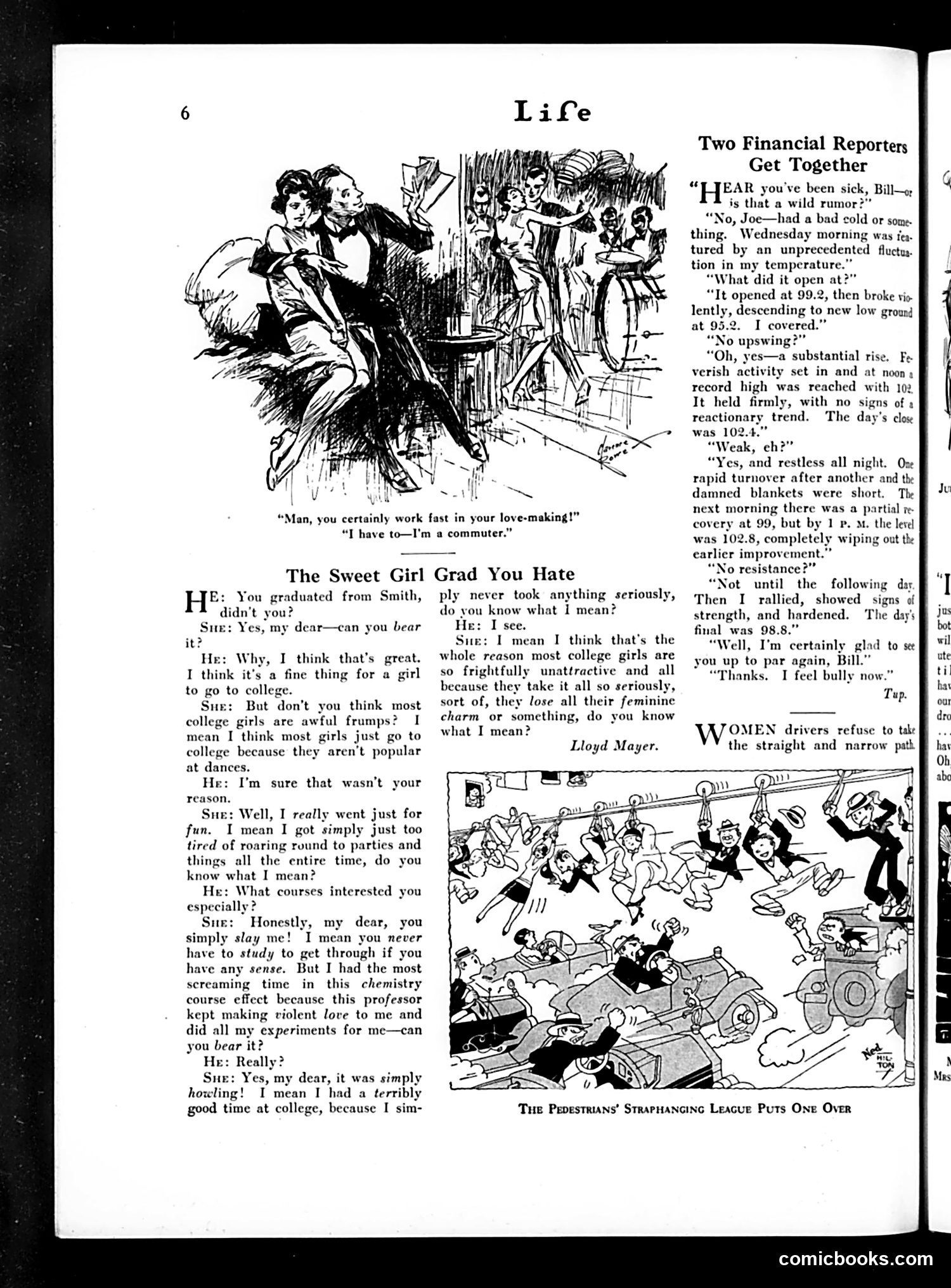
This page contains three separate humorous pieces typical of Life's satirical content: 1. **"Two Financial Reporters Get Together"** (top right): A dialogue mocking stock market traders during what appears to be market volatility, with specific price points (99.2, 95.2, 102.8) referenced. The joke centers on their obsessive, rapid-fire discussions of minute market fluctuations. 2. **"The Sweet Girl Grad You Hate"** (center): A conversation satirizing college-educated women who claim intellectual pursuits but attended primarily for socializing. The humor targets the gap between stated educational motives and actual campus priorities. 3. **"The Pedestrians' Straphanging League Puts One Over"** (bottom): A cartoon depicting crowded public transit chaos, likely satirizing urban commuting conditions or transit authority policies of the era. The overall tone reflects 1920s-era middle-class anxieties about markets, education, and modern urban life.
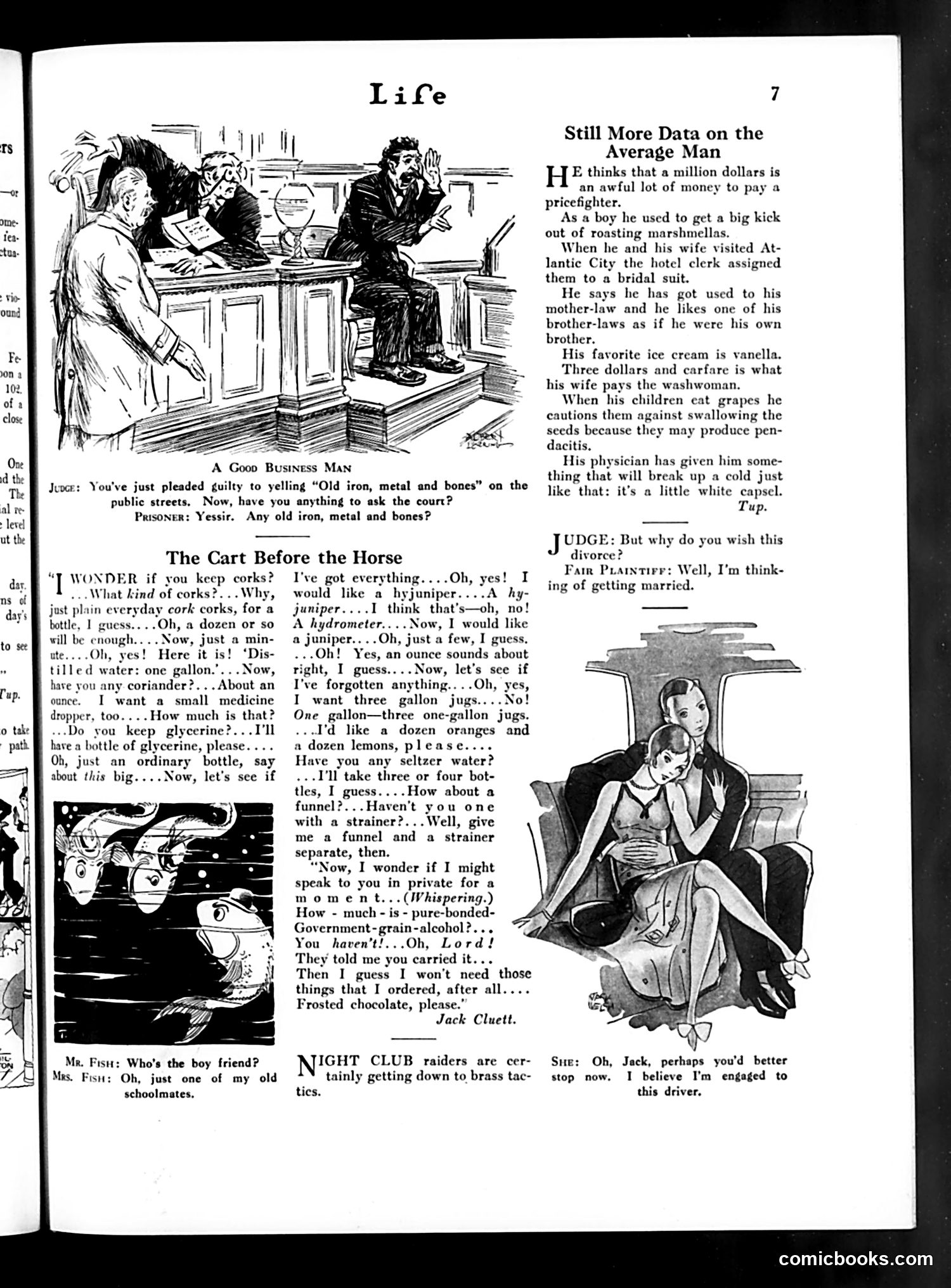
**"A Good Business Man"** depicts a judge sentencing a defendant for selling scrap metal ("old iron, metal and bones") to the public. The cartoon satirizes wartime profiteering and fraud—selling worthless or salvaged materials while misrepresenting them as valuable goods. **"The Cart Before the Horse"** shows a customer ordering an absurdly long list of specific items from what appears to be a general store or pharmacy, growing increasingly desperate and demanding. It satirizes both consumer entitlement and post-WWI scarcity, mocking people's unrealistic expectations when goods are limited. **The divorce-scene cartoon** shows a woman telling her taxi driver she's engaged to him to escape her marriage—satirizing either desperate marriages or the cynicism of urban romance. These pieces reflect 1920s concerns: fraud, consumerism, and social disruption post-war.
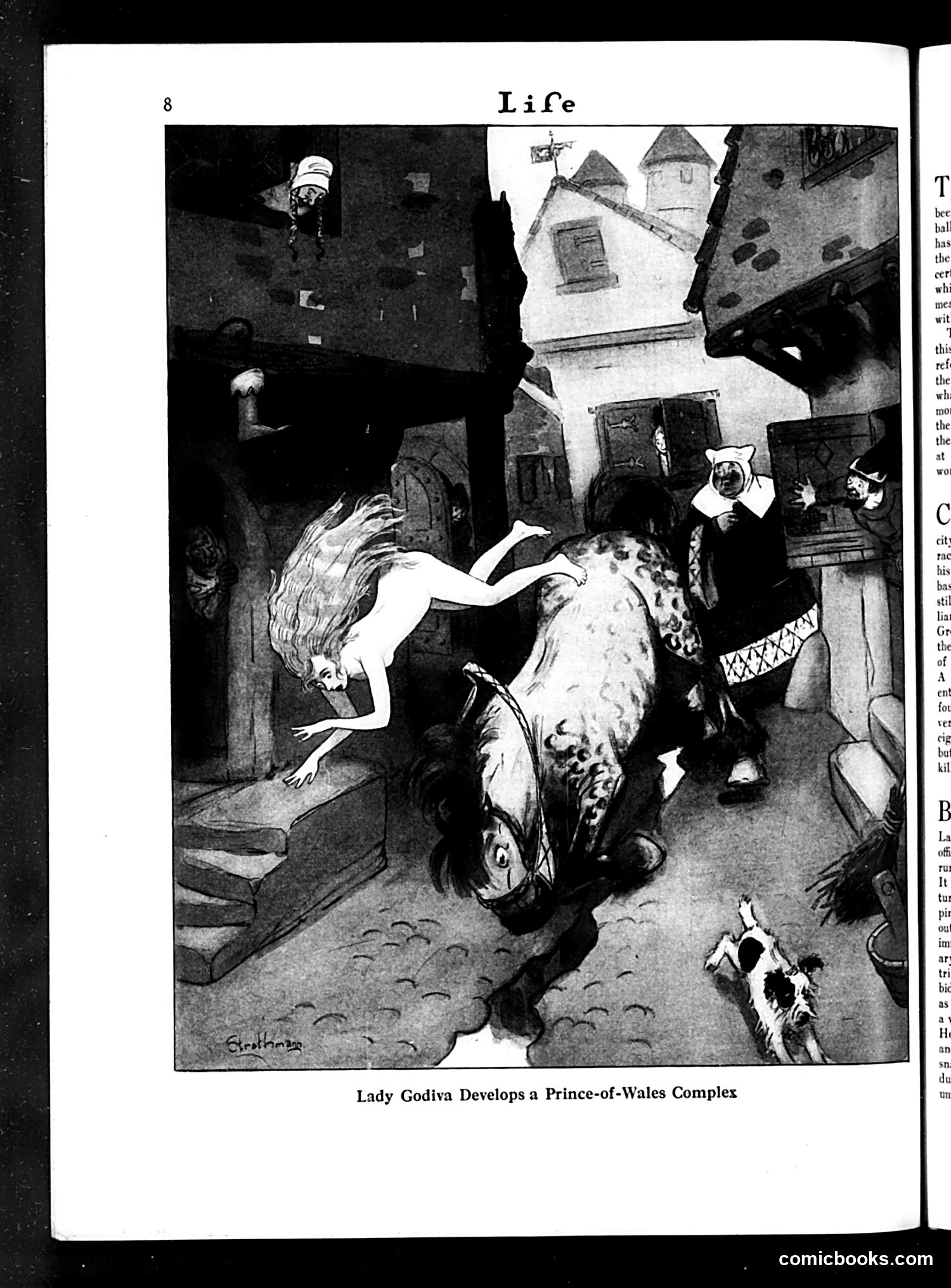
This satirical cartoon depicts a woman on horseback in a medieval-style town setting, clearly referencing the famous legend of Lady Godiva, who rode naked through town to protest taxation. The caption suggests she's developing an obsession with the Prince of Wales. The satire appears to mock excessive devotion to British royalty, particularly among certain social circles. The woman's dramatic pose and the onlookers' reactions suggest she's performing for attention or adopting aristocratic pretensions. The joke likely plays on "Prince-of-Wales complex" as a humorous term for affected upper-class aspirations or obsessive royal fandom—a social phenomenon Life's satirical readership would recognize as worthy of ridicule.
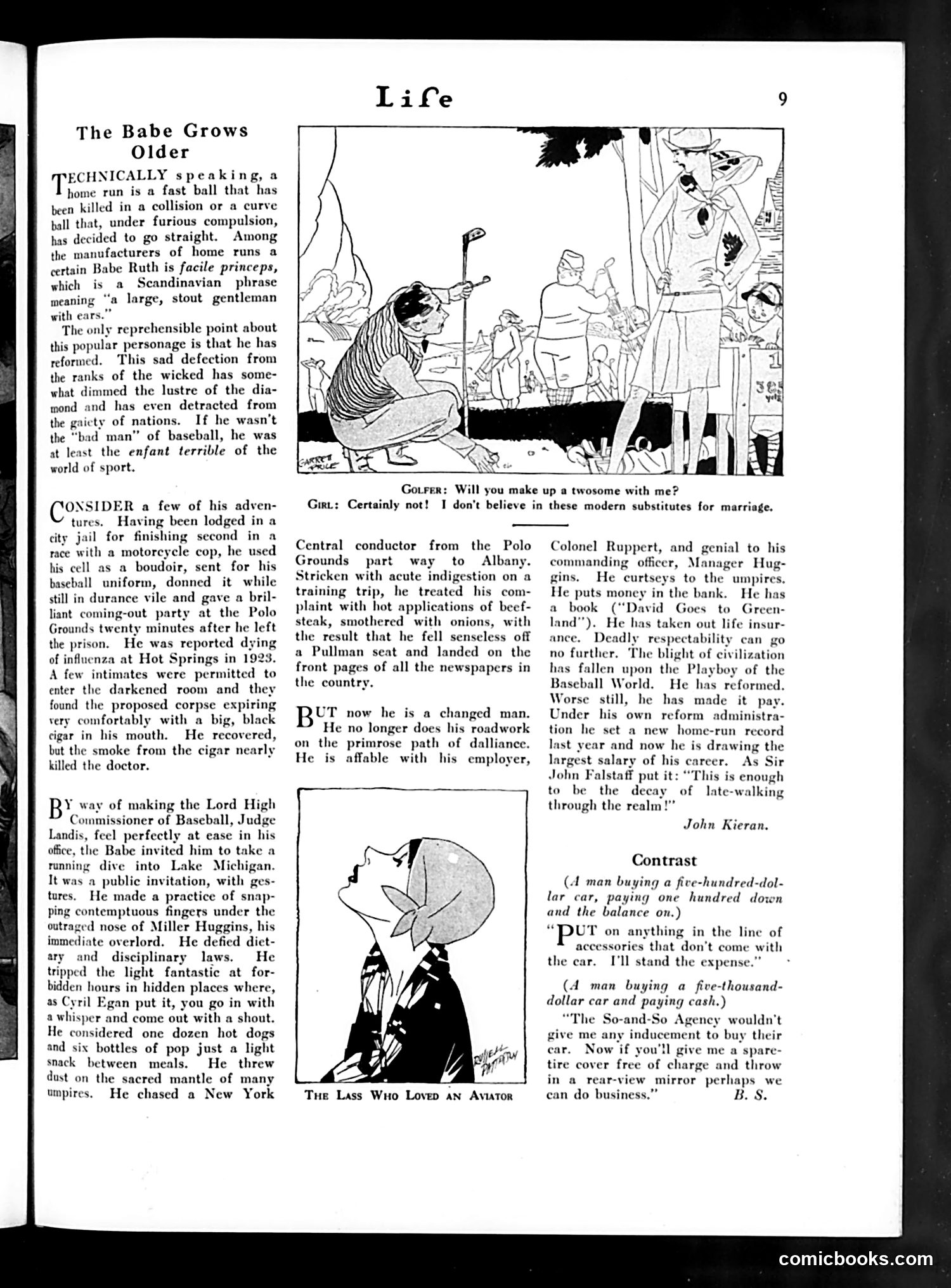
This page satirizes Babe Ruth's decline from baseball stardom. The article documents his deteriorating behavior and legal troubles—jail time for traffic violations, a motorcycle accident, and various infractions—suggesting he's becoming a liability to the sport rather than an icon. The text mocks Ruth's attempts at reformation, describing how he's "changed" and now works obediently for his employer. However, the overall tone is cynical: he's merely trading reckless notoriety for corporate conformity, which the article implies is its own form of decay ("the decay of late-walking through the realm"). The cartoon "The Lass Who Loved an Aviator" (unrelated) appears below, with brief humorous anecdotes about auto purchasing in the "Contrast" section.
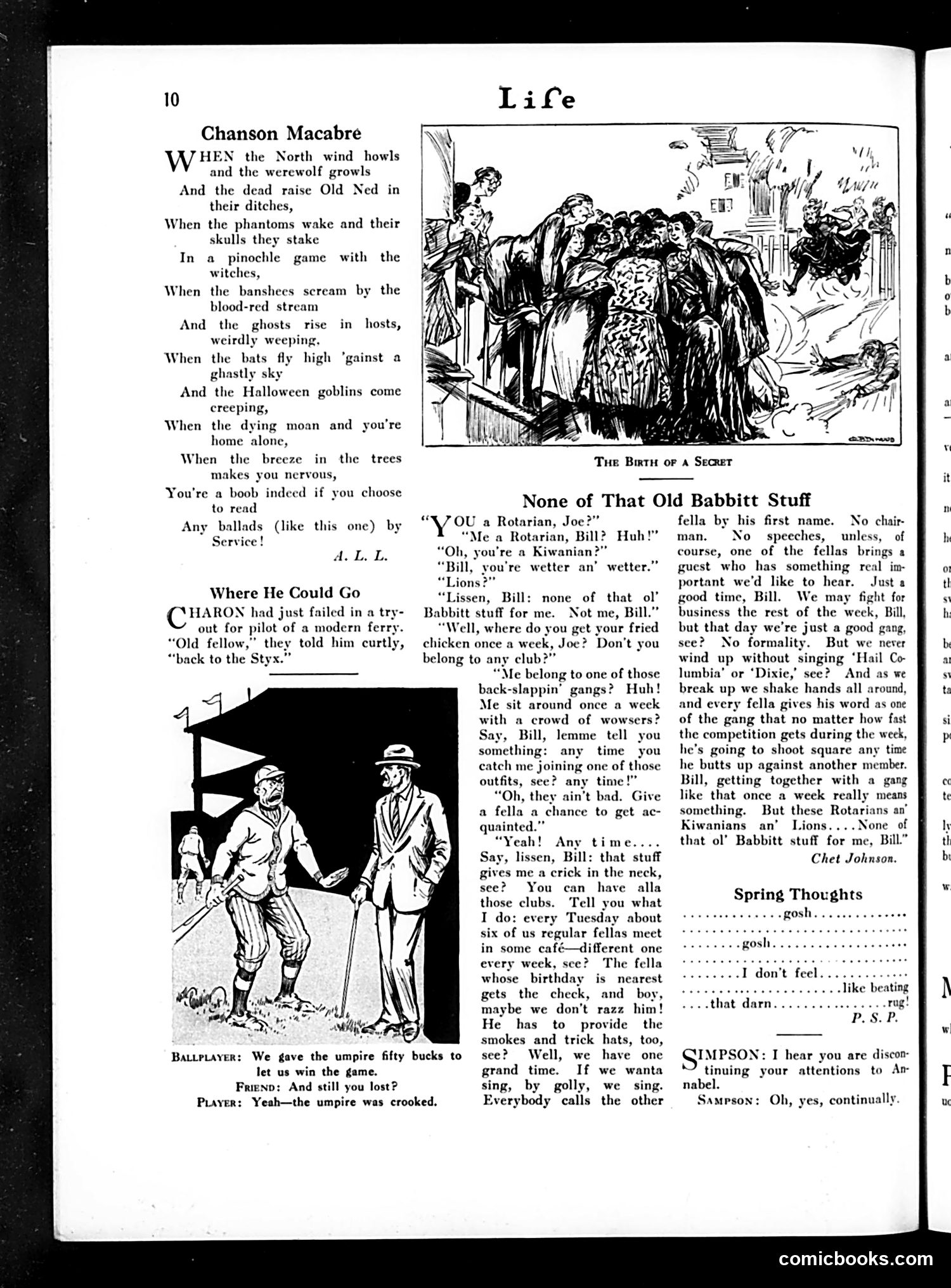
This page contains three separate pieces: a poem titled "Chanson Macabre" (a spooky, Halloween-themed verse), a short story called "Where He Could Go" featuring dialogue between characters named Charon and others about a ferry, and an article titled "None of That Old Babbitt Stuff" discussing men's clubs and social organizations. The cartoon accompanying "Where He Could Go" shows two men in suits and hats near a large "F" (likely representing a ferry), illustrating the story's premise about modern transportation replacing classical mythology. The humor appears centered on early 20th-century social commentary about men's clubs, conformity, and leisure activities—references that would require period context to fully appreciate today.
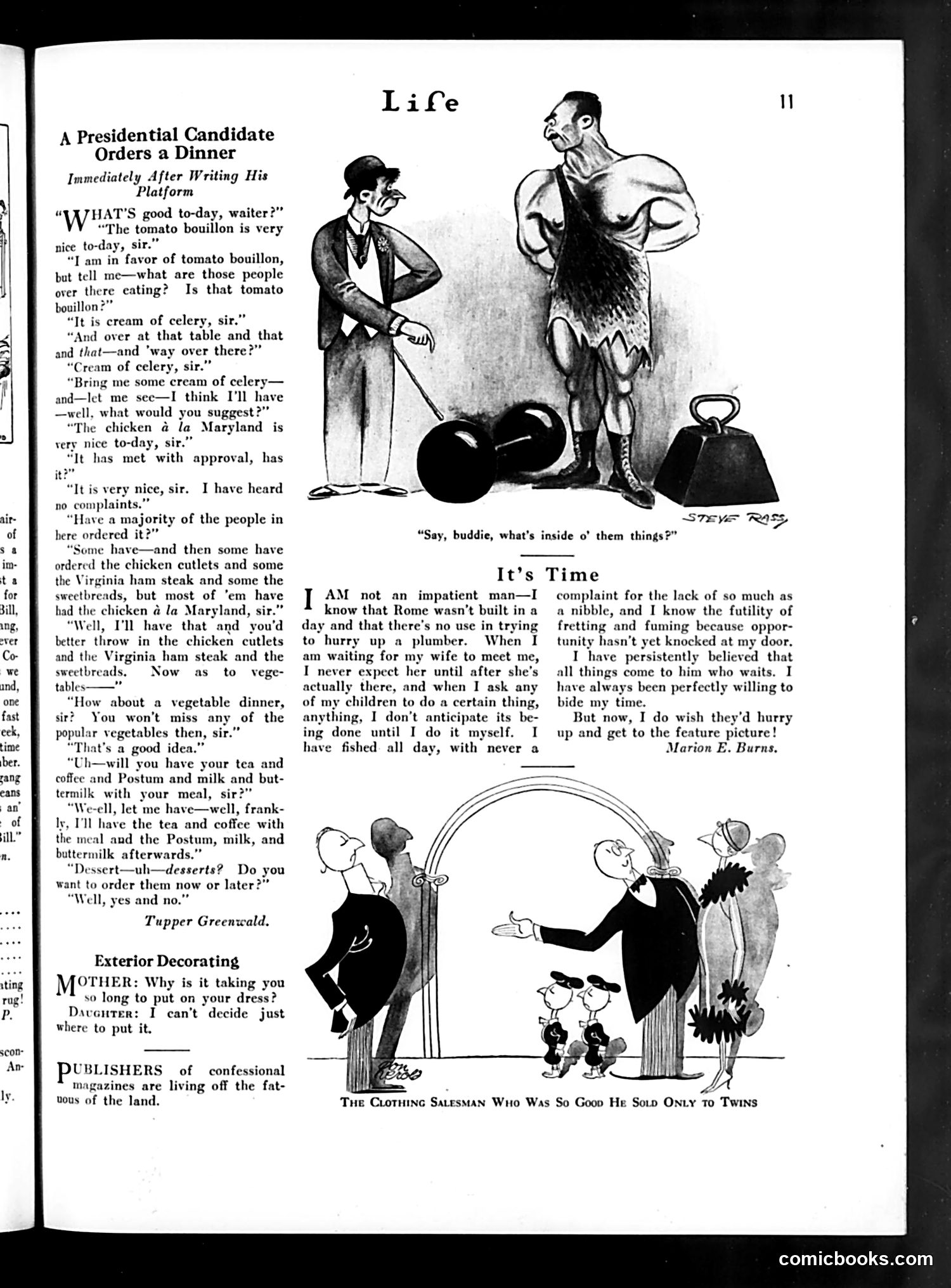
This page contains three separate humor pieces: 1. **"A Presidential Candidate Orders a Dinner"**: Satirizes a political candidate's indecisiveness and obsessive attention to trivial details (menu choices) immediately after writing his political platform. The joke mocks how politicians focus on minor matters while claiming to lead the nation. 2. **"It's Time"**: A domestic humor piece by Marion E. Burns about a man's impatience waiting for a plumber and his wife—poking fun at the common frustration of waiting for tradespeople. 3. **"The Clothing Salesman Who Was So Good He Sold Only to Twins"**: Visual gag showing an overly persuasive salesman who sells identical outfits exclusively to twins, suggesting his sales pitch is so effective he's created this absurd customer niche. All reflect period humor about everyday frustrations.
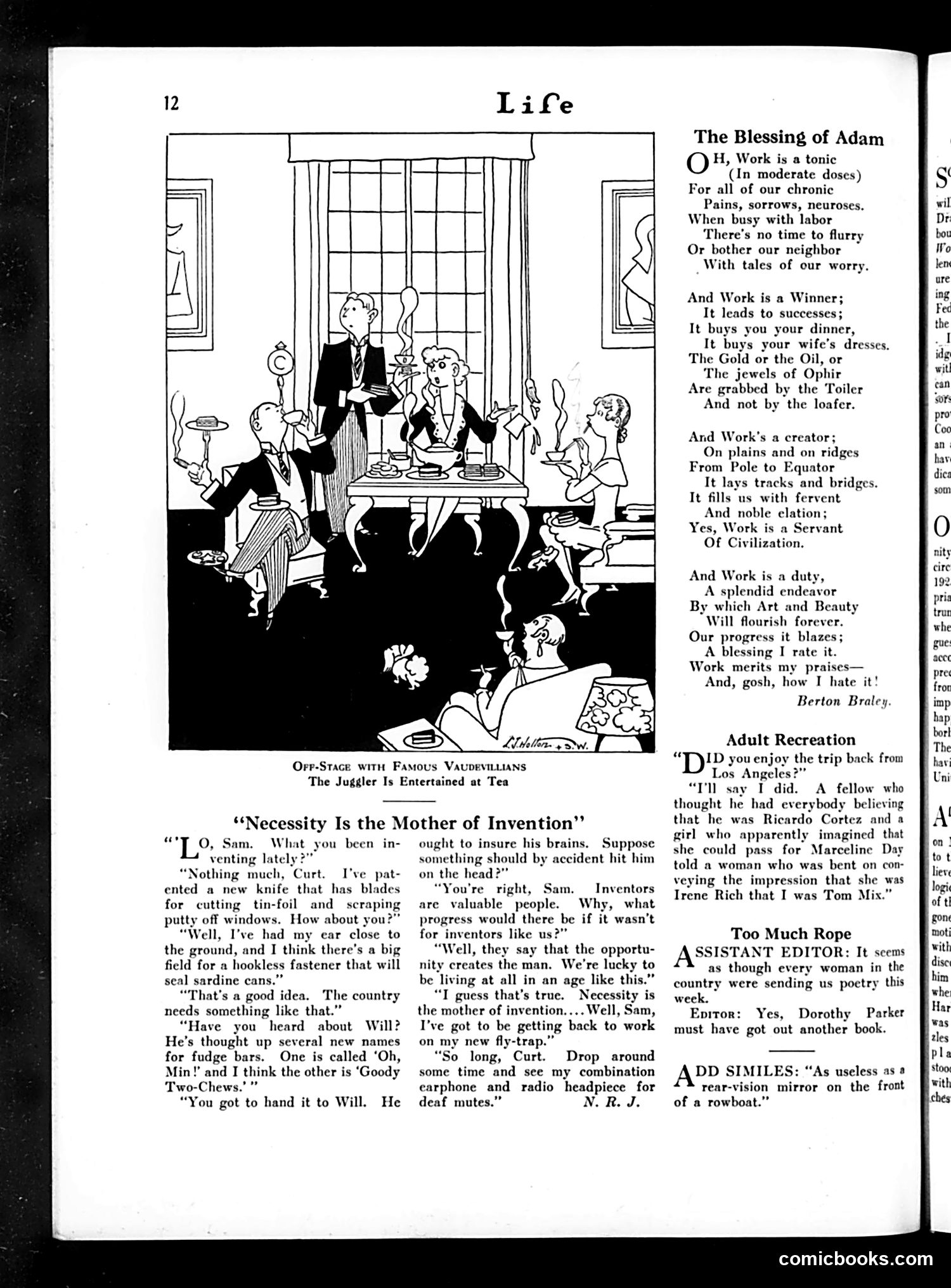
The main cartoon shows a tea party where people are being entertained by a juggler. The caption identifies this as "Off-Stage with Famous Vaudevillians: The Juggler Is Entertained at Tea"—satirizing vaudeville performers' social lives during the early 20th century. The joke appears to be that the entertainer becomes the entertainment even in private settings. Below, a dialog between "Sam" and "Curt" discusses inventing tin-foil cutting blades and sardine cans. Sam pitches new product ideas ("Oh, Min!" and "Goody Two-Chews"), with Curt responding skeptically. The piece ridicules inventors' optimism and their belief that necessity creates marketable inventions, when often their ideas are impractical or redundant.
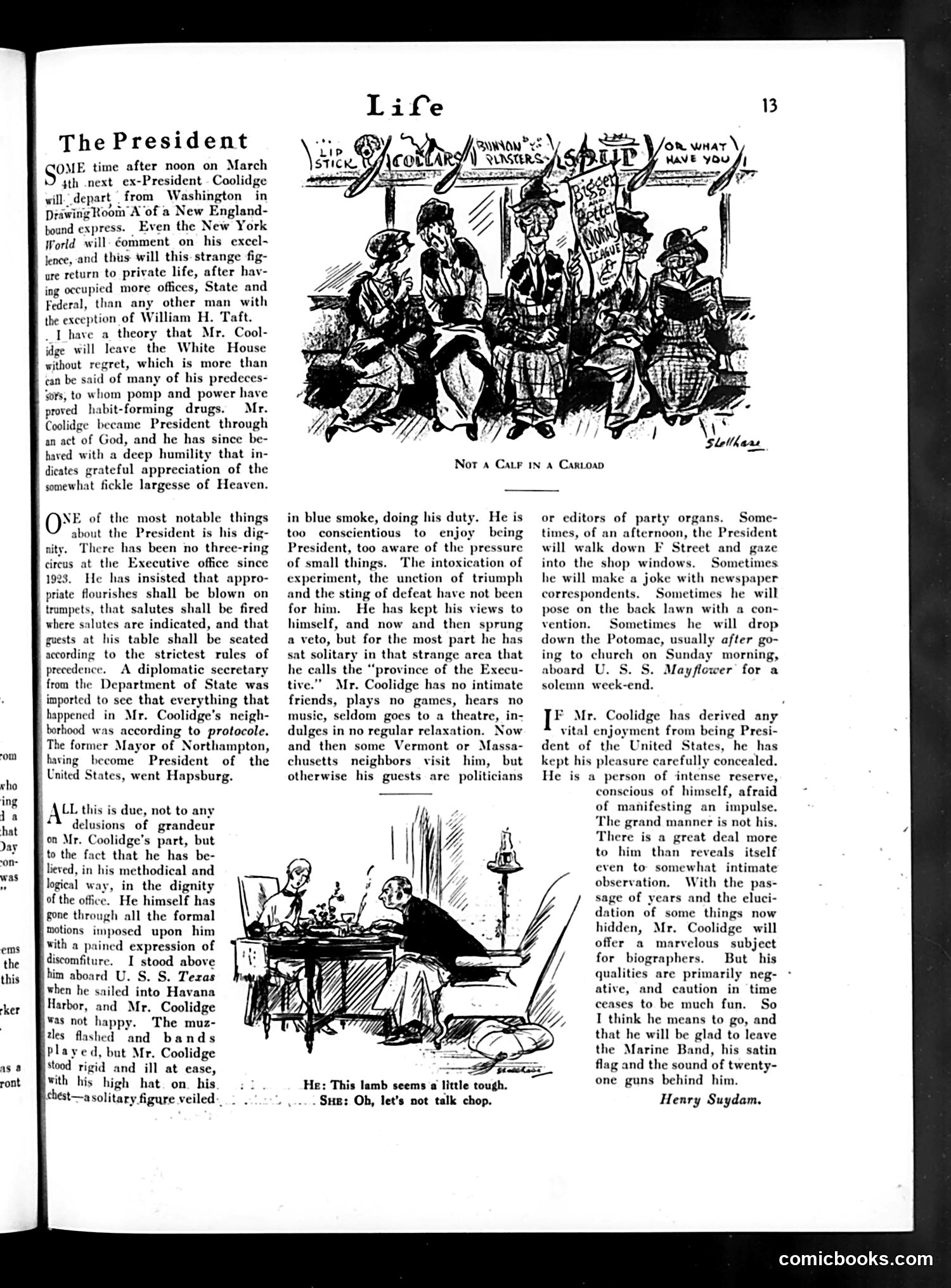
This page satirizes President Calvin Coolidge's personal manner and lifestyle. The top cartoon, "Not a Calf in a Carload," depicts Coolidge as emotionally detached—the text notes he's so reserved he avoids social pleasures like theater, music, and relaxation. The lower cartoon shows him working at a desk with the caption "This lamb seems a little tough" / "Oh, let's not talk shop," mocking his taciturn nature. The article praises Coolidge's dignity and formal adherence to presidential protocol, but the satire undercuts this: his famous reticence and avoidance of public enjoyment are presented as defining character traits. The cartoons suggest Coolidge is humorless and robotic—a stark contrast to more gregarious predecessors. This reflects 1920s criticism of Coolidge as withdrawn and uninspiring, despite his reputation for honest, efficient governance.
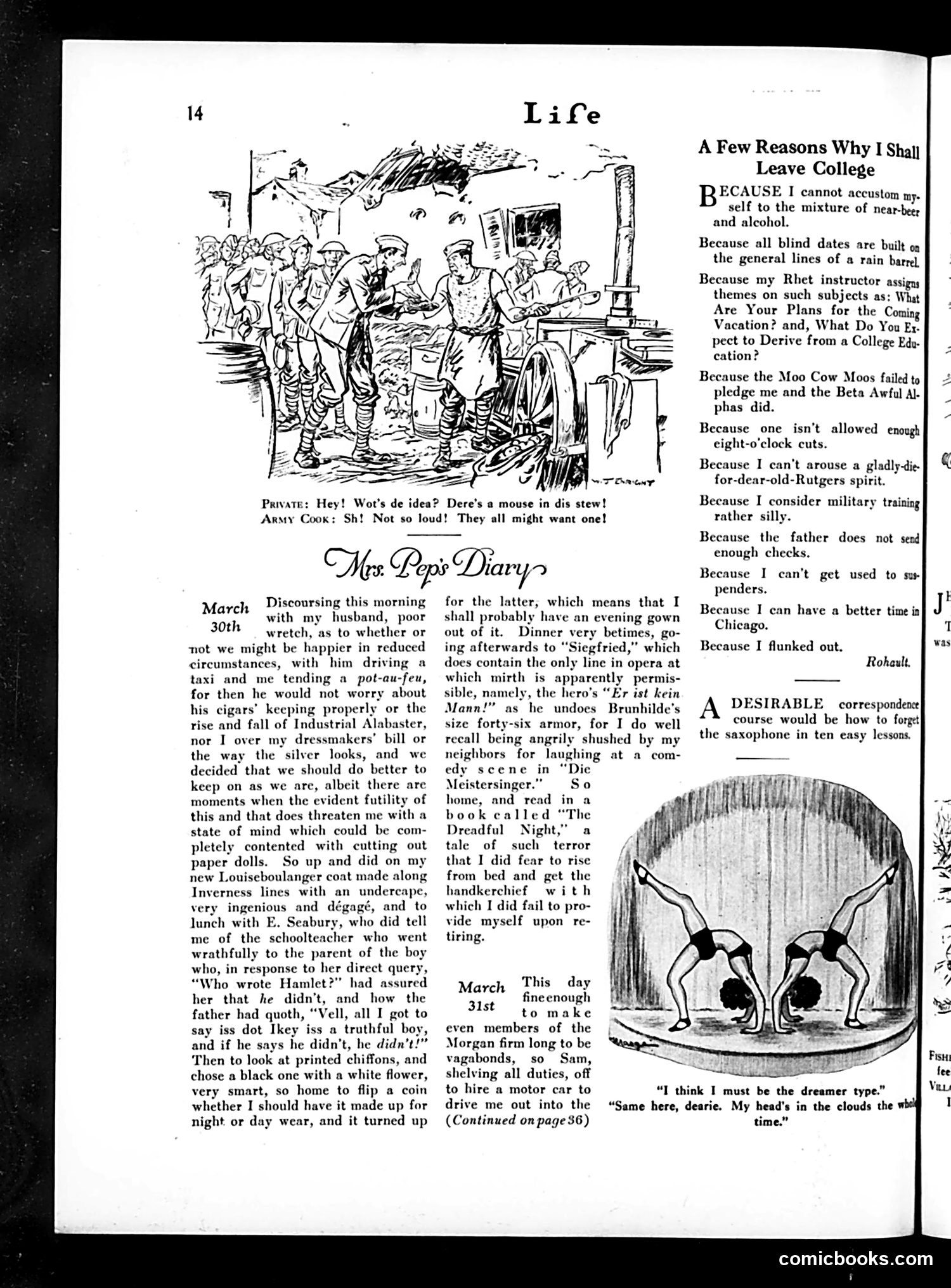
**Main Content:** This page features "Mrs. Pop's Diary" (March 30-31), a humorous domestic column about a middle-class wife's daily frustrations. The accompanying sketch shows soldiers or military personnel in what appears to be a camp setting, with a joke about finding a mouse in a stew. **The Satire:** The diary entry mocks: - Petty marital disagreements (taxi disputes, cigar storage) - Social pretensions and theater-going among the middle class - Anxieties about fashion and appearance - The mundane reality versus romantic ideals of marriage **Right Panel:** "A Few Reasons Why I Shall Leave College" lists humorous student grievances (failed pledges, mandatory 8 o'clock classes, flunking out). A cartoon shows a dreamer-type figure in clouds, satirizing romantic collegiate idealism versus harsh reality. The overall tone is lighthearted domestic and campus humor typical of 1920s-era Life magazine.
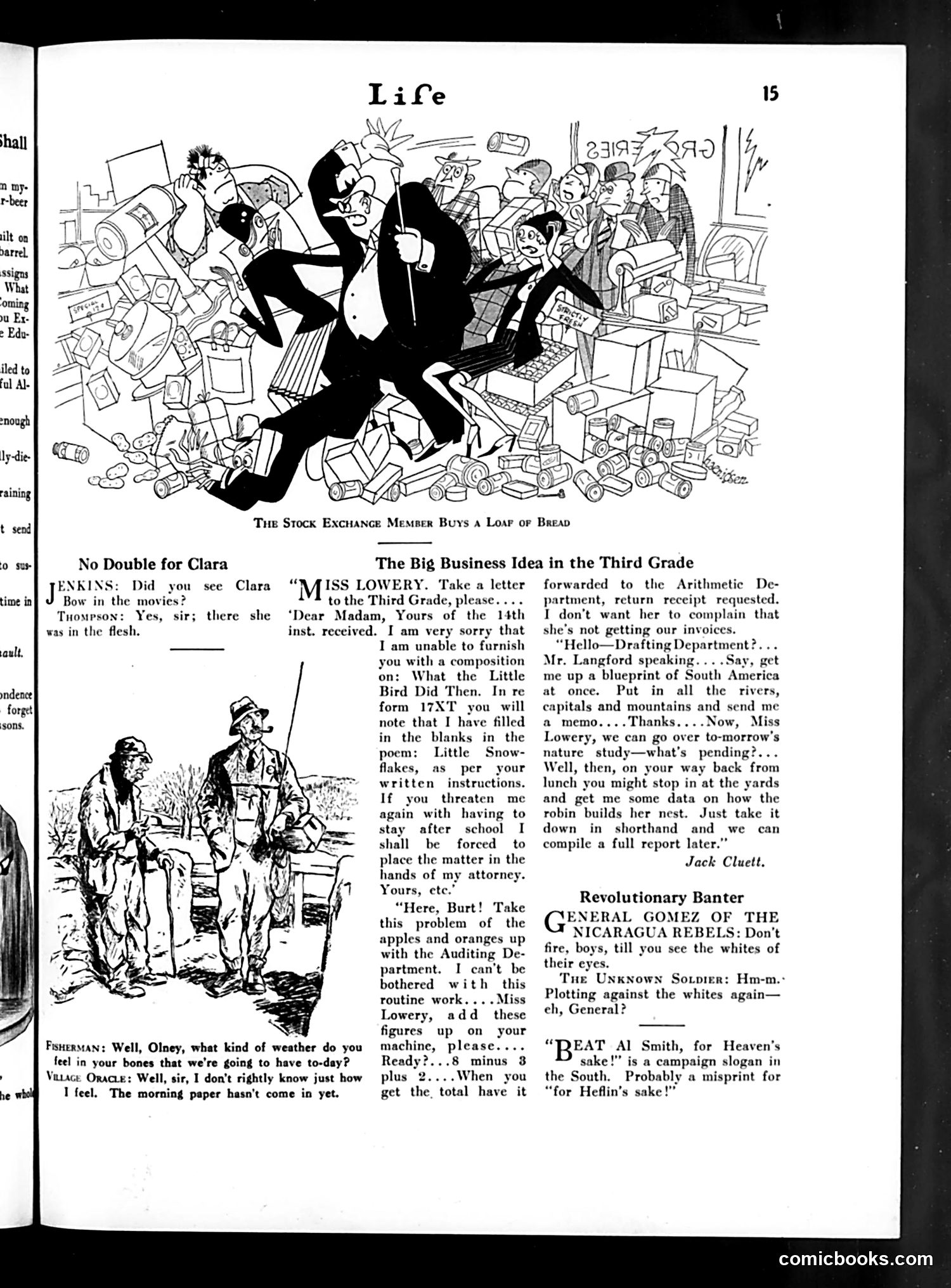
The main cartoon depicts "The Stock Exchange Member Buys a Loaf of Bread"—a satirical commentary on economic disparity. A wealthy, well-dressed stock exchange member is shown frantically purchasing bread amid scattered goods and money, suggesting financial chaos or collapse. The exaggerated, manic expression critiques wealthy financiers' desperation during economic turmoil. Below are three brief humorous pieces: "No Double for Clara" jokes about a woman's flesh, "The Big Business Idea in the Third Grade" satirizes bureaucratic complexity through a child's perspective, and "Revolutionary Banter" mocks political rhetoric about the Nicaragua rebels. The page's humor targets wealth inequality, financial instability, and the absurdity of bureaucratic systems—common satirical themes in early 20th-century American humor magazines.
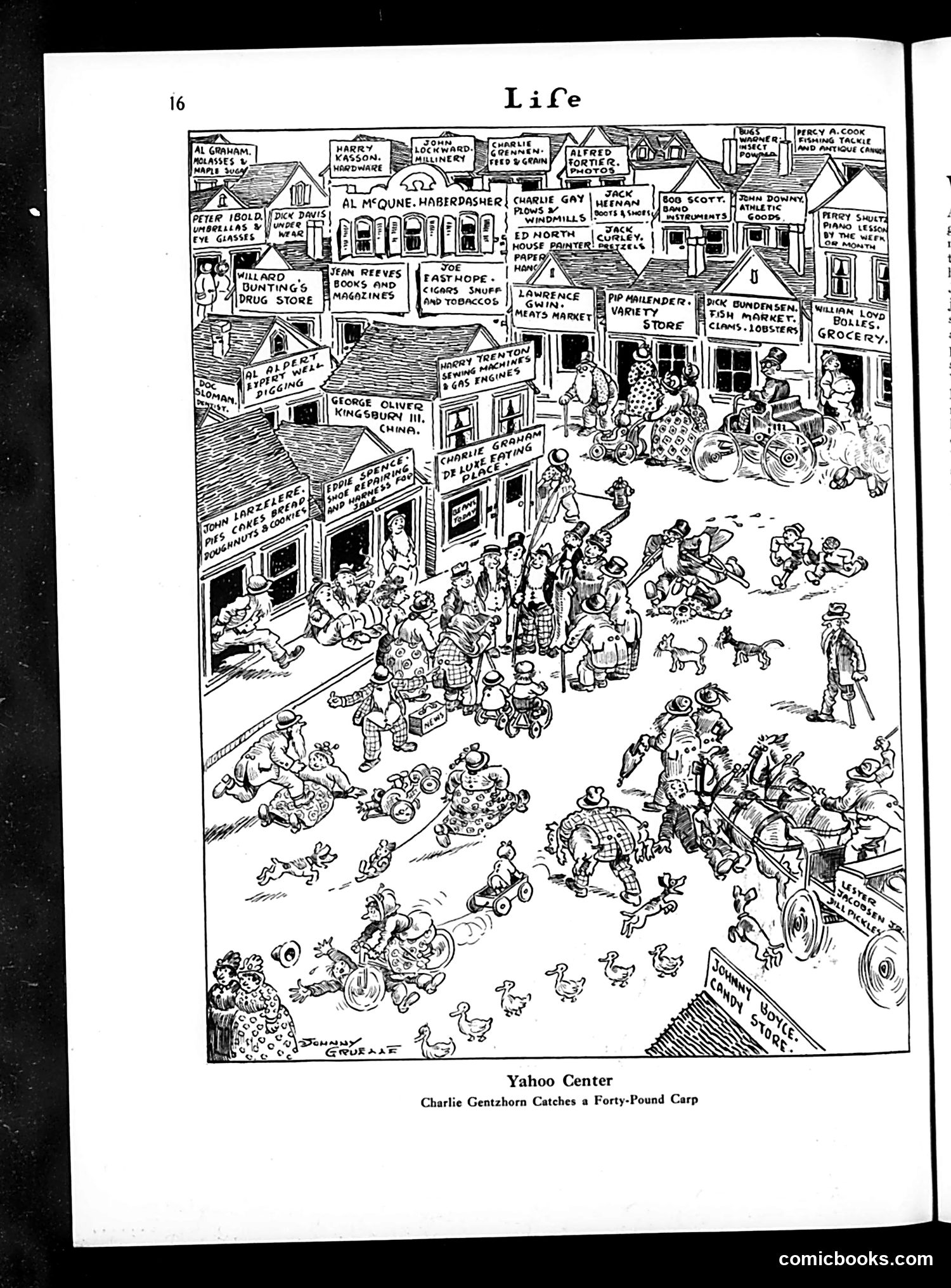
This is a busy street-scene illustration satirizing small-town American life, likely from the early 20th century. The cartoon depicts a crowded downtown street with numerous storefronts labeled with proprietors' names (Al Graham's Maple Shop, Harry Yeoman's Hardware, etc.). The central joke appears to be the absurd spectacle: Charlie Gentzhorn has caught a massive forty-pound carp, and the entire town has gathered in the street to witness this minor event. Children play, townspeople cluster around, and everyday commerce continues while this trivial achievement becomes a community attraction. The satire targets small-town mentality—how provincial communities elevate mundane local occurrences into major events worthy of widespread attention and disruption to daily life.
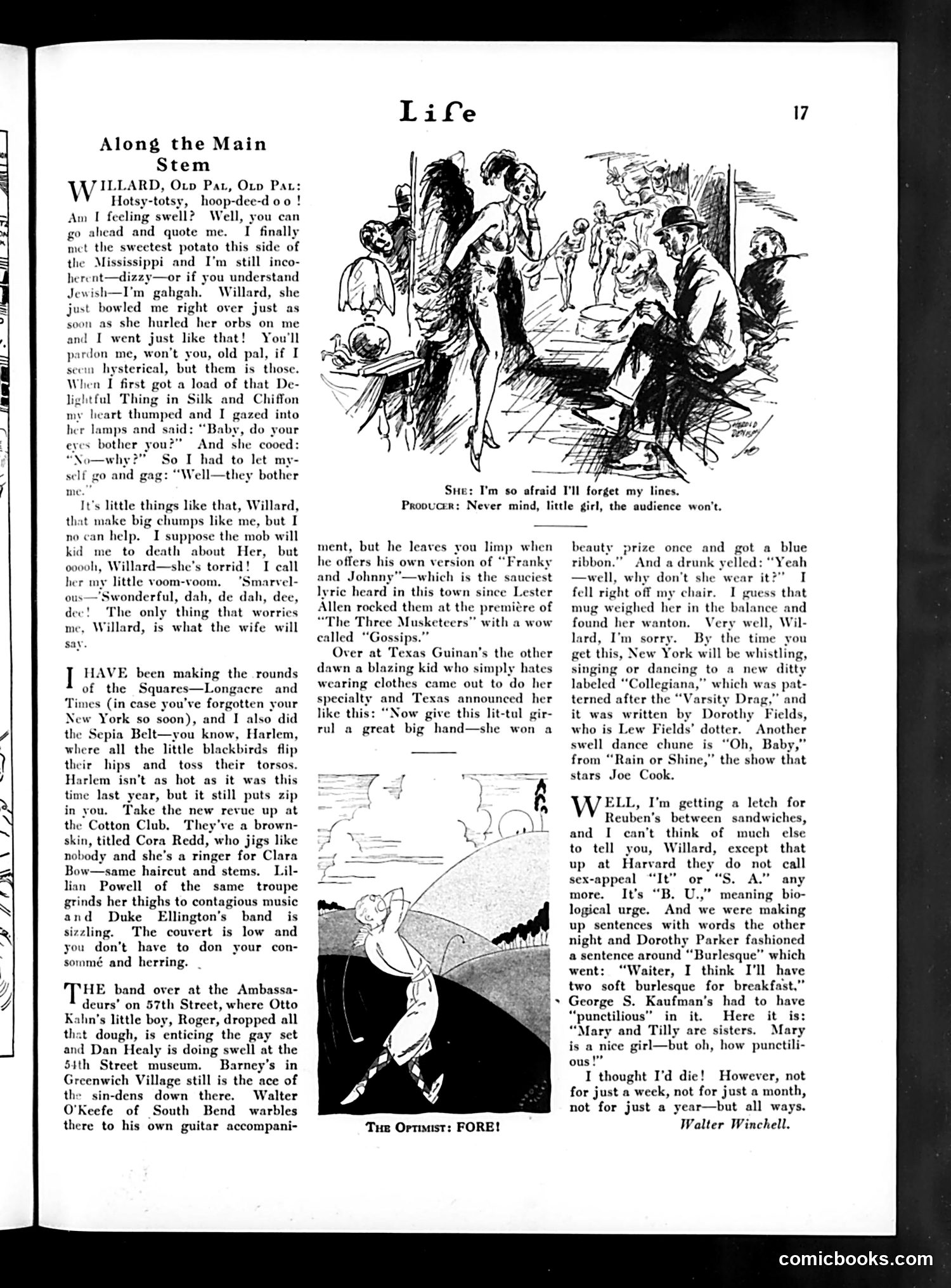
This page features theatrical gossip and social commentary by Walter Winchell, a famous Broadway columnist. The main text "Along the Main Stem" discusses New York theater personalities and performances, including references to various revues and performers at clubs like the Cotton Club. The two illustrations appear to be humorous sketches related to theater: the upper shows a theatrical scene with performers, captioned "She: I'm so afraid I'll forget my lines. Producer: Never mind, little girl, the audience won't"—mocking amateur or inexperienced performers. The lower sketch titled "The Optimist: Fore!" shows a golf scene, likely satirizing theater people's leisure activities. The overall tone is gossipy, insider commentary on 1920s-30s Broadway culture, with humor directed at theatrical pretensions and performer vanities.
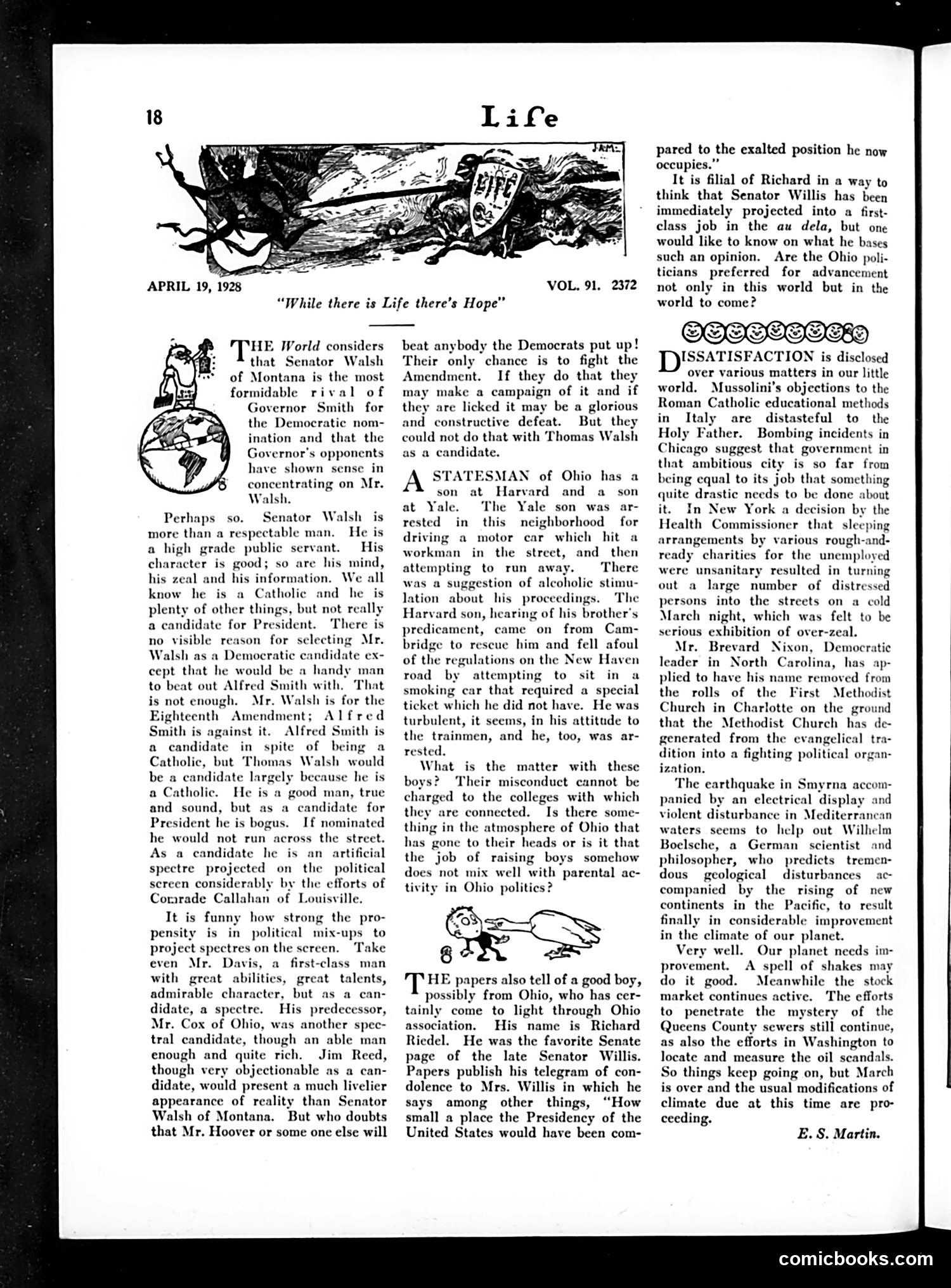
This page satirizes 1928 Democratic presidential politics, particularly Senator Thomas Walsh of Montana as an artificial "spectre" candidate. The magazine argues Walsh—though respectable—is merely positioned to block Governor Al Smith (a Catholic and anti-Prohibition candidate) rather than being a genuine contender. Life suggests Democrats' only viable strategy is fighting Prohibition; nominating Walsh would be hollow. The second section mocks Ohio politicians' sons for misbehavior (traffic violations, intoxication, train car misconduct), questioning whether Ohio's political culture corrupts youth. Finally, it ridicules young Richard Riedel, Senate page to late Senator Willis, for suggesting in a condolence telegram that the Presidency pales compared to Willis's presumed afterlife position—implying Riedel either lacks judgment or reflects Ohio politicians' grandiose self-regard.
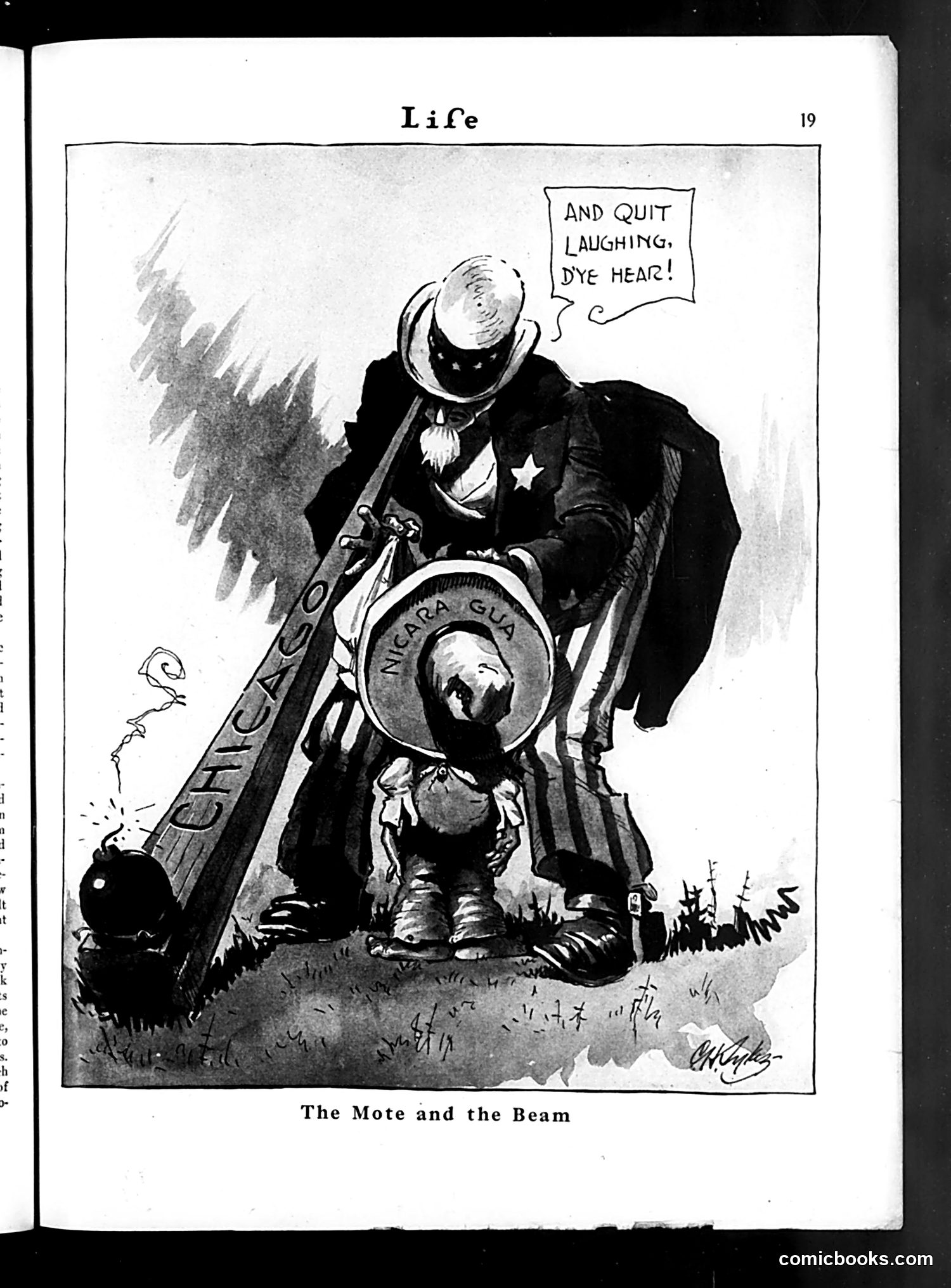
This political cartoon satirizes American interventionism, likely from the early 20th century. Uncle Sam (identified by his star-emblazoned jacket and characteristic appearance) holds a rifle and a child labeled "Nicaragua" while saying "And quit laughing, dye hear!" The title references the biblical parable about removing the beam from one's own eye before criticizing the mote in another's—suggesting American hypocrisy. Uncle Sam demands Nicaragua stop laughing while he himself commits violence against the smaller nation. The cartoon critiques U.S. military intervention in Central America, implying America lacks moral authority to police others' conduct while pursuing imperial ambitions. The contrast between Sam's aggressive posture and his indignant tone emphasizes the satirical point about selective morality.
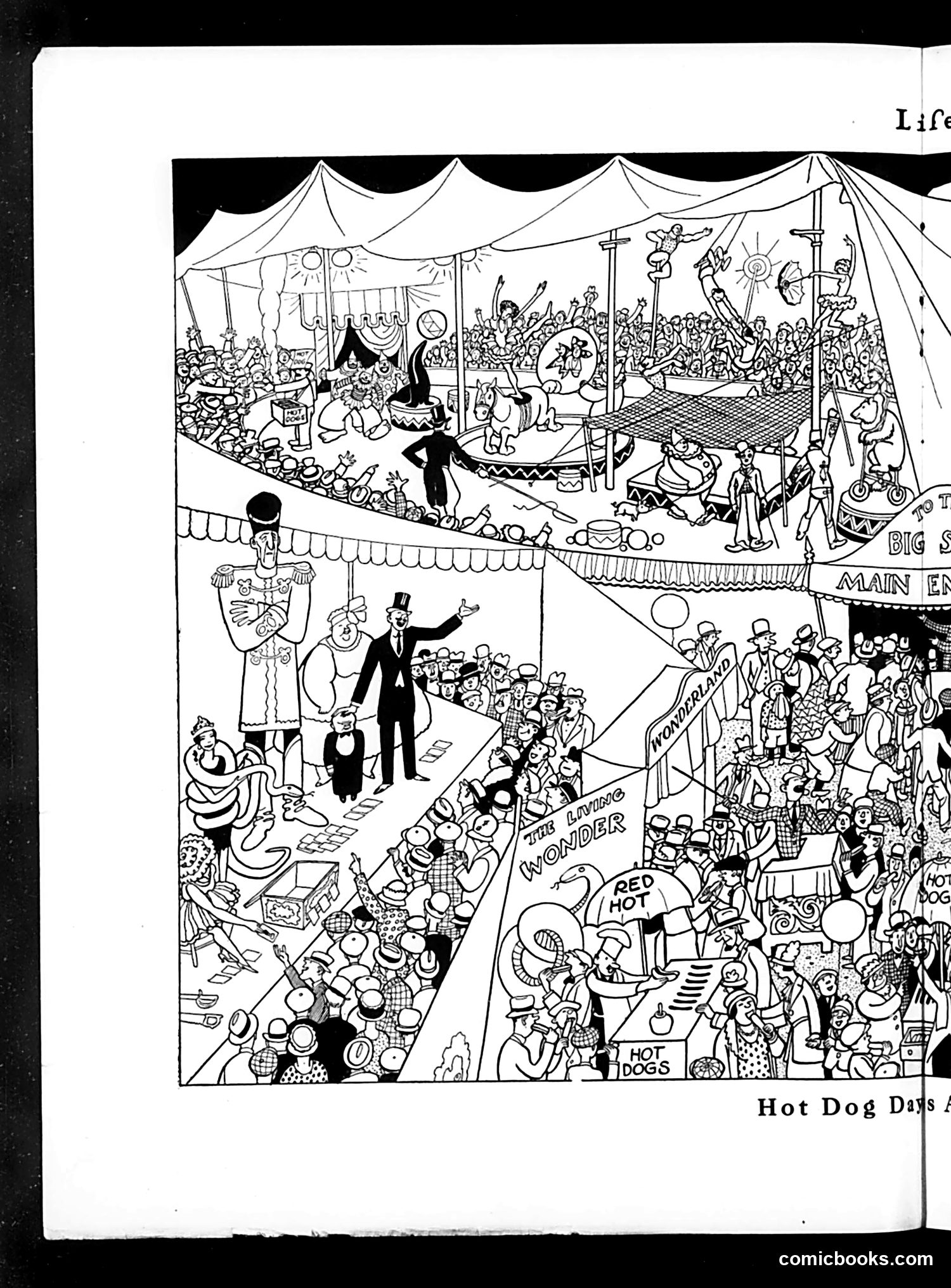
This is a satirical illustration of a circus scene packed with crowds and carnival attractions. The image depicts a busy circus tent with multiple levels of activity: acrobats and performers on platforms above, ringmasters in formal dress directing the action, and crowds of spectators below enjoying various concessions including hot dog stands. The satire likely comments on the chaotic nature of American consumer culture and entertainment—the circus functioning as a metaphor for society's spectacle-driven distractions. The emphasis on hot dog vendors and crowded consumption suggests mockery of mass entertainment and commercial excess. The formal-dressed ringmasters appear to be orchestrating the mayhem for profit, a common Life magazine critique of corporate entertainment industries of that era.
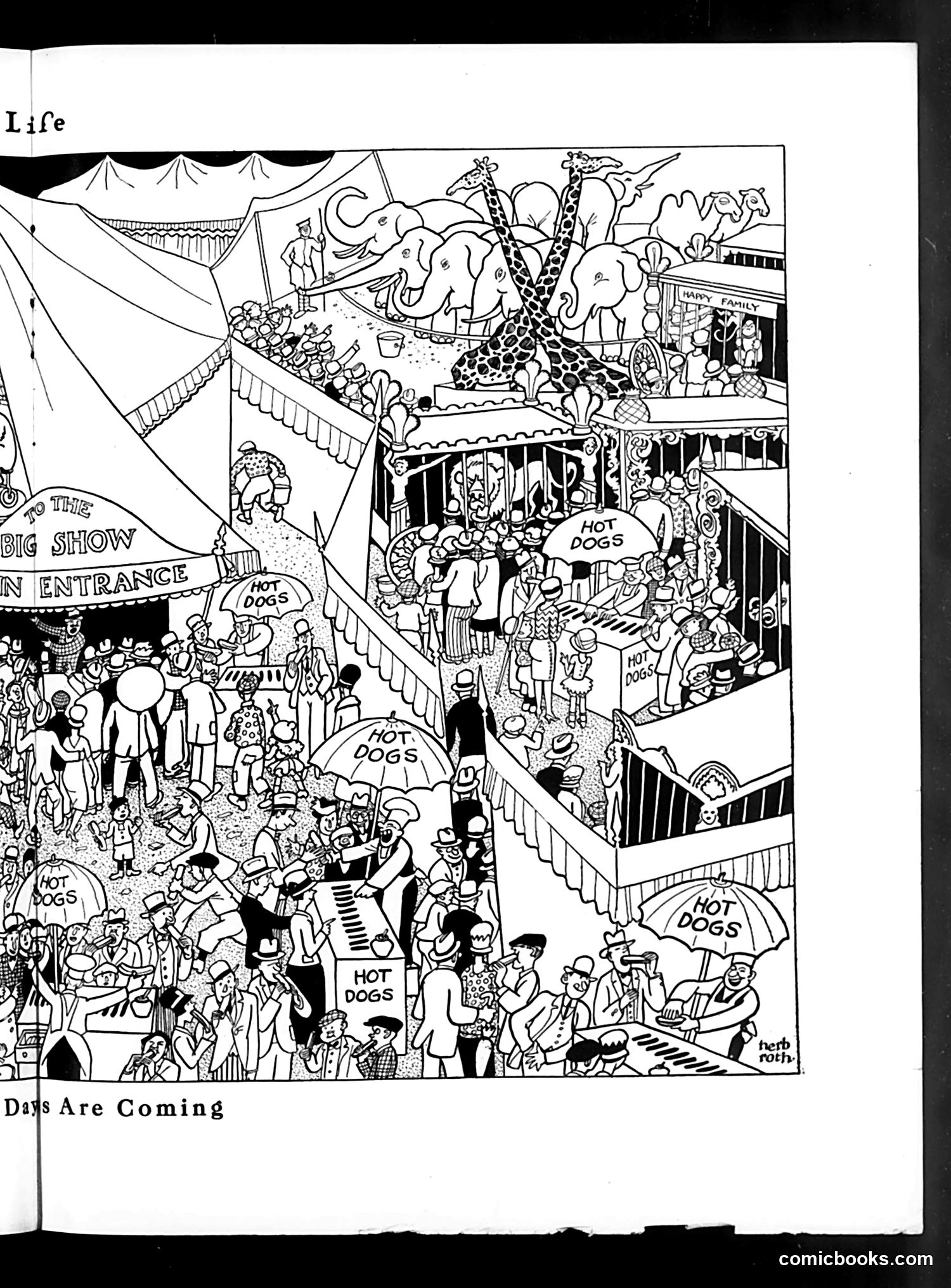
This is a densely-packed satirical cartoon titled "Life: Days Are Coming" depicting a bustling circus or carnival scene. The repetitive "HOT DOGS" signs and vendor umbrellas suggest commentary on commercialism and consumer culture overwhelming public spaces. The scene shows crowds of people amid circus animals (elephants, giraffes), entertainment, and food vendors—likely satirizing American leisure culture and mass consumption. The "big show" entrance sign and crowded, chaotic composition suggest satirical criticism of spectacle-driven society. The specific political targets remain unclear from the visible text alone, though the overall message appears to be warning that an era of frivolous abundance or distraction is approaching—or perhaps that such excess already dominates American life. The artist's signature reads "herb roth." Without additional context about Life magazine's publication date, precise satirical targets cannot be definitively identified.
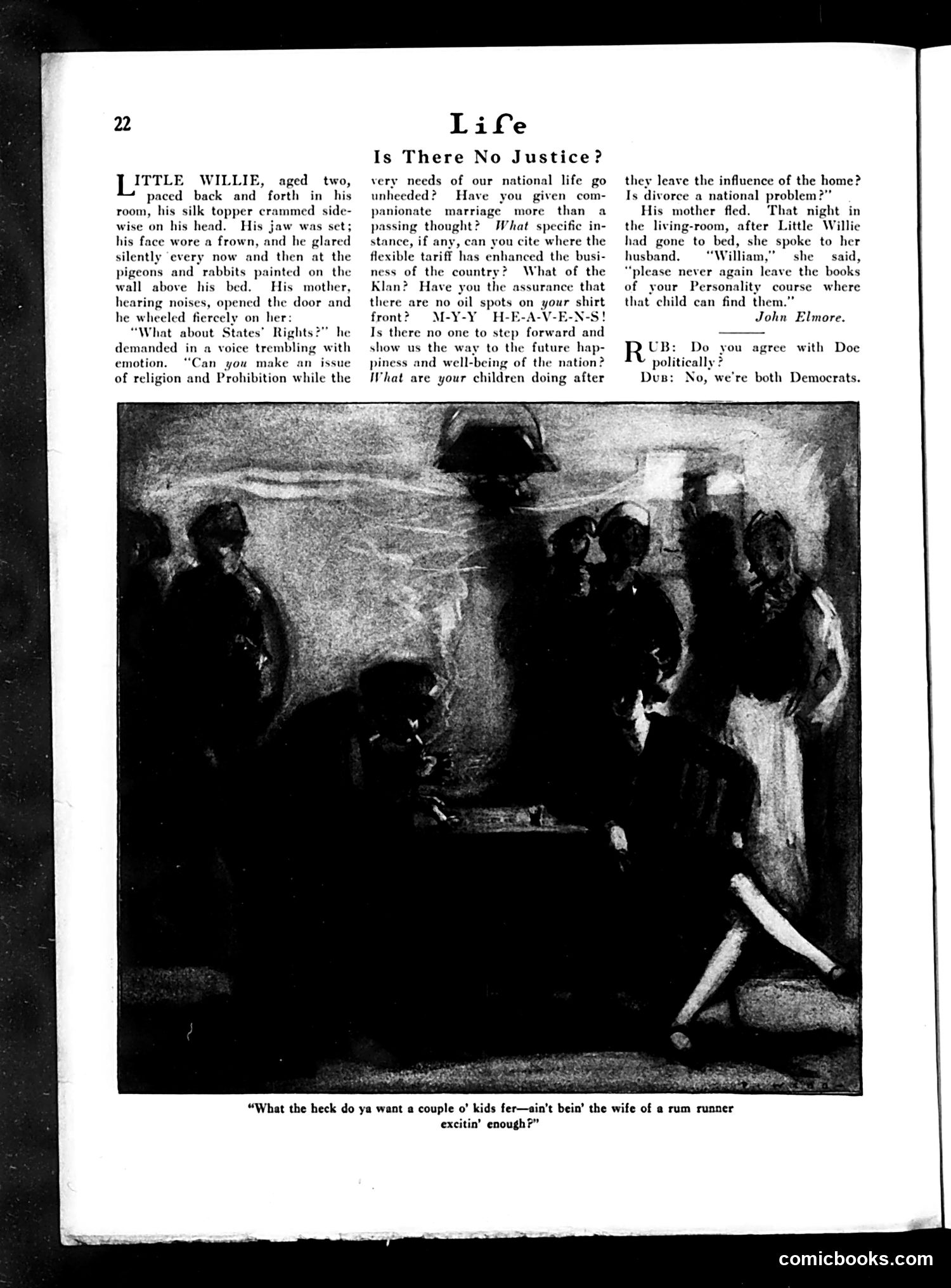
This page contains two separate satirical pieces from *Life* magazine (likely 1920s-era, based on references to Prohibition and the Klan). **"Little Willie" cartoon (top):** A two-year-old child parrots adult political rhetoric—invoking States' Rights, Prohibition, flexible tariffs, the Ku Klux Klan, and oil scandals. The joke satirizes how Americans obsess over abstract political debates while ignoring practical concerns. The mother's final realization—that her child absorbed these talking points from a "Personality course" book—mocks self-help literature and the mindless regurgitation of political slogans by ordinary citizens. **Bottom cartoon (photo):** A couple discusses having children, with one partner (appearing to be a woman married to a "rum runner"—an illegal alcohol smuggler during Prohibition) sarcastically questioning why she'd want kids when being married to a criminal is already exciting enough. This darkly mocks the lawlessness of the Prohibition era and women's limited domestic prospects. Both pieces ridicule American social and political absurdities of their time.
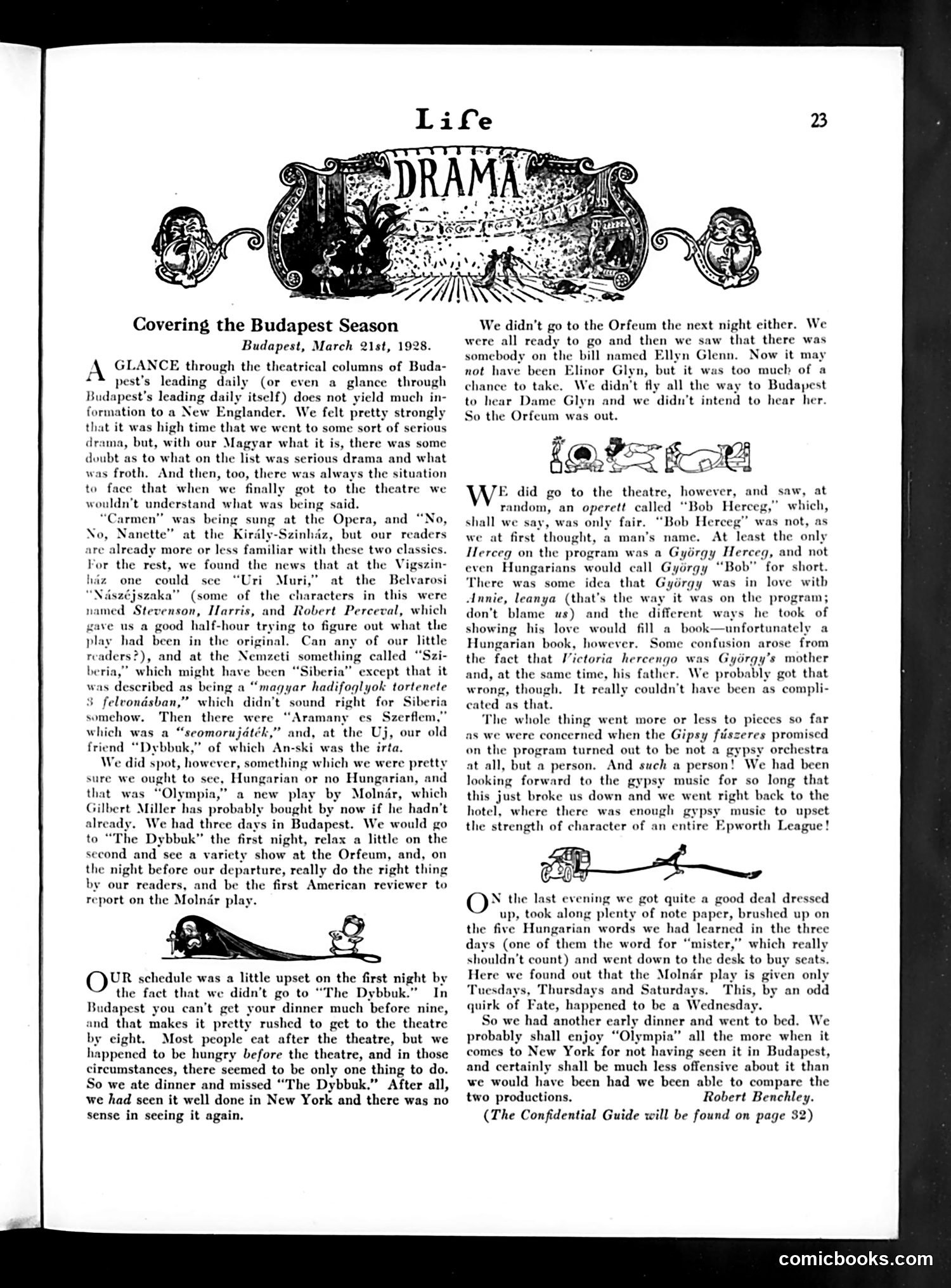
This is a humorous travel article about attending theater in Budapest. The author struggles with the language barrier when trying to select serious drama from Hungarian theater listings. They mention several productions including "Carmen" at the Opera and "No, No, Nanette"—familiar to American readers—alongside untranslatable Hungarian titles like "Uri Muri" and "Sziberia." The piece satirizes the practical challenges of being a foreigner: the author planned to see An-ski's "The Dybbuk" but skipped dinner before the late show, then avoided the variety show when spotting a performer with a name resembling **Elinor Glyn** (a famous British author known for risqué novels). Finally, they attended an operetta called "Bob Herceg," which proved mediocre and confusingly plotted. The satire targets both cultural tourism and the author's own provincial American perspective—the irony being that after traveling to experience authentic Hungarian drama, practical hunger and name recognition derail their plans.
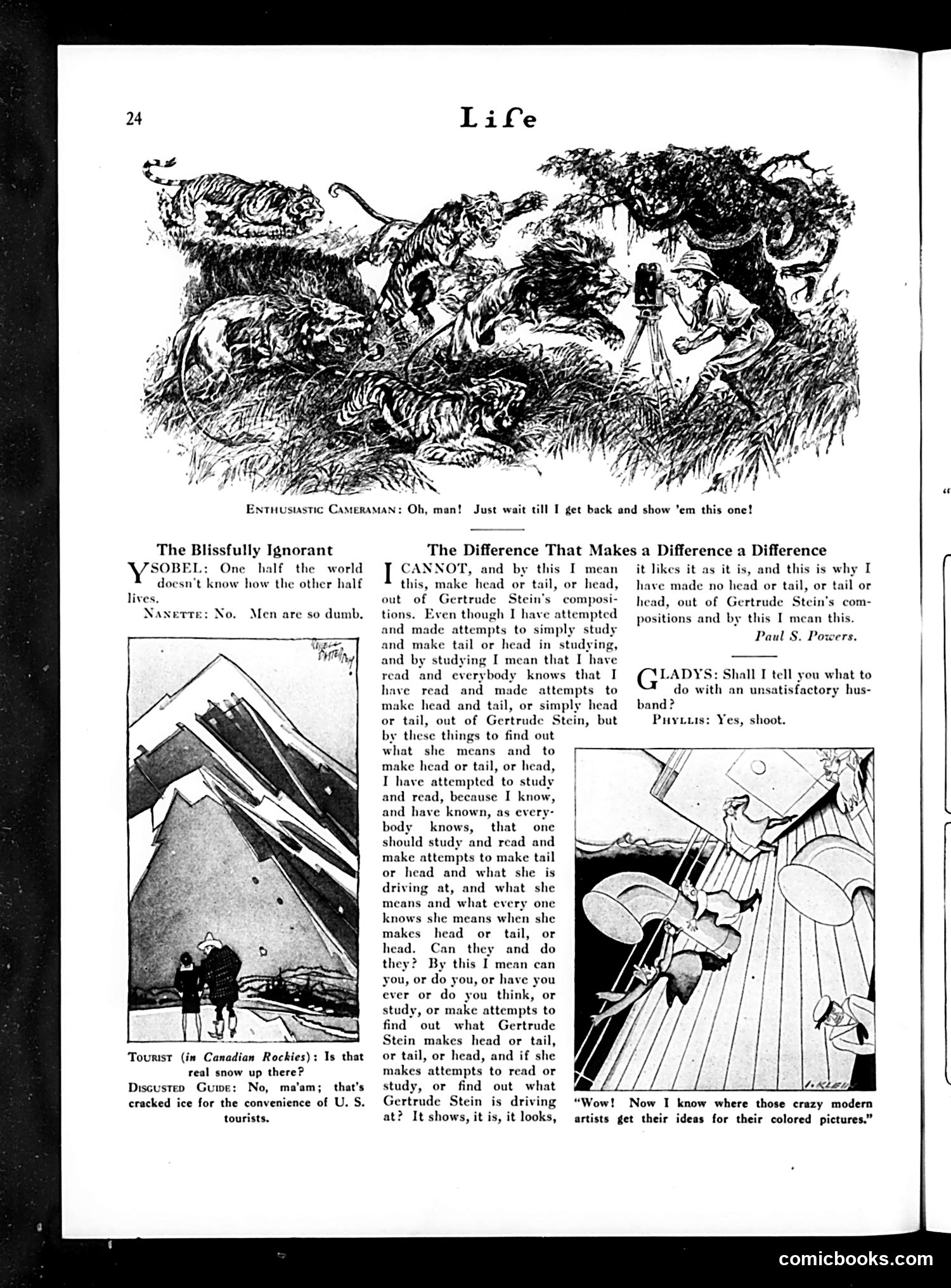
This page contains three satirical jokes typical of early 20th-century American humor: **"The Blissfully Ignorant"** mocks male ignorance through contrasting perspectives on world knowledge and tourist naiveté. **"The Difference That Makes a Difference a Difference"** directly parodies **Gertrude Stein**, the modernist writer famous for her repetitive, deliberately obscure prose style. The humor derives from mimicking her circular, seemingly meaningless syntax—the text itself becomes incomprehensible, demonstrating why readers found her work baffling. This reflects contemporary frustration with avant-garde literature. **The bottom cartoon** shows a cameraman filming wild animals, with the punchline suggesting that modern artists derive inspiration from chaotic nature photography rather than traditional sources—a jab at modernism's break from classical artistic conventions. Collectively, these pieces satirize early modernism: its literary obscurity (Stein), its rejection of traditional aesthetics, and the public bewilderment these movements provoked. The humor targets intellectual pretension and artistic innovation as incomprehensible to ordinary Americans.
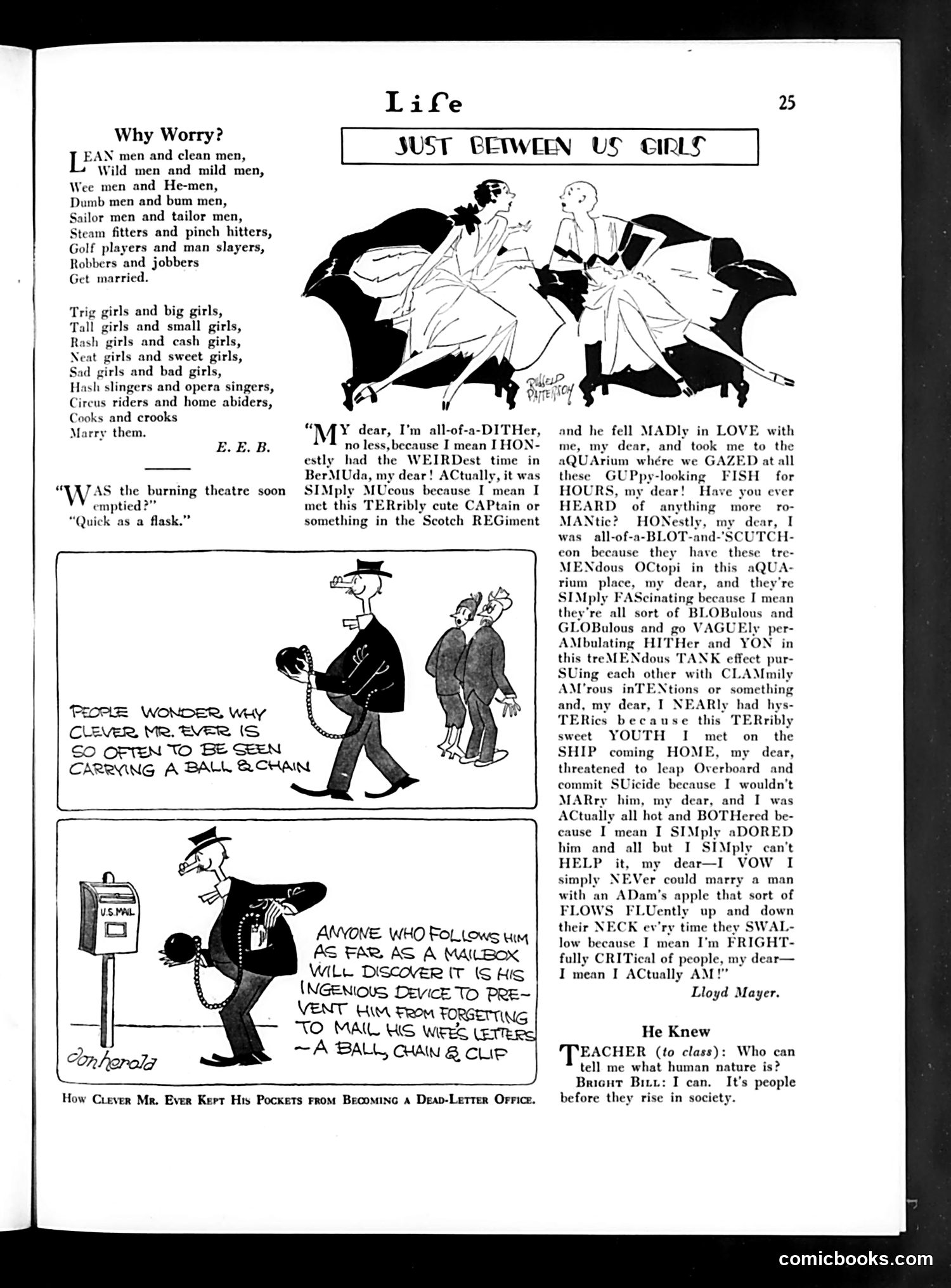
This page satirizes early 20th-century female affectation and gossip culture through multiple cartoons and sketches. **Main Feature**: A lengthy monologue by a young woman breathlessly recounting her romantic misadventures in Bermuda, filled with exaggerated theatrical delivery (capitalized syllables indicate dramatic emphasis). She describes a suitor so devoted he threatened suicide, yet dismisses him over trivial physical features like his Adam's apple. The satire mocks women's superficiality, their tendency toward melodramatic storytelling, and their contradictory romantic expectations. **Side Cartoons**: Depict a clever gentleman using a ball-and-chain device to prevent lost mail—absurdist humor about forgetfulness. Another shows a man being led about in actual chains, representing marriage's supposed restriction of male freedom. **Opening Poem**: Lists all types of men and women ("dumb men," "bad girls," etc.) who nonetheless "get married," suggesting marriage is universal regardless of character. **Bottom Joke**: A schoolboy quips that human nature is "people before they rise in society"—cynical commentary on social pretense. The overall message: satirizes both female vanity and male anxieties about matrimony.
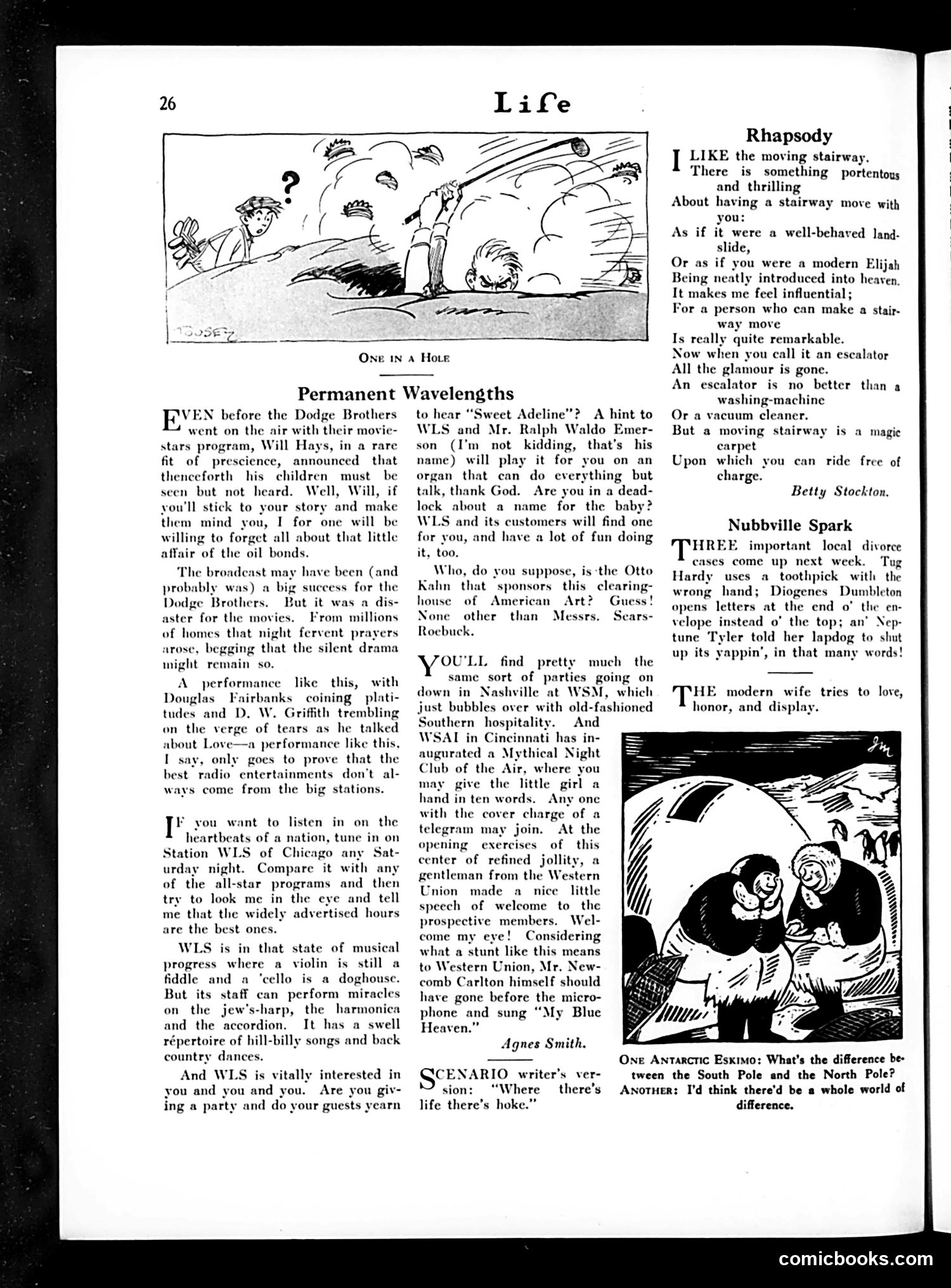
This page contains satirical commentary on early radio broadcasting (circa 1920s). The main article criticizes a Dodge Brothers radio program featuring film stars Douglas Fairbanks and D.W. Griffith, suggesting their public speaking was so poor it made audiences wish cinema remain silent. The author praises instead humble radio stations like WLS Chicago and WSM Nashville for their authentic appeal—noting WLS's sponsor is Sears-Roebuck, a mail-order giant reaching rural America. The cartoon "One in a Hole" (top) appears to depict someone stuck or in difficulty, though details are unclear. Side columns include brief humorous pieces: "Rhapsody" praises the romance of "moving stairways" (escalators) over the mundane term "escalator," and "Nubbville Spark" offers small-town gossip about upcoming divorce cases with comical reasons. The satire targets growing radio industry pretensions and corporate sponsorship of entertainment.
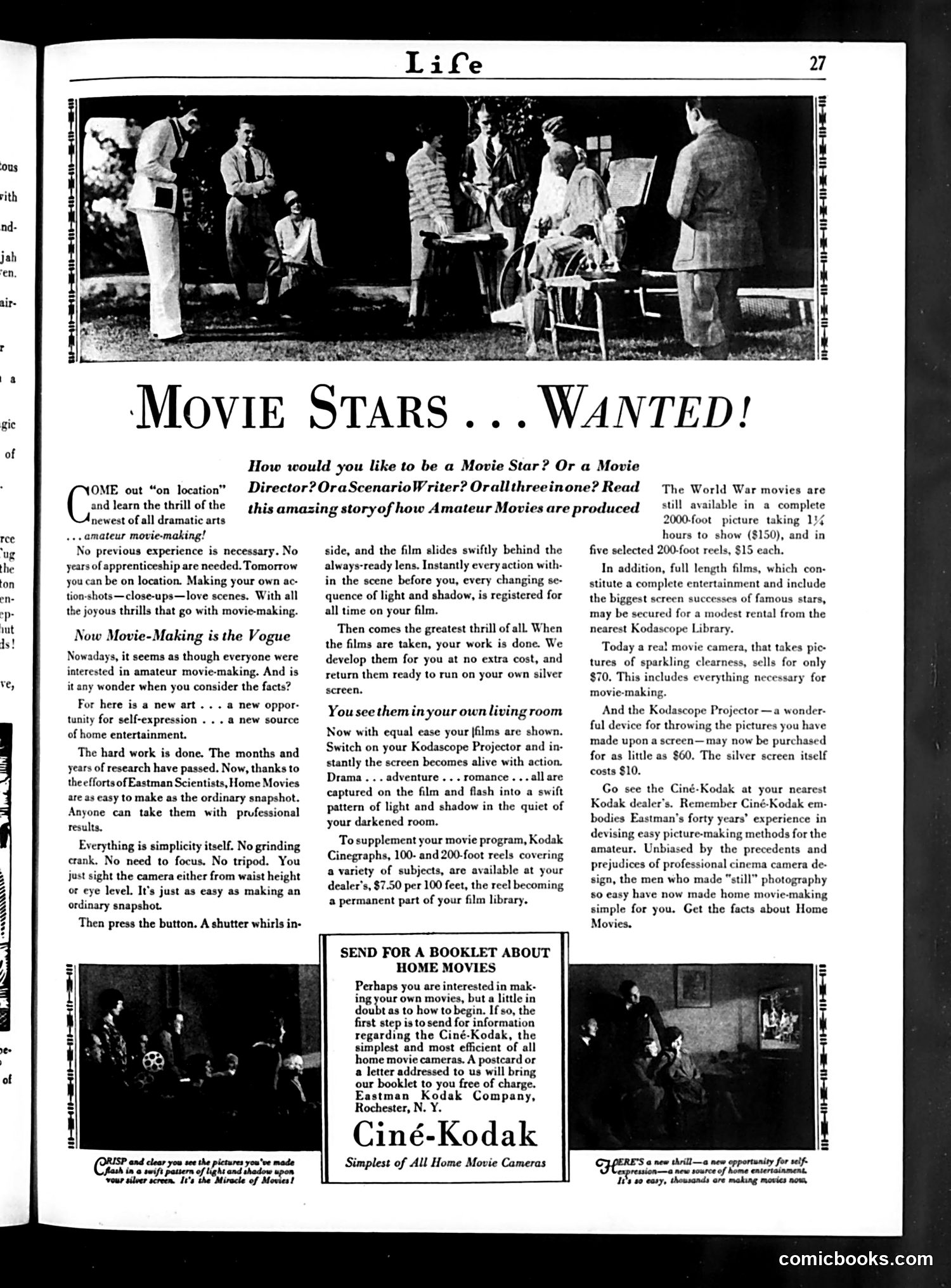
This is primarily a **Kodak advertisement disguised as editorial content** in Life magazine. Rather than satire, it's a marketing pitch for amateur home movie equipment aimed at ordinary people. The page promotes the democratization of filmmaking: Kodak claims anyone can now make movies without professional training—just point, shoot, and press a button. The photographs show civilians operating cameras and viewing films in domestic settings, contrasting sharply with the glamorous "movie stars wanted" headline. The satire is subtle: the headline promises Hollywood stardom, but the actual pitch is selling $70 cameras and $60 projectors to middle-class homeowners who'll make home movies of their families and vacations, not compete with professional studios. It's aspirational marketing—selling the *fantasy* of being a movie star while actually selling the modest reality of home entertainment technology. The reference to "World War movies" suggests this dates to the 1920s, when such conflict footage was commercially available.
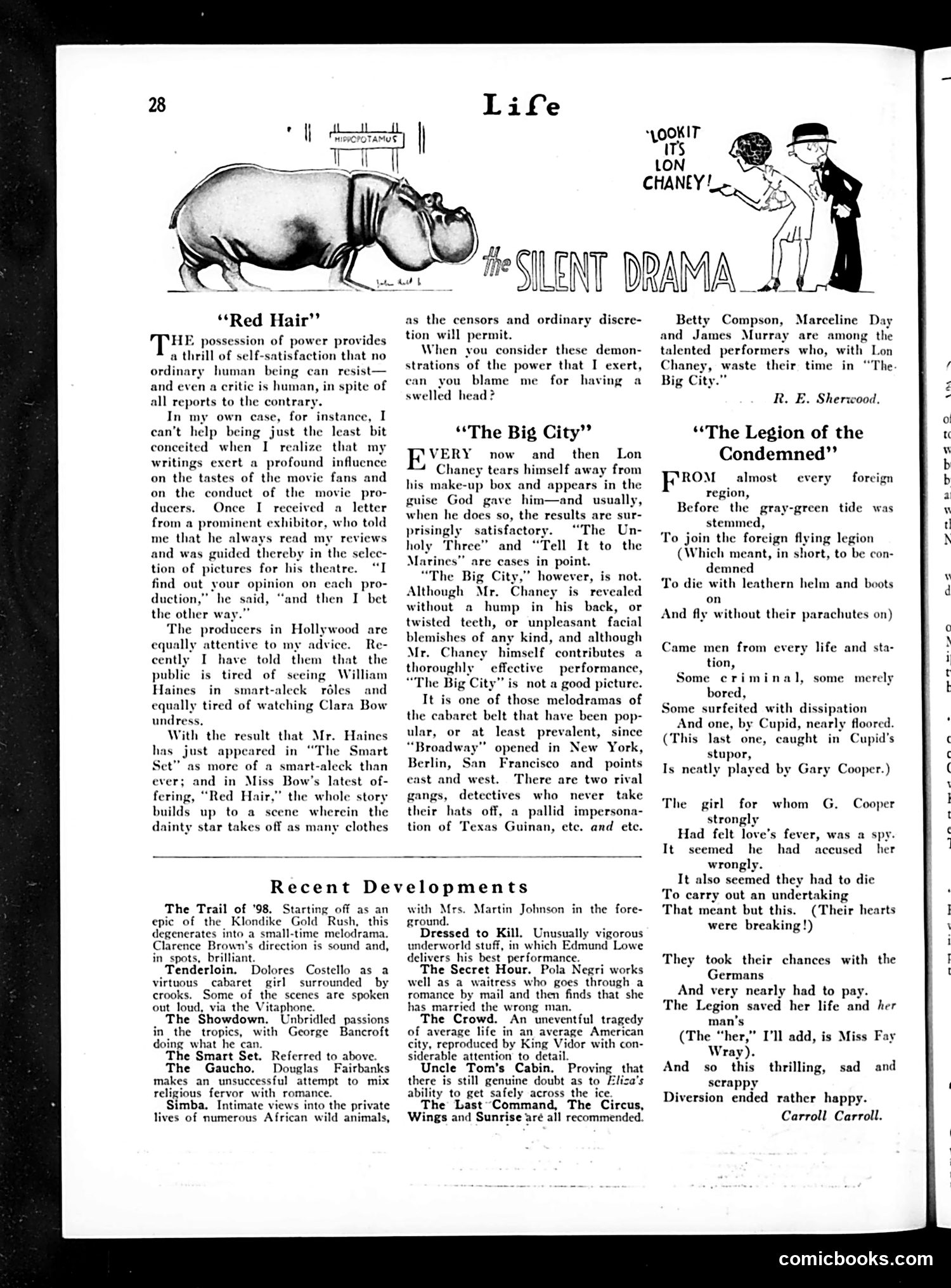
This page from Life magazine contains film reviews and commentary, circa mid-1920s. The cartoonist's satire centers on **the critic's own inflated ego**: a hippopotamus (representing the pompous reviewer) struts before two figures exclaiming "Look! It's Lon Chaney!" — mocking the critic's self-importance despite discussing famous actors like Lon Chaney, Clara Bow, and William Haines. The text satirizes how film critics overestimate their influence on both audiences and studios. The reviewer brags that exhibitors follow his reviews (then bet "the other way") and that producers heed his advice, yet contradictory results prove his judgment irrelevant. The "Recent Developments" section provides brief, dismissive reviews of contemporary silent films. The satire's target is **critical self-delusion**: the reviewer claims power while demonstrating none, and recommends pictures he's just criticized. The hippopotamus image reinforces the joke—an absurdly proud, ungainly creature perfectly embodies the pretentious film critic.
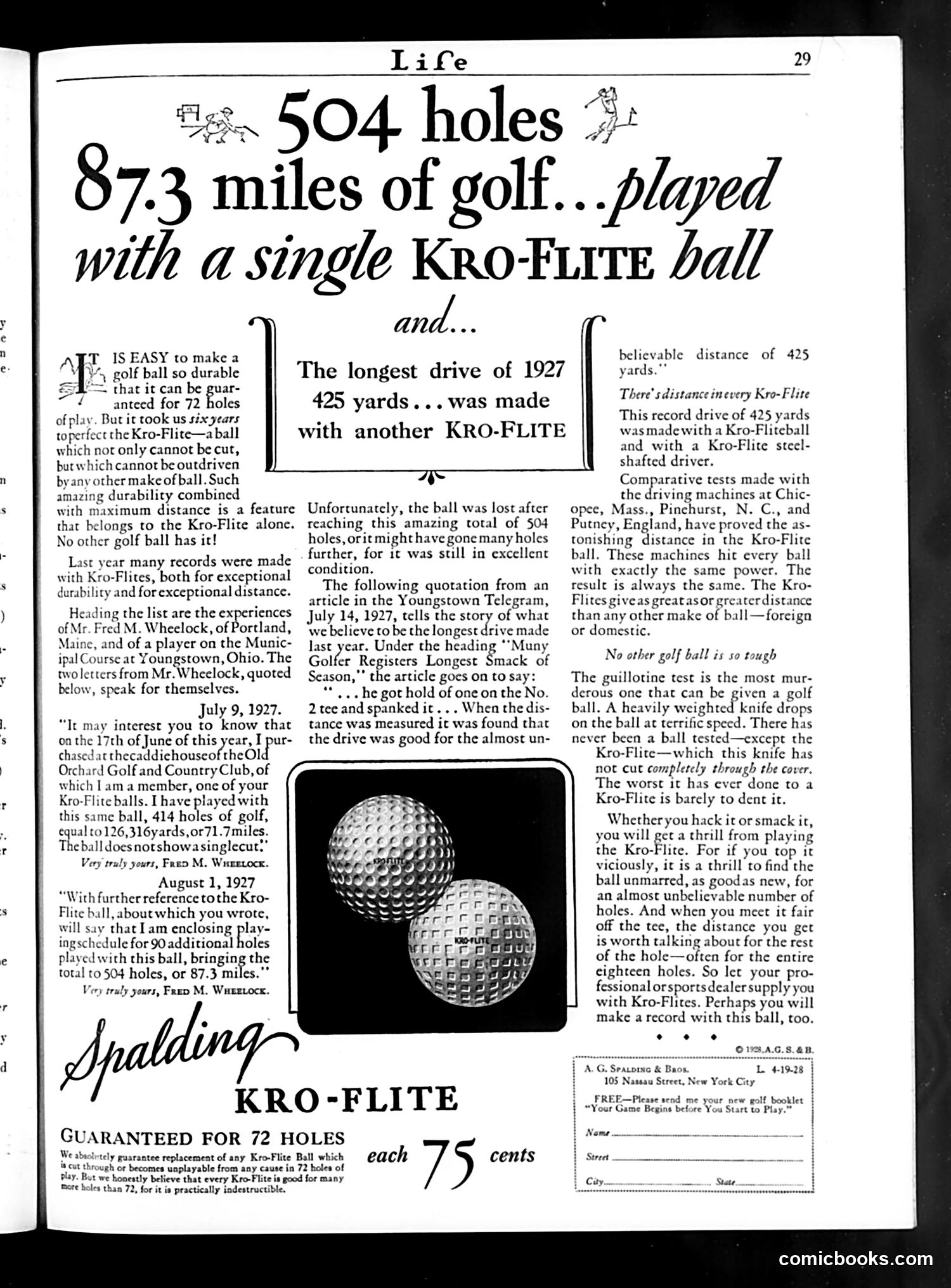
This is **not a political cartoon** but rather a full-page advertisement for Spalding's Kro-Flite golf ball. The page showcases the product's durability through customer testimonials and performance claims. **Key content:** - Fred M. Wheelock of Portland, Maine provides letters documenting that a single Kro-Flite ball endured 504 holes of golf (87.3 miles) without visible damage - A 1927 record drive of 425 yards allegedly made with a Kro-Flite ball - Claims the ball cannot be "cut" or "outdriven" by competitors - Marketing emphasizes durability testing, including a "guillotine test" where weighted knives fail to cut through the ball's cover **For modern readers:** This represents 1920s sports marketing emphasizing product longevity and performance superiority through documented evidence and competitive testing—essentially early "data-driven" advertising targeting affluent golfers.
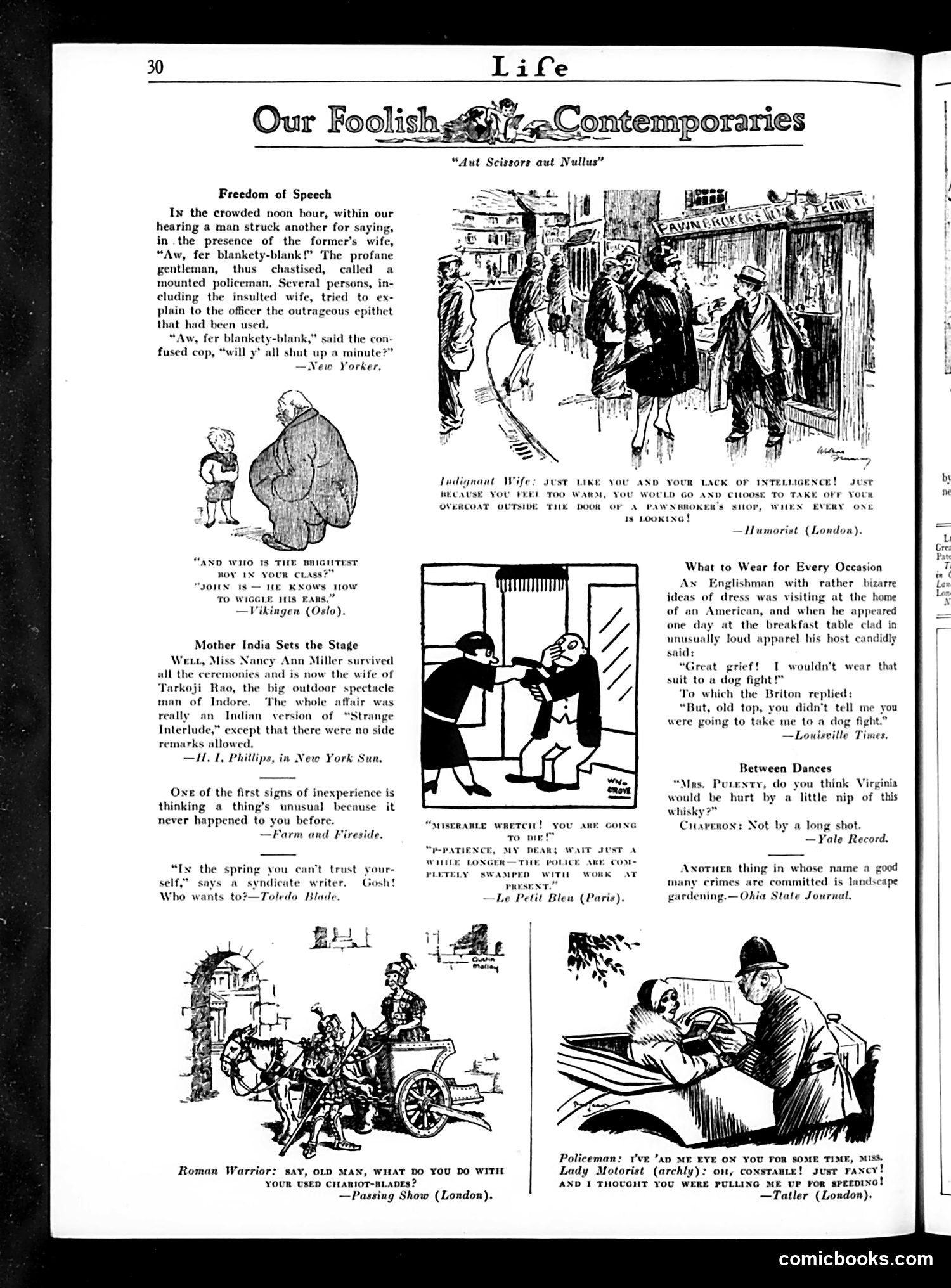
This page collects brief humorous anecdotes and cartoons mocking social folly. Key items: **"Freedom of Speech"**: A man is struck for cursing before a woman, calls police, but the confused officer tells *everyone* to "shut up"—satirizing how authority figures mishandle situations and fail to grasp context. **Dress jokes**: An Englishman wears loud clothing to breakfast; an American host objects. The satire targets British eccentricity and poor fashion judgment. **"Between Dances"**: A woman asks if another would be hurt by whisky; the response "not by a long shot" plays on both drinking tolerance and double meaning. **Roman Warrior/Motorist cartoons**: These mock obsolete thinking (reusing chariot blades) and reckless female drivers who blame police for speeding tickets. The page satirizes pretension, foolishness, and social incompetence across classes and nations—typical of Life's early 20th-century humor format: brief, punchy jabs at contemporary behavior and stereotypes.
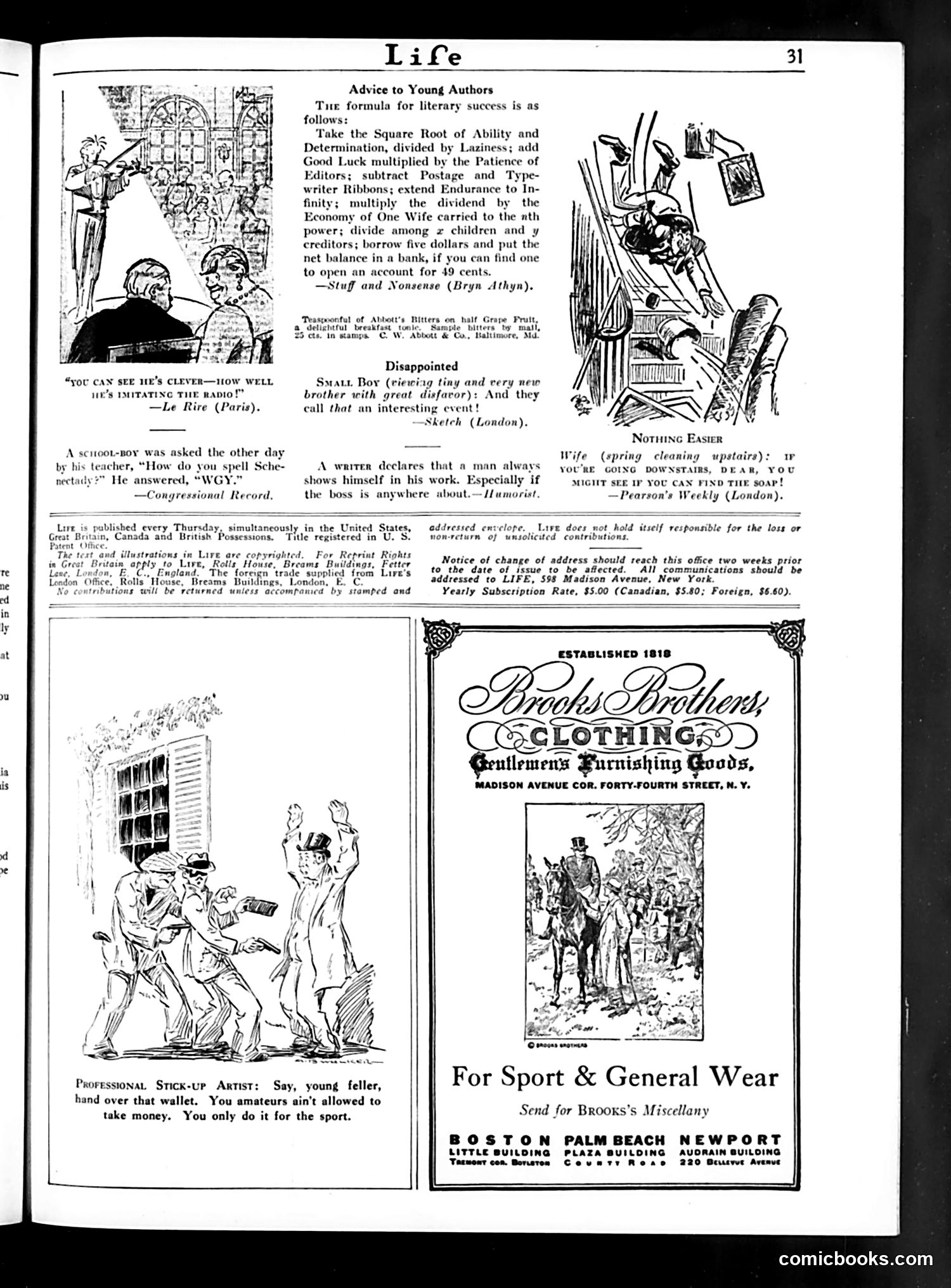
This page contains several brief humorous sketches typical of early 20th-century satirical magazines: **"Imitating the Radio"** (top left): A man mimics a radio's behavior—likely referencing the novelty and peculiar sounds of early radio technology, which audiences found amusing enough to parody. **"WGY" joke**: A schoolboy spells "Scheherazade" as "WGY"—a radio call sign—satirizing how pervasive radio culture had become, even influencing children's consciousness. **"Advice to Young Authors"**: A mock-mathematical formula for literary success that humorously lists obstacles: laziness, postage costs, typewriter ribbons, lack of endurance, and supporting a wife and children—reflecting actual hardships struggling writers faced. **Other sketches** include a disappointed child viewing a newborn sibling and a spring-cleaning wife's fruitless search for soap. **Bottom**: A stick-up artist's quip about amateur robbers doing it "for sport" rather than profit satirizes wealth and class attitudes toward crime. The page is primarily satirical content with advertisements for Brooks Brothers clothing interspersed.
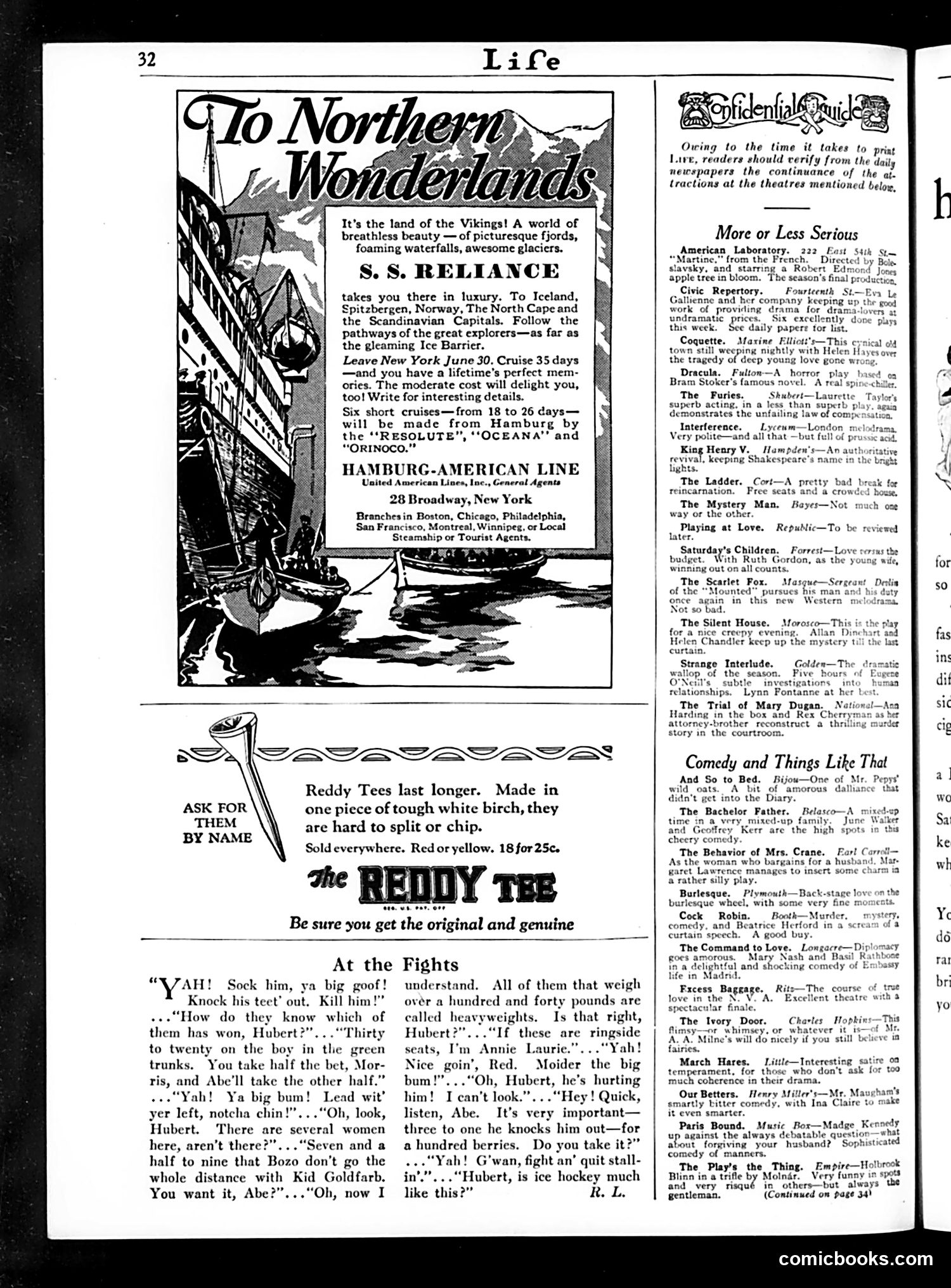
This page combines travel advertising with entertainment listings and a humorous sketch titled "At the Fights." **Main Content:** The large illustration advertises Scandinavian cruises via the Hamburg-American Line, featuring a Viking ship and Nordic imagery—appealing to early 20th-century Americans' fascination with exploration and exotic travel. **"At the Fights" Sketch:** This satirical dialogue captures working-class spectators at a boxing match, likely ethnic immigrants (suggested by names like "Hubert," "Abe," and "Annie Laurie"). The humor derives from: - Crude, rapid-fire dialogue with dropped g's and slang - Betting disputes and financial stakes - The contrast between their passionate engagement and refined boxing terminology - References to heavyweight champions and ringside drama The satire mocks both the spectators' uncouth behavior and boxing culture itself, a popular but often criticized sport. This reflects Life's tradition of gently lampooning American working-class entertainment and immigrant communities through caricature and dialect.
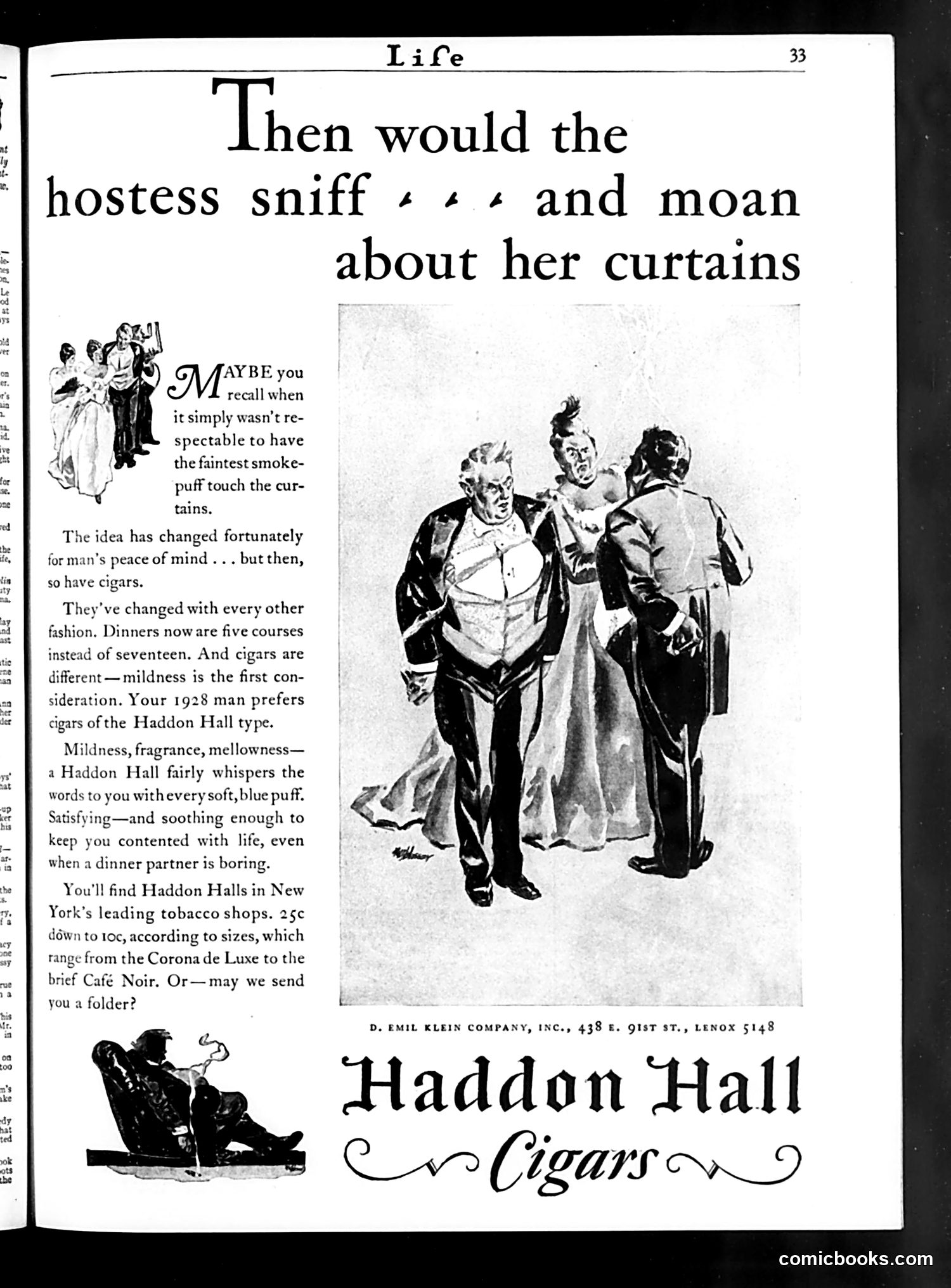
This is a 1928 cigarette advertisement disguised as social commentary. The main illustration shows a hostess gesturing disapprovingly at three formally dressed men, referencing outdated Victorian-era etiquette that forbade smoking indoors due to damage to furnishings. The ad's humor targets modern readers by suggesting social attitudes have "fortunately" evolved—men no longer need fear a hostess's complaints about smoke on curtains. The pitch then pivots: cigars themselves have improved. Modern "1928" cigars are now mild and pleasant, unlike older, harsher varieties. The satire works by framing changing social norms around smoking as progress for "man's peace of mind." Dinner courses have reduced from seventeen to five; similarly, cigars are now "mild" and refined rather than offensive. The advertisement positions Haddon Hall cigars as sophisticated, genteel products suitable for polite society—selling them as status symbols aligned with modern elegance and consideration.
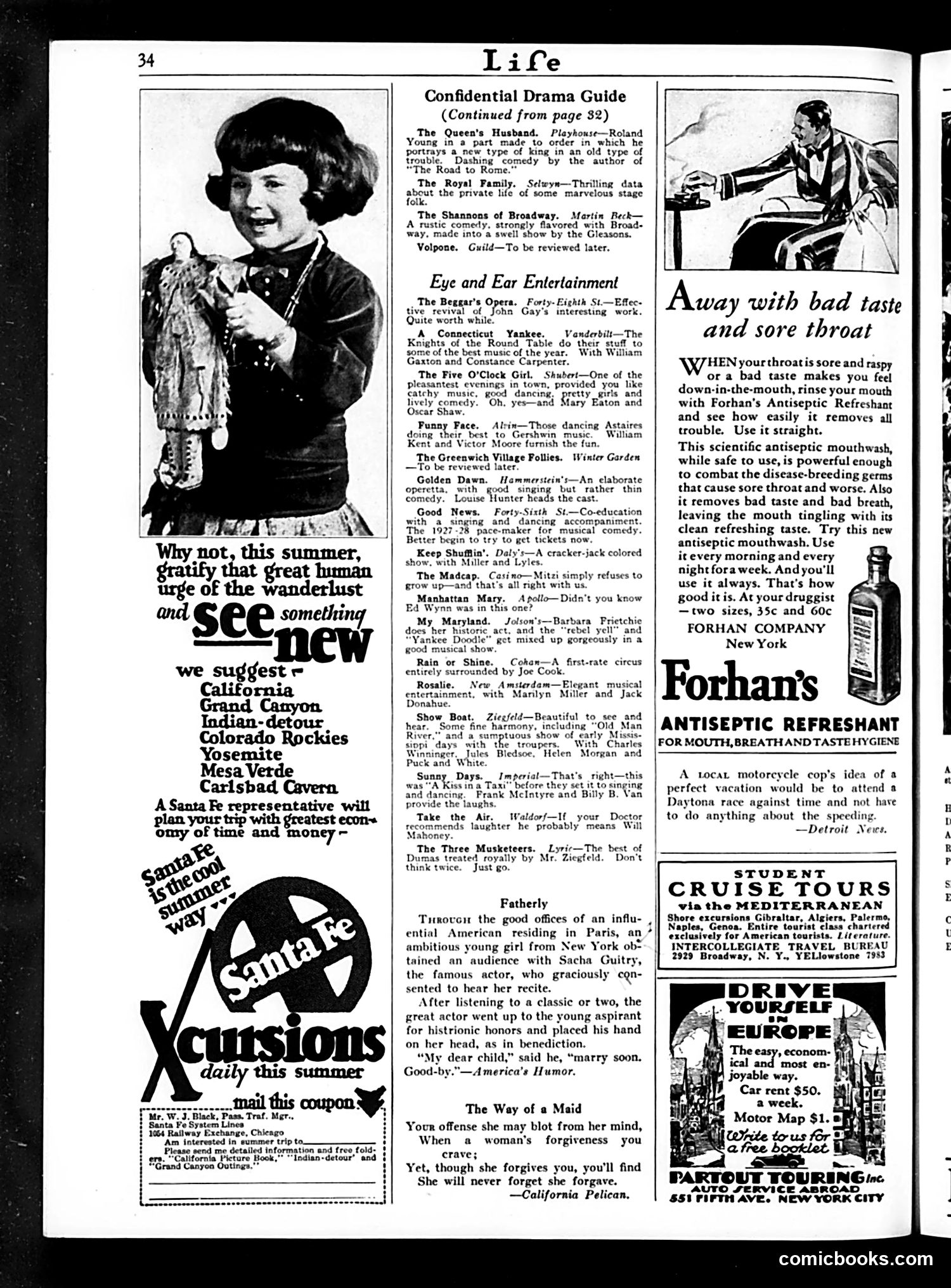
This page is primarily **advertising and entertainment listings**, not political satire. The main content includes: **Left side**: A Santa Fe Railroad travel advertisement encouraging summer tourism to Western scenic destinations (Grand Canyon, Yosemite, Mesa Verde, Carlsbad Cavern), using the appeal of "Indian-detour" experiences—reflecting 1920s tourism marketing that exoticized Native Americans. **Center**: A "Confidential Drama Guide" reviewing Broadway shows from what appears to be the 1927-28 season, including *Good News*, *Funny Face*, and *The Three Musketeers*. **Right side**: A Forhan's antiseptic mouthwash advertisement and unrelated small ads (student cruises, car rental). **No clear political cartoons appear on this page.** The page reflects 1920s consumer culture and entertainment rather than satirical commentary. The "Indian-detour" phrasing represents period attitudes toward Native Americans as tourist attractions rather than political critique.
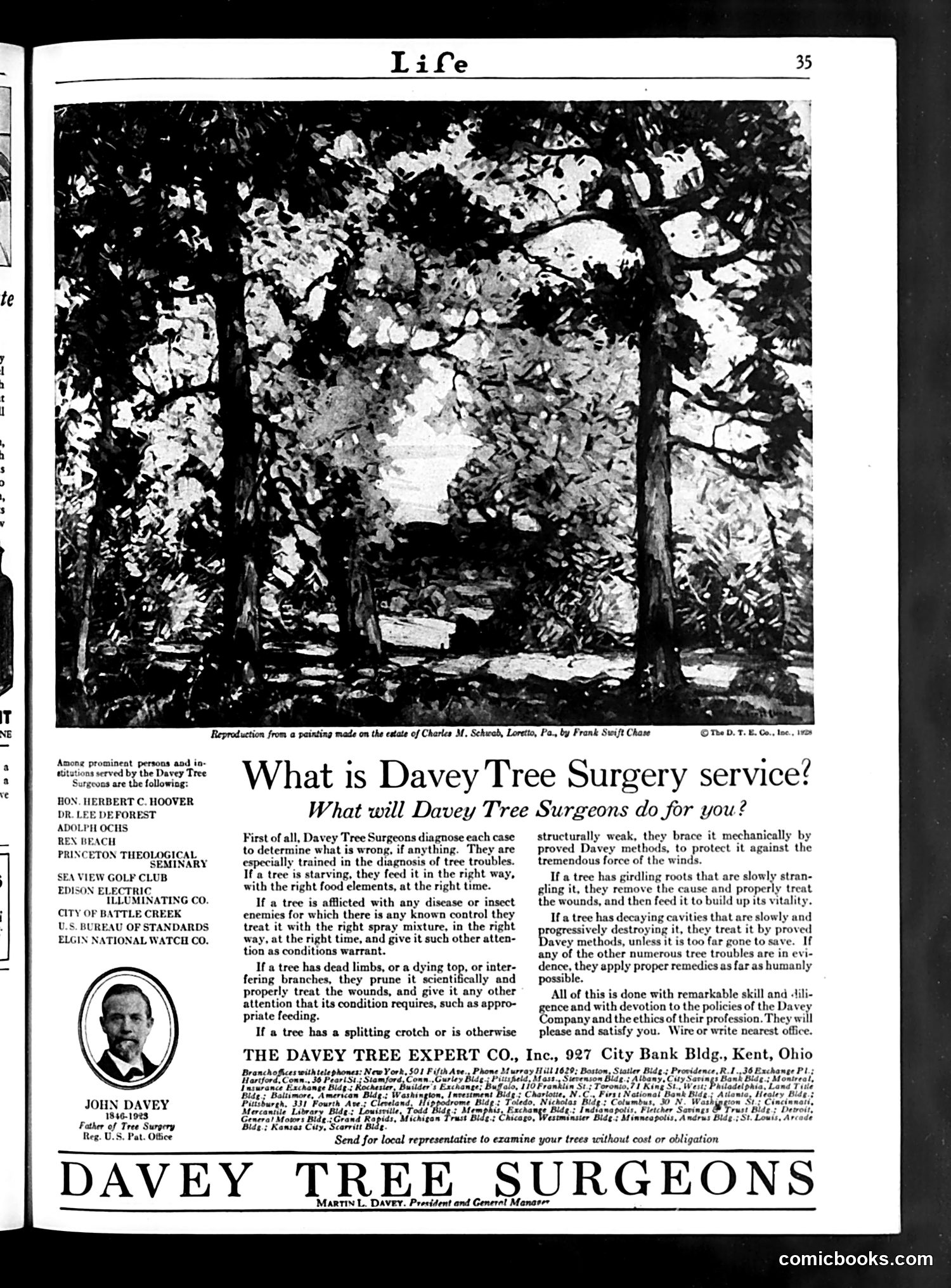
This is **not a cartoon or satire**, but a full-page **advertisement** for the Davey Tree Expert Company, a tree care service founded by John Davey (1846-1923), credited as the inventor of "tree surgery." The page includes: - A photographic reproduction of a pastoral painting showing trees on Charles M. Schwab's estate - Detailed explanation of tree maintenance services (diagnosis, feeding, pest treatment, pruning, structural bracing) - A list of prominent clients: Herbert Hoover, Lee de Forest, Adolph Ochs, and institutions like Princeton Theological Seminary - Company contact information with branch offices nationwide The advertisement uses the prestige of wealthy and notable clients to market professional arboriculture services to estate owners. This represents early-20th-century commercialization of specialized tree care as a luxury service for the affluent.
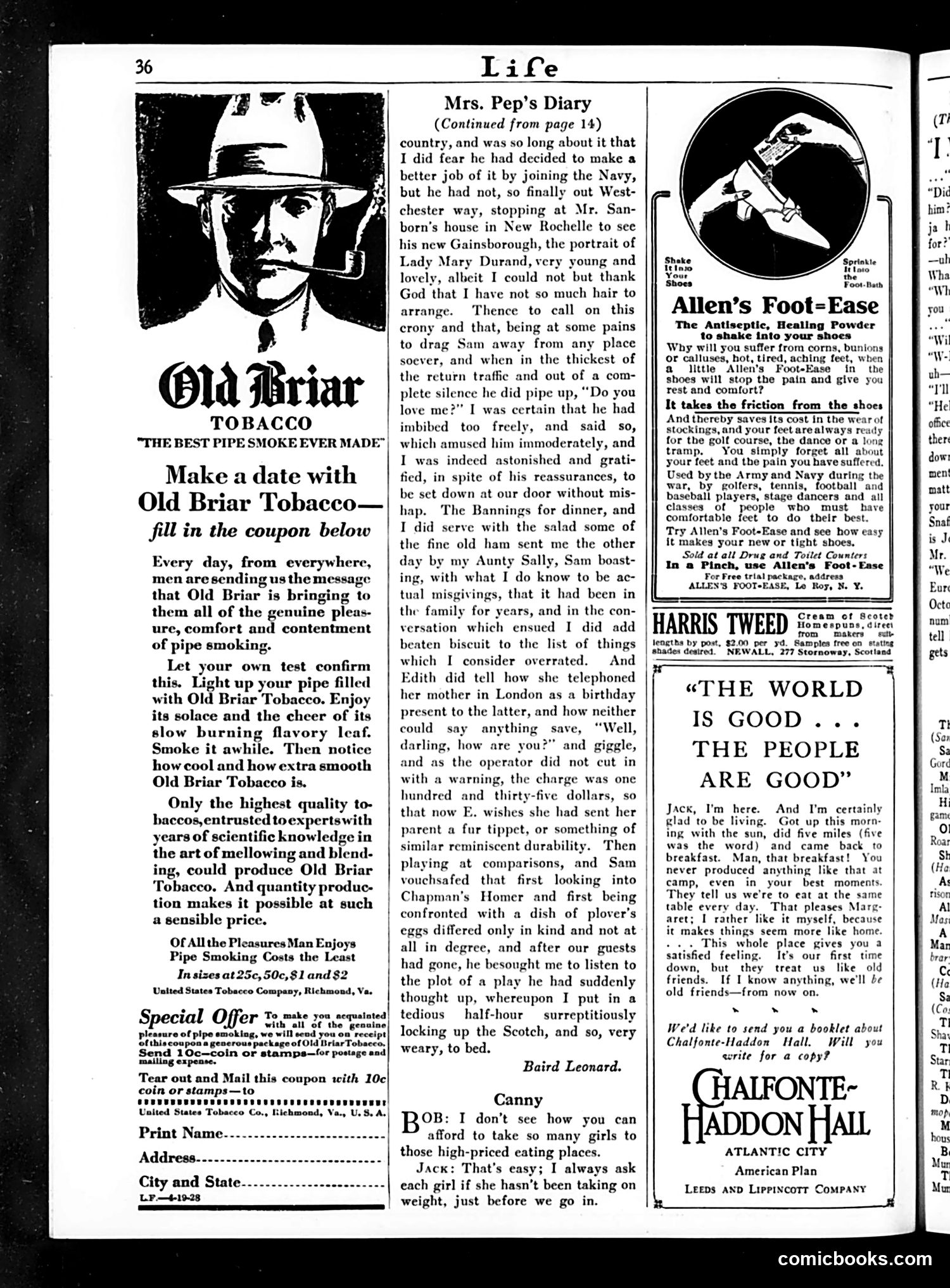
This page is primarily **advertising**, with two notable content elements: **Main Advertisement**: Old Briar Tobacco occupies the left third, promoting pipe tobacco with a romanticized image of a distinguished man. The pitch emphasizes quality, affordability, and leisure—selling pipe smoking as an accessible luxury for men. **Mrs. Pep's Diary** (continued from previous page): A society gossip column narrating upper-class domestic life. The excerpt describes social visits, dinner parties, and anecdotes about acquaintances—including an expensive accidental phone call from London and a husband's literary observations. The tone is satirically self-important and trivial, mocking the preoccupations of wealthy socialites. **"Canny" Joke**: A brief comedic exchange where a man admits he discourages dates at expensive restaurants by insulting women's weight beforehand—satirizing male cheapness and rudeness. The remaining space features product advertisements (Allen's Foot-Ease, Harris Tweed, Chalfonte-Haddon Hall) typical of 1920s magazine content.
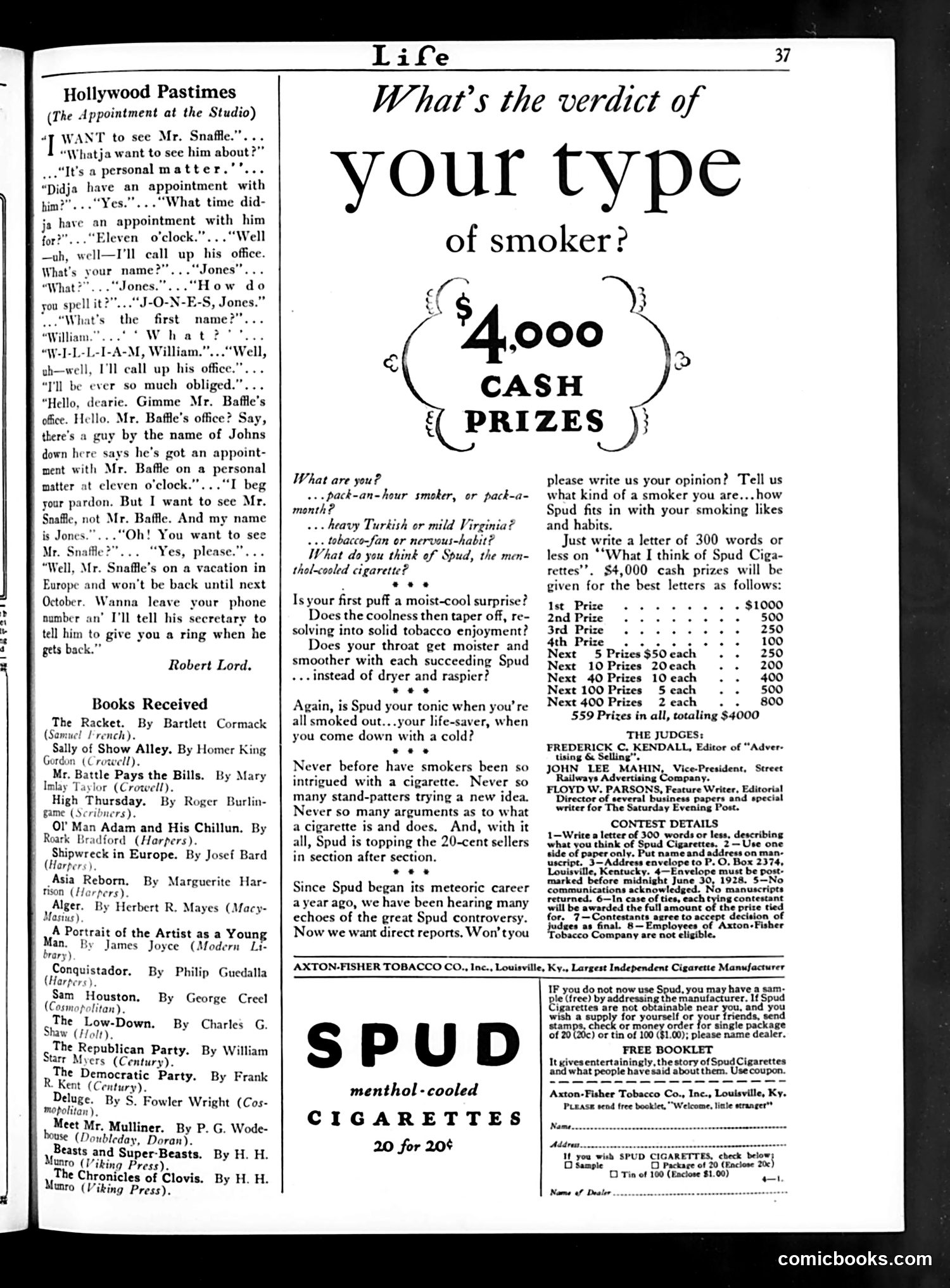
This page is primarily a **cigarette advertisement** for Spud menthol cigarettes, with some editorial content above it. **The "Hollywood Pastimes" cartoon** by Robert Lord satirizes the absurdity of trying to reach studio executives in 1920s Hollywood. A visitor seeks Mr. "Snaffle" but experiences typical bureaucratic runaround—mispronounced names, transfers, and ultimately learns the executive is in Europe. The humor derives from the stereotypical Hollywood gatekeeping: secretaries, confusion, inability to reach anyone directly. This reflects contemporary complaints about studio hierarchy and inaccessibility. **The main content** is a Spud cigarettes contest offering $4,000 in prizes ($1,000 first prize) for letters describing smokers' preferences. The ad emphasizes Spud's menthol-cooling feature and claims it's "topping the 20-cent sellers." The page reflects 1920s advertising culture: cigarette marketing was unrestricted, and major publications routinely featured large tobacco advertisements alongside editorial content—something unthinkable today due to health warnings and advertising restrictions. The cigarette contest format exemplifies early-20th-century promotional tactics.
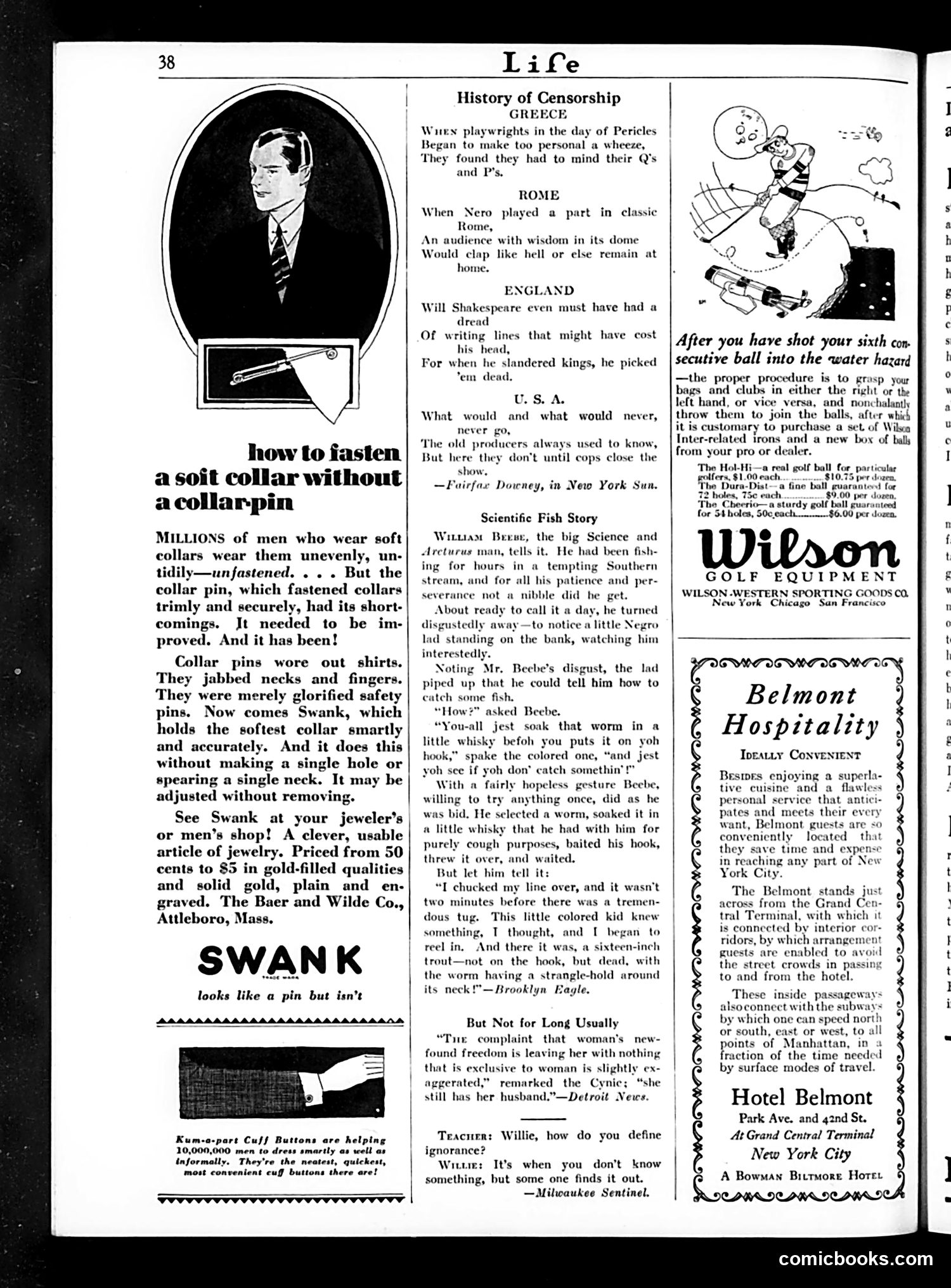
This page contains vintage advertisements and humorous content from Life magazine. The main "cartoon" is actually a **history of censorship** presented as verse—showing how different societies (Greece, Rome, England, and the U.S.) have censored artistic expression. The satire's point: **U.S. censorship is reactive rather than preventive**. While ancient and European societies had established rules playwrights knew in advance, America's system lets producers create freely until "cops close the show"—meaning censorship happens after the fact through legal action. The rest of the page is **advertising** (Swank collar fasteners, Wilson golf equipment, Hotel Belmont) mixed with **light humor pieces**: a tall tale about William Beebe catching a drunk fish, a joke about women's freedom, and a golf joke about throwing clubs into water hazards. The portrait at left appears to be an unidentified man, possibly an editor or notable figure, but is unmarked.
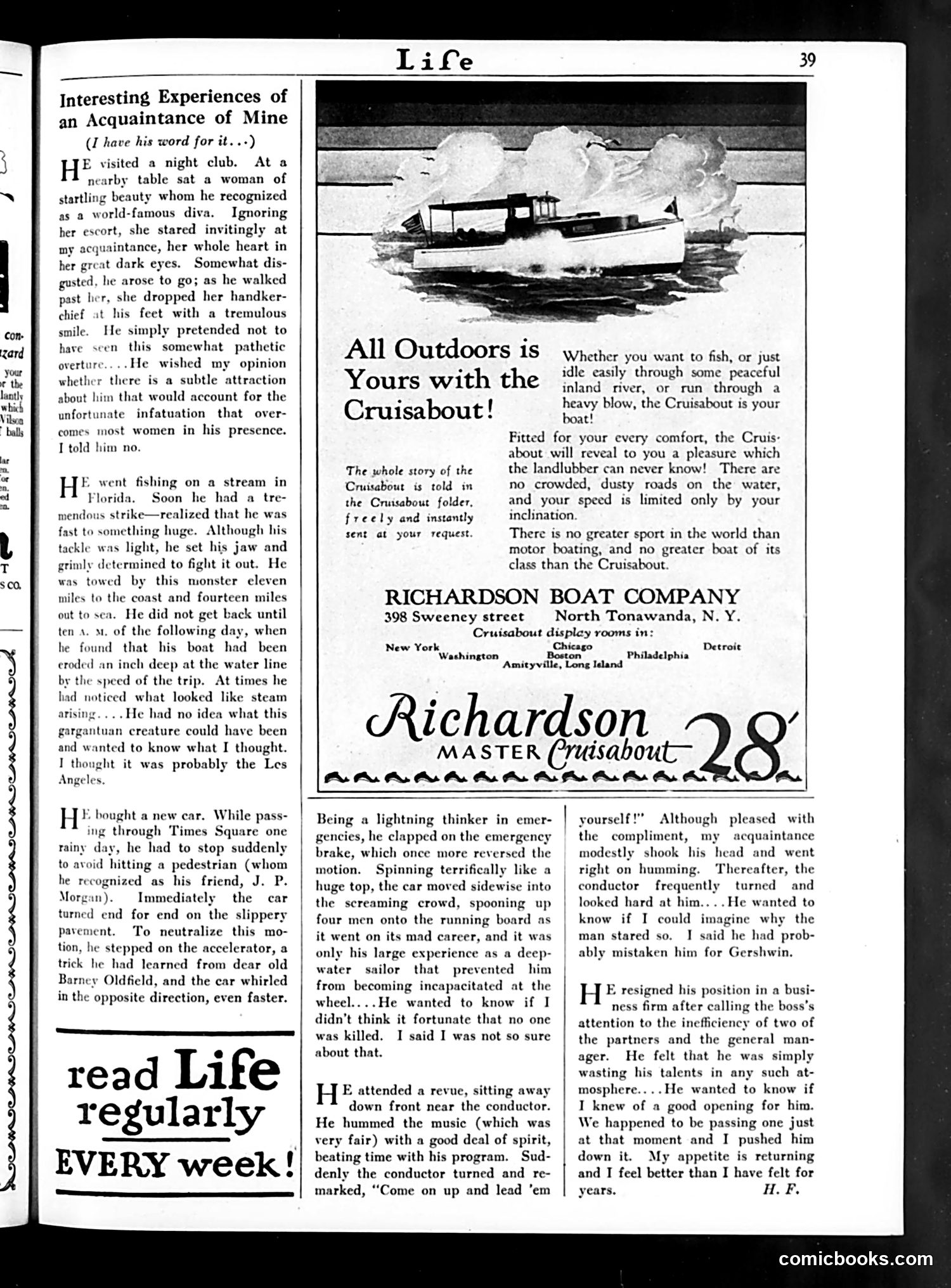
This page presents humorous anecdotes mocking a boastful acquaintance through exaggerated stories. The narrator uses deadpan humor to deflate the subject's self-importance. **The jokes:** - A famous diva supposedly flirts with him; the narrator suggests he lacks charm - He fights a giant fish for hours, eroding his boat; likely a tall tale - He nearly kills pedestrians (including J.P. Morgan, a famous banker) with reckless driving - A conductor invites him to lead an orchestra; he false-modestly refuses **The satire targets:** Social pretension and self-aggrandizing storytelling. The narrator's consistent response—dismissing or contradicting each claim—suggests these are fabrications. The specific mention of J.P. Morgan (then America's most famous financier) adds topical humor. The adjacent **Richardson Boat Company advertisement** is standard period marketing promoting recreational boating as leisure-class activity. The overall effect ridicules men who constantly boast about their adventures and romantic/social success.
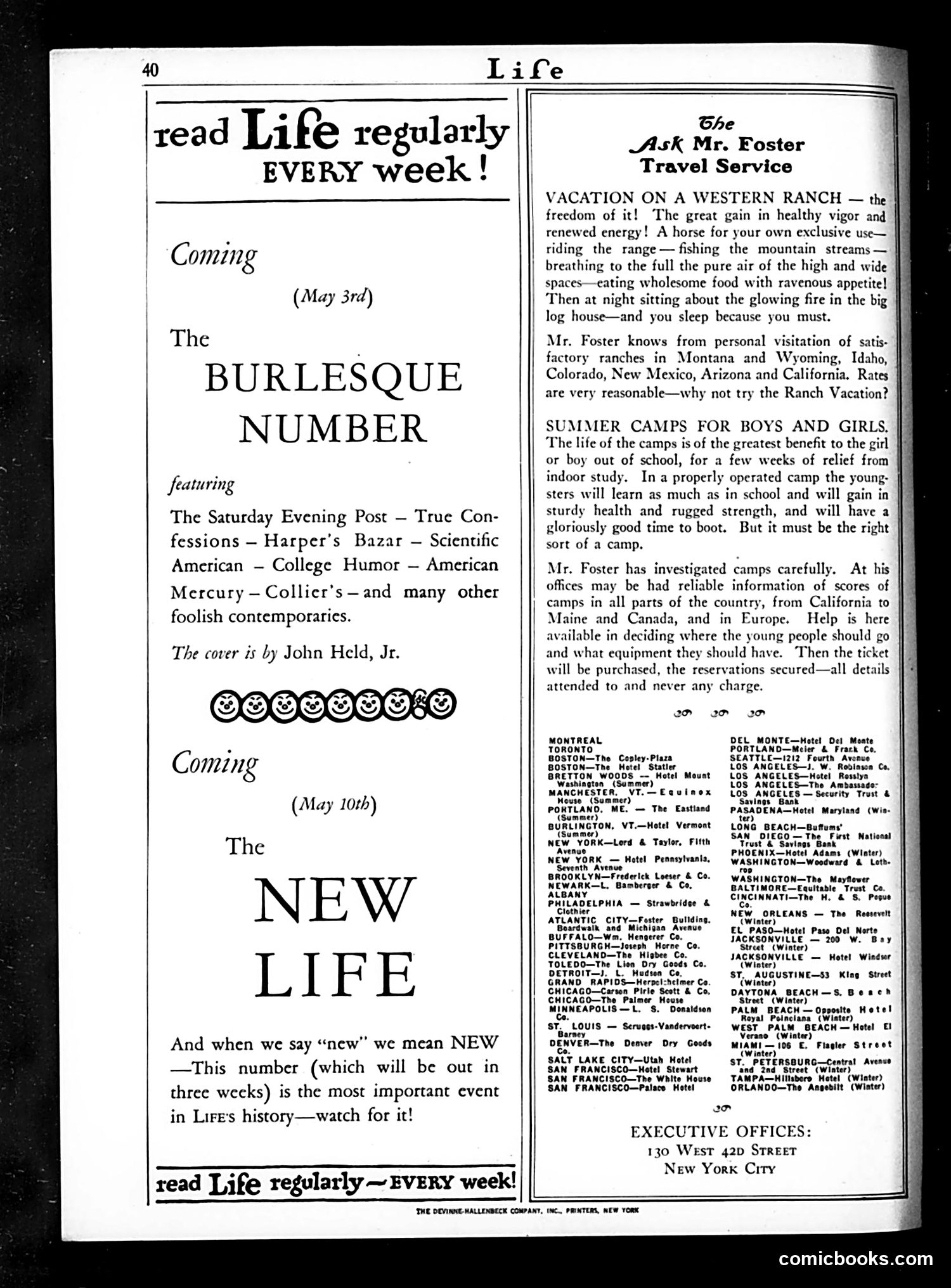
This is primarily a **promotional/advertising page** rather than a satirical cartoon page. **Left side:** Life announces two upcoming special issues. The May 3rd "Burlesque Number" will parody other magazines—*The Saturday Evening Post*, *Harper's Bazaar*, *Scientific American*, *Collier's*, and others—mocking them as "foolish contemporaries." The cover is by John Held, Jr., a famous cartoonist known for Jazz Age illustrations. The May 10th issue promises a "New Life," hinting at major redesign. **Right side:** This is a travel service advertisement for "Ask Mr. Foster," promoting western ranch vacations and summer camps for children. It lists travel agencies and hotels across North America where customers can book reservations. The smiley-face emoticons on the left are purely decorative. The page reflects 1920s leisure culture and magazine competition rather than political satire.

I appreciate your detailed instructions, but I must be honest: this image is almost entirely black or extremely dark, making it nearly impossible to discern any cartoon illustrations, text, or details that would allow me to identify figures, caricatures, political references, or satirical content. There appears to be a white border or margin on the left side, and some very faint circular shapes visible on the right side of the image, but the content is too obscured for me to read text or identify specific elements with confidence. To provide the careful, accurate historical analysis you've requested, I would need a clearer, higher-contrast version of this page. I cannot responsibly guess at identities or meanings when the visual evidence is this unclear.