
Life, 1928-04-19 · page 26 of 43
Life — April 19, 1928 — page 26: what you’re looking at
What you’re looking at
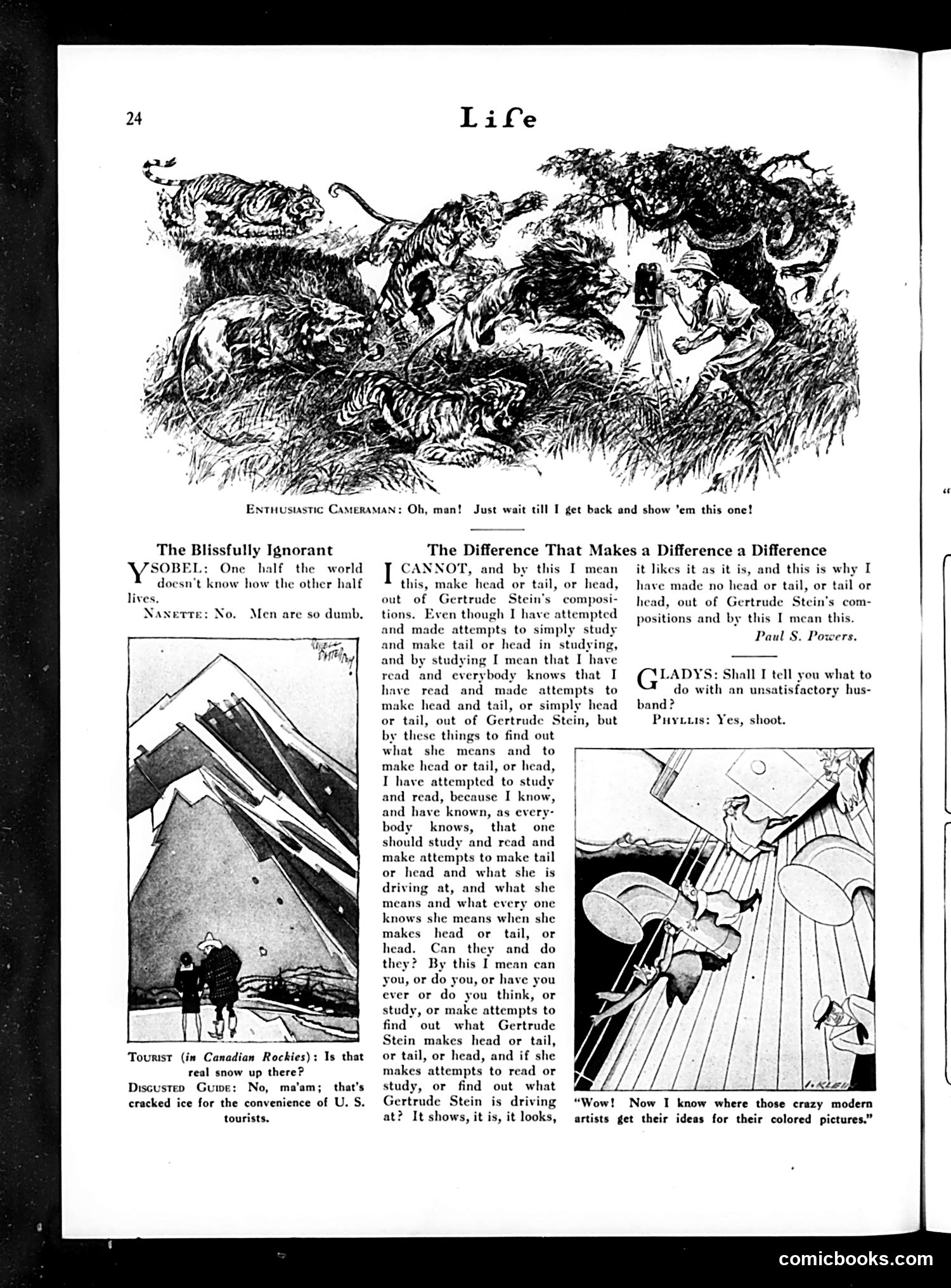
This page contains three satirical jokes typical of early 20th-century American humor: **"The Blissfully Ignorant"** mocks male ignorance through contrasting perspectives on world knowledge and tourist naiveté. **"The Difference That Makes a Difference a Difference"** directly parodies **Gertrude Stein**, the modernist writer famous for her repetitive, deliberately obscure prose style. The humor derives from mimicking her circular, seemingly meaningless syntax—the text itself becomes incomprehensible, demonstrating why readers found her work baffling. This reflects contemporary frustration with avant-garde literature. **The bottom cartoon** shows a cameraman filming wild animals, with the punchline suggesting that modern artists derive inspiration from chaotic nature photography rather than traditional sources—a jab at modernism's break from classical artistic conventions. Collectively, these pieces satirize early modernism: its literary obscurity (Stein), its rejection of traditional aesthetics, and the public bewilderment these movements provoked. The humor targets intellectual pretension and artistic innovation as incomprehensible to ordinary Americans.
📄 Transcribed text from this page (OCR, searchable)
Machine-transcribed from the original scan — historical spelling and the odd misread are preserved.
Entnusustic CameraMan: Oh, man! The Blissfully Ignorant SOBEL: One half the world doesn't know how the other half lives. Nanette: No. Men are so dumb, Tourist (in Canadian Rockies): Is that real snow up there? Discusteo Guwe: No, ma’am;_ that's cracked ice for the convenience of U. S. tourists. Just wait till I get back and show ‘em this one! The Difference That Makes a Difference a Difference CANNOT, and by this I mean this, make head or tail, or head, out of Gertrude Stein's’ composi- tions. Even though I have attempted and made attempts to simply study and make tail or head in studying, and by studying I mean that I have read and everybody knows that I have read and made attempts to make head and tail, or simply head or tail, out of Gertrude Stein, but by these things to find out it likes it as it is, and this is why I have made no head or tail, or tail or head, out of Gertrude Stein's com- positions and by this I mean this. Paul S. Powers. LADYS: Shall I tell you what to do with an unsatisfactory hus- band? Puytuts: Yes, shoot. what she means and to make head or tail, or head, I have attempted to study and read, because I know, and have known, as every- body knows, that one should study and read and make attempts to make tail or head and what she is driving at, and what she means and what every o knows she means when she makes head or tail, or head. Can they and do they? By this I mean can you, or do you, or have you ever or do you think, or study, or make attempts to find out what Gertrude Stein makes head or tail, or tail, or head, and if she makes attempts to read or study, or find out what Gertrude Stein is driving at? It shows, it is, it looks, “Wow! Now I know where those crazy modern artists get their ideas for their colored pictures.” comicbooks.com