
Life, 1928-04-19 · page 25 of 43
Life — April 19, 1928 — page 25: what you’re looking at
What you’re looking at
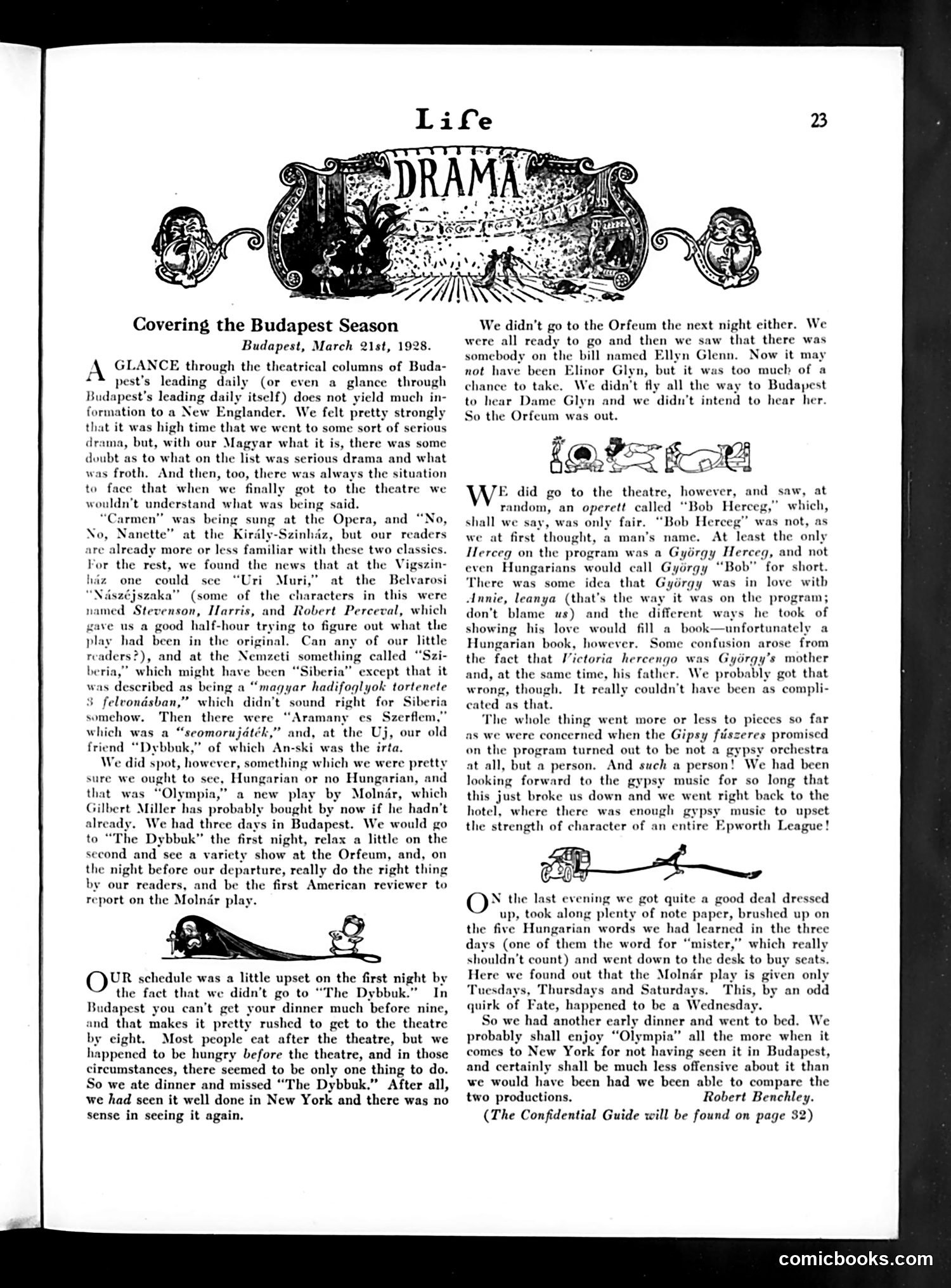
This is a humorous travel article about attending theater in Budapest. The author struggles with the language barrier when trying to select serious drama from Hungarian theater listings. They mention several productions including "Carmen" at the Opera and "No, No, Nanette"—familiar to American readers—alongside untranslatable Hungarian titles like "Uri Muri" and "Sziberia." The piece satirizes the practical challenges of being a foreigner: the author planned to see An-ski's "The Dybbuk" but skipped dinner before the late show, then avoided the variety show when spotting a performer with a name resembling **Elinor Glyn** (a famous British author known for risqué novels). Finally, they attended an operetta called "Bob Herceg," which proved mediocre and confusingly plotted. The satire targets both cultural tourism and the author's own provincial American perspective—the irony being that after traveling to experience authentic Hungarian drama, practical hunger and name recognition derail their plans.
📄 Transcribed text from this page (OCR, searchable)
Machine-transcribed from the original scan — historical spelling and the odd misread are preserved.
Covering the Budapest Season Budapest, March 21st, 1928. GLANCE through the theatrical columns of Buda- pest’s leading daily (or even a glance through Budapest's leading daily itself) does not yield much in- formation to a New Englander. We felt pretty strongly that it was high time that we went to some sort of serious drama, but, with our Magyar what it is, there was some doubt as to what on the list was serious drama and what was froth. And then, too, there was always the situation to face that when we finally got to the theatre we wouldn’t understand what was being said. “Carmen” was being sung at the Opera, and “No, No, Nanette” at the Kirdly-Szinhaz, but our readers are already more or less familiar with these two cls ; For the rest, we found the news that at the Vigszin- iz one could see “Uri Muri at the Belvarosi Nasa aka’ (some of the characters in this were named Stevenson, Harris, and Robert Perceval, which gave us a good half-hour trying to figure out what the play had been in the original. Can any of our little readers?), and at the Nemzeti something called “‘Szi- beria,” which might have been “Siberia” except that it was described as being a “magyar hadifoglyok tortencte 8 felvondsban,” which didn’t sound right for Siberia somehow. Then there e “Aramany es Szerflem,” which was a “seomoru ’ and, at the Uj, our old friend “Dybbuk,” of which An-ski was the irta. We did spot, however, something which we were pretty sure we ought to see, Hungarian or no Hungarian, and that was “Olympia,” a new play by Molnir, which Gilbert Miller has probably bought by now if he hadn't already. We had three days in Budapest. We would go to “The Dybbuk” the first night, relax a little on the second and see a variety show at the Orfeum, and, on the night before our departure, really do the right thing by our readers, and be the first American reviewer to report on the Molnar play. schedule was a little upset on the first night by the fact that we didn’t go to “The Dybbuk.” In O Budapest you can’t get your dinner much before nine, and that makes it pretty rushed to get to the theatre by eight. Most people eat after the theatre, but we happened to be hungry before the theatre, and in those circumstances, there seemed to be only one thing to do. So we ate dinner and missed “The Dybbuk.” After all, we had scen it well done in New York and there was no sense in seeing it again. We didn’t go to the Orfeum the next night either. We were all ready to go and then we saw that there was somebody on the bill named Ellyn Glenn. Now it may not have been Elinor Glyn, but it was too much of a chance to take, We didn't fly all the way to Budapest to hear Dame Glyn and we didn’t intend to hear her. So the Orfeum was out. W did go to the theatre, however, and saw, at random, an operett called “Bob Herceg,” which, shall we say, was only fair. “Bob Herceg” was not, as we at first thought, a man’s name, At least the only Herceg on the program was a Gyérgy Herceg, and not even Hungarians would call Gyérgy “Bob” for short. There was some idea that Gydrgy was in love with Annie, leanya (that's the way it was on the program; don't blame us) and the different ways he took of showing his love would fill a book—unfortunately a Hungarian book, however. Some confusion arose from the fact that Victoria hercengo was Gydrgy’s mother and, at the same time, his fath We probably got that wrong, though. It really couldn't have been as compli- cated as that. The whole thing went more or less to pieces so far as we were concerned when the Gipsy fisze promised on the program turned out to be not a gypsy orchestra at all, but a person. And such a person! We had been looking forward to the gypsy music for so long that this just broke us down and we went right back to the hotel, where there was enough gypsy music to upset the strength of character of an entire Epworth League! se __t—_ O* the last evening we got quite a good deal dressed up, took along plenty of note paper, brushed up on the five Hungarian words we had learned in the three days (one of them the word for “mister,” which really shouldn't count) and went down to the desk to buy seats. Here we found out that the Molndr play is given only Tuesdays, Thursdays and Saturdays. This, by an odd quirk of Fate, happened to be a Wednesday. So we had another early dinner and went to bed. We probably shall enjoy “Olympia” all the more when it comes to New York for not having seen it in Budapest, and certainly shall be much less offensive about it than we would have been had we been able to compare the two productions, Robert Benchley. (The Confidential Guide will be found on page 32) comicbooks.com