
Life, 1928-04-19 · page 30 of 43
Life — April 19, 1928 — page 30: what you’re looking at
What you’re looking at
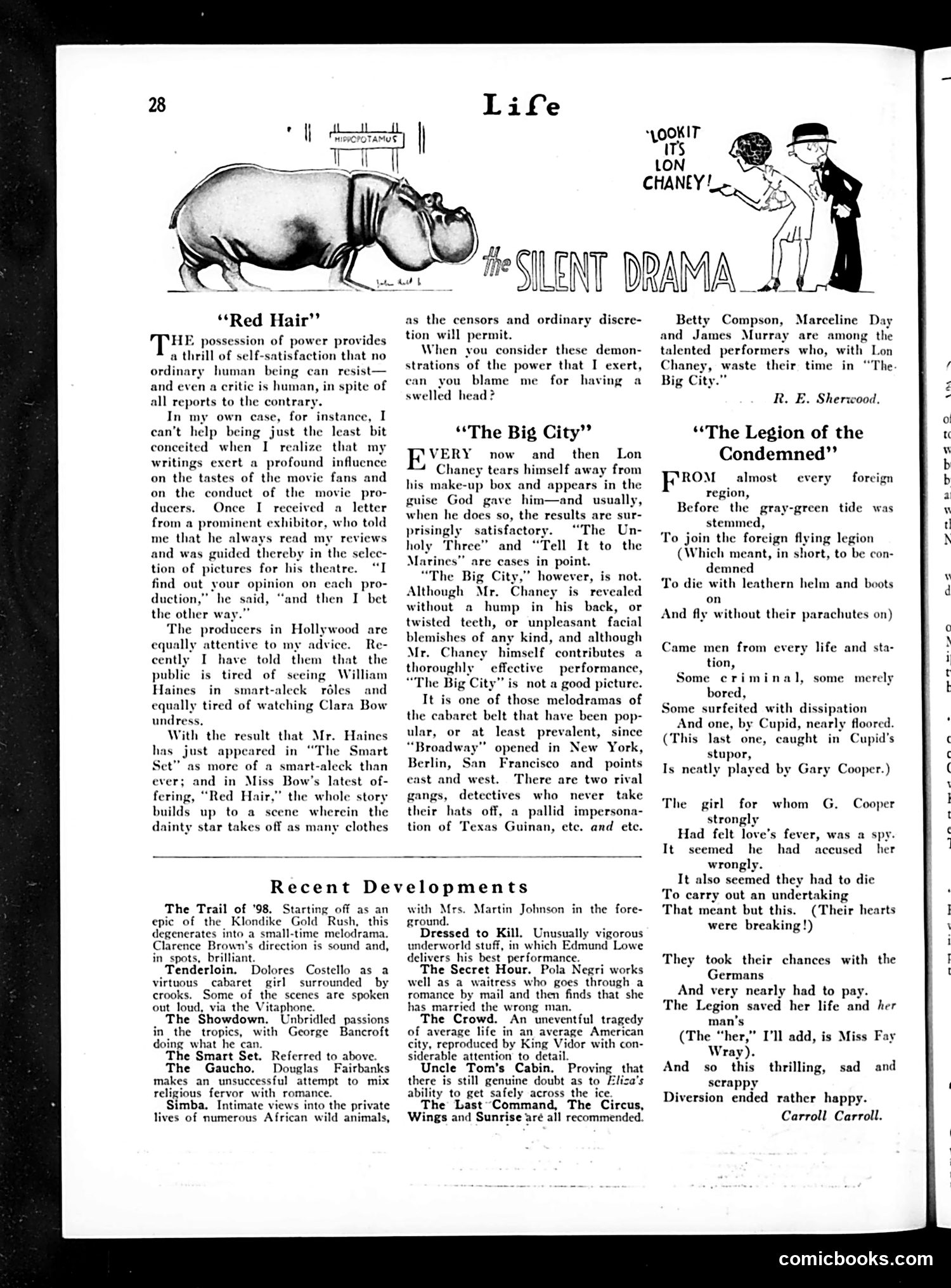
This page from Life magazine contains film reviews and commentary, circa mid-1920s. The cartoonist's satire centers on **the critic's own inflated ego**: a hippopotamus (representing the pompous reviewer) struts before two figures exclaiming "Look! It's Lon Chaney!" — mocking the critic's self-importance despite discussing famous actors like Lon Chaney, Clara Bow, and William Haines. The text satirizes how film critics overestimate their influence on both audiences and studios. The reviewer brags that exhibitors follow his reviews (then bet "the other way") and that producers heed his advice, yet contradictory results prove his judgment irrelevant. The "Recent Developments" section provides brief, dismissive reviews of contemporary silent films. The satire's target is **critical self-delusion**: the reviewer claims power while demonstrating none, and recommends pictures he's just criticized. The hippopotamus image reinforces the joke—an absurdly proud, ungainly creature perfectly embodies the pretentious film critic.
📄 Transcribed text from this page (OCR, searchable)
Machine-transcribed from the original scan — historical spelling and the odd misread are preserved.
“Red Hair” HE possession of power provides a thrill of self-satisfaction that no ordinary human being can resist— and even a critic is human, in spite of all reports to the contrary. In my own case, for instance, I can’t help being just the least bit conceited when I realize that my writings exert a profound influence on the tastes of the movie fans and on the conduct of the movie pro- ducers. Once I received a letter from a prominent exhibitor, who told me that he always read my reviews and was guided thereby in the selec- tion of pictures for his theatre. “I find out your opinion on each pro- duction,” he said, “and then I bet the other way The producers in Hollywood are equally attentive to my advice. Re- cently I have told them that the public is tired of seeing Willia Haines in smart-aleck réles and equally tired of watching Clara Bow undress, With the result that Mr. has just appeared in “The Smart of a smart-aleck than Bow’s latest of- * the whole story builds up to a scene wherein the dainty star takes off as many clothes fering, “Red Ha vue ah as the censors and ordinary discre- tion will permit. When you consider these demon- strations of the power that I exert, can you blame me for having a swelled head ? “The Big City” VERY now and then Lon Chaney tears himself away from his make-up box and appears in the guise God gave him—and usually, when he does so, the results are sur- prisingly satisfactory. “The Un- holy Three” and “Tell It to the Marines” are cases in point. “The Big City,” however, is not. Although Mr. Chaney is revealed without a hump in his back, or twisted teeth, or unpleasant facial blemishes of any kind, and although Mr. Chaney himself contributes a thoroughly effective performance, “The Big City” is not a good picture. It is one of those melodramas of the cabaret belt that have been pop- ular, or at least prevalent, since “Broadway” opened in New York, Berlin, San Francisco and points east and west. There are two rival gangs, detectives who never take their hats off, a pallid impersona- tion of Texas Guinan, ete. and ete. Recent Developments The Trail of ‘98. Starting off as an epic of the Klondike Gold Rush, this degenerates into a small-time melodrama. Clarence Brown's direction is sound and, in spots, brilliant. Tenderloin. Dolores Costello as a virtuous cabaret girl surrounded by crooks. Some of the scenes are spoken out loud, via the Vitaphone. The Showdown. Unbridled passions in the tropics, with George Bancroft doing what he can. The Smart Set. Referred to above. The Gaucho, Douglas Fairbanks makes an unsuccessful attempt to mix religious fervor with romance. Simba. Intimate views into the private lives of numerous African wild animals, with Mrs. Martin Johnson in the fore- ground. Dressed to Kill. Unusually vigorous underworld stuff, in which Edmund Lowe delivers his best performance. The Secret Hour. Pola Negri works well as a waitress who goes through a romance by mail and then finds that she has married the wrong man. The Crowd. An uneventful tragedy of average life in an average American city, reproduced by King Vidor with con- siderable attention to detail. Uncle Tom’s Cabin. Proving that there is still genuine doubt as to Eliza's ability to get safely across the ice. The Last “Command, The Circus, Wings and Sunrise aré all recommended. SENT DRAMA Betty Compson, Marceline Day and James Murray are among the talented performers who, with Lon Chaney, waste their time in “The Big ° R. E. Sherwood, “The Legion of the Condemned” ROM almost region, Before the gray-green stemmed, To join the foreign flying legion (Which meant, in short, to be con- demned To die with leathern helm and boots on And fly without their parachutes on) every — foreign tide was Came men from every life and sta- tion, Some criminal, some merely bored, Some surfeited with dissipation And one, by Cupid, nearly floored. (This last one, caught in Cupid's stupor, Is neatly played by Gary Cooper.) The girl for whom G. strongly Had felt love's fever, was a spy. It seemed he had accused her wrongly. It also seemed they had to die To carry out an undertaking That meant but this. (Their hearts were breaking!) Cooper They took their chances with the Germans And very nearly had to pay. The Legion saved her life and her man’s (The “her,” I'll add, is Miss Fay Wray). And so this scrappy Diversion ended rather happy. Carroll Carroll. thrilling, sad and comicbooks.com ae ee ere