
A complete issue · 50 pages · 1925
Life — November 5, 1925
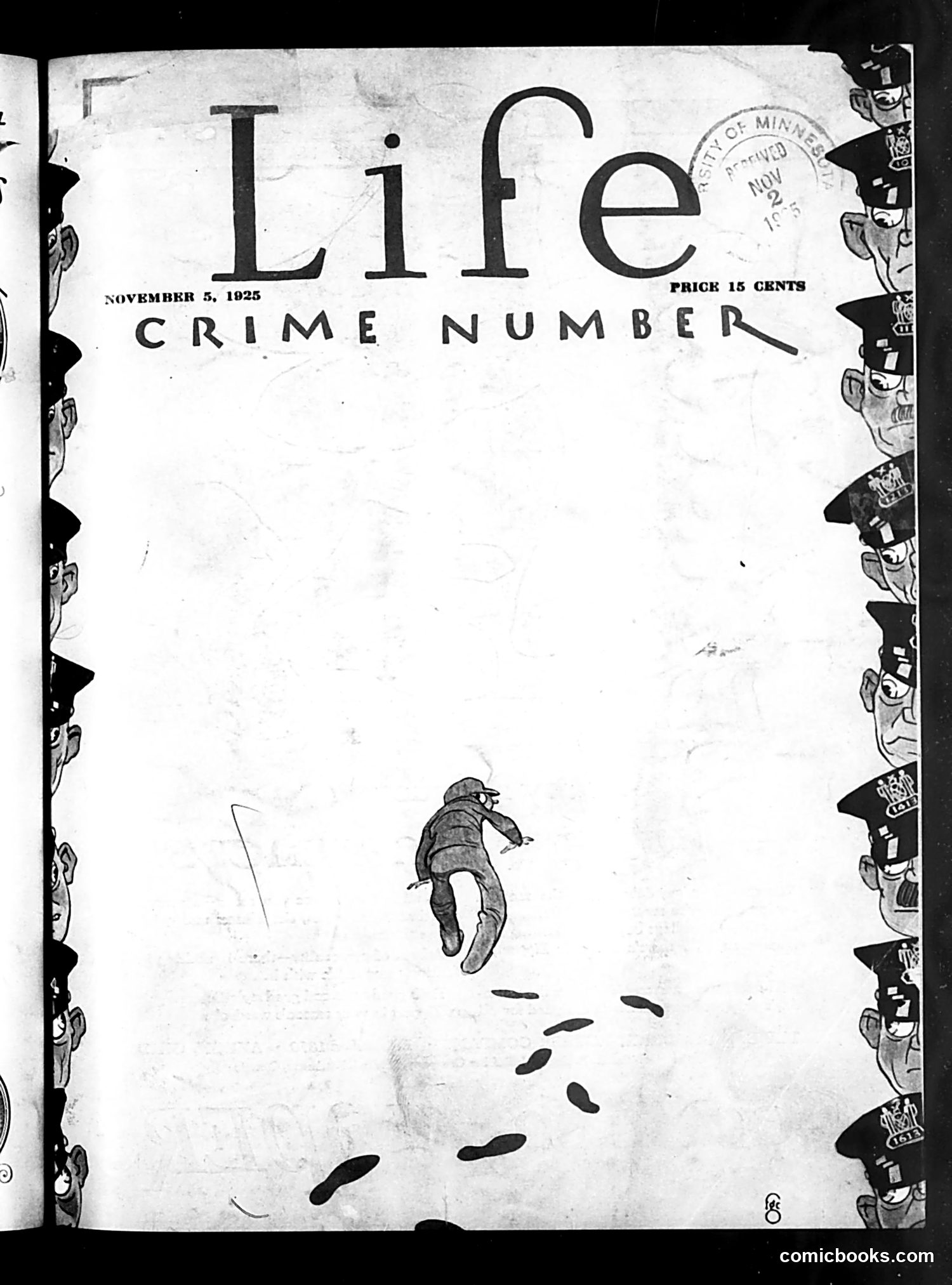
This is the cover of a special "Crime Number" issue. The main illustration shows a figure in a cap and coat following a trail of footprints, appearing to track or pursue someone. The image uses the footprints as a visual metaphor for criminal investigation or detective work. In 1925, America was in the midst of Prohibition (1920-1933), a period marked by widespread organized crime, bootlegging, and violent gang activity. The "Crime Number" likely addressed contemporary criminal issues dominating public concern—possibly referencing specific high-profile crimes or criminals of that era. The decorative border features repeated illustrated faces or criminal mugshots, reinforcing the crime theme. The cover costs 15 cents, typical for magazines of this period.
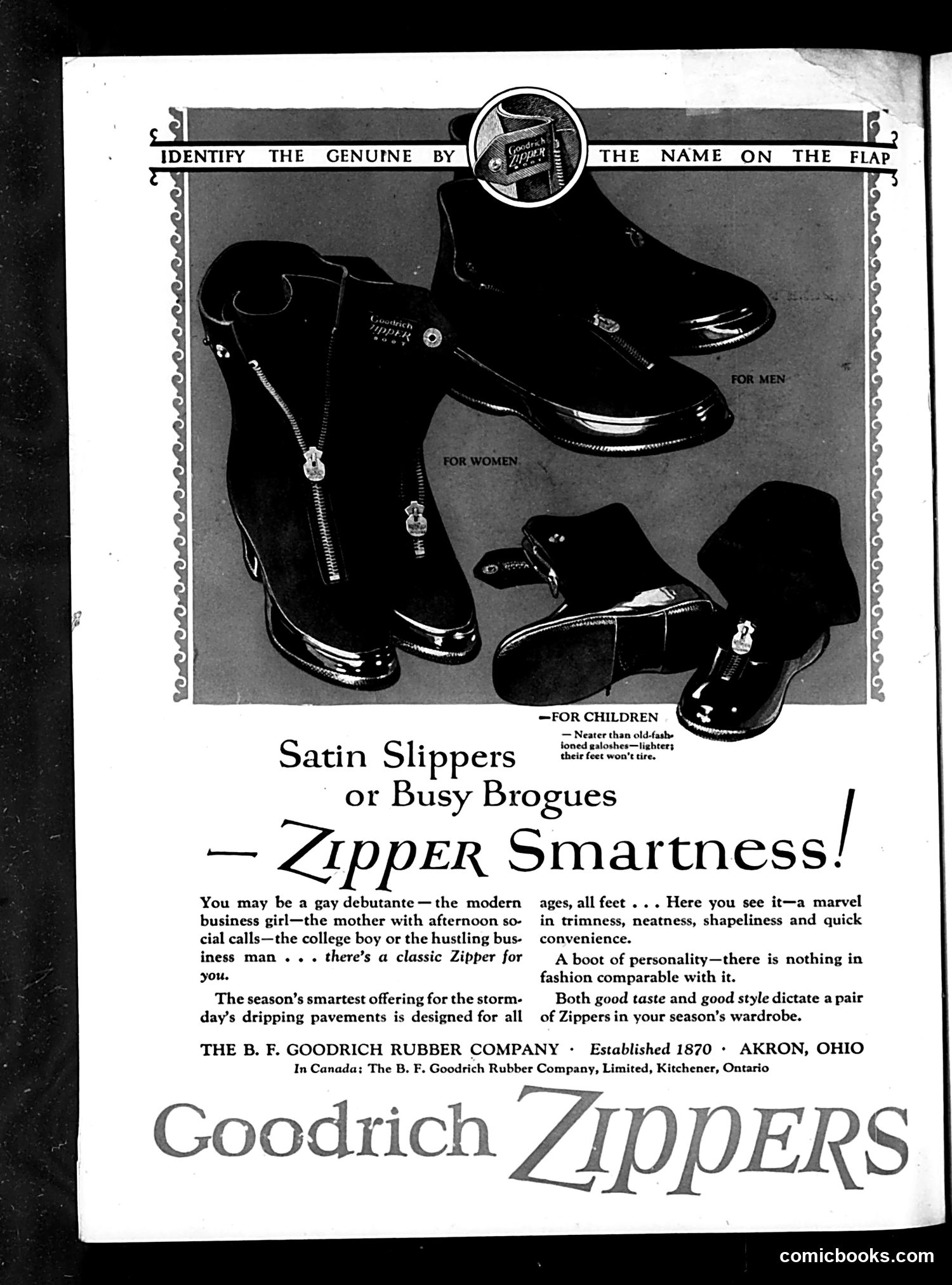
This is **not a cartoon or satire page** — it's a **straightforward advertisement** for Goodrich Zippers brand rubber footwear, specifically "Satin Slippers or Busy Brogues." The ad displays three shoe styles: women's, men's, and children's versions, all featuring zippers. The headline "ZIPPER Smartness!" emphasizes the convenience and modernity of zippered closures. The marketing pitch targets different demographics — "gay debutante," "business girl," "mother," "college boy," and "hustling business man" — promoting zippers as the season's smartest innovation for wet-weather shoes. Published by The B. F. Goodrich Rubber Company (established 1870, Akron, Ohio), this represents early-20th-century product advertising emphasizing technological convenience and social status through footwear design.
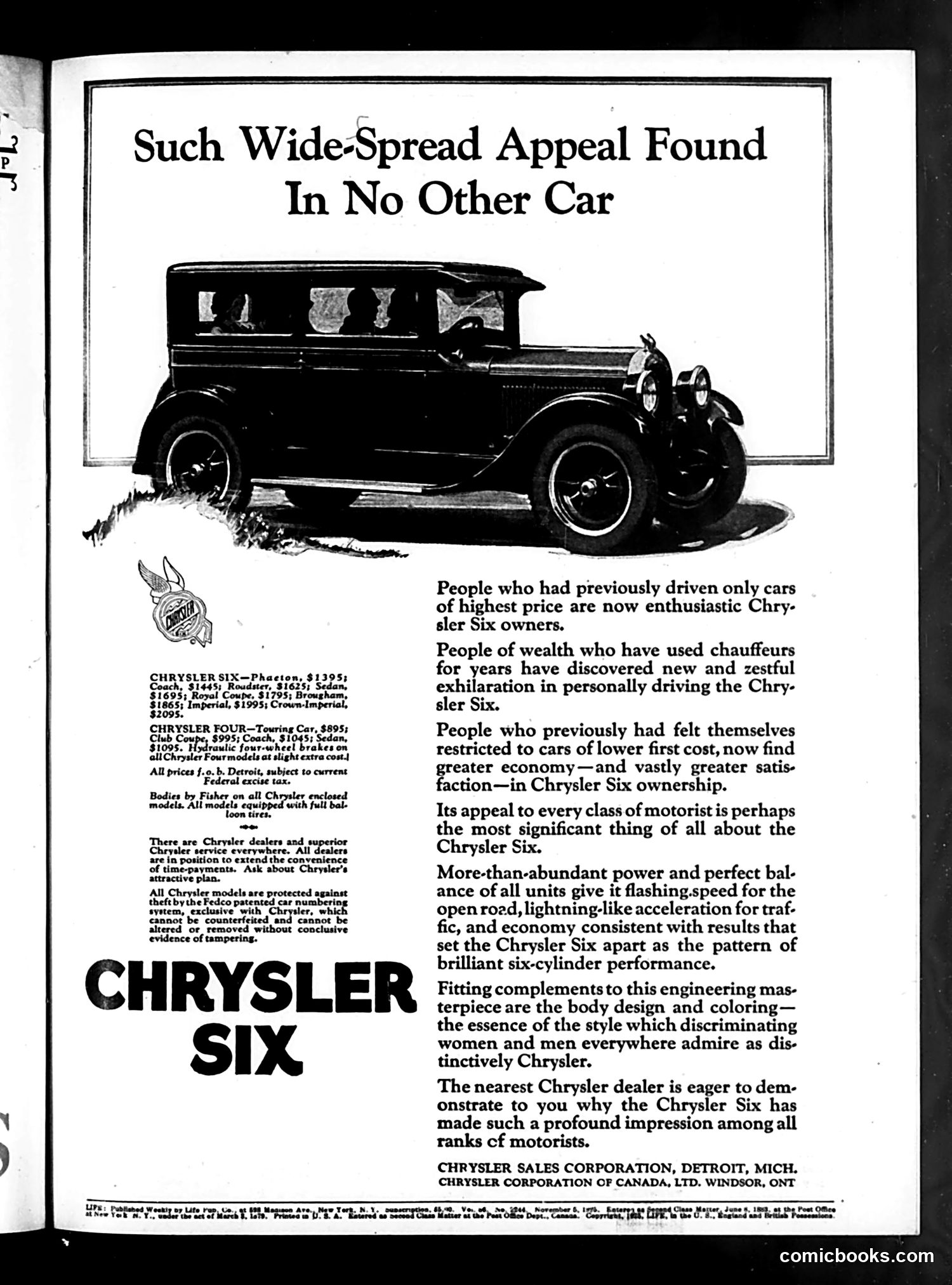
This is a Chrysler Six automobile advertisement, not political satire. The page promotes the Chrysler Six as having "wide-spread appeal found in no other car," claiming it attracts buyers across all economic classes—from wealthy former chauffeur employers to cost-conscious consumers seeking greater economy. The ad emphasizes the vehicle's engineering (six-cylinder engine), performance ("lightning-like acceleration"), and styling as distinctively Chrysler. It targets social aspiration by suggesting that owning a Chrysler Six elevates one's status regardless of previous car ownership. The text notes that Chrysler dealers stand ready to demonstrate why the car has gained such broad appeal among motorists of all ranks. This is purely commercial marketing from the Chrysler Sales Corporation in Detroit.
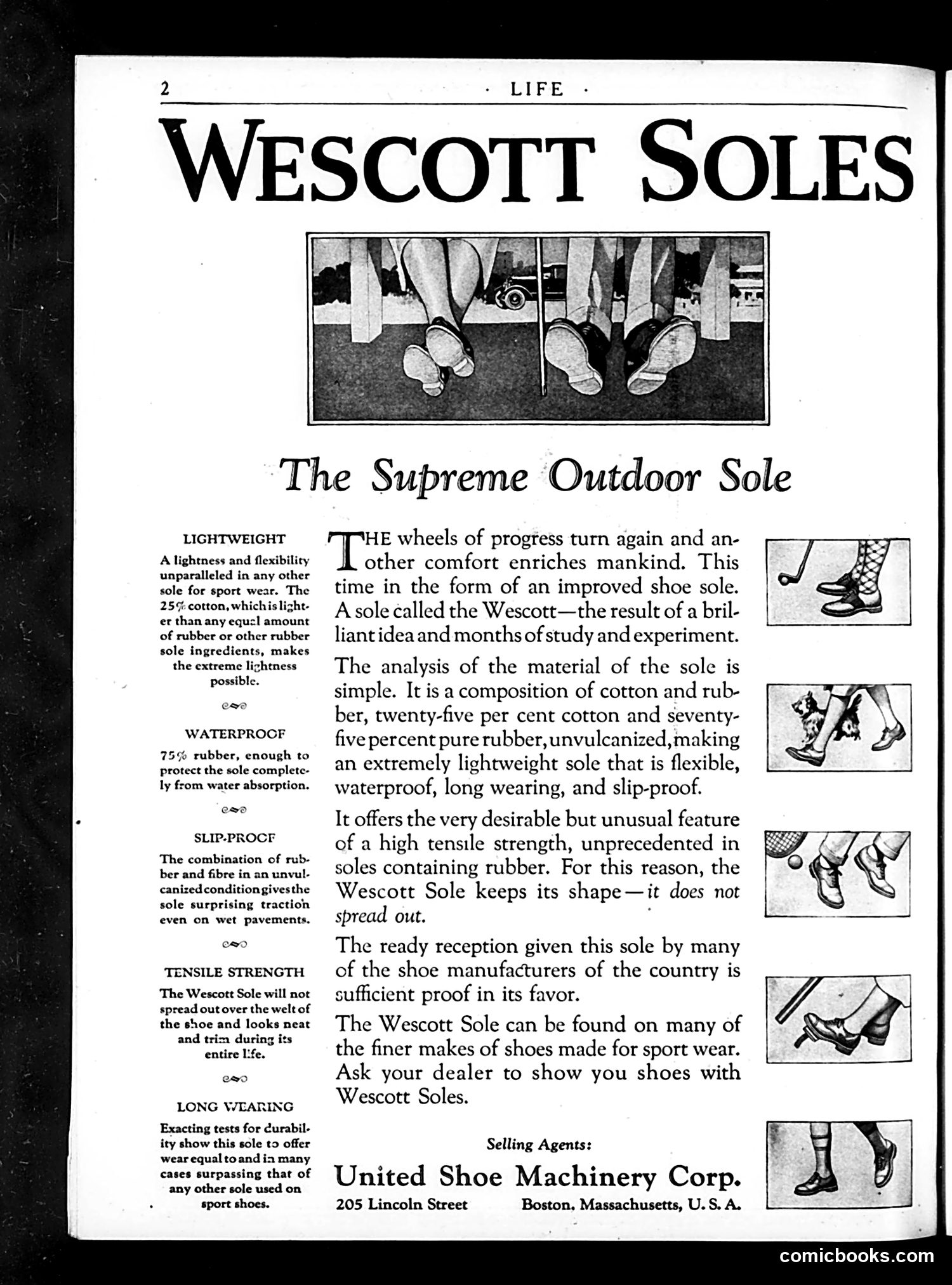
This is **not a political cartoon or satire page**—it's a straightforward **product advertisement** for Wescott Soles, a shoe sole made from a cotton-rubber composite. The page features: - A headline claiming Wescott Soles are "The Supreme Outdoor Sole" - Five small photographs showing shoes/feet wearing the product in various activities - Marketing copy highlighting technical features: lightweight construction, waterproofing, slip-resistance, and tensile strength - Left-margin callout boxes emphasizing key selling points The content is entirely commercial. United Shoe Machinery Corp. (Boston) is listed as the selling agent. There is no political commentary, satire, or cultural critique present—just vintage shoe marketing designed to persuade consumers of the product's superiority for sport wear.
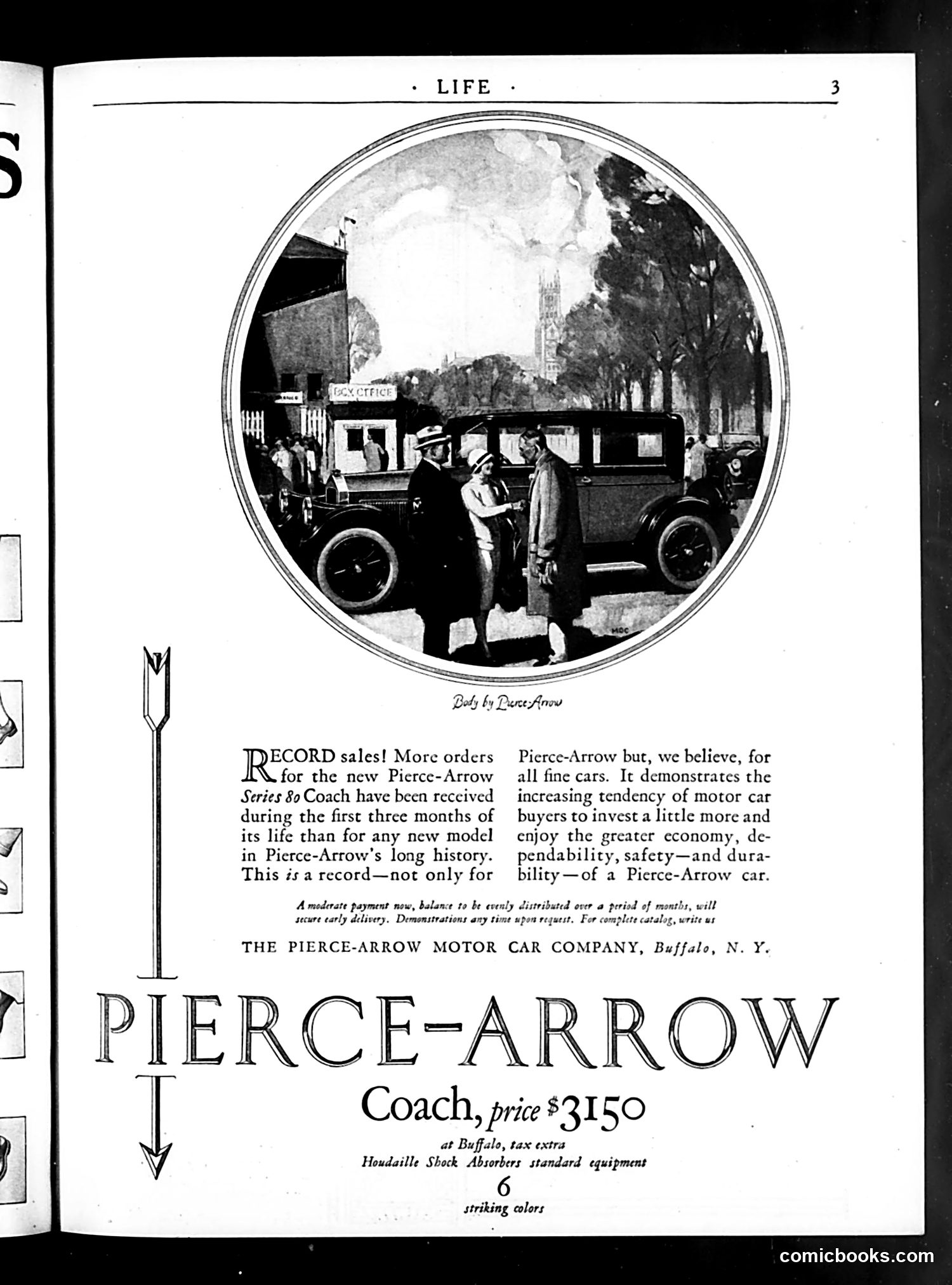
This is **not a cartoon or satirical piece** — it's a straightforward automobile advertisement from *Life* magazine for the Pierce-Arrow Coach automobile. The circular image shows a street scene with several well-dressed figures examining or standing near a Pierce-Arrow vehicle, with period architecture and trees in the background. The ad highlights record sales for this luxury car model during its first three months, emphasizing quality features: economy, dependability, safety, and durability. The price is listed as $3,150 (substantial for the era), with financing available through a payment plan. This appears to be a genuine commercial advertisement rather than satirical content — typical of *Life*'s dual function as both humor magazine and advertising platform during this period.
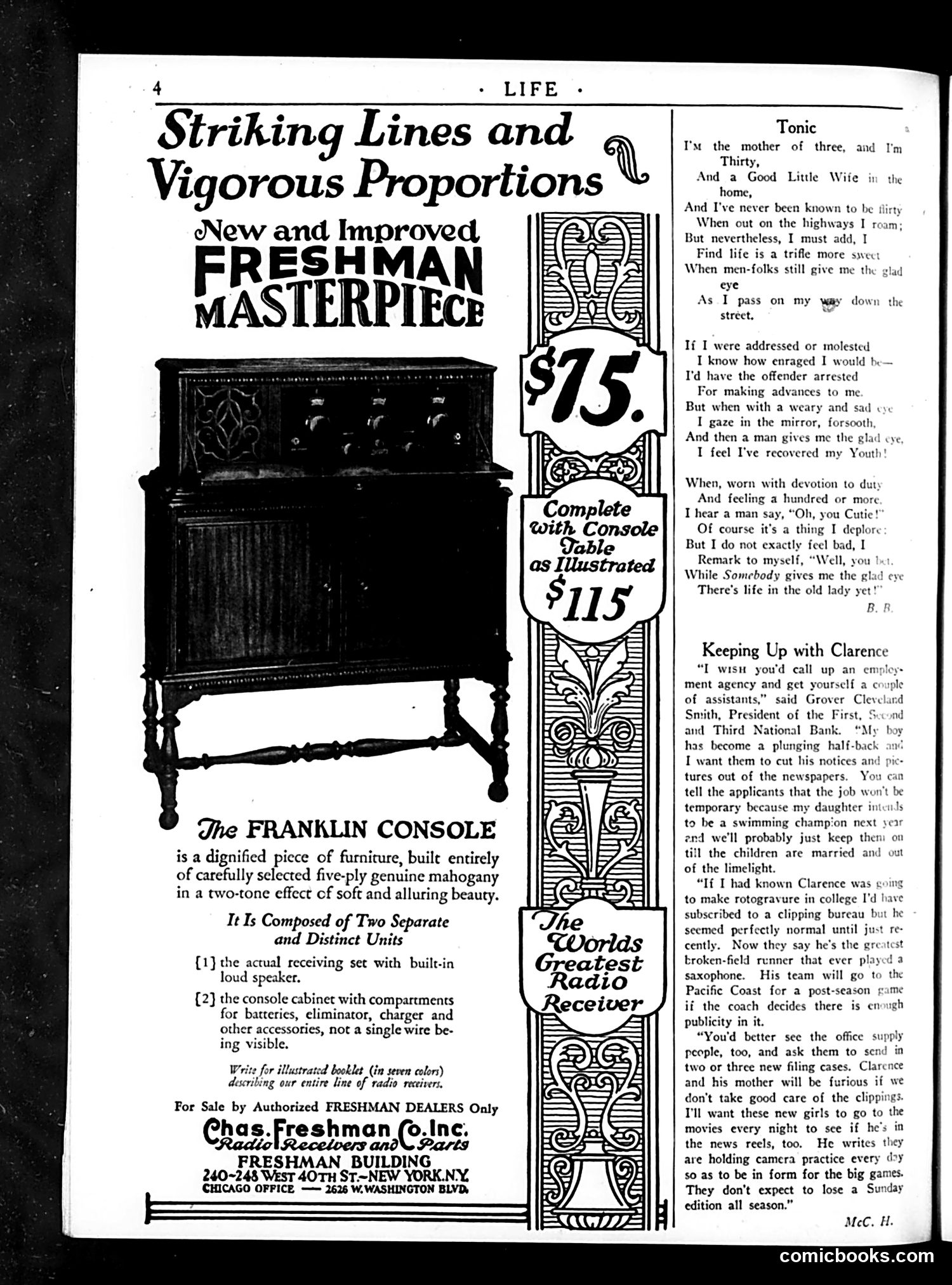
This page is **primarily advertising**, not political satire. The left side features a large ad for the "Franklin Console," a mahogany radio-phonograph combination priced at $75-$115 (complete with console table). It's marketed as a "Freshman Masterpiece" with "striking lines and vigorous proportions." The right side contains two distinct items: 1. **"Tonic"** — a humorous poem about a middle-aged woman reflecting on maintaining her youthful appearance and spirits despite motherhood and domestic duties. 2. **"Keeping Up with Clarence"** — a brief satirical piece mocking employment agencies and a young man named Clarence whose mother obsessively manages his career and public image, even clipping newspaper articles about him. The page reflects 1920s consumer culture and family dynamics rather than political commentary.
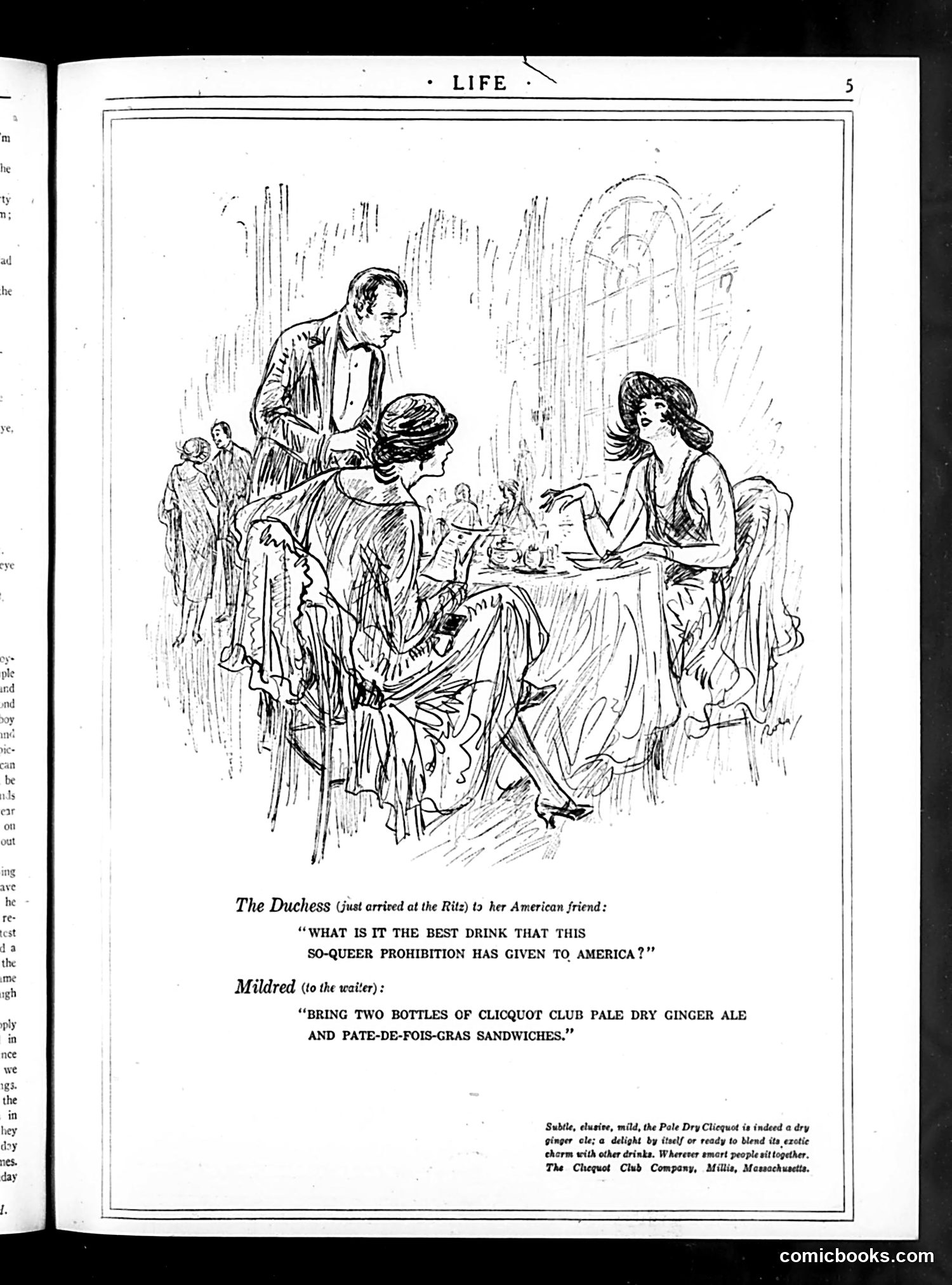
This page is primarily an **advertisement** for Clicquot Club ginger ale, disguised as satirical content in Life magazine's style. The cartoon depicts a social scene where a "Duchess" (likely a European aristocrat visiting America) asks an American friend what the "best drink that this so-queer Prohibition has given to America?" The American responds by ordering ginger ale and sandwiches. **The satire's point:** During Prohibition (1920-1933), alcoholic beverages were illegal in America. The ad humorously suggests that ginger ale represents what Americans have been "reduced to" drinking—implying it's an ironic "silver lining" to Prohibition. The ad positions Clicquot Club as at least a *quality* non-alcoholic option available during this restrictive period, appealing to upper-class sensibilities through the Duchess character.
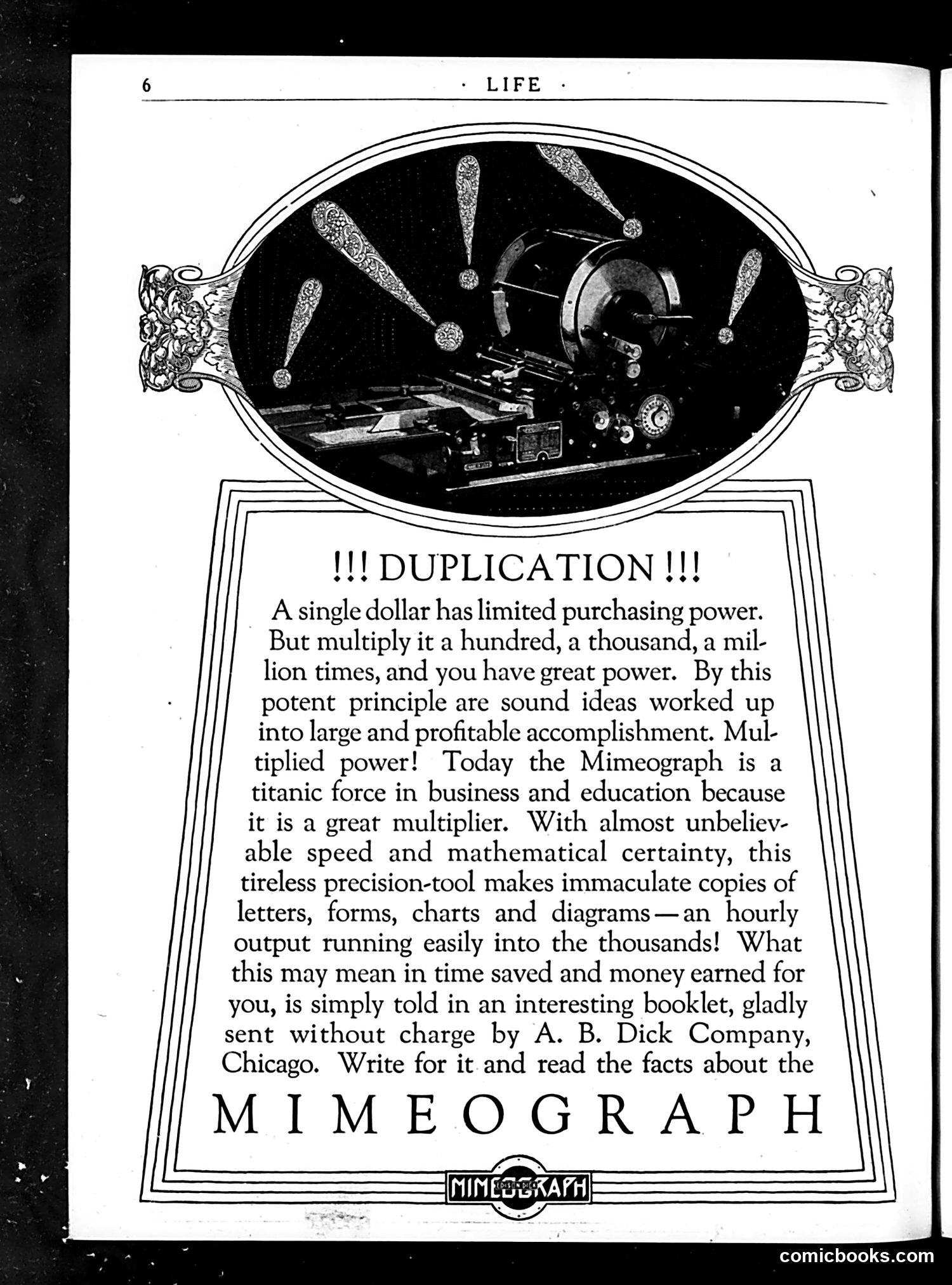
This page is primarily an **advertisement**, not a satirical cartoon. It promotes the Mimeograph machine, manufactured by A.B. Dick Company of Chicago. The ad uses a metaphor about money—comparing how multiplying a dollar increases its purchasing power to how the Mimeograph "multiplies" documents. The accompanying photograph shows the actual machine. The pitch targets business and educational users, emphasizing the machine's speed and precision in producing copies of "letters, forms, charts and diagrams" by the thousands hourly. The appeal is practical: time and money savings. There is no political satire here. Rather, this represents early 20th-century *Life* magazine's dual role as both satirical publication and advertising vehicle for modern office technology.
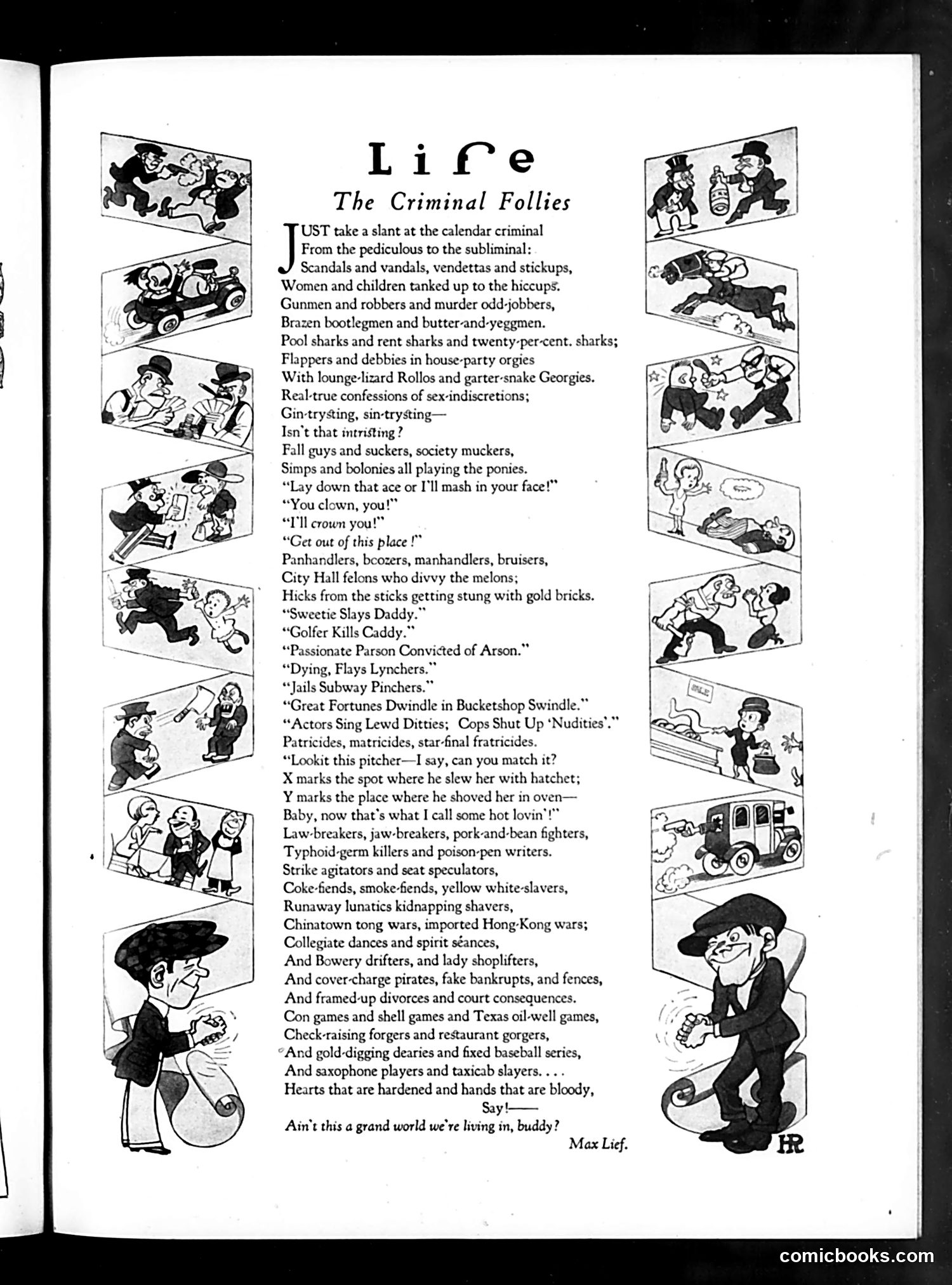
This satirical poem in *Life* magazine catalogs contemporary urban vices and crimes of the Jazz Age era. The accompanying cartoons illustrate various social ills: gambling, violence, sexual misconduct, bootlegging (during Prohibition), con games, kidnapping, and organized crime. The verse mocks both the criminals themselves and the sensational newspaper coverage of their exploits. References include "Passionate Parson Convicted of Arson," "Sweetie Slays Daddy," and "Dying, Flays Lynchers"—apparently real or semi-real scandals of the period. The poem's closing couplet asks sarcastically: "Ain't this a grand world we're living in, buddy?"—a rhetorical condemnation of American urban corruption and moral decay. The cartoons show pickpockets, car thieves, and various lowlifes operating freely in this lawless landscape.
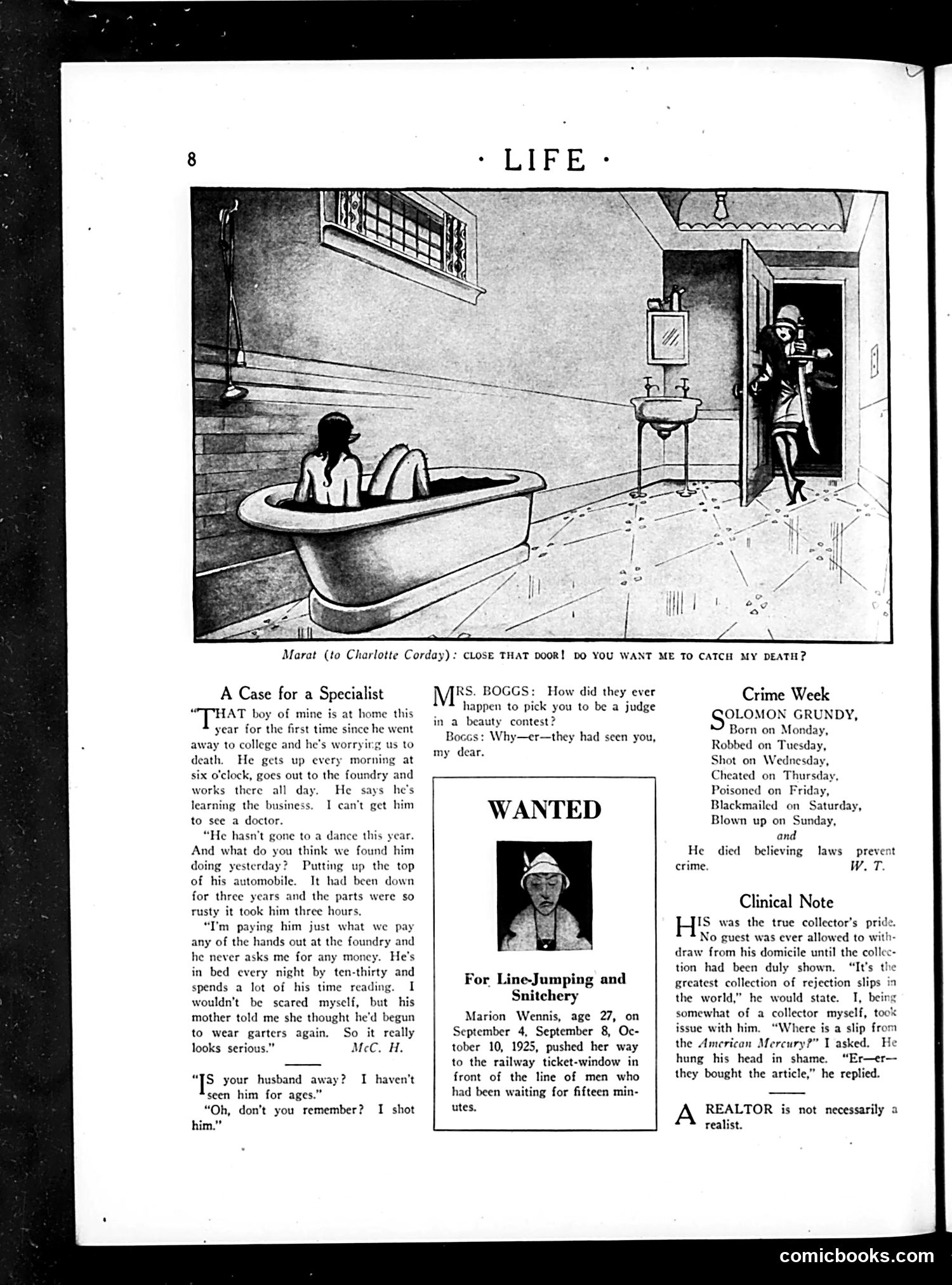
This page contains satirical humor pieces typical of 1920s Life magazine. The main cartoon shows a person in a bathtub confronted by a skeletal figure (Death) at the bathroom door, with the caption "CLOSE THAT DOOR! DO YOU WANT ME TO CATCH MY DEATH?"—a visual pun on the common expression. Below are three separate humor pieces: "A Case for a Specialist" mocks parents worried about their son's laziness, "Crime Week" presents dark humor about a criminal's busy schedule, and a "WANTED" notice references criminal suspects from that era. The "Clinical Note" jokes about collectors of rejection slips, while "A Realtor is not necessarily a realist" offers cynical commentary on real estate salesmen. These pieces reflect 1920s social anxieties about crime, illness, employment, and consumer culture.
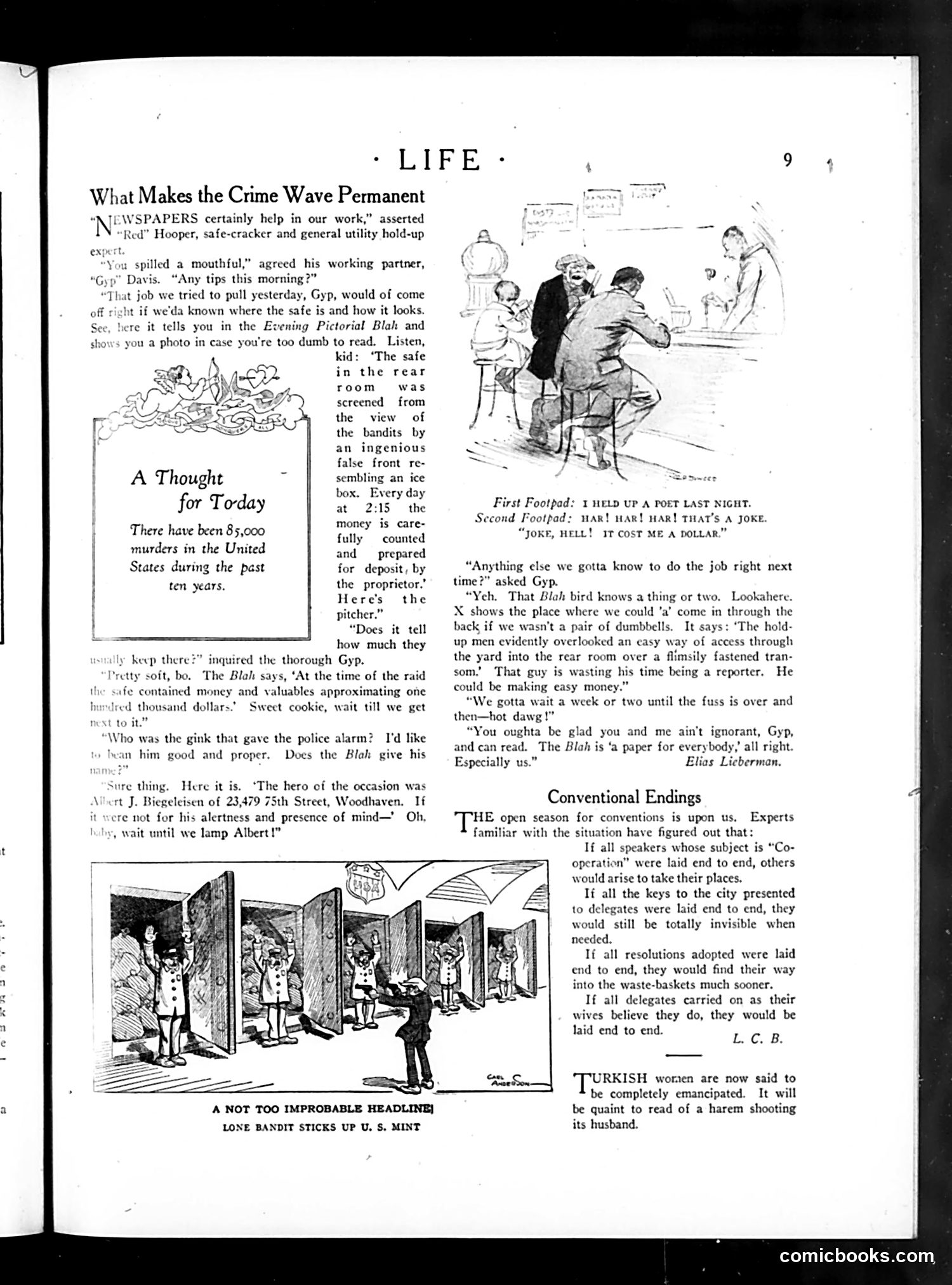
This page from *Life* magazine contains humor about crime and safes. The main cartoon shows two burglars discussing a safe's security features from a newspaper photograph. One burglar explains how the safe can be accessed through a hidden rear room—essentially critiquing that a newspaper (the "Evening Pictorial Blah") inadvertently revealed security vulnerabilities by publishing detailed photographs. The satire targets: 1. **Newspapers' role in crime**: By publishing specifics about safes and security, the press unwittingly helps criminals plan heists 2. **Journalistic irresponsibility**: The caption notes there have been 81,000 murders in ten years, implying sensationalist crime coverage contributes to criminal activity The cartoon appears to argue that press coverage itself perpetuates "crime waves" through careless reportage.
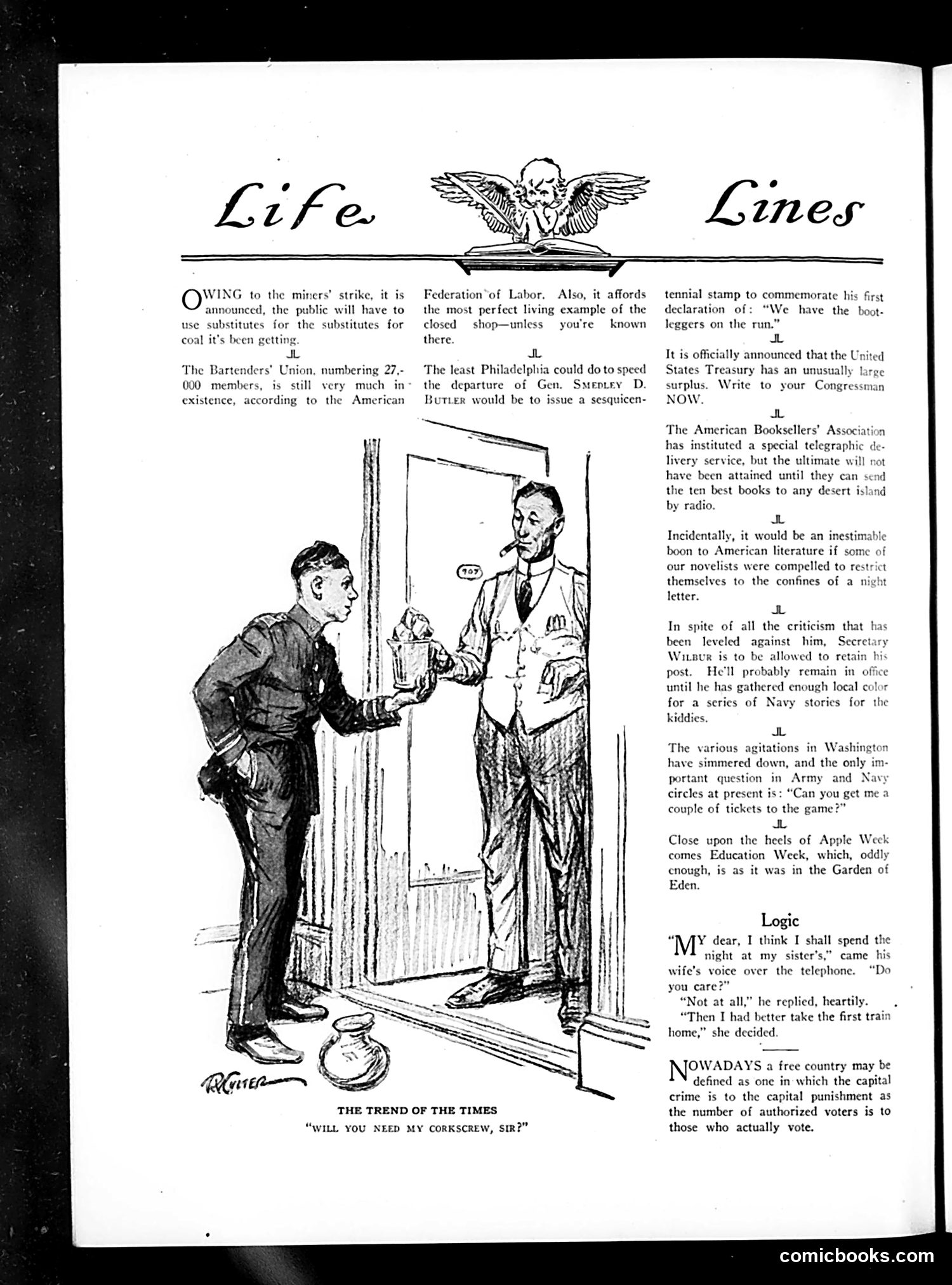
This cartoon satirizes workplace desperation during what appears to be a period of labor unrest (the text references a miners' strike and the Bartenders' Union). **The Scene:** A working man at a doorway asks a well-dressed gentleman, "Will you need my corkscrew, sir?" — implying he's offering to sell his own tools due to poverty. **The Satire:** The joke mocks economic hardship so severe that workers resort to selling personal possessions. The "corkscrew" detail suggests the gentleman is a drinker, adding irony: while the wealthy enjoy leisure, workers desperately peddle basic tools. **Context:** This reflects Depression-era or post-war economic anxiety when labor strikes and unemployment made survival precarious for ordinary people.
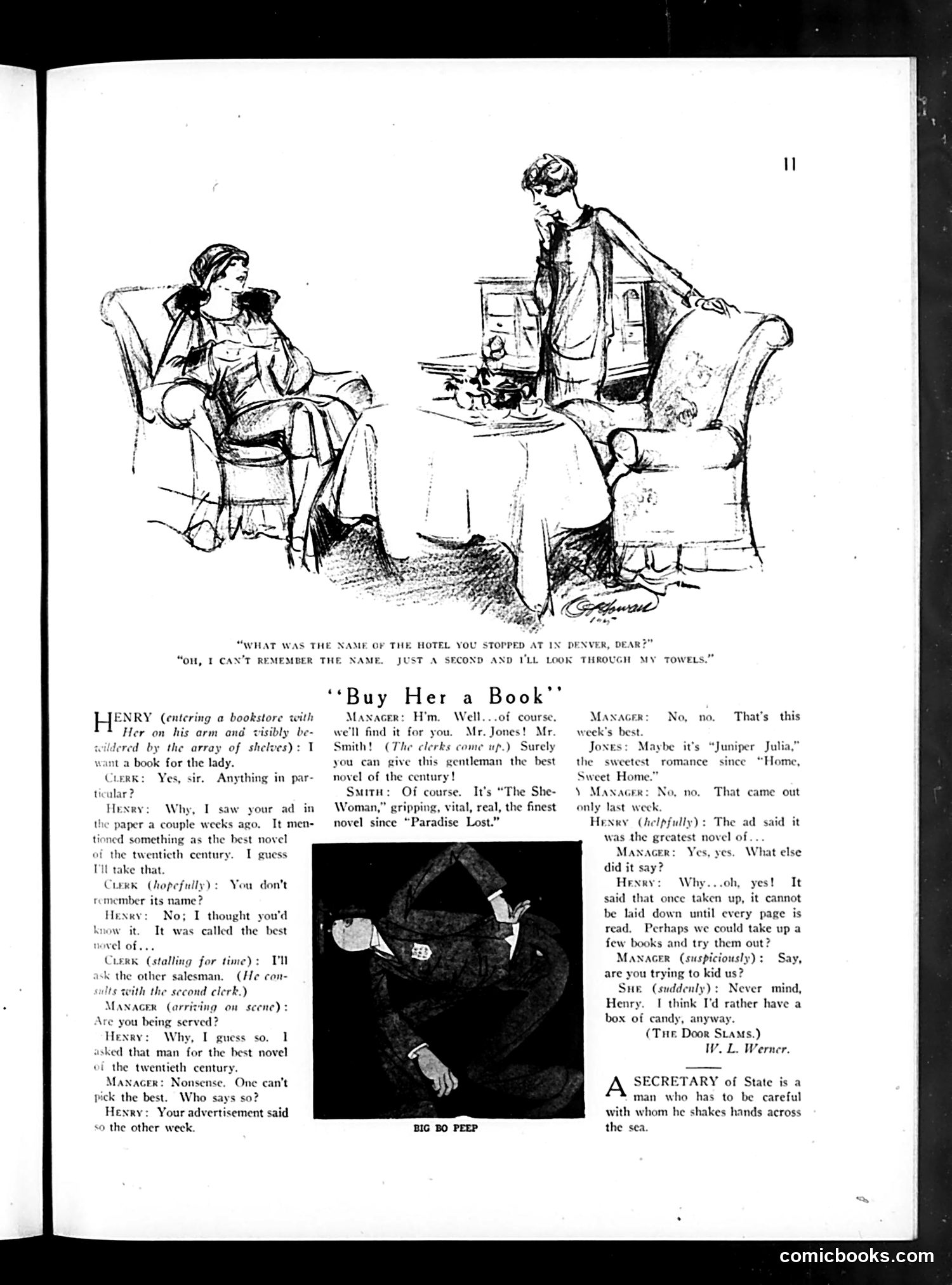
This page contains a humorous dialogue sketch titled **"Buy Her a Book"** rather than a political cartoon. It depicts a bookstore scene where a man (Henry) seeks a gift recommendation for a lady. The satire mocks the pretentiousness of literary recommendation culture: the store manager and clerk earnestly debate which "greatest novel" to suggest, citing titles like "The She-Woman" and "Paradise Lost," while constantly revising their opinions about what's supposedly "best." The joke is that they're overthinking a simple gift—Henry eventually just wants to buy *something*, and his companion suggests candy instead of books, deflating the entire literary discussion. The accompanying illustration labeled "BIG BO PEEP" appears unrelated. This satirizes both book-snobbery and the gap between highbrow literary talk and practical needs.
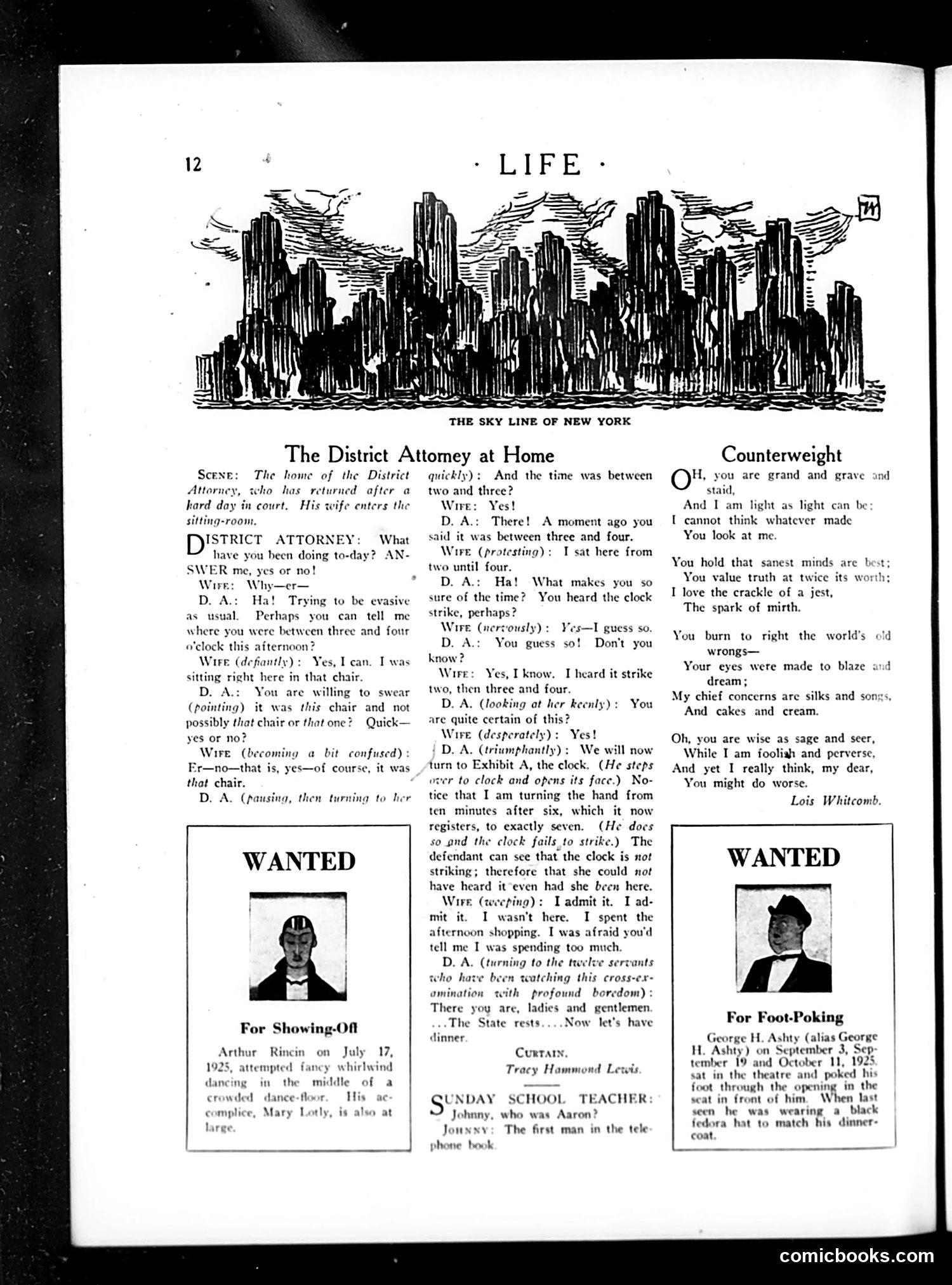
This page contains a satirical sketch titled "The District Attorney at Home" depicting a lawyer cross-examining his wife about her whereabouts, unable to abandon his courtroom demeanor even at home. The humor derives from the character's obsessive professional habits making him suspicious and interrogative with his spouse. The page also includes two "WANTED" notices satirizing minor infractions: Arthur Rincin for "Showing-Off" (fancy dancing in 1925) and George H. Ashby for "Foot-Poking" (disrupting a theater performance). These mock the overwrought language of actual wanted posters applied to trivial social misbehavior, typical of Life's satirical approach to everyday urban life and social etiquette of the 1920s.
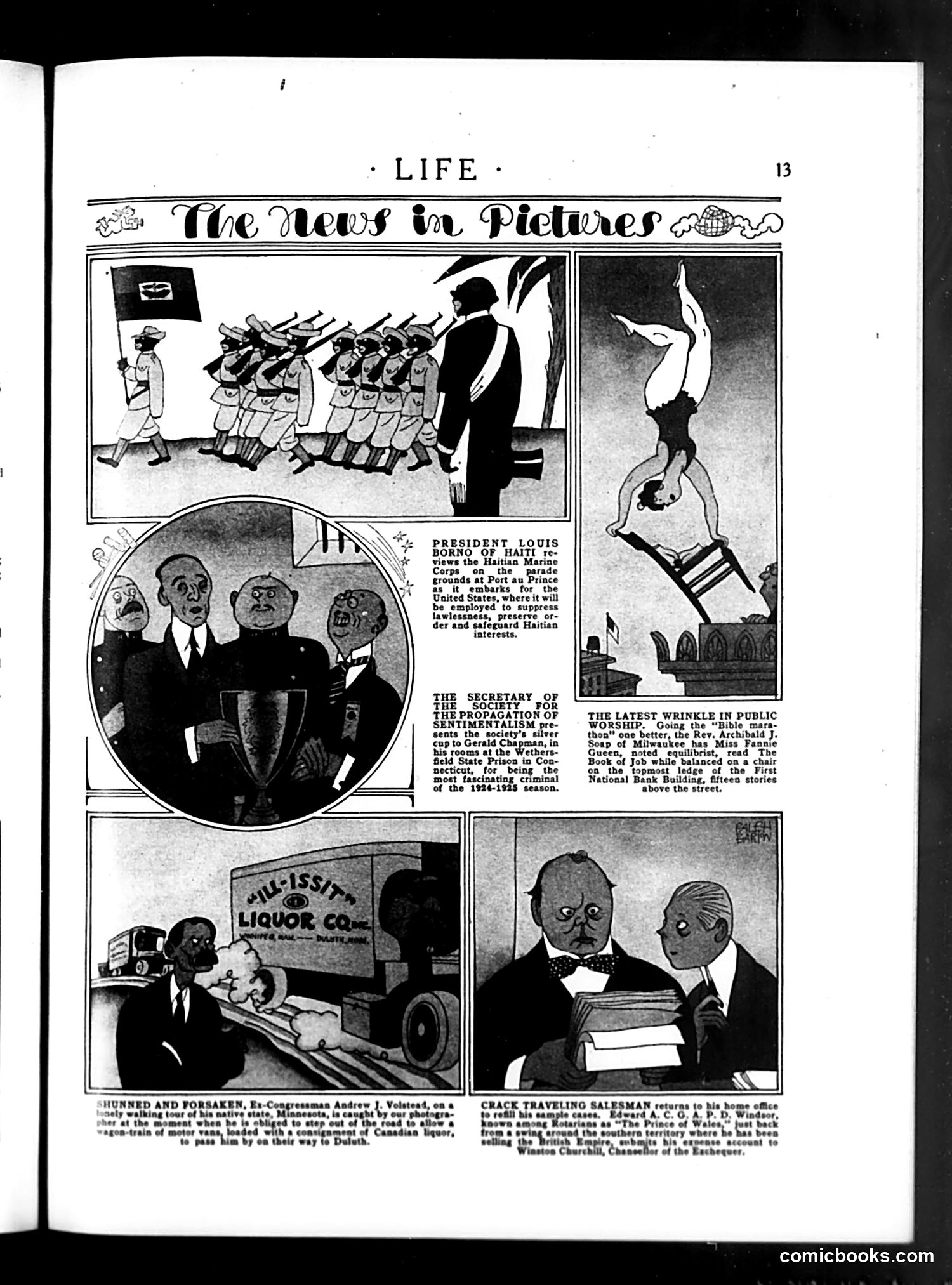
This page contains four satirical cartoons from Life magazine's visual news section: 1. **Top left**: Military parade with Italian flag, referencing President Louis Bororo of Haiti reviewing Italian Marines. 2. **Top right**: A person doing a headstand, captioned as "The Latest Wrinkle in Public Worship"—appearing to mock Rev. Archibald Soap of Milwaukee for balancing the Book of Job on a chair while inverted. 3. **Bottom left**: A man in formal dress next to a liquor truck, captioned "Shunned and Forsaken"—showing Congressman Andrew Volstead during Prohibition, caught viewing Canadian liquor (ironic given his famous anti-alcohol stance). 4. **Bottom right**: Two men examining sample cases labeled as traveling salesmen, with a caption about "The Prince of Wales" books circulating in territories. The satire targets public figures through exaggeration and visual humor.
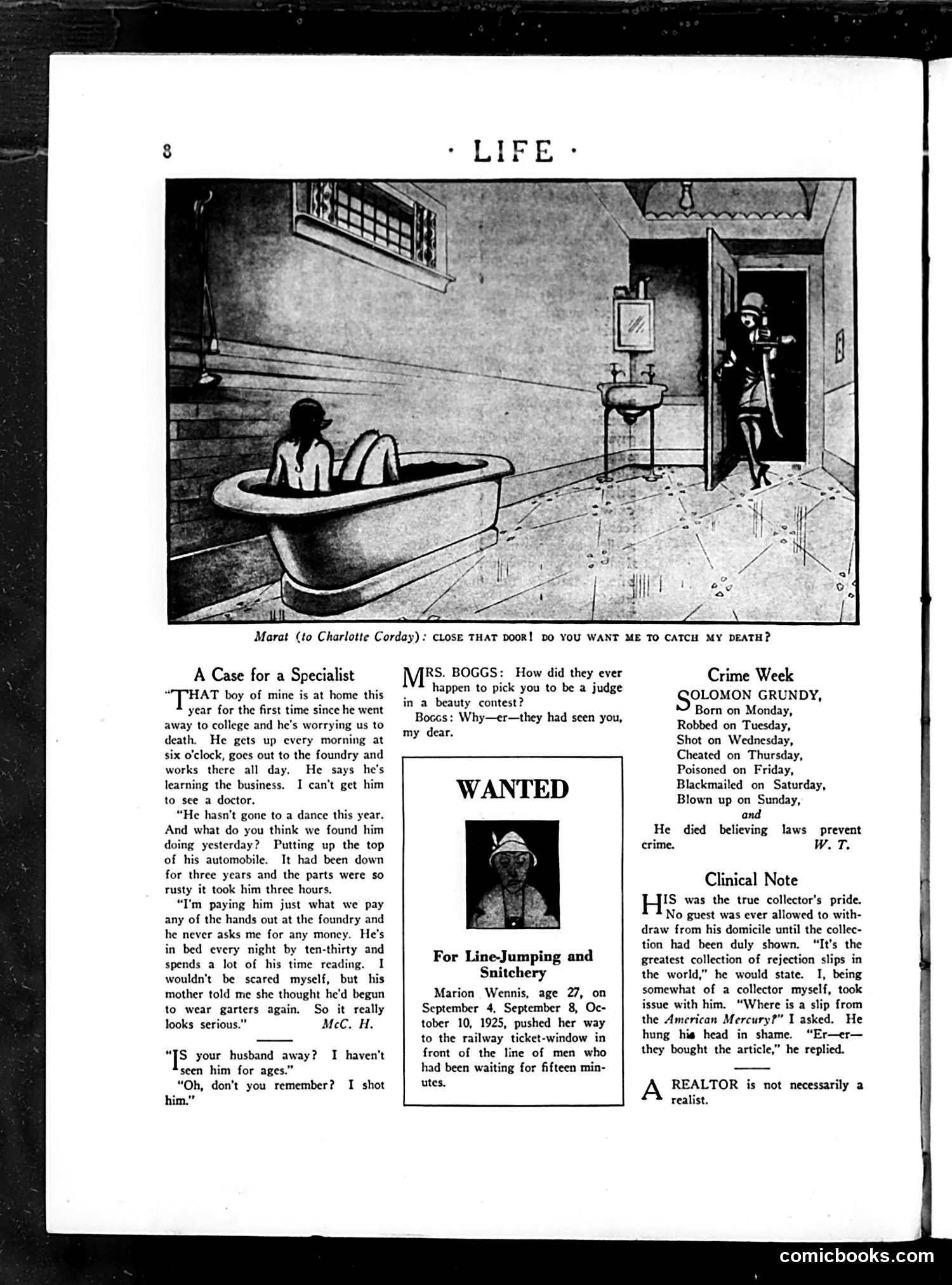
The main cartoon depicts a bathroom scene where a man in a bathtub addresses a woman entering through the door, saying "CLOSE THAT DOOR! DO YOU WANT ME TO CATCH MY DEATH?" This is a visual gag playing on the common domestic complaint about someone leaving the bathroom door open and letting heat escape. The accompanying text sections include: - **"A Case for a Specialist"**: A humorous anecdote about a son working at a foundry, illustrating marital concerns - **"WANTED"**: A missing person notice for Marion Wennis, wanted for line-jumping and snitchery at a railway ticket window (September 1925) - **"Crime Week"**: Dark humor listing crimes committed daily, ending with "He died believing laws prevent crime" - **"Clinical Note"**: A satirical comment about a collector's pride in rejection slips The page combines domestic humor with social satire typical of 1920s Life magazine.
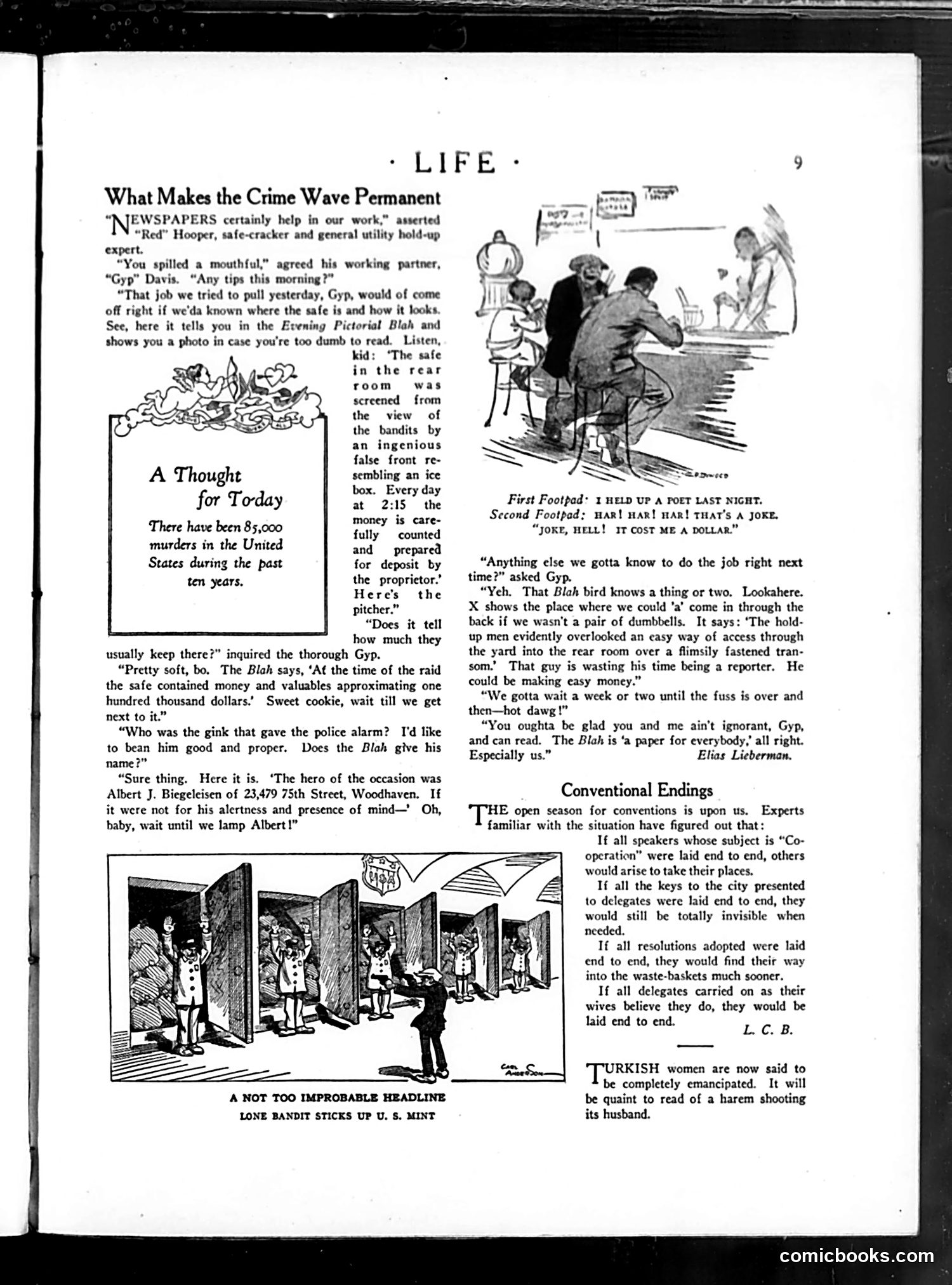
This page satirizes organized crime and safe-cracking techniques. The main article "What Makes the Crime Wave Permanent" features dialogue between "Red" Hooper (a safe-cracker) and "Gyp" Davis (his partner), discussing how criminals locate safes in businesses. They reference the *Evening Pictorial Blah*—a fictional newspaper—which allegedly revealed safe locations through photographs. The satire targets two things: (1) newspaper sensationalism that inadvertently aids criminals by publishing operational details, and (2) the prevalence of crime in 1920s America (the article notes 85,000 murders in ten years). The cartoon "A Not Too Improbable Headline" mocks the ineffectiveness of law enforcement, showing a bandit robbing the U.S. Mint itself—suggesting that even the government's most secure facility isn't safe from criminals.
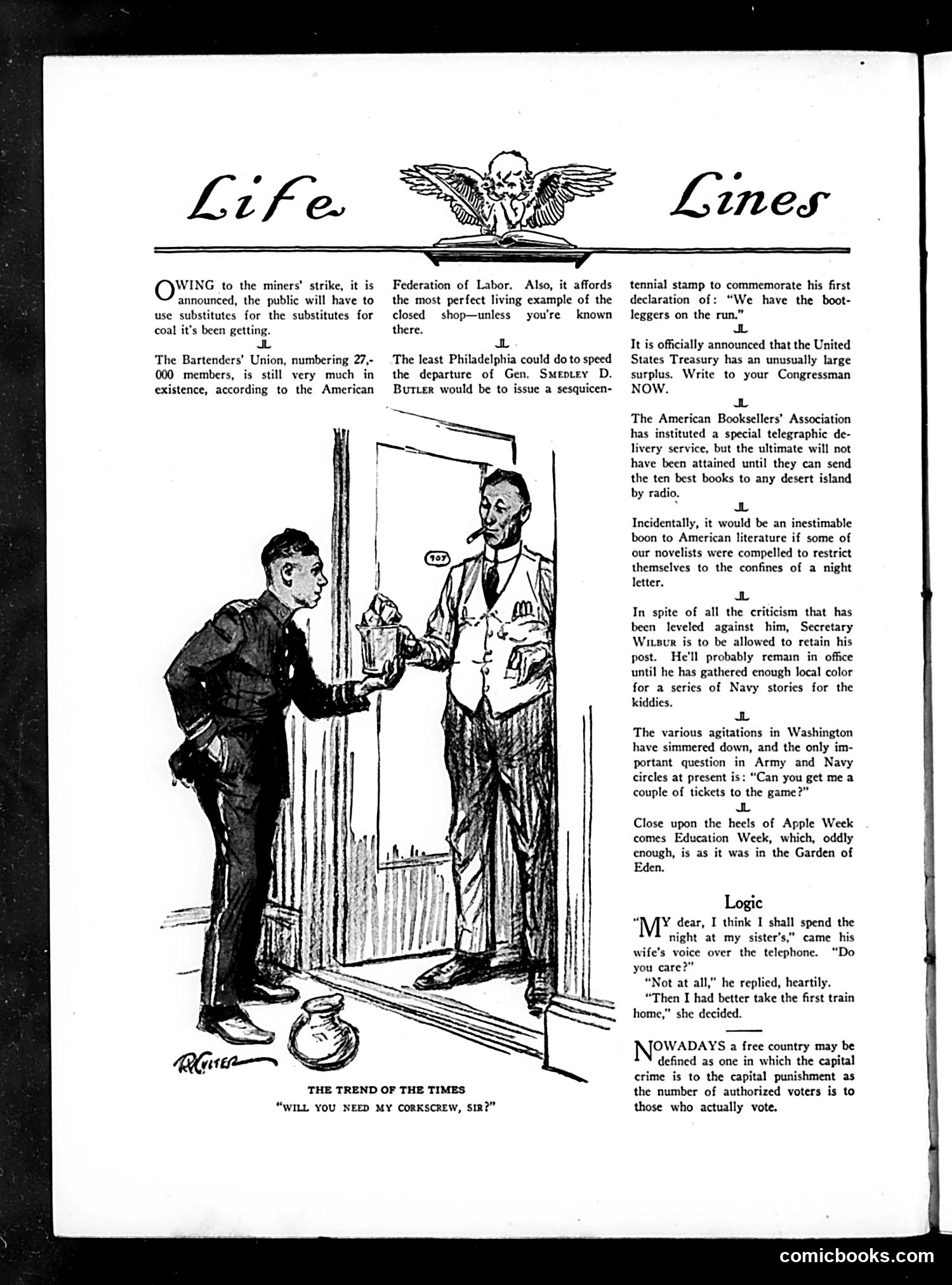
The main cartoon, titled "The Trend of the Times: 'Will You Need My Corkscrew, Sir?'" depicts a working-class man at a doorway asking a well-dressed gentleman for his corkscrew. The satire comments on economic desperation during labor unrest—specifically referencing the miners' strike mentioned in the text. The implication is that the poor man must borrow basic tools, suggesting economic hardship forces working people into humiliating dependency. The surrounding "Life Lines" column contains brief satirical commentary on contemporary issues: labor union membership, political figures (including Secretary Wilcox and General Smedley Butler), book distribution initiatives, and voting rights—all typical of early 20th-century American social criticism. The cartoon critiques wealth inequality and labor conditions of the era.
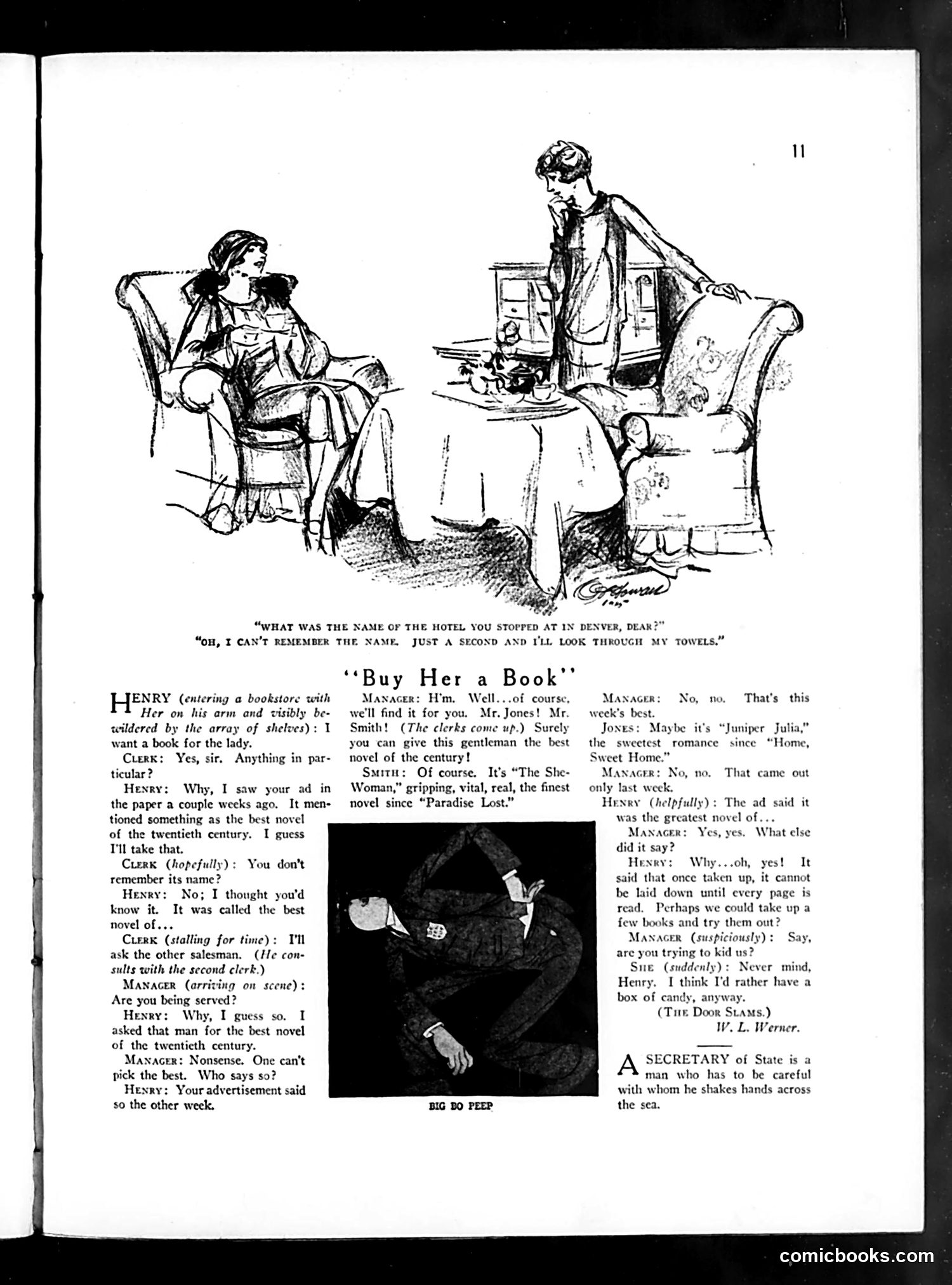
This sketch satirizes the absurdity of literary advertising and bookstore commerce in the early 20th century. A man (Henry) enters a bookstore seeking "the best novel of the twentieth century" based on a newspaper advertisement he saw weeks earlier. The joke exposes how bookstores and publishers make contradictory claims: different clerks and the manager each insist *their* current stock represents the best novel—"The She-Woman," "Juniper Julia," etc.—with no consistency week to week. The satire mocks both aggressive advertising that makes unprovable superlative claims and the gullibility of consumers who believe them. When Henry logically suggests they simply try multiple books to find one you "cannot lay down," the manager suspects he's being mocked. His companion Sue abandons the search entirely for candy—a jab at the futility of the enterprise. The humor targets commercial hype and the impossibility of objectively ranking literature.
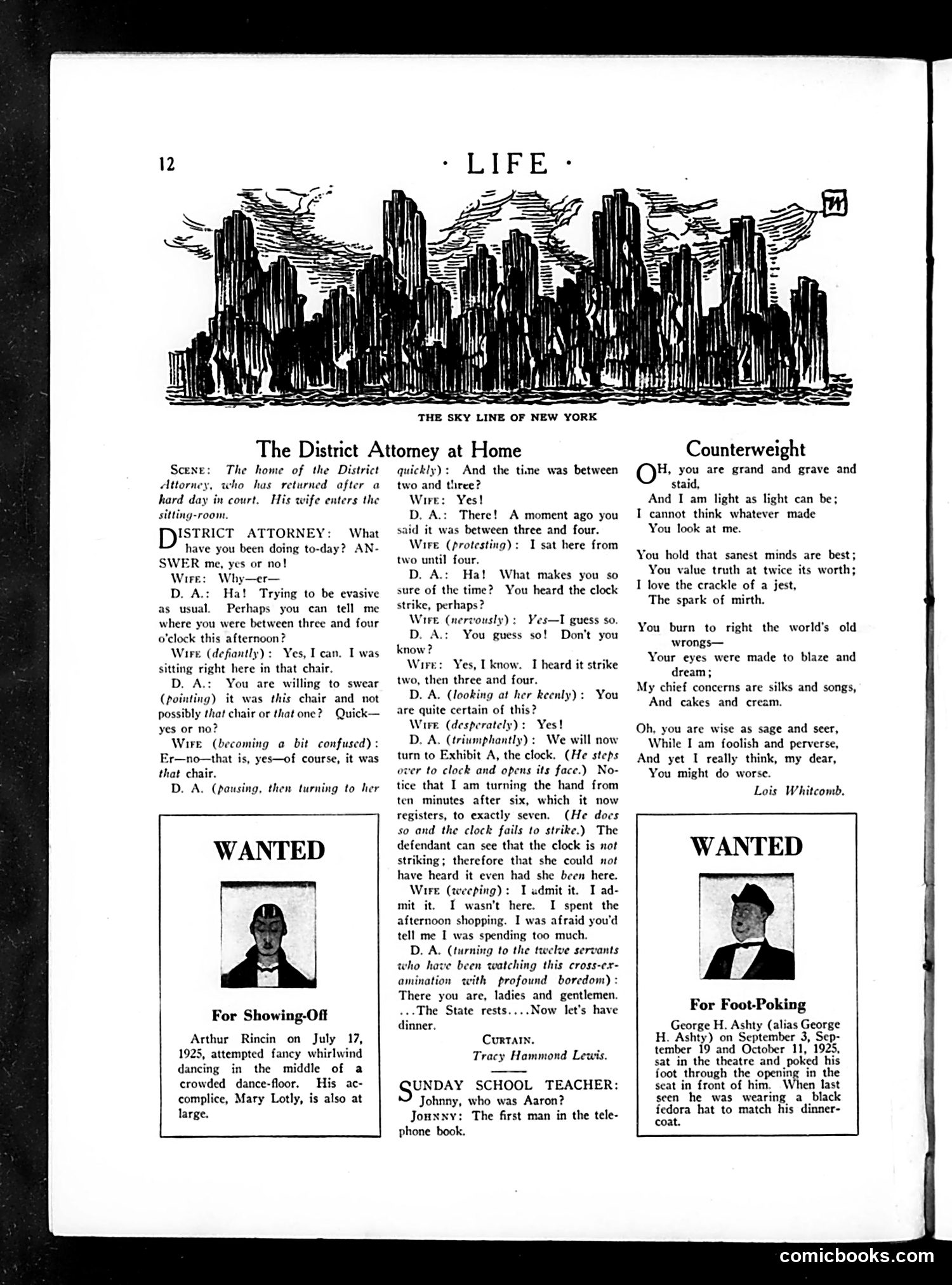
This satirical sketch mocks overzealous prosecutors who apply aggressive courtroom interrogation tactics to their own domestic lives. The District Attorney cross-examines his wife about her afternoon whereabouts with the same relentless intensity he'd use in court—demanding yes/no answers, catching her in contradictions about the time, and triumphantly "proving" she wasn't home by manipulating a clock as evidence. The humor lies in the absurdity: he treats his wife like a hostile witness, reducing a simple domestic question into a theatrical legal victory. The sketch satirizes how some officials become so consumed by their prosecutorial mindset that they lose perspective, turning intimate family moments into adversarial proceedings. It's social commentary on professional men who cannot separate work from home life, and perhaps also a gentle critique of the aggressive interrogation methods of 1920s law enforcement more broadly.
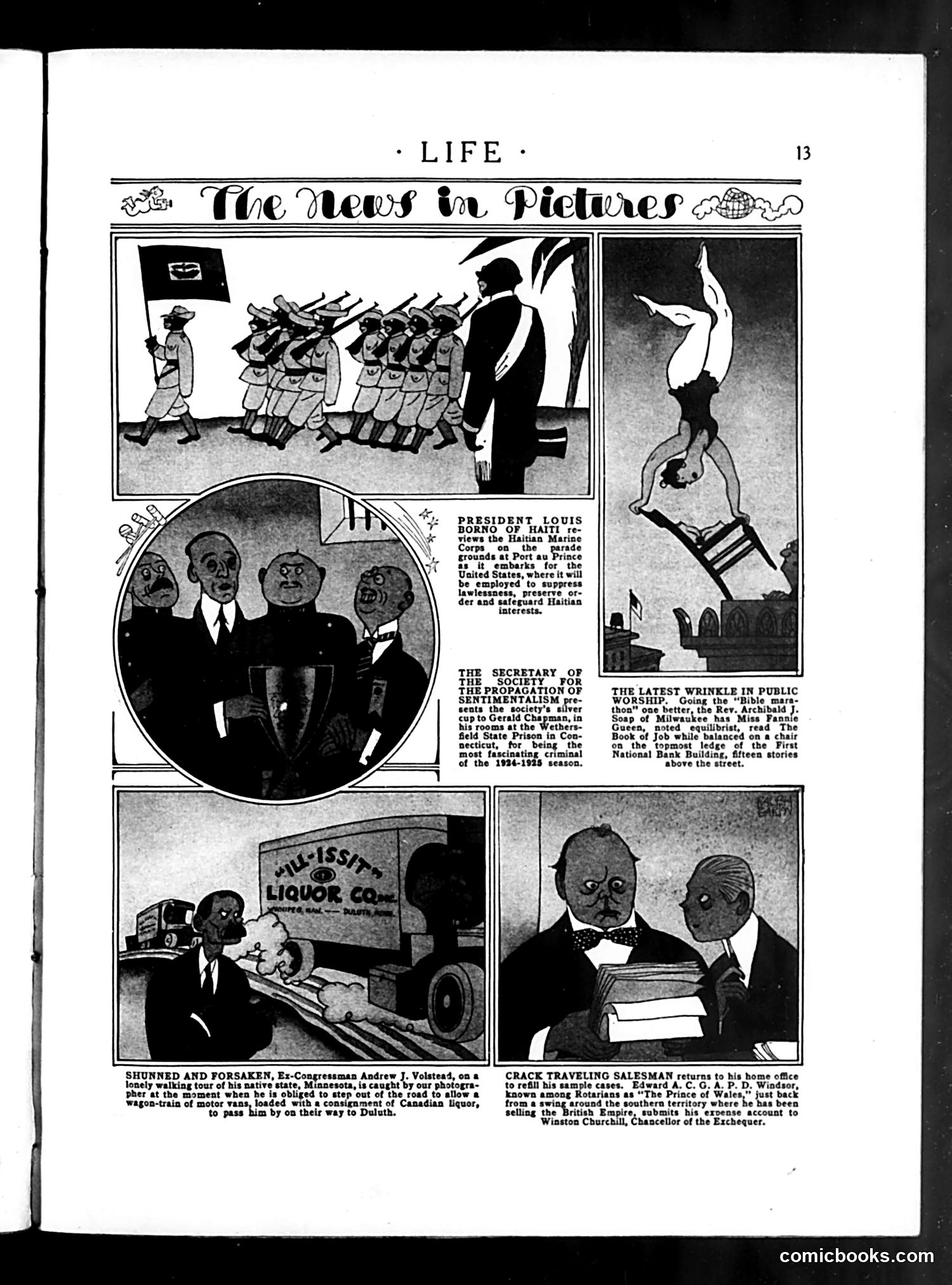
This page contains four separate political cartoons satirizing 1920s American figures and events: 1. **Top left**: Haiti's President Louis Borno reviews his Marine Corps before deployment to the U.S.—likely mocking American military intervention in Haiti. 2. **Center**: The "Secretary of Society" awards a silver cup to Gerald Chapman, a notorious criminal, for being the "most fascinating criminal" of 1924-1925—sarcasm about sensationalizing crime. 3. **Top right**: A minister balances a woman reading the Book of Job on a skyscraper ledge as religious "spectacle"—mocking excessive religious showmanship. 4. **Bottom left**: Ex-Congressman Andrew Volstead, author of Prohibition legislation, must step aside for trucks smuggling Canadian liquor—the ultimate irony: Prohibition's architect humiliated by the lawbreaking it spawned. 5. **Bottom right**: A salesman reports expenses to Winston Churchill—unclear reference, likely mocking either salesmanship culture or Churchill's fiscal policies.
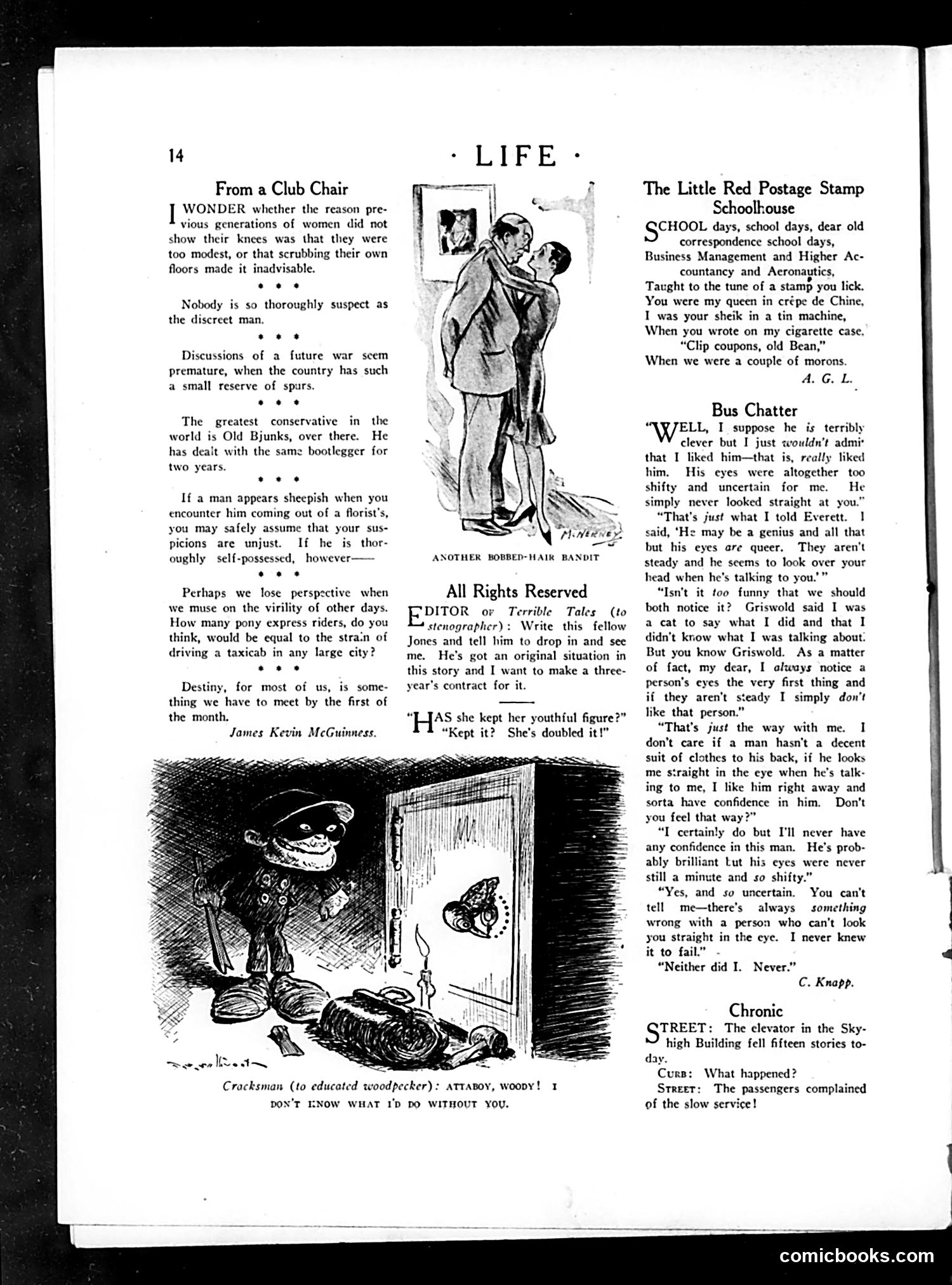
This page contains several short satirical pieces typical of 1920s Life magazine humor: **"From a Club Chair"** comprises witty, disconnected social observations—noting women showing knees (post-flapper era), suspicion of "discreet" men, and comparisons of modern life (taxi driving) to supposedly hardy historical figures. **"Another Bobbed-Hair Bandit"** references the actual 1920s crime phenomenon: young women criminals, often bobbed-haired, who robbed gas stations. The illustration shows a stereotypical female criminal. **"All Rights Reserved"** satirizes pulp fiction editors seeking sensational stories. **"The Little Red Postage Stamp Schoolhouse"** mocks correspondence school romance and the "sheik" slang (popularized by Valentino films). **"Bus Chatter"** satirizes shallow social observation—two women judge a man's character entirely by whether he makes direct eye contact, missing deeper truths. **"Chronic"** offers a final joke: elevator passengers complain about *speed* rather than the catastrophic accident itself—satirizing modern complaints and priorities. The humor reflects post-WWI American anxieties about changing social norms, modern technology, and superficial judgment.
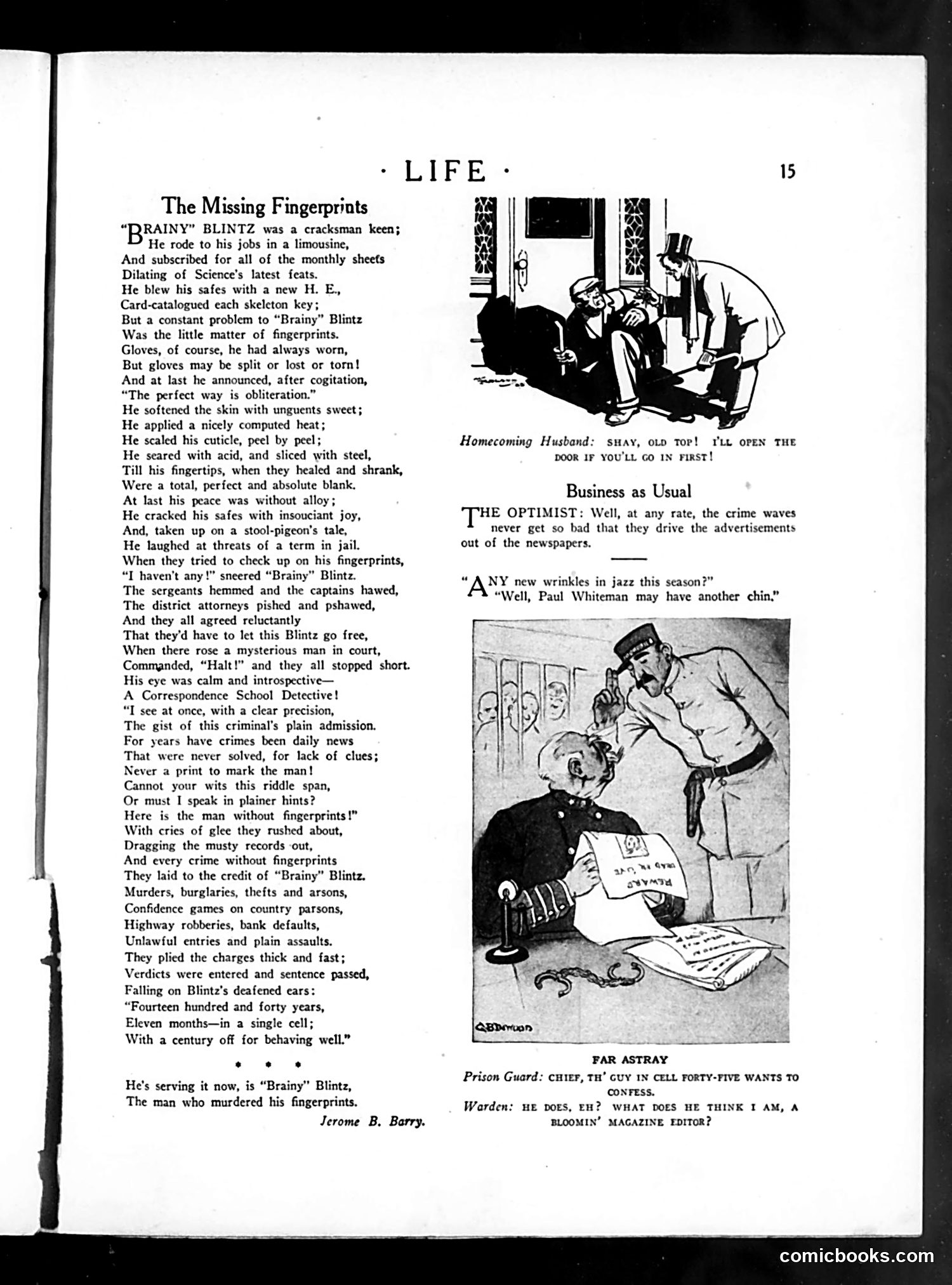
This page contains a humorous narrative poem about a criminal mastermind named "Brainy" Blintz who removes his own fingerprints to evade identification. The satire works on two levels: **The Main Joke:** Blintz's elaborate scheme—literally obliterating his fingerprints through chemical and surgical means—backfires when a "Correspondence School Detective" deduces that the *absence* of fingerprints at unsolved crime scenes actually identifies him. He's convicted and sentenced to over 1,400 years in prison. **The Social Reference:** This mocks the then-emerging science of fingerprint identification as a forensic tool. The poem suggests that even attempting to outwit modern detective methods is futile—the very absence of evidence becomes incriminating. The accompanying cartoons on the page offer lighter social humor about domestic life and media cynicism, unrelated to the fingerprint story.
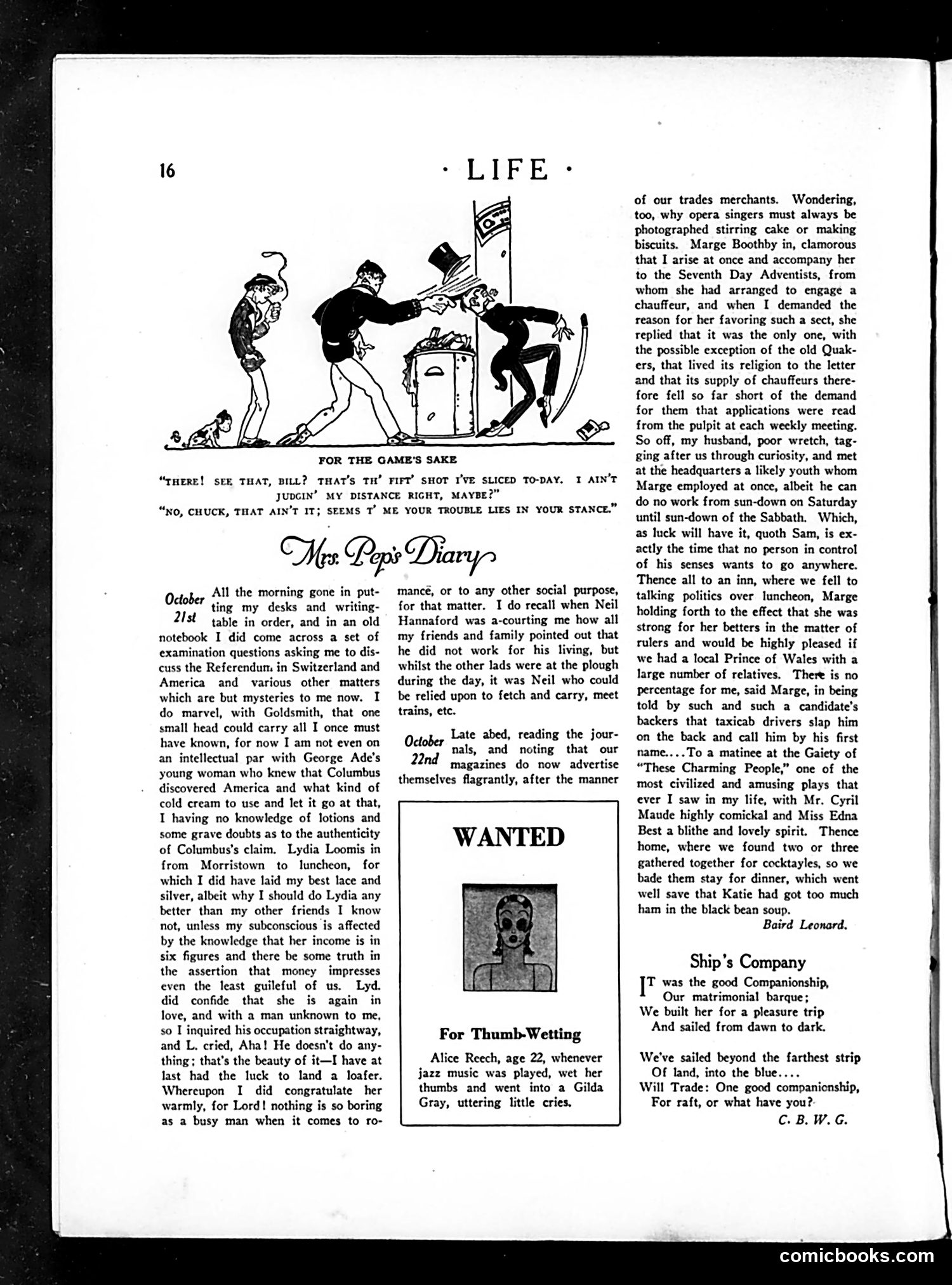
The cartoon depicts two golfers discussing a poor golf shot. One player ("Chuck") has sliced his fifth shot of the day and asks his companion ("Bill") if he's misjudging distance. Bill responds that the problem isn't distance but Chuck's "stance"—his body position during the swing. This is a straightforward sports humor cartoon playing on double meaning: "stance" literally refers to golf posture, but the dialogue's phrasing ("your trouble lies in your stance") creates comic ambiguity, as if suggesting deeper personal failings. The joke relies on readers' familiarity with golf terminology and the common experience of golf frustration. The page also contains *Mrs. Pep's Diary*, a serialized personal essay offering social commentary on topics like wealth, courtship, and religious sect practices—typical magazine filler content of the era.
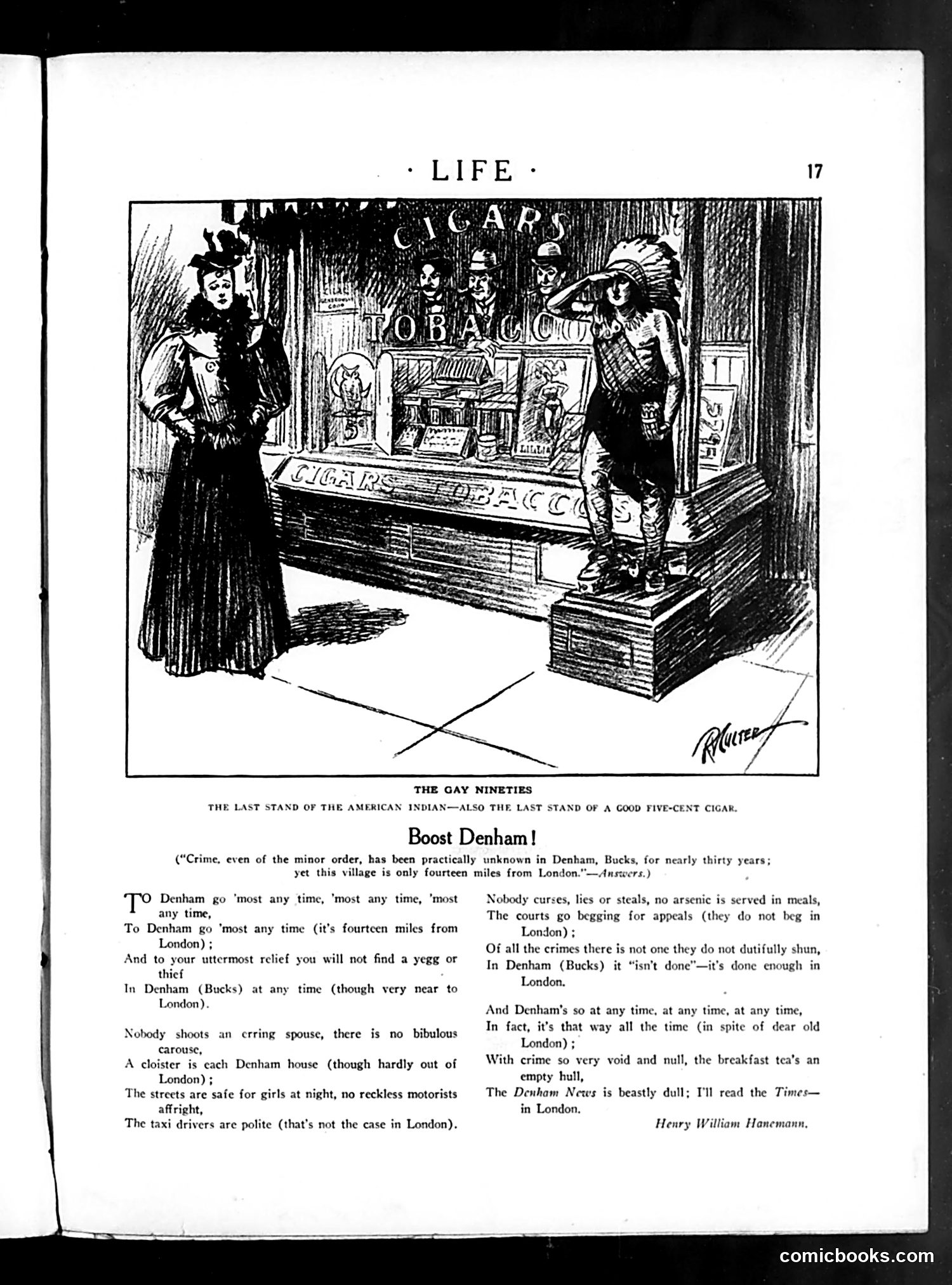
The cartoon depicts a cigar shop window labeled "CIGARS TOBACCO," with well-dressed figures examining the display. The caption sarcastically compares "the last stand of the American Indian" to "the last stand of a good five-cent cigar"—suggesting both are disappearing relics. Below is a humorous poem by Henry William Hanemann promoting Denham, a village fourteen miles from London. The satire's point: Denham is *so perfectly crime-free and virtuous* that it's boring. The poem repeatedly contrasts Denham's safety, politeness, and moral purity with London's chaos—shootings, drunkenness, reckless drivers, theft, and crime. The joke's sting: despite Denham's appealing virtue, the speaker would rather read the *Times* in exciting, corrupt London than the "beastly dull" local news. The satire mocks both small-town monotony and urban vices, suggesting virtue without stimulation isn't actually desirable.
This page contains no political cartoons, but rather editorial commentary on three current events: **1. The Locarno Treaty:** European powers (Germany, Belgium, France, Britain, Italy) have signed a mutual guarantee agreement to settle disputes peacefully rather than through war. The editor celebrates this as significant progress for Western peace. **2. French Debt Negotiations:** U.S.-French discussions about war debts nearly succeeded but collapsed when American politicians (Senator Borah, Herbert Hoover, Senator Smoot) unexpectedly reversed course—the editor humorously blames Vermont snow for the "chill" that killed the agreement. **3. Henry Ford as Polish King:** A rumor circulates that industrialist Henry Ford might become Poland's monarch to solve its financial crisis. The editor dismisses this, suggesting Polish statesman Paderewski would be better, with Ford serving as financial adviser instead. The editorial's tone is optimistic about European peace prospects while gently satirizing American political fickleness and the absurdity of industrial magnates as monarchs.
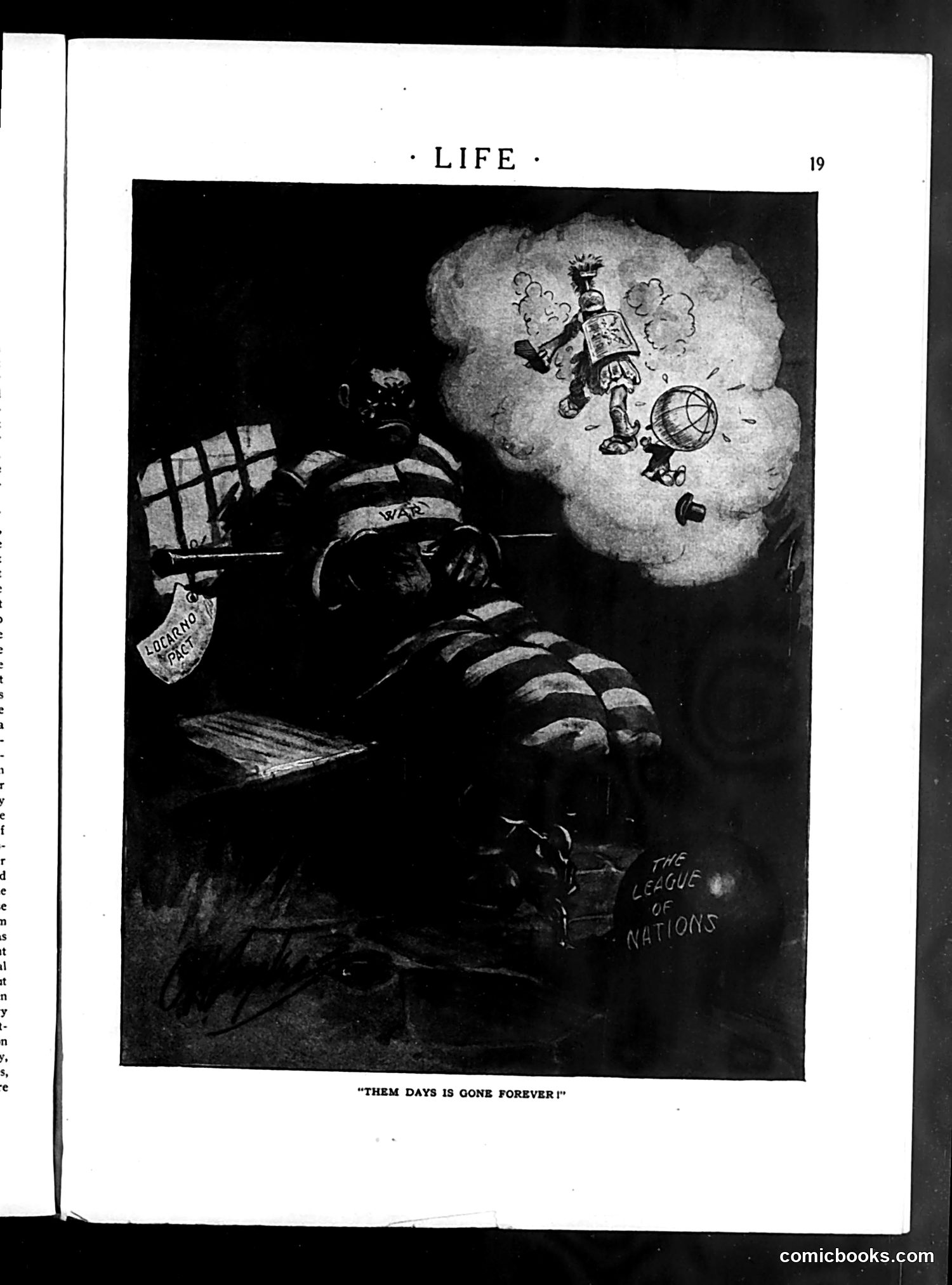
This satirical illustration depicts a figure in bed having a nightmare or fever dream. The sleeping figure appears to be a soldier or military man (suggested by the striped blanket and military context). Above him floats a grotesque vision showing caricatured figures engaged in conflict or chaos, with a globe visible. The caption "Them Days Is Gone Forever!" combined with the visible text reference to "The League of Nations" suggests this comments on post-World War I disillusionment. The nightmare imagery likely represents anxieties about international conflict returning despite hopes that the League would prevent future wars. The cartoon appears to criticize either naive optimism about the League's effectiveness or expresses darker fears about permanent global instability.
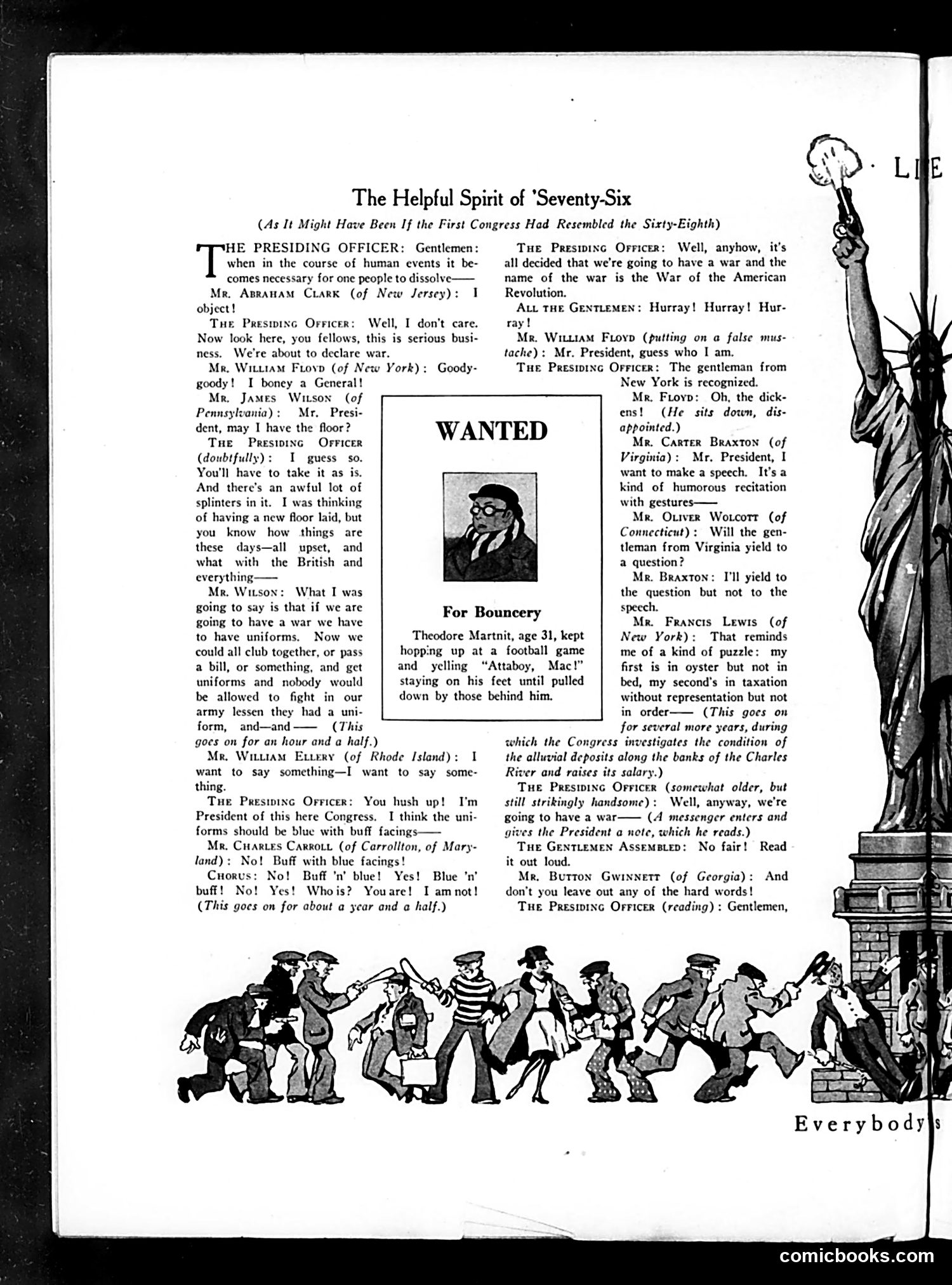
This satire compares the Continental Congress of 1776 to the 68th Congress (1923-1925), mocking contemporary legislative dysfunction. The "Helpful Spirit of Seventy-Six" imagines the Founding Fathers behaving like modern politicians—bickering over trivial details (blue vs. buff uniform facings), long-winded speeches, procedural obstruction, and self-interested delays while supposedly declaring war on Britain. Named congressmen represent real 1920s politicians engaging in petty disputes and obstruction. The "Wanted" poster for Theodore Martinit (who disrupted a football game by refusing to sit) appears to be a humorous aside, possibly referencing an actual incident. The joke's point: The 68th Congress was notoriously gridlocked and ineffectual. By imagining the Revolutionary Congress as equally dysfunctional, Life ridicules contemporary lawmakers, suggesting they lack the decisive patriotism of the founders. The satire implies that modern Congress wastes time on procedural arguments while avoiding substantive action—a sharp critique of post-WWI American political paralysis.
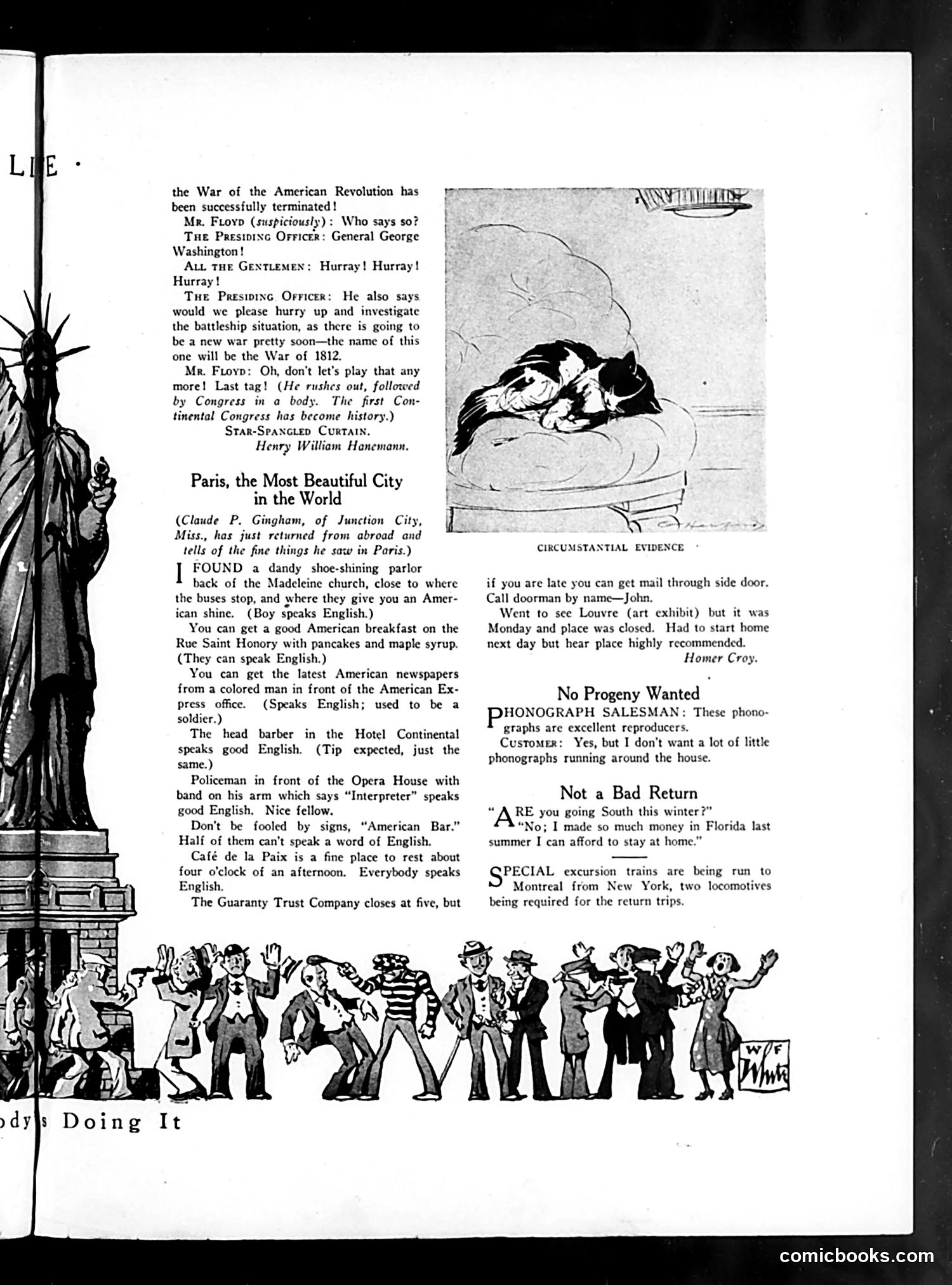
This page contains a satirical dramatic sketch and several humorous brief items typical of Life magazine's satirical format. **The Main Sketch**: "Star-Spangled Curtain" by Henry William Hanemann mocks American political complacency. Mr. Floyd skeptically questions General Washington's announcement that the Revolutionary War is won. When a Presiding Officer mentions a new war—"the War of 1812"—is coming soon, Floyd and Congress literally flee the stage. The joke: Americans are so war-weary they refuse to even discuss future conflicts, treating warfare as exhausting repetition rather than patriotic necessity. **"Paris" Section**: Homer Croy humorously catalogs Paris attractions by their American accessibility—shoe shines that give "American shine," American breakfasts, English-speaking staff. The satire targets American tourists' provincialism: they visit Paris only to find American conveniences, unable to engage authentically with French culture. **Brief Items**: The remaining jokes mock consumerism (phonograph reproduction anxiety), Florida real estate speculation profiteering, and railroad inefficiency (needing two locomotives to return from Montreal). The overall tone is gently cynical about American society and travel habits.
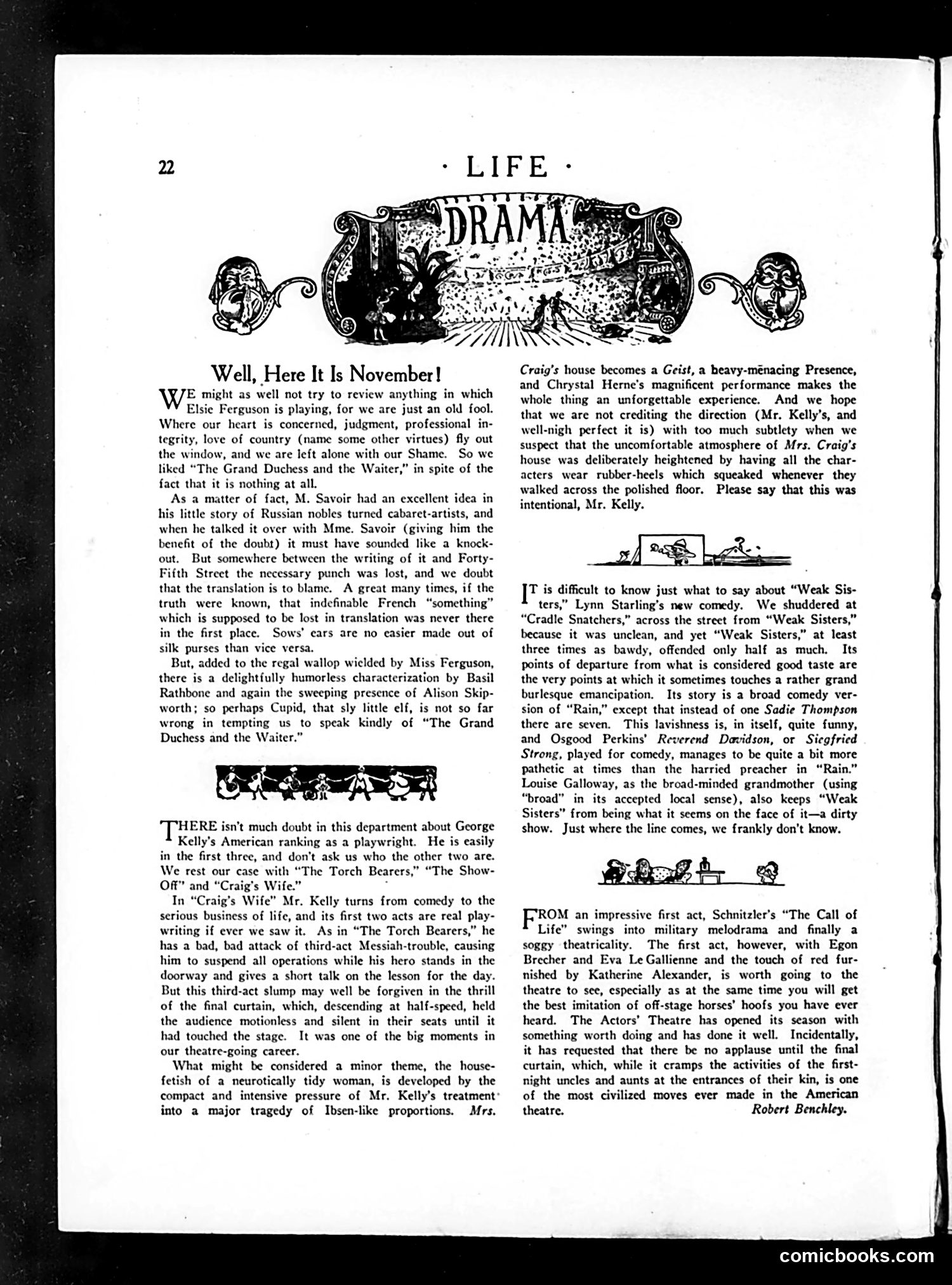
This is a theater review page from Life magazine's drama section. The critic discusses three Broadway productions: **"The Grand Duchess and the Waiter"**: A French play adapted to English about Russian nobility turned cabaret performers. The critic admits personal bias toward actress Elsie Ferguson, calling the play itself mediocre despite decent performances by Basil Rathbone and Alison Skipworth. **"Craig's Wife"** by George Kelly: Praised as serious drama ranking Kelly among America's top three playwrights (alongside "The Torch Bearers" and "The Show-Off"). The critic praises the first two acts but notes Kelly's recurring "third-act problem"—having the hero deliver a preachy speech. The review highlights how the house itself becomes a menacing presence through Chrystal Herne's performance and clever direction using squeaking rubber-heeled shoes on polished floors. **"Weak Sisters"**: A bawdy comedy with multiple female characters mirroring the plot of "Rain." The critic finds its broad humor sometimes touches genuine burlesque entertainment. The small decorative vignettes are period theatrical ornaments typical of Life's design.
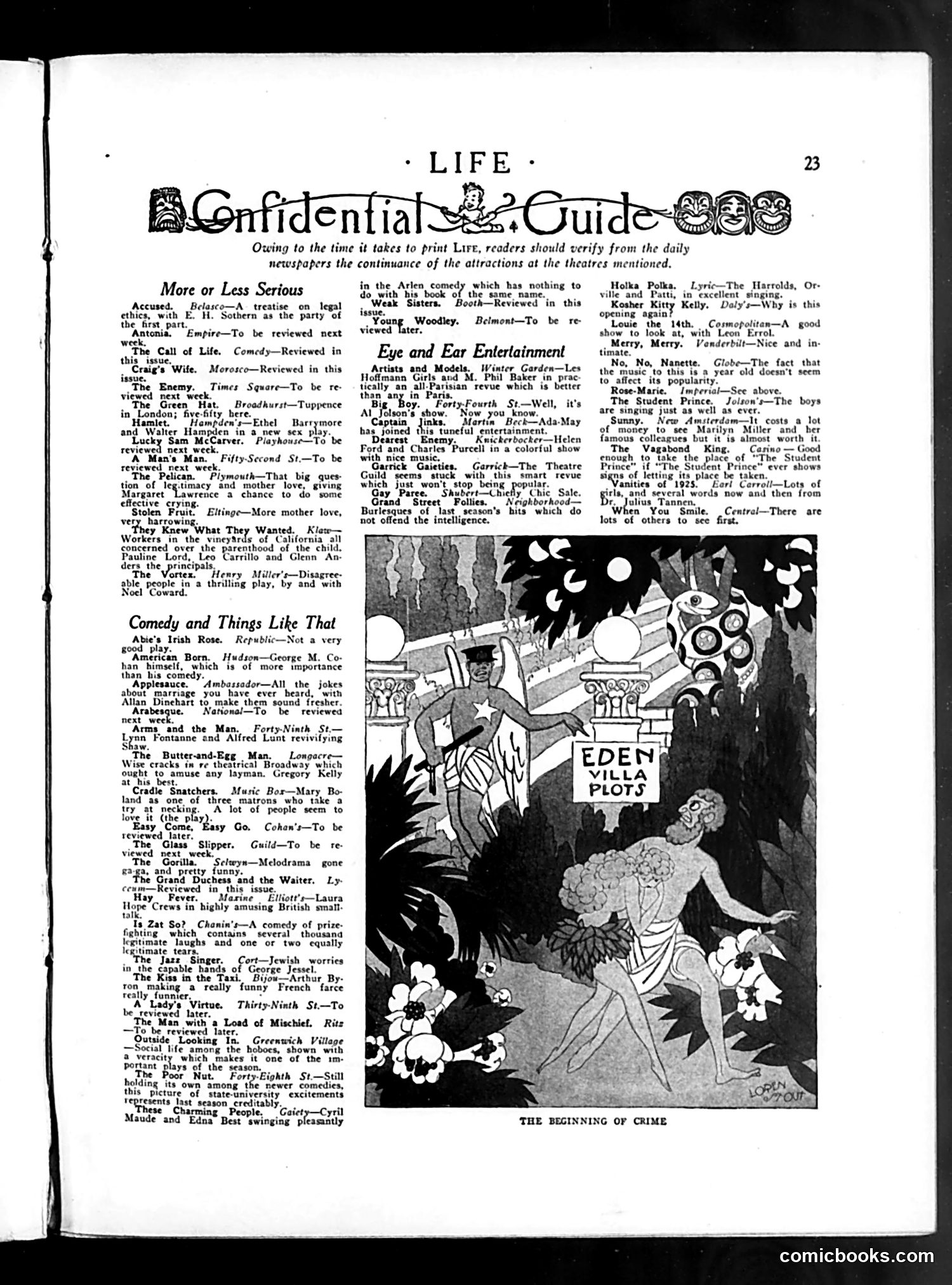
This page from *Life* magazine is primarily a theater guide reviewing Broadway shows and entertainment—not a political cartoon. The main image labeled "THE BEGINNING OF CRIME" appears to be an illustration for "Eden Villa Plots," likely a theatrical production or serial story being advertised. The illustration shows a dramatic scene with a woman in distress and a menacing figure, typical of melodramatic entertainment of the 1920s era. The accompanying text consists of brief, often witty reviews of current Broadway plays, musicals, and revues—many emphasizing comedies about infidelity, mother-love, and romantic entanglements that were popular theater topics of the period. Rather than satire, this is straightforward entertainment journalism with arch commentary on theatrical productions and performers of the day.
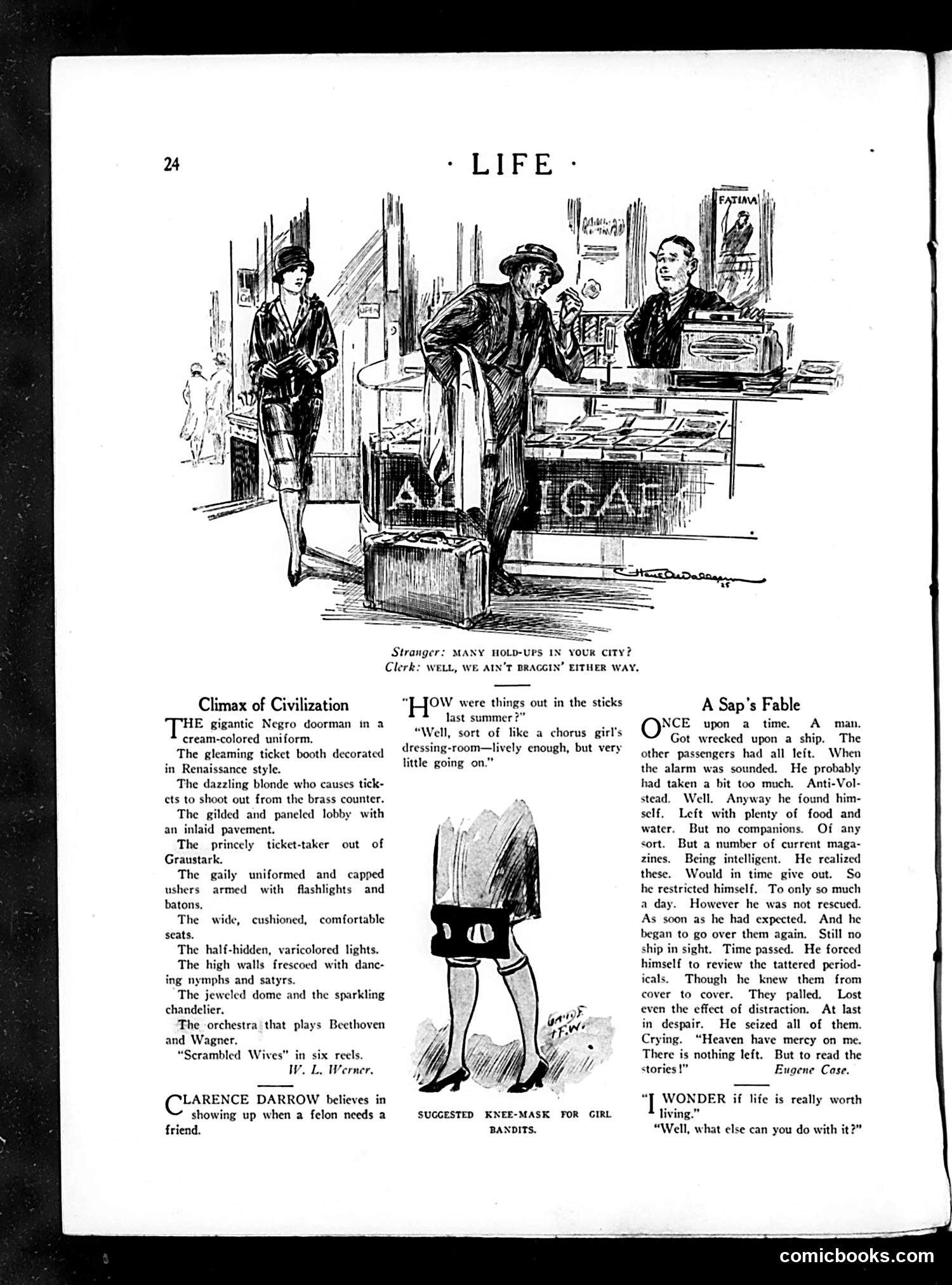
This Life magazine page contains three satirical pieces mocking early 1920s American culture: **"Climax of Civilization"** ridicules movie theater extravagance—ornate lobbies, uniformed staff, elaborate decor—as wasteful excess masking mediocre entertainment ("Scrambled Wives" in six reels). **The cartoon** depicts a crime-wave concern of the era: women bandits. The "suggested knee-mask" jest mocks how female criminals might disguise themselves while preserving their fashionable appearance—satirizing both crime's prevalence and society's superficiality. **"A Sap's Fable"** uses a shipwreck survivor forced to reread magazines repeatedly as allegory for life's meaninglessness, concluding with existential despair—reflecting post-WWI disillusionment among intellectuals. The **dialogue strip** jokes about urban crime: a stranger asks about rural safety; the clerk admits the city has hold-ups but won't boast about it either way—cynical commentary on widespread lawlessness (likely Prohibition-era violence). The overall tone: sophisticated mockery of American materialism, crime, and existential emptiness.
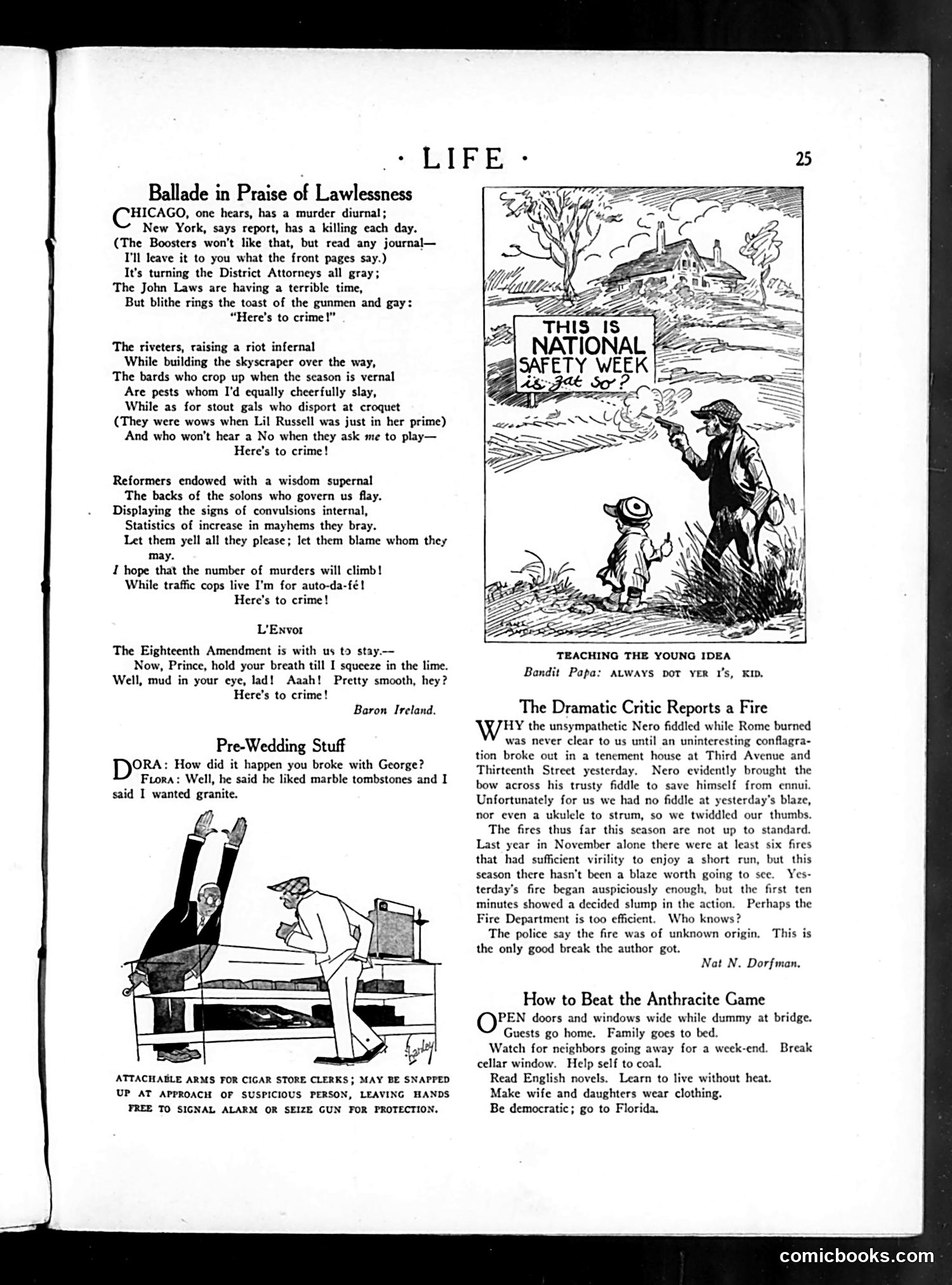
This satirical page from Life magazine critiques American social disorder and lawlessness in the 1920s-30s era. **"Ballade in Praise of Lawlessness"** ironically celebrates crime while documenting real concerns: Chicago's daily murders, New York's killings, and rising violence. The poem mocks both criminals ("Here's to crime!") and the ineffectual authorities trying to stop them—district attorneys, police ("John Laws"), and reformers. The "Eighteenth Amendment" reference indicates Prohibition-era crime and the perceived futility of law enforcement. **"Teaching the Young Idea"** shows a criminal parent teaching a child to dot his i's—crude but darkly humorous commentary on generational criminality. **"The Dramatic Critic Reports a Fire"** parodies detached intellectuals by comparing a boring tenement fire to Nero fiddling during Rome's burning, suggesting even cultural critics find modern disasters underwhelming. **"How to Beat the Anthracite Game"** offers sardonic tips for coal theft during heating shortages—reflecting Depression-era fuel hardships. The overall theme: widespread lawlessness and social breakdown, treated with satirical gallows humor rather than outrage.
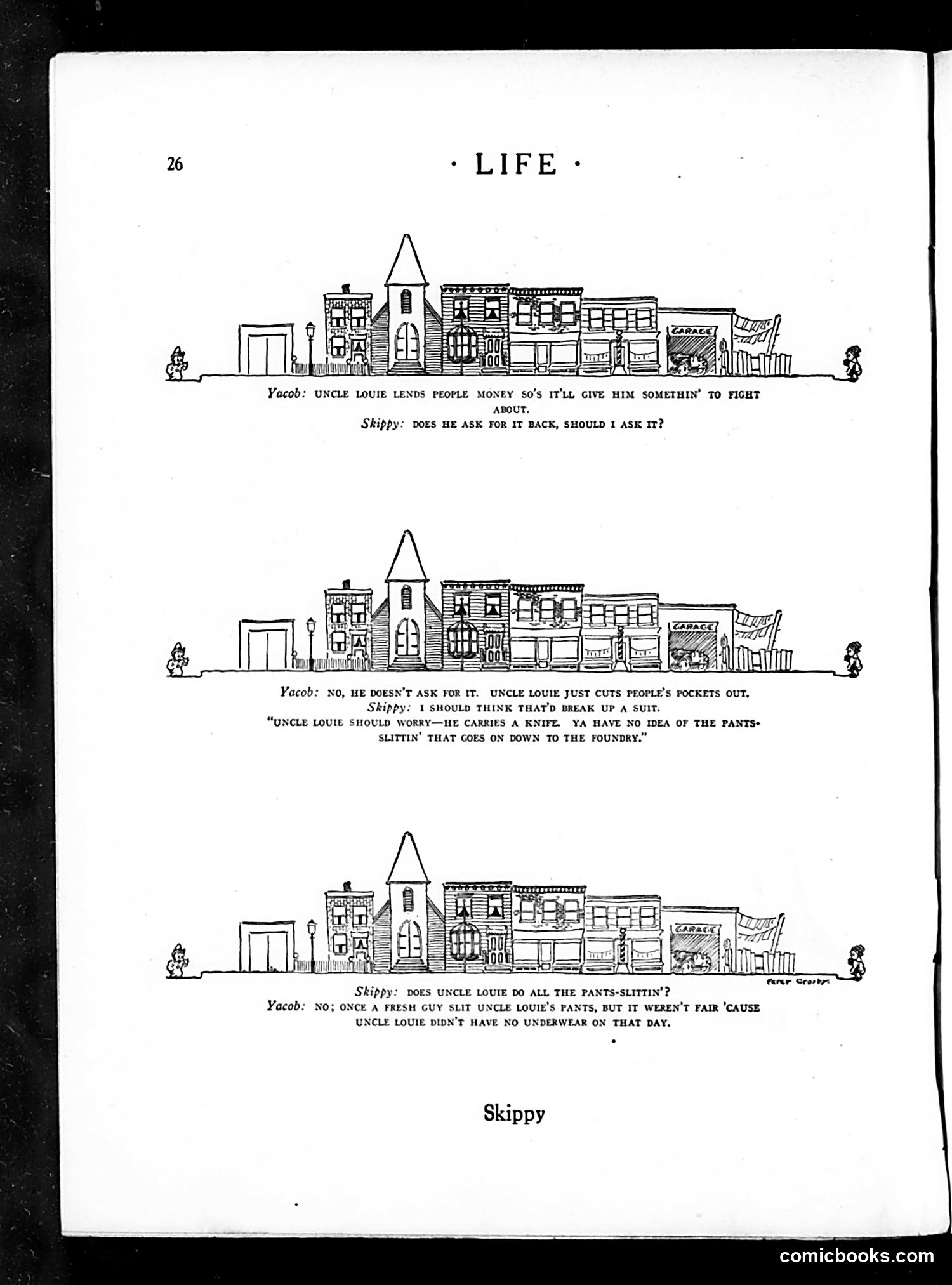
This is a three-panel comic strip featuring characters Skippy and Yacob discussing "Uncle Louie," a street character known for predatory lending and violence. The humor exploits period ethnic stereotypes—Yacob appears to be a Jewish immigrant character speaking in exaggerated dialect. The satire targets loan sharks who lend money not to help but to create debt leverage for extortion or fighting. The escalating absurdity—from lending for fights, to pocket-cutting, to "pants-slitting" at the foundry—reflects immigrant working-class culture and street violence. The punchline involves Uncle Louie's lack of underwear, adding crude physical humor typical of 1920s-30s comics. The strip satirizes both predatory lending practices and lower-class criminality, using ethnic caricature as its comedic vehicle—reflecting attitudes acceptable to *Life* magazine's audience at the time.
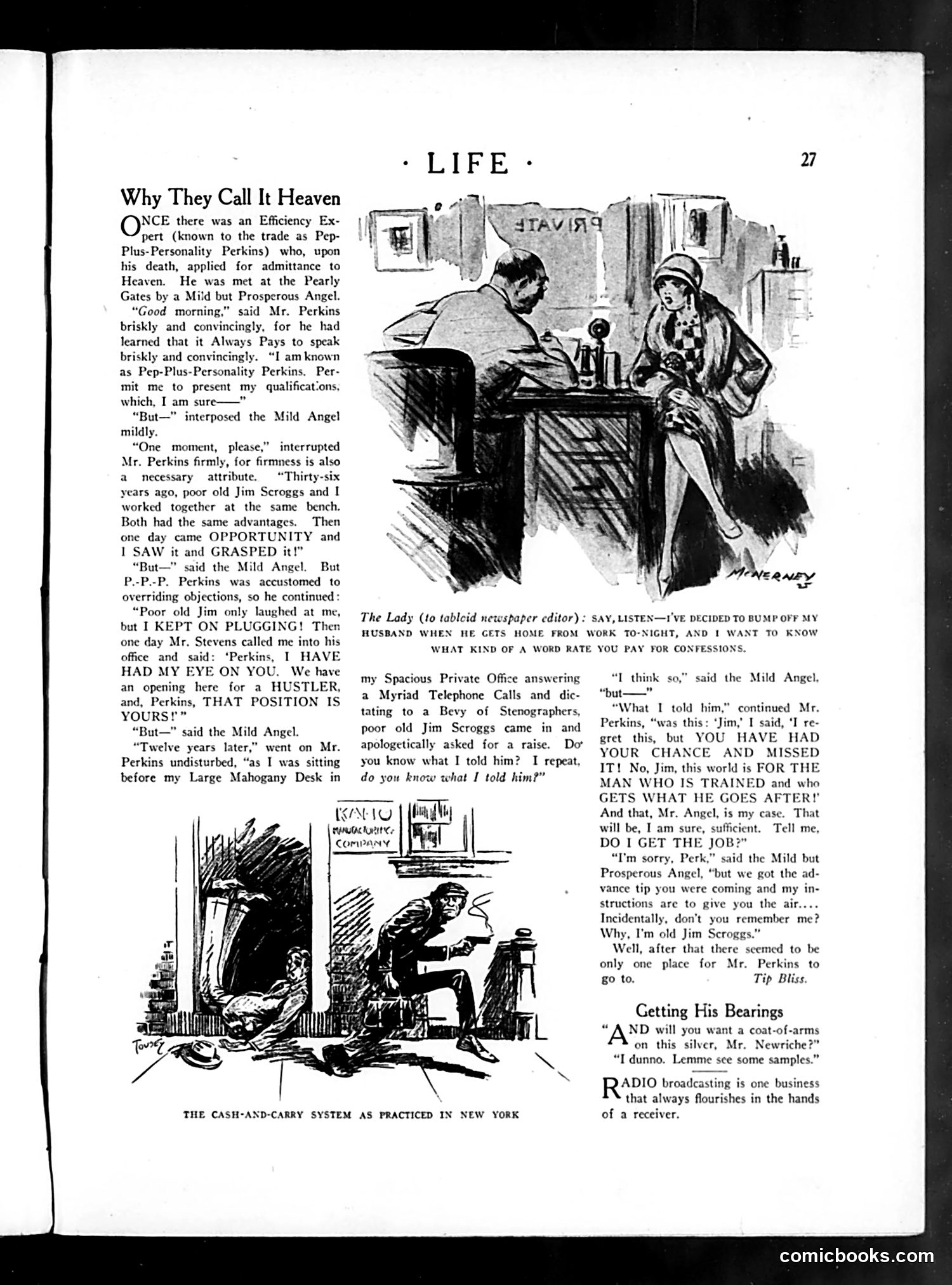
This page contains three distinct satirical pieces from Life magazine: **"Why They Call It Heaven"** is the main story, a morality tale mocking the "Efficiency Expert" archetype—corporate self-help culture personified by "Pep-Plus-Personality Perkins." The joke: Perkins boasts to an angel about his ruthless business success, only to discover the angel is Jim Scroggs, the poor coworker he refused to help. He's damned not to Hell literally, but to spend eternity with the person he wronged. It satirizes cutthroat 1920s business culture and its hollow "bootstraps" mentality. **"The Lady" cartoon** mocks tabloid newspapers' sensationalism—a woman casually discusses murdering her husband while negotiating payment rates with a newspaper editor, treating crime as commodity. **"Getting His Bearings"** ridicules "Newriche" (nouveau riche—newly wealthy people lacking class sophistication), suggesting they'll adopt heraldic symbols without understanding them. All three pieces target American commercialism, social climbing, and moral corruption disguised as success.
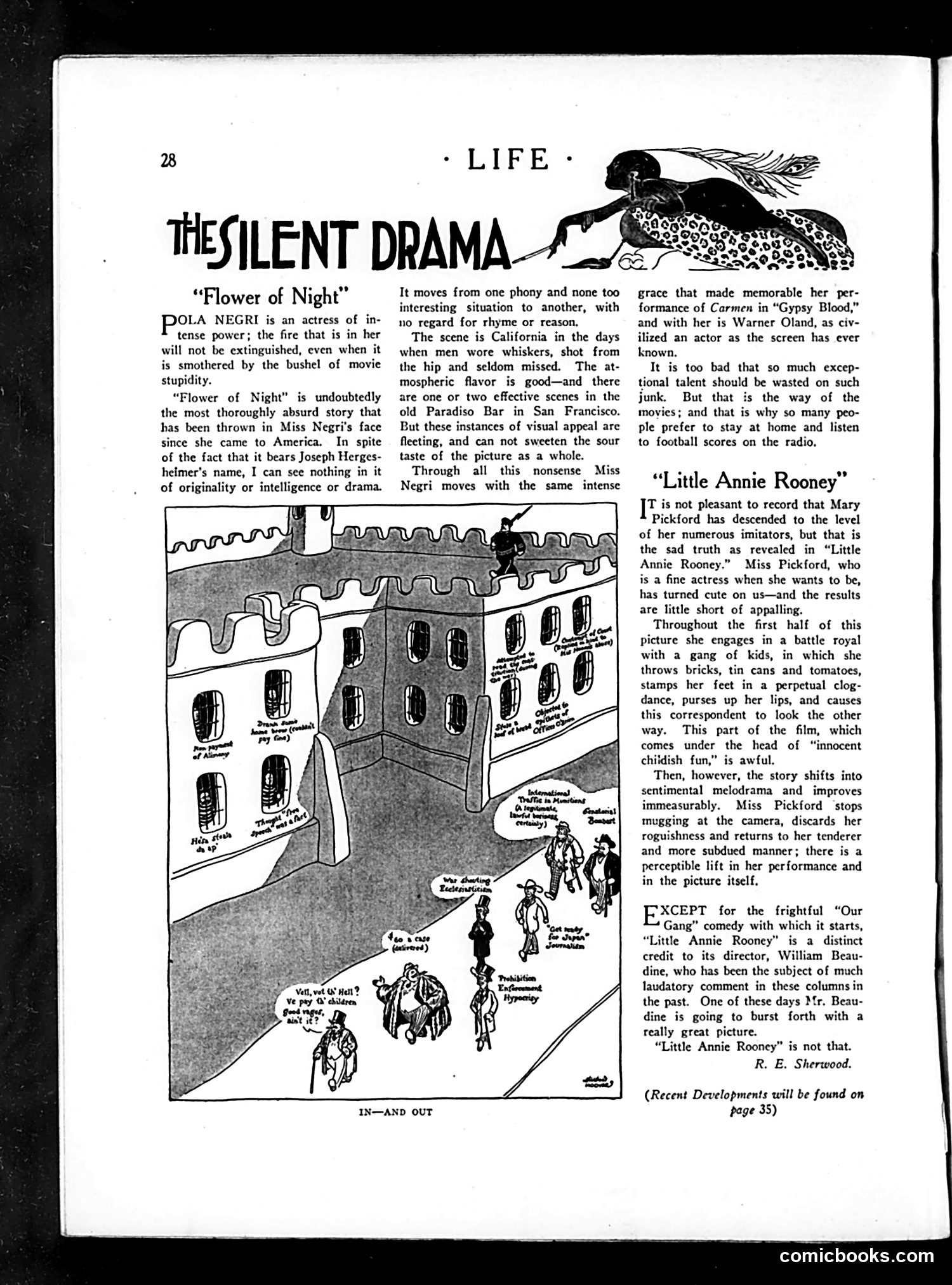
This page contains two film reviews from Life's "Silent Drama" column, critiquing contemporary movies. The illustration depicts a street scene labeled "IN—AND OUT," apparently visualizing the narrative structure of one film. **"Flower of Night"** reviews a vehicle for actress Pola Negri, set in Old West California. The critic praises Negri's intense performance and notes co-star Warner Oland's sophistication, but devastates the film itself as absurd and poorly constructed—adapted from author Joseph Hergesheimer's work yet lacking originality. The review suggests audiences prefer listening to radio football broadcasts at home rather than endure such "junk." **"Little Annie Rooney"** records Mary Pickford's apparent decline into cute mugging and slapstick, engaging in battles with child actors throwing objects. The reviewer finds this section "awful." However, the film improves when shifting to sentimental melodrama, allowing Pickford to display genuine acting ability. Director William Beaudine receives partial credit, though the critic suggests greater achievements await him. Both reviews reflect 1920s film criticism's emphasis on narrative coherence and serious acting craft.
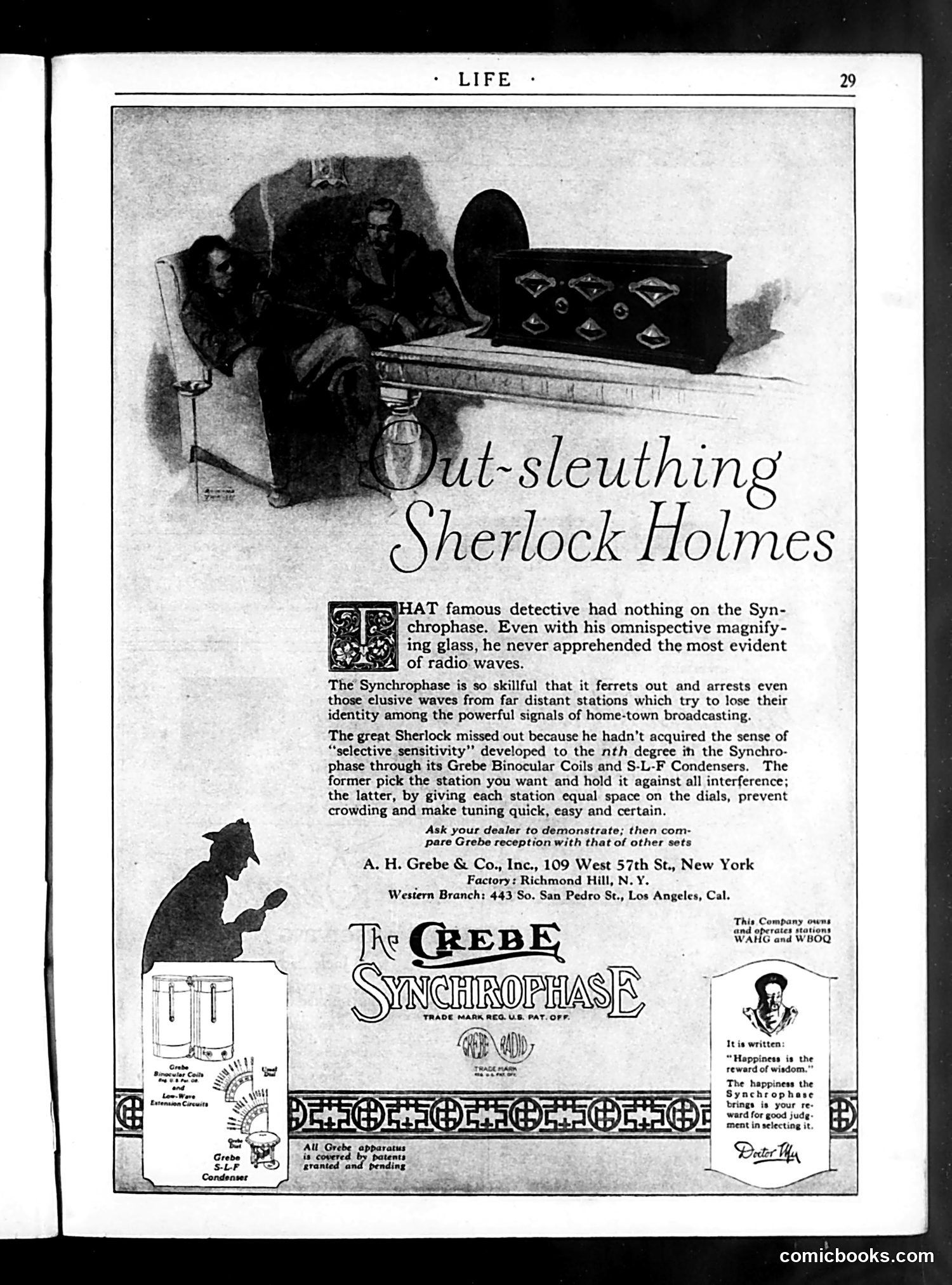
This is primarily a **product advertisement** for the Grebe Synchrophase radio receiver, appearing in *Life* magazine. The satire is gentle and playful rather than political. The ad compares the radio's tuning capabilities to **Sherlock Holmes's detective skills**, suggesting the Synchrophase is even more impressive at "detecting" distant radio stations than the famous fictional detective was at solving crimes. The humor plays on Holmes's reputation for extraordinary perception—the radio supposedly possesses superhuman "selective sensitivity" to isolate weak signals from interference. The advertisement targets early radio enthusiasts (this appears to be from the 1920s radio boom) by using a recognizable cultural reference to make their product seem almost magical. The Synchrophase's technical features—"Grebe Binocular Coils and S-L-F Condensers"—are presented as giving listeners unprecedented tuning precision. The joke is straightforward: **even Sherlock Holmes couldn't do what this radio can do**—making the product seem revolutionary to contemporary consumers.
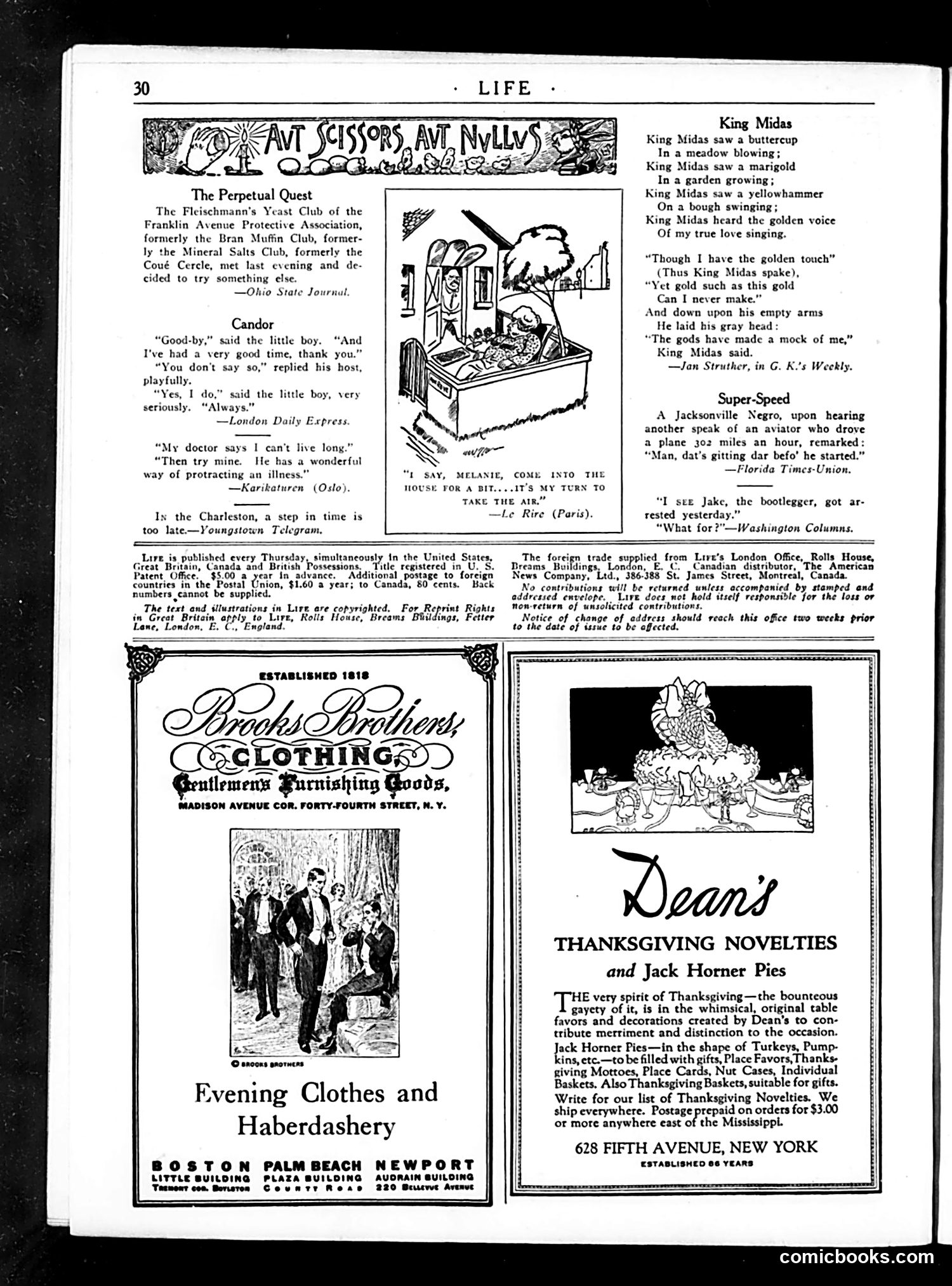
This page combines **short humorous pieces and advertisements** typical of Life's satirical format. The cartoons mock contemporary social trends and pretension: 1. **"The Perpetual Quest"** satirizes fad-chasing—a club that constantly reinvents itself (Fleischmann's Yeast Club, formerly Bran Muffin Club, etc.), poking fun at 1920s wellness crazes and self-improvement obsessions. 2. **"Candor"** and other brief jokes play on social awkwardness and irony—a child's brutal honesty, a doctor's dark humor. 3. **"King Midas"** retells the myth as commentary on materialism's limitations: even magical wealth cannot capture genuine human value (love, beauty). 4. **"Super-Speed"** mocks the aviation craze with a dialect joke about an aviator traveling so fast he "arrives before he started"—absurdist humor about modern speed obsession. The **Charleston reference** alludes to the popular 1920s dance, suggesting even dancing has gone too fast. The page primarily consists of **period advertisements** for Brooks Brothers clothing and Dean's Thanksgiving novelties, reflecting Life's dual purpose as satire and luxury-goods publication.
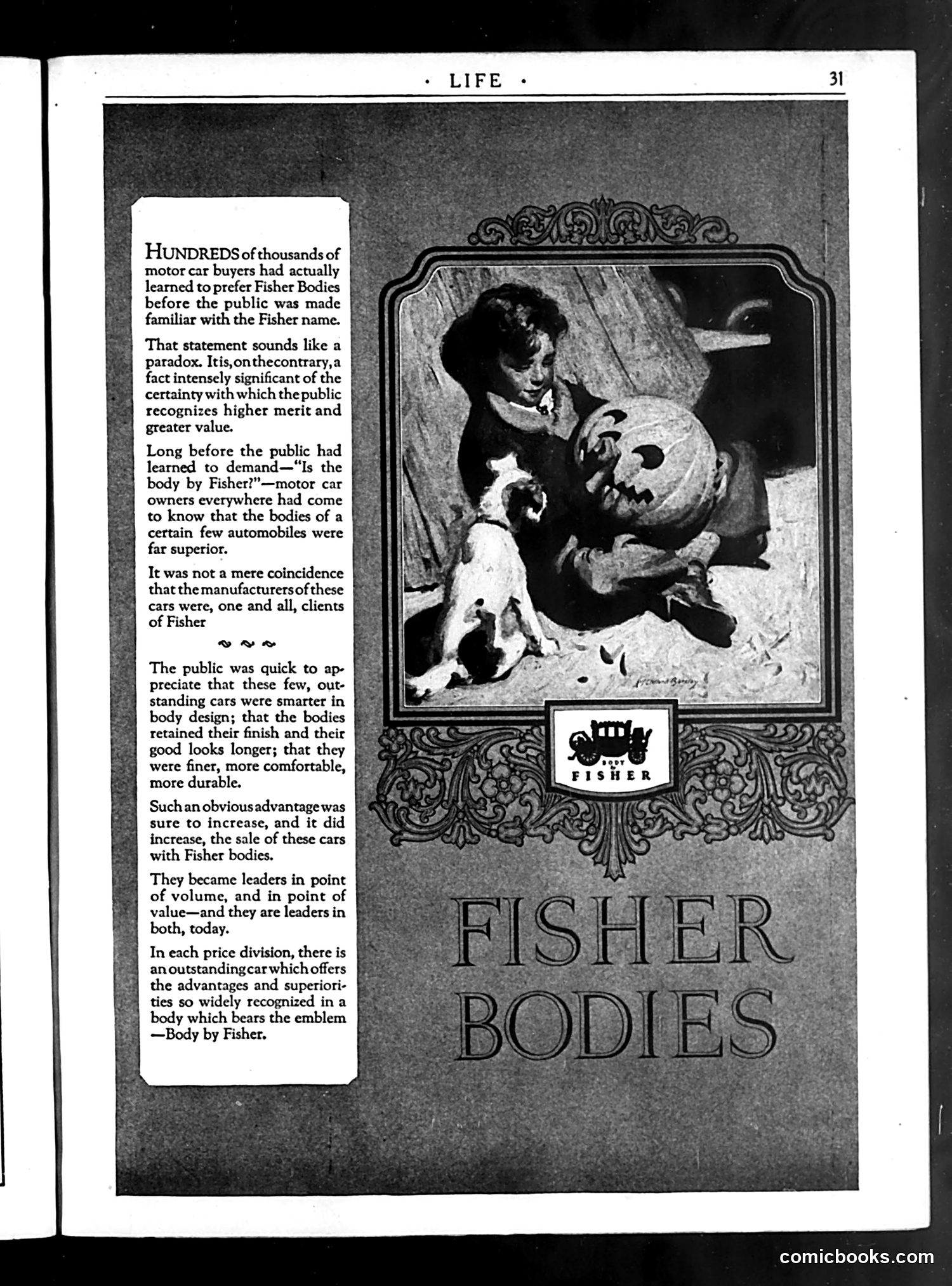
This is a **product advertisement**, not a political cartoon. It's a Fisher Body Company promotional piece from *Life* magazine promoting automobile bodies. The ad features a photograph of a woman and child admiring an automobile, with decorative Art Deco framing and the Fisher Bodies logo. The accompanying text argues that Fisher Bodies became prestigious *before* consumers knew the company's name—buyers simply recognized superior quality in cars using Fisher bodies. The rhetoric claims this demonstrates how the public instinctively appreciates craftsmanship: better design, durability, finish, and comfort. The ad positions Fisher as the premium choice across all price categories, using the paradox of "unknown brand preference" to suggest that excellence speaks for itself. This reflects early 1920s automobile marketing, when car bodies (the visible exterior) were increasingly important selling points as mechanically, competing vehicles became similar. The emotional appeal to the family suggests stability and trust.
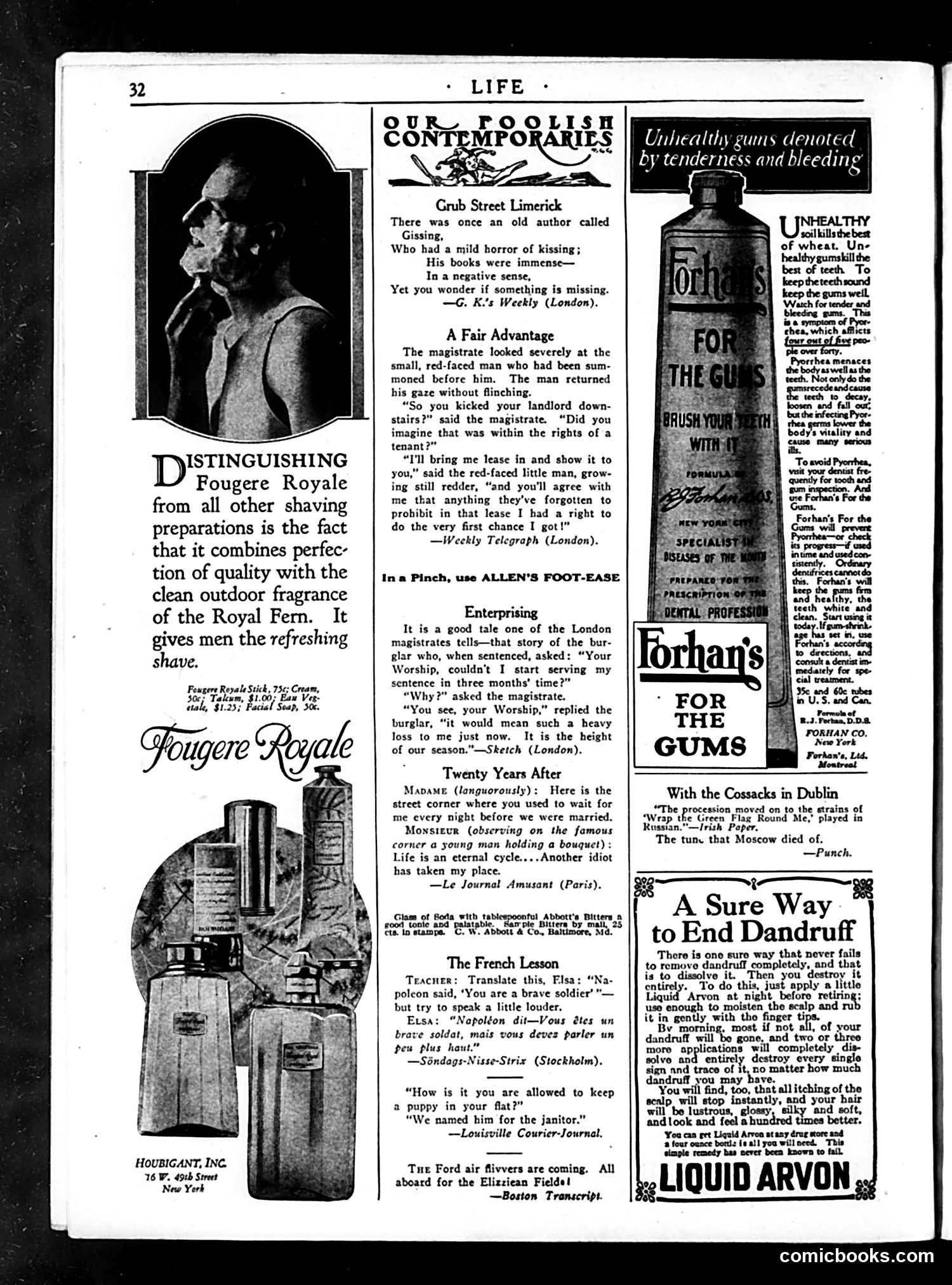
This page combines satirical humor with period advertising, typical of Life magazine's format. The left side features **Fougère Royale shaving cream advertising** alongside humor pieces drawn from international publications (London's *Sketch*, Paris's *Le Journal Amusant*, etc.). The cartoons mock everyday absurdities: a tenant arguing his lease permits kicking his landlord downstairs; a burglar requesting delayed sentencing because "it's our busy season"; a couple revisiting their courtship spot to find another man with flowers in the same position—"Life is an eternal cycle." The right side contains patent medicines and remedies (Forhan's gum treatment, Liquid Arvon dandruff cure)—standard advertising for the era when such products made unregulated health claims. A joke references **Irish reaction to the Russian Revolution**: the melody "Wrap the Green Flag Round Me" played by Cossacks in Dublin is sardonically called "the tune that Moscow died of"—mocking both Russian communism and Irish politics. The humor reflects 1920s concerns: marriage, class tensions, and contemporary geopolitical upheaval.
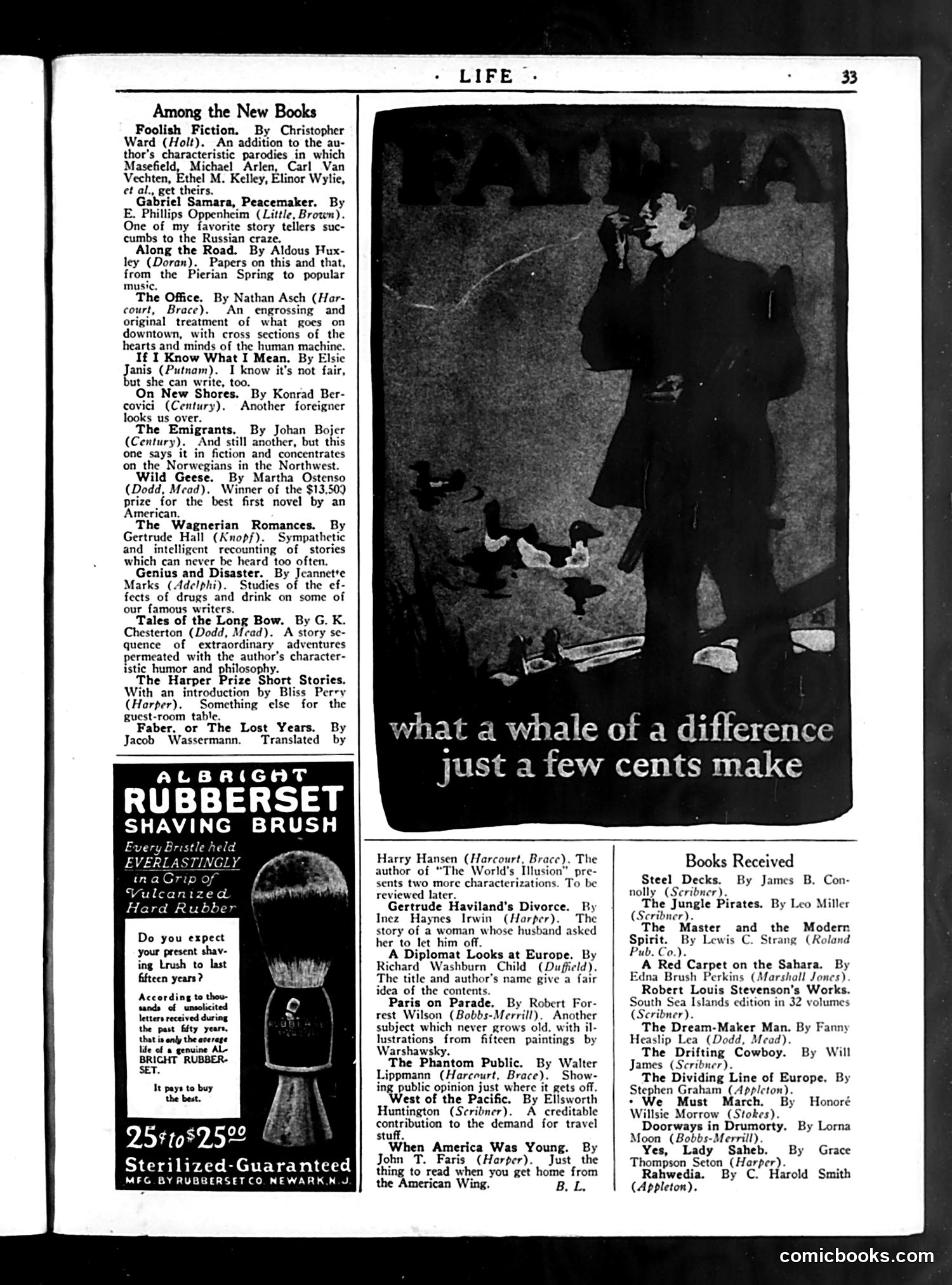
This page consists primarily of a **book review section** listing newly published novels and received books from the early 1920s. The reviews are brief, often witty dismissals—notably mocking authors succumbing to trends like "the Russian craze" and foreign writers observing America. The only visual content is a **Rubberset shaving brush advertisement** featuring a product shot and a separate advertisement showing two men in profile with the caption "what a whale of a difference just a few cents make"—a typical consumer goods pitch emphasizing value. There is **no political cartoon** on this page. The page reflects the literary zeitgeist of early 1920s America: interest in modernist writers (Huxley, Lippmann), concern about foreign perspectives on American society, and celebration of American literary achievements (the $13,500 prize for Martha Ostenso's *Wild Geese*).
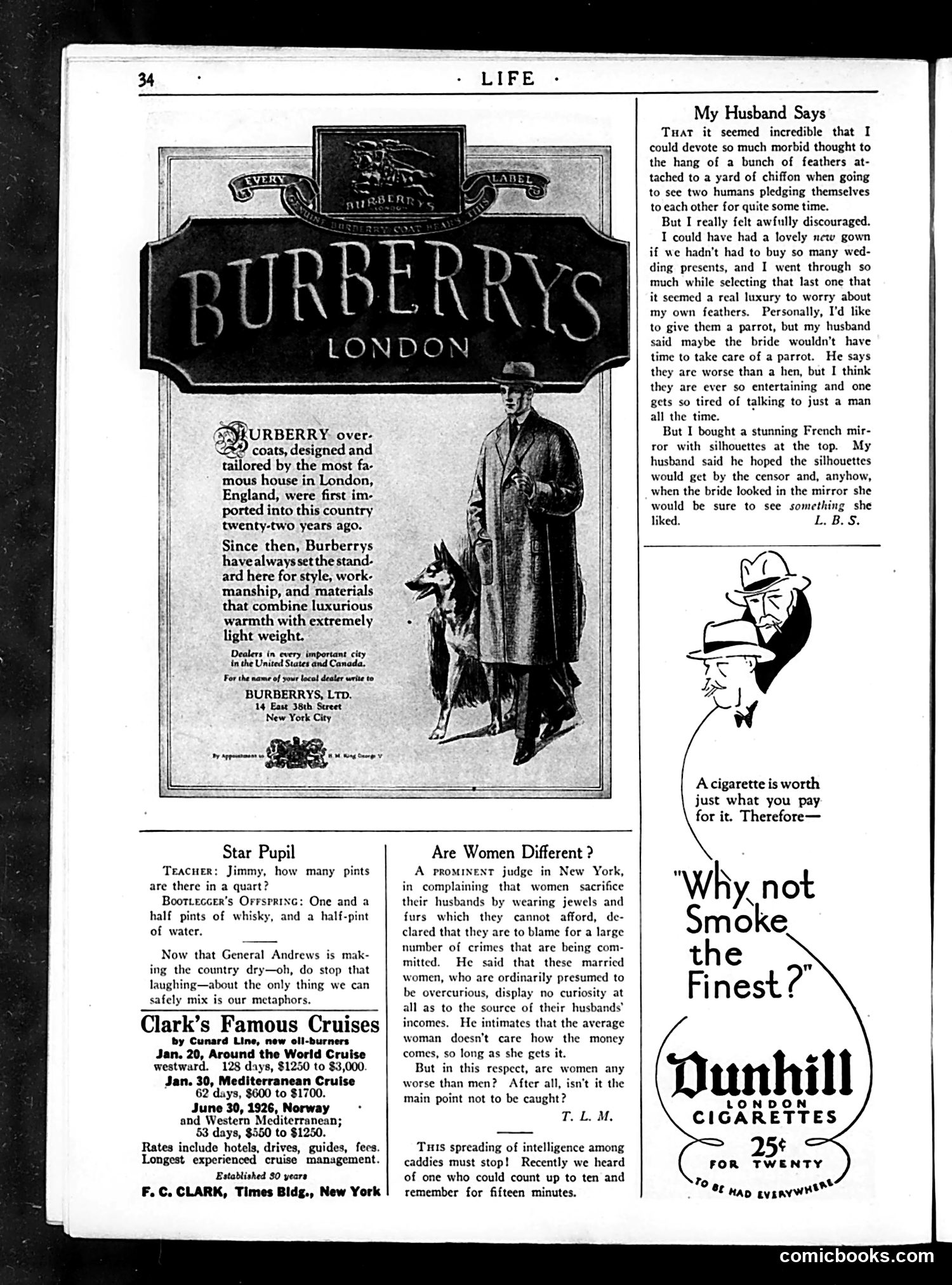
This page contains **advertisements and humor pieces** reflecting 1920s American social attitudes. The **"Star Pupil" joke** satirizes Prohibition (enacted 1920). A teacher asks a student about liquid measurements; the bootlegger's son answers using whiskey and water instead of standard pints/quarts. The humor mocks both Prohibition's failure and widespread illegal alcohol consumption—the joke assumes readers find bootlegging commonplace. **"Are Women Different?"** presents a judge's complaint that wives don't question husbands' income sources, implying women cause crime by enabling it through extravagance. The author defends women by asking whether men are equally culpable for not asking uncomfortable questions—a sardonic commentary on gender hypocrisy. **"My Husband Says"** humorously describes wedding gift anxiety, with the husband making crude jokes about a mirror's "silhouettes" potentially offending censors—reflecting contemporary concerns about obscenity standards. The **advertisements** (Burberrys, cruises, Dunhill cigarettes) target wealthy readers, establishing the magazine's upscale audience.
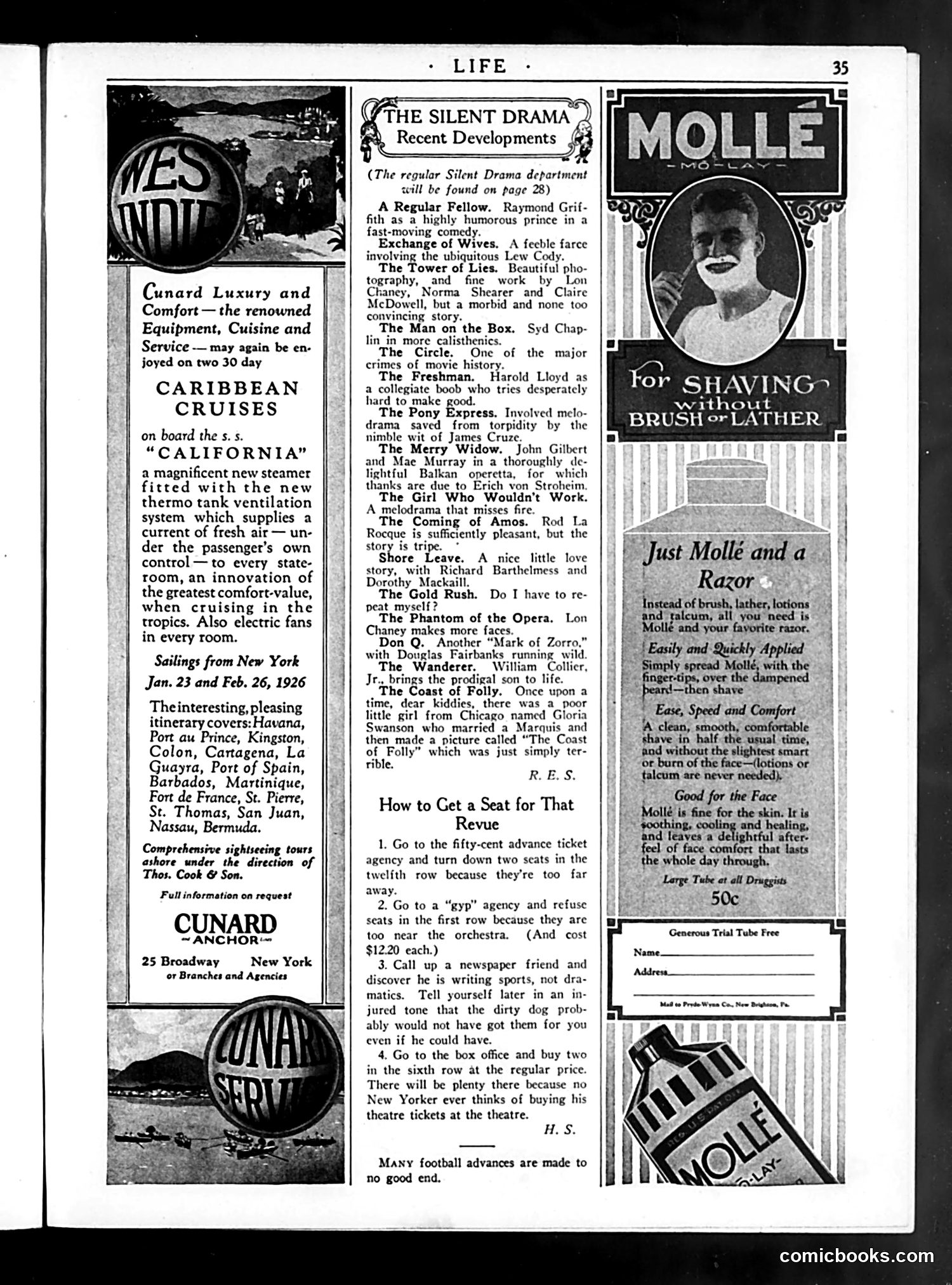
This page is primarily **advertising and entertainment reviews**, not political satire. The main content includes: **Cunard cruise advertisements** featuring the S.S. "California" offering Caribbean voyages—typical luxury travel marketing for wealthy 1920s readers. **"The Silent Drama" section** reviews contemporary silent films (Harold Lloyd's "The Freshman," Charlie Chaplin's "The Gold Rush," etc.), with generally dismissive commentary. The reviews mock some films as tedious or poorly conceived—standard entertainment criticism. **A humorous how-to article** on securing Broadway revue tickets satirizes New York theater-goers' behavior: rejecting good seats as "too far" or "too near," calling newspaper friends expecting favors, then finally buying regular box office tickets—poking fun at New Yorkers' impractical theater-going habits. **Mollé shaving cream advertisement** featuring a woman's face, promoting brushless shaving. The page reflects 1920s consumer culture and entertainment, with no significant political content or social commentary beyond light mockery of theater-patron pretension.
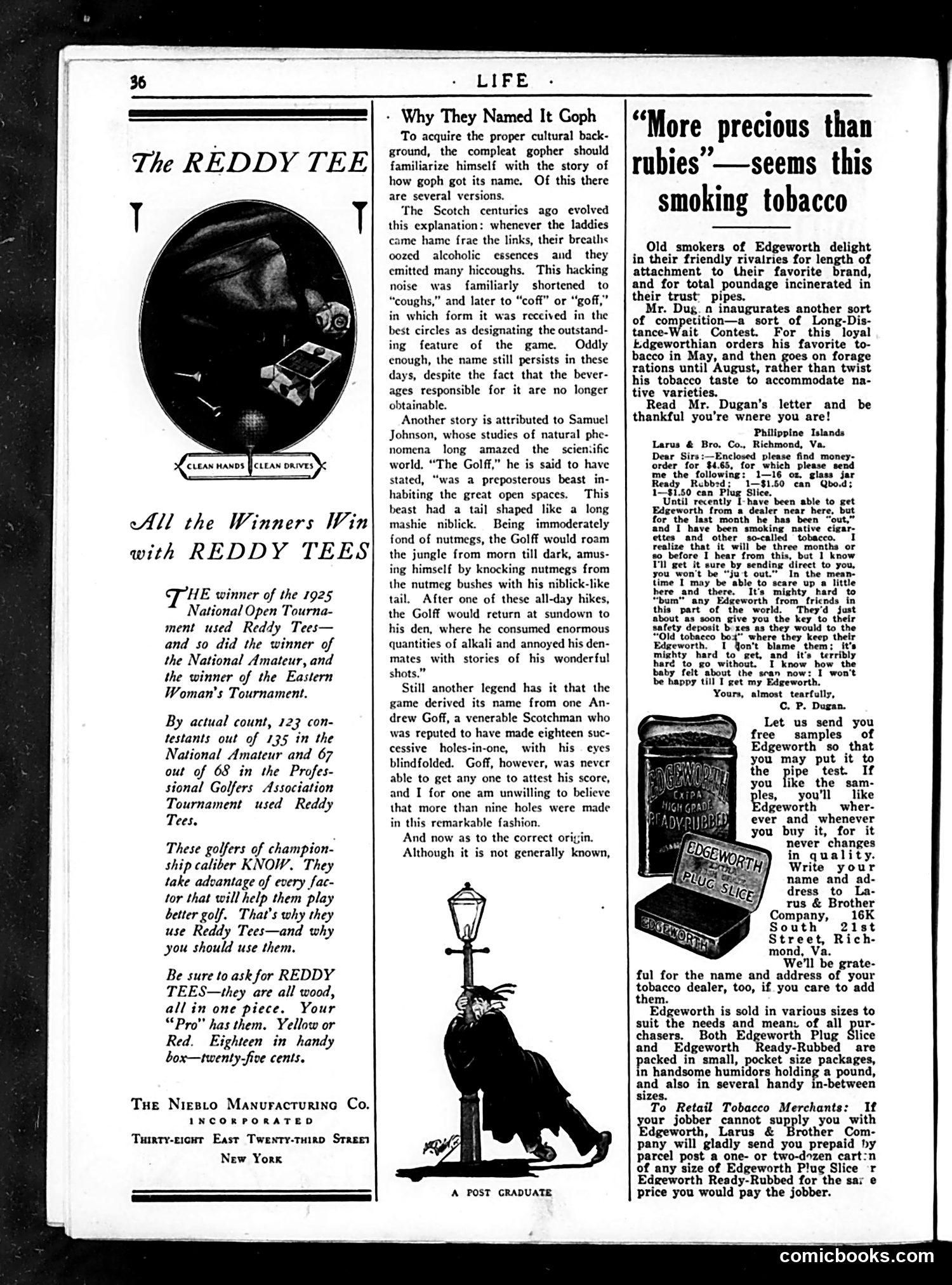
This page contains two unrelated advertisements from a 1925 *Life* magazine issue. **Left side:** An ad for "Reddy Tees" (golf tees). The copy emphasizes that professional golfers—winners of major tournaments—used this product, claiming 123 of 135 amateur contestants and 67 of 68 professionals used them. The appeal is straightforward: championship golfers know best, so you should too. The product was wooden, affordable (25 cents), and came in yellow or red. **Right side:** An ad for Edgeworth pipe tobacco, featuring a humorous letter from a customer in the Philippine Islands describing his loyalty to the brand—he orders it in bulk in May to last until August rather than smoke inferior local alternatives. The ad includes satirical "origin stories" of golf's name (referencing "goph"), mixing absurdist humor with Scottish vernacular. Both ads use *Life's* satirical voice to sell products through appeals to aspiration and loyalty rather than functional benefits.
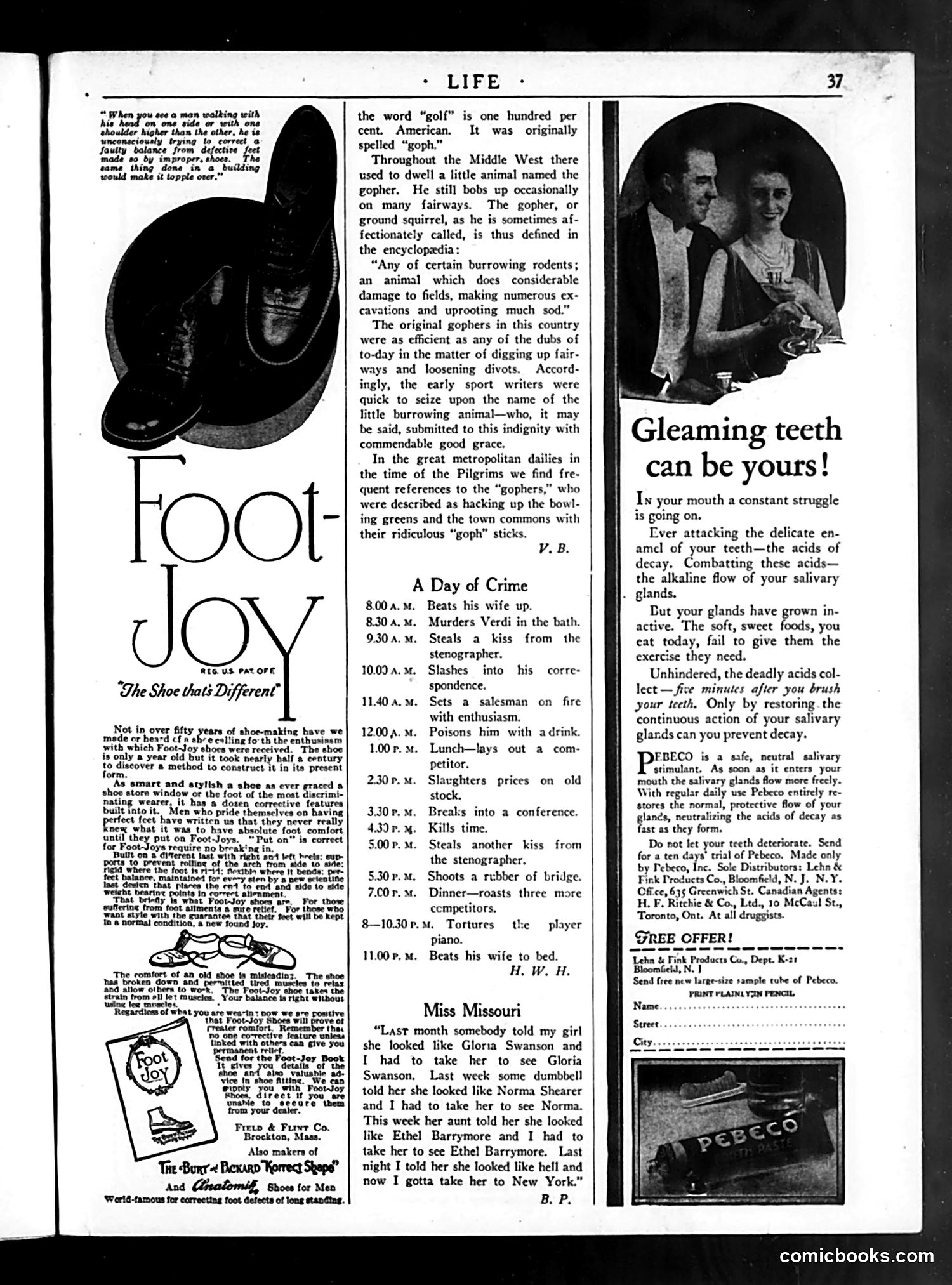
This page from *Life* magazine contains several satirical pieces typical of the publication's humor: **"Foot-Joy" Advertisement**: A shoe company ad claiming their product corrects foot defects—typical early 20th-century advertising making exaggerated health claims. **"A Day of Crime"**: A humorous timeline satirizing urban professional life. Actions like "beats his wife," "murders Verdi in the bath," and "poisons him with a drink" use violent language metaphorically for ordinary business activities ("sets a salesman on fire with enthusiasm," "slaughters prices"). The joke mocks the intensity and moral flexibility of competitive business culture. **"Miss Missouri"**: A joke about a boyfriend constantly taking his girlfriend to see movies because strangers compare her to famous actresses (Gloria Swanson, Norma Shearer, Ethel Barrymore). The punchline—he finally tells her she looks "like hell" and now must take her to New York—satirizes both cinema obsession and dating frustrations. **Golf/Gopher Etymology**: An educational humor piece explaining how "golf" derives from "gopher," the burrowing animal that damages fairways—playing on language evolution. The page primarily showcases *Life*'s characteristic blend of advertising, light satire, and joke humor.
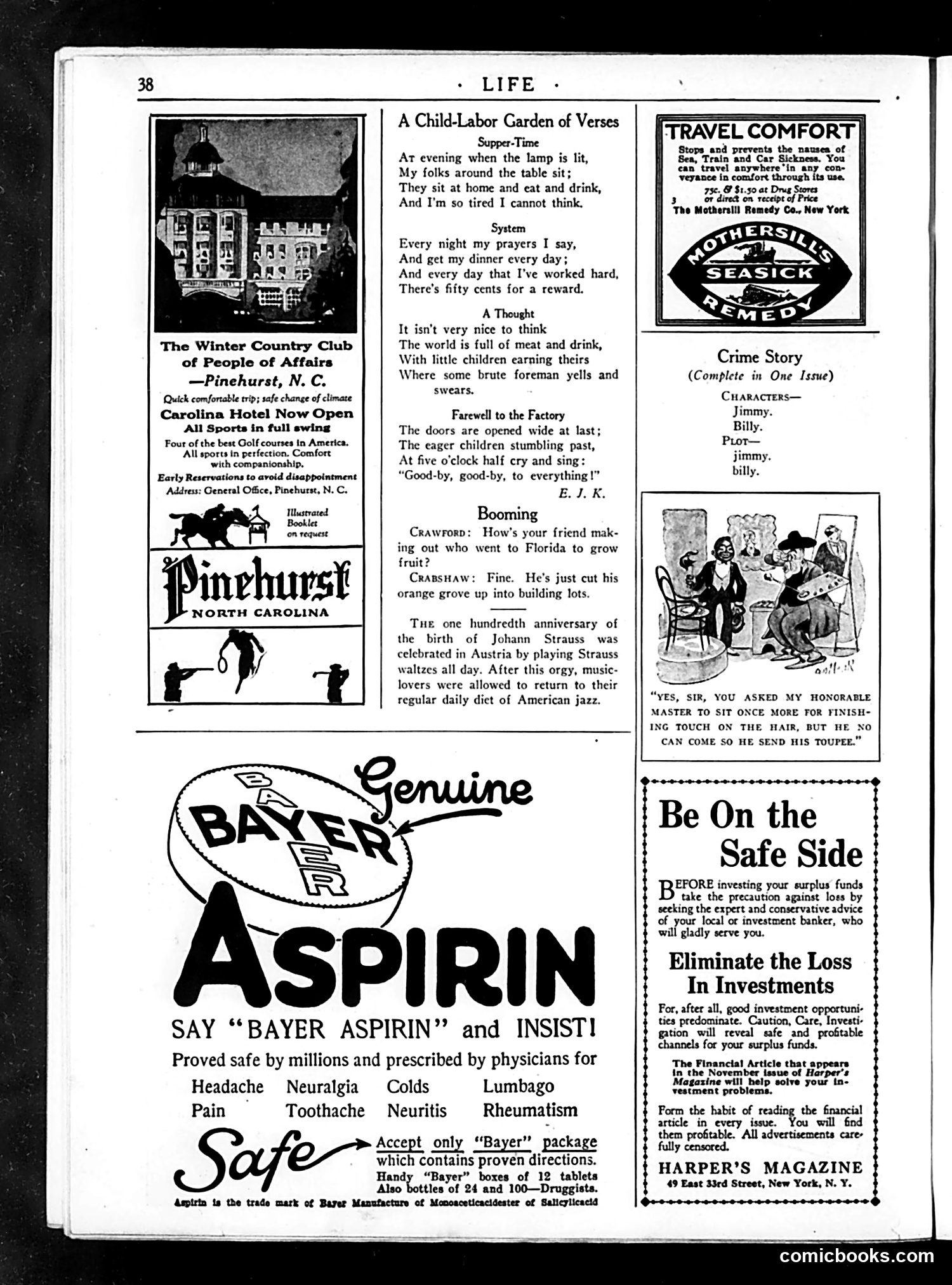
This page contains **social satire about child labor** alongside period advertisements. The central feature, "A Child-Labor Garden of Verses," presents a series of brief poems depicting the exhaustion and exploitation of working children. Poems like "Supper-Time" show children too tired to think after labor, "System" describes earning fifty cents as reward for hard work, and "Farewell to the Factory" captures children's relief at leaving brutal working conditions where "brute foreman[s]" yell at them. The satire works by framing these grim realities in the gentle form of children's verse—the contrast between the innocent genre and the harsh content highlights the cruelty of child labor practices that were common in early 20th-century America. Surrounding this are period advertisements for luxury travel, aspirin, and investment advice—creating an ironic juxtaposition between the privileged leisure world advertised and the exploited child workers depicted in the verse. This editorial placement appears intentionally designed to criticize social inequality.
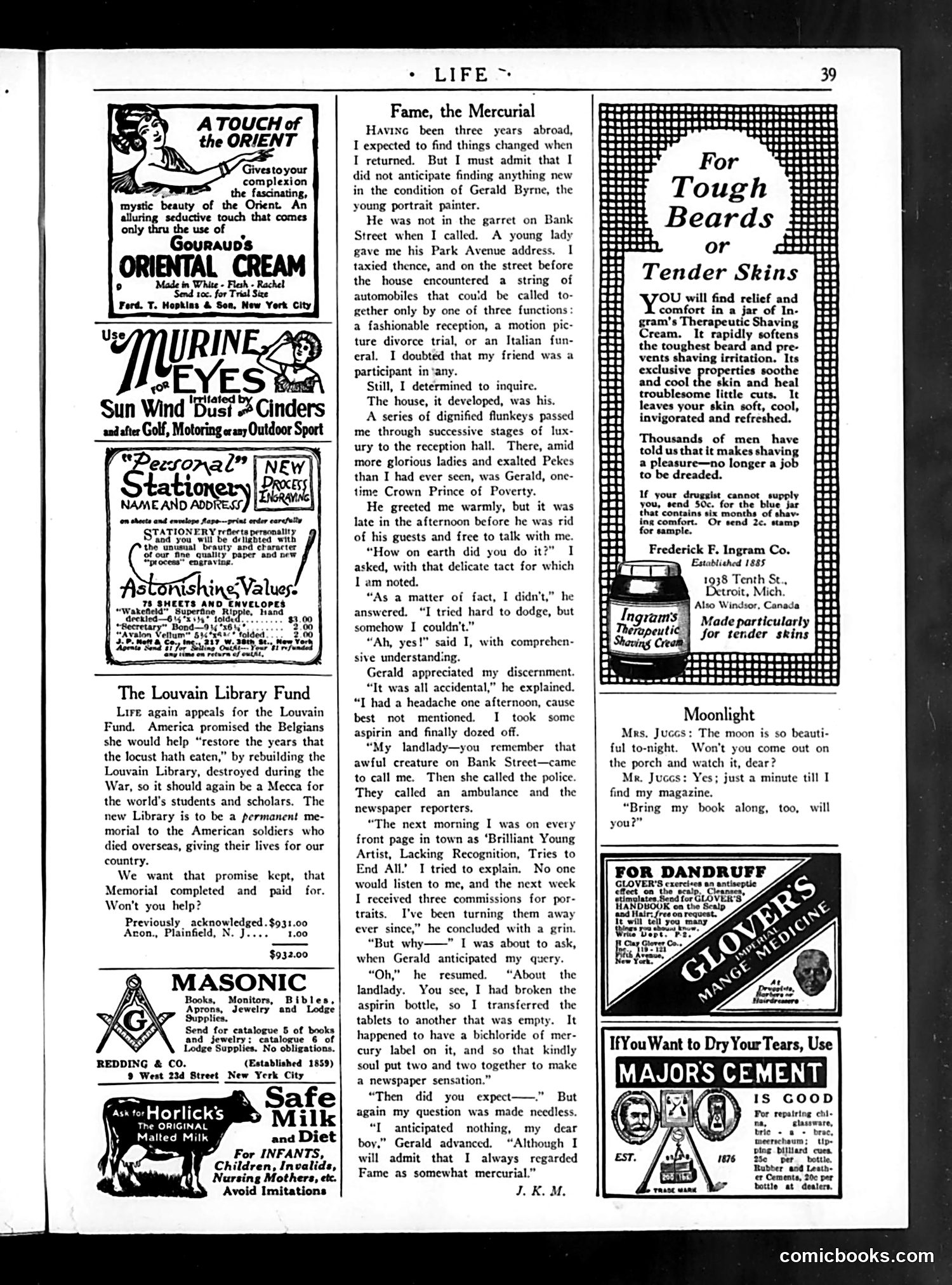
This short story satirizes how **fame and success can arrive through pure accident rather than merit**. The protagonist, Gerald Byrne, is a struggling portrait painter living in poverty on Bank Street. After taking aspirin for a headache, he falls asleep. His landlady discovers an empty bottle labeled with a bichloride of mercury (a poison) and calls police, assuming he attempted suicide. This triggers newspaper headlines proclaiming him a "Brilliant Young Artist, Lacking Recognition, Tries to End All." The irony: the resulting publicity—built entirely on a false suicide attempt—generates three portrait commissions, transforming him into a wealthy, successful man living on Park Avenue surrounded by luxury and society. The story's title, "Fame, the Mercurial," puns on both Mercury (the Roman god of commerce and trickery) and the literal mercury poisoning misunderstanding. It mocks how **arbitrary and undeserved success can be**, and how **public perception matters more than actual talent or circumstance**. Modern readers would recognize this as an early satire of manufactured celebrity.
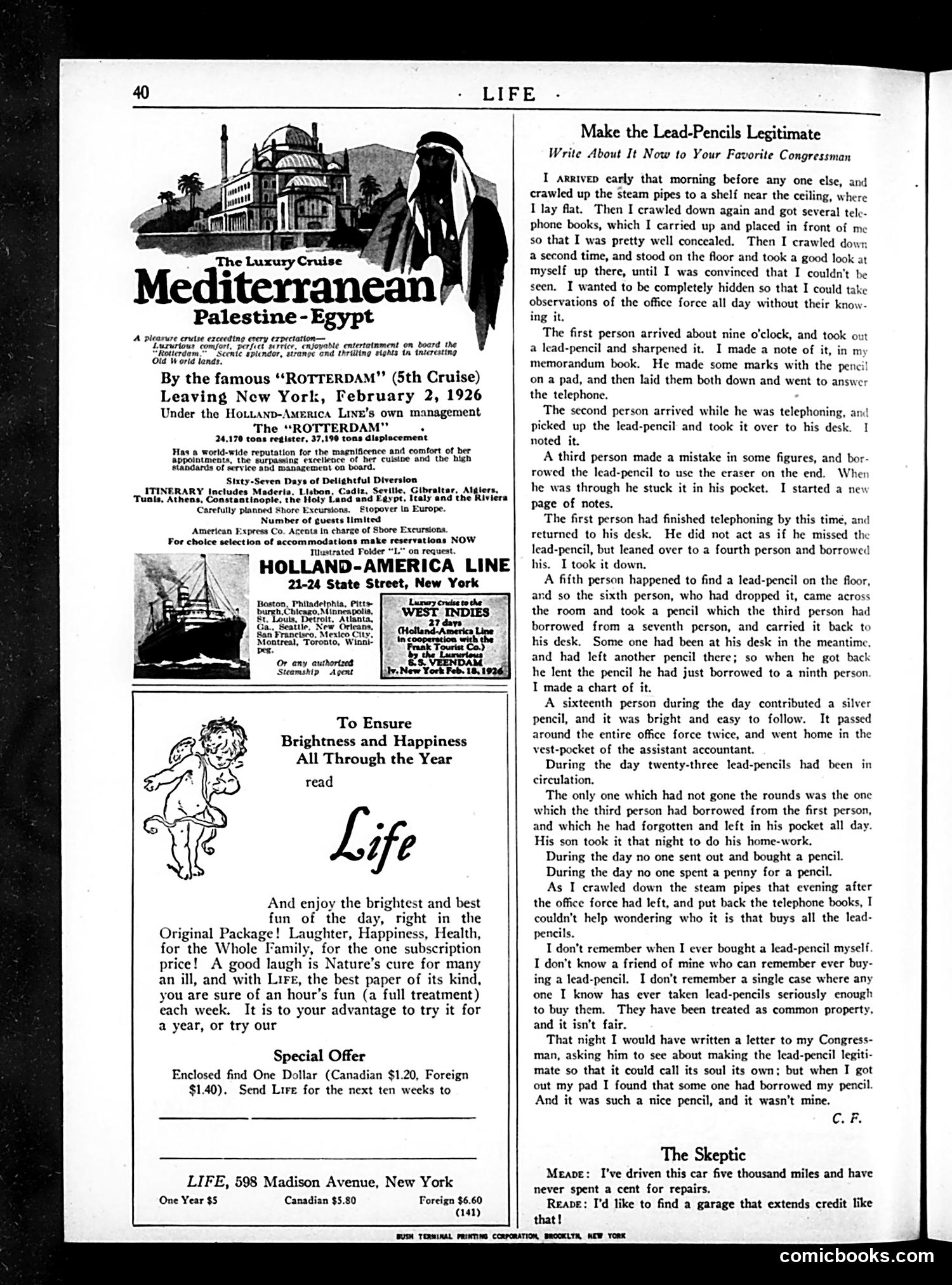
This satirical article mocks office inefficiency and petty theft. The unnamed narrator hides in an office to document how a single lead-pencil circulates among coworkers throughout the day—borrowed, misplaced, and repeatedly exchanged without anyone purchasing replacements. The piece is a humorous critique of workplace culture: employees casually "steal" shared supplies rather than buying their own, treating office property as communal. The author suggests this casual pilferage should be addressed by Congress, ironically elevating minor office misconduct to the level of legislative concern. The satire targets both employee dishonesty and the absurdity of treating pencil-borrowing as a serious issue worthy of congressional action—a comedic exaggeration typical of Life magazine's satirical style, highlighting everyday workplace hypocrisy and minor moral compromises.
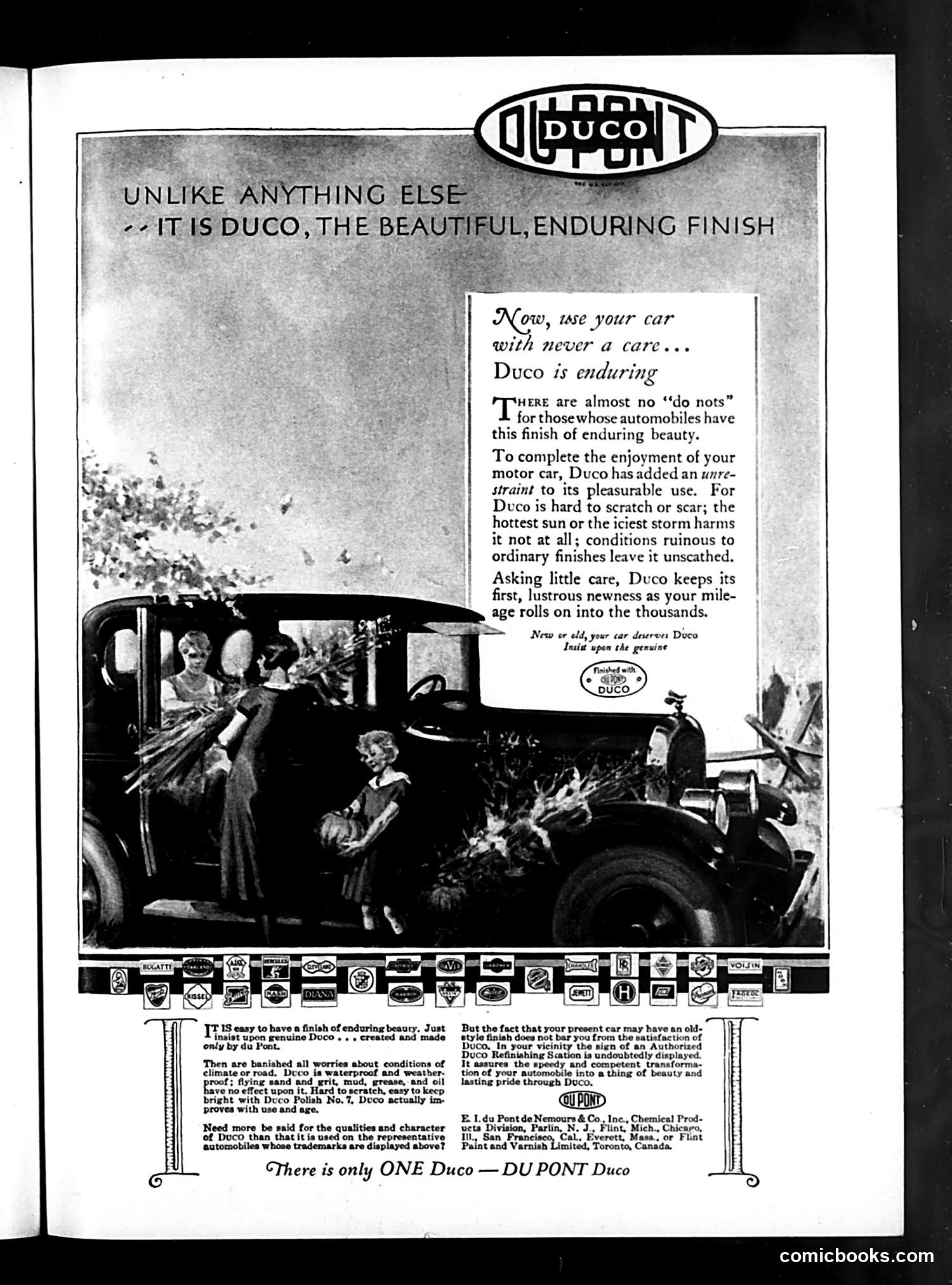
This is primarily a **DuPont company advertisement** for Duco, an automobile paint/lacquer finish, not a political cartoon. The page promotes Duco's durability and aesthetic qualities to car owners. The imagery shows a vintage automobile (appears to be 1920s-era) with well-dressed passengers, emphasizing the product's ability to maintain a lustrous appearance despite weathering, sun exposure, and wear. The advertisement stresses that Duco requires minimal maintenance while resisting scratches, fading, and environmental damage better than competing finishes. The lower section displays automotive manufacturer logos (Bugatti, Packard, and others), suggesting these prestigious brands used Duco finishes—a marketing strategy leveraging endorsements. The ad encourages owners of older cars to have their vehicles refinished with Duco at authorized DuPont refinishing stations. This reflects early 20th-century consumer marketing emphasizing product superiority and durability.
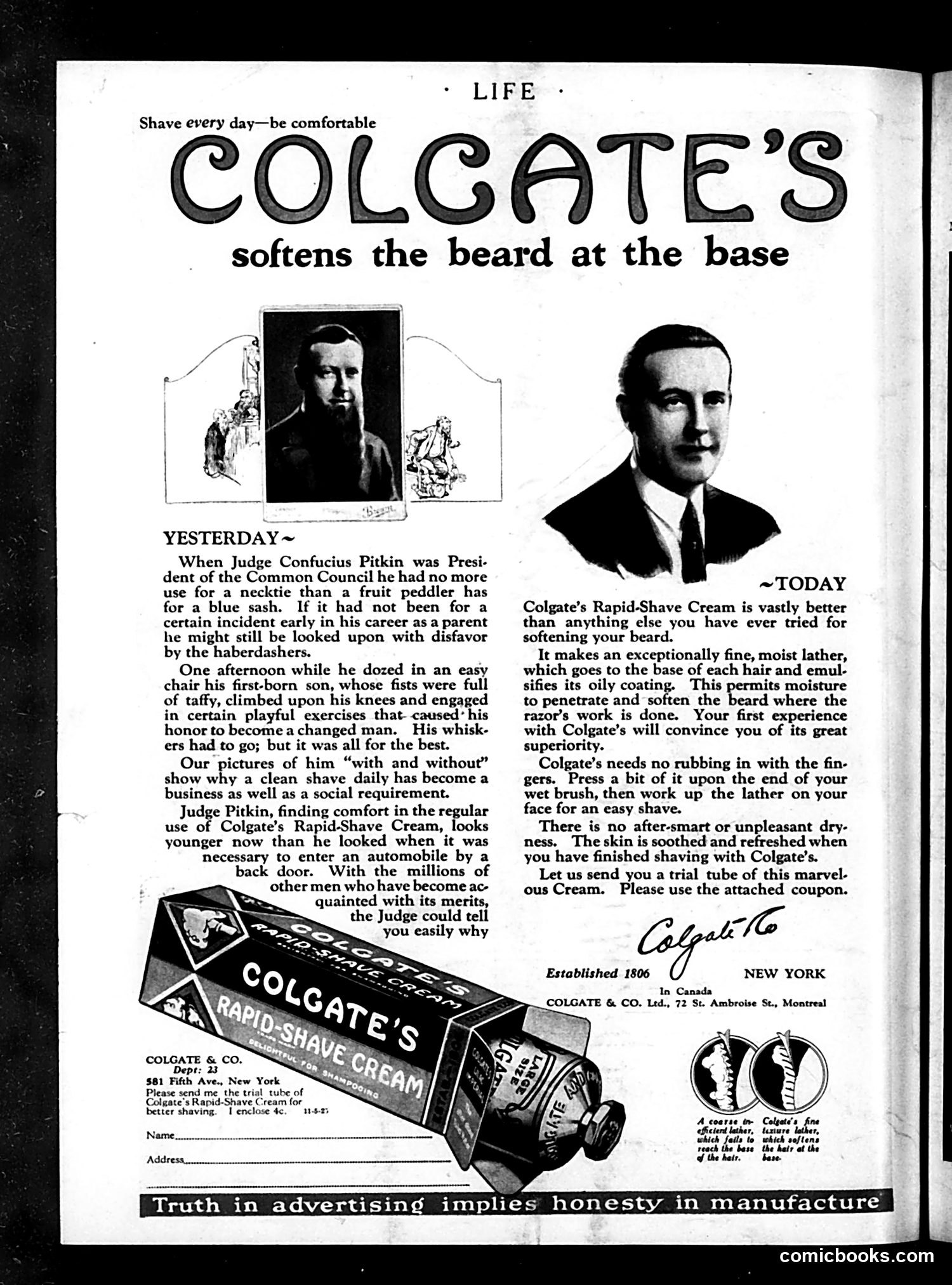
This is primarily a **shaving cream advertisement**, not political satire. The page uses a humorous narrative to pitch the product. The joke centers on "Judge Confucius Pitkin," a fictional character (the name combines a Chinese philosopher with an ordinary American surname for comic effect). The story contrasts his past—when he kept an unkempt beard and was viewed unfavorably by respectable society—with his present after discovering Colgate's cream. A key moment: his young son, sticky with taffy, climbed on his lap, prompting Pitkin to finally shave regularly to maintain dignity. The advertisement's logic: regular shaving becomes both a business and social necessity for respectability. The product supposedly provides superior beard-softening, easier application, and no skin irritation. The accompanying photographs show the same man "with and without" a beard, demonstrating the transformative effect. The fine print offers a trial tube coupon. This reflects early-20th-century advertising strategy: using relatable domestic narratives to sell grooming products by linking them to social status and masculine respectability.