
Life, 1925-11-05 · page 36 of 50
Life — November 5, 1925 — page 36: what you’re looking at
What you’re looking at
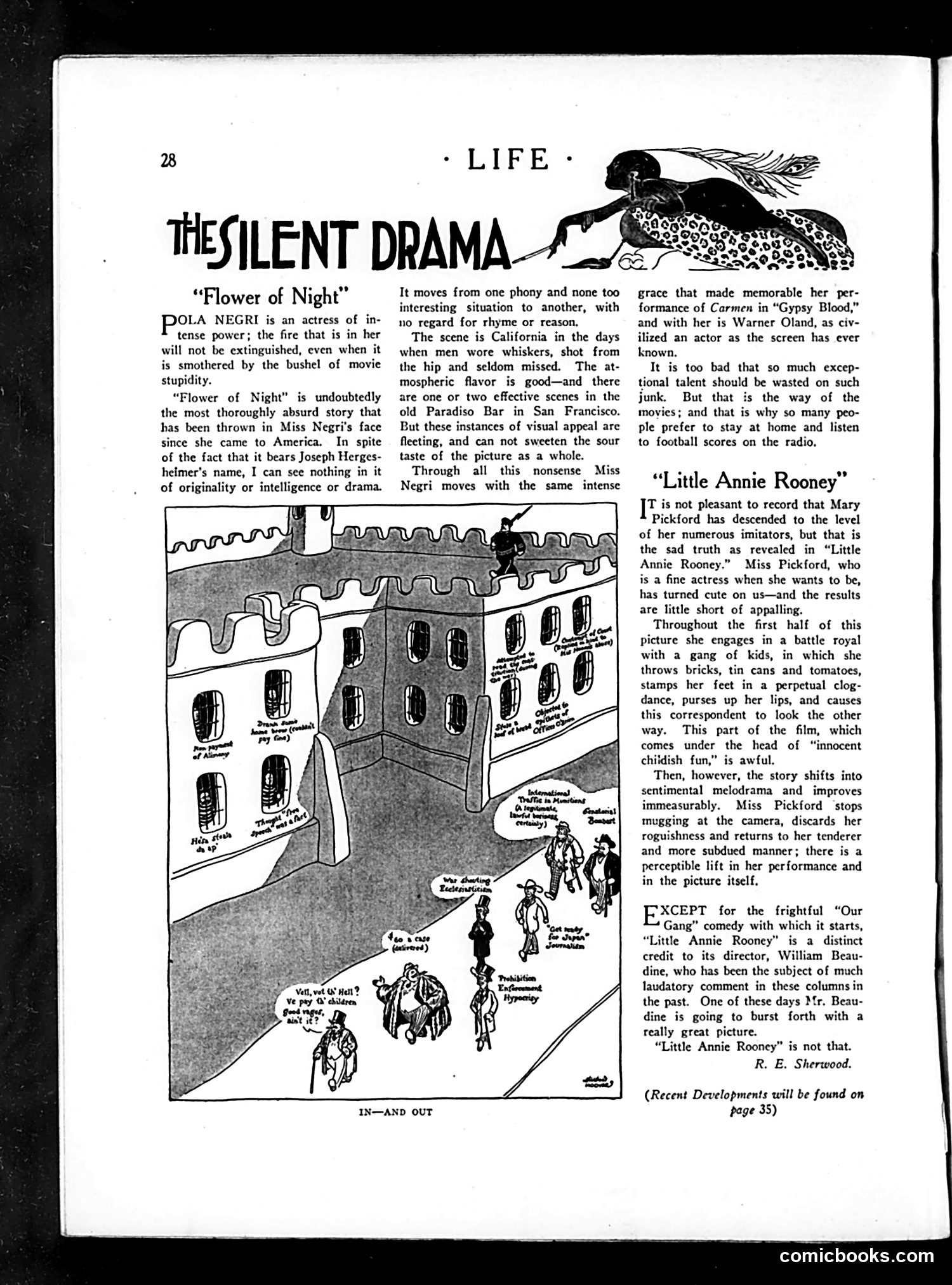
This page contains two film reviews from Life's "Silent Drama" column, critiquing contemporary movies. The illustration depicts a street scene labeled "IN—AND OUT," apparently visualizing the narrative structure of one film. **"Flower of Night"** reviews a vehicle for actress Pola Negri, set in Old West California. The critic praises Negri's intense performance and notes co-star Warner Oland's sophistication, but devastates the film itself as absurd and poorly constructed—adapted from author Joseph Hergesheimer's work yet lacking originality. The review suggests audiences prefer listening to radio football broadcasts at home rather than endure such "junk." **"Little Annie Rooney"** records Mary Pickford's apparent decline into cute mugging and slapstick, engaging in battles with child actors throwing objects. The reviewer finds this section "awful." However, the film improves when shifting to sentimental melodrama, allowing Pickford to display genuine acting ability. Director William Beaudine receives partial credit, though the critic suggests greater achievements await him. Both reviews reflect 1920s film criticism's emphasis on narrative coherence and serious acting craft.
📄 Transcribed text from this page (OCR, searchable)
Machine-transcribed from the original scan — historical spelling and the odd misread are preserved.
28 «* LURE * THES|LENT DRAMA “Flower of Night” OLA NEGRI is an actress of in- tense power; the fire that is in her will not be extinguished, even when it is smothered by the bushel of movie stupidity. “Flower of Night” is undoubtedly the most thoroughly absurd story that has been thrown in Miss Negri’s face since she came to America. In spite of the fact that it bears Joseph Herges- heimer’s name, I can see nothing in it of originality or intelligence or drama. Fett, vot 8 Hell? Ve pay (children Egos tis It moves from one phony and none too interesting situation to another, with no regard for rhyme or reason. The scene is California in the days when men wore whiskers, shot from the hip and seldom missed. The at- mospheric flavor is good—and there are one or two effective scenes in the old Paradiso Bar in San Francisco. But these instances of visual appeal are fleeting, and can not sweeten the sour taste of the picture as a whole. Through all this nonsense Miss Negri moves with the same intense IN—AND OUT grace that made memorable her per- formance of Carmen in “Gypsy Blood,” and with her is Warner Oland, as civ- ilized an actor as the screen has ever known, It is too bad that so much excep- tional talent should be wasted on such junk. But that is the way of the movies; and that is why so many peo- ple prefer to stay at home and listen to football scores on the radio. “Little Annie Rooney” [-. is not pleasant to record that Mary Pickford has descended to the level of her numerous imitators, but that is the sad truth as revealed in “Little Annie Rooney.” Miss Pickford, who is a fine actress when she wants to be, has turned cute on us—and the results are little short of appalling. Throughout the first half of this picture she engages in a battle royal with a gang of kids, in which she throws bricks, tin cans and tomatoes, stamps her feet in a perpetual clog- dance, purses up her lips, and causes this correspondent to look the other way. This part of the film, which comes under the head of “innocent childish fun,” is awful. Then, however, the story shifts into sentimental melodrama and improves immeasurably. Miss Pickford ‘stops mugging at the camera, discards her roguishness and returns to her tenderer and more subdued manner; there is a perceptible lift in her performance and in the picture itself. EXCEPT for the frightful “Our Gang” comedy with which it starts, “Little Annie Rooney” is a distinct credit to its director, William Beau- dine, who has been the subject of much laudatory comment in these columns in the past. One of these days Mr. Beau- dine is going to burst forth with a really great picture. “Little Annie Rooney” is not that. R. E. Sherwood. (Recent Developments will be found on page 35) comicbooks.com