
Life, 1925-11-05 · page 26 of 50
Life — November 5, 1925 — page 26: what you’re looking at
What you’re looking at
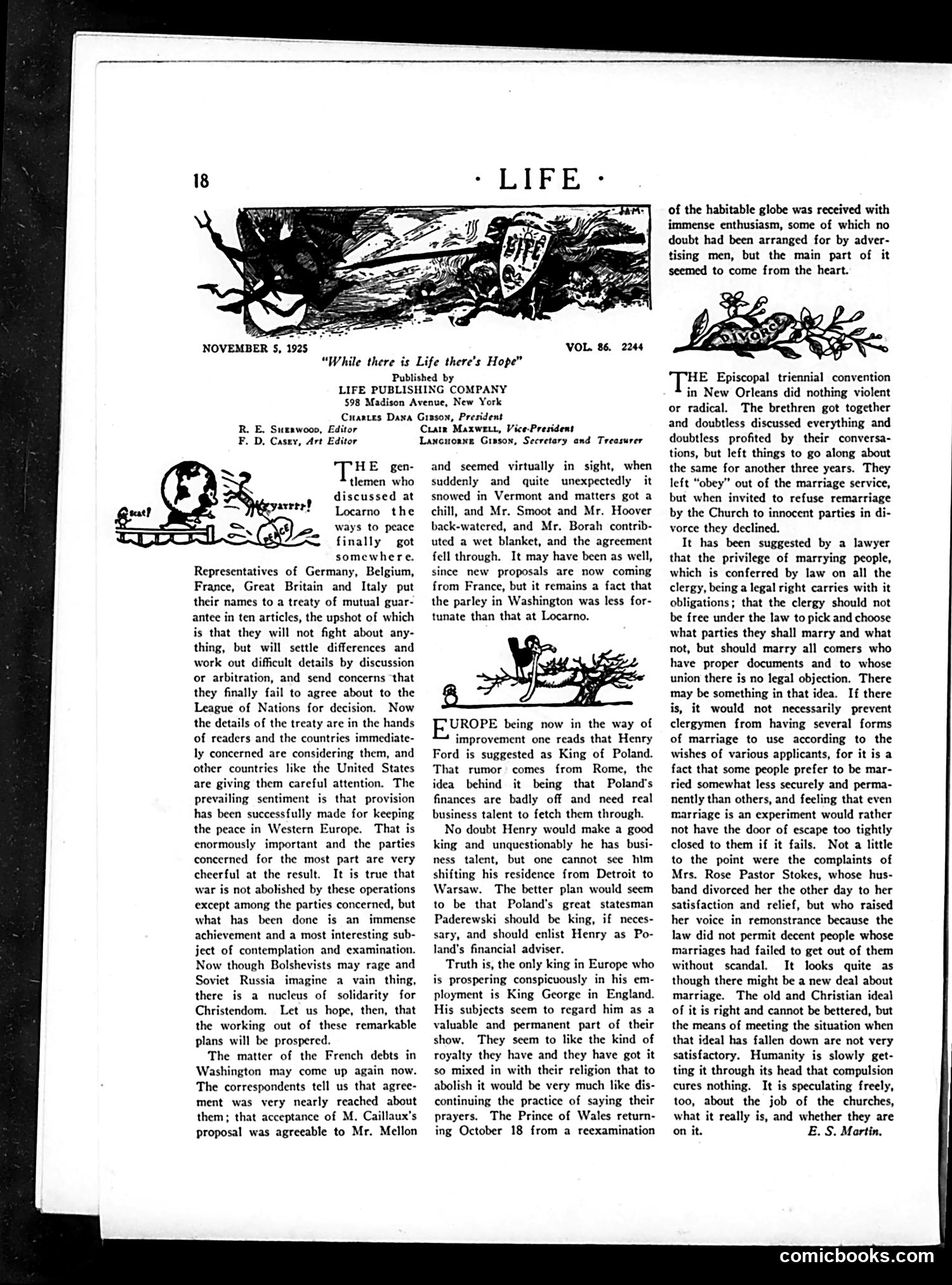
This page contains no political cartoons, but rather editorial commentary on three current events: **1. The Locarno Treaty:** European powers (Germany, Belgium, France, Britain, Italy) have signed a mutual guarantee agreement to settle disputes peacefully rather than through war. The editor celebrates this as significant progress for Western peace. **2. French Debt Negotiations:** U.S.-French discussions about war debts nearly succeeded but collapsed when American politicians (Senator Borah, Herbert Hoover, Senator Smoot) unexpectedly reversed course—the editor humorously blames Vermont snow for the "chill" that killed the agreement. **3. Henry Ford as Polish King:** A rumor circulates that industrialist Henry Ford might become Poland's monarch to solve its financial crisis. The editor dismisses this, suggesting Polish statesman Paderewski would be better, with Ford serving as financial adviser instead. The editorial's tone is optimistic about European peace prospects while gently satirizing American political fickleness and the absurdity of industrial magnates as monarchs.
📄 Transcribed text from this page (OCR, searchable)
Machine-transcribed from the original scan — historical spelling and the odd misread are preserved.
NOVEMBER 5, 1925 VOL. 86. 2244 “While there is Life there’s Hope” Published by LIFE PUBLISHING COMPANY $98 Madison Avenue, New York Cuartes Daxa Grason, President R. E. Suawooo, Editor F. D, Casey, Art Editor HE gen- tlemen who discussed at Locarno the ways to peace finally got somewhere. Representatives of Germany, Belgium, France, Great Britain and Italy put their names to a treaty of mutual guar- antee in ten articles, the upshot of which is that they will not fight about any- thing, but will settle differences and work out difficult details by discussion or arbitration, and send concerns ‘that they finally fail to agree about to the League of Nations for decision. Now the details of the treaty are in the hands of readers and the countries immediate- ly concerned are considering them, and other countries like the United States ing them careful attention. The prevailing sentiment is that provision has been successfully made for keeping the peace in Western Europe. That is enormously important and the parties concerned for the most part are very cheerful at the result. It is true that war is not abolished by these operations except among the parties concerned, but what has been done is an immense achievement and a most interesting sub- ject of contemplation and examination. Now though Bolshevists may rage and Soviet Russia imagine a vain thing, there is a nucleus of solidarity for Christendom. Let us hope, then, that the working out of these remarkable plans will be prospered. The matter of the French debts in Washington may come up again now. The correspondents tell us that agree- ment was very nearly reached about them; that acceptance of M. Caillaux’s proposal was agreeable to Mr. Mellon Cratr Maxweit, Vice-President Lancuoang Grason, Secretary and Treasurer and seemed virtually in sight, when suddenly and quite unexpectedly it snowed in Vermont and matters got a chill, and Mr, Smoot and Mr. Hoover back-watered, and Mr. Borah contrib- uted a wet blanket, and the agreement fell through. It may have been as well, since new proposals are now coming from France, but it remains a fact that the parley in Washington was less for- tunate than that at Locarno. F,UROPE being now in the way of improvement one reads that Henry Ford is suggested as King of Poland. That rumor comes from Rome, the idea behind it being that Poland's finances are badly off and need real business talent to fetch them through. No doubt Henry would make a good king and unquestionably he has busi- ness talent, but one cannot see him shifting his residence from Detroit to Warsaw. The better plan would seem to be that Poland's great statesman Paderewski should be king, if neces- sary, and should enlist Henry as Po- land’s financial adviser. Truth is, the only king in Europe who is prospering conspicuously in his em- ployment is King George in England. His subjects seem to regard him as a valuable and permanent part of their show. They seem to like the kind of royalty they have and they have got it so mixed in with their religion that to abolish it would be very much like dis- continuing the practice of saying their prayers. The Prince of Wales return- ing October 18 from a reexamination of the habitable globe was received with immense enthusiasm, some of which no doubt had been arranged for by adver- tising men, but the main part of it seemed to come from the heart. TH Episcopal triennial convention in New Orleans did nothing violent or radical. The brethren got together and doubtless discussed everything and doubtless profited by their conversa- tions, but left things to go along about the same for another three years. They left “obey” out of the marriage service, but when invited to refuse remarriage by the Church to innocent parties in di- vorce they declined. It has been suggested by a lawyer that the privilege of marrying people, which is conferred by law on all the clergy, being a legal right carries with it obligations; that the clergy should not be free under the law to pick and choose what parties they shall marry and what not, but should marry all comers who have proper documents and to whose union there is no legal objection. There may be something in that idea. If there is, it would not necessarily prevent clergymen from having several forms of marriage to use according to the wishes of various applicants, for it is a fact that some people prefer to be mar- ried somewhat less securely and perma- nently than others, and feeling that even marriage is an experiment would rather not have the door of escape too tightly closed to them if it fails. Not a little to the point were the complaints of Mrs. Rose Pastor Stokes, whose hus- band divorced her the other day to her satisfaction and relief, but who raised her voice in remonstrance because the law did not permit decent people whose marriages had failed to get out of them without scandal. It looks quite as though there might be a new deal about marriage. The old and Christian ideal of it is right and cannot be bettered, but the means of meeting the situation when that ideal has fallen down are not very satisfactory. Humanity is slowly get- ting it through its head that compulsion cures nothing. It is speculating freely, too, about the job of the churches, what it really is, and whether they are on it. E. S. Martin, comicbooks.com