
Life, 1925-11-05 · page 20 of 50
Life — November 5, 1925 — page 20: what you’re looking at
What you’re looking at
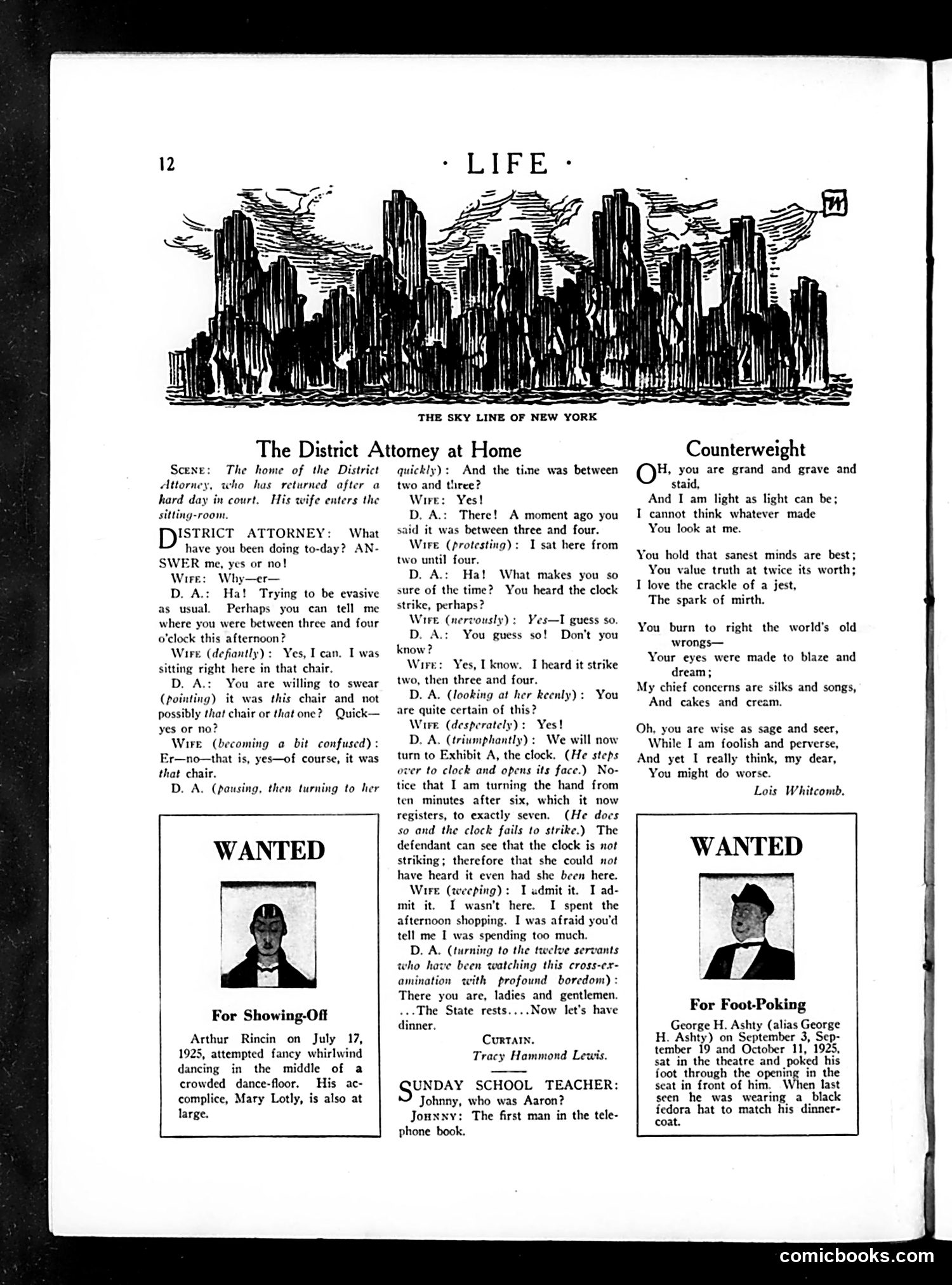
This satirical sketch mocks overzealous prosecutors who apply aggressive courtroom interrogation tactics to their own domestic lives. The District Attorney cross-examines his wife about her afternoon whereabouts with the same relentless intensity he'd use in court—demanding yes/no answers, catching her in contradictions about the time, and triumphantly "proving" she wasn't home by manipulating a clock as evidence. The humor lies in the absurdity: he treats his wife like a hostile witness, reducing a simple domestic question into a theatrical legal victory. The sketch satirizes how some officials become so consumed by their prosecutorial mindset that they lose perspective, turning intimate family moments into adversarial proceedings. It's social commentary on professional men who cannot separate work from home life, and perhaps also a gentle critique of the aggressive interrogation methods of 1920s law enforcement more broadly.
📄 Transcribed text from this page (OCR, searchable)
Machine-transcribed from the original scan — historical spelling and the odd misread are preserved.
THE SKY LINE OF NEW YORK The District Attorney at Home The home of the District ‘y, who has returned after a hard day in court. His wife enters the sitting-room, ISTRICT ATTORNEY: What have you been doing to-day? AN- SWER me, yes or no! f Why—er— Ha! Trying to be evasive as usual. Perhaps you can tell me where you were between three and four o'clock this afternoon? Wire (defiantly): Yes, I can. I was sitting right here in that chair. D. : You are willing to swear (pointing) it was this chair and not possibly that chair or that one? Quick— yes or no? Wire (becoming a bit confused): Er—no—that is, yes—of course, it was that chair. D. A. (pausing, then turning to her For Showing-Off Arthur Rincin on July 17, 1925, attempted fancy whirlwind dancing in the middle of a crowded dance-floor. His ac- complice, Mary Lotly, is also at large. quickly): And the time was between two and three? There! A moment ago you between three and four. Wire (protesting): I sat here from two until four. D, A.: Ha! sure of the time? strike, perhaps? Wire (nervously): Yes—I guess so. D. A.: You guess so! Don't you know Wire: Yes, [ know. I heard it strike two, then three and four. D. A. (looking at her keenly) : are quite certain of this? Wire (desperately): Yes! D. A. (triumphantly): We will now turn to Exhibit A, the clock. (He steps over to clock and opens its face.) No- tice that I am turning the hand from ten minutes after six, which it now registers, to exactly seven. (He does so and the clock fails to strike.) The defendant can see that the clock is not striking; therefore that she could not have heard it even had she been here. Wire. (weeping): I admit it. I ad- mit it. I wasn’t here. I spent the afternoon shopping. I was afraid you'd tell me I was spending too much, D. A. (turning to the twelve servants who have been watching this cross-ex- amination with profound boredom) : There you are, ladies and gentlemen. ...The State rests....Now let's have dinner. What makes you so You heard the clock You Curtatn. Tracy Hammond Lewis. UNDAY SCHOOL TEACHER: Johnny, who was Aaron? Jouxxy: The first man in the tele- phone book. Counterweight O#. you are grand and grave and staid, And I am light as light can be; I cannot think whatever made You look at me. You hold that sanest minds are best; You value truth at twice its worth; I love the crackle of a jest, The spark of mirth. You burn to right the world’s old wrongs— Your eyes were made to blaze and dream ; My chief concerns are silks and songs, And cakes and cream. Oh, you are wise as sage and seer, While I am foolish and perverse, And yet I really think, my dear, You might do worse. Lois Whitcomb. For Foot-Poking George H. Ashty (alias George H. Ashty) on September 3, Sep- tember 19 and October 11, 1925, sat in the theatre and poked his foot through the opening in the seat in front of him, When last seen he was wearing a_ black fedora hat to match his dinner- coat. comicbooks.com