
Life, 1925-11-05 · page 30 of 50
Life — November 5, 1925 — page 30: what you’re looking at
What you’re looking at
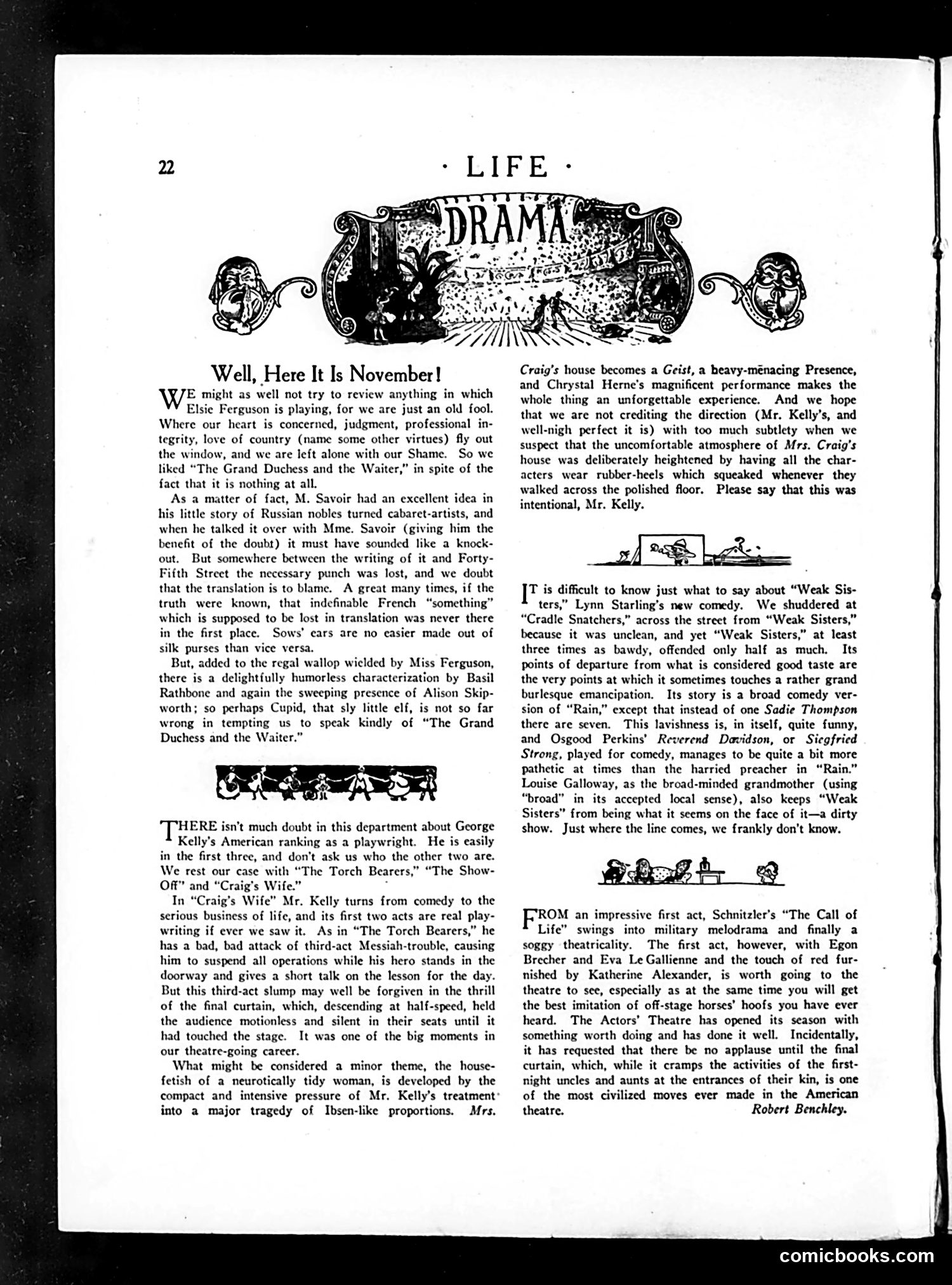
This is a theater review page from Life magazine's drama section. The critic discusses three Broadway productions: **"The Grand Duchess and the Waiter"**: A French play adapted to English about Russian nobility turned cabaret performers. The critic admits personal bias toward actress Elsie Ferguson, calling the play itself mediocre despite decent performances by Basil Rathbone and Alison Skipworth. **"Craig's Wife"** by George Kelly: Praised as serious drama ranking Kelly among America's top three playwrights (alongside "The Torch Bearers" and "The Show-Off"). The critic praises the first two acts but notes Kelly's recurring "third-act problem"—having the hero deliver a preachy speech. The review highlights how the house itself becomes a menacing presence through Chrystal Herne's performance and clever direction using squeaking rubber-heeled shoes on polished floors. **"Weak Sisters"**: A bawdy comedy with multiple female characters mirroring the plot of "Rain." The critic finds its broad humor sometimes touches genuine burlesque entertainment. The small decorative vignettes are period theatrical ornaments typical of Life's design.
📄 Transcribed text from this page (OCR, searchable)
Machine-transcribed from the original scan — historical spelling and the odd misread are preserved.
Well, Here It Is November! WE might as well not try to review anything in which Elsie Ferguson is playing, for we are just an old fool. Where our heart is concerned, judgment, professional in- tegrity, love of country (name some other virtues) fly out the window, and we are left alone with our Shame. So we liked “The Grand Duchess and the Waiter,” in spite of the fact that it is nothing at all. As a matter of fact, M. Savoir had an excellent idea in his little story of Russian nobles turned cabaret-artists, and when he talked it over with Mme. Savoir (giving him the benefit of the doubt) it must have sounded like a knock- out. But somewhere between the writing of it and Forty- Fifth Street the necessary punch was lost, and we doubt that the translation is to blame. A great many times, if the truth were known, that indefinable French “something” which is supposed to be lost in translation was never there in the first place. Sows’ ears are no easier made out of silk purses than vice versa. But, added to the regal wallop wiclded by Miss Ferguson, there is a delightfully humorless characterization by Basil Rathbone and again the sweeping presence of Alison Skip- worth; so perhaps Cupid, that sly little elf, is not so far wrong in tempting us to speak kindly of “The Grand Duchess and the Waiter.” em HERE isn’t much doubt in this department about George Kelly's American ranking as a playwright. He is easily in the first three, and don't ask us who the other two are. We rest our case with “The Torch Bearers,” “The Show- Off” and “Craig's Wife.” . In “Craig's Wife” Mr. Kelly turns from comedy to the serious business of life, and its first two acts are real play- writing if ever we saw it. As in “The Torch Bearers,” he has a bad, bad attack of third-act Messiah-trouble, causing him to suspend all operations while his hero stands in the doorway and gives a short talk on the lesson for the day. But this third-act slump may well be forgiven in the thrill of the final curtain, which, descending at half-speed, held the audience motionless and silent in their seats until it had touched the stage. It was one of the big moments in our theatre-going career. What might be considered a minor theme, the house- fetish of a neurotically tidy woman, is developed by the compact and intensive pressure of Mr. Kelly’s treatment’ into a major tragedy of Ibsen-like proportions. Mrs. Craig’s house becomes a Geist, a heavy-ménacing Presence, and Chrystal Herne’s magnificent performance makes the whole thing an unforgettable experience. And we hope that we are not crediting the direction (Mr. Kelly’s, and well-nigh perfect it is) with too much subtlety when we suspect that the uncomfortable atmosphere of Mrs. Craig's house was deliberately heightened by having all the char- acters wear rubber-heels which squeaked whenever they walked across the polished floor. Please say that this was intentional, Mr. Kelly. ig is difficult to know just what to say about “Weak Sis- ters,” Lynn Starling’s new comedy. We shuddered at “Cradle Snatchers,” across the street from “Weak Sisters,” because it was unclean, and yet “Weak Sisters,” at least three times as bawdy, offended only half as much. Its points of departure from what is considered good taste are the very points at which it sometimes touches a rather grand burlesque emancipation. Its story is a broad comedy ver- sion of “Rain,” except that instead of one Sadie Thompson there are seven. This lavishness is, in itself, quite funny, and Osgood Perkins’ Reverend Davidson, or Siegfried Strong, played for comedy, manages to be quite a bit more pathetic at times than the harried preacher in “Rain.” Louise Galloway, as the broad-minded grandmother (using “broad” in its accepted local sense), also keeps “Weak Sisters” from being what it seems on the face of it—a dirty show. Just where the line comes, we frankly don’t know. ‘ROM an impressive first act, Schnitzler’s “The Call of Life” swings into military melodrama and finally a soggy theatricality. The first act, however, with Egon Brecher and Eva LeGallienne and the touch of red fur- nished by Katherine Alexander, is worth going to the theatre to see, especially as at the same time you will get the best imitation of off-stage horses’ hoofs you have ever heard. The Actors’ Theatre has opened its season with something worth doing and has done it well. Incidentally, it has requested that there be no applause until the final curtain, which, while it cramps the activities of the first- night uncles and aunts at the entrances of their kin, is one of the most civilized moves ever made in the American theatre. Robert Benchley. comicbooks.com