
Life, 1925-11-05 · page 29 of 50
Life — November 5, 1925 — page 29: what you’re looking at
What you’re looking at
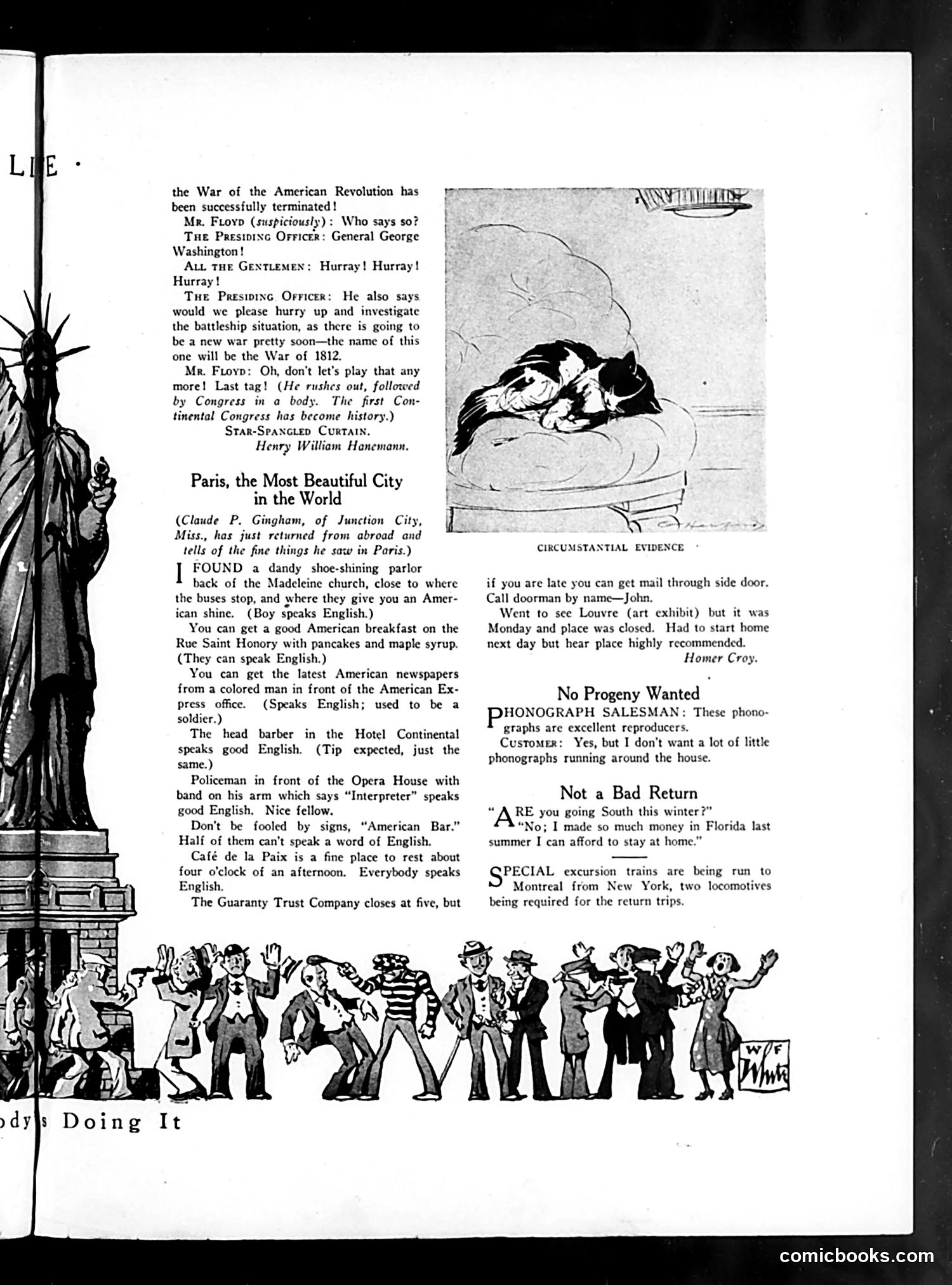
This page contains a satirical dramatic sketch and several humorous brief items typical of Life magazine's satirical format. **The Main Sketch**: "Star-Spangled Curtain" by Henry William Hanemann mocks American political complacency. Mr. Floyd skeptically questions General Washington's announcement that the Revolutionary War is won. When a Presiding Officer mentions a new war—"the War of 1812"—is coming soon, Floyd and Congress literally flee the stage. The joke: Americans are so war-weary they refuse to even discuss future conflicts, treating warfare as exhausting repetition rather than patriotic necessity. **"Paris" Section**: Homer Croy humorously catalogs Paris attractions by their American accessibility—shoe shines that give "American shine," American breakfasts, English-speaking staff. The satire targets American tourists' provincialism: they visit Paris only to find American conveniences, unable to engage authentically with French culture. **Brief Items**: The remaining jokes mock consumerism (phonograph reproduction anxiety), Florida real estate speculation profiteering, and railroad inefficiency (needing two locomotives to return from Montreal). The overall tone is gently cynical about American society and travel habits.
📄 Transcribed text from this page (OCR, searchable)
Machine-transcribed from the original scan — historical spelling and the odd misread are preserved.
the War of the American Revolution has been successfully terminated! Mr. FLoyp (suspiciously) : Who says so? Tue Presininc Orricer: General George Washington! Aut tHe Genttemen: Hurray! Hurray! Hurray! Tue Presipinc Orricer: He also says would we please hurry up and investigate the battleship situation, as there is going to be a new war pretty soon—the name of this one will be the War of 1812. Mr. Froyp: Oh, don't let's play that any more! Last tag! (He rushes out, followed by Congress in a body. The first Con- tinental Congress has become history.) Srar-Spancren Curtain. Henry William Hanemann. Paris, the Most Beautiful City in the World (Claude P. Gingham, of Junction City, Miss., has just returned from abroad and tells of the fine things he saw in Paris.) I FOUND a dandy shoe-shining parlor back of the Madeleine church, close to where the buses stop, and where they give you an Amer- ican shine. (Boy speaks English.) You can get a good American breakfast on the Rue Saint Honory with pancakes and maple syrup. (They can speak English.) You can get the latest American newspapers from a colored man in front of the American Ex- press office. (Speaks English; used to be a soldier.) The head barber speaks good English. same.) Policeman in front of the Opera House with band on his arm which says “Interpreter” speaks good English. Nice fellow. Don’t be fooled by signs, “American Bar.” Half of them can’t speak a word of English. Café de la Paix is a fine place to rest about four o'clock of an afternoon. Everybody speaks English. The Guaranty Trust Company closes at five, but in the Hotel Continental (Tip expected, just the CIRCUMSTANTIAL EVIDENCE if you are late you can get mail through side door. Call doorman by name—John. Went to see Louvre (art exhibit) but it was Monday and place was closed. Had to start home next day but hear place highly recommended. Homer Croy. No Progeny Wanted HHONOGRAPH SALESMAN: These phono- graphs are excellent reproducers. Customer: Yes, but I don’t want a lot of little phonographs running around the house. Not a Bad Return “ ARE you going South this winter?” “No; I made so much money in Florida last summer I can afford to stay at home.” PECIAL excursion trains are being run to Montreal from New York, two locomotives being required for the return trips. comicbooks.com