
A complete issue · 74 pages · 1925
Life — October 22, 1925
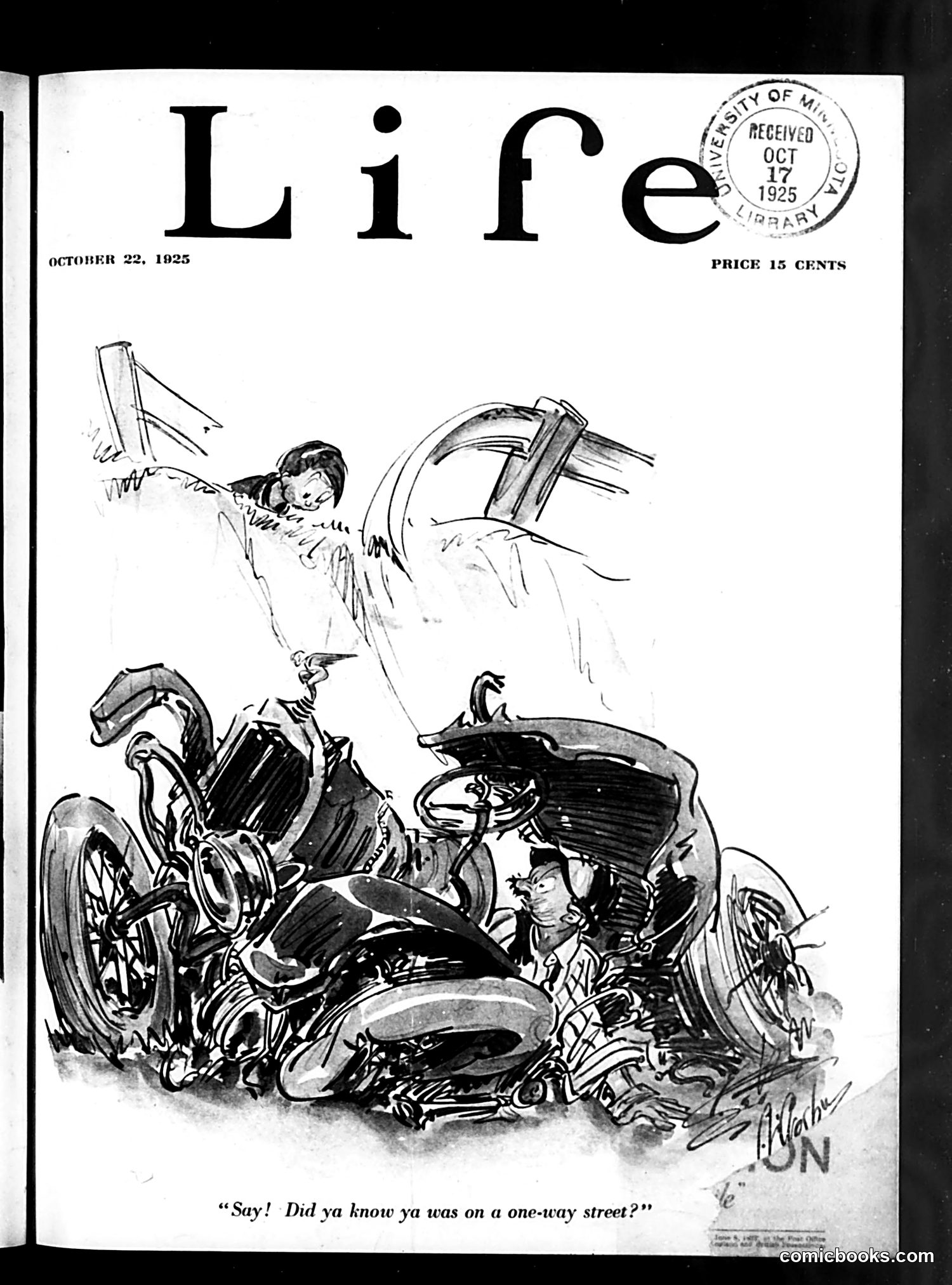
This satirical cartoon depicts a car accident on a city street. The caption reads: "Say! Did ya know ya was on a one-way street?" The joke targets reckless or careless drivers who ignore traffic laws—specifically one-way street designations. The crashed vehicles and scattered debris suggest a collision caused by someone driving the wrong direction. The figures appear to be arguing or gesturing in confusion. This reflects early 1920s concerns about automobile safety and traffic regulation. As cars became more prevalent, one-way streets were increasingly implemented in cities to manage traffic flow. The cartoon satirizes drivers who either ignored these new traffic rules or were unfamiliar with them, suggesting this was a common source of accidents and frustration during this period of rapid motorization.
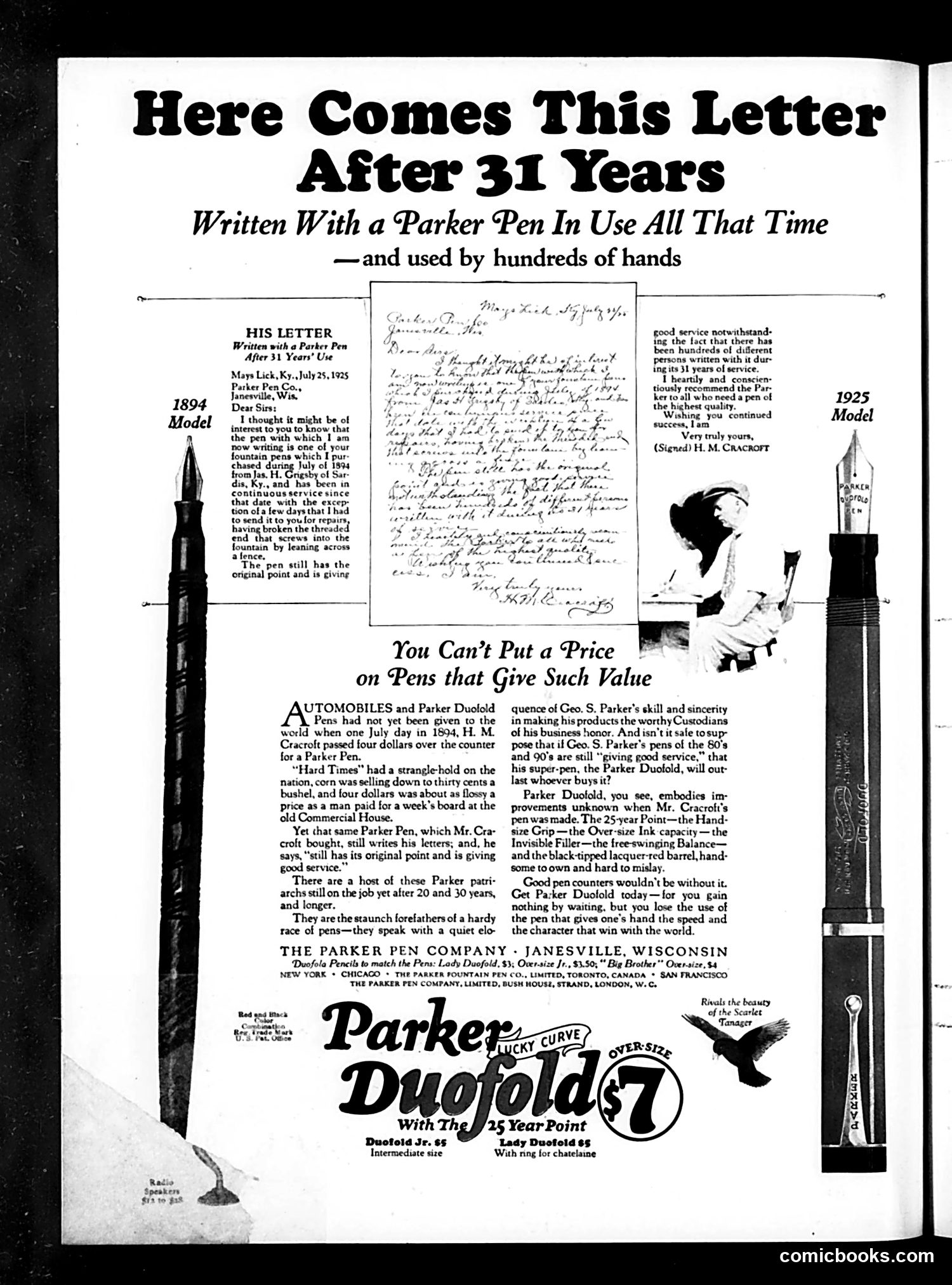
This page is **primarily a Parker Duofold pen advertisement**, not satire or political commentary. The headline creates a marketing narrative: a Parker pen has been in continuous use for 31 years, passed through hundreds of hands, and still functions reliably. The centerpiece is a handwritten letter dated May 1925, purportedly written with the same 1894 Parker pen, demonstrating durability. The advertisement compares 1894 and 1925 pen models visually. The text emphasizes the pen's value proposition—reliability and longevity justify its cost. There is **no political satire** here. This is straightforward early 20th-century product advertising using an impressive durability claim as its sales hook. The "Life" magazine context simply means this appeared in a popular publication where such ads were common.
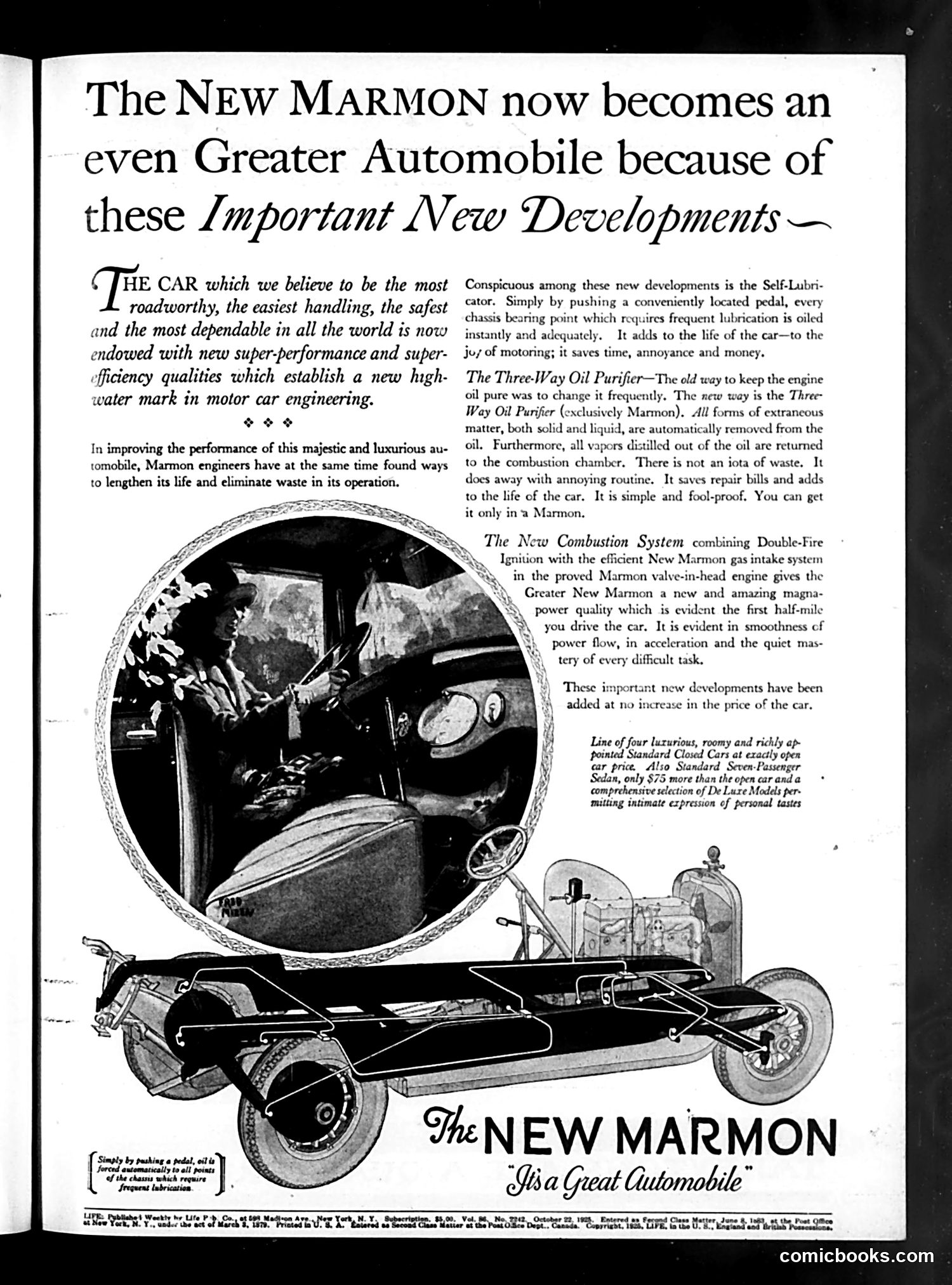
This is **not a satirical cartoon** but rather a **straightforward advertisement** for the Marmon automobile, published in Life magazine. The page promotes three mechanical innovations: a self-lubricating chassis, a three-way oil purifier, and a new combustion system with double-fire ignition. The circular inset photograph shows the car's luxurious interior. The lower technical diagram displays the chassis and engine layout. The advertising copy emphasizes engineering superiority and performance improvements "at no increase in price." There is no satire, political commentary, or caricature present. This represents typical early 20th-century automotive advertising, where Life's pages regularly featured paid promotional content alongside editorial material.
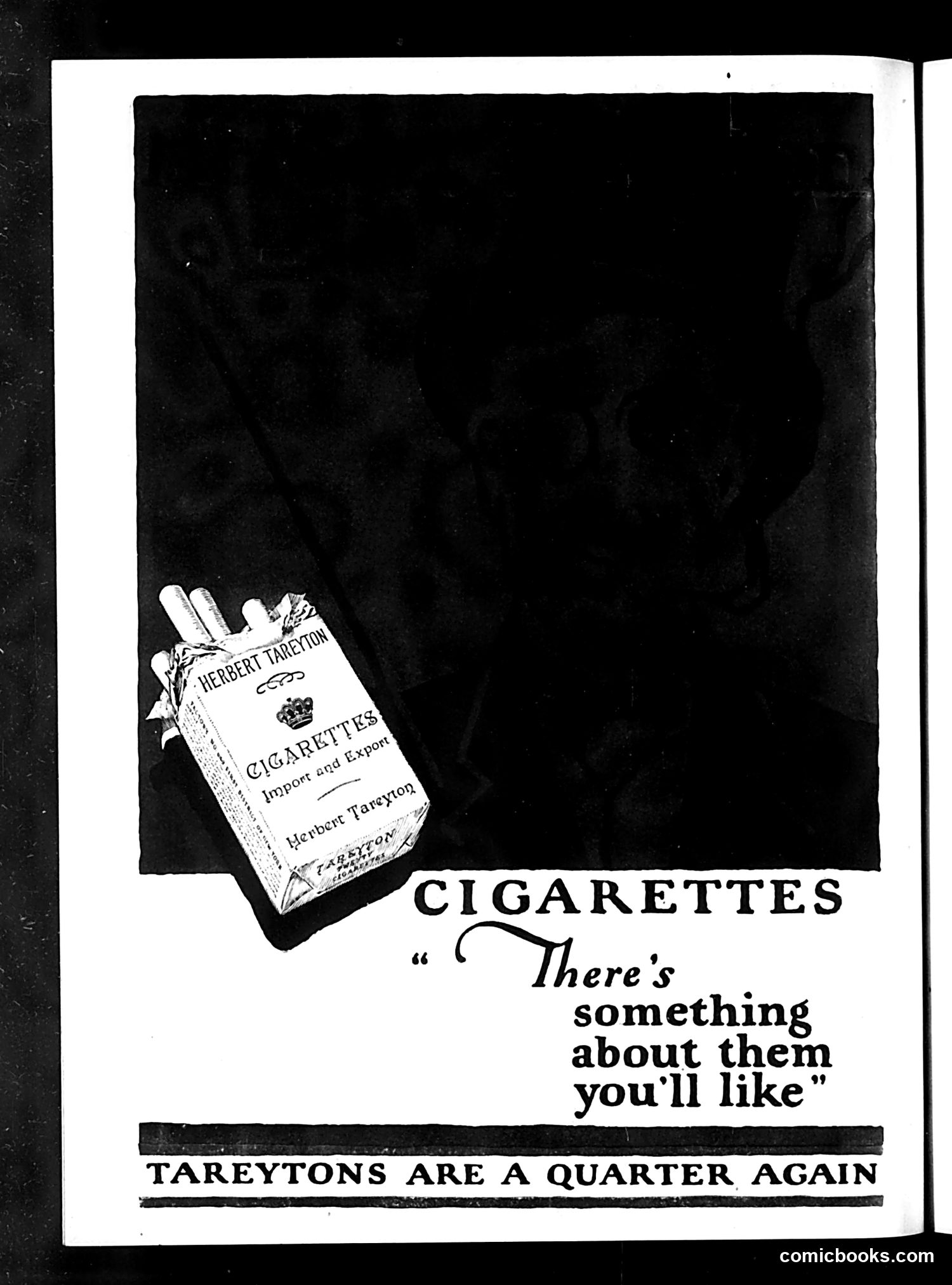
This is **advertising, not satire or political commentary**. It's a cigarette advertisement for Herbert Tareyton brand, featuring their product package prominently displayed against a dark background. The ad's appeal is straightforward: the tagline "There's something about them you'll like" uses vague but positive messaging to encourage purchase. The secondary text "TAREYTONS ARE A QUARTER AGAIN" likely refers to a price point or packaging size — common advertising language of the era. The large dark rectangle above the cigarette package appears designed to draw the viewer's eye and create visual emphasis. This is a standard commercial advertisement from Life magazine's advertising pages, not editorial content or political satire.
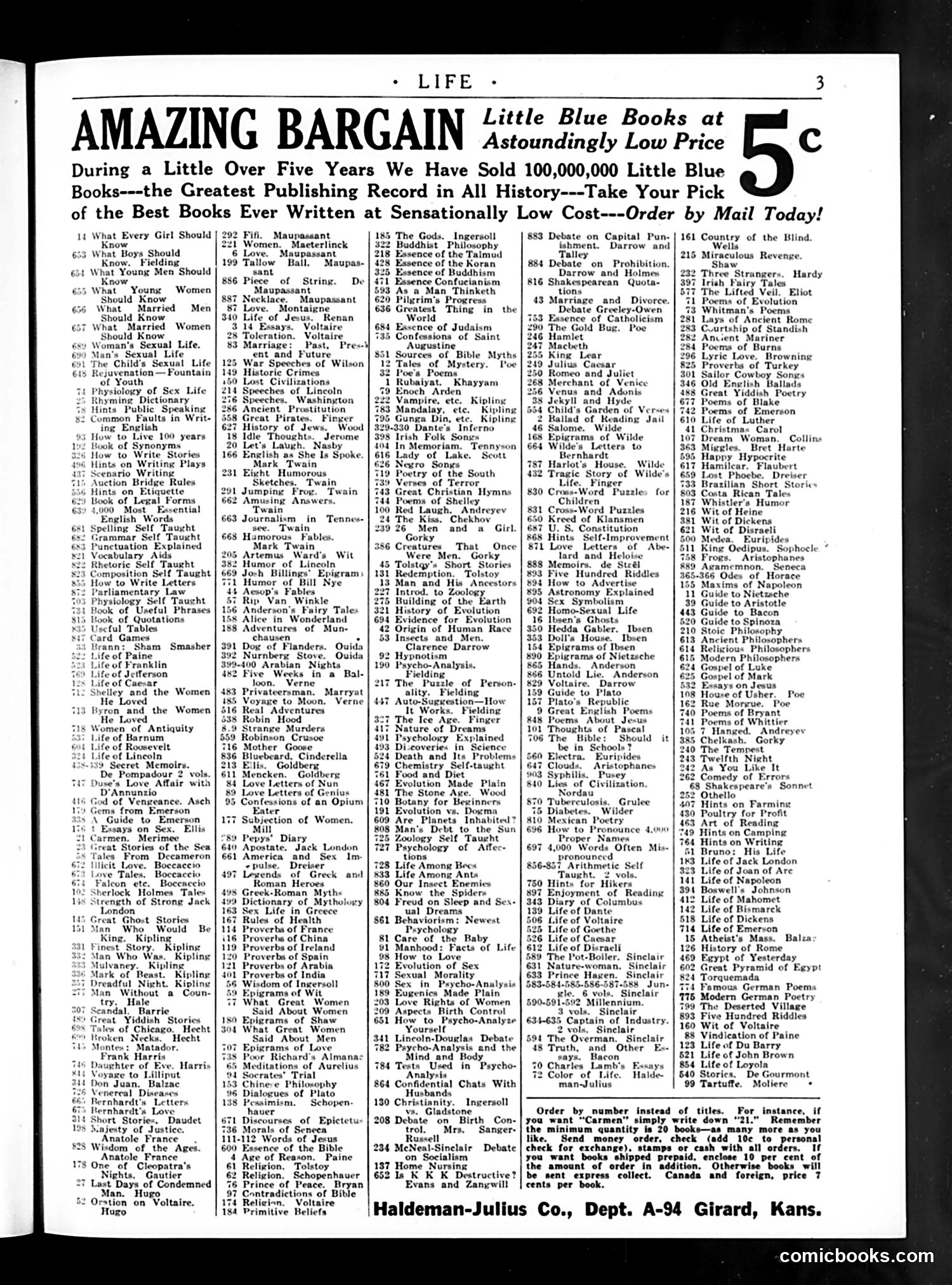
This page is **primarily advertising, not satire or political commentary**. It consists almost entirely of a mail-order catalog listing for "Little Blue Books"—inexpensive paperback volumes priced at 5 cents each, sold by Haldeman-Julius Co. of Girard, Kansas. The "Amazing Bargain" headline and dense multi-column listing showcase hundreds of available titles spanning literature, philosophy, science, history, and practical guides. The text emphasizes the company's sales record of "100,000,000 Little Blue Books" over five years. The only notable graphic element is the publisher's name and address at bottom. This is a straightforward commercial advertisement typical of early 20th-century magazines, with no discernible political satire or editorial cartooning present.
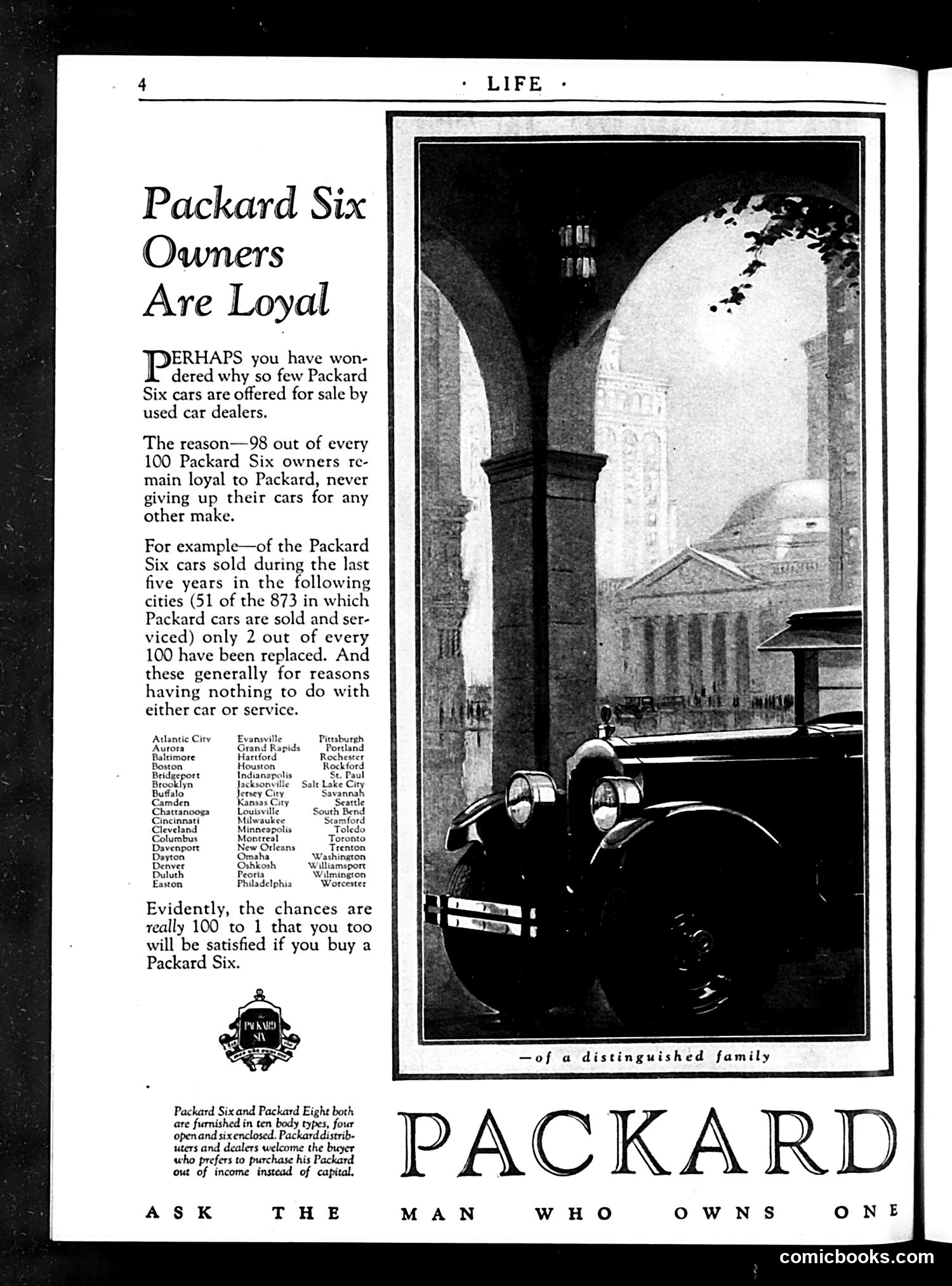
This is **not satire or political commentary**, but rather a **straightforward automobile advertisement** for Packard automobiles. The ad claims that 98 out of 100 Packard Six owners remain loyal to the brand—an unusually high retention rate. It supports this by citing that among Packard Six cars sold in the previous five years across 51 major American cities, only 2 out of every 100 were replacements, suggesting owners rarely trade them in. The dramatic photograph shows a Packard Six positioned in an elegant architectural setting (classical columns and arches), emphasizing luxury and sophistication. The caption reads "of a distinguished family," reinforcing the car's status appeal. The tagline "ASK THE MAN WHO OWNS ONE" was Packard's actual advertising slogan, inviting potential buyers to seek endorsements from satisfied owners.
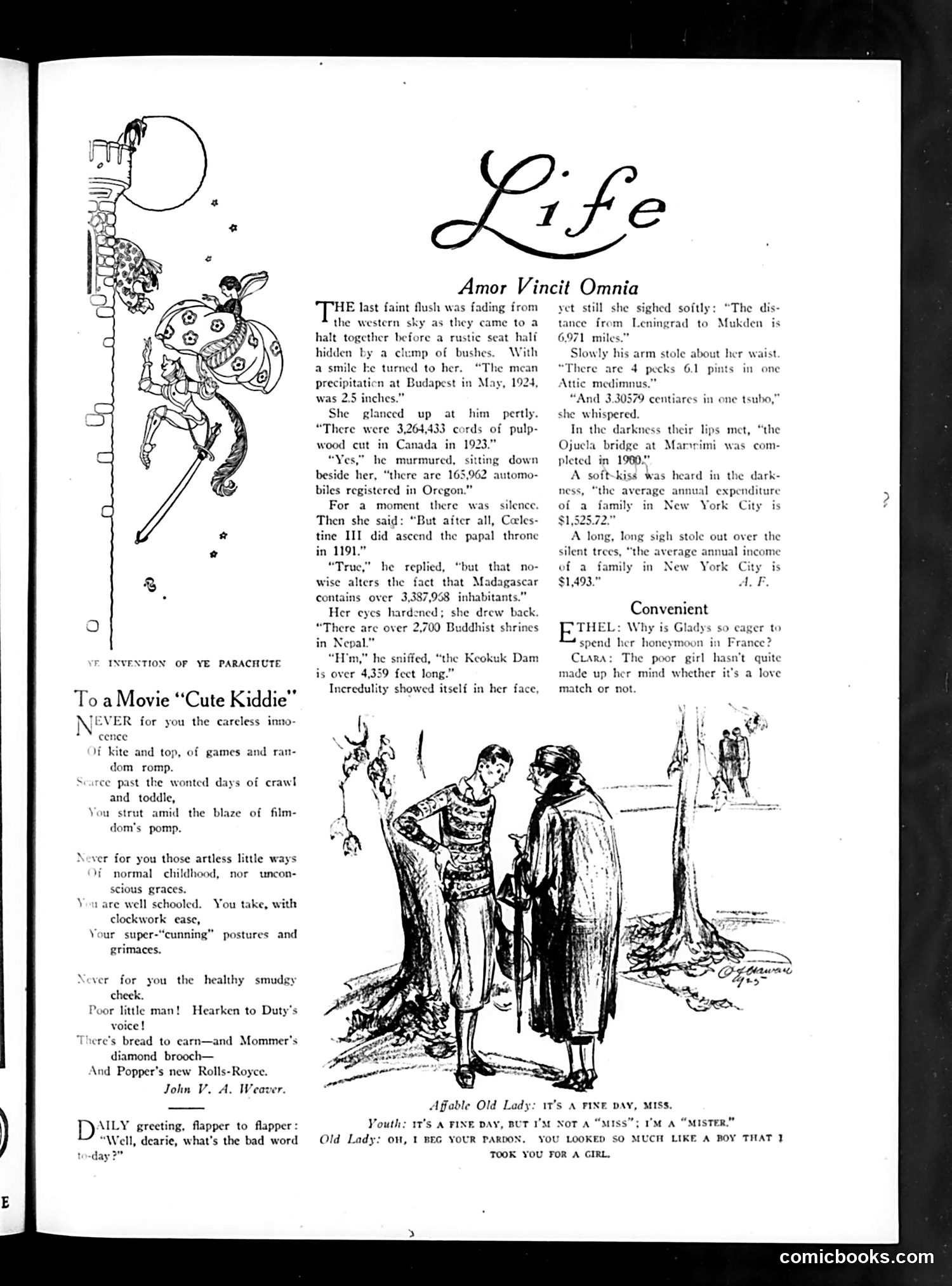
This page contains three distinct pieces: 1. **"Life" column (top)**: A satirical essay titled "Amor Vincit Omnia" ("Love Conquers All") that uses absurd statistics to mock romantic couples. It references specific places (Budapest, Madagascar, Newfoundland) and includes humorous data like "3,264,433 cards of pulpwood cut in Canada in 1923." 2. **"To a Movie 'Cute Kiddie'"**: A poem by John V. A. Weaver mocking child actors in silent films—criticizing their "super-cunning postures and grimaces" and artificial performance style rather than genuine childhood behavior. 3. **"Convenient" cartoon (bottom)**: An illustration showing two women, with dialogue where an older woman compliments a younger woman on a fine day, but the youth corrects her: she's a "mister," not a "miss," suggesting either cross-dressing or androgynous presentation—likely satirizing changing gender presentation norms of the 1920s era.
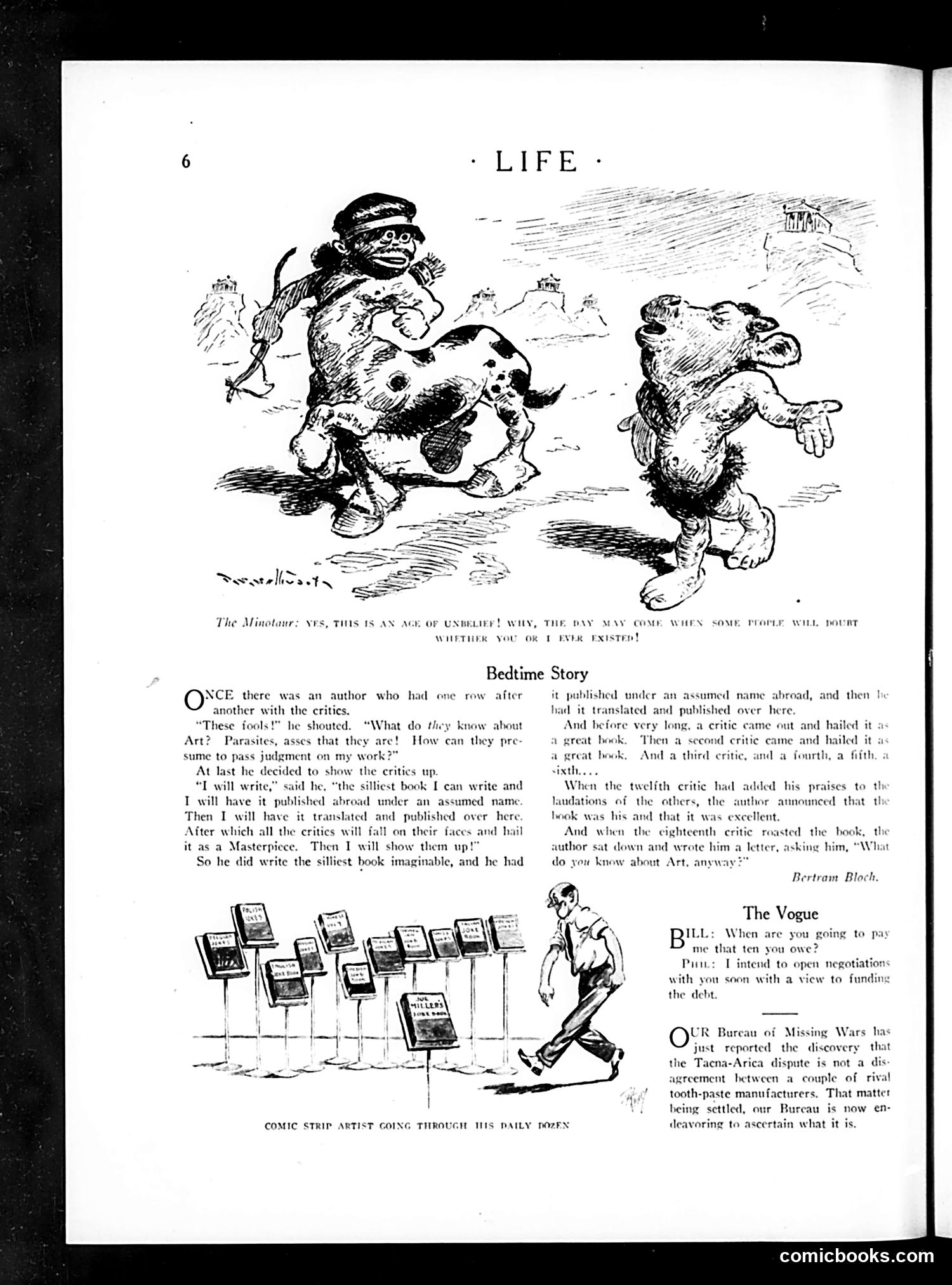
This page contains three separate satirical pieces: **Top cartoon**: Shows a dinosaur figure confronting another character, with text about "an age of unbelief." This appears to satirize skepticism toward evolution or religious doubt in the modern era. **"Bedtime Story"**: A prose satire about an author who writes a mediocre book, gets it rejected domestically, publishes it abroad under a false name, then has it "discovered" and praised by multiple critics upon re-import. This mocks the literary establishment's tendency to value foreign or prestigious-seeming sources over domestic merit. **Bottom cartoon**: Depicts a figure walking past multiple books on pedestals labeled "JAZZ," satirizing what appears to be the proliferation or commercialization of jazz literature/culture. **"The Vogue" section**: A brief dialogue about debt and financial negotiations. The page satirizes pretension in literature, criticism, and culture.
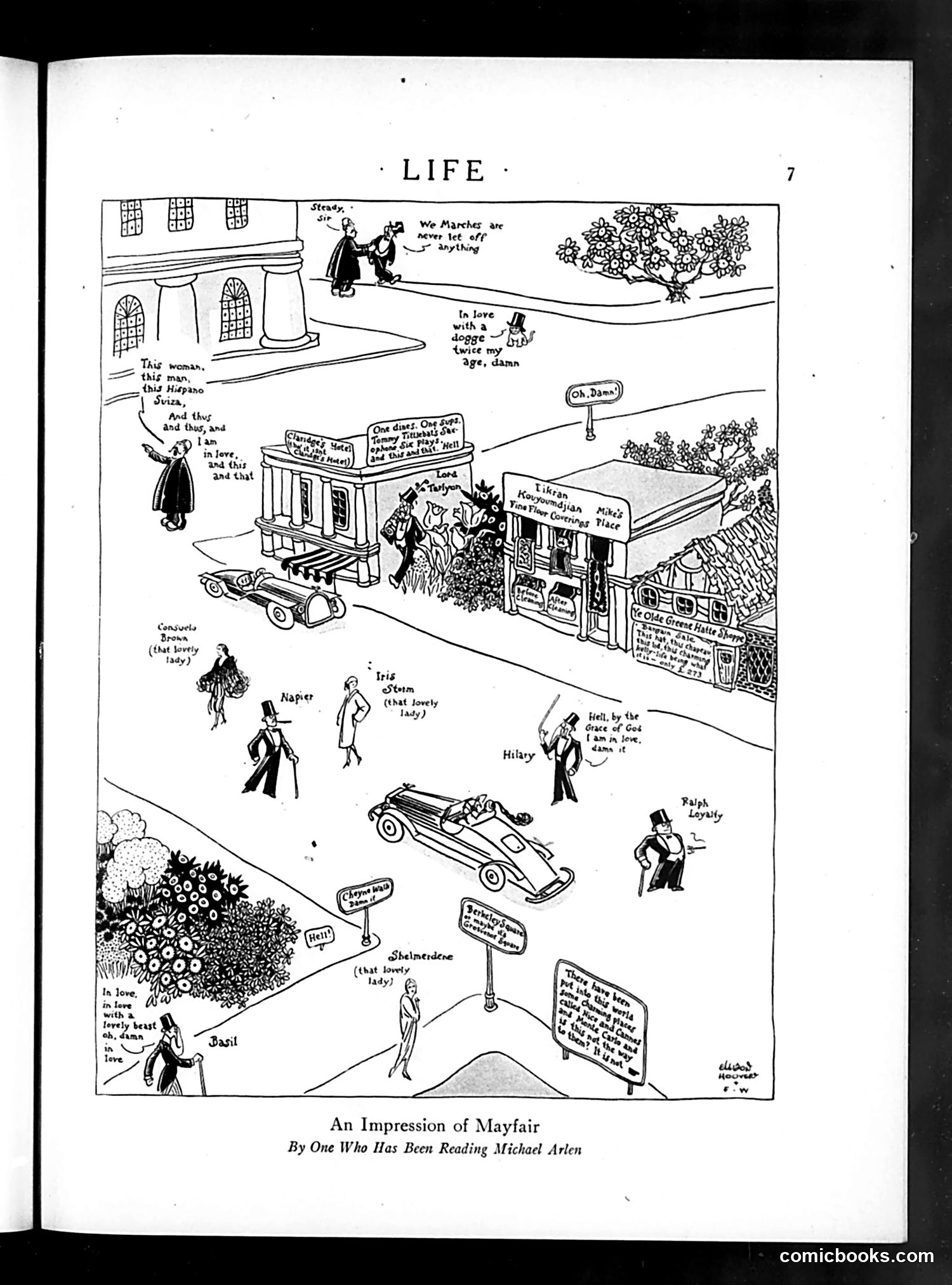
This cartoon satirizes the social scene of Mayfair, London's wealthy district. The artist depicts fashionable aristocrats and society figures engaged in romance and leisure activities—driving sports cars, promenading, shopping at exclusive stores, and flirting. The humor relies on exaggerated character types labeled with names like "Iris Storm," "Basil," and "Sheila Inderence"—likely parodying actual society figures or Michael Arlen's literary characters (the subtitle references Arlen's novel about Mayfair society). The satire mocks the superficiality and obsession with romantic entanglements among the wealthy elite, their material consumption, and the gossipy drama that dominates their lives. The crowded, chaotic composition emphasizes how these concerns dominate the Mayfair social world.
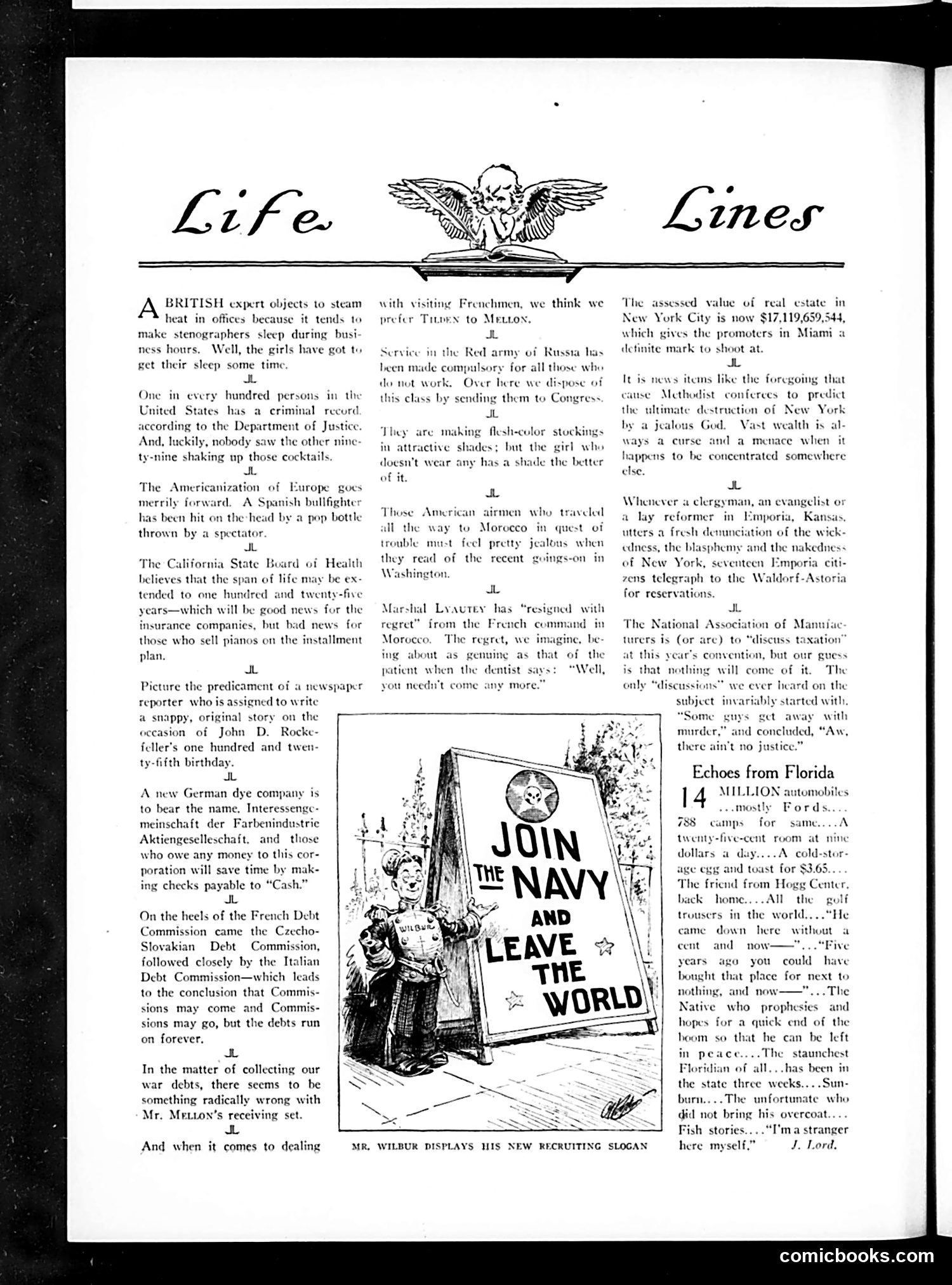
This satirical column page features a Navy recruiting poster cartoon captioned "Mr. Wilbur Displays His New Recruiting Slogan." The image shows a figure (likely Secretary of the Navy Josephus Daniels or another contemporary naval official) presenting a poster reading "JOIN THE NAVY AND LEAVE THE WORLD." The satire targets post-WWI disillusionment with military service. The slogan's promise to "leave the world" mocks recruitment propaganda by suggesting the Navy offers escape rather than patriotic duty—particularly biting given recent combat experience. The surrounding "Life Lines" column contains brief, caustic social commentary on contemporary issues: European debt, real estate speculation in Miami, Congressional dysfunction, and Methodist reform movements. The overall tone reflects 1920s cynicism about government institutions and modernization.
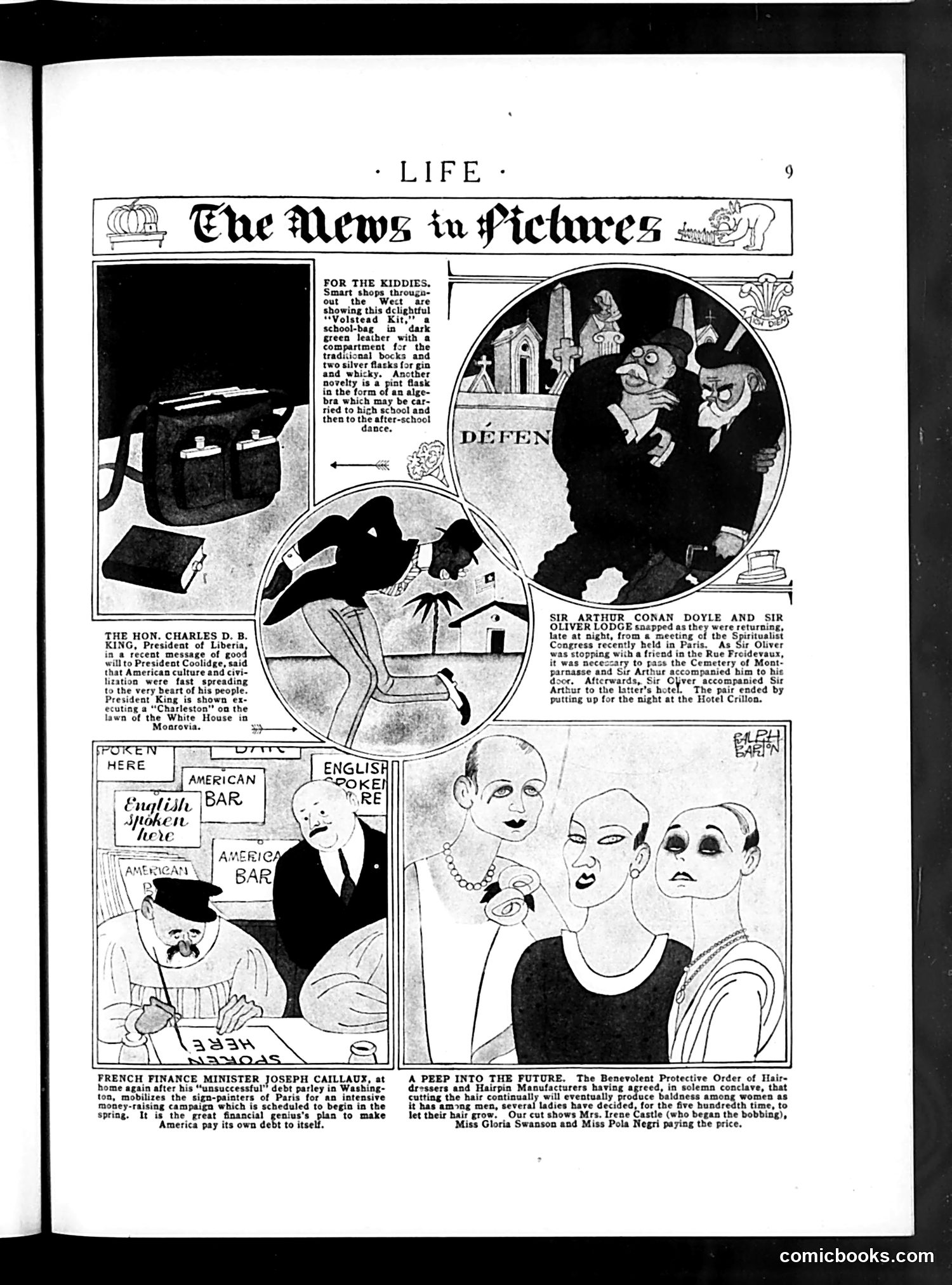
This page contains four satirical cartoons reflecting 1920s American concerns: 1. **Top left**: Shows a school satchel for children, captioned "For the Kiddies"—appears to be advertising school supplies. 2. **Top right**: Depicts two men labeled as Sir Arthur Conan Doyle and Sir Oliver Lodge discussing spiritualism at the Rue Prideaux, likely mocking the era's fascination with séances and supernatural beliefs among educated figures. 3. **Bottom left**: A cartoon about Prohibition-era bars. American bartenders claim to speak "English," satirizing how American drinking establishments pretended legitimacy during alcohol's legal ban by adopting foreign names. 4. **Bottom right**: "A Peep into the Future" mocks women's hair loss, suggesting manufacturers' claims that hair treatments cause baldness—darkly humorous commentary on dubious cosmetic industry promises. The page captures 1920s anxieties: spiritualism, Prohibition enforcement, and consumer skepticism.
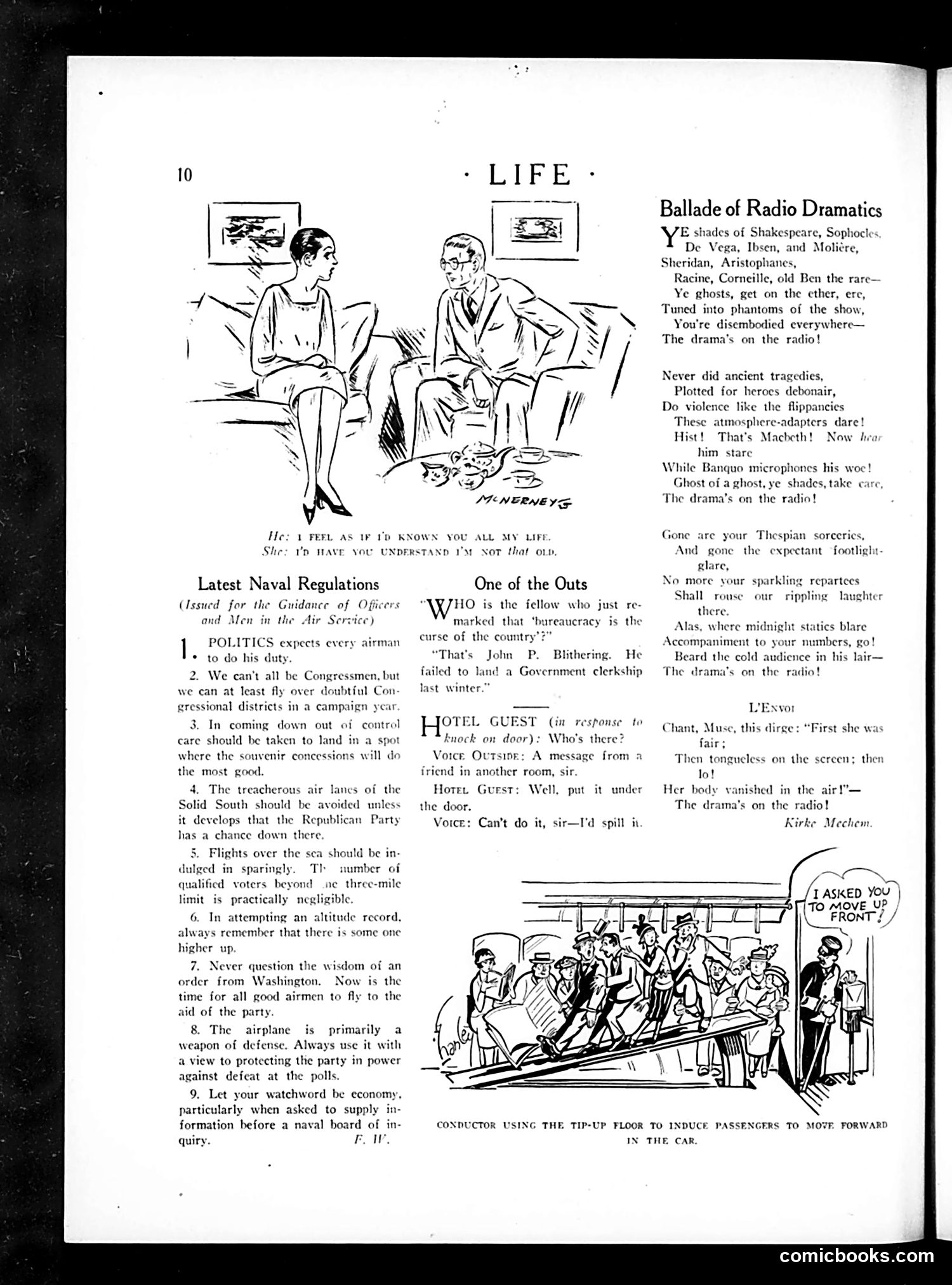
This page contains several distinct satirical pieces: **"Ballad of Radio Dramatics"** mocks early radio drama adaptations of classic literature—Shakespeare, Greek tragedies, etc.—arguing they're inferior to stage versions. The satire suggests radio actors overact and that these theatrical works lose their power when reduced to disembodied voices. **"Latest Naval Regulations"** appears to satirize military bureaucracy and politics, suggesting that political considerations (rather than merit) determine naval appointments and policy decisions. **"One of the Outs"** comments on government employment, using a character named John P. Blithering who "failed to land a Government clerkship last winter"—likely satirizing Depression-era unemployment and patronage systems. The bottom cartoon depicts a crowded train car with a conductor using a "tip-up floor" to force passengers forward, satirizing overcrowding and poor public transportation.
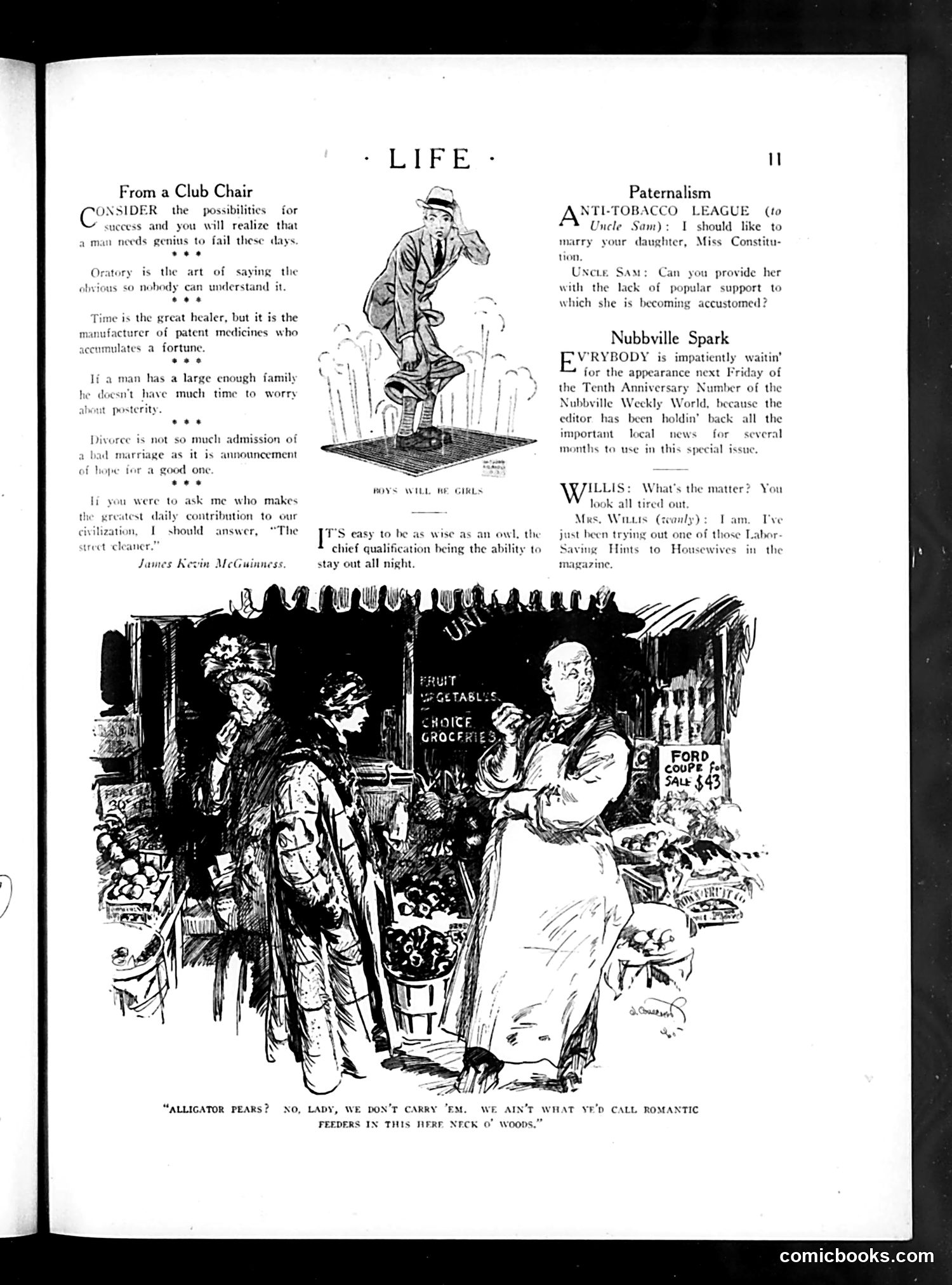
This page from *Life* magazine contains humorous social commentary and a cartoon. The main illustration depicts a grocer's shop, with the caption joking about "alligator pears" (an old term for avocados) not being "romantic feeders" in the backwoods—a rural/urban class humor playing on unsophisticated country folk encountering unfamiliar exotic produce. The text sections above include brief satirical observations: one mocks the "street cleaner" as civilization's greatest contributor, another jokes about divorce as "announcement of hope for a good one," and a third quips that wisdom requires staying up all night like an owl. The "Nubbville Spark" section references a local weekly newspaper's anniversary issue. Overall, the page uses gentle satire to mock everyday social pretensions and rural-urban cultural differences typical of early 20th-century American humor.
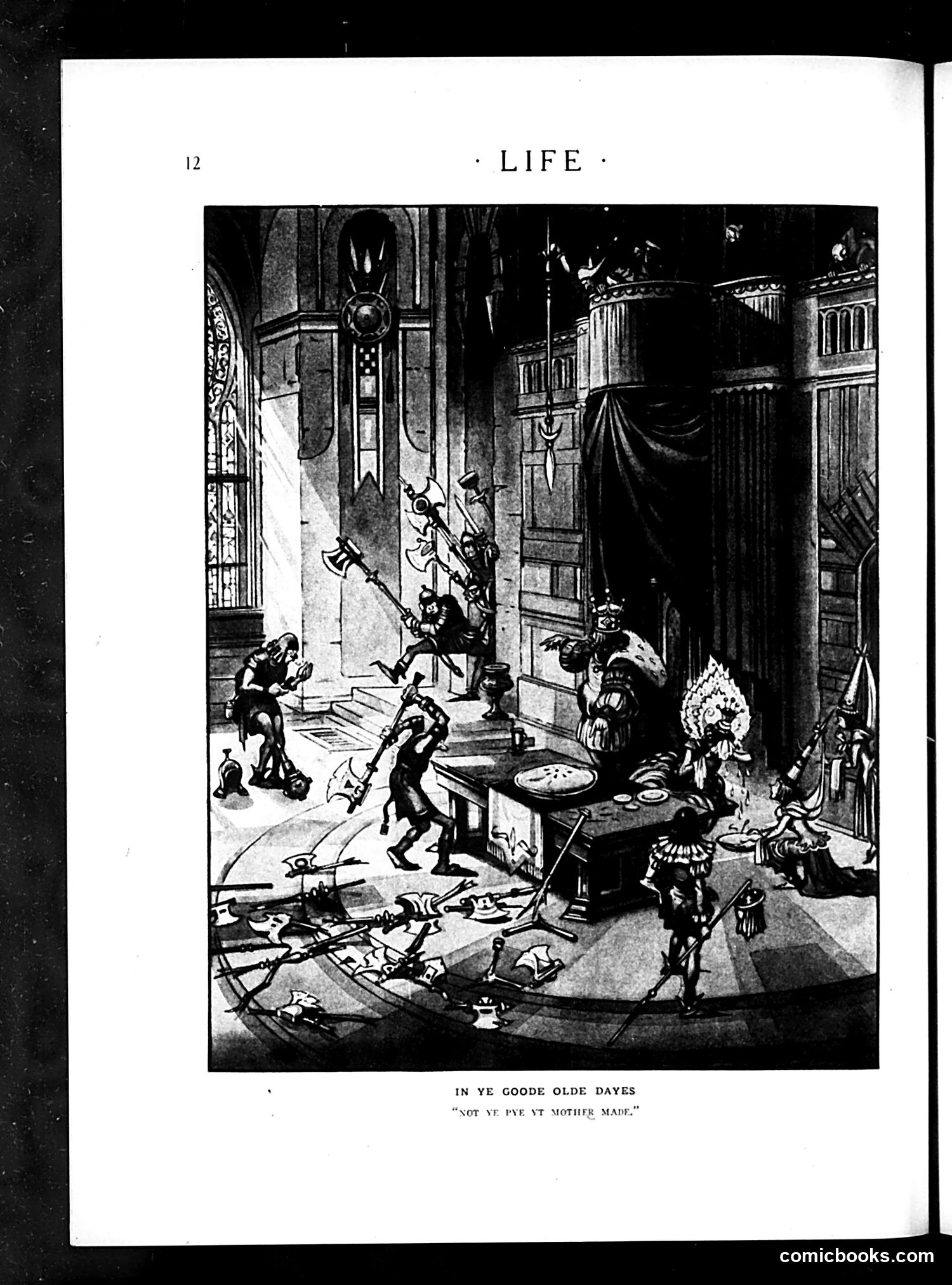
This is a satirical illustration titled "IN YE GOODE OLDE DAYES / 'NOT YE EYE YT MOTHER MADE.'" The image depicts a chaotic medieval or Renaissance court scene with elaborately dressed figures engaged in what appears to be mischief or debauchery. The scene includes: - Multiple costumed courtiers in period dress - Scattered weapons and objects on the floor - A figure on an elevated platform or throne area - Rich architectural details suggesting a palace or noble residence The satire appears to mock nostalgic romanticization of "the good old days," suggesting that past eras were actually filled with crude behavior and disorder rather than the refined, wholesome culture people imagine. The subtitle's archaic spelling reinforces this critique of idealized historical memory versus messy reality.
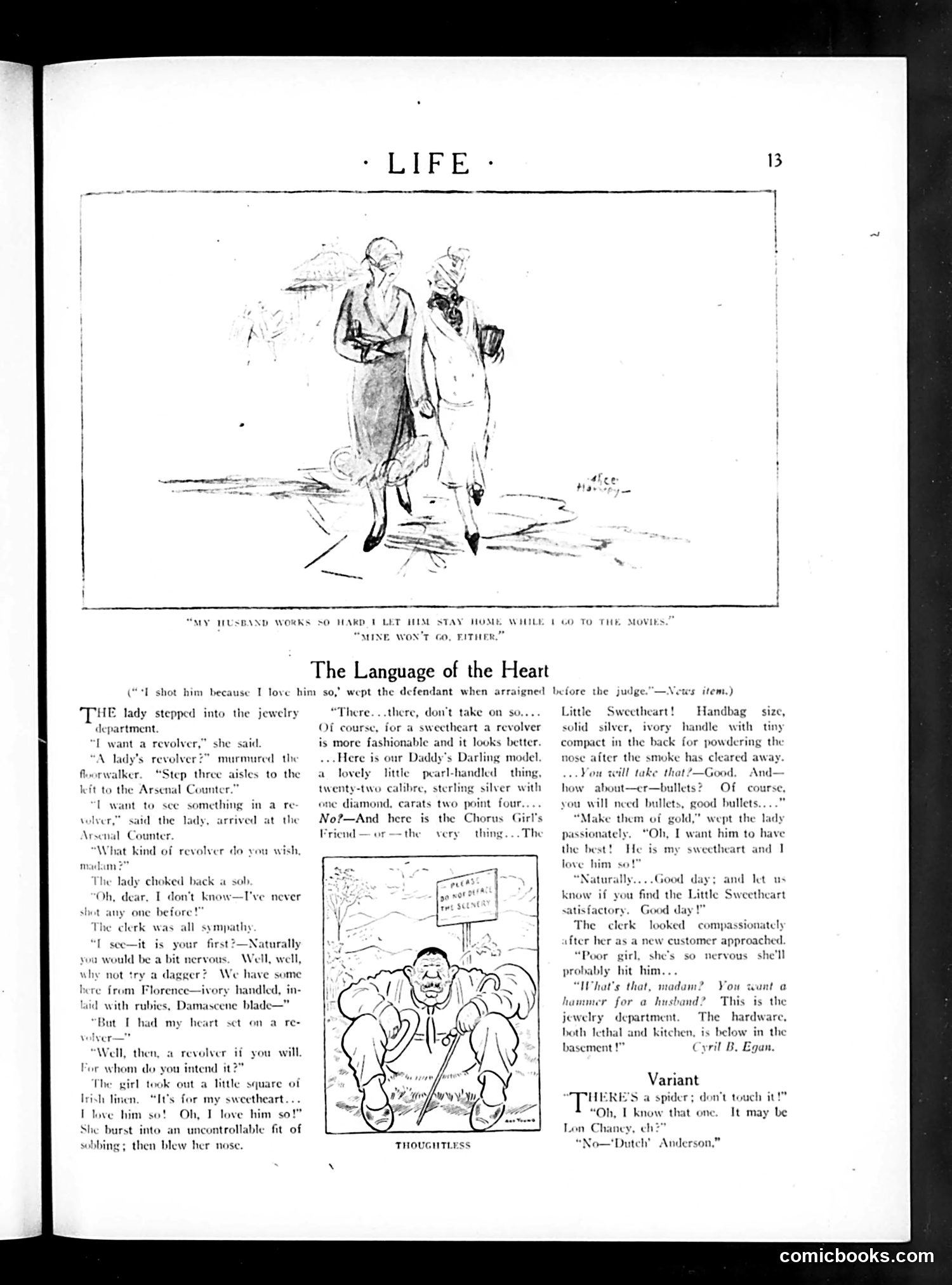
**Top Cartoon:** A sketch showing a couple at what appears to be a movie theater. The caption reads: "My husband works so hard I let him stay home while I go to the movies" / "Mine won't go either." This satirizes gender dynamics and marital compromise—likely commenting on wives' independence in pursuing entertainment while husbands remain home. **Main Story:** "The Language of the Heart" presents a domestic comedy. A woman shopping for a revolver claims it's for her sweetheart, sparking the clerk's sympathetic concern. The humor derives from the contradiction: revolvers are weapons, yet she frames it romantically—either satirizing excessive sentimentality or suggesting marital discord masked by pet names. **"Thoughtless" Cartoon:** Depicts a rotund, simple-minded man, illustrating domestic thoughtlessness toward wives.
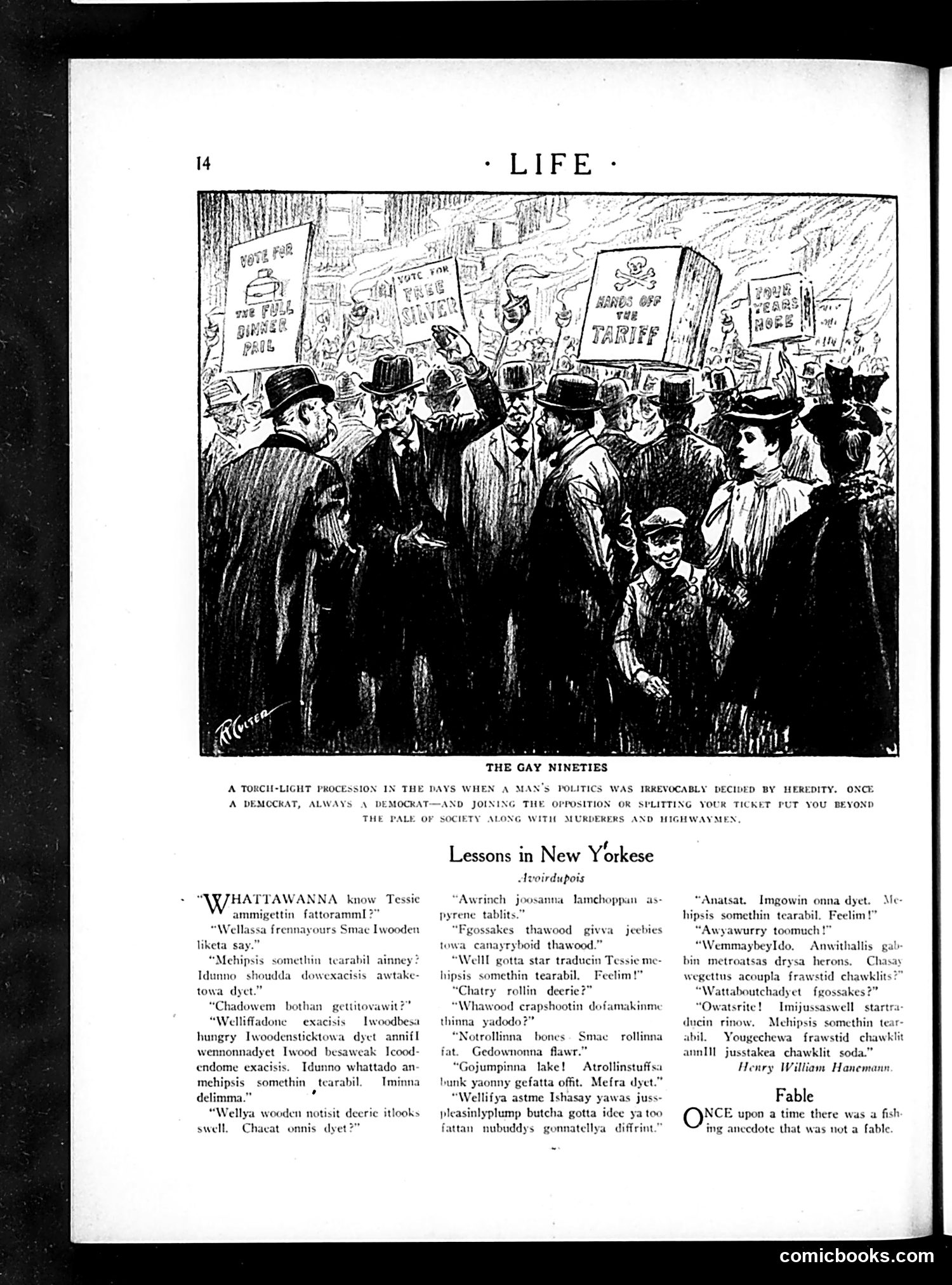
This cartoon depicts a torch-light political procession from the 1890s era. The caption explains the historical context: in that period, a man's political allegiance was strictly hereditary—changing parties was socially scandalous, potentially placing one "beyond the pale of society along with murderers and highwaymen." The crowd carries protest signs advocating for tariff policies, a major political debate of that era. The satire targets the rigidity of party loyalty, suggesting that switching political sides was considered worse than serious crime. The "Gay Nineties" title ironically references this supposedly carefree decade while highlighting its social intolerance regarding political independence. The detailed crowd scene captures the public pressure and social conformity that enforced partisan loyalty during this period.
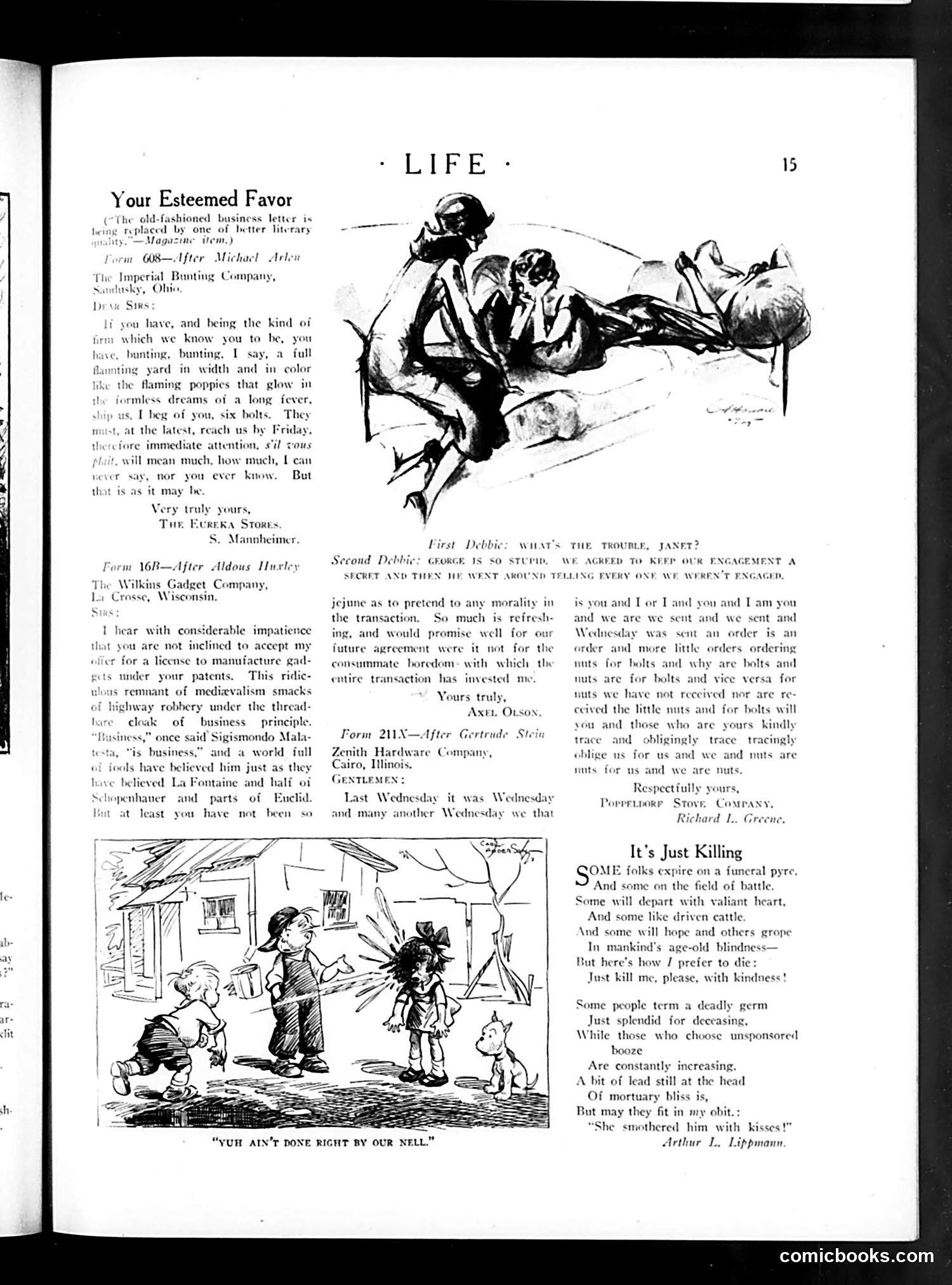
This page from *Life* magazine contains humorous business letters (Forms 688, 160, and 211) mocking overwrought commercial correspondence and business pretension. The letters satirize verbose, flowery language in routine business matters—someone asking for a "flaming yard in width and in color" of fabric, and disputes over tiny bolts and nuts between companies. The accompanying cartoons illustrate everyday social absurdities. One sketch shows children playing outdoors with the caption "YUH AIN'T DONE RIGHT BY OUR NELL," suggesting parental scolding. The poem "It's Just Killing" (by Arthur L. Lippmann) darkly jokes about funeral practices and increasing alcohol consumption, reflecting early 20th-century social concerns about drinking and mortality customs. The satire targets both bureaucratic verbosity and contemporary social anxieties.
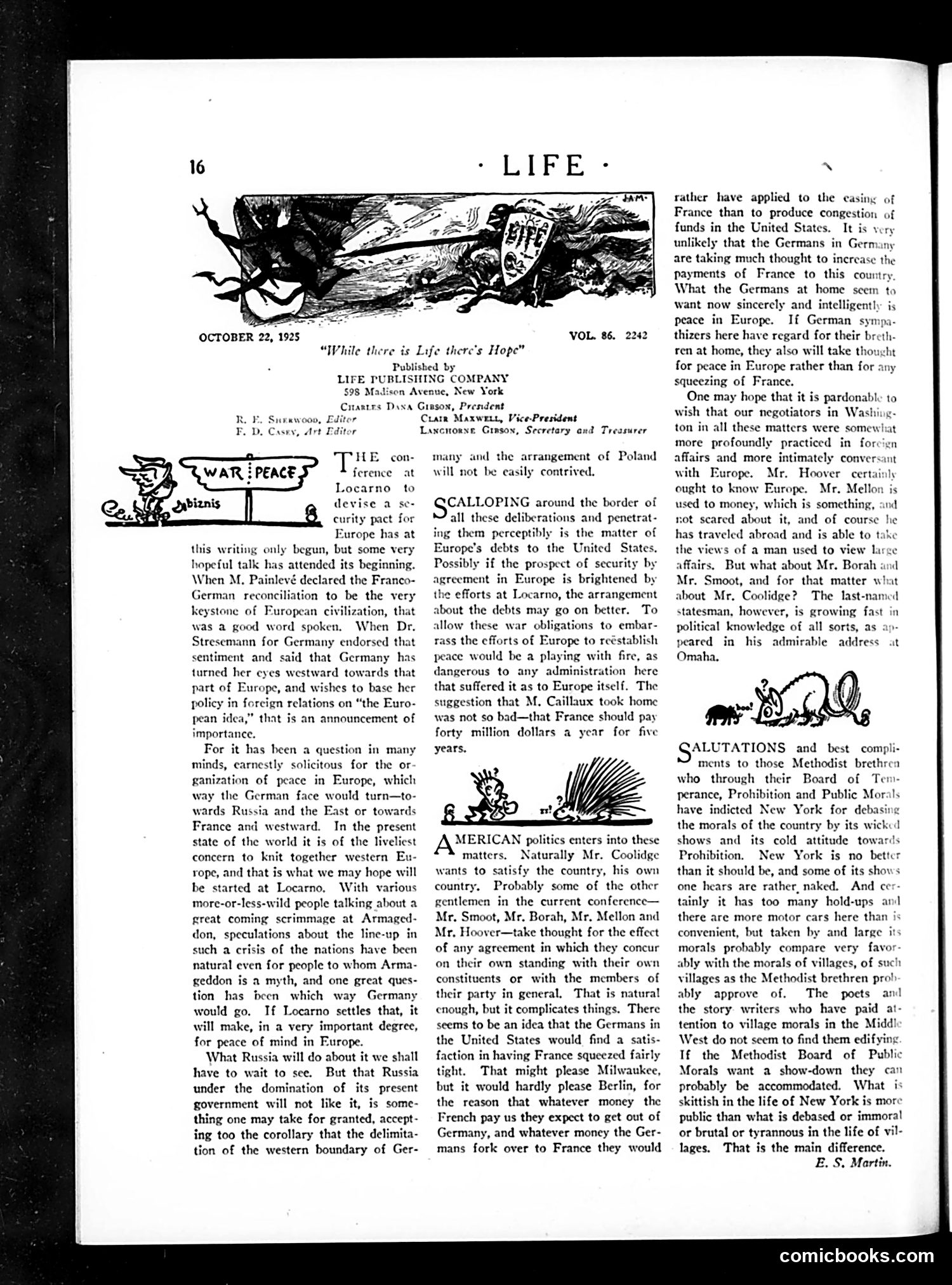
The page discusses the League of Nations conference at Locarno, which aimed to establish European peace and security agreements after World War I. The main cartoon depicts a figure labeled "RIFF" (likely referring to Riff tribesmen in Morocco) or war/conflict personified, shown as a menacing creature. The editorial argues that while peace negotiations are underway, practical concerns remain: France's war debts to America, Germany's reparation payments, and concerns about whether Germany might turn aggression toward Russia or France instead. The text expresses hope that diplomatic efforts—particularly those involving Mr. Hoover (U.S. Commerce Secretary)—might succeed, though skepticism about sustainable European peace is evident throughout the discussion.
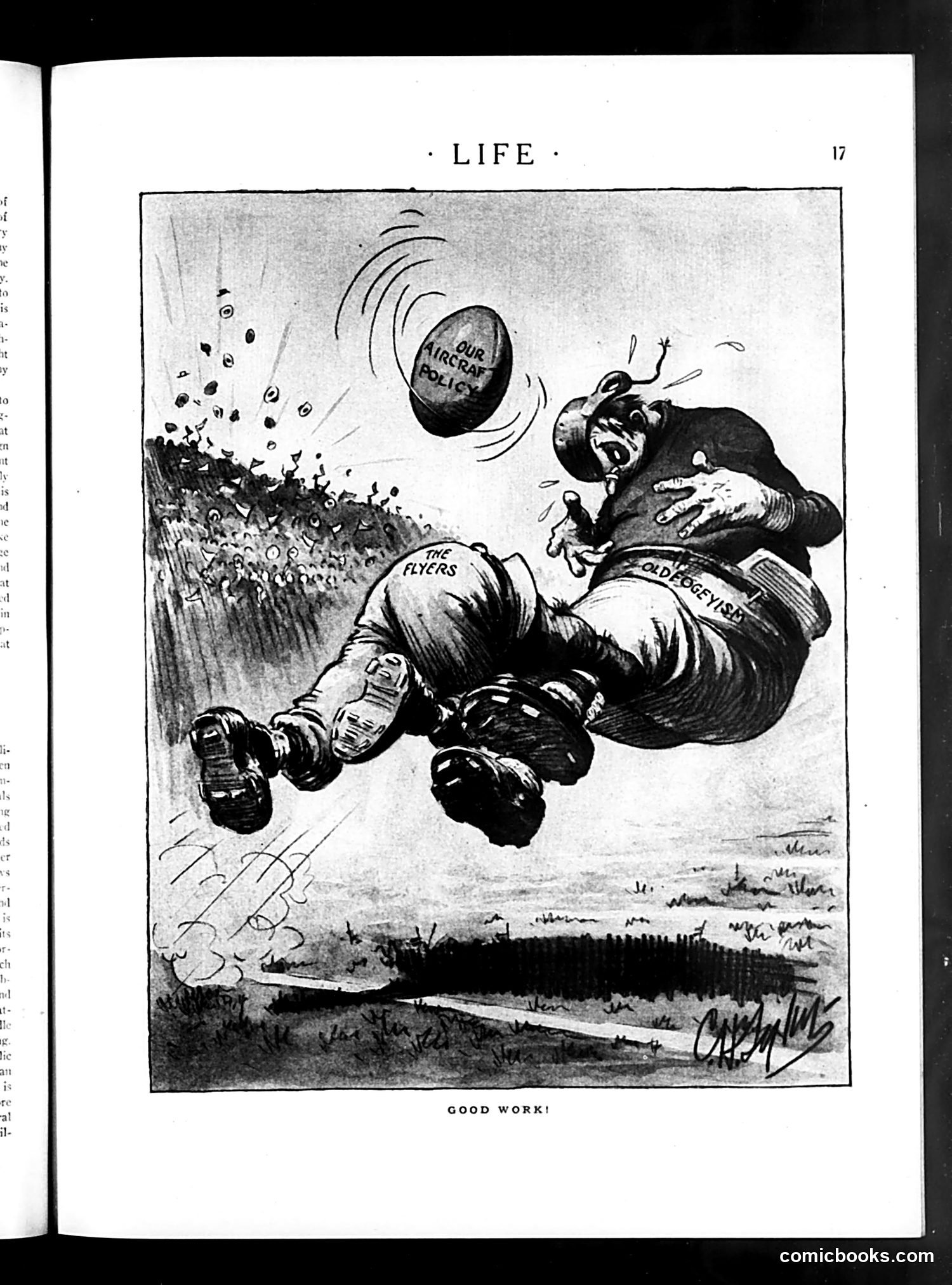
This satirical cartoon depicts a figure labeled "OLD PREJUDICE" being struck by bombs labeled "OUR AIRCRAFT" and "THE FLYERS." The character is shown being knocked backward by aerial bombardment, with explosions visible on the ground below. The cartoon appears to celebrate military aviation's role in combating prejudice, likely from World War I or II era. "The Flyers" (pilots) are portrayed as weapons against social prejudice, with the caption "GOOD WORK!" offering approval of this metaphorical assault on bigotry. The satire suggests that modern warfare—specifically air power—can symbolically destroy entrenched prejudices. However, without a visible publication date, the specific historical context and which prejudices are targeted remain unclear from the image alone.
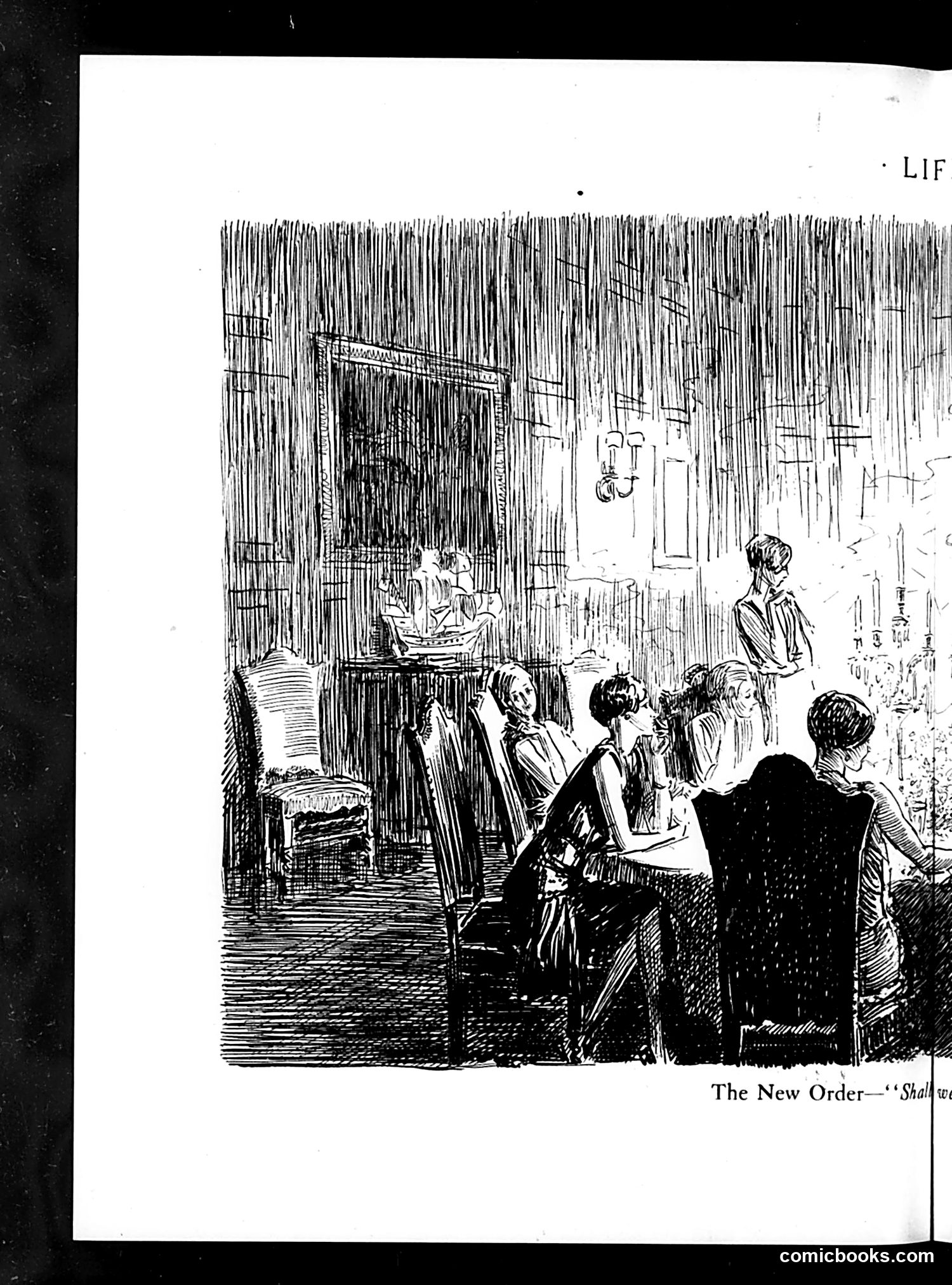
This sketch depicts a formal gathering or meeting, with a speaker addressing an audience of women seated in what appears to be an institutional or civic space. The title "The New Order—'Shall we..." suggests satirical commentary on contemporary social change, likely referencing women's evolving roles in public life. The packed venue and attentive audience indicate this concerns significant social developments. Given Life magazine's satirical nature, this likely mocks either the expansion of women's participation in civic affairs or debates about changing gender roles in early-to-mid 20th century America. The incomplete caption prevents definitive interpretation of the specific target. The sketch's tone—detailed but slightly exaggerated—is typical of Life's gentle social satire of the era.
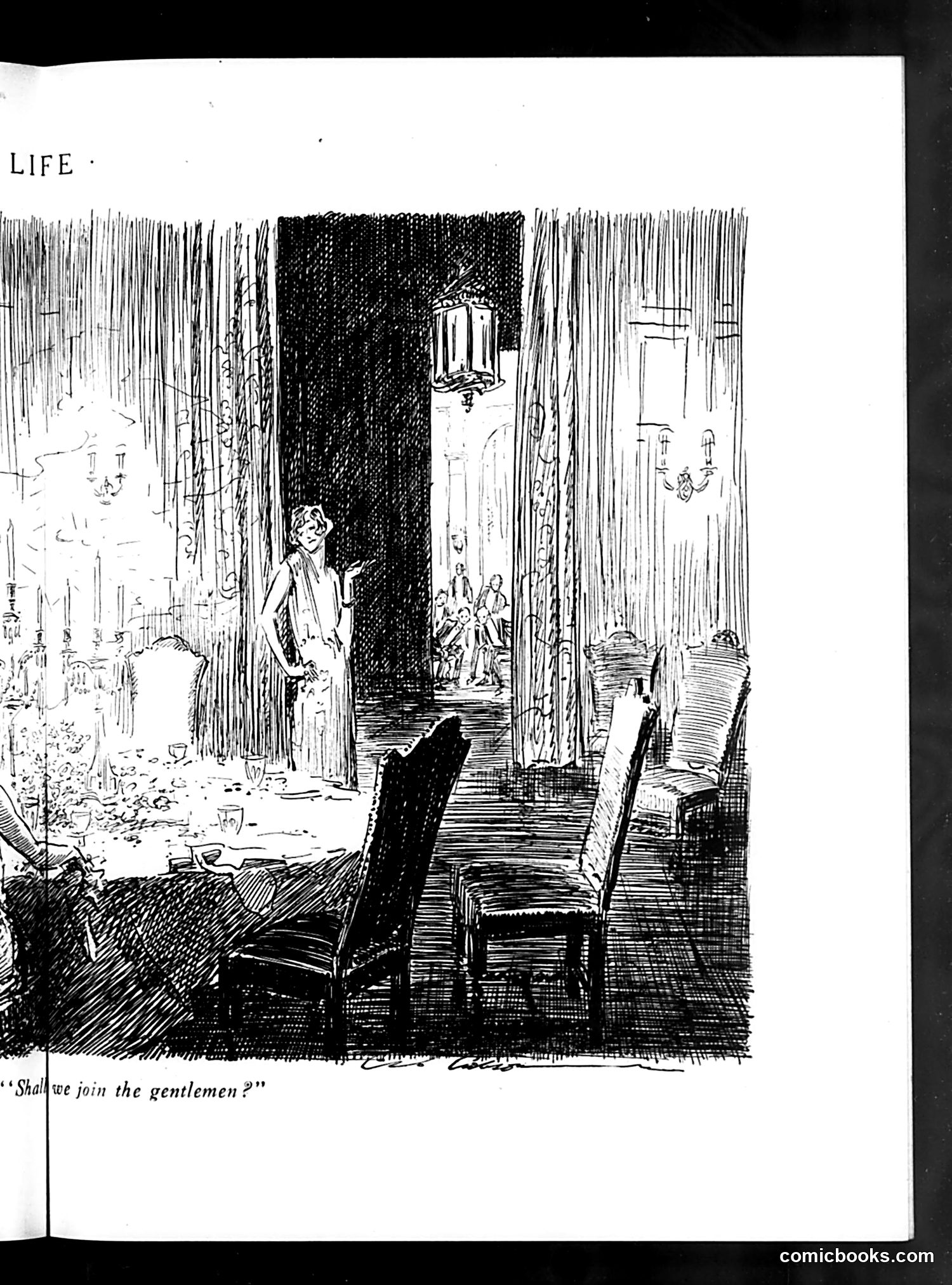
This is a single-panel cartoon from *Life* magazine depicting a social scene in what appears to be an elegant interior with tall curtains and period furnishings. A woman stands in a doorway addressing others, asking "Shall we join the gentlemen?" The humor likely plays on traditional Victorian or Edwardian social customs where men and women separated after dinner—women retired to drawing rooms while men remained in the dining room for cigars and conversation. The cartoon's satire probably comments on gender segregation practices of the era, though without additional context or caption details, the specific social critique remains unclear. The formal setting and the woman's phrasing suggest commentary on rigid social etiquette and gender conventions of the period.
This page reviews contemporary theatrical productions. The text discusses several plays: **"The Accused"** examines whether a lawyer should defend a woman accused of infidelity, raising questions about professional integrity versus personal sympathy. **"A Holy Terror"** features George Abbott as a character willing to endure tedious stretches of friendship-focused drama. **"Applesauce"** by Allan Dinehart is criticized as a collection of marriage-related jokes that, while pleasant, offers little substance—characters merely "dragging in by the heels" tired material. **"The Bridge of Distances"** at the International Playhouse is noted as Chinese-themed and sound-sleeping (possibly meaning boring or requiring audience patience). The small decorative cartoons are generic theatrical flourishes rather than specific political satire, typical of Life's drama section formatting.
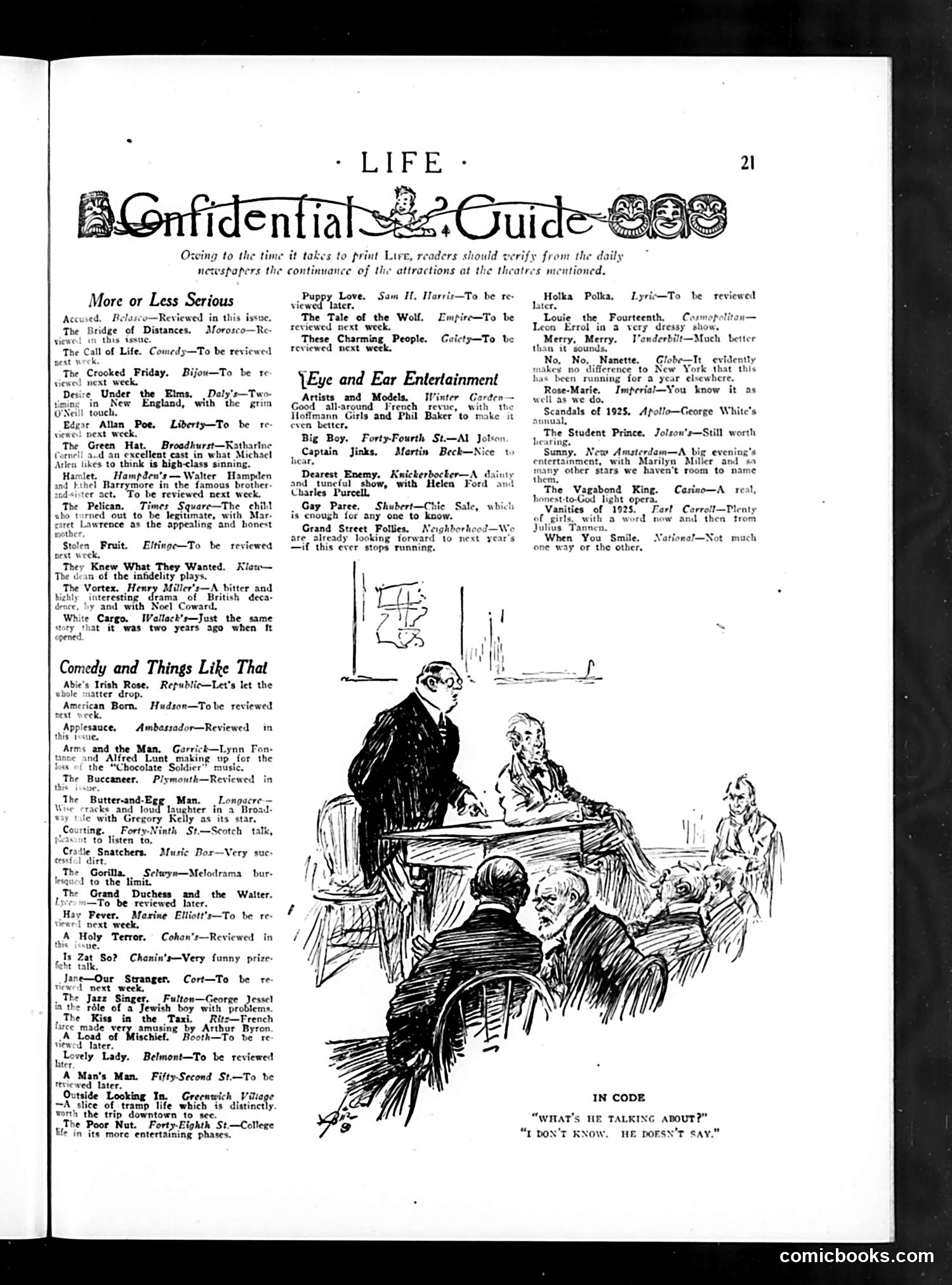
This page is a **theater review and entertainment listing** from Life magazine, typical of the 1920s era. It contains no political cartoons—only one small illustration. The single cartoon at bottom shows a scene "In Code" with the caption "What's he talking about? I don't know. He doesn't say." It depicts what appears to be a **silent film or pantomime scenario**—a social gathering where someone is speaking but remaining incomprehensible, likely satirizing the confusion of early sound films or the awkwardness of trying to understand someone in a noisy venue. The bulk of the page lists Broadway theater productions with brief reviews—comedies, musicals, and dramas. Notable mentions include *The Jazz Singer* (starring George Jessel) and *Rose-Marie*, reflecting popular 1925 entertainment. The tone is gossipy and casual, typical of Life's satirical approach to theater criticism of the period.
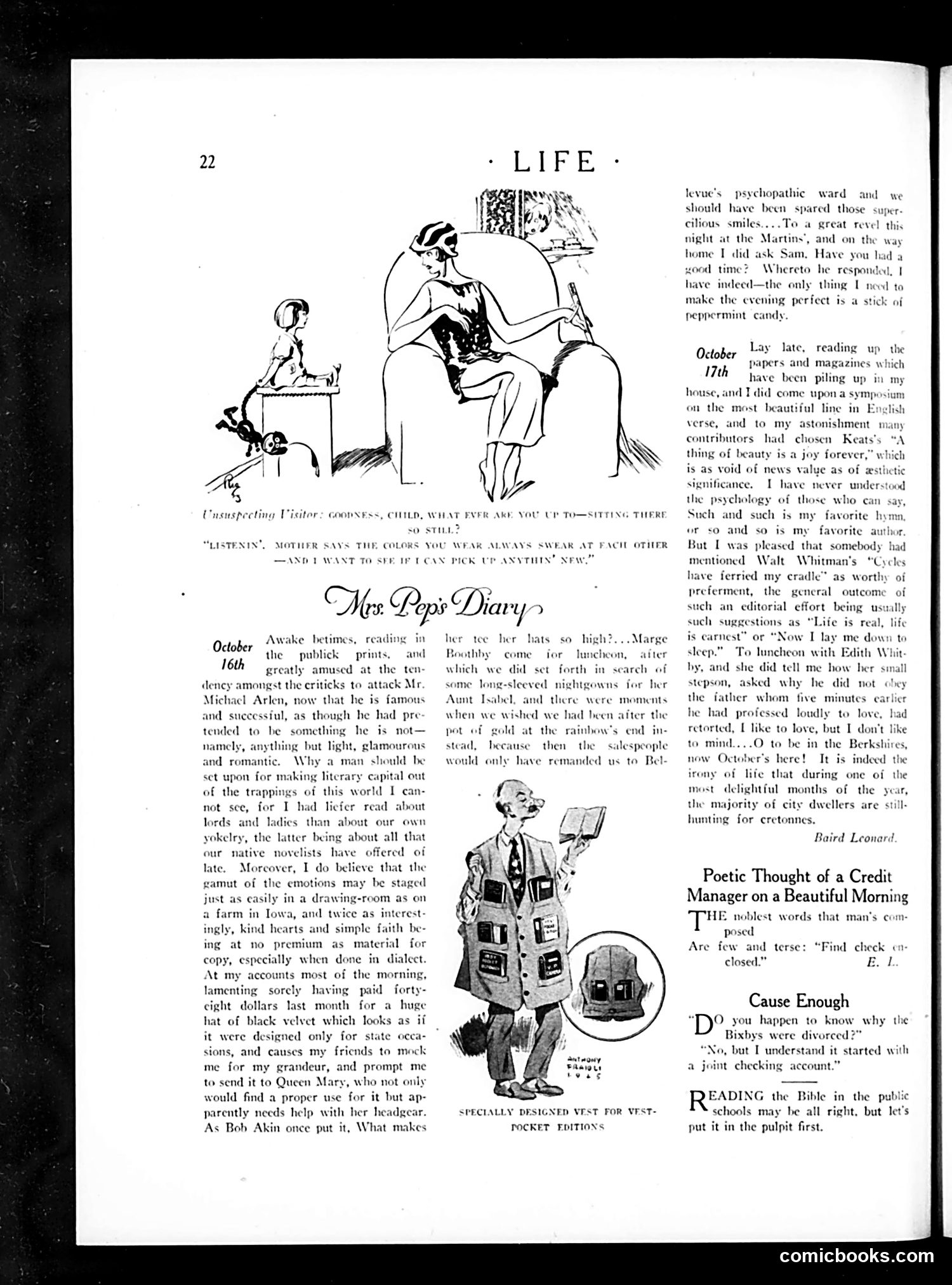
This page from *Life* magazine (circa 1920s based on style) contains several satirical pieces mocking contemporary American social pretensions and literary culture. **"Mrs. Pep's Diary"** (main feature): A wealthy woman's diary entry lamenting her social struggles—an expensive black velvet hat designed only for state occasions, friends mocking her pretensions, and the irony that during "one of the most delightful months of the year," city dwellers hunt for fabric samples rather than enjoy October. **Top cartoon**: A mother scolds her child for sitting and listening while she and others use colorful language, humorously depicting working-class speech patterns. **Other short jokes**: - "Poetic Thought of a Credit Manager"—mocks business jargon masquerading as profundity - "Cause Enough"—satirizes marital discord caused by joint bank accounts - Final quip critiques the hypocrisy of public Bible reading without genuine religious practice The overall satire targets: social climbing, literary pretension, middle-class anxieties about status symbols, and American hypocrisy regarding morality and culture.
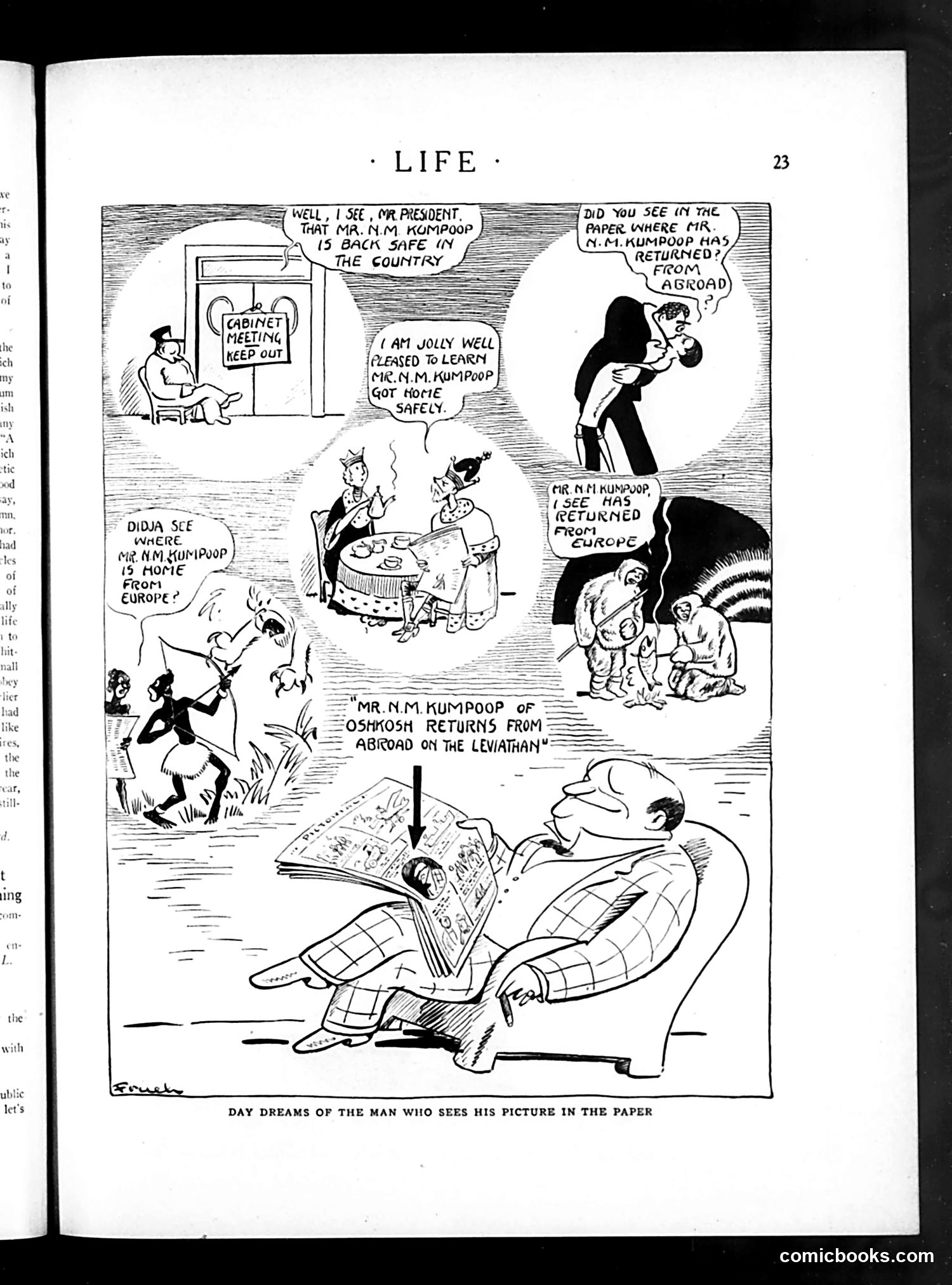
This is a satirical comic strip mocking a vain, minor public figure—"Mr. N.M. Kumpoop"—who has traveled abroad and returned home. The humor centers on his self-importance and delusion. The cartoon depicts multiple scenes: a man seeing his own picture in a newspaper and daydreaming about the attention it supposedly generates. Various characters congratulate him on his safe return from Europe, with exaggerated enthusiasm that the protagonist imagines. The final panel shows him lounging contentedly, fantasizing about his newfound celebrity status. The satire targets the everyman's inflated ego upon minor recognition—the absurd pleasure someone might take from appearing in print, however briefly. "Kumpoop" itself is a deliberately ridiculous name emphasizing the character's insignificance. The strip mocks both the human tendency toward vanity and the media's role in creating false importance around ordinary people. It's a timeless joke about ordinary people mistaking brief newspaper mention for genuine significance.
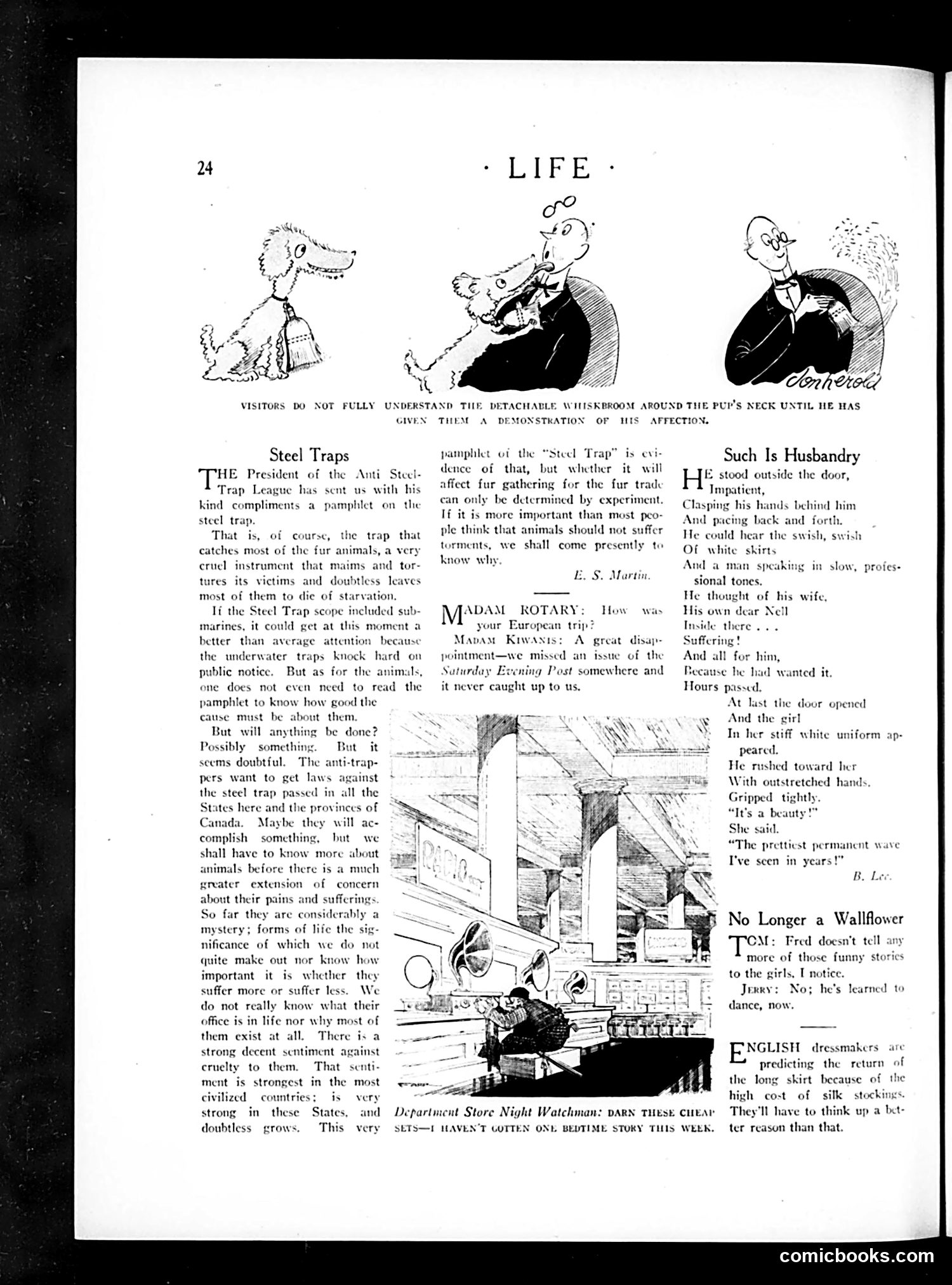
This page contains four distinct humor pieces typical of early 20th-century satirical journalism: **Top cartoon**: Shows a poodle with a detachable "whiskbroom" around its neck. The joke is that visitors don't understand the device's purpose until the dog demonstrates affection by wagging its tail, causing the broom to sweep—a pun on the dog's usefulness. **"Steel Traps"**: An editorial piece debating animal welfare. The Anti Steel-Trap League advocate argues for laws banning traps that maim fur-bearing animals, while the author expresses skepticism about whether we truly understand animal suffering enough to legislate it. **"Such Is Husbandry"**: A sentimental short story about a man waiting anxiously outside a door, worried his wife is suffering inside—revealed to be her getting a permanent wave hairdo. The satire mocks his overwrought concern. **Bottom items**: Brief humor bits about a department store night watchman lacking bedtime stories, a woman's return to dancing, and English dressmakers' dubious reasoning for predicting long skirts' return due to silk stocking costs.
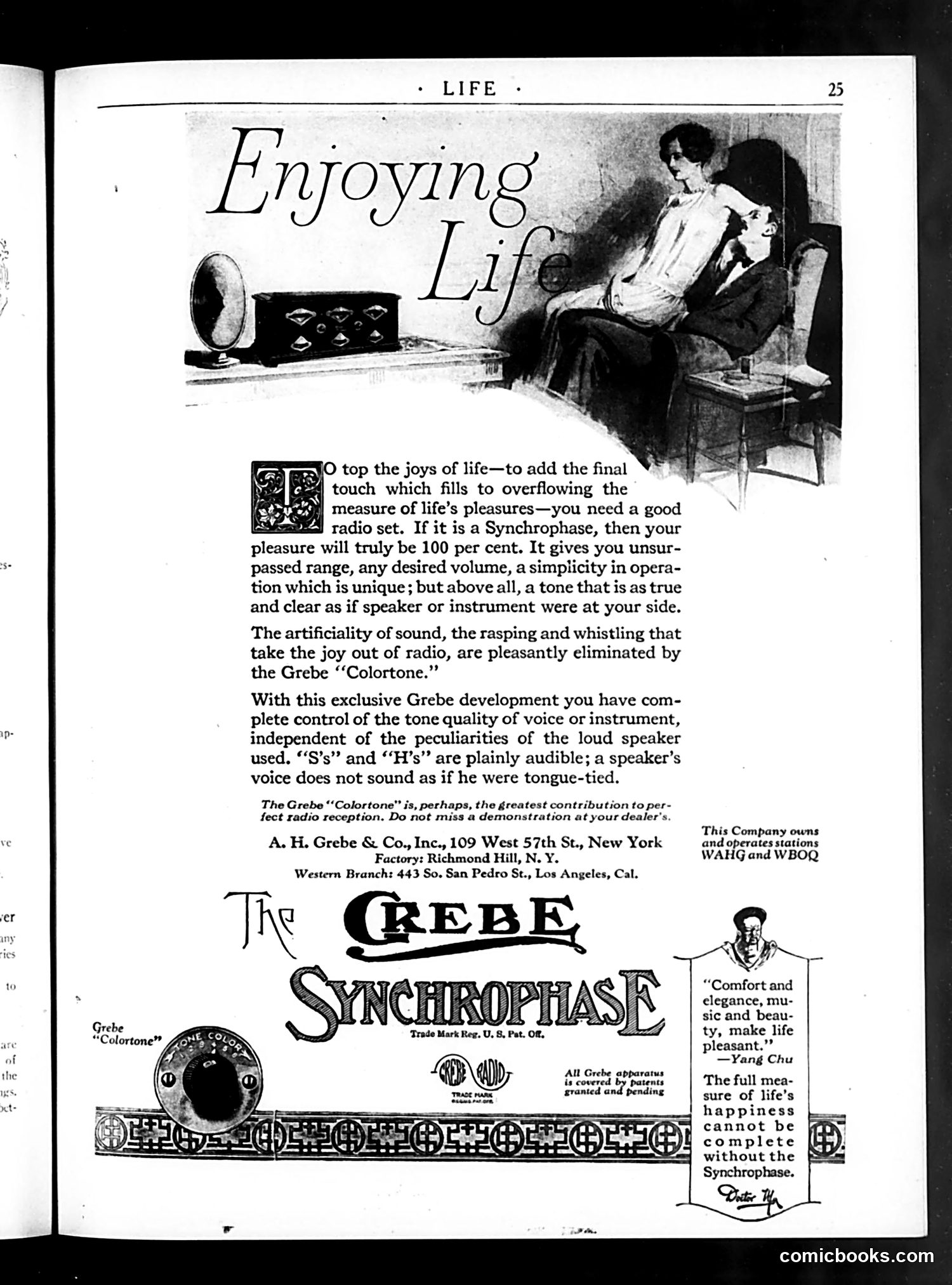
This page is primarily **advertising, not satire or political content**. It's a full-page advertisement for the Grebe Synchrophase radio set, published in Life magazine (which was primarily a humor/satire publication, but accepted advertisements). The illustration shows a couple enjoying leisure time—a man reading while a woman holds a cat, with a radio on a side table. This depicts the aspirational lifestyle the product promises. The text emphasizes the radio's superior sound quality, particularly the "Colortone" feature that eliminates static and distortion. The quote attributed to "Yang Chu" about comfort and elegance reinforces the luxury positioning. **Context for modern readers**: This reflects the 1920s-30s fascination with radio as transformative consumer technology. The ad suggests radio ownership signals refined taste and enhances domestic happiness—a common marketing strategy for emerging technologies. The company even operated its own radio stations (WAHG and WBOQ), demonstrating vertical integration typical of the era.
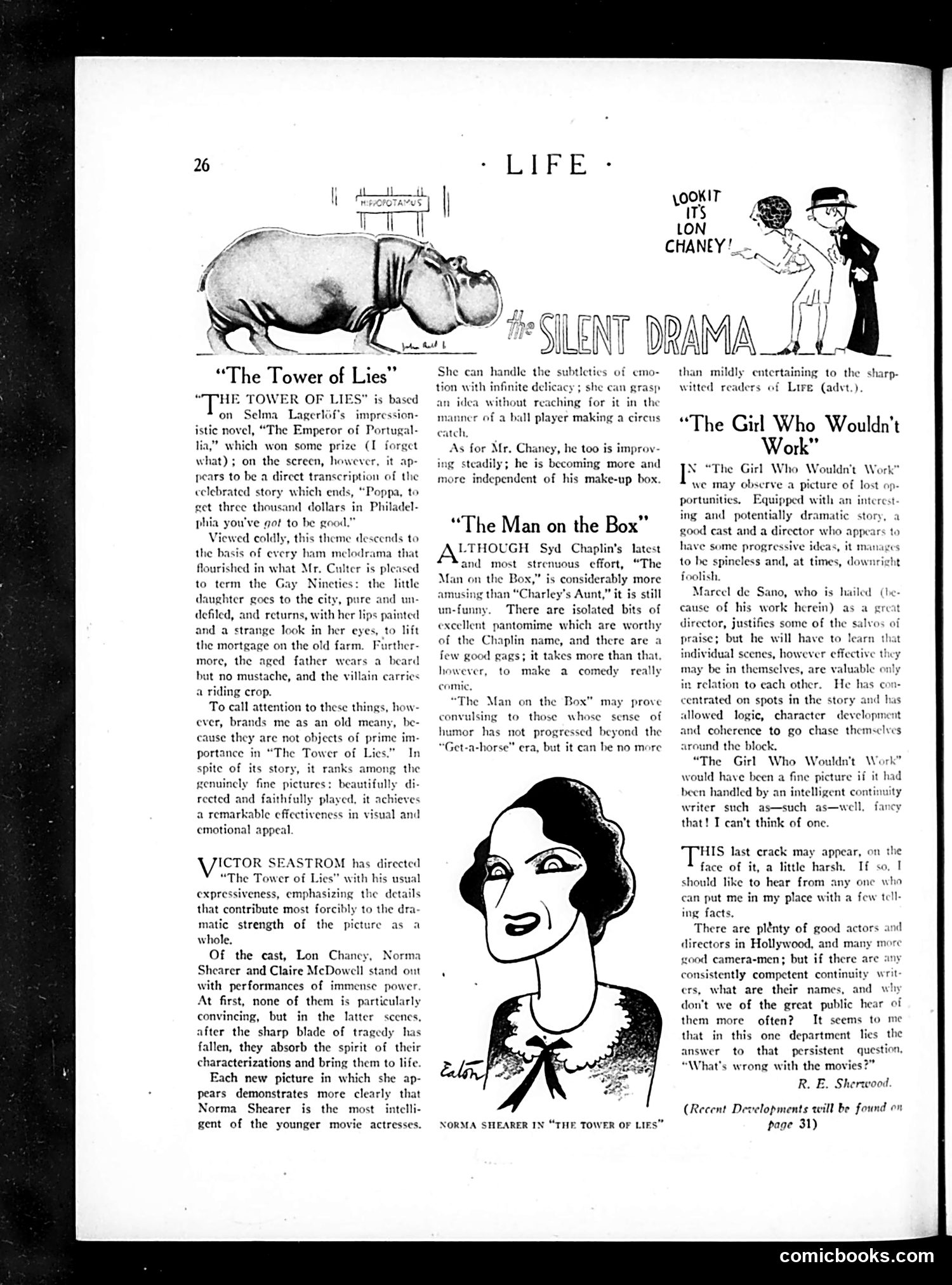
This page reviews three silent films from the 1920s: **"The Tower of Lies"** - The critic praises director Victor Seastrom's visual storytelling and the performances of Lon Chaney and Norma Shearer, though he dismisses the melodramatic plot (about a rural daughter who goes to the city) as hackneyed "Gay Nineties" fare. He notes Shearer's intelligence as an actress. **"The Man on the Box"** - Syd Chaplin's comedy is criticized as derivative and unfunny, following an outdated "Get-a-horse" comedic style. **"The Girl Who Wouldn't Work"** - Despite having potential and a good cast, the critic finds it incoherent, blaming the director Marcel de Sano for focusing on individual scenes rather than overall narrative coherence. The small cartoon at top-right ("Look it's Lon Chaney!") is simply a joke acknowledging Chaney's famous makeup artistry and dramatic range. The content reflects 1920s film criticism standards and the transition from silent film conventions.
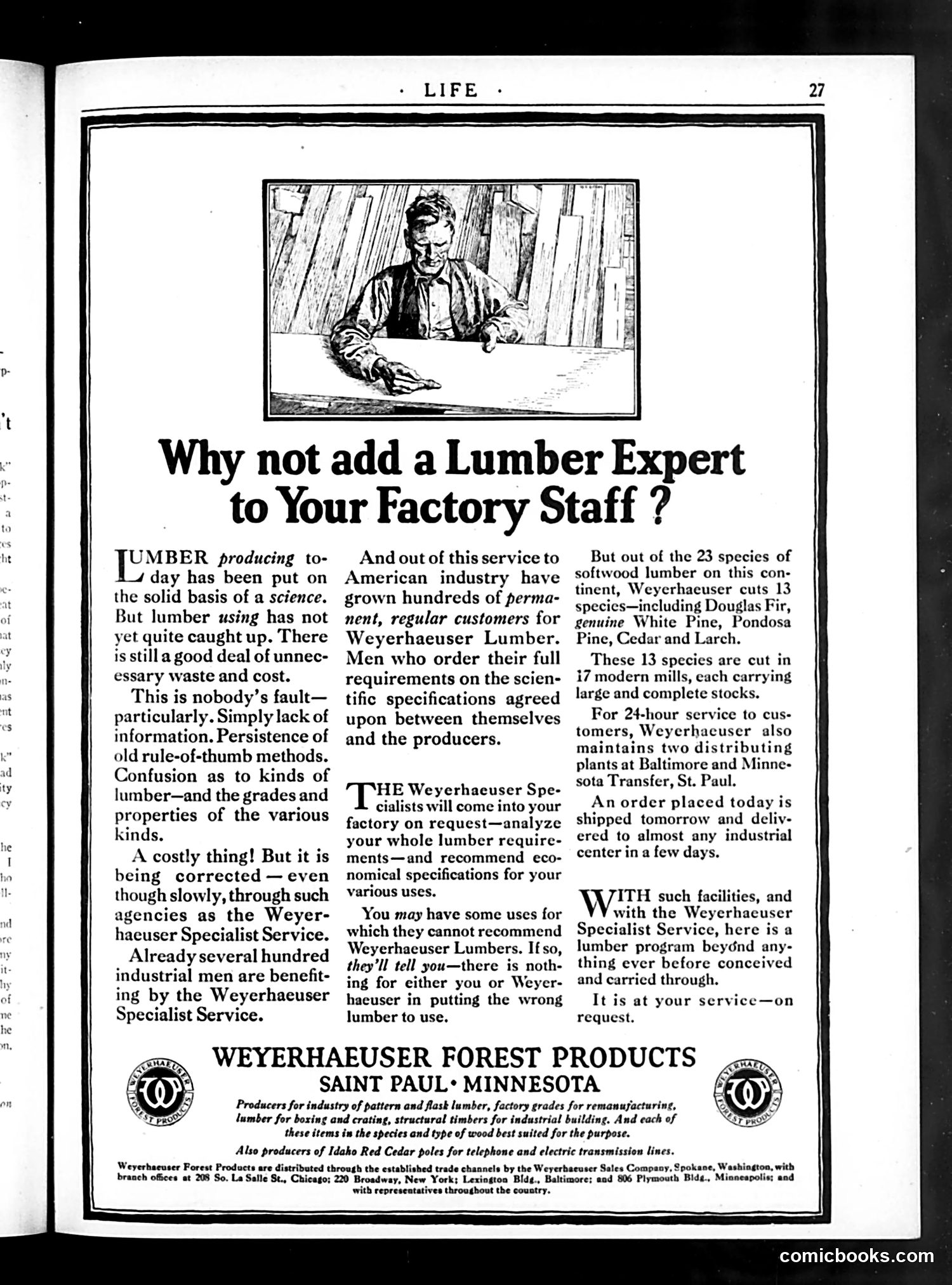
This is **not a cartoon or satire**—it's a full-page advertisement for Weyerhaeuser Forest Products, a lumber company. The illustration shows a carpenter or factory worker examining lumber, used to establish credibility. The ad's premise is straightforward business messaging: American factories waste money using lumber inefficiently because they lack scientific knowledge about wood grades and properties. Weyerhaeuser offers a "Specialist Service"—experts who will analyze a factory's lumber needs and recommend the right wood types from their 13 softwood species, cut across 17 mills. The pitch emphasizes efficiency, rapid delivery (next-day shipping), and honest service (they'll admit when Weyerhaeuser products aren't suitable). This reflects early 20th-century industrial marketing: positioning a commodity supplier as a scientific expert solving wasteful "old rule-of-thumb methods." There's no satire here—just persuasive advertising targeting factory managers.
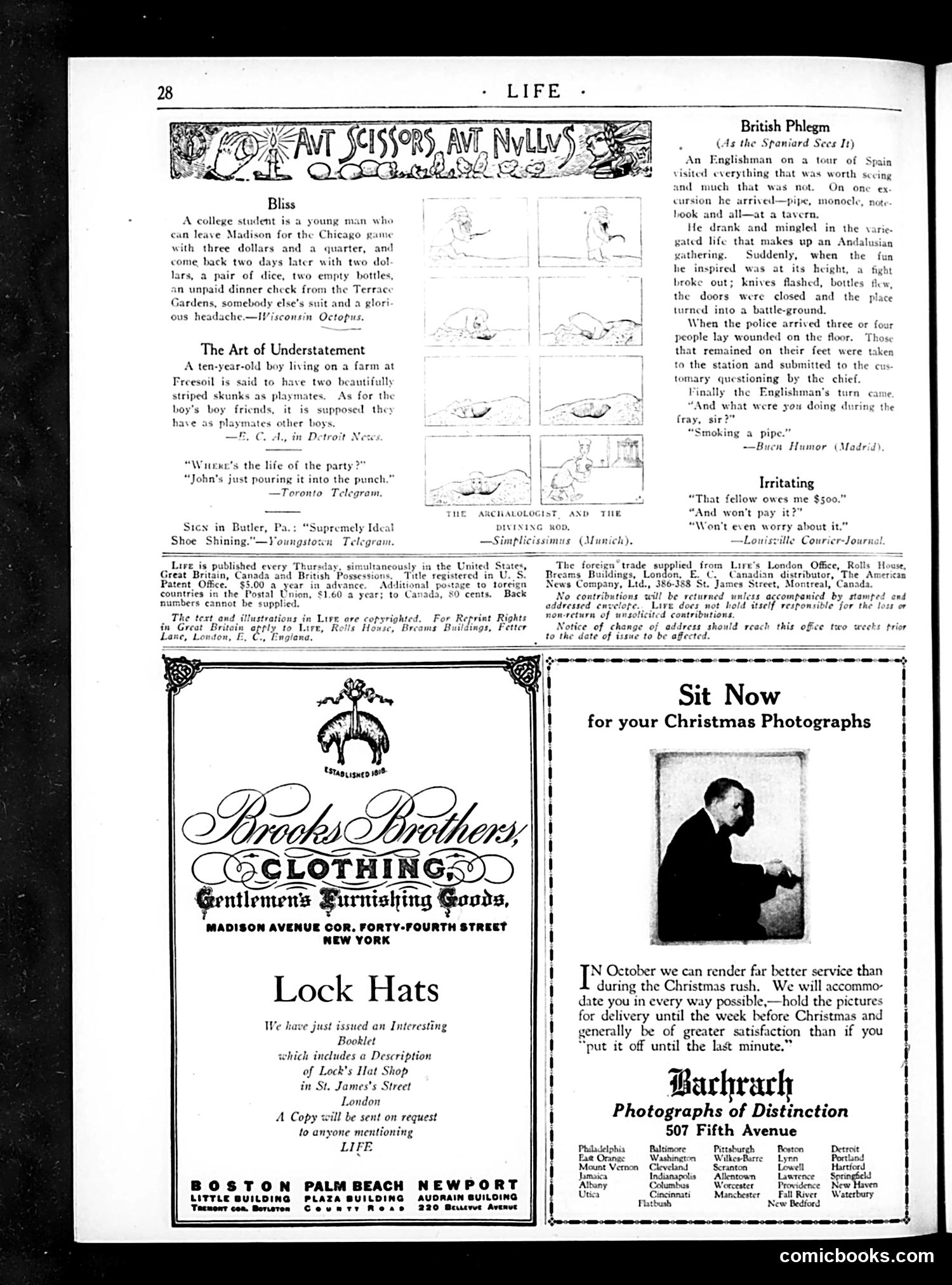
This page contains three humorous short pieces typical of Life's satirical format: **"British Phlegm"** depicts a stereotype about English composure. An English tourist (identifiable by his pipe and monocle—period markers of upper-class Britishness) visits a Spanish tavern where a brawl erupts with knives and bottles. When police arrive, the Englishman remains so emotionally detached that when questioned about his role in the fray, he simply replies he was "smoking a pipe." The joke plays on the British reputation for emotional restraint and understatement, even in chaotic situations. **"The Art of Understatement"** and **"Irritating"** are brief quips about communication styles—one praising minimalist expression, the other mocking someone's avoidance of debt payment. The page is otherwise dominated by **advertisements**: Brooks Brothers (clothing), Lock Hats (London haberdashery), and Bachrach (portrait photography studio). These upscale brand placements reflect Life's affluent readership. The illustrated comic panel labeled "The Archaeologist and the Divining Rod" appears to be a visual joke, though details are unclear from the image quality.
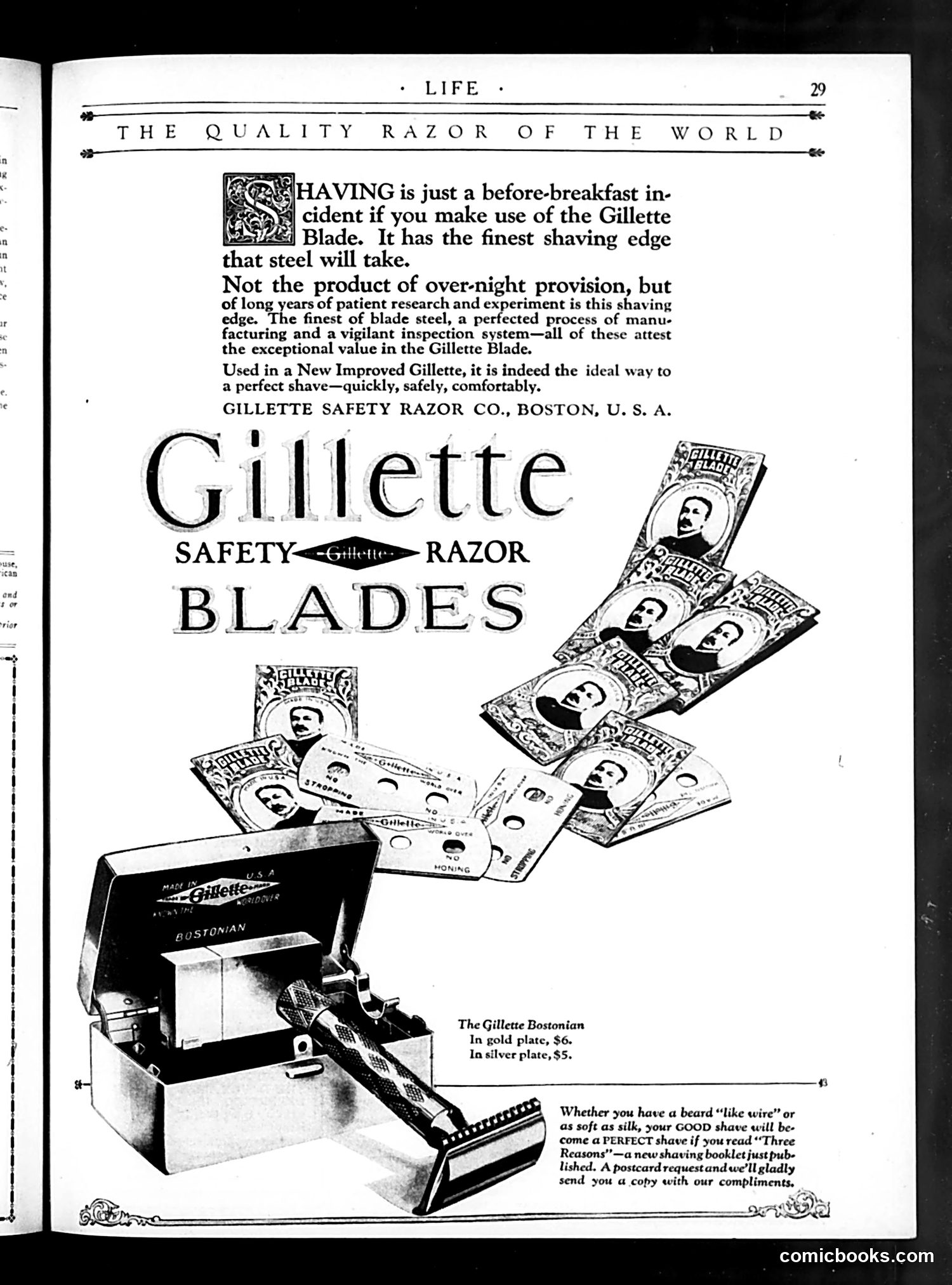
This is a **commercial advertisement**, not political satire. The page promotes Gillette Safety Razor blades and the "Bostonian" razor model to *Life* magazine readers. The ad emphasizes the blade's superior quality through claims of "long years of patient research" and rigorous manufacturing inspection. It positions shaving as a quick, routine morning task made perfect by Gillette's product. The visual displays product packaging (featuring what appears to be a man's portrait) and the razor device itself. Pricing is listed: $6 in gold plate, $5 in silver plate. A closing pitch offers a free booklet titled "Three Reasons"—apparently explaining why the razor works well regardless of beard type (described colorfully as either "like wire" or "soft as silk"). This reflects early-20th-century advertising strategy: emphasizing scientific manufacturing processes and offering educational materials to build consumer confidence in a new technology.
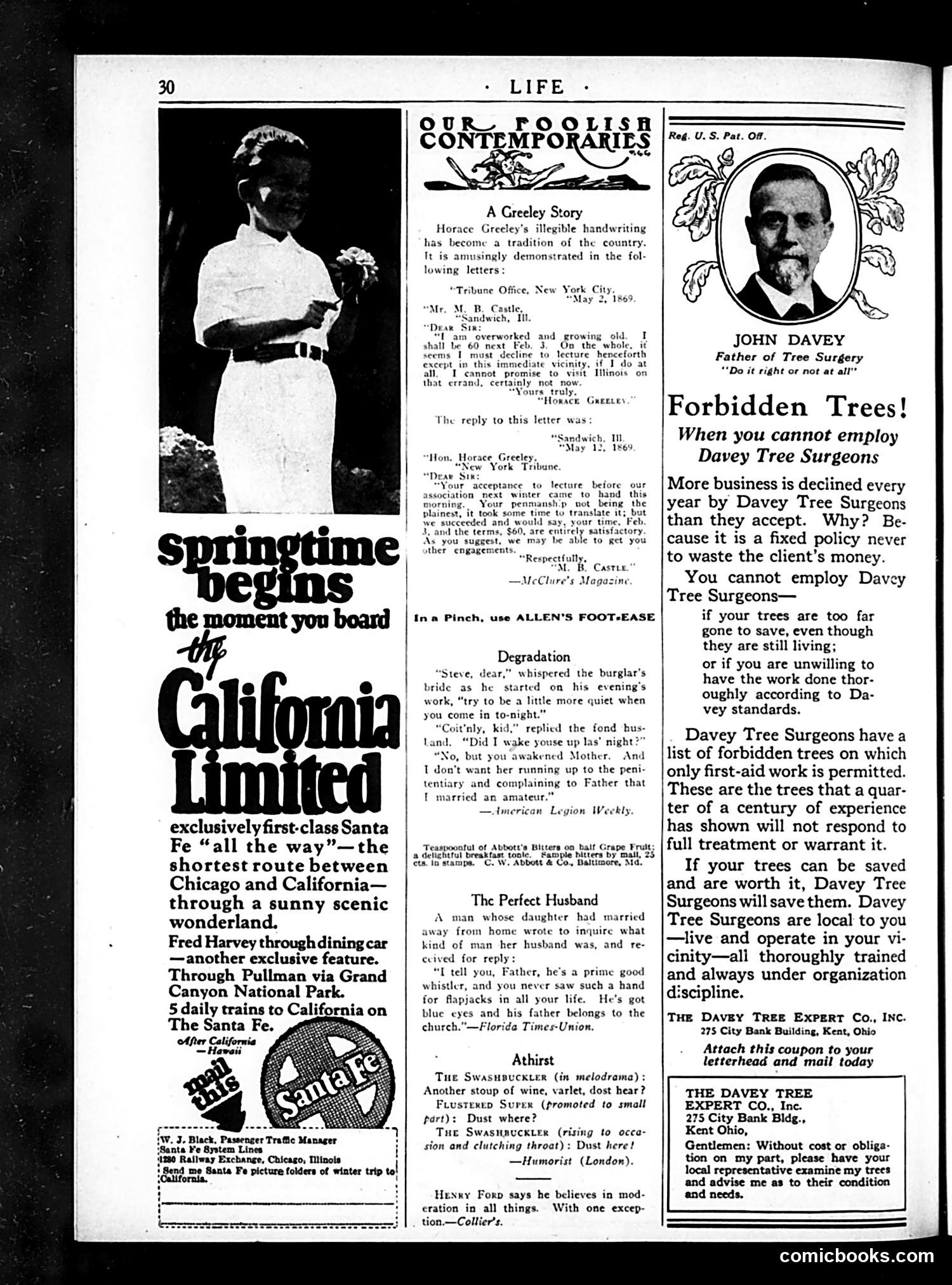
This Life magazine page (appears to be from early 1900s) mixes humor pieces with advertising: **"A Greeley Story"** satirizes Horace Greeley (19th-century newspaper editor and politician) for his notoriously illegible handwriting. The joke shows an exchange where Greeley declines a lecture invitation in scrawl so bad that the recipient's reply quips they couldn't read it—a running joke about Greeley's penmanship becoming legendary. **Other brief humor pieces** include jokes about burglars, husbands, and theatrical performers—light social comedy typical of the era, poking fun at working-class life and marital mishaps. **The advertisements** for the California Limited train and Davey Tree Surgeons dominate the right side, promoting exclusive travel and professional tree care services to affluent readers. The page reflects early 20th-century American magazine culture: celebrity gossip, genteel humor, and advertising targeting the middle-to-upper class.
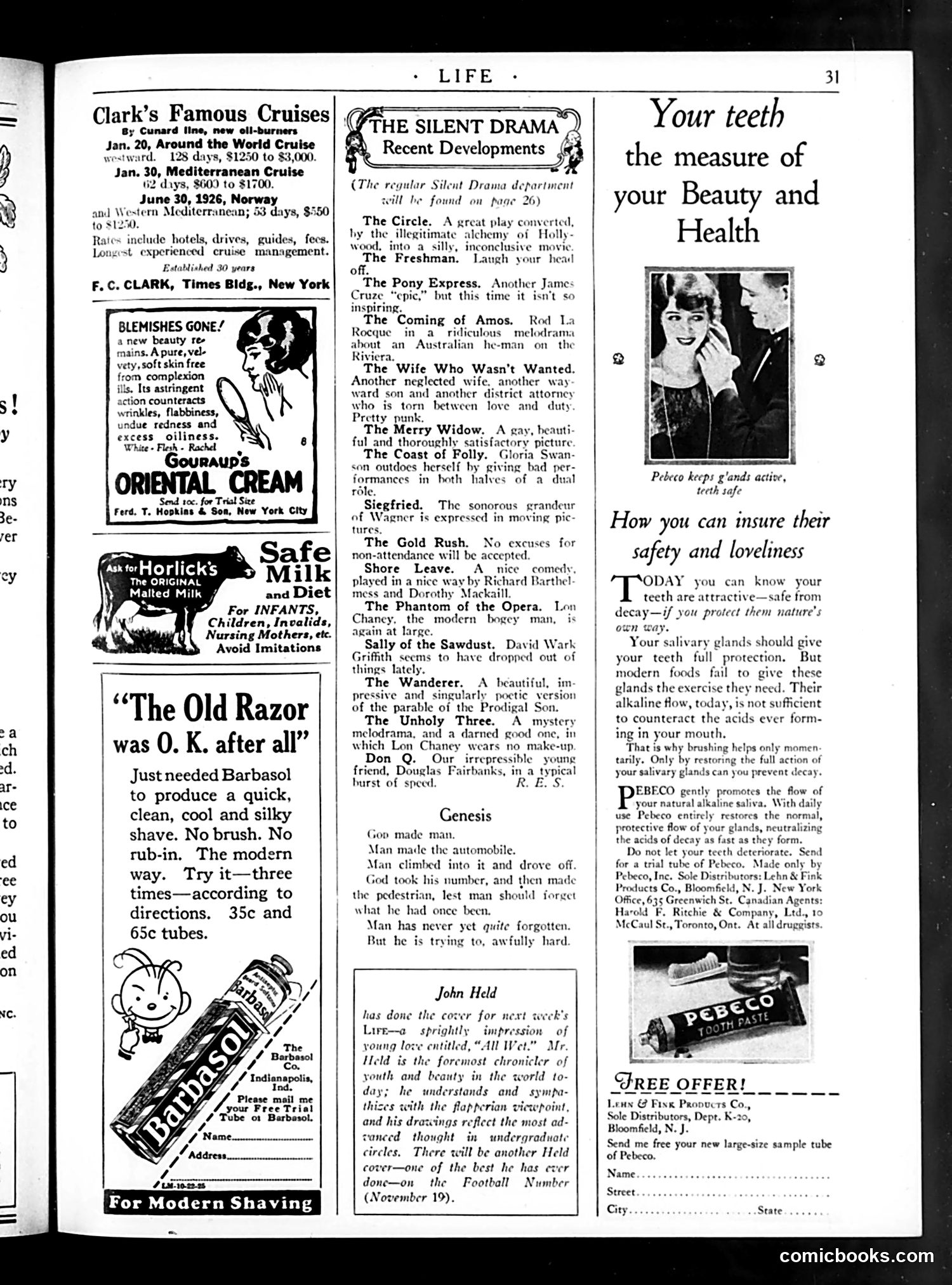
This page is primarily **advertising and entertainment coverage** from Life magazine, circa 1925-1926. The notable non-commercial content includes: **"The Silent Drama"** section reviews contemporary films. References like "The Gold Rush" (Chaplin) and "The Phantom of the Opera" (Lon Chaney) were current hits. The reviews are brief, satirical critiques—calling one film "punk" and declaring attendance at another film non-optional. **"Genesis"** is a short satirical poem mocking modern progress: God created man, man created the automobile, and God then created the pedestrian as a consequence of man's recklessness. It's social commentary on automobile danger—a contemporary concern as cars proliferated in the 1920s. **John Held tribute** celebrates the illustrator as chronicler of "flapperian viewpoint"—referencing the Jazz Age "flapper" youth culture that Held famously depicted. The page is otherwise dominated by advertisements for cruises, beauty creams, razors, and milk products—typical 1920s consumer marketing emphasizing leisure, appearance, and modern convenience.
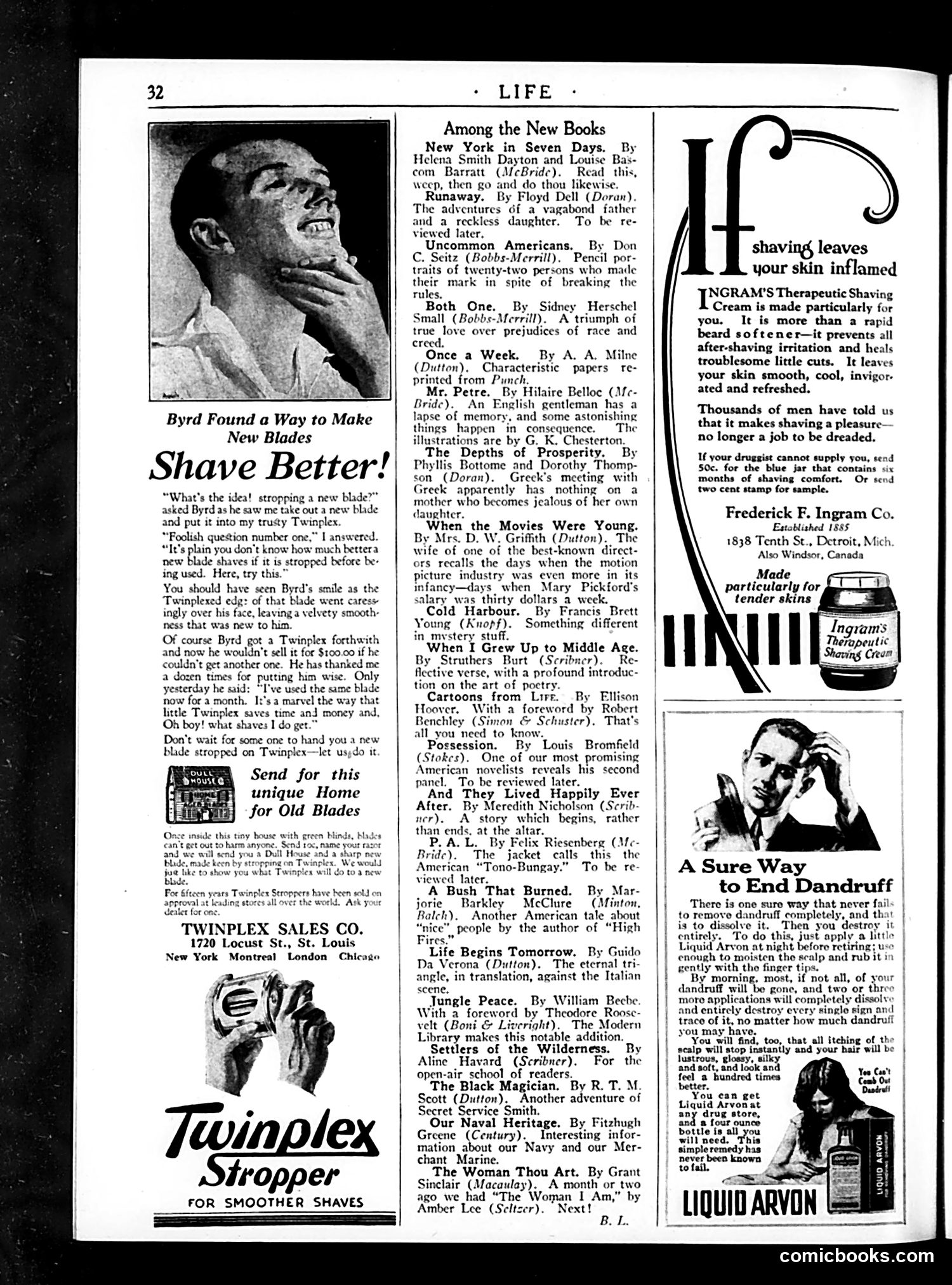
This is primarily a **book review section and advertisements** from Life magazine, not a political cartoon. The page features: **Left side:** An advertisement for the Twinplex razor stropper, showing a man named "Byrd" discovering that stropping new razor blades before use produces better shaves. The "joke" is a consumer testimonial—Byrd is so impressed he refuses to sell his Twinplex for $100 and claims to use the same blade for a month. **Center/Right:** A "New Books" section reviewing contemporary literature (1920s era), including works by A.A. Milne, Hilaire Belloc, and D.W. Griffith's wife about early cinema. **Right side:** Advertisements for Ingram's Therapeutic Shaving Cream and Liquid Arvon hair product, both addressing common grooming problems. This is **commercial content masquerading as editorial**—typical of Life's era when advertising and articles blended together. There is no political satire here.
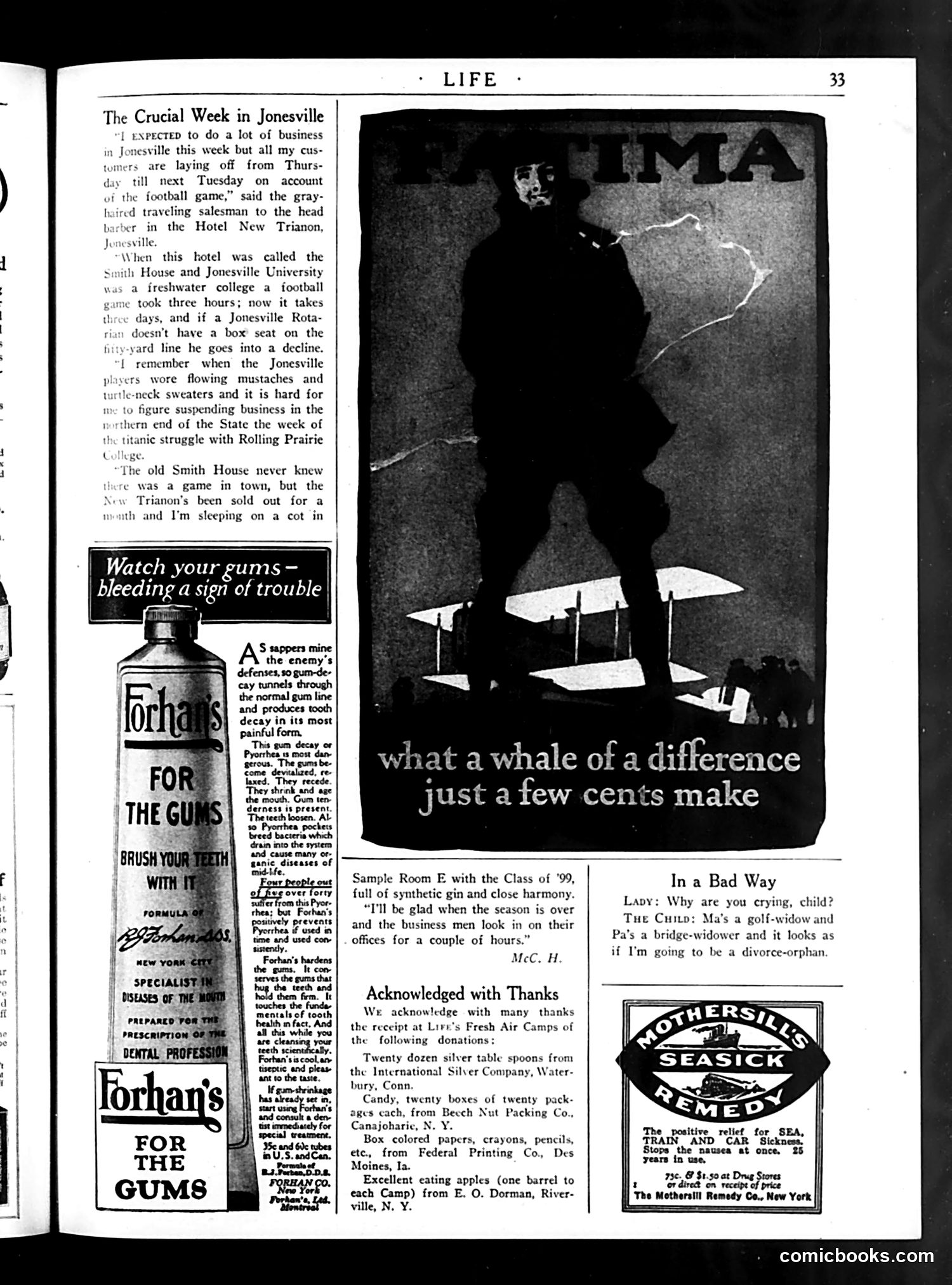
This satirical piece mocks how completely a college football game disrupts small-town commerce and life. A traveling salesman complains that all his customers have shut down their businesses from Thursday through Tuesday to attend or prepare for a game between Jonesville and Rolling Prairie College. The humor lies in the exaggeration of football's grip on the community: the game now takes three days instead of the old three hours; hotel rooms are completely sold out; businessmen abandon their offices entirely. The nostalgic reference to when the "Smith House never knew there was a game in town" emphasizes how dramatically priorities have shifted. The accompanying cartoon shows men in what appears to be a hotel room drinking "synthetic gin" and singing—depicting the excess and distraction of game week. The satire suggests that American small towns have become dangerously obsessed with college sports, to the detriment of actual business and productivity.
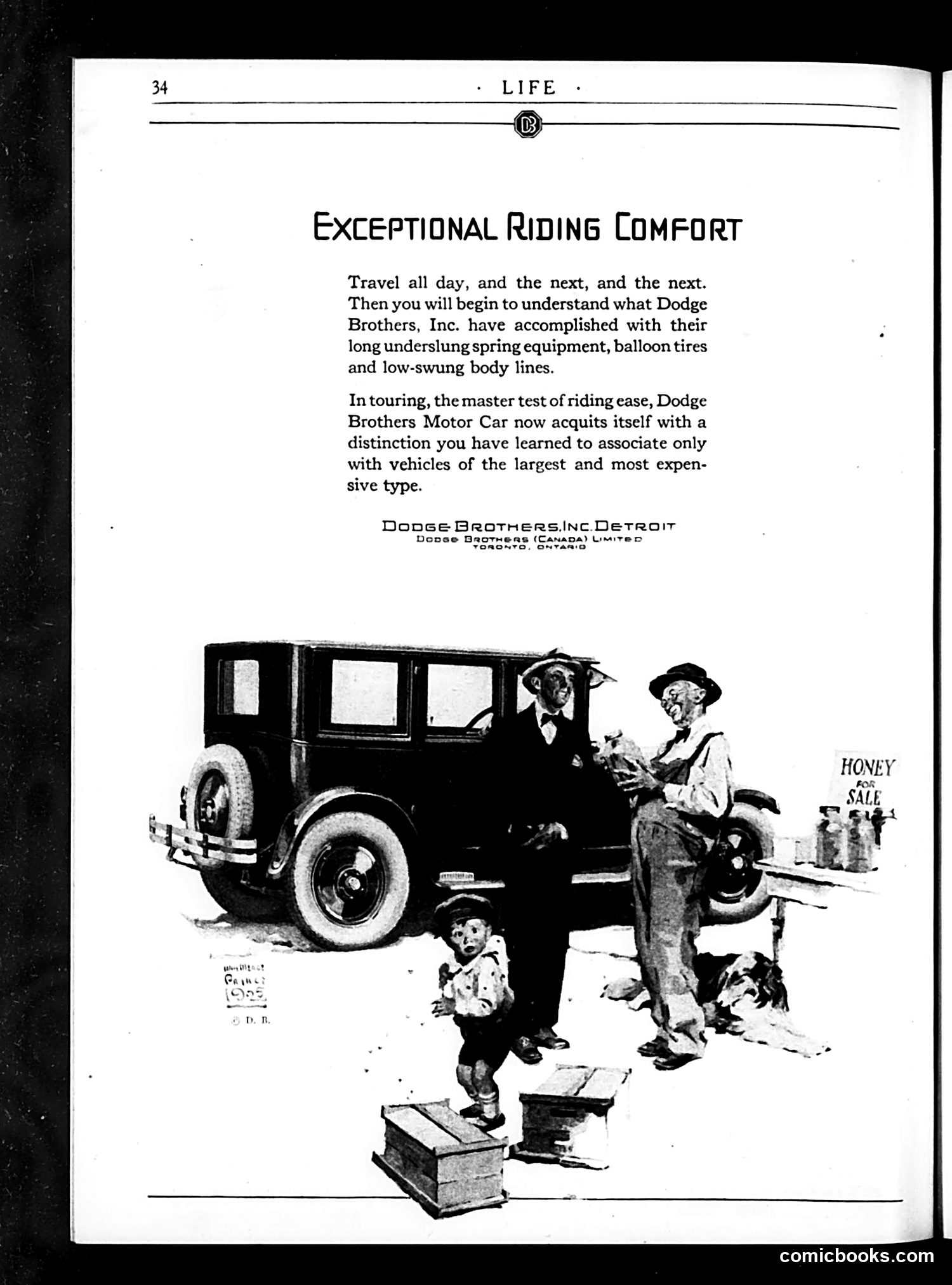
This is a Dodge Brothers automobile advertisement, not a political cartoon. The page promotes the "Exceptional Riding Comfort" of Dodge motor cars, emphasizing their advanced suspension system ("long underslung spring equipment"), balloon tires, and low-slung body design. The illustration shows a family on a rural roadside—a man in a car, a woman selling honey, and children—depicting leisure travel. The ad's message claims that Dodge vehicles now offer riding comfort previously associated only with expensive luxury cars, making them accessible to middle-class families. This was a significant selling point in the 1920s-30s when automobile comfort was still a developing feature. The "Honey for Sale" sign suggests an American pastoral setting, positioning Dodge as ideal for extended touring trips.
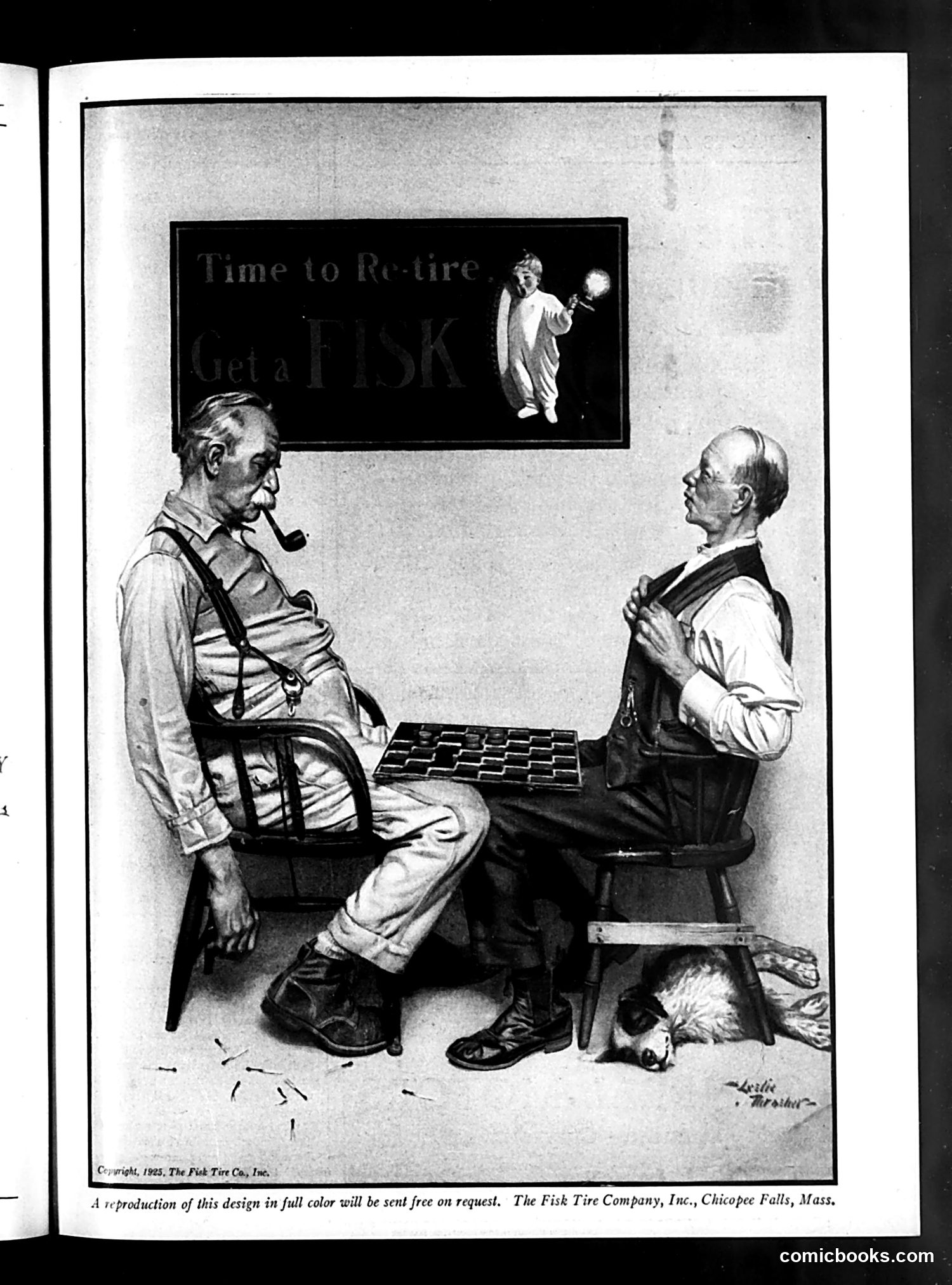
This is a **Fisk Tire Company advertisement**, not political satire. Two older men play checkers while contemplating retirement, with a thought-bubble showing a cherub holding a glowing orb labeled "Time to Re-tire / Get a Fisk." The visual pun plays on "re-tire" (retire from work) versus "retyre" (replace tires). A small dog sleeps nearby. The ad's message targets middle-aged workers: retirement security depends on reliable Fisk tires for leisure travel. The cherub suggests comfort and ease—aspirational imagery for early automotive culture. The copyright date appears to be 1925 (the "1985" is likely a OCR error), placing this in Life magazine's heyday as a humor and advertising publication.
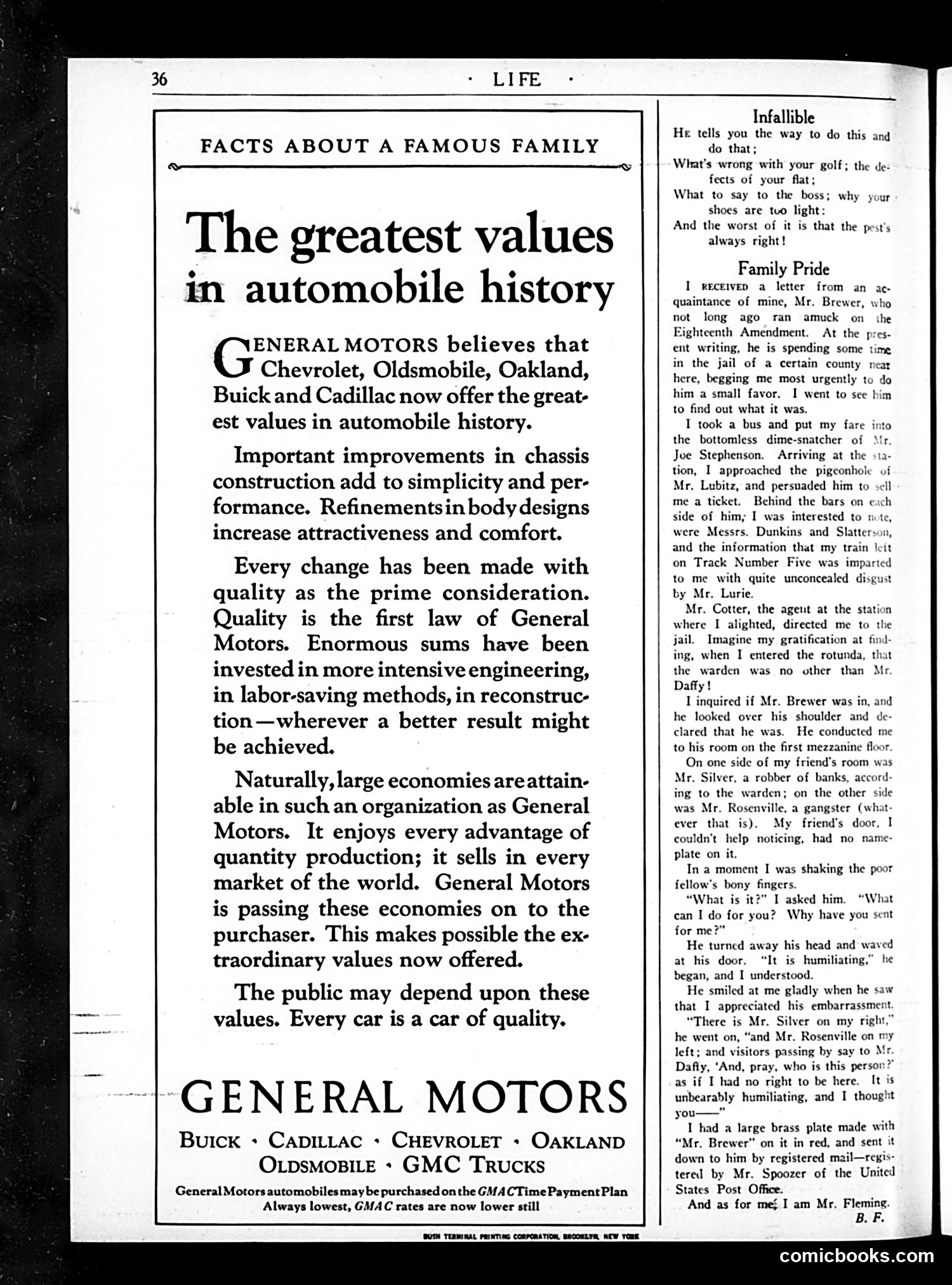
This is primarily a **General Motors advertisement** disguised as editorial content, claiming GM's five car brands offer "the greatest values in automobile history." The ad emphasizes quality engineering, economies of scale, and affordable pricing through the GMAC payment plan—a pitch to Depression-era consumers concerned about value. The right column contains two separate **humorous short stories**: 1. **"Infallible"**: A satirical complaint about someone (likely a nagging spouse or know-it-all) who constantly offers unsolicited advice on golf, home décor, workplace matters, and fashion—and is always annoyingly correct. 2. **"Family Pride"**: A man imprisoned for Prohibition violations (the "Eighteenth Amendment" reference) requests the narrator's help. His humiliation stems not from his crime, but from having no nameplate on his jail cell door—appearing anonymous while notorious criminals (a bank robber, a gangster) have theirs. The solution: a brass nameplate reading "Mr. Brewer." The joke satirizes misplaced pride in maintaining respectability despite criminal incarceration.
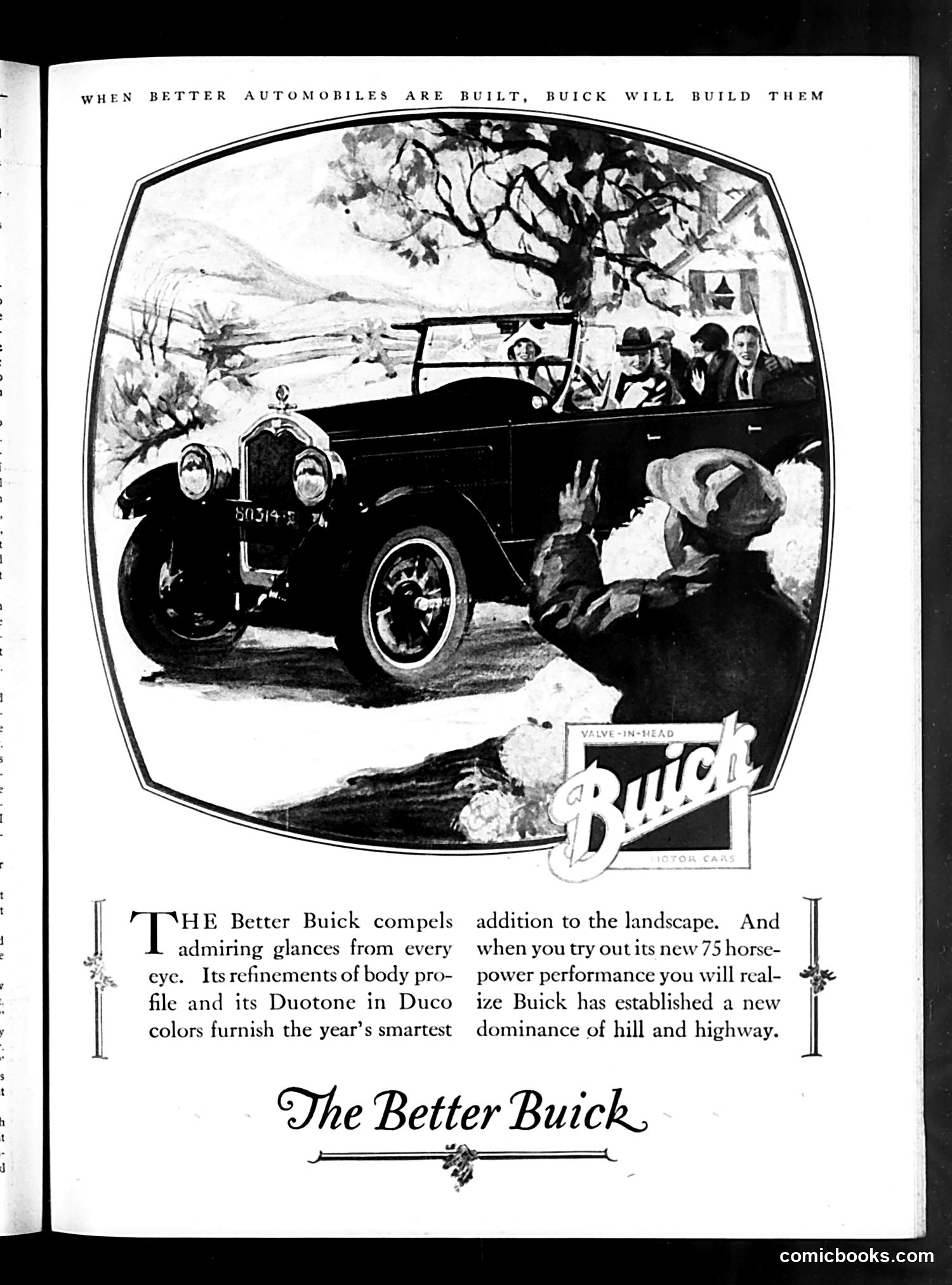
This is a **Buick automobile advertisement**, not political satire. The page promotes "The Better Buick" with the famous slogan "When better automobiles are built, Buick will build them." The illustration shows a stylish 1920s-era open touring car with well-dressed passengers admiring the vehicle. A man in the foreground gestures appreciatively at the car, emphasizing its appeal. The text highlights features appealing to contemporary buyers: refined body design, "Duotone in Duco colors" (a paint technology), and 75 horsepower—then impressive performance. The "Valve-in-Head" notation references the car's engine technology. For modern readers, this represents early automotive marketing emphasizing both aesthetic appeal and mechanical performance to an aspirational middle/upper-class audience during the prosperous 1920s.
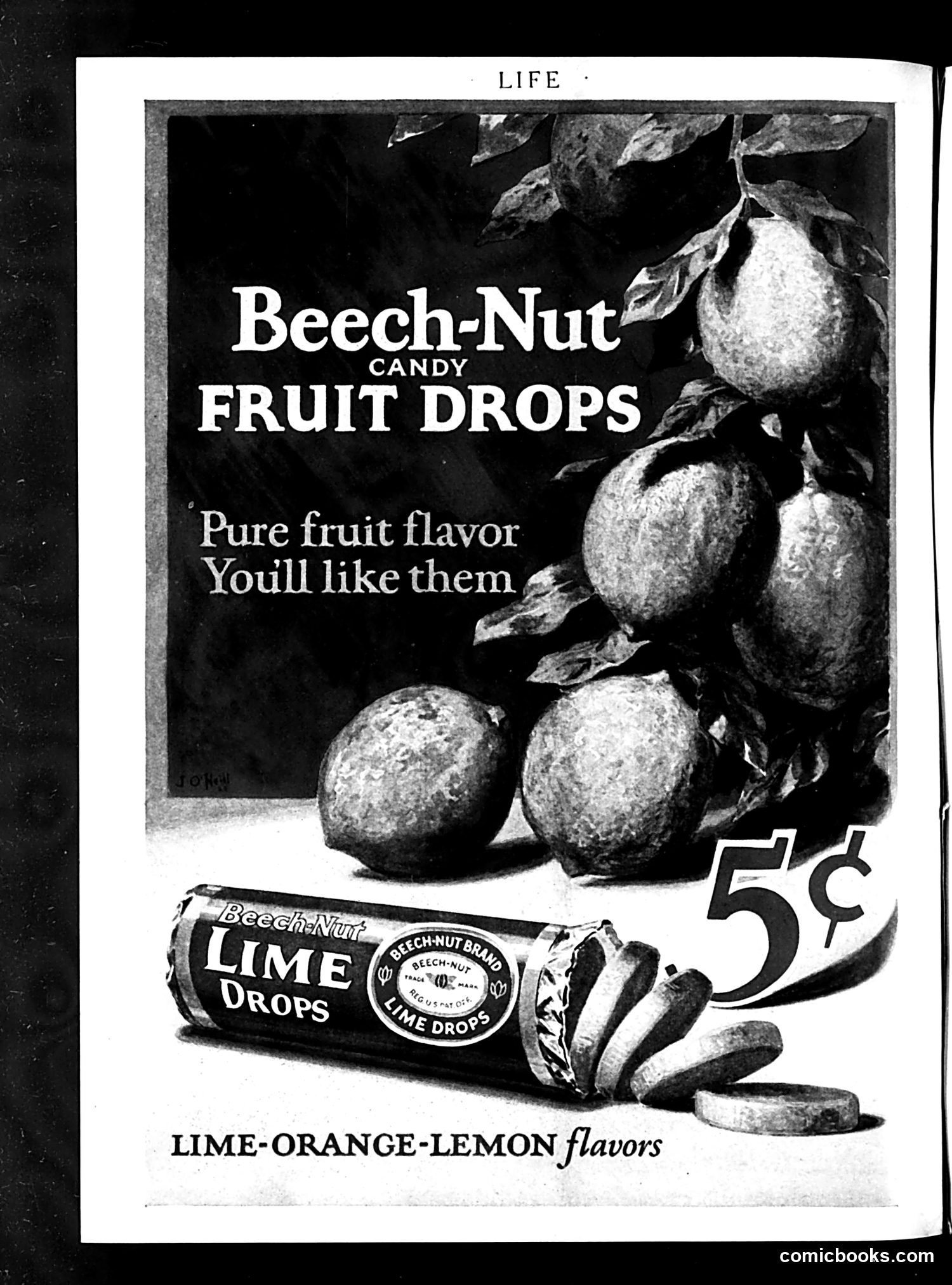
This is a vintage advertisement, not political satire or a cartoon. It promotes Beech-Nut brand Fruit Drops candy, priced at 5 cents. The ad features photographs of pears on the branch and an unwrapped roll of Lime Drops candies with several pieces displayed. The marketing message emphasizes "pure fruit flavor" as the selling point. The specific flavor mentioned is "Lime-Orange-Lemon," suggesting the candy combined multiple citrus tastes. The inclusion of actual fruit imagery was a common advertising strategy to suggest natural, quality ingredients—a persuasive technique relevant to early-to-mid 20th century consumer marketing. There is no political commentary, caricature, or satirical intent visible on this page. It is straightforward product advertising from Life magazine's commercial content.
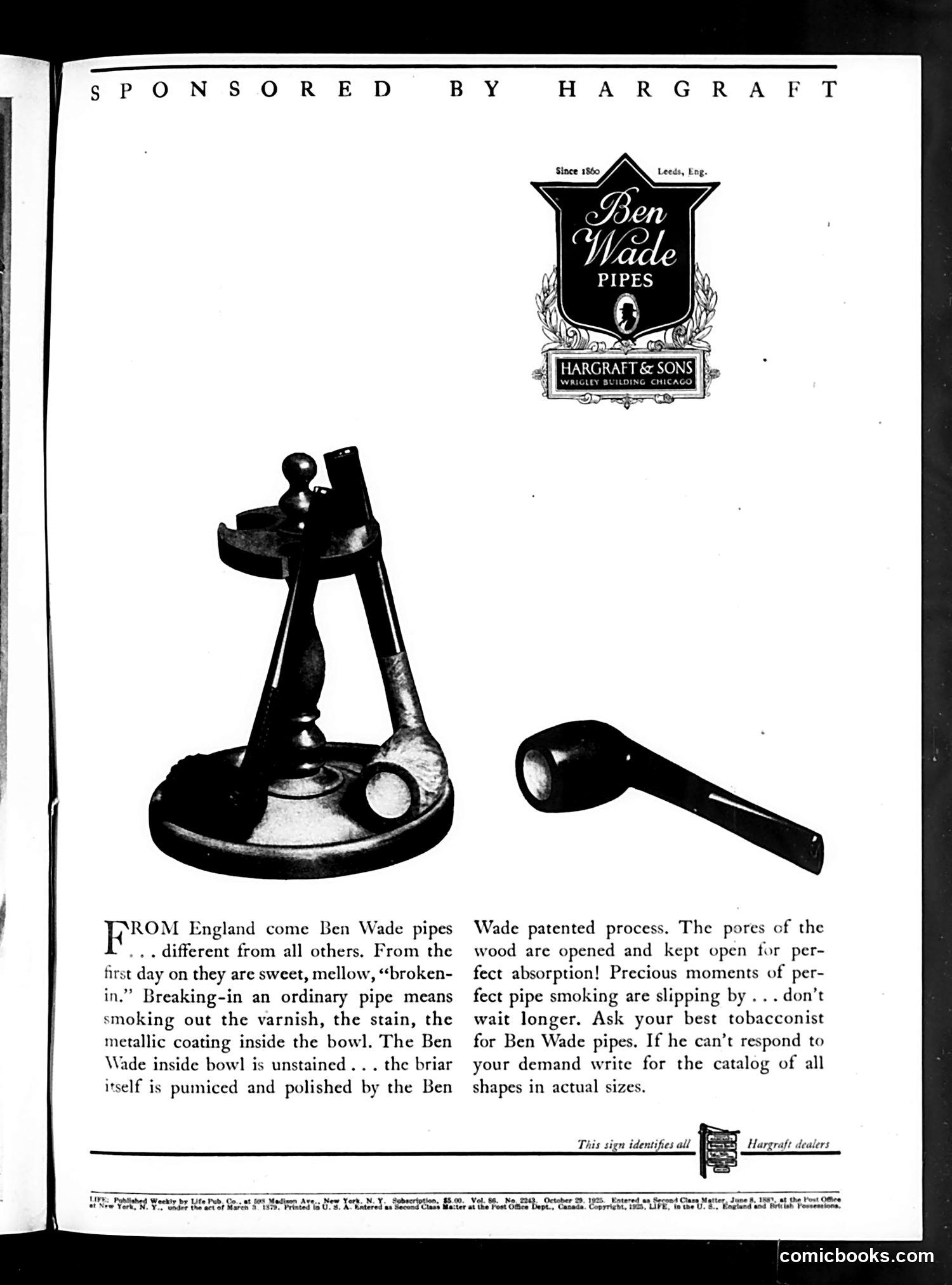
This is a straightforward **advertisement**, not satire or political commentary. The page promotes Ben Wade pipes, manufactured in Leeds, England and distributed by Hargraft & Sons in Chicago. The ad emphasizes the pipes' key selling point: they arrive "broken-in" and ready to smoke immediately, unlike ordinary pipes requiring tedious seasoning that strips away varnish and metallic coatings. Ben Wade uses a patented process that pre-opens the wood's pores for superior absorption and smoking quality. The images show the pipe stand/holder and the pipe itself. The copy addresses modern consumers impatient with traditional pipe maintenance ("Precious moments of perfect pipe smoking are slipping by"). It directs readers to ask their tobacconist or request a catalog. This reflects 1920s consumer marketing: emphasizing convenience, patented innovation, and time-saving for busy customers.
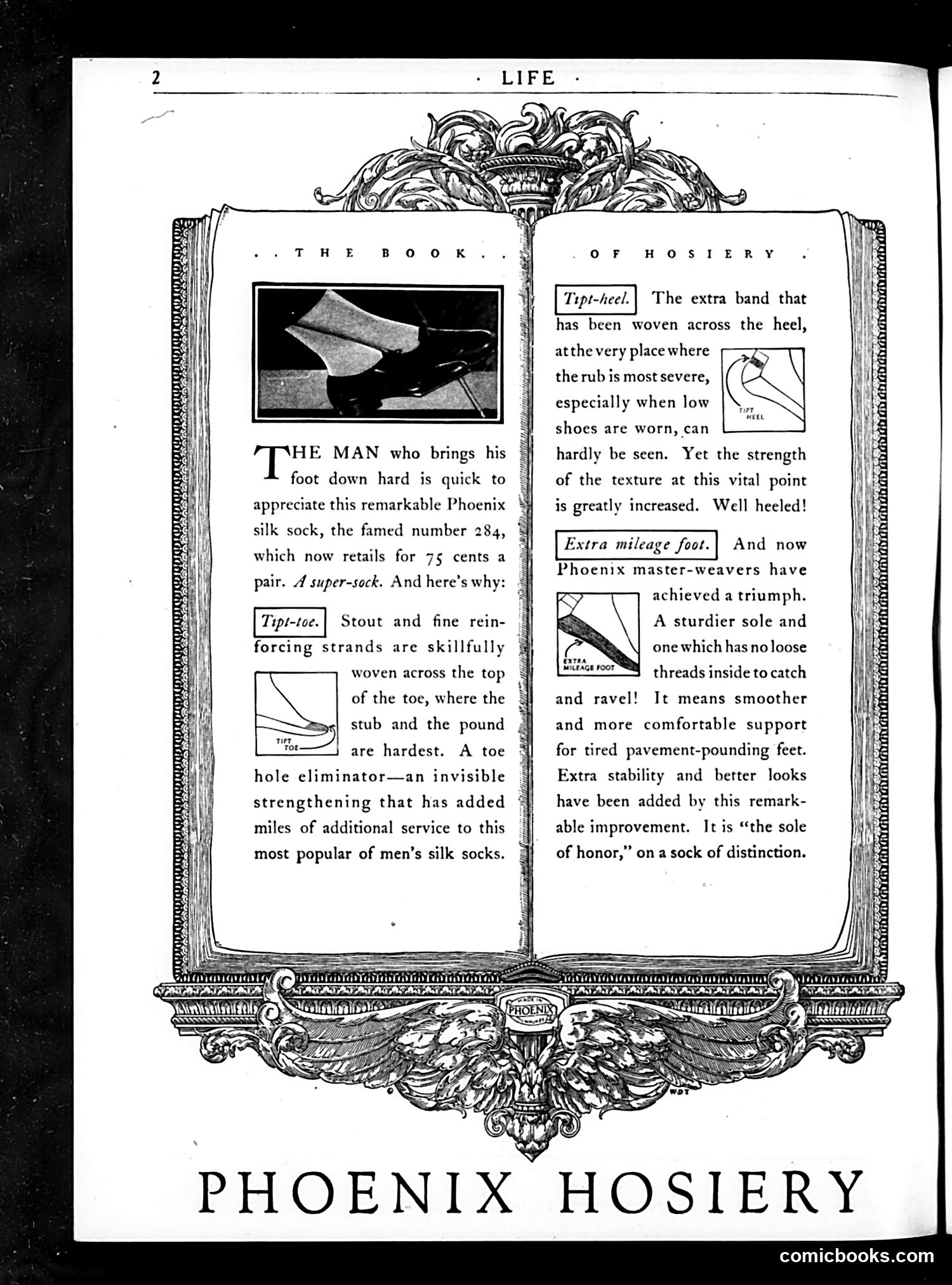
This is **not a cartoon or satire**, but rather a **product advertisement** for Phoenix brand silk socks (style #284, retailing at 75 cents per pair). The page uses educational diagrams and detailed text to highlight technical features: reinforced weaving at the toe (where wear is heaviest), extra banding at the heel, and a improved sole with no loose threads. The copywriting employs mild wordplay ("Well heeled!" "sole of honor") typical of early 20th-century advertising, positioning the product as premium ("a sock of distinction"). The opening line about a man who "brings his foot down hard" is simply an appeal to active, working men. This appears to be from *Life* magazine's advertising section, showcasing hosiery innovation. There is no political or satirical content—it's straightforward commercial messaging emphasizing durability and comfort for "tired pavement-pounding feet."
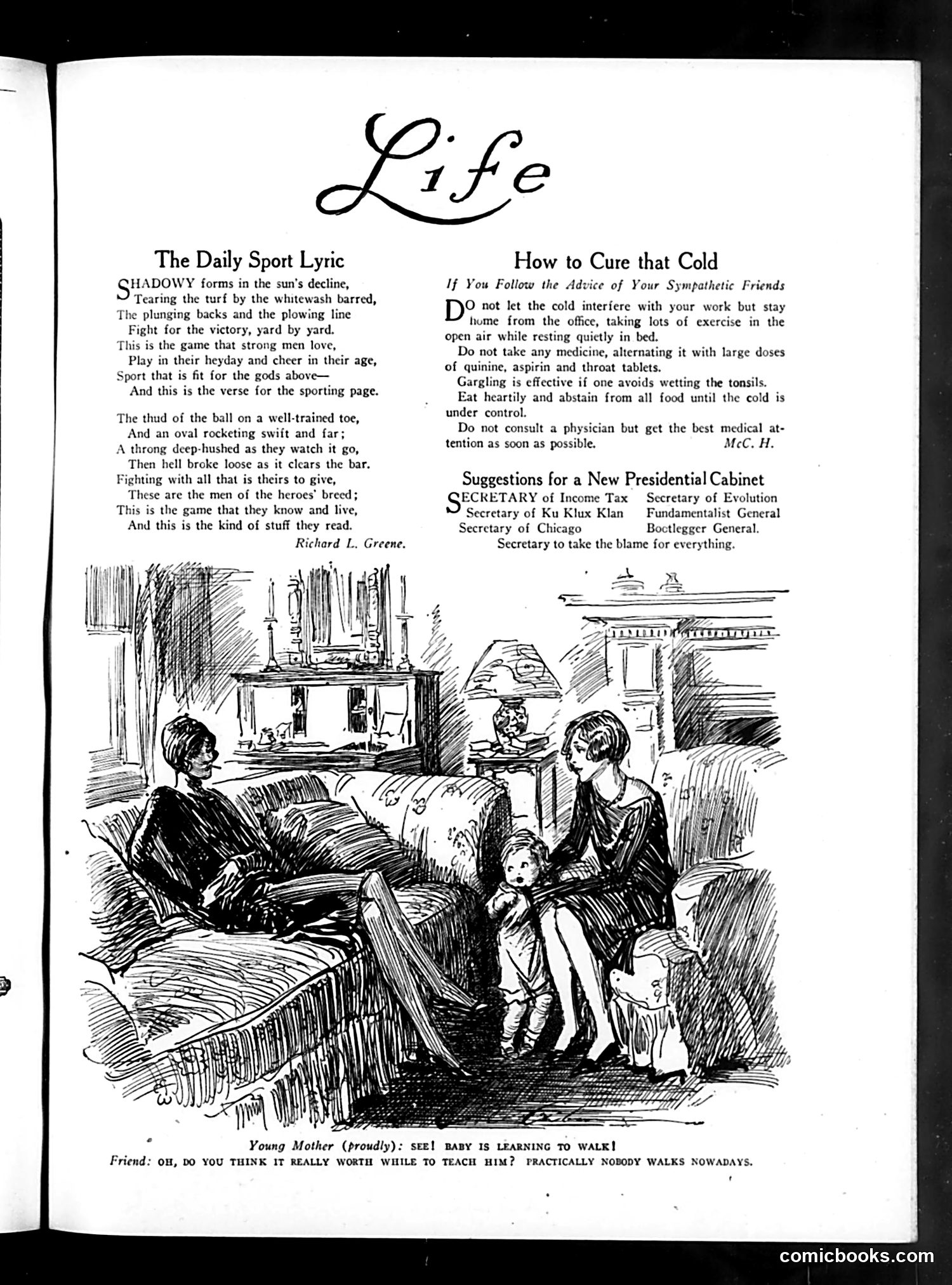
This page contains three satirical pieces reflecting early 20th-century American concerns: **"The Daily Sport Lyric"** celebrates football with romantic verse about athletic competition and masculine valor—typical of the era's idealization of sports. **"How to Cure that Cold"** is contradictory satire mocking folk remedies and conflicting medical advice. It deliberately pairs opposing instructions (stay home/exercise, avoid medicine/take medicine, eat/abstain) to ridicule the confusion people faced when seeking health guidance. **"Suggestions for a New Presidential Cabinet"** targets contemporary politics and social movements: the Secretary of Ku Klux Klan reference indicates the KKK's prominent political influence in the 1920s; "Secretary of Chicago" and "Bootlegger General" mock Prohibition-era corruption; the final joke about a scapegoat secretary satirizes government dysfunction. **The bottom cartoon** humorously contrasts modern life with walking, suggesting automobiles had made pedestrian travel obsolete—reflecting rapid urbanization and automobile culture's social impact on family life.
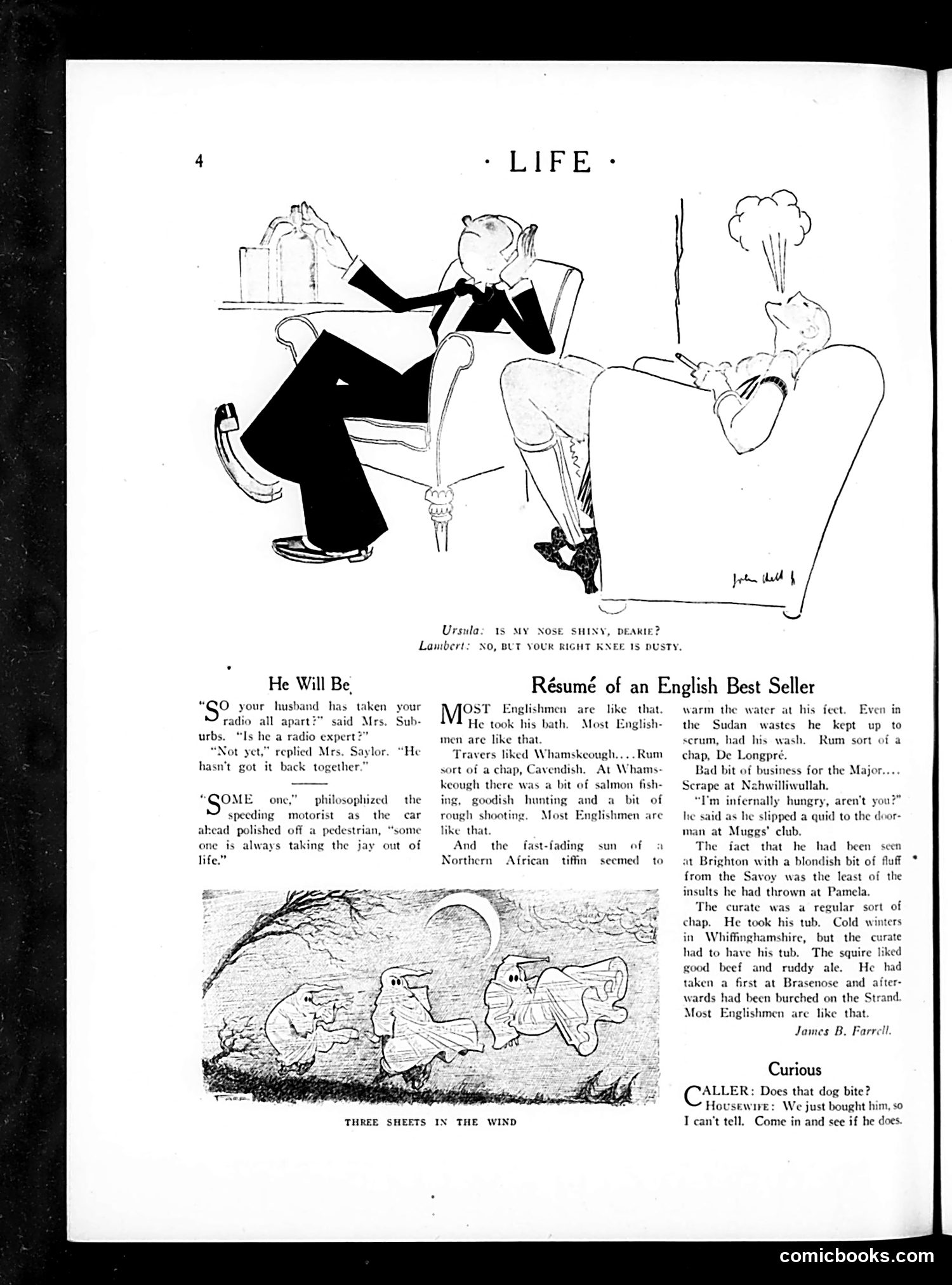
This page contains three satirical pieces mocking English culture and British social conventions: **Top cartoon**: A couple discusses the husband's appearance—she asks if her nose is shiny; he deflects by criticizing her dusty knee. It satirizes marital banter and superficial concerns. **"He Will Be" section**: Parodies a bestselling English novel by repeatedly describing various English gentlemen as stereotypically similar ("Most Englishmen are like that"). It mocks both the formulaic nature of popular British fiction and the homogeneity of the English upper/middle class. References to places like Whamskeough, hunting, salmon fishing, and club life emphasize predictable country-gentry narratives. **"Three Sheets in the Wind" cartoon**: Shows three figures blown about, illustrating the idiom meaning drunk. **"Curious" section**: A brief joke about buying a dog of unknown temperament—poking fun at casual purchasing decisions. The satire targets British literary conventions and social stereotypes, suggesting English novels and gentlemen follow rigid, repetitive patterns. The tone is affectionate mockery rather than harsh criticism.
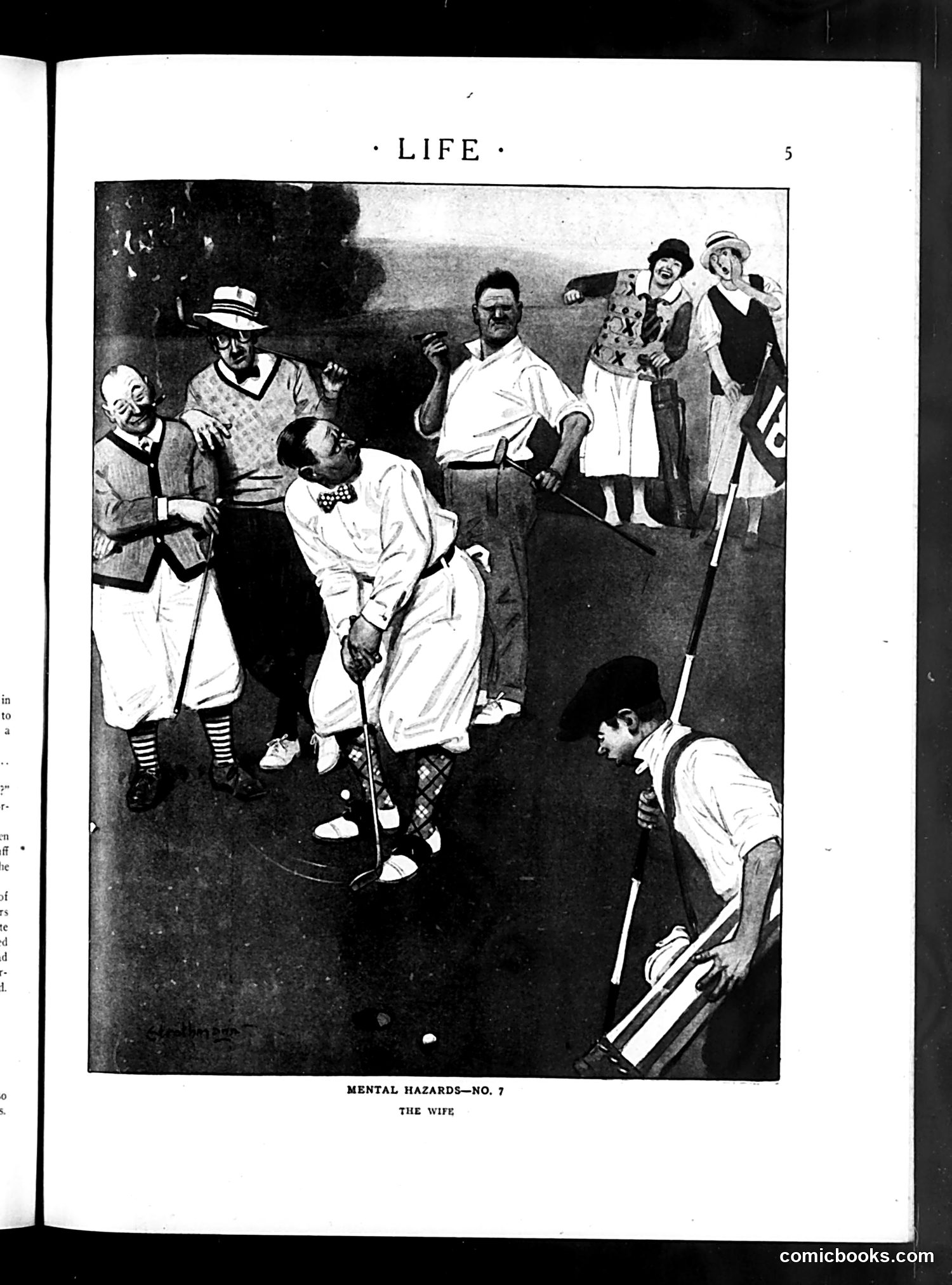
This is a satirical cartoon from Life magazine's "Mental Hazards" series, specifically issue No. 7 titled "The Wife." The image depicts a golf scene where a woman in light-colored clothing is about to putt while several men watch nervously, some appearing to shield their eyes or look away anxiously. The satire addresses the social anxiety surrounding women golfers in early-to-mid 20th century America. The "mental hazard" appears to be the psychological pressure men experience when women participate in golf—a sport traditionally dominated by men. The anxious male spectators suggest discomfort with female athletic participation, poking fun at gender attitudes of the era. The cartoon mocks both the men's nervousness and, implicitly, the social resistance to women's sports involvement.
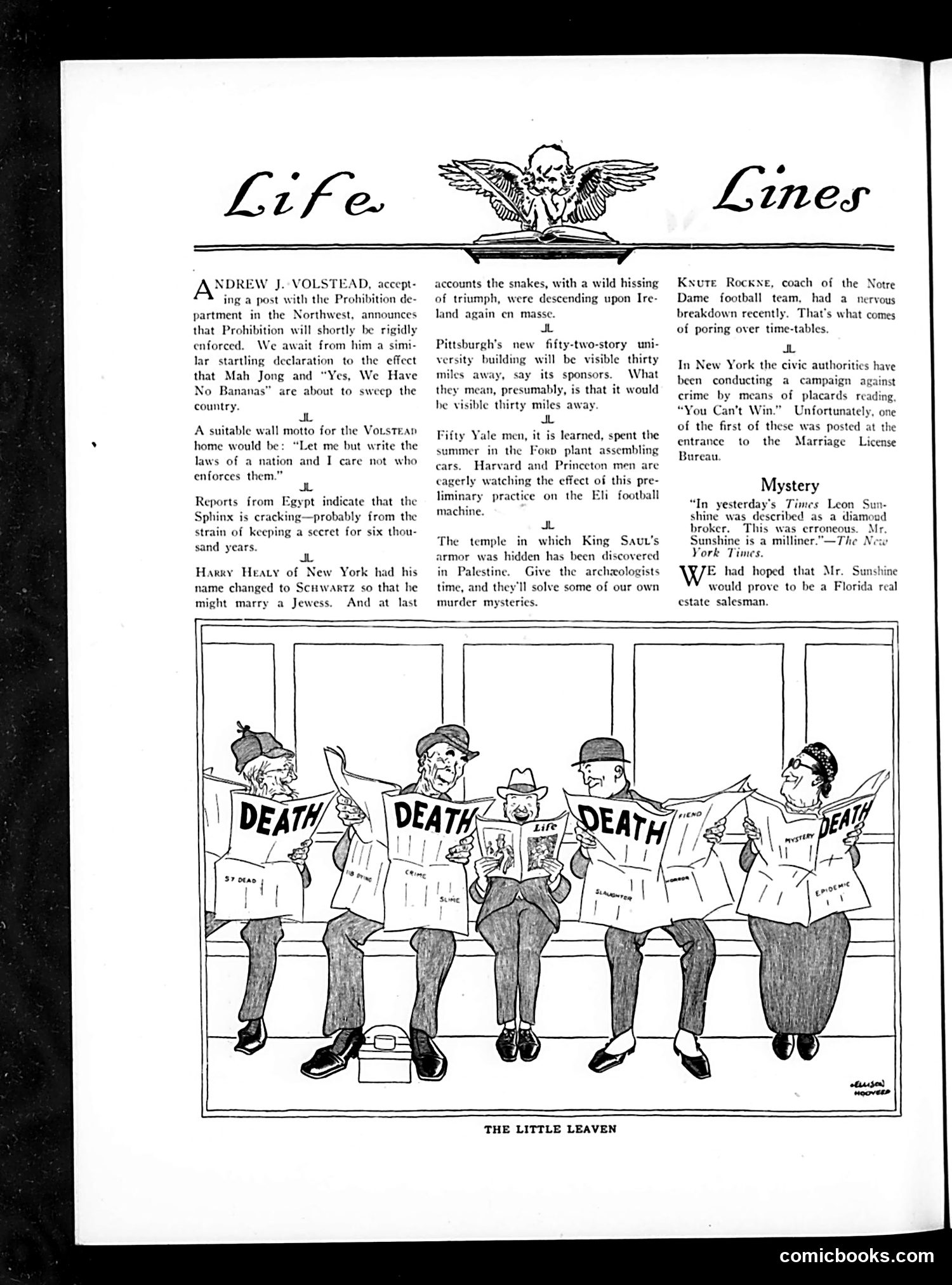
This cartoon satirizes newspaper readers obsessed with sensational crime reporting. Five men sit reading newspapers headlined "DEATH" while a sixth figure (appearing smaller, possibly representing innocence or truth) reads "Life" magazine—suggesting he's oblivious to or above the morbid fixation. The title "The Little Leaven" references the biblical phrase about small amounts of influence spreading widely, implying that crime coverage corrupts public discourse. The joke targets how newspapers profit from death-focused stories, making violent crime entertainment for commuters. The accompanying "Life Lines" column contains brief satirical jabs at contemporary figures: Andrew Volstead (Prohibition enforcer), various athletes and institutions. The tone mocks American preoccupations with both reform efforts and celebrity culture. The cartoon reflects early 1920s anxieties about yellow journalism and sensationalism—a recurring criticism throughout this era.
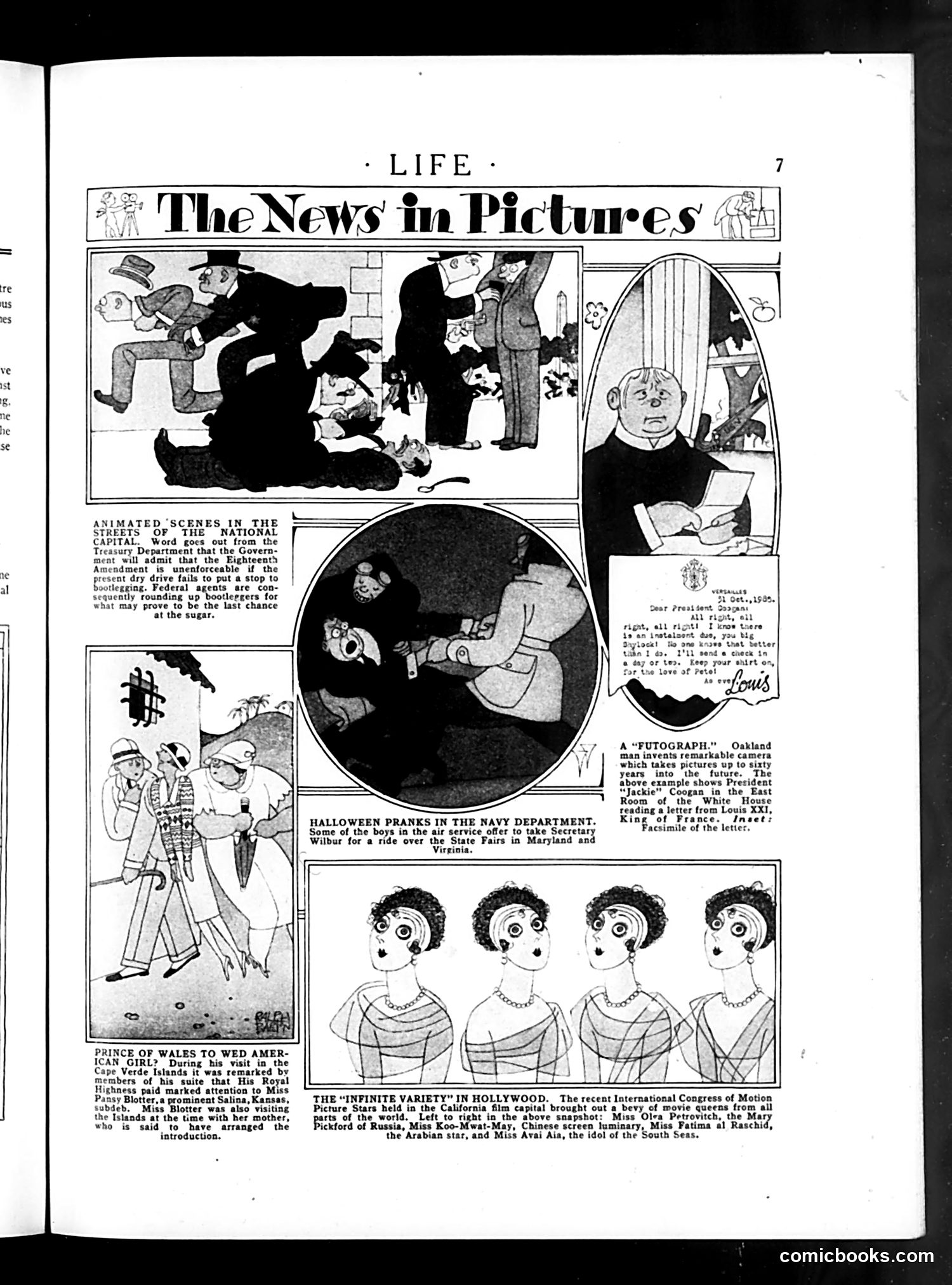
This page collects four humorous news vignettes typical of Life's satirical approach: 1. **Prohibition Enforcement**: Mocks Treasury Department claims that Prohibition can work, depicting agents "rounding up bootleggers" as a last-ditch effort. The satire suggests government admission of defeat. 2. **"Futograph" Camera**: A fictional invention that photographs the future, humorously showing child actor Jackie Coogan as President reading a letter from "Louis XXI, King of France"—absurdist humor implying an unlikely, fantastical future. 3. **Navy Department "Halloween Pranks"**: Navy air service officers offer Secretary Wilbur a plane ride at state fairs, depicted as youthful hijinks during official business. 4. **Prince of Wales Romance**: Gossip-style satire about the Prince's supposed attention to an American woman during Caribbean travels. 5. **Hollywood Congress**: Parodies international film stars with obviously fabricated names and nationalities, mocking Hollywood's exoticism and the celebrity circus. The page exemplifies early 20th-century American satirical humor targeting government, popular culture, and current events through illustrated mockery.
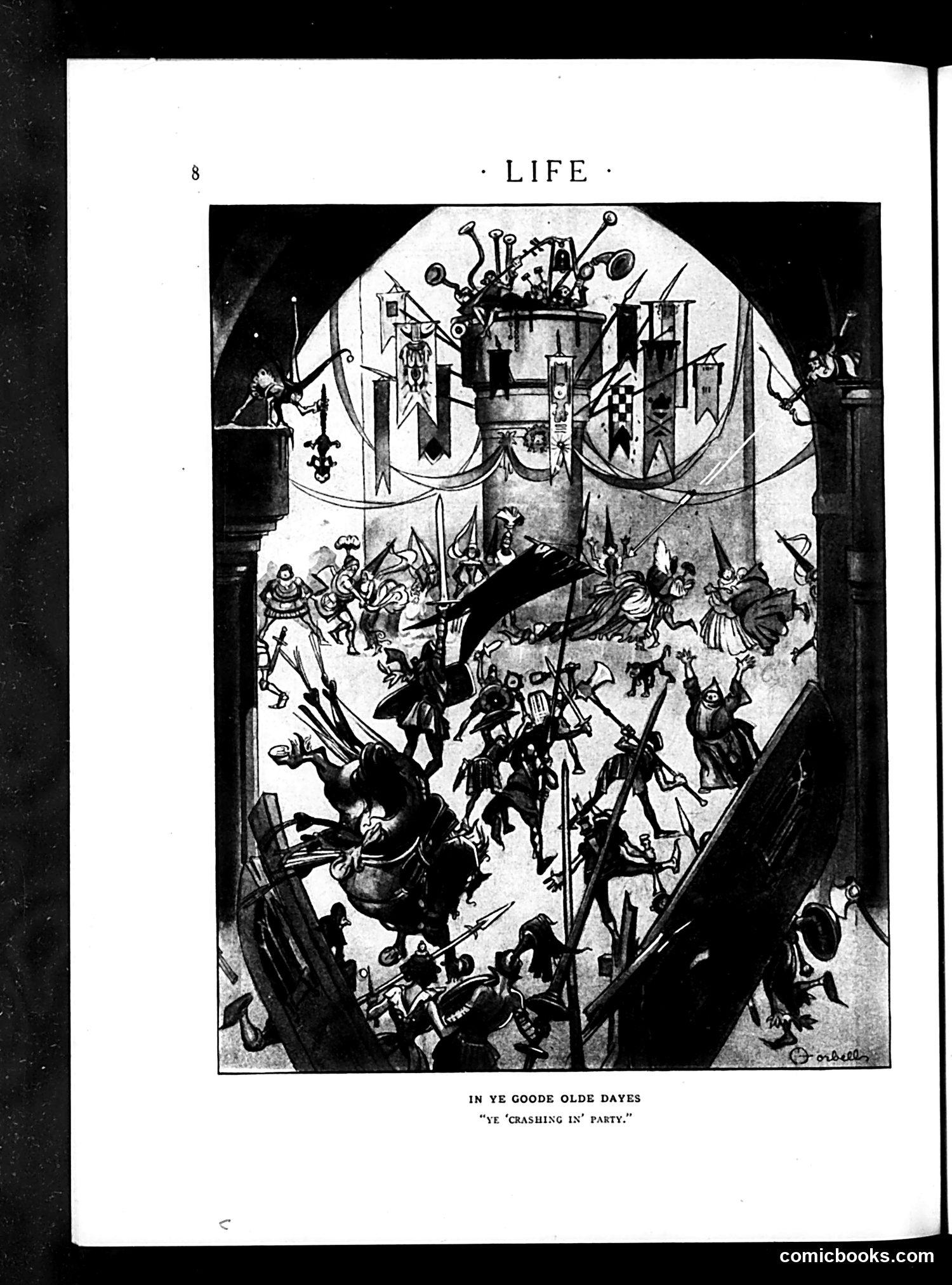
This satirical illustration depicts a chaotic medieval castle scene crowded with uninvited revelers forcing their way into a noble's celebration. The title plays on "crashing" a party—showing up without invitation—by setting it in mock-archaic language ("Ye Goode Olde Dayes"). The cartoon satirizes the social problem of unwanted gate-crashers disrupting exclusive events. The masses pushing through the castle gates, the disorder among the formally-dressed attendants, and the overwhelmed hosts suggest commentary on class boundaries breaking down or social climbing behavior. The "olde dayes" framing implies this misbehavior is timeless human nature, not merely modern rudeness. The artist's signature appears in the lower right corner.
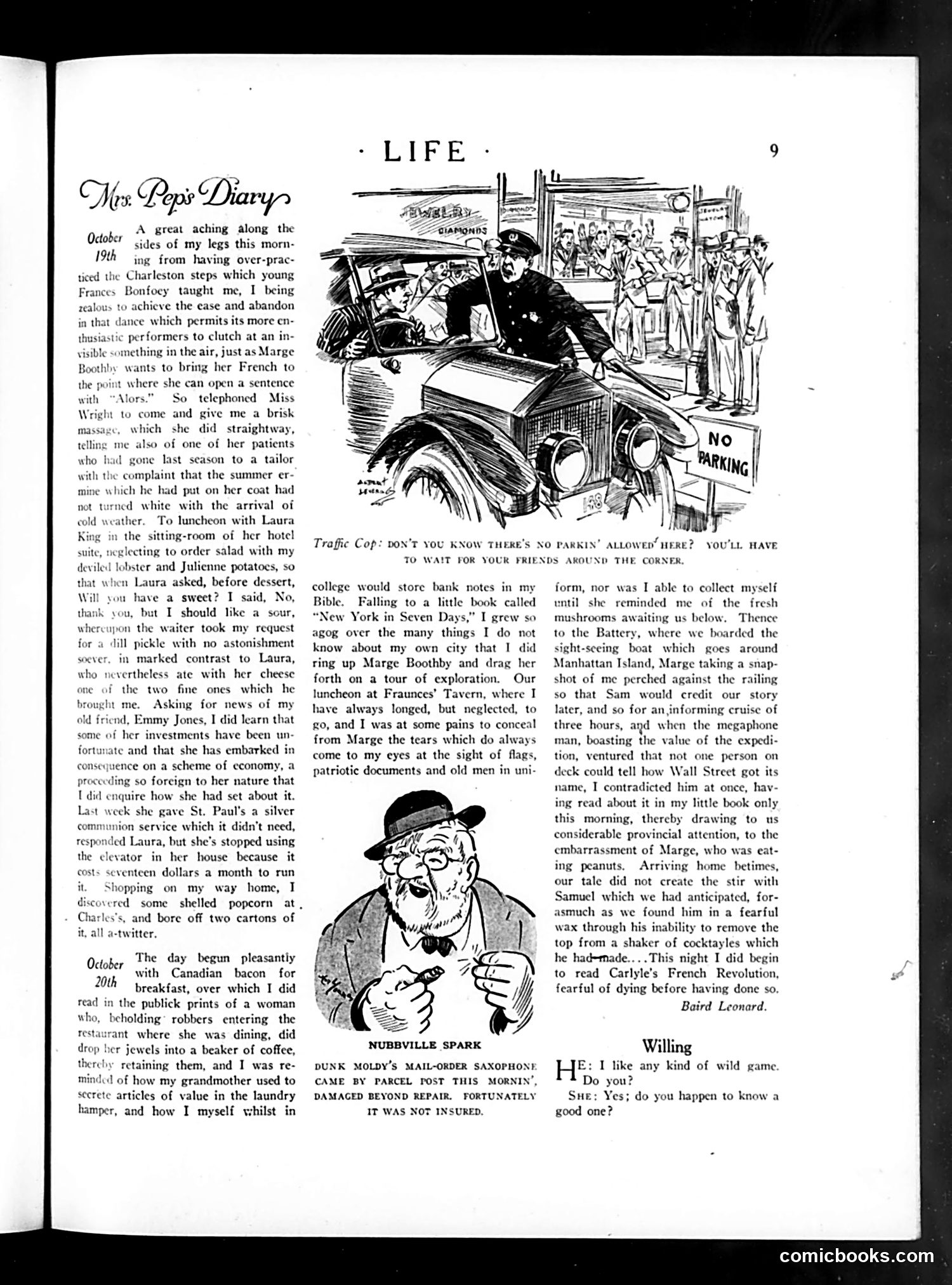
**Mrs. Peps's Diary** is a personal column documenting the author's mundane social activities—massage appointments, lunches with friends, shopping—in early 20th-century New York society. The entries reveal period-specific details: the Charleston dance craze, elevator costs, and patriotic tourism (Fraunces' Tavern, the Battery). **The main cartoon** depicts a traffic cop stopping a car with a "No Parking" sign visible. The joke is straightforward satire: the cop absurdly tells the driver to wait for friends "around the corner," when the entire street is congested with parked vehicles. This mocks either traffic enforcement inconsistency or New York's parking chaos in 1918. **"Nubbville Spark"** is a brief joke about Dunk Moldy receiving a damaged mail-order saxophone by parcel post, fortunately uninsured—a quip about unreliable shipping or cheap merchandise. Both cartoons are light, domestic humor typical of *Life*'s satirical approach to everyday urban American life rather than political commentary.
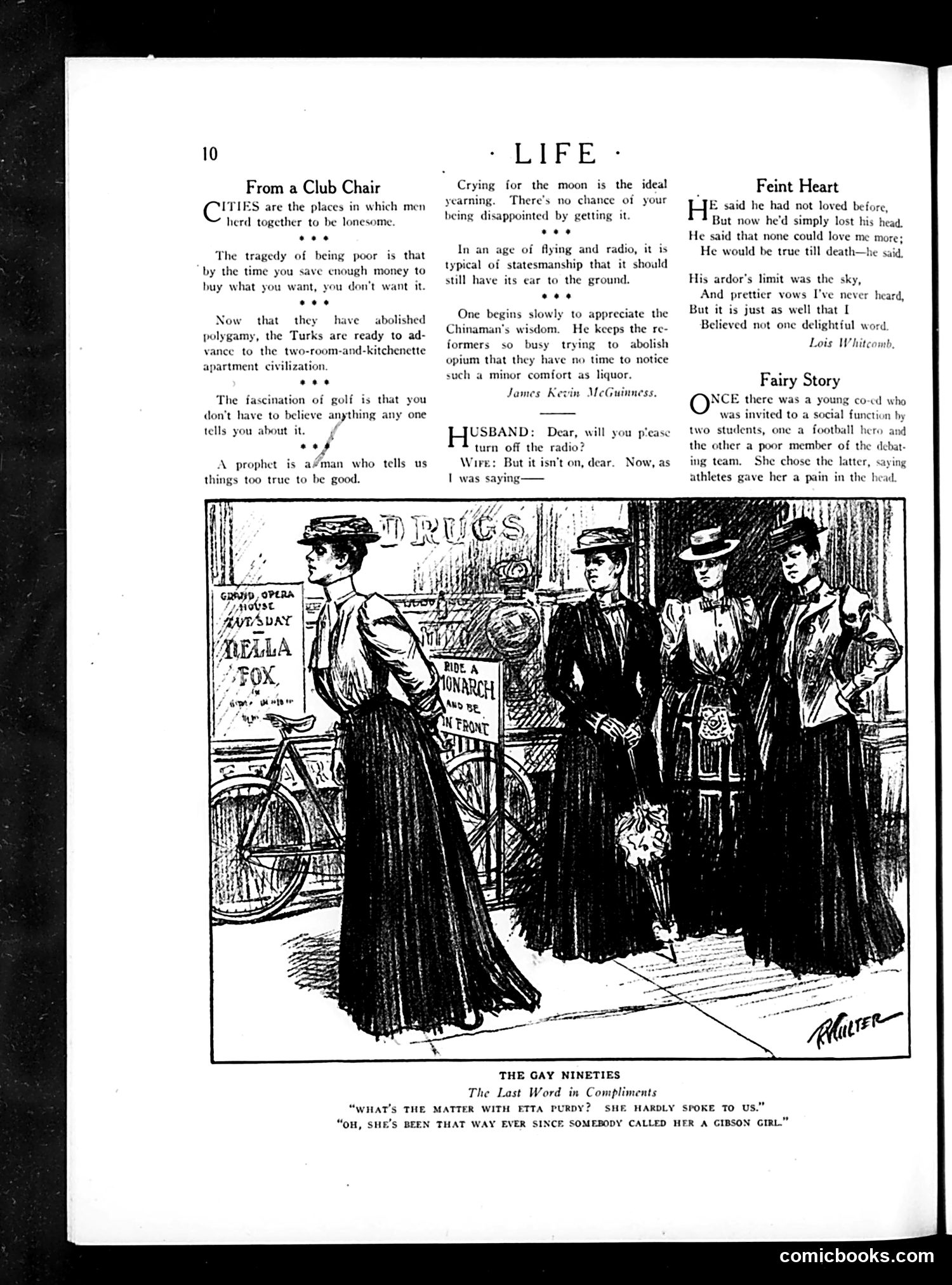
This page combines satirical commentary with period humor. The top section offers social observations: cities breed loneliness; poverty's timing is cruel; polygamy's abolition lets Turks advance civilly; golf requires no truth-telling; prophets state uncomfortable truths. A husband-wife joke plays on radio distraction. The main illustration, titled "The Gay Nineties: The Last Word in Compliments," depicts fashionably dressed women from that era on a city street. The caption reveals the satire: one woman, Etta Purdy, remains silent while her companions gossip. The punchline suggests she's been withdrawn "ever since somebody called her a Gibson Girl"—the era's idealized female beauty standard. The joke implies that being complimented as a Gibson Girl somehow damaged her socially or emotionally, likely mocking how women internalized appearance-based identity during that period. The "Fairy Story" and "Faint Heart" poems offer romantic commentary typical of the magazine's light verse.
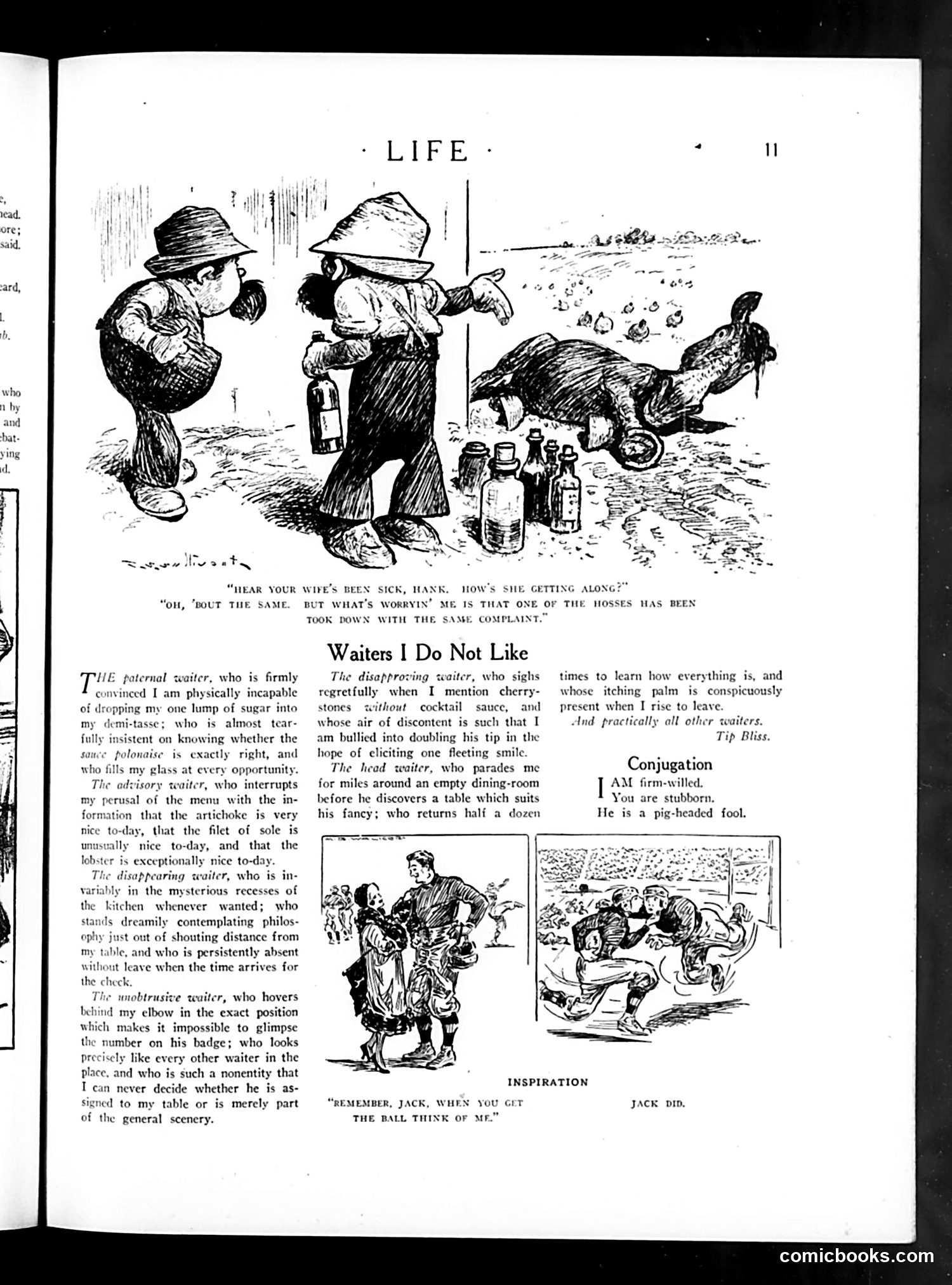
This page satirizes different types of restaurant waiters through exaggerated character types. The author catalogs annoying waiter behaviors: the overly-attentive "paternal waiter" who won't let diners manage their own coffee; the "disappearing waiter" who vanishes when needed; the "disapproving waiter" who guilts customers into larger tips through visible displeasure; the "head waiter" who wastes time seating guests in empty rooms. The top cartoon depicts rural/working-class men discussing a sick horse with the same indifference they'd show a sick wife—crude humor about male priorities and class attitudes. The "Conjugation" section uses a grammar joke: "I am firm-willed / You are stubborn / He is a pig-headed fool"—illustrating how people rationalize identical behavior differently depending on perspective. The satire targets both waiter pretension and diner anxieties about social performance in restaurants, a growing concern in early 20th-century American leisure culture.
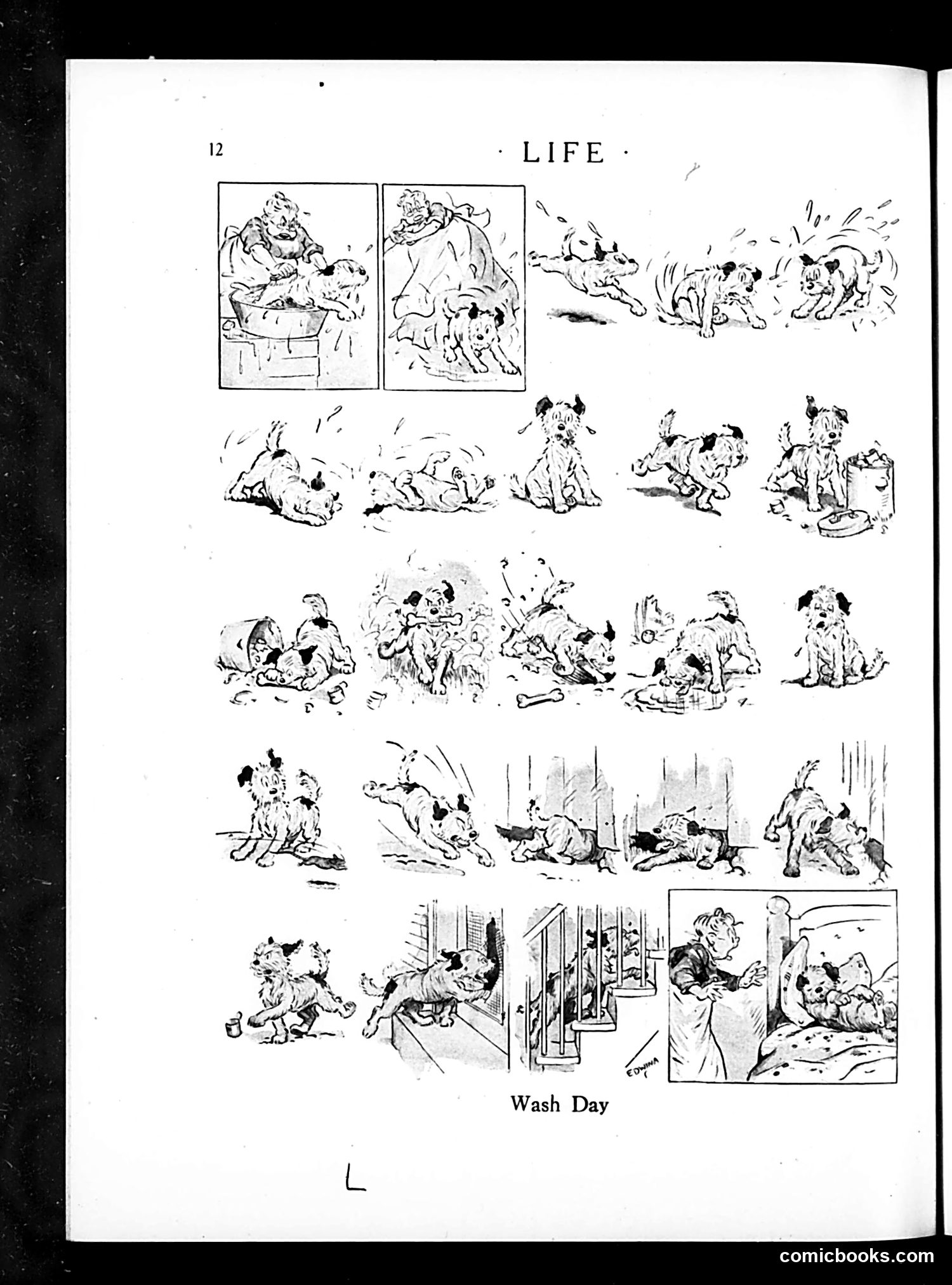
This page from *Life* magazine presents a comic strip titled "Wash Day" depicting the chaotic experience of bathing dogs. The sequence shows multiple panels progressing through the washing process: owners attempting to bathe energetic, resistant dogs in basins and tubs, with water splashing everywhere and dogs escaping or shaking themselves dry. The final panels show the aftermath—a thoroughly soaked owner and bathroom. The humor derives from the universal domestic struggle of washing pets: their resistance, the mess created, and the reversal where the owner ends up as wet as the dog. This is gentle domestic satire rather than political commentary, reflecting the magazine's tradition of illustrated humor about everyday life and family experiences.
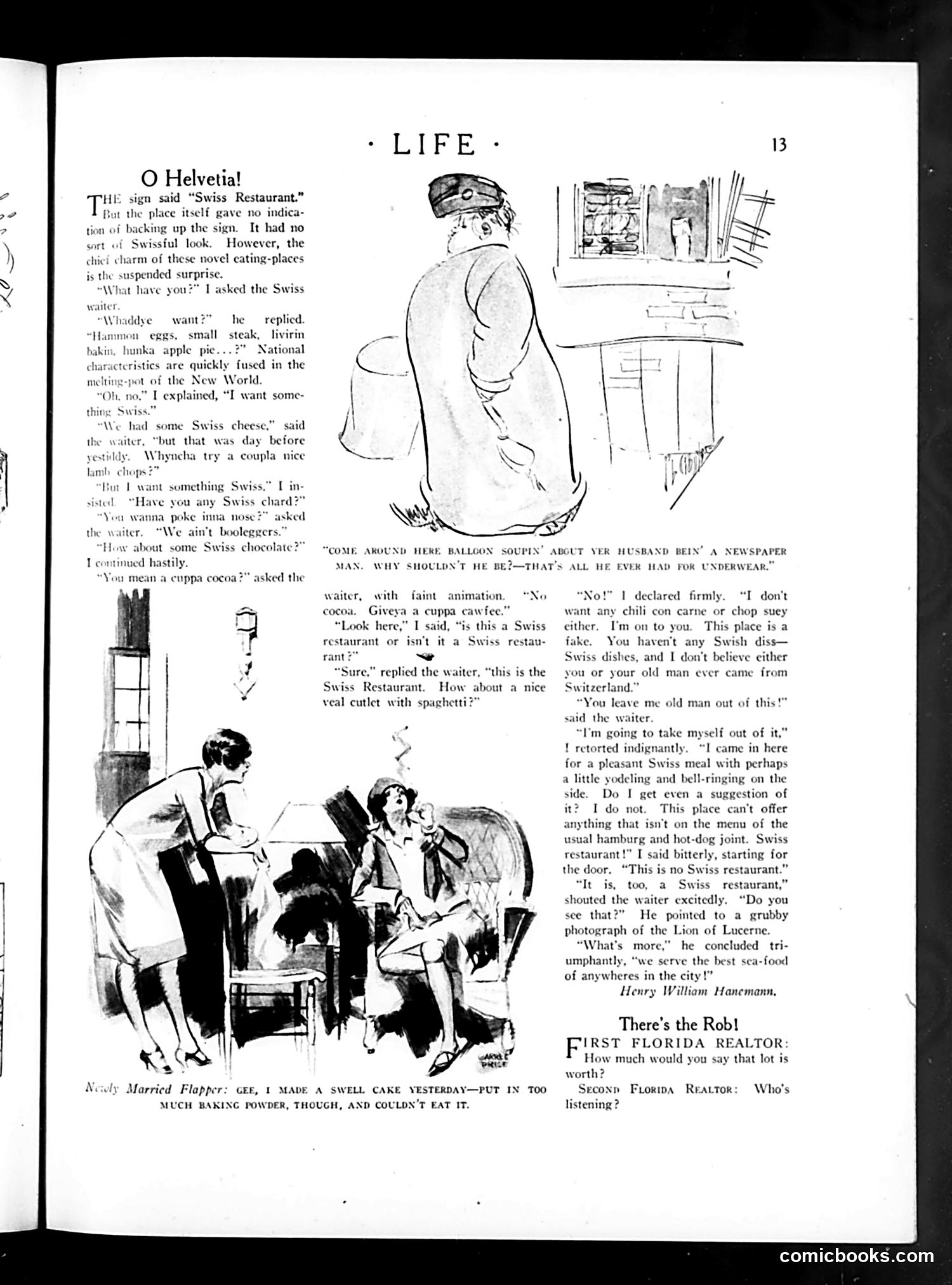
This humorous piece mocks the proliferation of "ethnic" restaurants in America that trade on Swiss (or other foreign) theming while serving standard American fare. The narrator visits a "Swiss Restaurant" expecting authentic Swiss cuisine and atmosphere but finds a waiter speaking in broad ethnic-accented English ("Whaddye want?") who offers only typical diner food: ham and eggs, chops, apple pie, chili con carne, chop suey, and hot dogs. The satire targets two things: (1) restaurants fraudulently claiming ethnic authenticity through mere signage and a single decorative element (a Lion of Lucerne photograph), and (2) the "melting pot" reality where immigrant-run establishments abandon authentic cuisine for mass-market American comfort food. The waiter's final triumphant defense—that they serve "the best sea-food of anywheres in the city"—underscores the joke: even their boast contradicts their Swiss identity. This reflects post-WWI American anxiety about assimilation and commercialized ethnic identity.
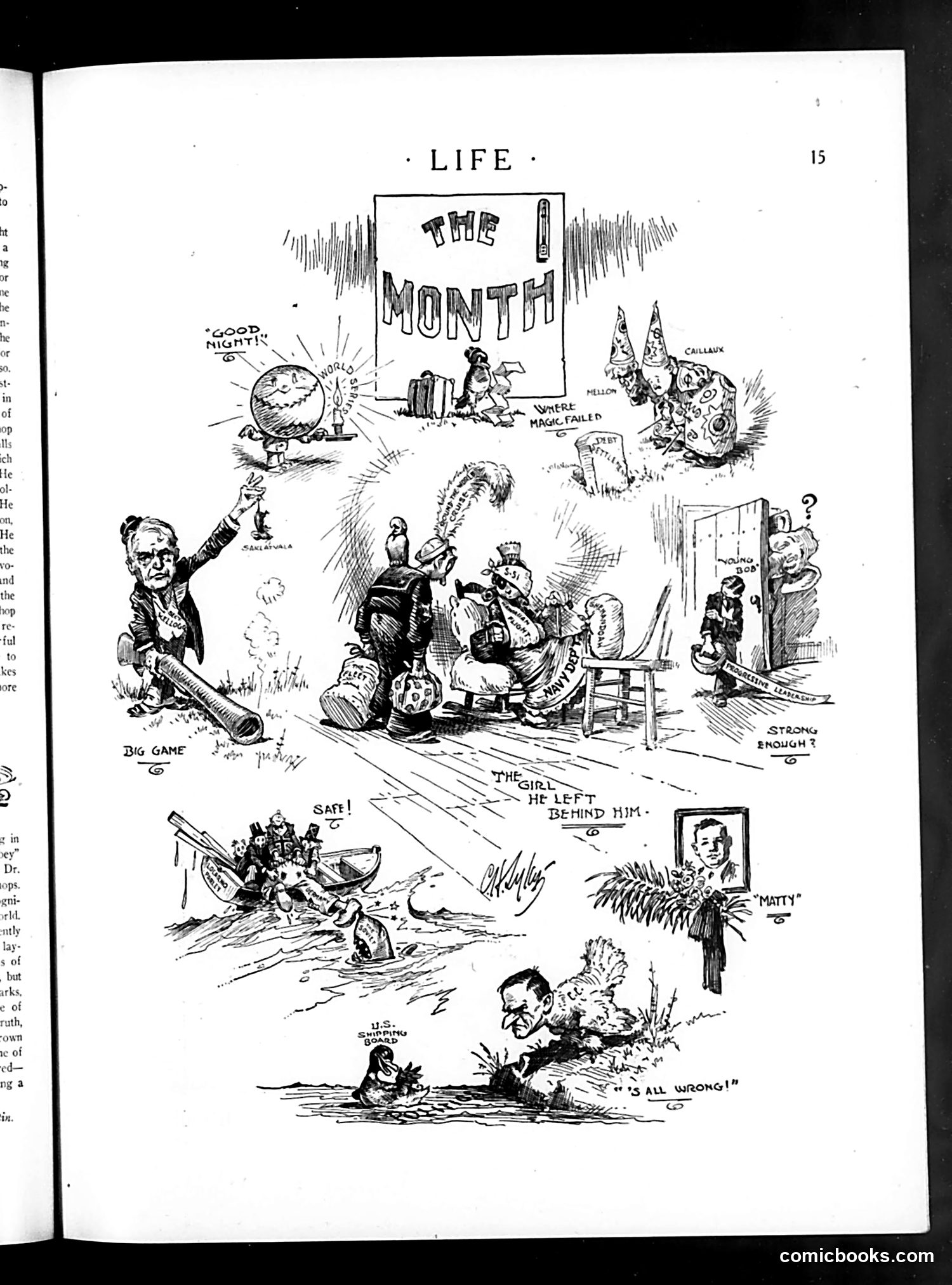
This page presents satirical vignettes labeled "The Month," a common Life magazine feature commenting on current events. The sketches depict various political and social situations through exaggerated caricatures: Key visible labels include "Big Game," "Safe!," "Where Magic Failed," "The Girl He Left Behind Him," "Strong Enough?," and "Is All Wrong!" The cartoons appear to reference political figures and events of their era through satirical scenes—one shows what appears to be political maneuvering, another depicts someone fleeing or abandoning something/someone, and others suggest commentary on political strength or competence. Without clearer labeling of specific figures or dated context, the precise political references remain unclear, though the overall tone suggests criticism of contemporary political behavior and decisions.
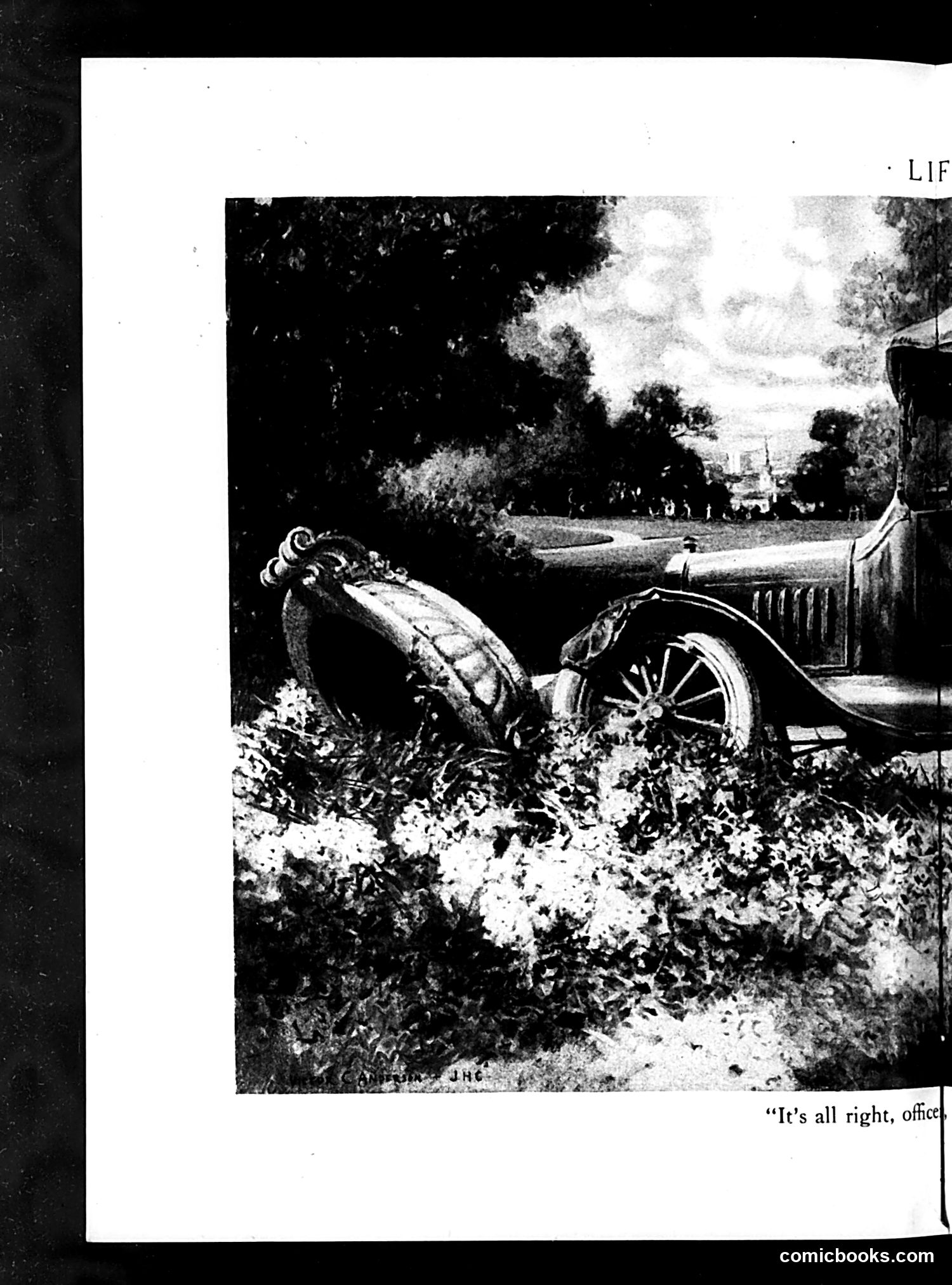
This appears to be a humorous illustration rather than a political cartoon. The image shows an overturned or abandoned automobile partially obscured by flowering bushes and overgrown vegetation in what seems to be a garden or park setting. A well-dressed figure stands nearby observing the scene. The caption reads "It's all right, officer," suggesting someone is reassuring law enforcement about the wrecked vehicle. The joke likely plays on the absurdity of the situation—perhaps implying the car has been abandoned so long it's become naturalized into the landscape, or that the speaker is casually dismissing what should be a serious accident. The satire appears directed at casual attitudes toward property damage or safety violations rather than at any specific political figure.
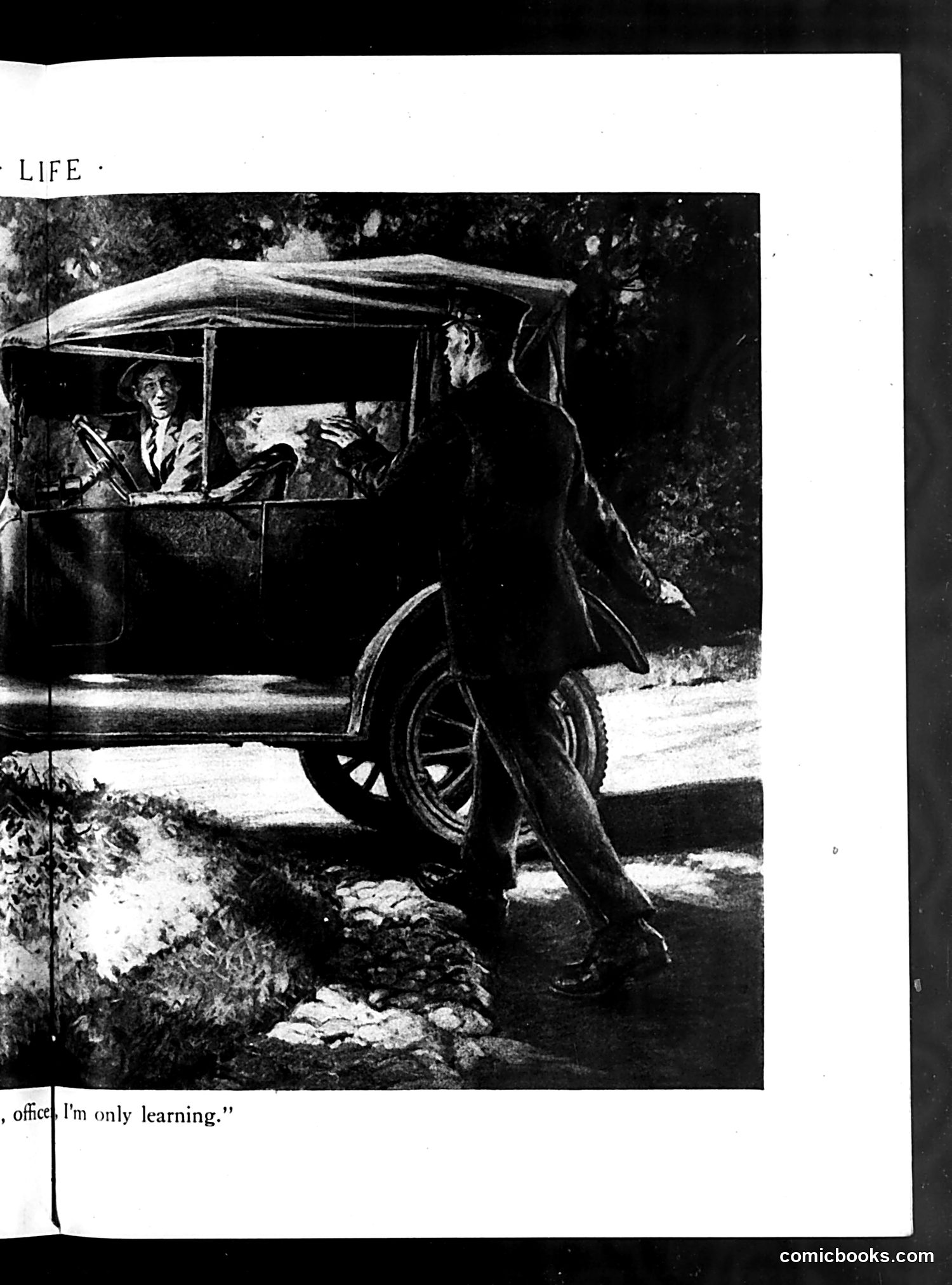
This appears to be a satirical cartoon from *Life* magazine showing a driving lesson scenario. A figure sits in the driver's seat of an early automobile (likely 1920s-1930s era based on the vehicle design), while an instructor or examiner stands outside the car observing. The caption reads "office I'm only learning," suggesting the humor derives from the learner driver's excuse-making or inexperience. The satire likely targets either incompetent drivers, defensive attitudes about poor driving skills, or possibly bureaucratic/workplace incompetence by comparing office work to dangerous activities like learning to drive. The specific historical or political reference remains unclear without additional context about the magazine's date or the office context referenced.
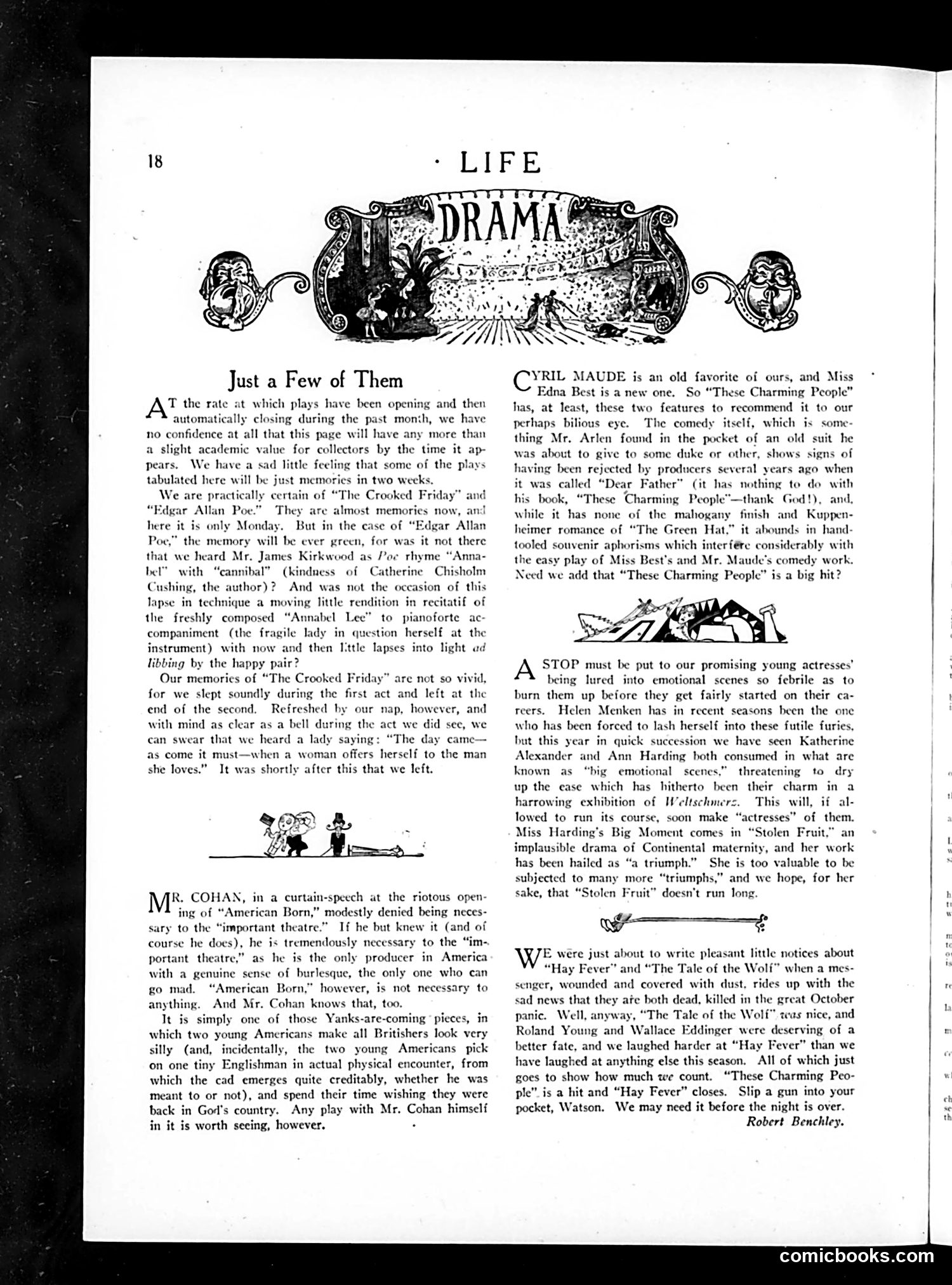
This page from *Life* magazine reviews several Broadway plays opening and closing in rapid succession. The critic sarcastically notes plays are closing so quickly they'll be "just memories in two weeks." The reviews mock specific productions: "The Crooked Friday" (the critic admits sleeping through it), "Edgar Allan Poe" (ridiculed for an absurd rhyme of "Annabel" with "cannibal"), and "American Born" featuring producer George M. Cohan. That last play is dismissed as another tiresome "Yanks-are-coming" piece where Americans mock British people—though the critic admits Cohan's presence makes anything worth seeing. The page critiques overworked young actresses like Helen Menken, Katherine Alexander, and Ann Harding being cast in exhaustingly emotional roles that "burn them up" before their careers properly develop. The tone throughout is witty deprecation of theatrical excess and poor playwriting disguised as entertainment.
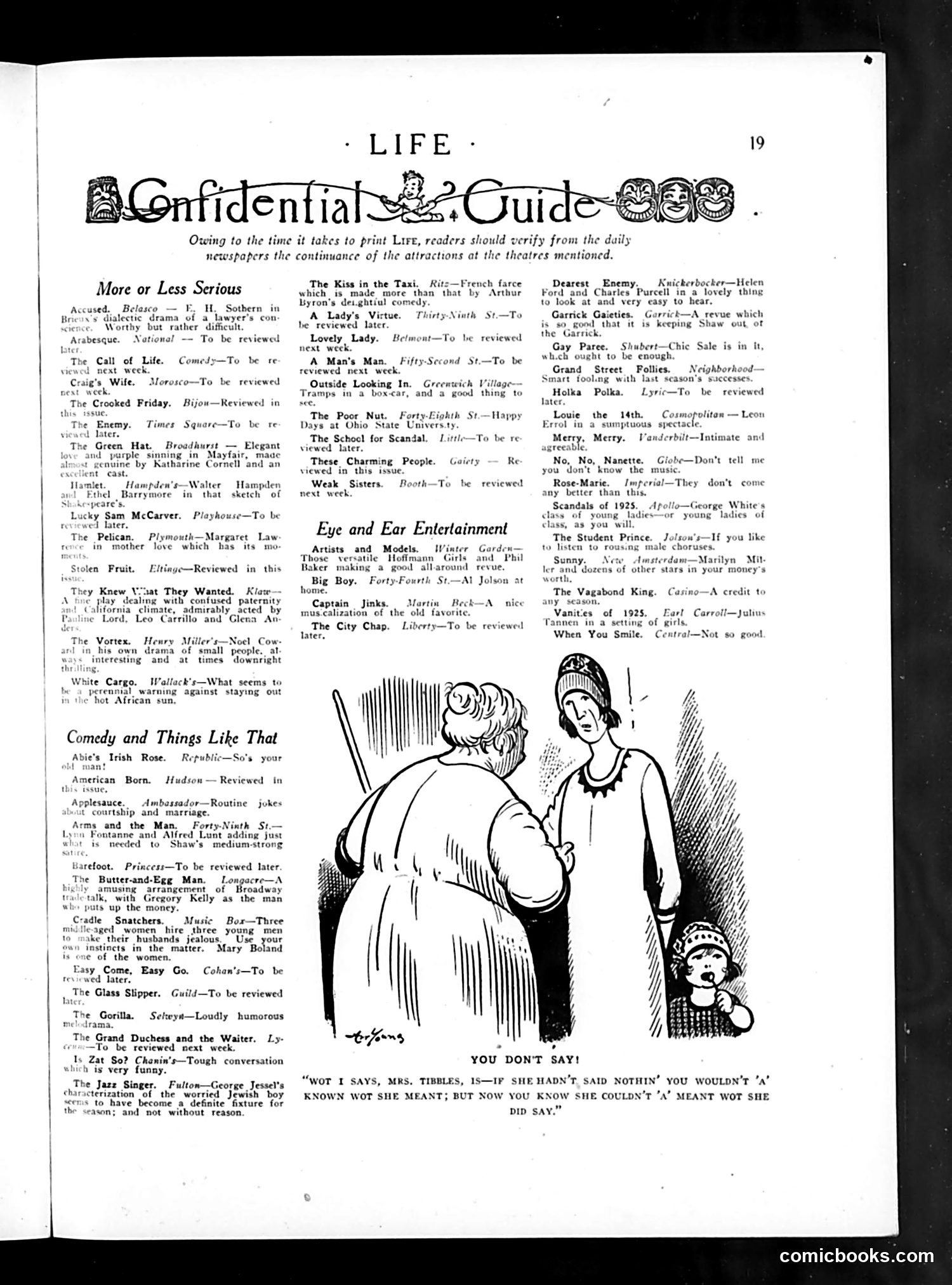
This page is a theater listing and review guide from Life magazine, circa mid-1920s. The cartoon illustrates the page's humorous social commentary about language and class distinctions. **The Cartoon:** Shows a working-class woman (indicated by her appearance and manner of dress) speaking to a more refined woman. The caption depicts a dialect-heavy confrontation about proper English: the working-class character insists she said nothing wrong, but the refined woman corrects her grammar regarding the use of the article "a." **The Satire's Point:** This mocks the rigid class-consciousness of 1920s America, where proper English pronunciation and grammar served as markers of social status. The joke ridicules both the pretentiousness of those who police language and the defensiveness of those judged by it—a common theme in Life's satirical commentary on American social hierarchies. The theater listings below represent Broadway's diverse offerings, from serious drama to vaudeville, reflecting the era's thriving theatrical culture.
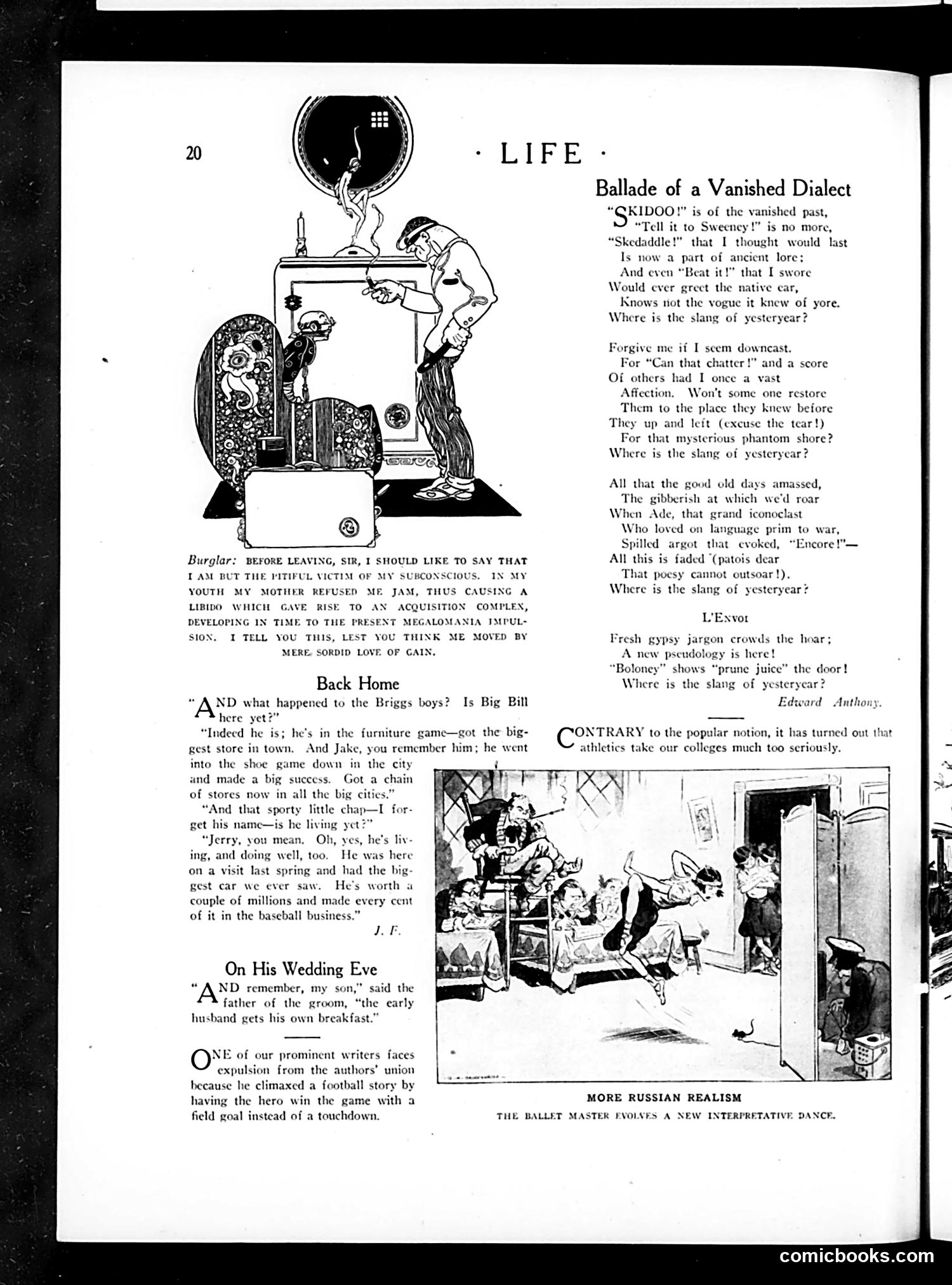
This page contains multiple satirical pieces typical of Life's early 20th-century humor: **The Burglar cartoon** mocks psychoanalytic jargon newly fashionable in America. A burglar, caught mid-theft, absurdly justifies his crime using Freudian language about his "subconscious," "libido," and "acquisition complex"—satirizing how people were adopting pseudo-psychological explanations for behavior, replacing simple morality with trendy pseudo-science. **"Ballade of a Vanished Dialect"** nostalgically laments obsolete American slang ("Skidoo," "Tell it to Sweeney," "Skedaddle"). The poem mourns generational linguistic change, referencing humorist George Ade, who popularized such dialect. **"Back Home"** and **"On His Wedding Eve"** are brief humorous anecdotes about social mobility and marital advice. **The final note** jokes that a writer faced expulsion from the authors' union for ending a football story with a field goal rather than a touchdown—absurdist humor about both rigid institutional rules and the football-obsessed culture of American colleges.
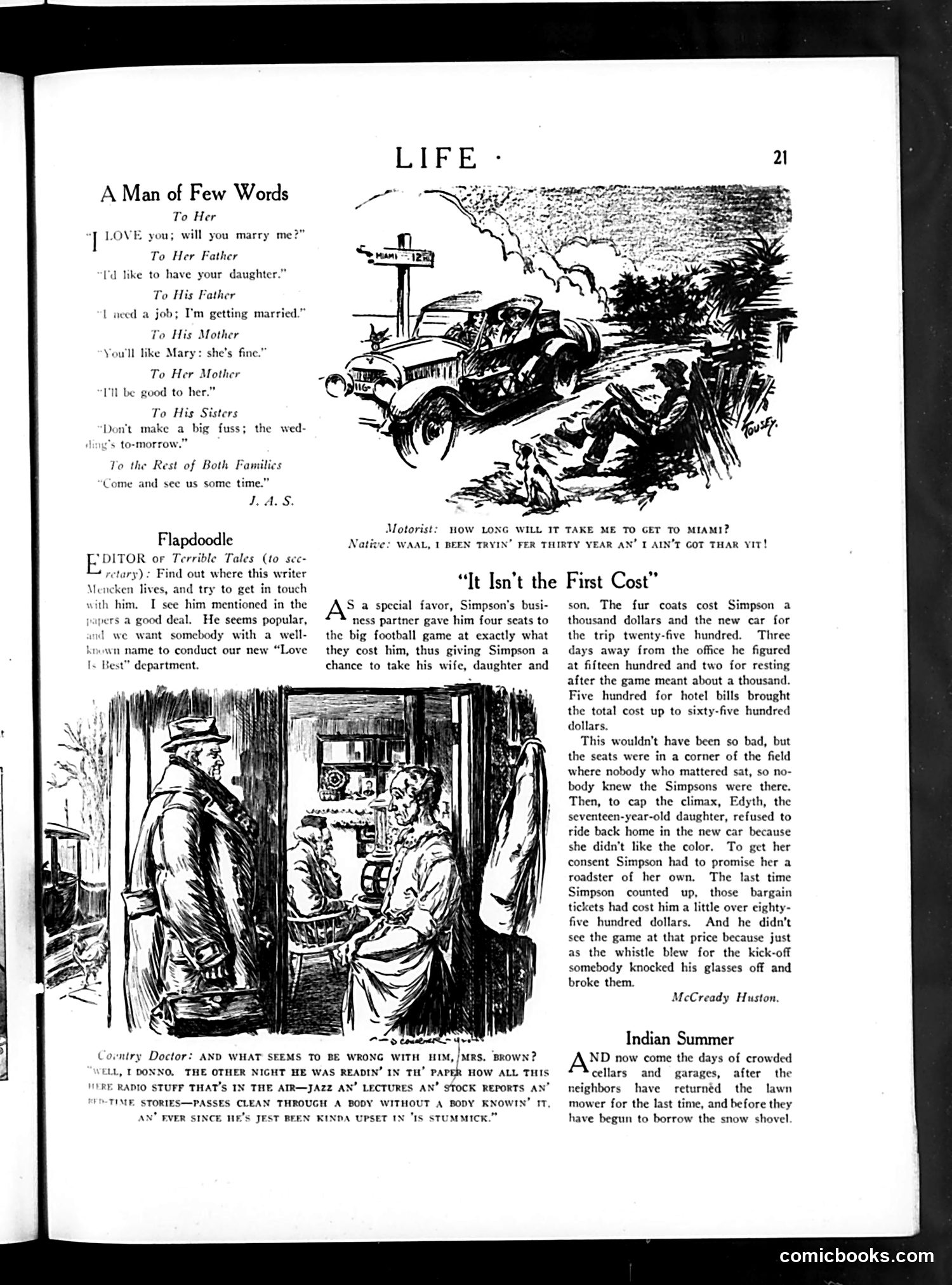
This page contains several satirical pieces typical of 1920s Life magazine humor: **"A Man of Few Words"** mocks the taciturn groom—a stock character type—by listing his minimal utterances to various family members before marriage, suggesting men become emotionally withdrawn or unromantic once married. **"Flapdoodle"** is an editor's note seeking a writer named Mencken (likely H.L. Mencken, the famous cultural critic) to conduct a "Love Advice" column, satirizing magazines' trend of hiring recognizable names regardless of actual expertise. **The motorist cartoon** jokes about the slow development of rural Florida—a "thirty year" journey to Miami humorously suggests the region's remoteness and poor infrastructure. **"It Isn't the First Cost"** satirizes hidden expenses and poor value. Simpson receives "cheap" football tickets but must spend thousands on fur coats, a car, and hotels to make the outing respectable—only to sit where "nobody who mattered" could see them, and miss the game entirely when his glasses break. All pieces target consumer excess and social pretension characteristic of the prosperous 1920s.
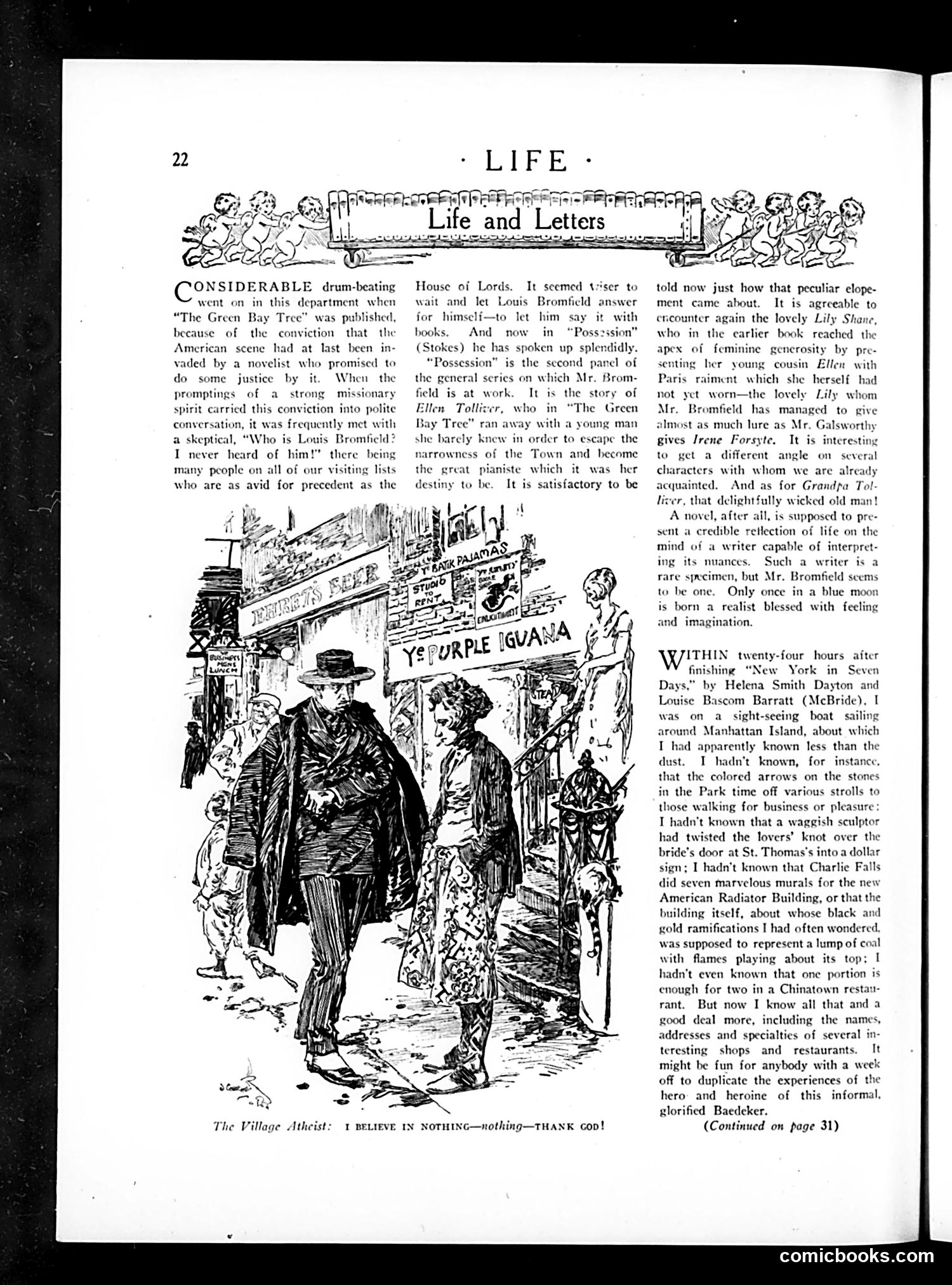
This page reviews recent novels by Louis Bromfield and others. The main illustration, captioned "The Village Atheist," depicts a street scene with figures discussing religion or belief—one character declares "I BELIEVE IN NOTHING—nothing—THANK GOD!" The satire mocks the self-contradiction of atheistic declarations made with religious fervor. The text discusses Bromfield's novel "Possession," the second book in a series following "The Green Bay Tree," praising his realistic portrayal of characters like the "lovely Lily Shane." It notes Bromfield was initially unknown to New York's social circles despite critical acclaim. A second review covers "New York in Seven Days" by Dayton and Barratt, a guidebook praising the authors for revealing Manhattan's hidden details—colored park arrows, architectural quirks, and obscure restaurants. The reviewer humorously describes becoming a tourist after reading it, suggesting the guide successfully captures New York's overlooked charms for visitors or residents.
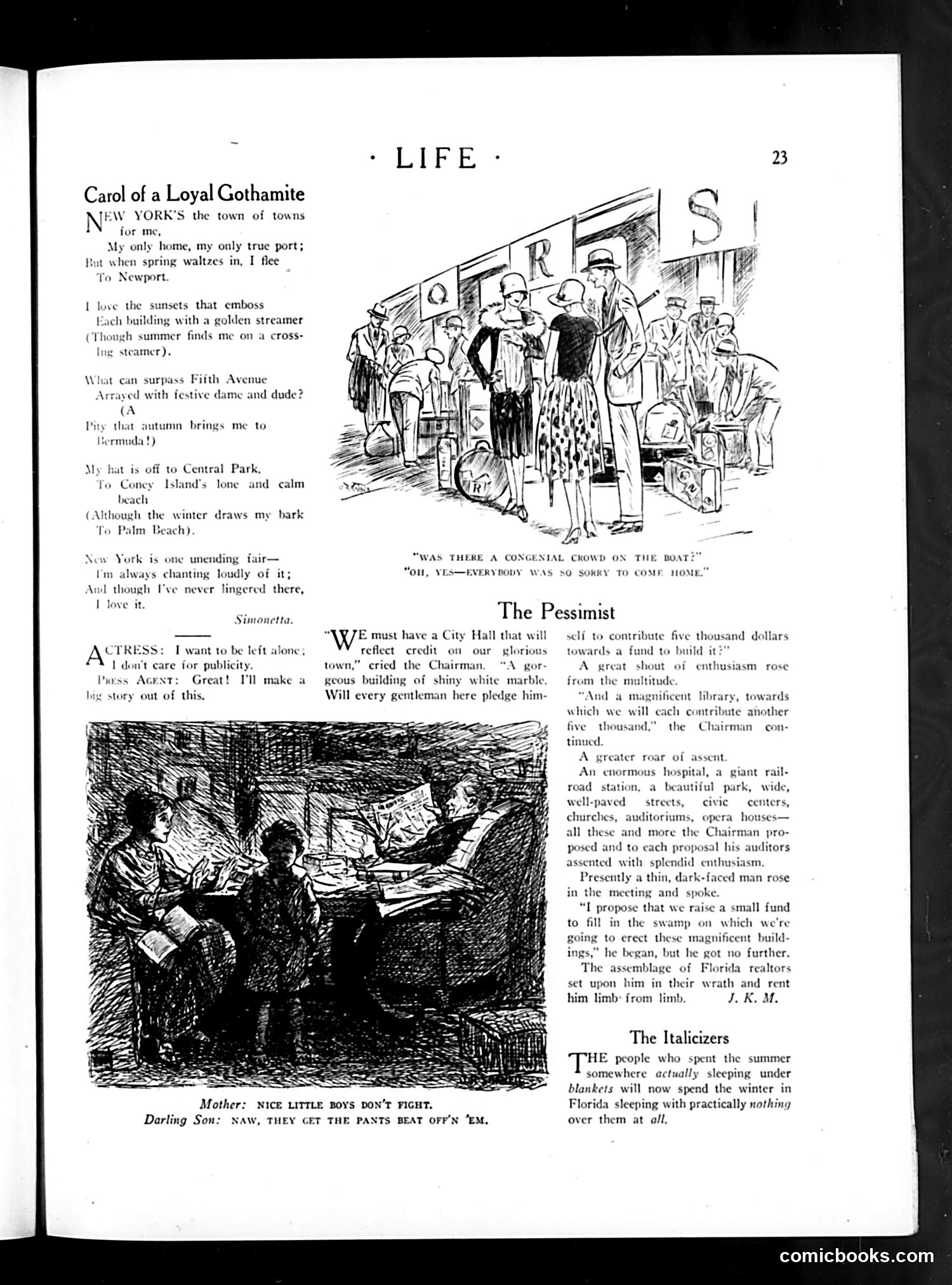
This page contains three distinct satirical pieces mocking New York society and human nature: **"Carol of a Loyal Gothamite"**: A poem ridiculing wealthy New Yorkers who claim to love the city while constantly fleeing it seasonally—to Newport (spring), Bermuda (autumn), Palm Beach (winter), and Coney Island (summer). The satire exposes the contradiction: the narrator "loves" New York yet has "never lingered there." **"The Pessimist"**: A short story mocking civic boosterism. Wealthy citizens enthusiastically pledge donations for grand public buildings (City Hall, library, hospital, opera houses), but when one man pragmatically suggests funding a swamp-drainage project—the unglamorous prerequisite for construction—they literally tear him apart. It satirizes how people prefer glamorous projects over practical necessities. **"The Italicizers"**: A brief joke about wealthy Americans who summer under blankets (suggesting discomfort abroad) then winter in Florida with "practically nothing over them"—mocking the pretense and discomfort of leisure travel. All three pieces target wealthy, fashionable society's contradictions and vanities.
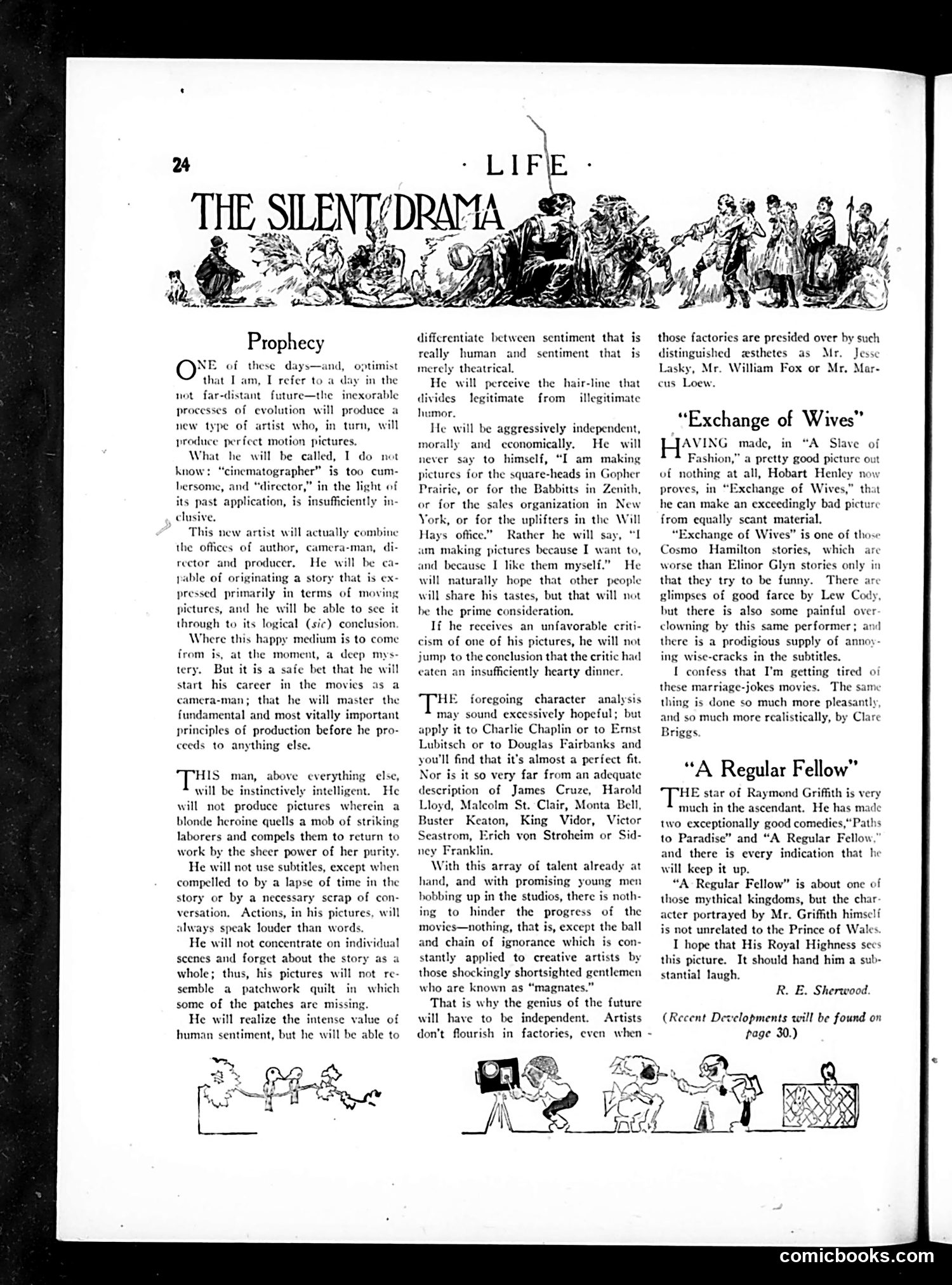
This page critiques 1920s Hollywood's creative constraints. The main article "Prophecy" argues that truly great motion pictures require a new breed of artist—someone who combines author, cameraman, director, and producer roles, working with artistic integrity rather than commercial calculation. The text specifically praises directors like Charlie Chaplin, Buster Keaton, and Erich von Stroheim as exemplars, while condemning studio "magnates" (named Jesse Lasky, William Fox, and Marcus Loew) for stifling creativity with commercial demands and censorship concerns (the "Will Hays office" reference). The satire targets studio executives' assumption that audiences are intellectually limited ("square-heads in Gopher Prairie," "Babbitts")—implying these bosses underestimate both artists and viewers. The article advocates for filmmakers who create from personal vision, not factory-like commercial calculation, predicting that independent-minded artists will ultimately produce superior cinema.
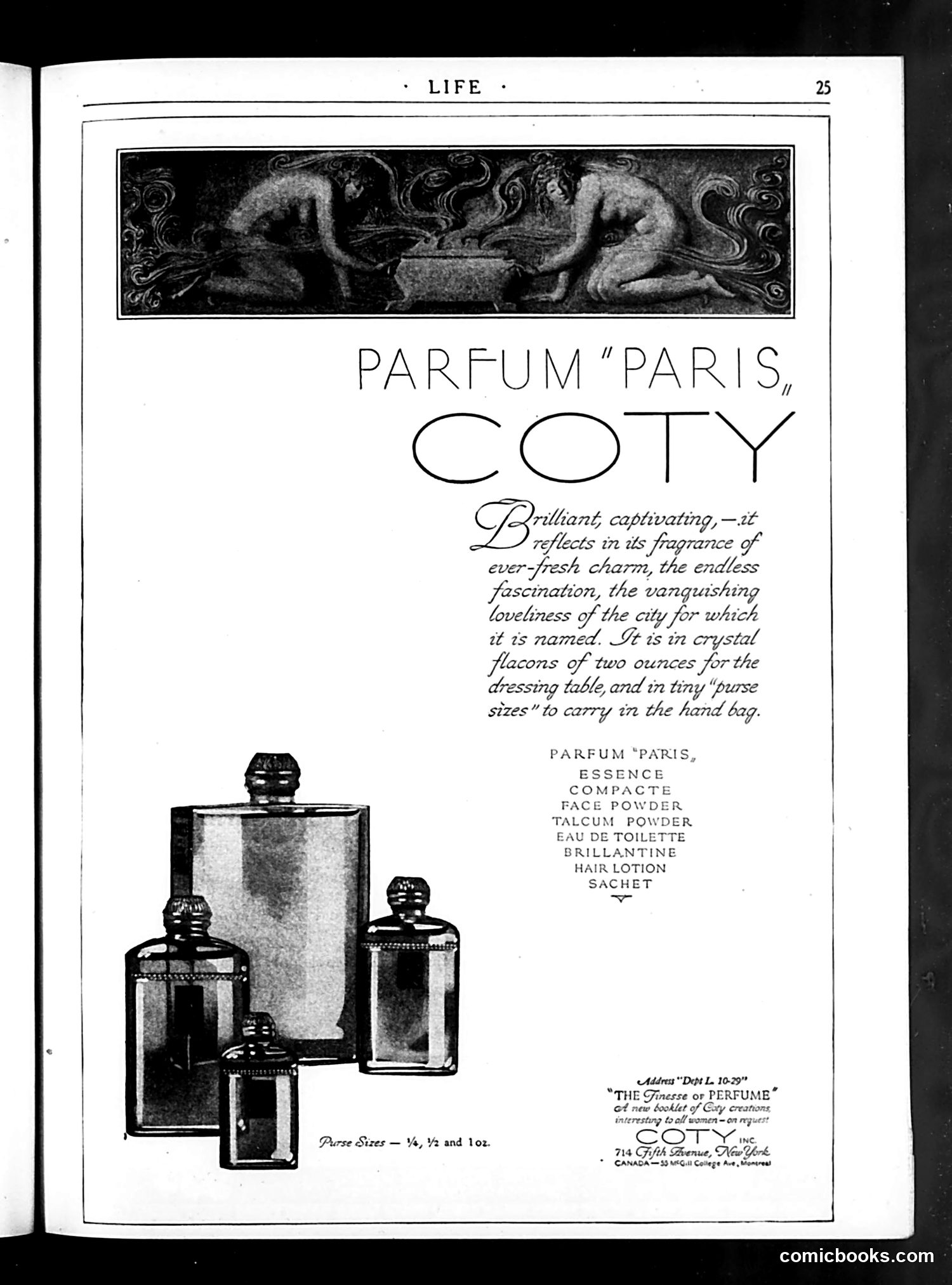
This page is **primarily an advertisement**, not political satire or a cartoon. It advertises "Parfum 'Paris'" by Coty, a real perfume brand from the early 20th century. The decorative header shows classical nude figures—likely representing mythological beauty or luxury—common in period cosmetics advertising to convey elegance and sophistication. The ad copy uses romanticized language about Paris ("ever-fresh charm," "vanquishing loveliness") to market the fragrance, capitalizing on Paris's cultural prestige. The product line includes perfume, powder, hair lotion, and sachets in multiple sizes for home and portable use. The bottles illustrated show typical vintage perfume packaging with ornate stoppers. This is straightforward commercial advertising rather than satirical content—Life magazine, despite its satirical roots, regularly published advertisements alongside editorial material.
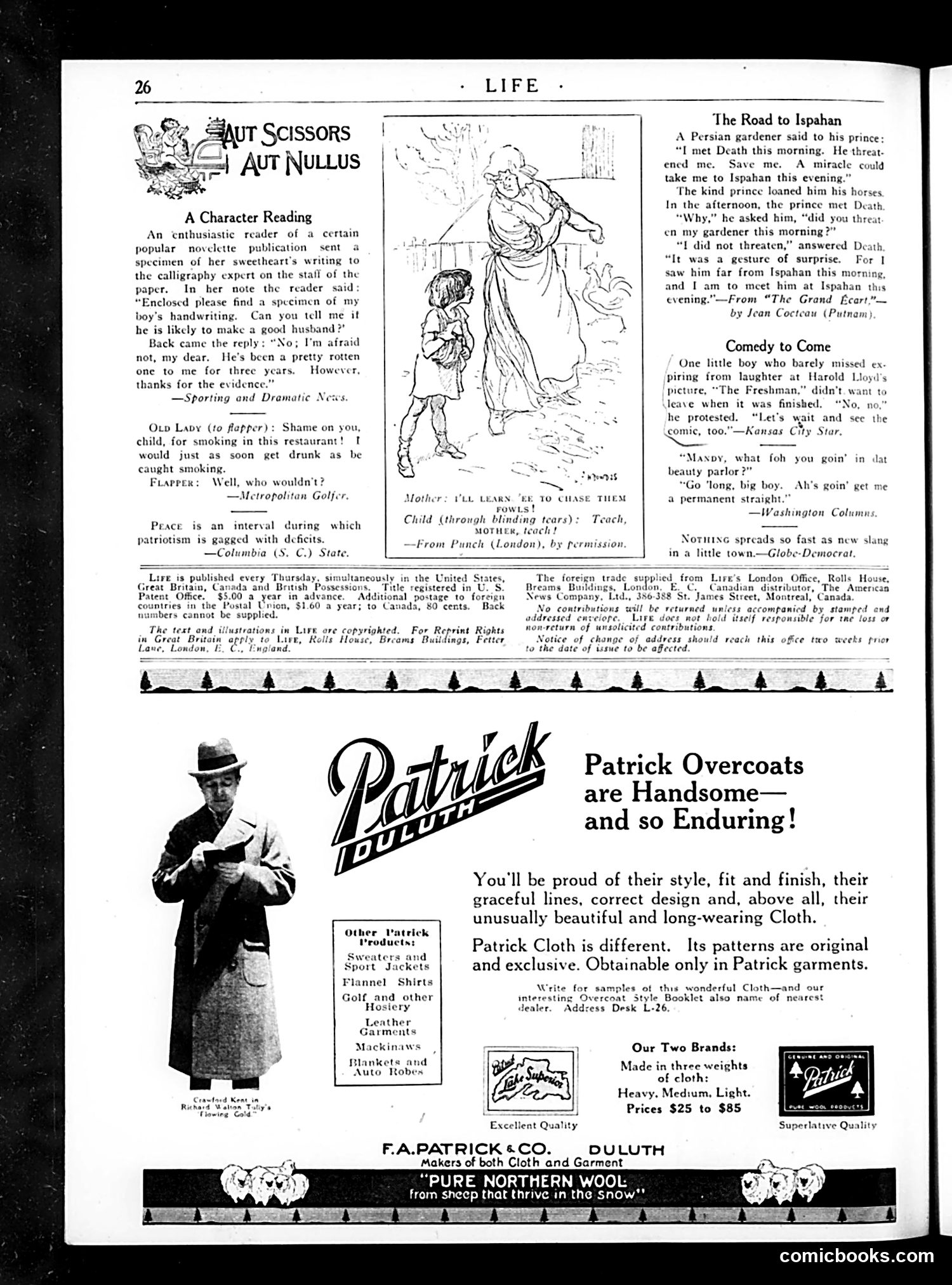
This page from *Life* magazine contains several short humorous pieces typical of the publication's satirical format: **"A Character Reading"** jokes about a woman sending her boyfriend's handwriting for analysis, only to receive a cynical reply from the "expert"—revealed to be the man's ex-wife. **"The Road to Ispahan"** presents a philosophical tale (credited to Jean Cocteau) about Death and fate, where a gardener flees to escape Death, only to encounter him at his intended destination anyway. The remaining pieces are brief quips poking fun at contemporary social behavior: a flapper smoking despite an older woman's disapproval, observations about patriotism and deficits, and dialect humor about African American speech patterns (reflecting period attitudes). The page is largely dominated by a **Patrick Overcoats advertisement** promoting men's clothing as stylish and durable, emphasizing exclusive patterns and "pure northern wool." The humor is genteel rather than biting—typical of *Life*'s approach during this era.
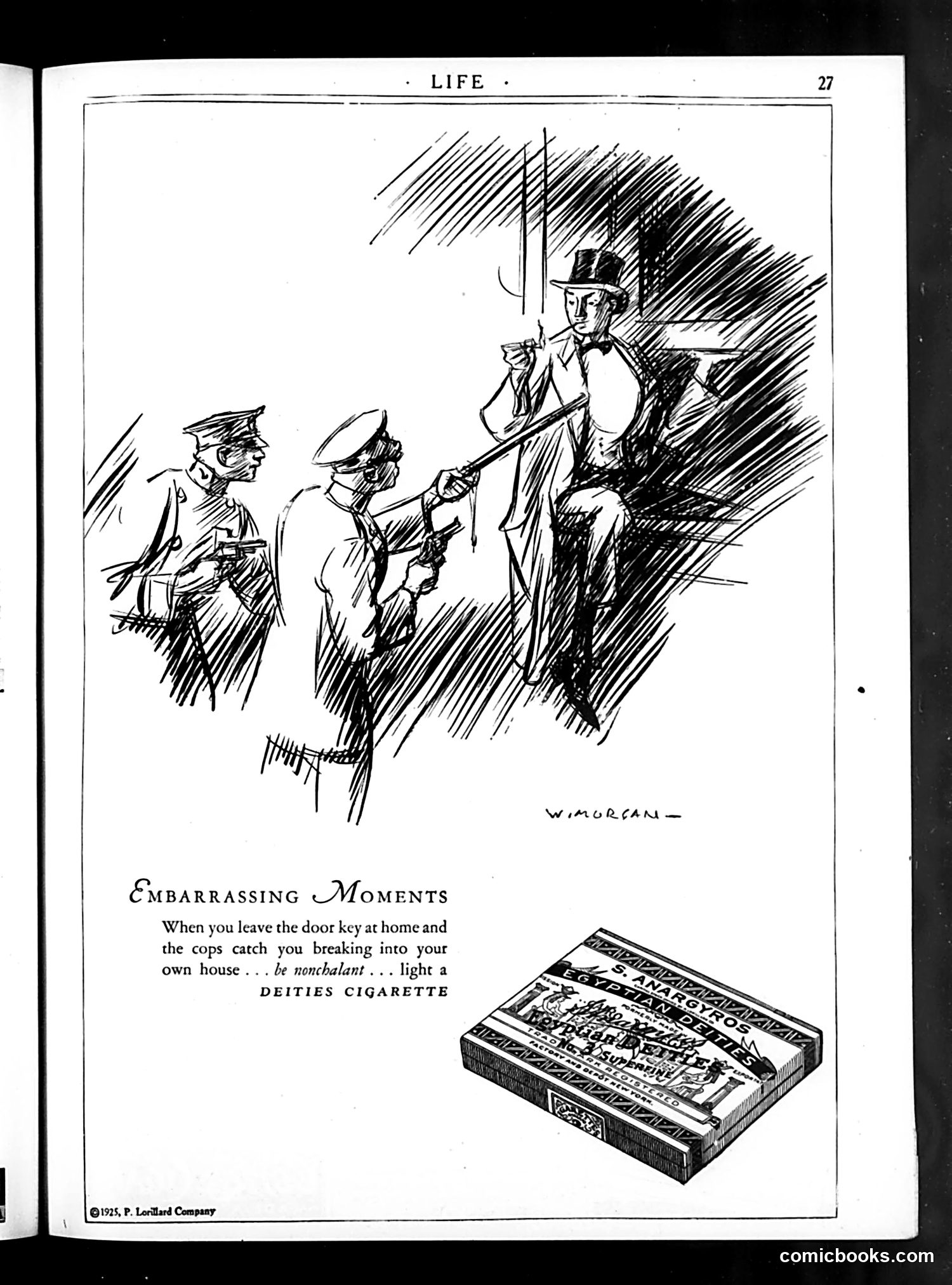
This is a cigarette advertisement masquerading as comic content. The cartoon depicts an embarrassing social scenario: a man caught breaking into his own house by police officers, apparently having left his key at home. The "joke" is that he should appear casual and nonchalant in this awkward situation by lighting a Deities cigarette—implying the cigarette provides composure and sophistication even in humiliating circumstances. The ad exemplifies 1925 marketing that conflated cigarette smoking with confidence and social grace. The cartoon style is signed "Waurgan" (the artist). The copyright indicates P. Lorillard Company, a major tobacco manufacturer. This represents a common advertising approach of the era, embedding product placement within editorial-style humor to make advertisements seem like magazine content rather than paid promotion.
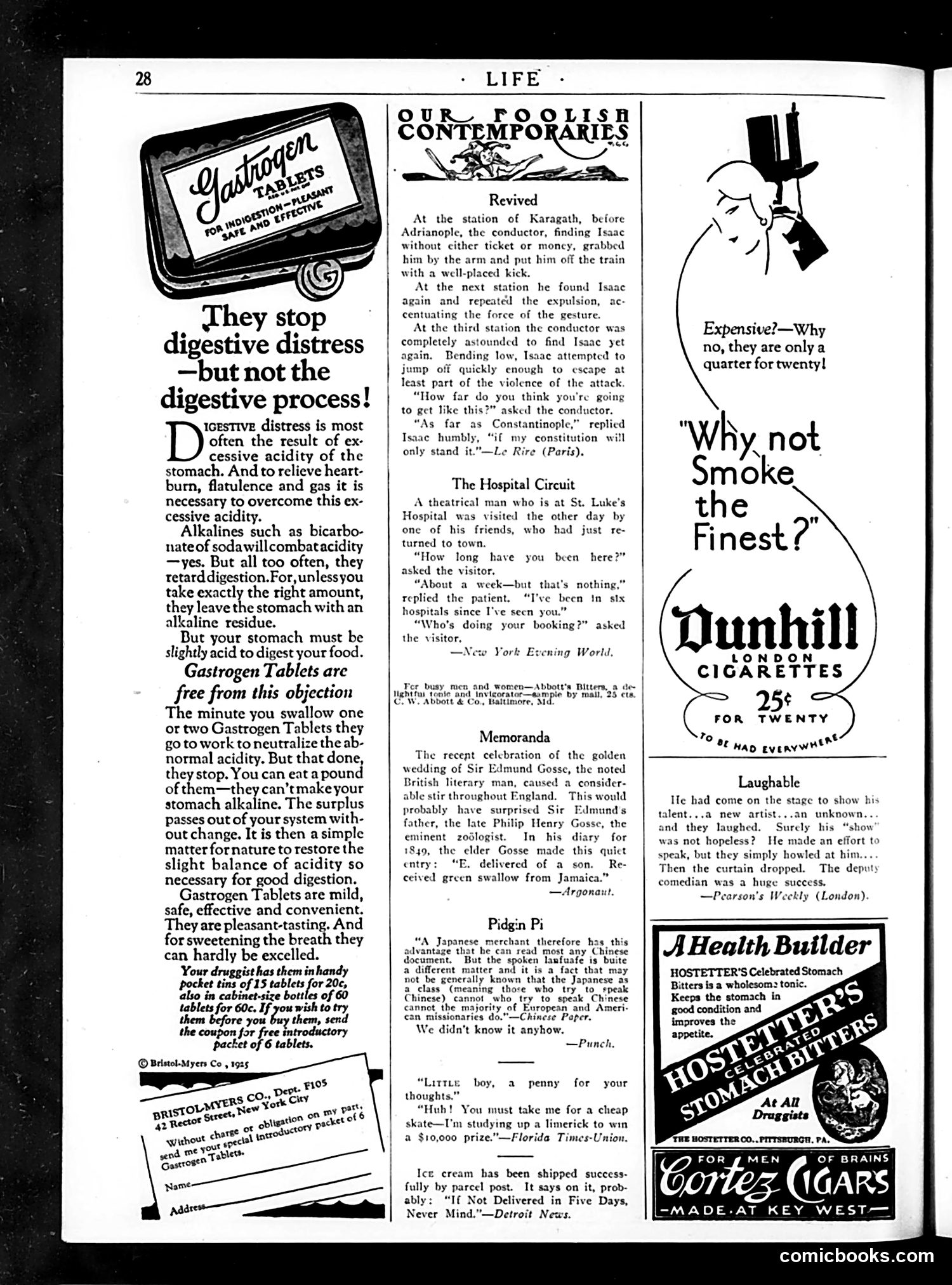
This page is primarily **advertising and humor columns**, not political cartoons. The content includes: **Main Advertisement**: Gastrogen Tablets (digestive aid) dominates the left side, with a detailed sales pitch explaining how the product neutralizes stomach acid without over-alkalizing. **Humor Sections** ("Our Foolish Contemporaries"): - A anecdote about a man repeatedly kicked off a train by a conductor, claiming he'll reach Constantinople if his constitution permits—satirizing absurd persistence. - A hospital joke about a theatrical man who's been in six hospitals, mocking hypochondria. - A note on Sir Edmund Gosse's golden wedding, contrasting his father's indifference to his birth (1849) with modern celebration—gentle literary humor. - Commentary on Japanese merchants reading Chinese documents but struggling with spoken Chinese—mocking cultural/linguistic confusion. - A joke about winning a limerick contest. **Sidebar advertisements**: Dunhill cigarettes, Hostetter's Stomach Bitters, and Cortez Cigars. The page reflects **1920s consumer culture** and light satirical commentary on contemporary social absurdities.
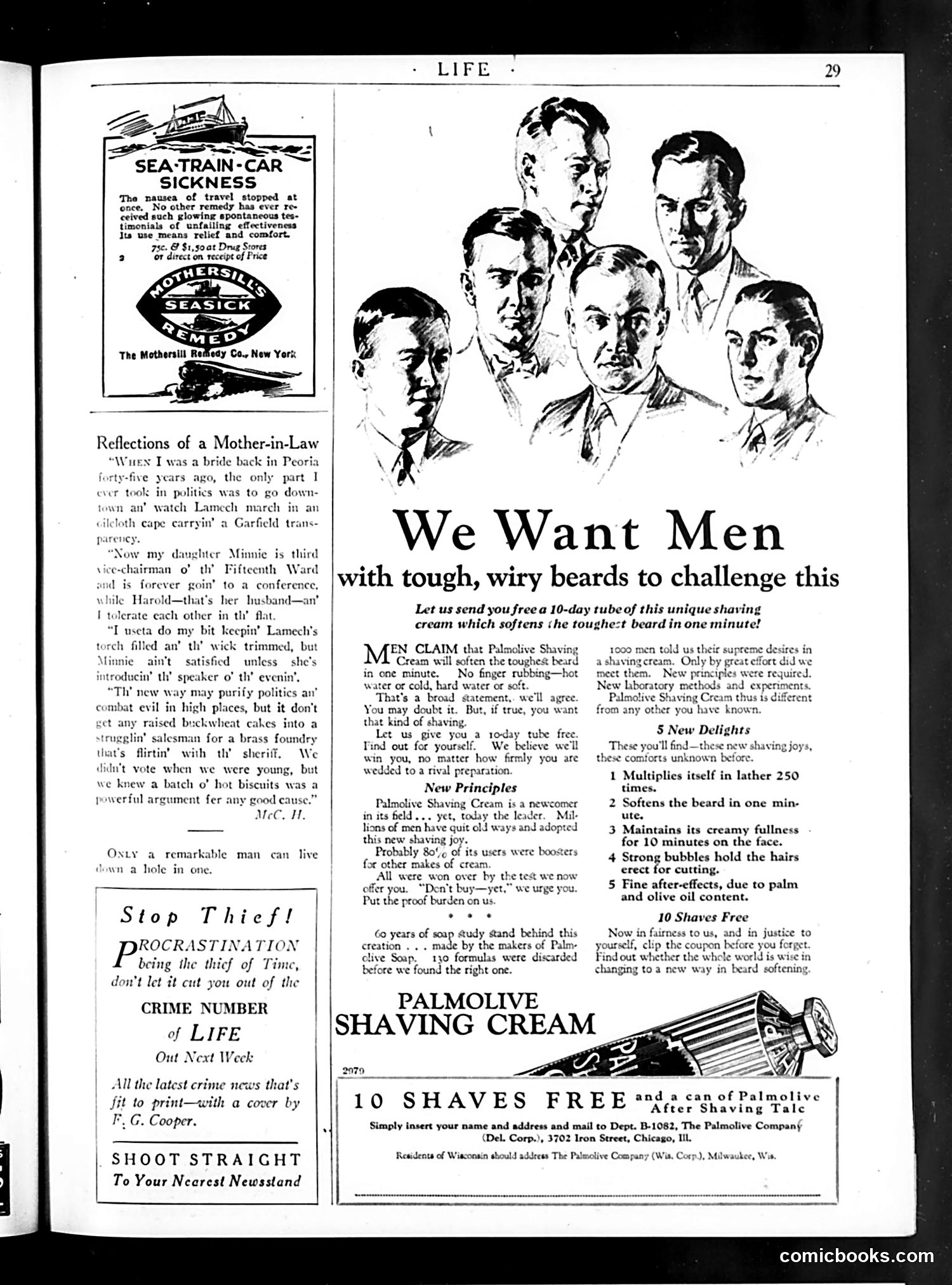
This page contains a satirical column and period advertisements, not political cartoons. **"Reflections of a Mother-in-Law"** is a humorous commentary on changing women's political participation. The unnamed mother-in-law contrasts her youth in Peoria—when women's only political involvement was watching civic parades supporting candidates like Garfield—with her daughter Minnie's current role as "third vice-chairman o' th' Fifteenth Ward." The joke critiques modern women's political activism as ineffectual compared to traditional domestic contributions. The speaker suggests that while "the new way may purify politics," it hasn't improved practical life for working-class men like her son-in-law. The column uses vernacular dialect and wry observation typical of Life's social satire. The remainder comprises advertisements for travel sickness remedy and Palmolive shaving cream, promoting a free sample offer targeting men with difficult beards.
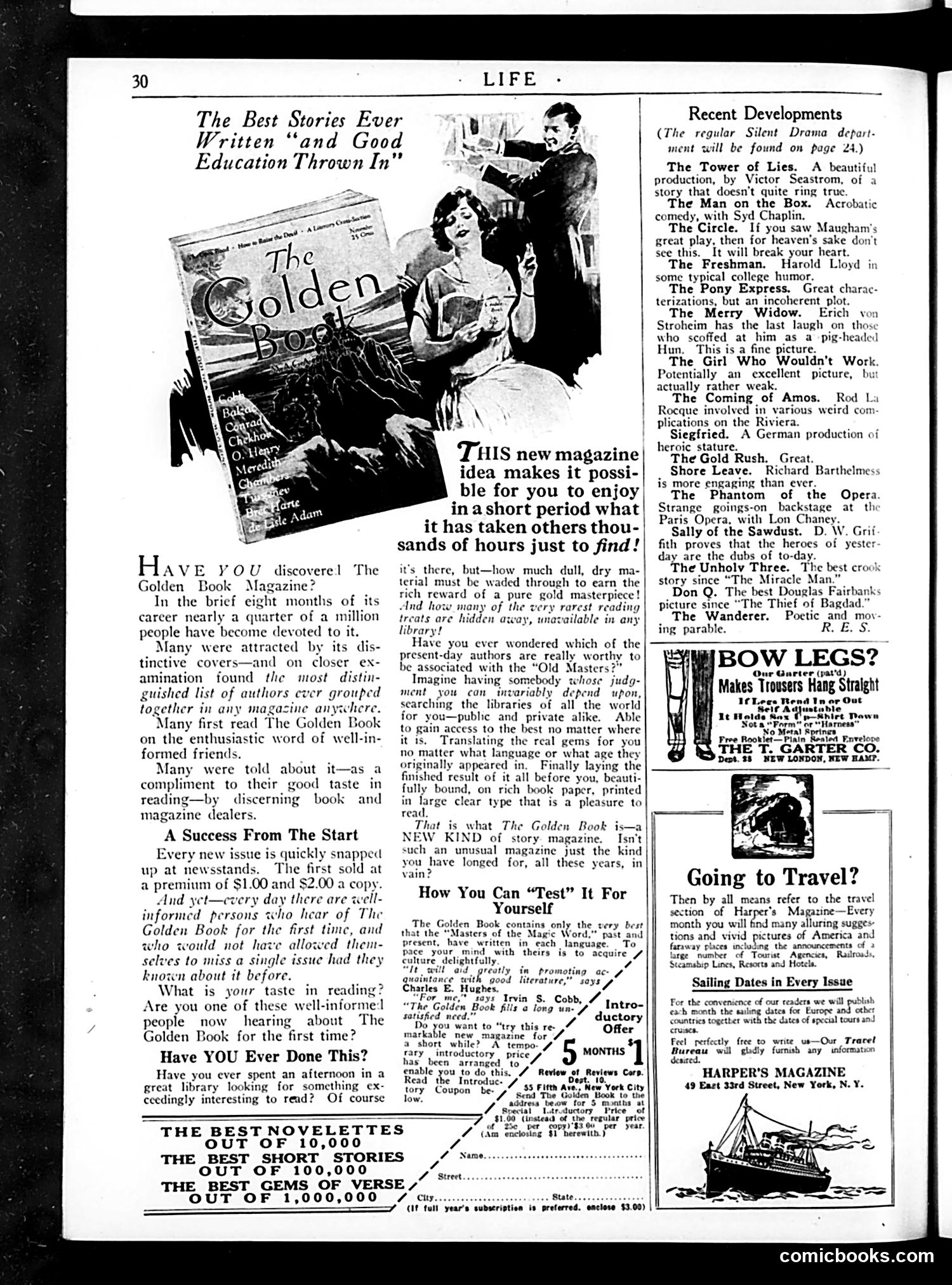
This is primarily **advertising disguised as editorial content** for *The Golden Book Magazine*, a 1920s literary digest. The pitch: *The Golden Book* claims to solve a real problem—that libraries contain vast amounts of mediocre material alongside rare masterpieces. The magazine promises to curate "the very best" stories, poems, and literary works from world literature, translated and beautifully printed, saving readers from tedious searching. The endorsements from figures like Charles E. Hughes and Irvin S. Cobb lend credibility. The offers ("best novelettes out of 10,000," etc.) suggest rigorous editorial standards. **The satire angle** (if any exists) is subtle: the ad's breathless tone and elaborate promises reflect 1920s consumer culture's tendency to market convenience and cultural refinement as purchasable commodities—the idea that good taste can be delivered monthly by subscription. The page also includes a "Recent Developments" section reviewing silent films, which was standard *Life* content of the era.
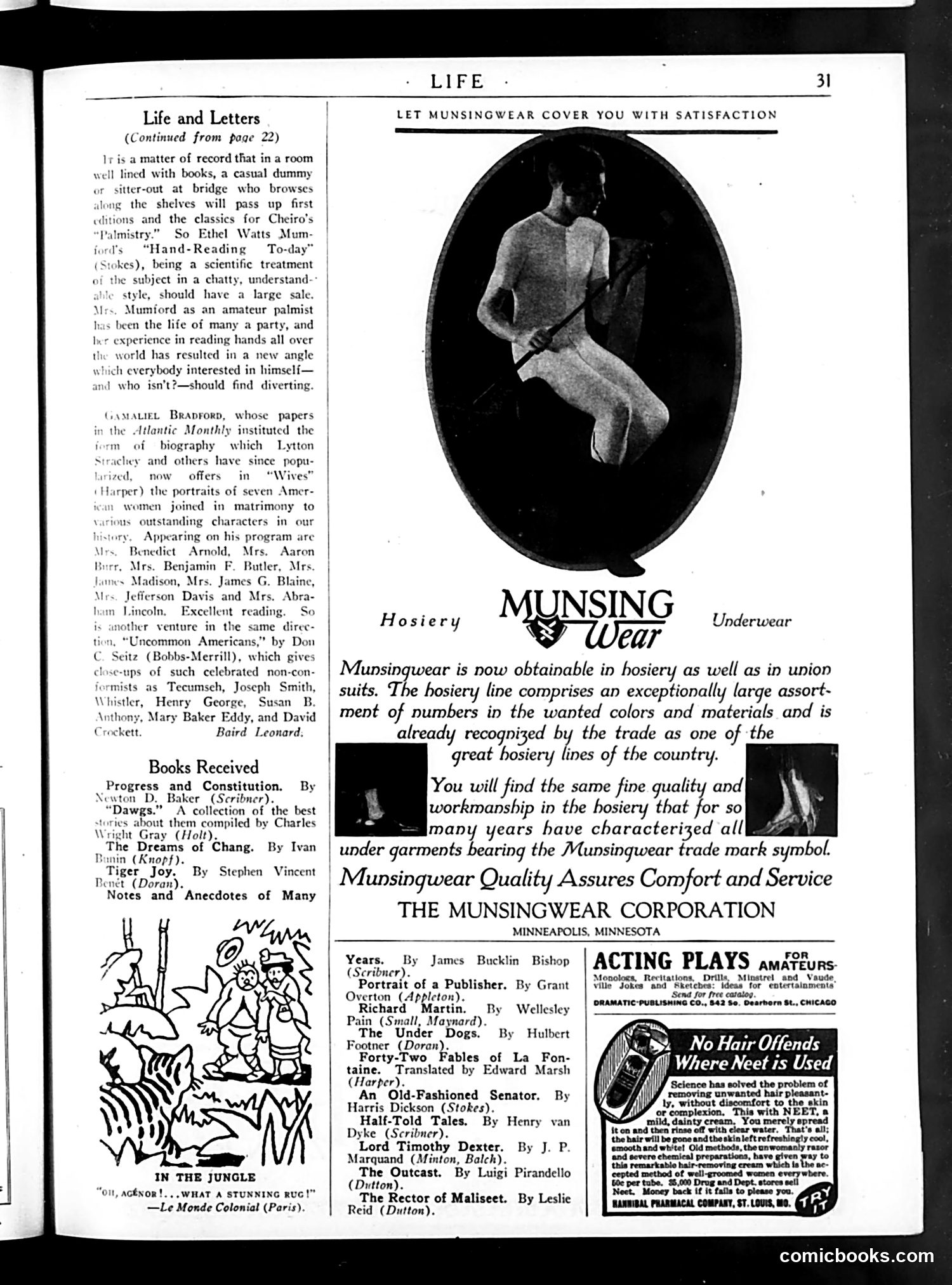
This page is primarily **advertising and book reviews**, not political satire. The small cartoon at bottom left—captioned "OH, ACTOR!...WHAT A STUNNING RUG!"—is a brief joke reprinted from *Le Monde Colonial* (a Paris publication). It appears to mock colonial-era pretension: someone admires what they believe is a fine rug, but the joke's full meaning is unclear without additional context—possibly it's commenting on colonial exploitation or misidentification of objects. The page's main content consists of literary reviews (including books on palmistry and biographies of notable Americans' wives) and advertisements for Munsingwear hosiery and underwear, plus a Neet hair-removal product ad. The decorative jungle illustration labeled "IN THE JUNGLE" is unrelated editorial artwork. The satire, if present, is minimal and localized to the single Paris-sourced caption.
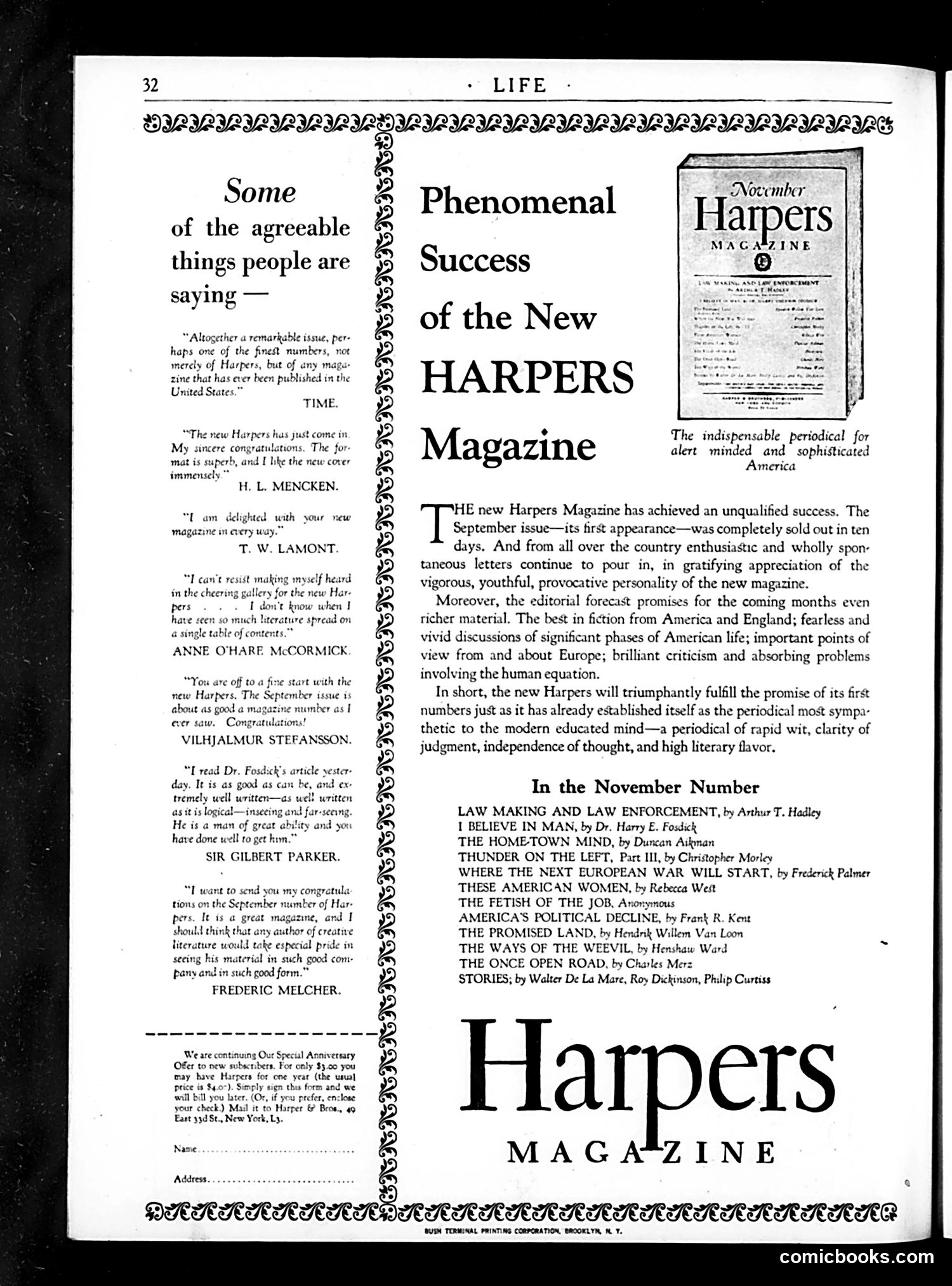
This is primarily an **advertisement for the newly relaunched Harper's Magazine**, not a political cartoon. The page celebrates Harper's September 1915 debut with testimonials from prominent figures including H.L. Mencken, T.W. Lamont, and Anne O'Hare McCormick—lending credibility through authority endorsement, a common advertising tactic. The satire is subtle: Life magazine (a competing publication) is promoting a rival's success, which appears generous but likely contains ironic undertones about Harper's pretensions to intellectual sophistication. The description as "the indispensable periodical for alert minded and sophisticated America" and emphasis on "rapid wit, clarity of judgment, independence of thought" targets educated, elite readers. The November issue preview lists serious content—articles on law enforcement, American women, and predictions of European war—positioning Harper's as substantive and forward-thinking rather than merely entertaining.
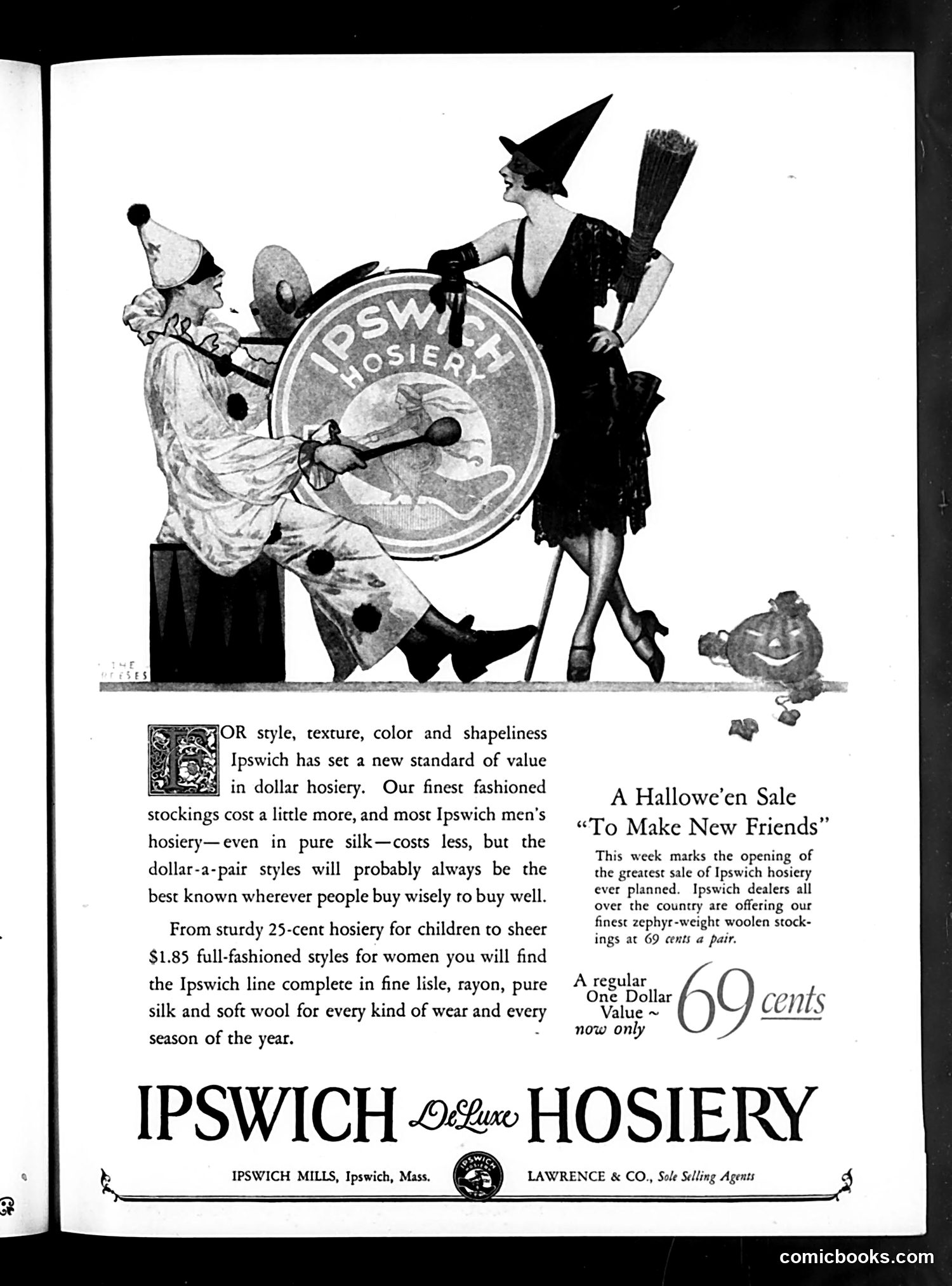
This is primarily an **advertisement for Ipswich hosiery**, not political satire. The illustration shows stylized Halloween-themed figures—a clown, a witch, and a goblin—dressed in costumes, promoting a Halloween sale of stockings at reduced prices (69 cents per pair, down from one dollar). The "satire" is purely commercial: the ad uses holiday imagery and playful language ("To Make New Friends") to market hosiery as affordable luxury goods. The text emphasizes value—quality stockings at accessible prices across multiple materials (silk, rayon, wool, lisle). The Halloween costume characters are simply decorative, meant to capture attention and seasonal relevance. There's no political commentary or social critique visible; this is straightforward 1920s-era product advertising dressed up in festive humor.
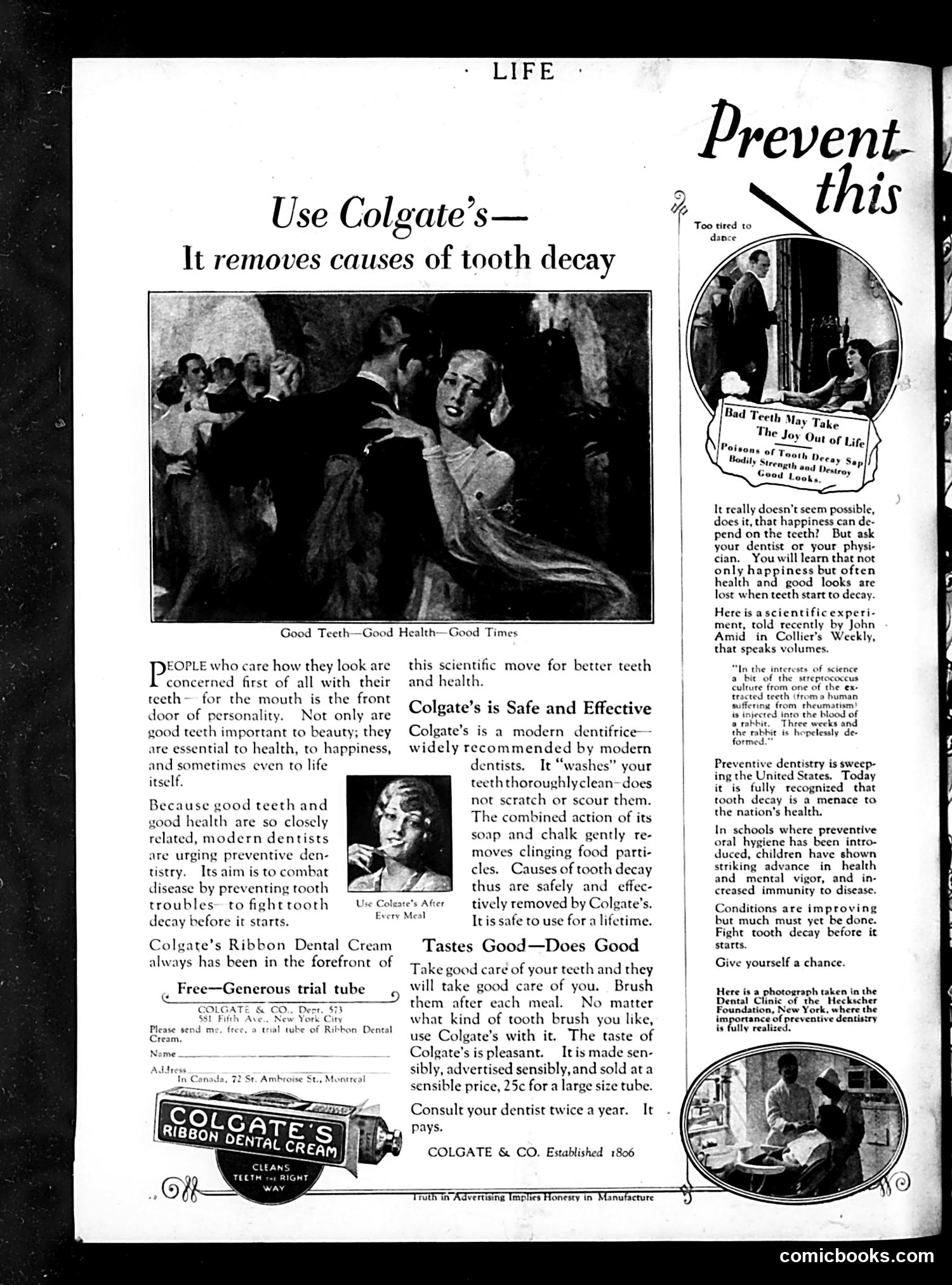
This is primarily a **Colgate's toothpaste advertisement**, not satire. The page promotes preventive dentistry to a modern American audience circa early 20th century. The two illustrated vignettes on the right show social consequences of poor teeth: a woman too self-conscious about her appearance to dance, and a dental clinic examining children. These aren't satirical but cautionary—emphasizing that tooth decay damages both health and social standing. The text quotes preventive dentistry as an emerging medical movement, citing an experiment where bacteria from decayed teeth caused rheumatism in rabbits. This reflects genuine early-20th-century medical beliefs linking oral health to systemic disease. The core message: good teeth ensure "Good Health—Good Times." Colgate's positions itself as scientifically endorsed by modern dentists, safe, and affordable at 25 cents. The ad conflates dental care with personal success and social acceptance—a standard advertising strategy that remains familiar today.