
Life, 1925-10-22 · page 64 of 74
Life — October 22, 1925 — page 64: what you’re looking at
What you’re looking at
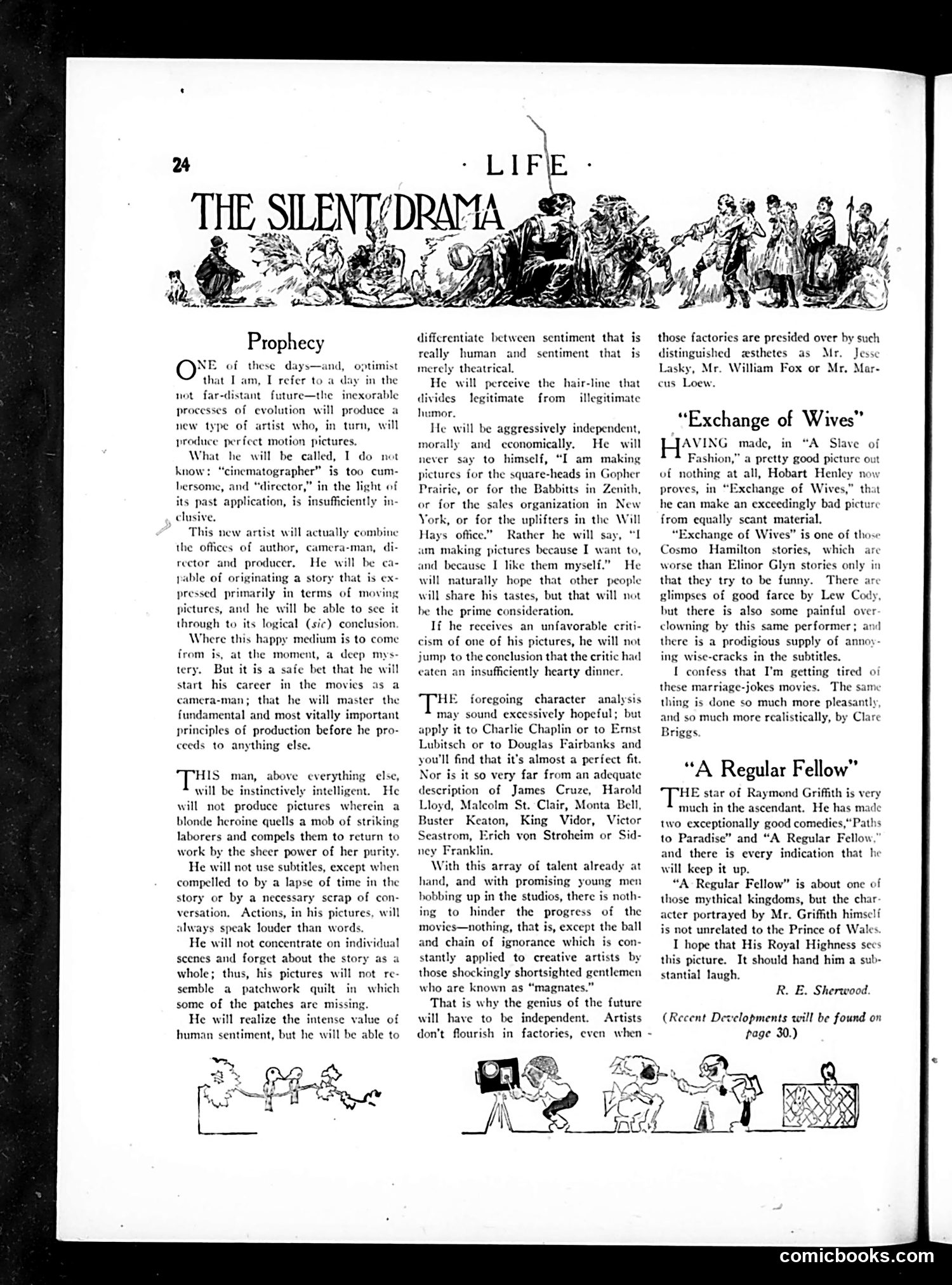
This page critiques 1920s Hollywood's creative constraints. The main article "Prophecy" argues that truly great motion pictures require a new breed of artist—someone who combines author, cameraman, director, and producer roles, working with artistic integrity rather than commercial calculation. The text specifically praises directors like Charlie Chaplin, Buster Keaton, and Erich von Stroheim as exemplars, while condemning studio "magnates" (named Jesse Lasky, William Fox, and Marcus Loew) for stifling creativity with commercial demands and censorship concerns (the "Will Hays office" reference). The satire targets studio executives' assumption that audiences are intellectually limited ("square-heads in Gopher Prairie," "Babbitts")—implying these bosses underestimate both artists and viewers. The article advocates for filmmakers who create from personal vision, not factory-like commercial calculation, predicting that independent-minded artists will ultimately produce superior cinema.
📄 Transcribed text from this page (OCR, searchable)
Machine-transcribed from the original scan — historical spelling and the odd misread are preserved.
Prophecy E of these days—and, optimist that I am, I refer to a day in the net -distant: future—the processes of evolution will produce a new type of artist who, in turn, will produce perfect motion pictures. What he will be called, I do not know: “cinematographer” is too cum- hersome, and “director,” in the light of its past application, is insufficiently in- clusive. This new a inexorable tist will actually combine the offices of author, camera-man, di and producer, He will be pable of originating a story that is ex- pressed primarily in terms of moving pictures, and he will be able to see it through to its logical (sic) conclusion Where this happy medium is to come from is, at the moment, a deep mys- tery. But it is a safe bet that he will start his career in the movies as a camcra-man; that he will master the fundamental and most vitally important principles of production before he pro- ceeds to anything else. rector HIS man, above everything else, will be instincti intelligent. He will not produce pictures wherein a blonde heroine quells a mob of striking laborers and compels them to return to work by the sheer power of her purity. He will not use subtitles, except when compelled to by a lapse of time in the story or by a necessary scrap of con- versation, Actions, in his pictures, will always speak louder than words. He will not concentrate on individual scenes and forget about the story as a whole; thus, his pictures will not re- semble a patchwork quilt in which some of the patches are missing. He will realize the intense value of human sentiment, but he will be able to differentiate between sentiment that is really human and sentiment that is merely theatrical. He will perceive the hair-line that divides legitimate from _ illegitimate humor. He will be aggressively independent, and economically, He will never say to himself, “I am making pictures for the square-heads in Gopher Prairie, or for the Babbitts in Zenith, for the sales organization in New York, or for the uplifters in the Will Hays office.” Rather he will say, “I am making pictures because I want to, and because I like them myself, He will naturally hope that other people will share his tastes, but that will not be the prime consideration, If he receives an unfavorable criti- cism of one of his pictures, he will not jump to the conclusion that the critic had eaten an insufficiently hearty dinner. morally 'H foregoing character analysis may sound excessively hopeful; but apply it to Charlie Chaplin or to Lubitsch or to Douglas Fairbanks and you'll find that it’s almost a perfect fit. Nor is it so very far from an adequate description of James Cruze, Harold Lloyd, Malcolm St. Clair, Monta Bell, Buster Keaton, King Vidor, Victor Seastrom, Erich von Stroheim or Sid- ney Franklin. With this array of talent already at hand, and with promising young men bobbing up in the studios, there is noth- ing to hinder the progress of the movies—nothing, that is, except the ball and chain of ignorance which is con- stantly applied to creative artists by those shockingly shortsighted gentlemen who are known as “magnates.” That is why the genius of the future will have to be independent. Artists don’t flourish in factories, even when - those factories are presided over by such distinguished gsthetes as Mr. Lasky, Mr. William Fox or Mr. Mar- cus Loew. Jesse “Exchange of Wives” HAaAviXG made, in “A Slave of Fashion,” a pretty good picture out of nothing at all, Hobart Henley now proves, in “Exchange of Wives,” that he can make an exceedingly bad picturc from equally scant material. “Exchange of Wives” is one of thos Cosmo Hamilton stories, which are worse than Elinor Glyn stories only is that they try to be funny. There are glimpses of good farce by Lew Cody, but there is also some painful over clowning by this same performer; and there is a prodigious supply of annoy- ing wise-cracks in the subtitles. I confess that I'm getting tired of these marriage-jokes movies. The same thing is done so much more pleasantly and so much more realistically, by Clare Briggs. “A Regular Fellow” HE star of Raymond Griffith is very much in the ascendant. He has made two exceptionally good comedies," Pa’ to Paradise” and “A Regular Fellow,’ and there is every indication that he will keep it up. “A Regular Fellow” is about one of those mythical kingdoms, but the char acter portrayed by Mr. Griffith himself is not unrelated to the Prince of Wales I hope that His Royal Highness secs this picture. It should hand him a sub- stantial laugh. R. E. Sherwood. (Recent Developments will be found on comicbooks.com