
Life, 1925-10-22 · page 28 of 74
Life — October 22, 1925 — page 28: what you’re looking at
What you’re looking at
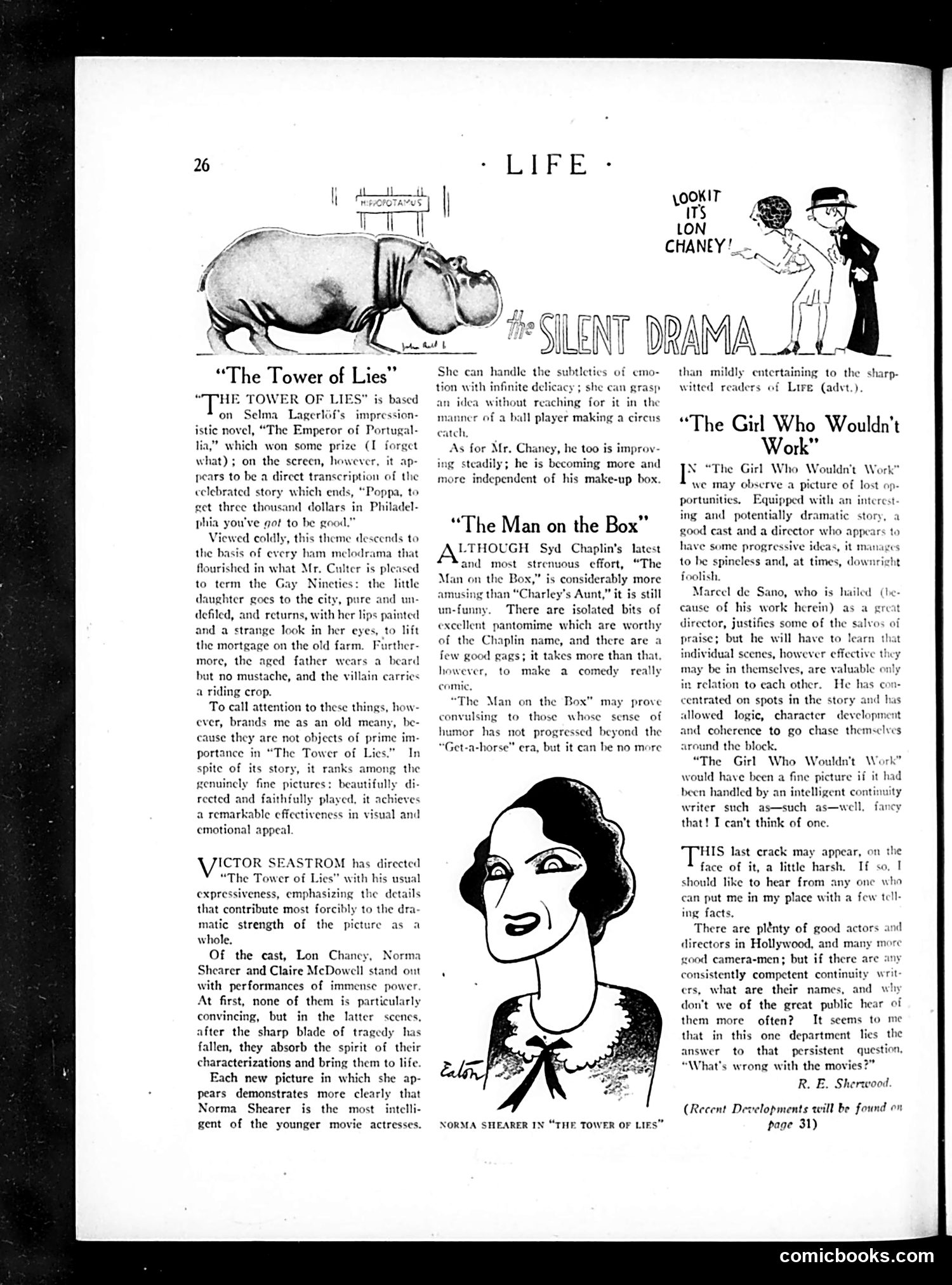
This page reviews three silent films from the 1920s: **"The Tower of Lies"** - The critic praises director Victor Seastrom's visual storytelling and the performances of Lon Chaney and Norma Shearer, though he dismisses the melodramatic plot (about a rural daughter who goes to the city) as hackneyed "Gay Nineties" fare. He notes Shearer's intelligence as an actress. **"The Man on the Box"** - Syd Chaplin's comedy is criticized as derivative and unfunny, following an outdated "Get-a-horse" comedic style. **"The Girl Who Wouldn't Work"** - Despite having potential and a good cast, the critic finds it incoherent, blaming the director Marcel de Sano for focusing on individual scenes rather than overall narrative coherence. The small cartoon at top-right ("Look it's Lon Chaney!") is simply a joke acknowledging Chaney's famous makeup artistry and dramatic range. The content reflects 1920s film criticism standards and the transition from silent film conventions.
📄 Transcribed text from this page (OCR, searchable)
Machine-transcribed from the original scan — historical spelling and the odd misread are preserved.
pe el b “The Tower of Lies” “TH 2 TOWER OF LIES" is based on Selma Lagerlif’s impression- istic novel, “The Emperor of Portugal- lia,” which won some prize (I forget what); on the screen, however, it ap- pears to be a dircct transcription of the celebrated story which ends, “Poppa, to get three thousand dollars in Philadel- phia you've got to be good.” Viewed coldly, this theme descends to the basis of every ham melodrama that flourished in what Mr. Culter is pleased to term the Gay Nineties: the little daughter goes to the city, pure and un- defiled, and returns, with her lips painted and a strange look in her eyes, to lift the mortgage on the old farm. Further- more, the aged father wears a beard but no mustache, and the villain carries a riding crop. To call attention to these things, how- ever, brands me as an old meany, be- cause they are not objects of prime portance in “The Tower of Lies,” In spite of its story, it ranks a the genuincly fine pictures: beautifully di- rected and faithfully played, it achieves a remarkable effectiveness in visual and emotional appeal. im- nong ICTOR SEASTROM has directed “The Tower of Lies” expressiveness, emphasizing the details that contribute most forcibly to the dra matic strength of the picture as a whole, Of the cast, Lon Chaney, Norma Shearer and Claire McDowell stand ont with performances of immense power. At first, none of them is particularly convincing, but in the latter scenes, after the sharp blade of tragedy has fallen, they absorb the spirit of their characterizations and bring them to life. Each new picture in which she ap- pears demonstrates more clearly that Norma Shearer is the most intelli- gent of the younger movie actresses. with his usual She can handle tion with infinite de she can grasp an idea without reaching for it in. the manner of a ball player making a catch, i cmo- circus As for Mr. Chaney, he too is improv- ing steadily; he is becoming more and more independent of his make-up box. “The Man on the Box” ALTHOUGH Syd Chaplin’s latest and most strenuous effort, “The Man on the Box,” is considerably more a *s Aunt,” it is still There are isolated bits of excellent pantomime which are worthy of the Chaplin name, and there are few good gags; it takes more than that. however, to make a comedy really amusing than “Charl un-funny. comic, “The Man on the convulsing to those humor has -a-horse Box” whose may sense of prove not progressed beyond the ra, but it can be no more NORMA SHEARER IN “THE TOWER OF LIES” \OOKIT ITS LON CHANEY! than mildly witted rea entertaining to the sharp- rs of Lire (advt.). “The Girl Who Wouldn't Work” Is “The Girl Who Wouldn't Wor we may observe a picture of lost op- portunitics, Equipped with an interest ing and potentially dramatic F good cast and a director who appears have some progressive ideas, it mar to be spineless and, at times, downright foolish. Marcel de Sano, who is hailed (he- cause of his work herein) as director, justifies some of the salvos of praise; but he will have individual scenes, however effective they may be in themselves, are valuable ¢ in relation to each other. He has cv centrated on spots in the story and has allowed logic, character development and coherence to go chase themselves around the block. “The Girl Who Wouldn't Work” would have been a fine picture if it had been handled by an intelligent conti writer such as—such as—well, fa that! T can’t think of one. a great to learn that HIS last crack may appear, on the face of it, a little harsh. If so. I should like to hear from who can put me in my place with a few tell- ing facts. There are pltnty of good actors directors in Hollywood, and many 1 good camera-men; but if there are consistently competent continuity writ- ers, what are their names, and why don't we of the great public hear of them more often? It seems to me that in this one department lies the answer to that persistent quest! “What's wrong with the movies?” R. E. Sherwood. any one (Recent Developments will be found on page 31) comicbooks.com