
Life, 1925-10-22 · page 60 of 74
Life — October 22, 1925 — page 60: what you’re looking at
What you’re looking at
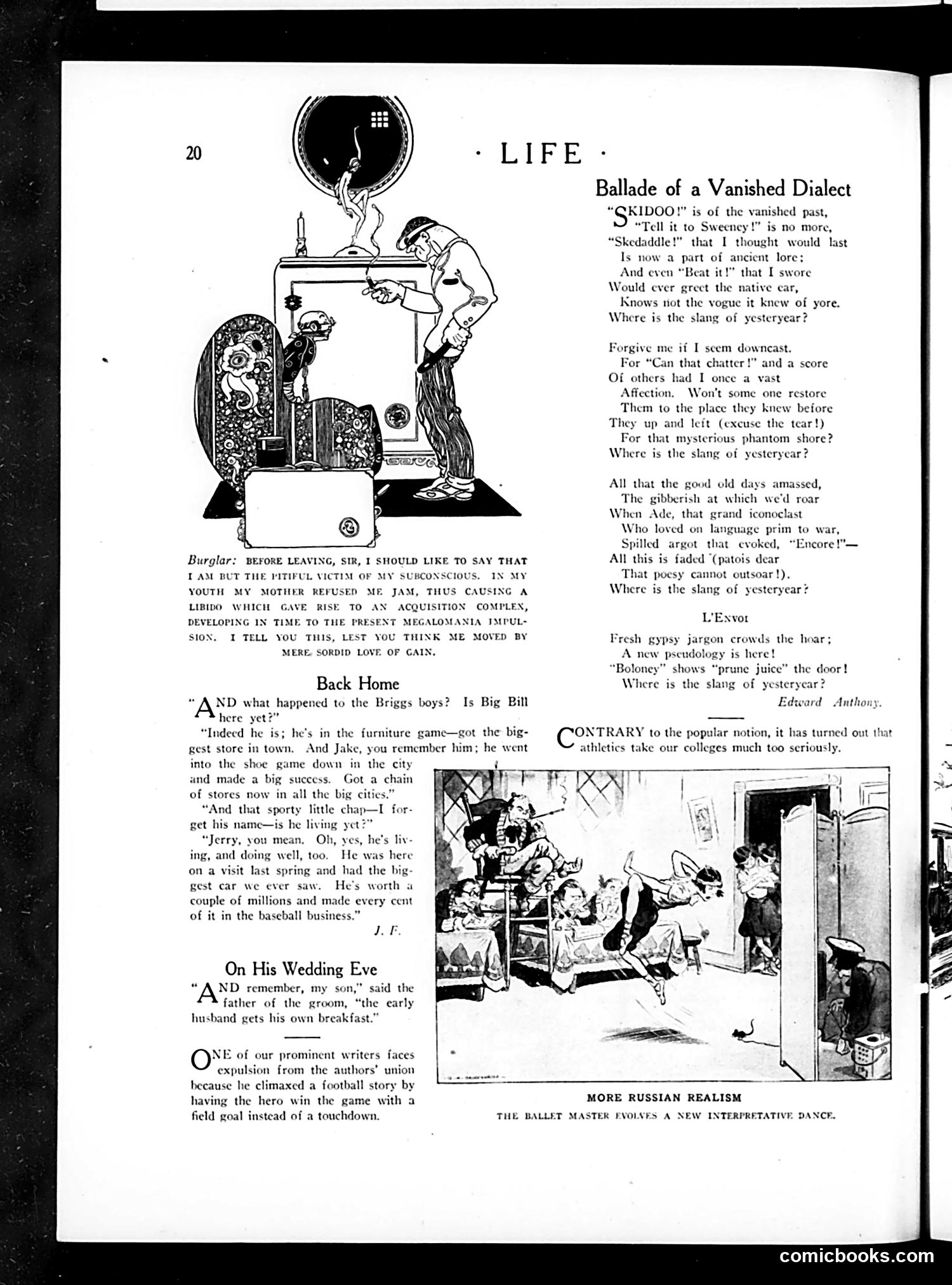
This page contains multiple satirical pieces typical of Life's early 20th-century humor: **The Burglar cartoon** mocks psychoanalytic jargon newly fashionable in America. A burglar, caught mid-theft, absurdly justifies his crime using Freudian language about his "subconscious," "libido," and "acquisition complex"—satirizing how people were adopting pseudo-psychological explanations for behavior, replacing simple morality with trendy pseudo-science. **"Ballade of a Vanished Dialect"** nostalgically laments obsolete American slang ("Skidoo," "Tell it to Sweeney," "Skedaddle"). The poem mourns generational linguistic change, referencing humorist George Ade, who popularized such dialect. **"Back Home"** and **"On His Wedding Eve"** are brief humorous anecdotes about social mobility and marital advice. **The final note** jokes that a writer faced expulsion from the authors' union for ending a football story with a field goal rather than a touchdown—absurdist humor about both rigid institutional rules and the football-obsessed culture of American colleges.
📄 Transcribed text from this page (OCR, searchable)
Machine-transcribed from the original scan — historical spelling and the odd misread are preserved.
Burglar; BeEYORE LEAVING, SIR, I SHOULD LIKE TO SAY THAT TAM BUT THE PITIFUL VICTIM OF MY SUBCONSCIOUS. IN MY YOUTH MY MOTHER REFUSED ME JAM, THUS CAUSING A LIBIDO WHICH GAVE RISE TO ACQUISITION COMPLEX, DEVELOPING IN TIME TO THE PRESENT MEGALOMANIA IMPUL- SION, I TELL YOU THIS, LEST YOU THINK ME MOVED BY MERE. SORDID LOVE OF GAIN. Back Home ND what happened to the Briggs boys? here yet?” “Indeed he is; he’s in the furniture game—got the big- gest store in town. And Jake, you remember him; he went into the shoe game down in the city Is Big Bill Ballade of a Vanished Dialect “QKIDOO!” is of the vanished past, “Tell it to Sweeney!” is no more, Skedaddle!" that I thought would last Is now a part of ancient lore; And even “Beat it!” that I swore Would ever grect the native car, Knows not the vogue it knew of yore. Where is the slang of yesteryear? Forgive me if I seem downcast, For “Can that chatter!" and a score Of others had I once a vast Affection. Won't some one restore Them to the place they knew before They up and left (excuse the tear!) ‘or that mysterious phantom shore? Where is the slang of yesteryear? All that the good old days amassed, The gibberish at which we'd roar When Ade, that grand iconoclast Who loved on language prim to war, Spilled argot that evoked, “Encore !"— All this is faded “(patois dear That poesy cannot outsoar!). Where is the slang of yesteryear? L'Exvor Fresh gypsy jargon crowds the hoar; A new pseudolog “Boloney” s here! rune juice” the door! Where is the slang of yesteryear? shows. Edward Anthony. (CONTRARY to the popular notion, it has turned out that athletics take our colleges much too seriously. and made a big success. Got a chain of stores now in all the big cities.” “And that sporty little chap—I for- get his name—is he living yet “Jerry, you mean. Oh, yes, he’s liv- ing, and doing well, too. He was here on a visit last spring and had the big- gest car we ever saw. He's worth a couple of millions and made every cent of it in the baseball business.” dF On His Wedding Eve “AND remember, my son,” said the father of the groom, “the early husband gets his own breakfast.” NE of our prominent writers faces expulsion from the authors’ union because he climaxed a football story by having the hero win the game with a MORE RUSSIAN REALISM field goal instead of a touchdown. THE BALLET MASTER EVOLVES A NEW INTERPRETATIVE comicbooks.com