
Life, 1925-10-22 · page 18 of 74
Life — October 22, 1925 — page 18: what you’re looking at
What you’re looking at
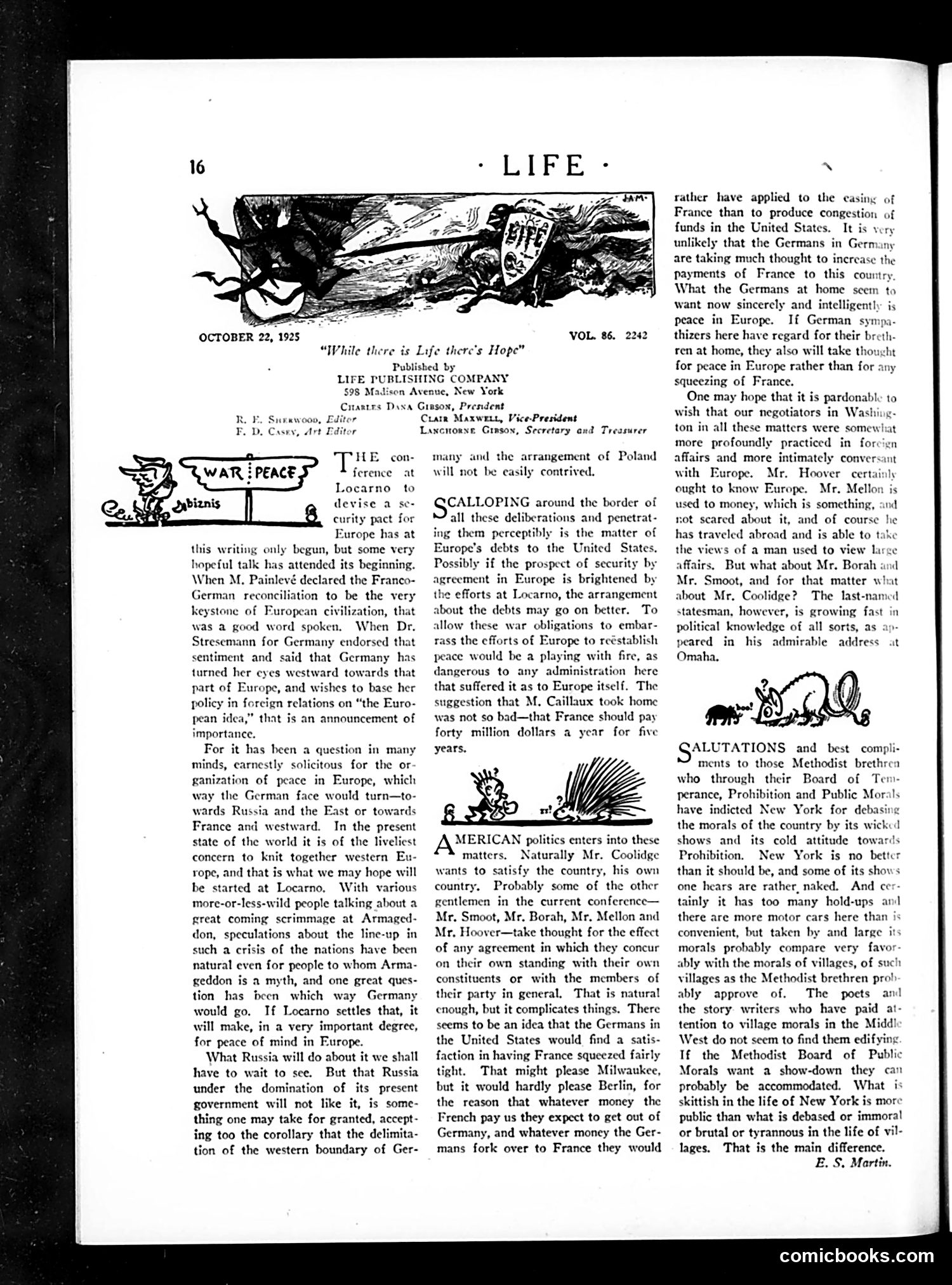
The page discusses the League of Nations conference at Locarno, which aimed to establish European peace and security agreements after World War I. The main cartoon depicts a figure labeled "RIFF" (likely referring to Riff tribesmen in Morocco) or war/conflict personified, shown as a menacing creature. The editorial argues that while peace negotiations are underway, practical concerns remain: France's war debts to America, Germany's reparation payments, and concerns about whether Germany might turn aggression toward Russia or France instead. The text expresses hope that diplomatic efforts—particularly those involving Mr. Hoover (U.S. Commerce Secretary)—might succeed, though skepticism about sustainable European peace is evident throughout the discussion.
📄 Transcribed text from this page (OCR, searchable)
Machine-transcribed from the original scan — historical spelling and the odd misread are preserved.
OCTOBER 22, 1925 VOL. 86. 2242 “While there is Life there's Hope” Published by LIFE PUBLIS $98 Mad 1ING COMPANY on Avenue, New York Citaatrs Dixa Giason, President R. FE. Sunawooo, Editer F. D, Casey, Art Editor TH Econ ference at Locarno to devise a se- curity pact for Europe has at this writing only begun, but some very hopeful talk has attended its beginning. When M., Painlevé declared the Franco- German reconciliation to be the very keystone of European civilization, that was a good word spoken. When Dr, Stresemann for Germany endorsed th sentiment and said that Germany ha turned her cyes westward towards that part of Europe, and wishes to base her policy in ign relations on “the Euro- pean idea,” that is an announcement of importance. For it has been a question in many minds, earnestly solicitous for the or ganization of peace in Europe, which way the German face would turn—to- wards Russia and the East or towards France and westward. In the present state of the world it is of the liveliest concern to knit together western Eu- rope, and that is what we may hope will be started at Locarno, With various more-or-less-wild people talking about a great coming scrimmage at Armaged- don, speculations about the line-up in such a crisis of the nations have been natural even for people to whom Arma- geddon is a myth, and one great ques- tion has been which way Germany would go. If Locarno settles that, it will make, in a very important degree, for peace of mind in Europe. What Russia will do about it we shall have to wait to see. But that Russia under the domination of its present government will not like it, is some- thing one may take for granted, accept- ing too the corollary that the delimita- tion of the western boundary of Ger- Crate Maxwait, Vice-President Laxcntoexe Grasox, Secretary and Treasurer many and the arrangement of Poland will not be easily contrived. CALLOPING around the border of all these deliberations and penetrat- ing them perceptibly is the matter of Europe's debts to the United States, Possibly if the prospect of security by agreement in Europe is brightened by the efforts at Locarno, the arrangement about the debts may go on better. To allow these war obligations to embar- rass the efforts of Europe to reéstablish peace would be a playing with fire, as dangerous to any administration here that suffered it as to Europe itself. The suggestion that M. Caillaux took home was not so bad—that France should pay forty million dollars a year for five AMERICAN politics enters into these matters. Naturally Mr. Coolidge wants to satisfy the country, his own country, Probably some of the other gentlemen in the current conference— Mr. Smoot, Mr. Borah, Mr. Mellon and Mr. Hoover—take thought for the effect of any agreement in which they concur on their own standing with their own constituents or with the members of their party in general, That is natural cnough, but it complicates things. There seems to be an idea that the Germans in the United States would find a satis- faction in having France squeezed fairly tight. That might please Milwaukee, but it would hardly please Berlin, for the reason that whatever money the French pay us they expect to get out of Germany, and whatever money the Ger- mans fork over to France they would N rather have applied to the easing of France than to produce congestion of funds in the United States. It is very unlikely that the Germans in Germany are taking much thought to increase the payments of France to this country. What the Germans at home seein to want now sincerely and intelligently is peace in Europe. If German thizers here have regard for their ren at home, they also will take tho for peace in Europe rather than for squeezing of France. One may hope that it is pardonable to wish that our negotiators in Wa a ton in all these matters were some more profoundly practiced in foreign affairs and more intimately conversant with Europe. Mr. ought to know Europe. Mr. Mellon is used to money, which is something, and rot scared about it, and of course he has traveled abroad and is able to take the views of a man used to view large affairs, But what about Mr. Borah and Mr. Smoot, and for that matter what about Mr. Coolidge? The last-named statesman, however, is growing fast in political knowledge of all sorts, as ap- peared in his admirable address at Omaha. ympa- Hoover certainly GALUTATIONS and best compli- ments to those Methodist brethren who through their Board of Ten- perance, Prohibition and Public Morals have indicted New York for debasi the morals of the country by its wicked shows and its cold attitude towards Prohibition. New York is no better than it should be, and some of its shows one hears are rather, naked. And cer- tainly it has too many hold-ups anil there are more motor cars here than is convenient, but taken by and large i morals probably compare very fav ably with the morals of villages, of such villages as the Methodist brethren pro! ably approve of. The poets aml the story writers who have paid at- tention to village morals in the Midd! West do not seem to find them edifying If the Methodist Board of Public Morals want a show-down they ca probably be accommodated. What is skittish in the life of New York is more public than what is debased or immoral or brutal or tyrannous in the life of vil- lages. That is the main difference. E. S. Martin. comicbooks.com