
Life, 1925-10-22 · page 58 of 74
Life — October 22, 1925 — page 58: what you’re looking at
What you’re looking at
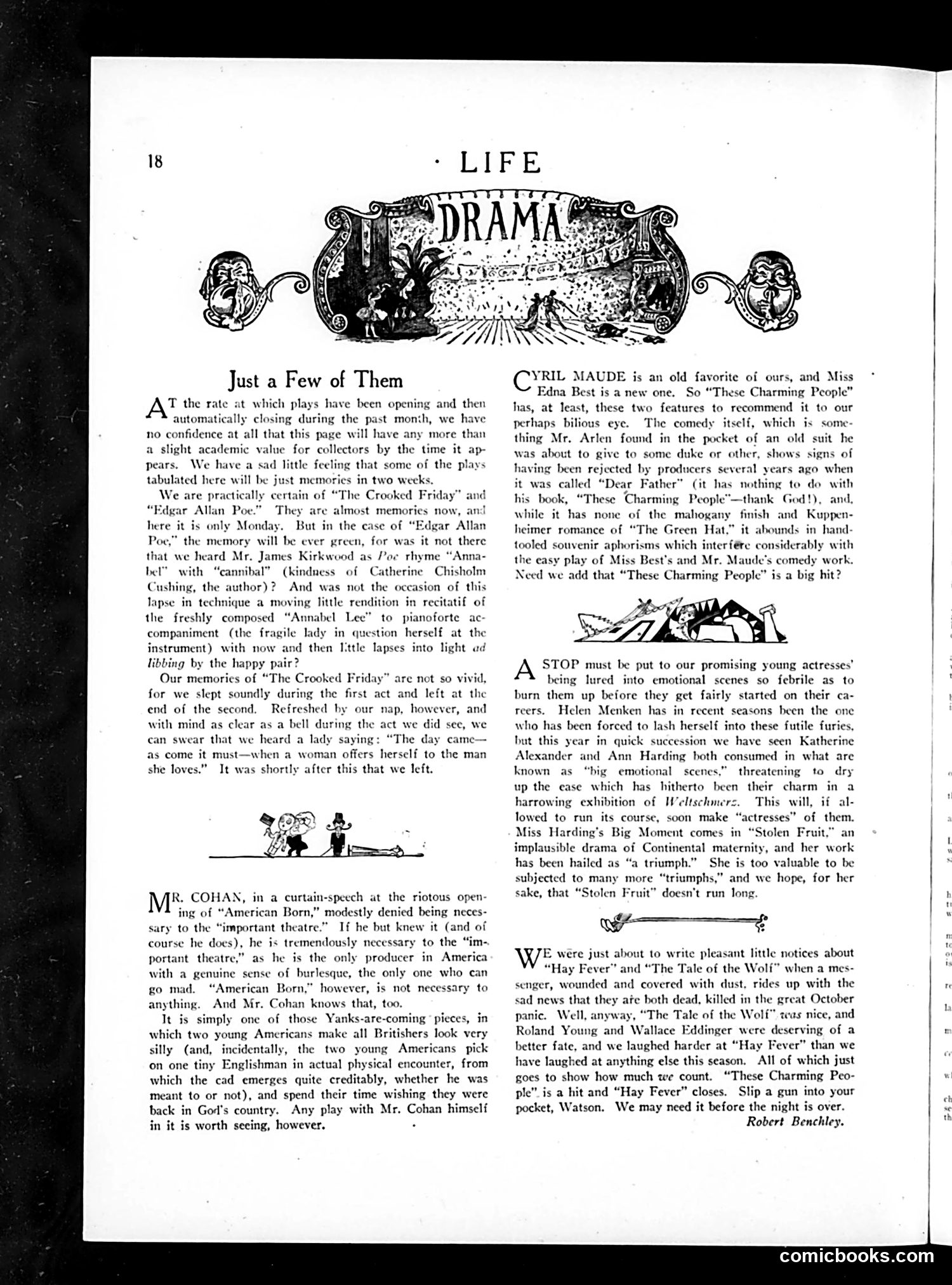
This page from *Life* magazine reviews several Broadway plays opening and closing in rapid succession. The critic sarcastically notes plays are closing so quickly they'll be "just memories in two weeks." The reviews mock specific productions: "The Crooked Friday" (the critic admits sleeping through it), "Edgar Allan Poe" (ridiculed for an absurd rhyme of "Annabel" with "cannibal"), and "American Born" featuring producer George M. Cohan. That last play is dismissed as another tiresome "Yanks-are-coming" piece where Americans mock British people—though the critic admits Cohan's presence makes anything worth seeing. The page critiques overworked young actresses like Helen Menken, Katherine Alexander, and Ann Harding being cast in exhaustingly emotional roles that "burn them up" before their careers properly develop. The tone throughout is witty deprecation of theatrical excess and poor playwriting disguised as entertainment.
📄 Transcribed text from this page (OCR, searchable)
Machine-transcribed from the original scan — historical spelling and the odd misread are preserved.
18 Just a Few of Them T the rate at which plays have been opening and then automatically closing during the past month, we have no confidence at all that this page will have any more than a slight academic value for collectors by the time it ap- pears. We have a sad little feeling that some of the plays tabulated here will be just memories in two weeks. We are practically certain of “The Crooked Friday” and “Edgar Allan Poe.” They are almost memories now, here it is only Monday, But in the case of “Edgar Allan Poe,” the memory will be ever green, for was it not there that we heard Mr. nes Kirkwood as Poe rhyme “Anna- bel” with “cannibal” (kindness of Catherine Chisholm Cushing, the author)? And was not the occasion of this nt lapse in technique a moving litle rendition in recitatif, of the freshly composed “Annabel Lee” to pianoforte ac- companiment (the fragile lady in question herself at the instrument) with now and then [ttle lapses into light ad libbing by the happy pair? Our memories of “The Crooked Friday” are not so vivid, for we slept soundly during the first act and left at the end of the second. Refreshed by our nap, however, and with mind as clear as a bell during the act we did see, we can swear that we heard a lady saying: “The day came as come it must—when a woman offers herself to the man she loves.” It was shortly after this that we left. " R. COHAN, in a curtain-speech at the riotous open- ing of “American Born,” modestly denied being neces- sary to the “important theatr If he but knew it (and of course he does), he is tremendously necessary to the “im- portant theatre,” as he is the only producer in America with a genuine sense of burlesque, the only one who can go mad. “American Born,” however, is not necessary to anything. And Mr. Cohan knows that, too. It is simply one of those Yanks-are-coming ‘pieces, in which two young Americans make all Britishers look very silly (and, incidentally, the two young Americans pick on one tiny Englishman in actual physical encounter, from which the cad emerges quite creditably, whether he was meant to or not), and spend their time wishing they were back in God's country. Any play with Mr. Cohan himself in it is worth seeing, however. . YRIL MAUDE is an old favorite of ours, and Miss Edna Best is a new one. So “These Charming People” has, at least, these two features to recommend it to our perhaps bilious eye. The comedy itself, which is some- thing Mr. Arlen found in the pocket of an old suit he was about to give to some duke or other, shows signs of ing been rejee zo when it was called “Dear Father” (it has nothing to do with his book, “These Charming People"—thank God!), and, while it has none of the mahogany finish and Kuppen- heimer romance of “The Green Hat,” it abounds in hand- tooled souvenir aphorisms which interfé@re considerably with the easy play of Miss Best's and Mr. Maude’s comedy work. Need we add that “These Charming People” is a big hit? ed by producers several years 3 A STOP must be put to our promising young actresses’ being lured into emotional scenes so febrile as to burn them up before they get fairly started on their ca- reers. Helen Menken has in recent seasons been the on who has been forced to lash herself into these futile furies, but this year in quick succession we have seen Katherine Alexander and Ann Harding both consumed in what are known as “big emotional scenes,” threatening to dry up the ease which has hitherto been their charm in a harrowing exhibition of Weltschme This will, if al- lowed to run its course, soon make “actresses” of them. Miss Harding's Big Moment comes in “Stolen Frui implausible drama of Continental maternity, and her work has been hailed as “a triumph.” She is too valuable to be subjected to many more “triumphs,” and we hope, for her sake, that “Stolen Fruit” doesn’t run long. w 7 di W were just about to write pleasant little notices about “Hay Fever” and “The Tale of the Wolf” when a mes- senger, wounded and covered with dust, rides up with the sad news that they afe both dead, killed in the great October panic. Well, The Tale of the Wolf” twas nice, and Roland Young and Wallace Eddinger were deserving of a better fate, and we laughed harder at “Hay Fever” than we have laughed at anything else this season. All of which just goes to show how much we count. “These Charming Peo- ple” is a hit and “Hay Fever” closes. Slip a gun into your pocket, Watson. We may need it before the night is over. Robert Benchley. comicbooks.com