
Life, 1925-10-22 · page 62 of 74
Life — October 22, 1925 — page 62: what you’re looking at
What you’re looking at
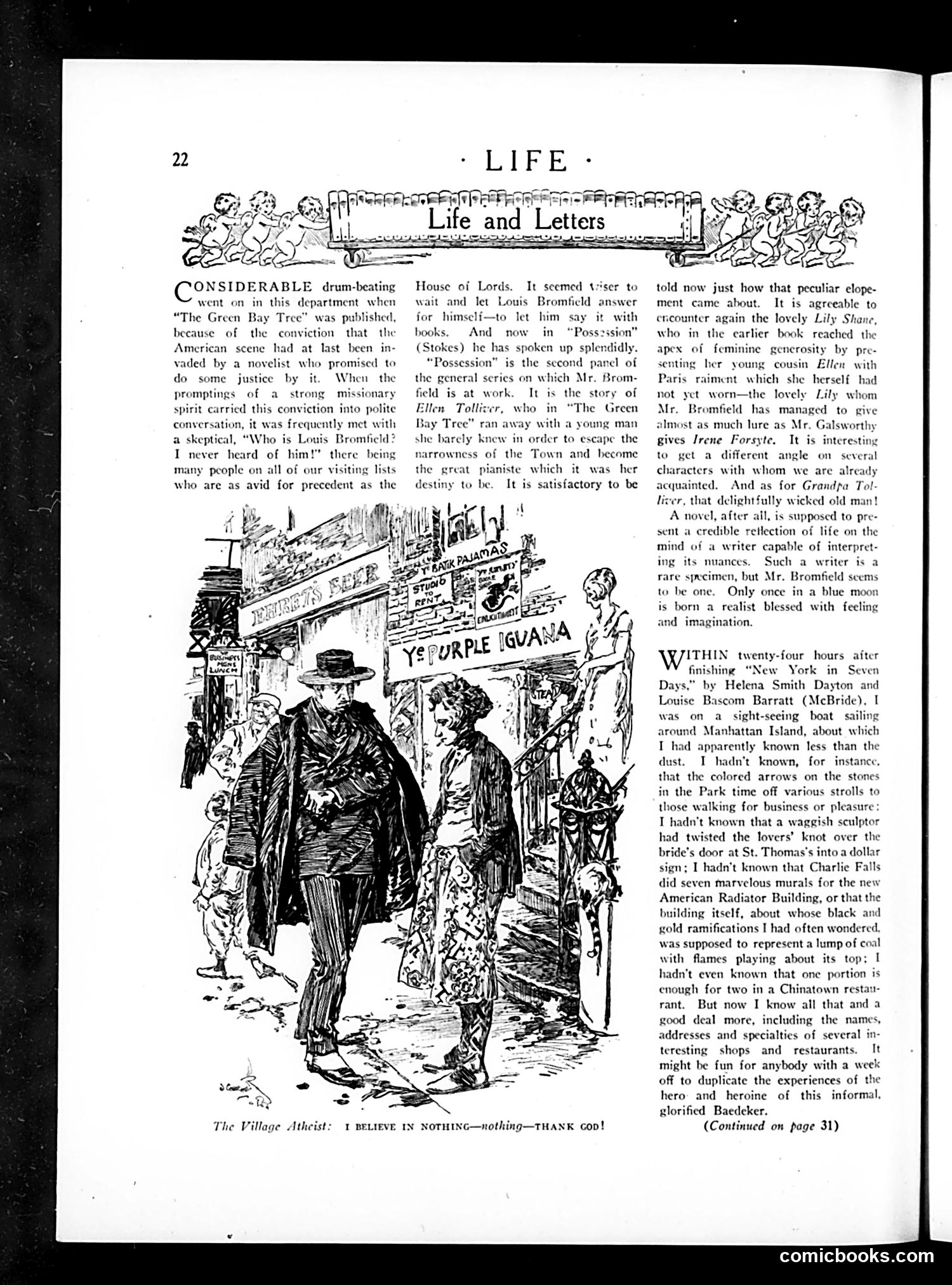
This page reviews recent novels by Louis Bromfield and others. The main illustration, captioned "The Village Atheist," depicts a street scene with figures discussing religion or belief—one character declares "I BELIEVE IN NOTHING—nothing—THANK GOD!" The satire mocks the self-contradiction of atheistic declarations made with religious fervor. The text discusses Bromfield's novel "Possession," the second book in a series following "The Green Bay Tree," praising his realistic portrayal of characters like the "lovely Lily Shane." It notes Bromfield was initially unknown to New York's social circles despite critical acclaim. A second review covers "New York in Seven Days" by Dayton and Barratt, a guidebook praising the authors for revealing Manhattan's hidden details—colored park arrows, architectural quirks, and obscure restaurants. The reviewer humorously describes becoming a tourist after reading it, suggesting the guide successfully captures New York's overlooked charms for visitors or residents.
📄 Transcribed text from this page (OCR, searchable)
Machine-transcribed from the original scan — historical spelling and the odd misread are preserved.
ONSIDERABLE drum-beating went on in this department when “The Green Bay Tree” was published, because of the conviction that the American scene had at last been in- vaded by a novelist who promised to do justice When the promptings of a missionary spirit carried this conviction into polite some by it strong conversation, it was frequently met with a skeptical, “Who is Louis Bromfield? I never heard of him!" there many people on all of our visiting lists who are as avid for precedent as the being The Village Atheist: Al House of Lords. It seemed tiser to wait and let Louis Bromfield answer for himself—to let him say it with books. And now in ion” (Stokes) he has spoken up splendidly. “Possession” is the second panel of the general series on which Mr. Brom- field is at work. It is the story of Ellen Toll who in “The Green Bay Tree” ran away with a young man she barely knew in order to escape the narrowness of the Town and become the great pianiste which it was her It is satisfactory to be “Poss? wer, destiny to be. ae A. I BELIEVE IN NOTHING—nothing—THANK cop! told now just how that peculiar clope- ment came about. It is agreeable to encounter again the lovely Lily Shane, who in the earlier book reached the apex of feminine generosity by pre- ing her young cousin Ellen with Paris raiment which she herself had not yet worn—the lovely Lily whom Mr. Bromfield has managed to give almost as much lure as Mr. Galsworthy gives Irene Forsyte. It is interesting to get a different angle on several characters with whom we are already acquainted. And as for Grandpa 5 liver, that delightfully wicked old man! A novel, after all, is supposed to pre- sent a credible reflection of life on the mind of a writer capable of interpret- ing its nuances. Such a writer is a rare specimen, but Mr. Bromfield seems to be one. Only once in a blue moon is born a realist blessed with feeling and_ imagination. ITHIN twenty-four hours after finishing “New York in Seven Days,” by Helena Smith Dayton and Louise Bascom Barratt (McBride), I was on a_ sight-seeing boat. sailing around Manhattan Island, about which I had apparently known less than the dust. I hadn't known, for instance, that the colored arrows on the stones in the Park time off various strolls to those walking for business or pleasure: I hadn't known that a waggish sculptor had twisted the lovers’ knot over the bride's door at St. Thomas's into a dollar sign; I hadn't known that Charlie Falls did seven marvelous murals for the new American Radiator Building, or that the building itself, about whose black and gold ramifications I had often wondered, was supposed to represent a lump of coal with flames playing about its top; I hadn't even known that one portion is enough for two in a Chinatown restau- rant. But now I know all that and a good deal more, including the names, addresses and specialties of several in- teresting shops and restaurants. It might be fun for anybody with a week off to duplicate the experiences of the hero and heroine of this informal, glorified Baedeker. (Continued on page 31) comicbooks.com