
A complete issue · 36 pages · 1923
Life — March 15, 1923
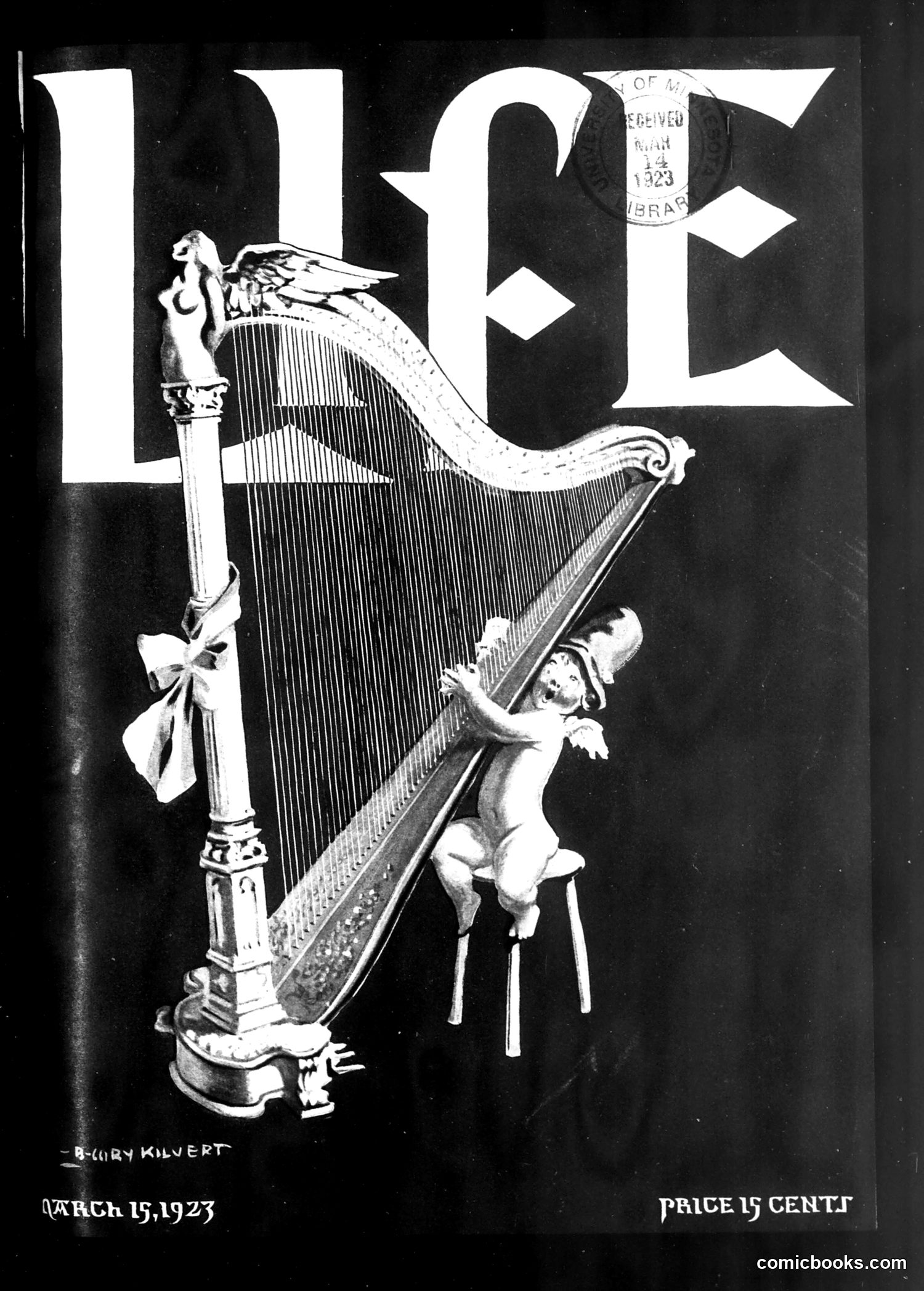
This is a Life magazine cover featuring an ornate harp with a peacock finial (top) and a cherub figure playing it. The large "LIFE" text dominates the composition. The imagery appears to be purely decorative rather than overtly political—a classical artistic design emphasizing elegance and refinement. The harp was traditionally associated with music, the arts, and classical culture. The peacock suggests aestheticism and beauty. Without additional contextual text on this page, the specific satirical point remains unclear. It may reference contemporary artistic trends, cultural pretensions, or entertainment topics of 1923, but the cover itself reads primarily as an aesthetic design rather than pointed social commentary. The artist is credited as "B. Cory Kilvert."
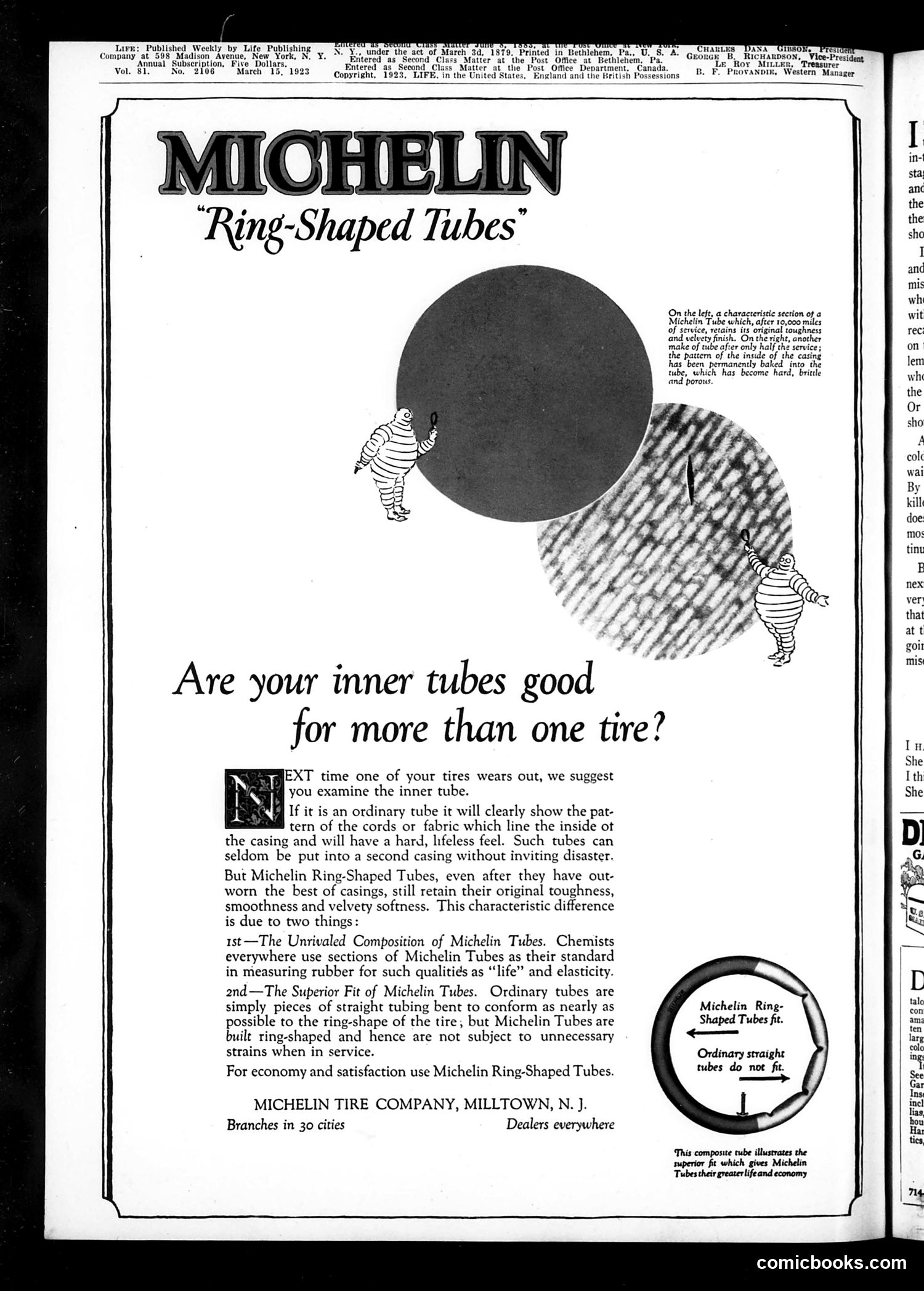
This page is **not satire or political commentary**—it's a straightforward product advertisement for Michelin Ring-Shaped Tubes, published in *Life* magazine around 1923. The ad features two cartoon figures (appearing to be Michelin's mascot, Bibendum, the rotund "Michelin Man") demonstrating the superiority of Michelin's ring-shaped inner tubes over competitors' straight tubes. The visual metaphor shows how ring-shaped tubes conform better to tire geometry, maintaining elasticity and durability longer than ordinary tubes. The text emphasizes two technical advantages: the "Unrivaled Composition" and "Superior Fit" of Michelin tubes. A circular diagram compares the ring-shaped versus straight tube design. This is commercial advertising integrated into the magazine's editorial space, typical of early 20th-century publication practices.
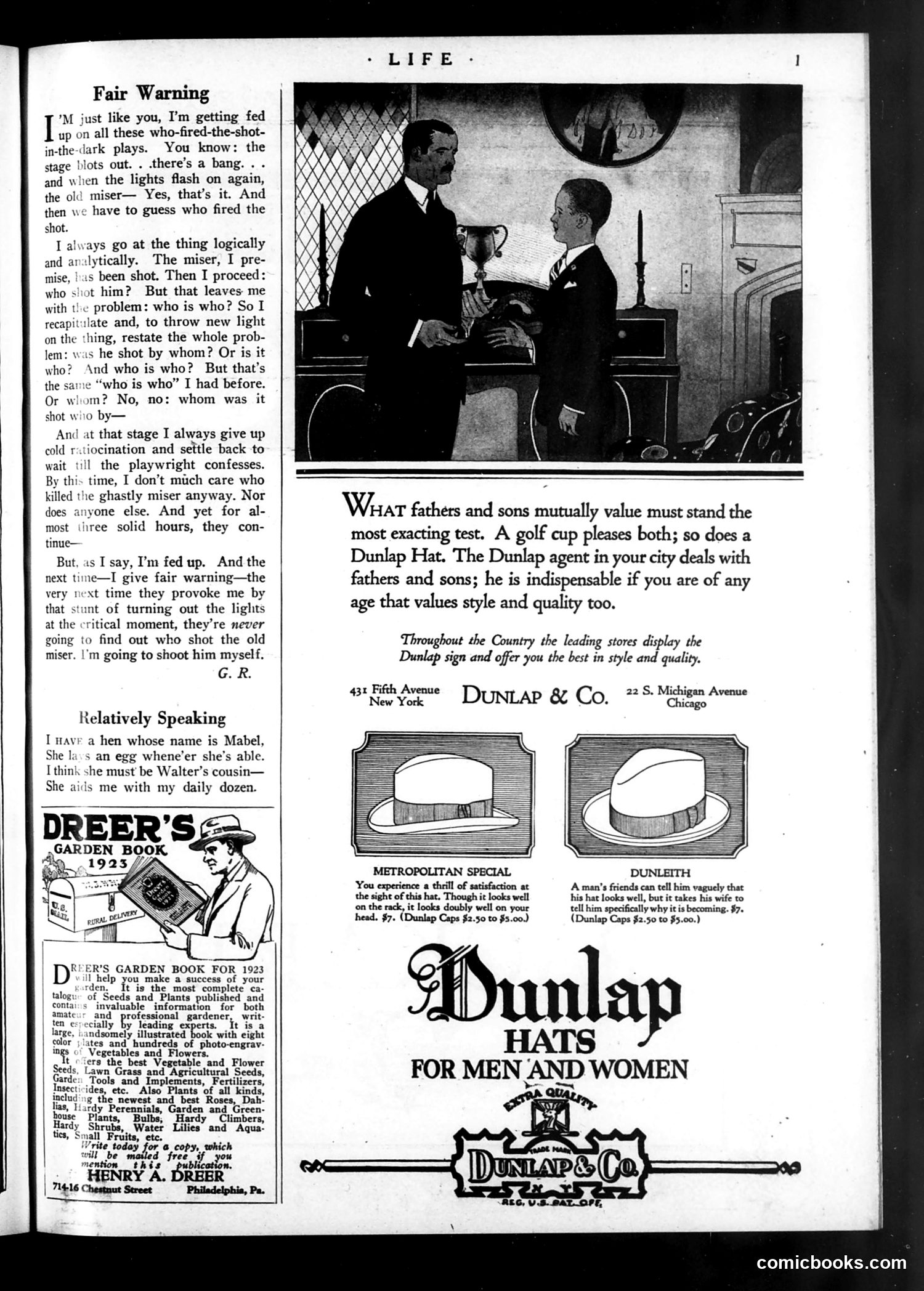
This page is primarily **advertising**, not editorial content. The main visual shows two men exchanging a golf trophy, accompanying a **Dunlap & Co. hat advertisement** emphasizing that quality hats appeal to both fathers and sons. The upper left contains a brief satirical piece titled "Fair Warning" criticizing mystery plays where audiences must guess the murderer. The author complains these plots are illogical and promises to shoot the actual perpetrator himself next time rather than endure such confusing theater. Below that, "Relatively Speaking" is a humorous anecdote about a hen named Mabel who lays eggs regularly. The page also advertises **Dreer's Garden Book for 1923** and displays two Dunlap hat styles (Metropolitan Special and Dunleith) with product descriptions.
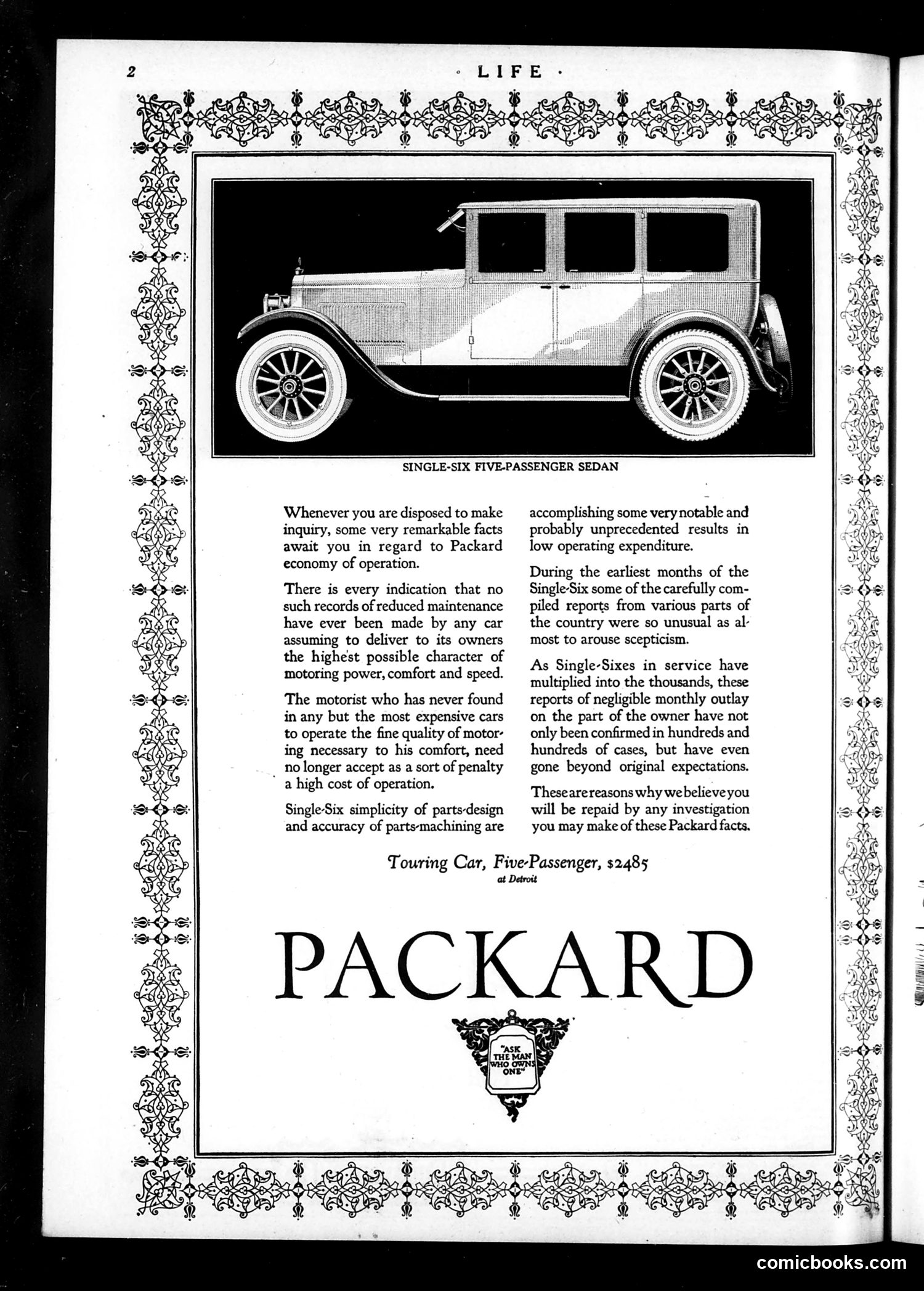
This page is **not a cartoon or satire—it's a straightforward automobile advertisement** from *Life* magazine for a Packard Single-Six automobile. The image shows a side profile illustration of a 1920s sedan. The accompanying text makes factual claims about the vehicle's reliability and low operating costs, arguing that Packard owners report minimal maintenance expenses and that the car delivers "motorizing power, comfort and speed." The ad emphasizes the car's engineering simplicity and mechanical durability as selling points. The price listed is $2,485 for the five-passenger touring model. This represents typical early-20th-century automotive advertising that positioned luxury vehicles by highlighting practical economic benefits rather than luxury or status appeal.
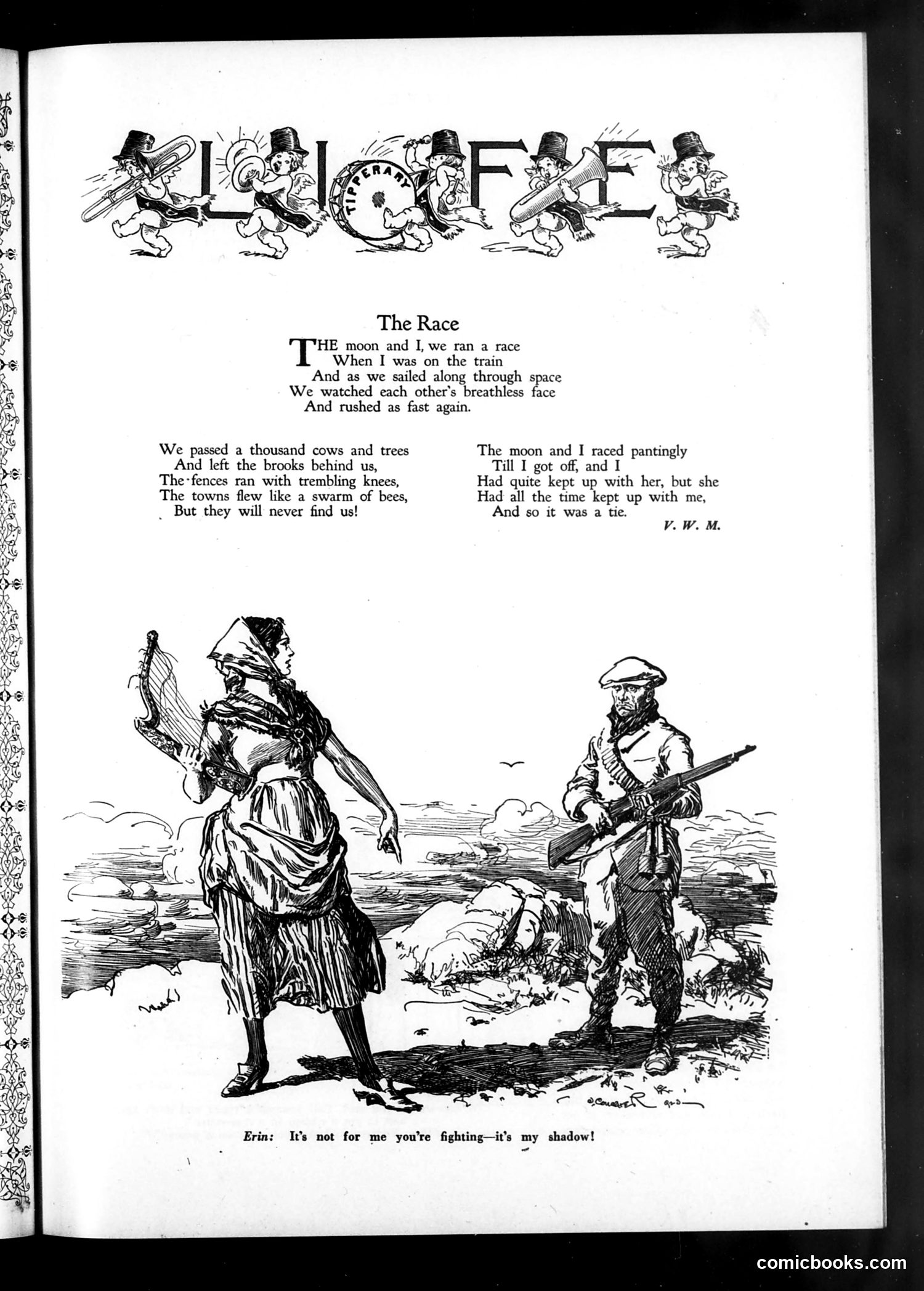
**"The Race" (poem by P.W.M.):** A whimsical piece imagining the narrator racing the moon while on a train, with both competitors evenly matched despite passing cows, trees, and towns. The tie ending is lighthearted fantasy. **"Erin" cartoon (bottom):** Shows a woman holding a torch facing a soldier with a rifle. The caption reads: "It's not for me you're fighting—it's my shadow!" This likely references **Irish independence struggles**, with Erin (personification of Ireland) suggesting that the soldier fights not for Ireland herself but for her "shadow"—perhaps British imperialism, colonial authority, or abstract political forces rather than genuine Irish interests. The satire critiques the disconnect between stated military purposes and actual power dynamics.
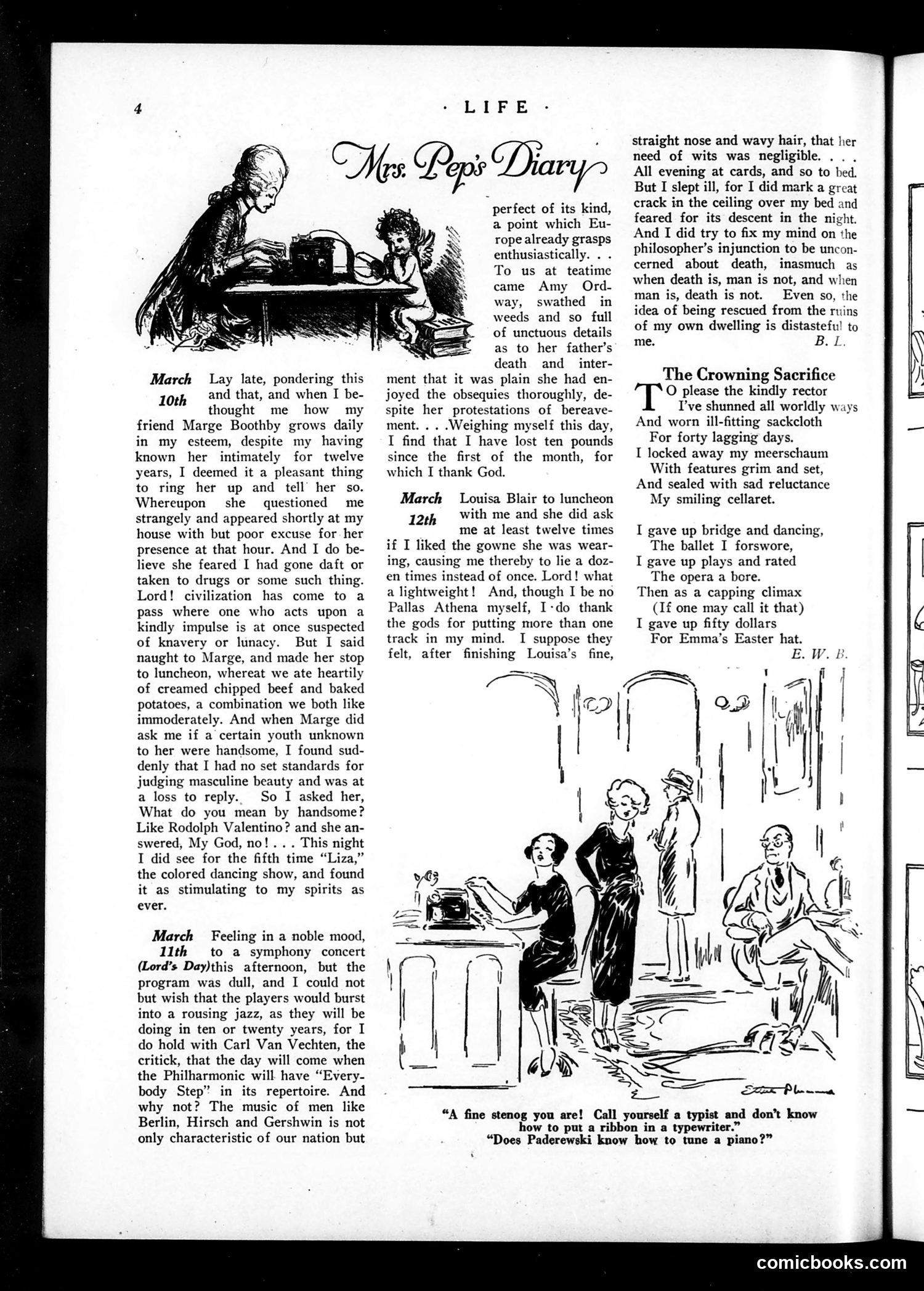
This page contains a personal diary column rather than political cartoons. The main illustration shows a humorous domestic scene of a woman at a typewriter being critiqued by onlookers. The caption's joke targets early-twentieth-century pretension: someone calling themselves a "typist" while lacking basic skills (not knowing how to thread a ribbon or tune a piano). This mocks social climbing—adopting professional titles without actual competence. The diary entries reference mundane upper-middle-class activities: visiting friends, attending concerts and dancing shows, shopping. References to "Rodolph Valentino" (the famous silent-film star) indicate this is 1920s-era content. The satire gently ridicules the superficiality and leisure-focused concerns of affluent women of the period, particularly their obsession with fashionable appearances and entertainment.
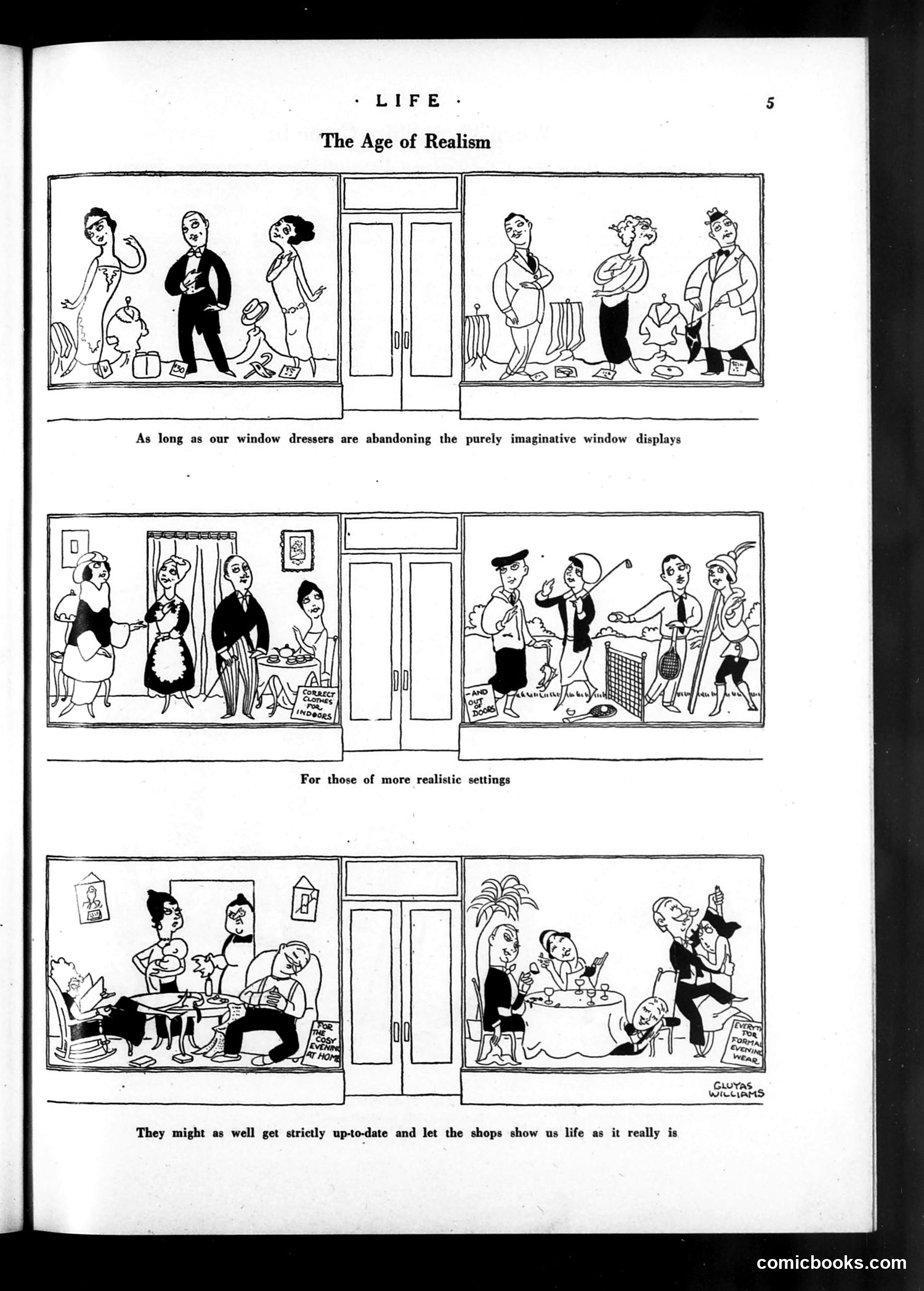
This three-panel cartoon by Gluyas Williams critiques retail window displays of the era. The title "The Age of Realism" suggests department stores should abandon purely fantastical or imaginative window displays. **Panel 1** shows unrealistic, whimsical scenes with exaggerated figures. **Panel 2** depicts "more realistic settings"—domestic and recreational scenes (cooking, sports, entertaining). **Panel 3** shows contemporary social life: women socializing indoors, a formal dinner party, people mingling at what appears to be an upscale event. The final caption proposes stores should display "life as it really is"—suggesting that retail windows should reflect authentic contemporary life rather than fantasy. This satirizes both consumer culture aspirations and the tension between escapism and realism in 1920s-30s merchandising.
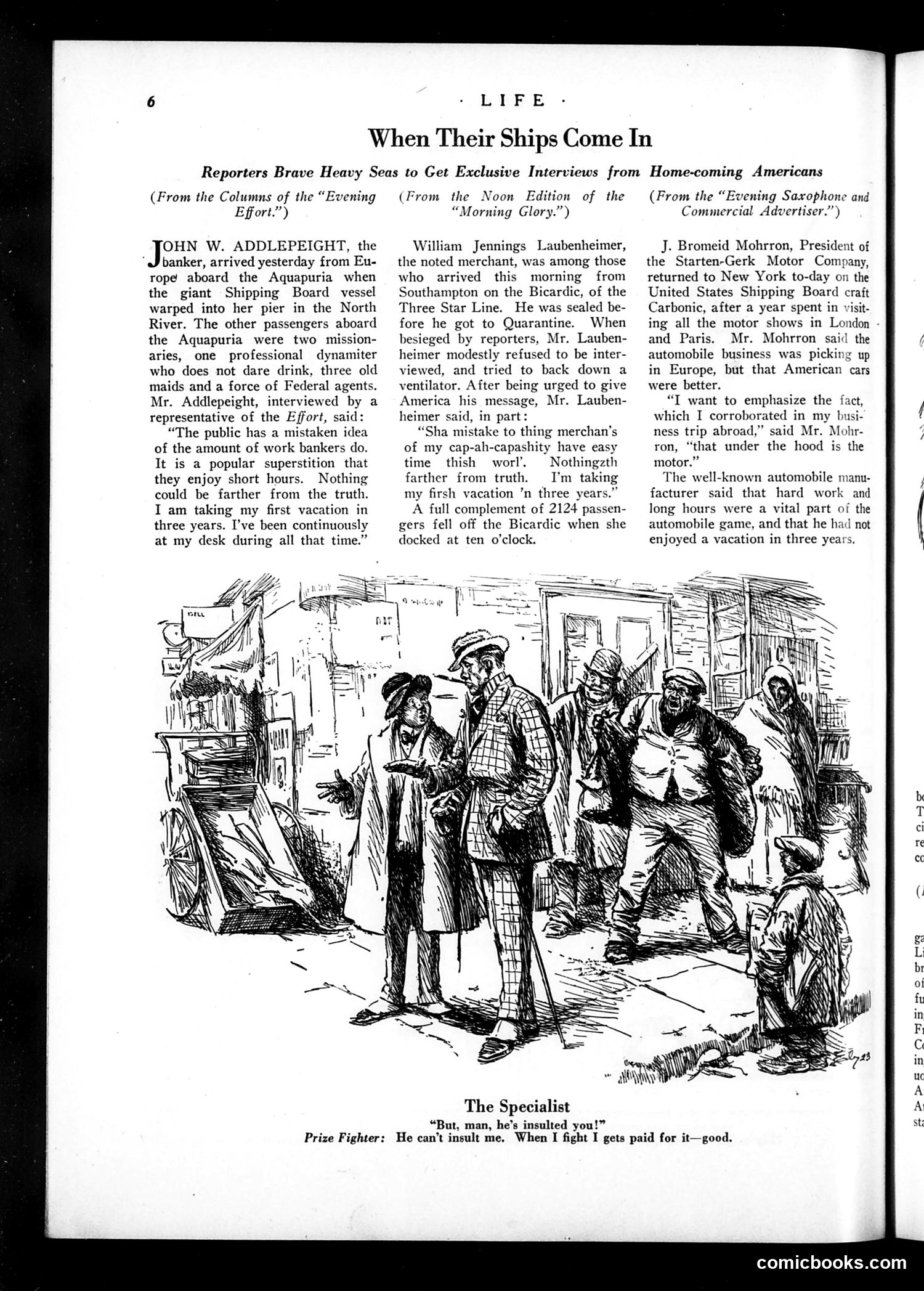
This page features three separate articles about wealthy Americans returning from European voyages, accompanied by a cartoon titled "The Specialist." The main article discusses journalist interviews with homecoming passengers, including banker John W. Addlepleight from the Aquapuria and merchant William Jennings Laubenheimer from the Bicardie. Both men discuss taking rare vacations. **The cartoon** depicts a prize fighter claiming he was insulted and demanding payment before fighting. The caption reads: "But man, he's insulted you! He can't insult me. When I fight I gets paid for it—good." The satire mocks a pugilistic mercenary attitude—a boxer so focused on compensation that honor itself becomes negotiable. It's social commentary on working-class pragmatism versus genteel notions of pride.
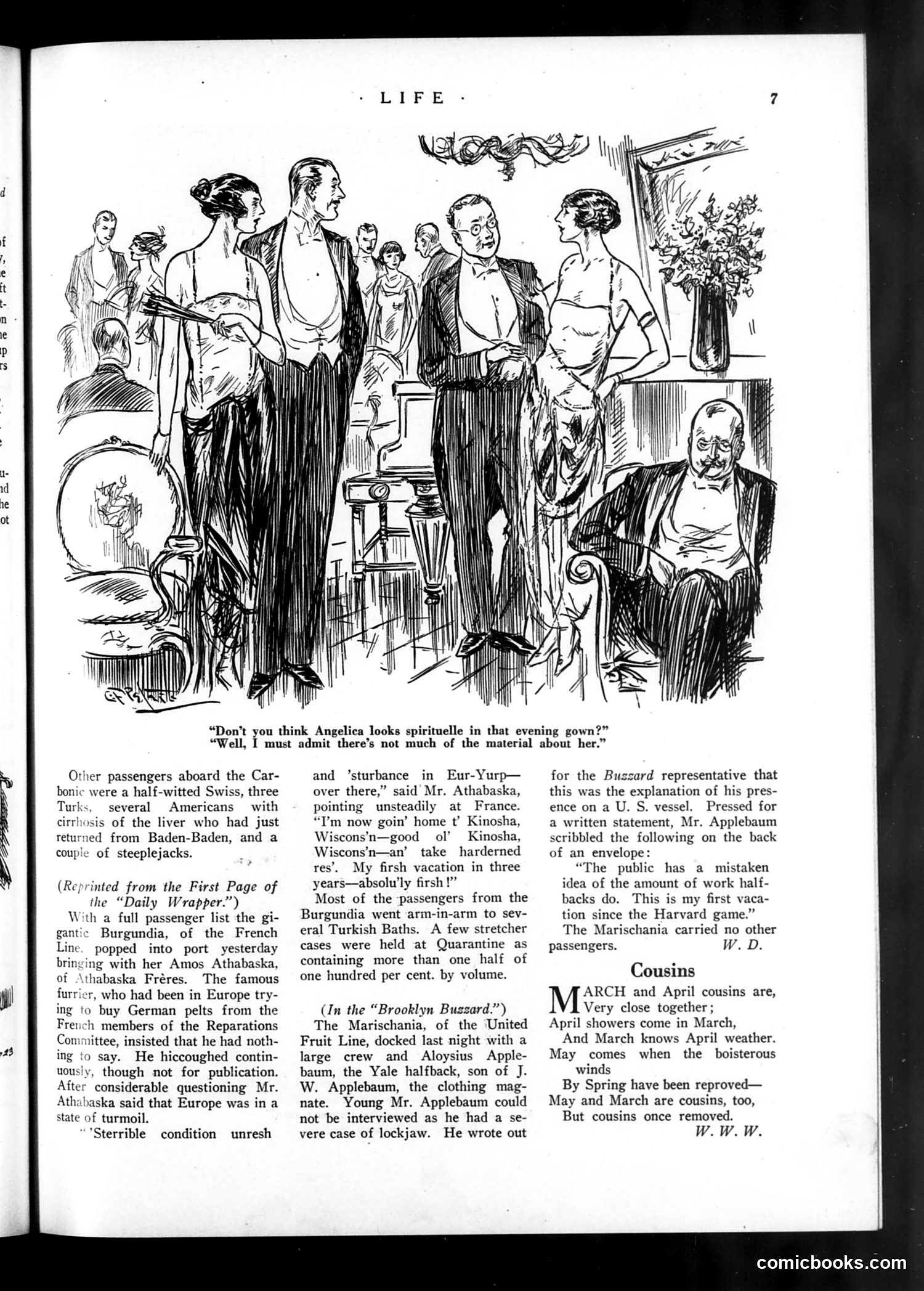
This page from *Life* magazine features a satirical drawing of an elegant evening social gathering. The cartoon caption reads: "Don't you think Angelica looks spirituelle in that evening gown?" with the response "Well, I must admit there's not much of the material about her." The humor targets upper-class vanity and pretension—specifically mocking a woman's fashionable but extremely thin appearance. "Spirituelle" (spiritual/ethereal) is juxtaposed with "material" (physical substance), suggesting the woman is so thin she appears almost ghostlike. The page also discusses European travel and steamship passengers, including references to Swiss nationals and Turkish baths. The satire reflects early 20th-century American attitudes toward European sophistication and leisure culture.
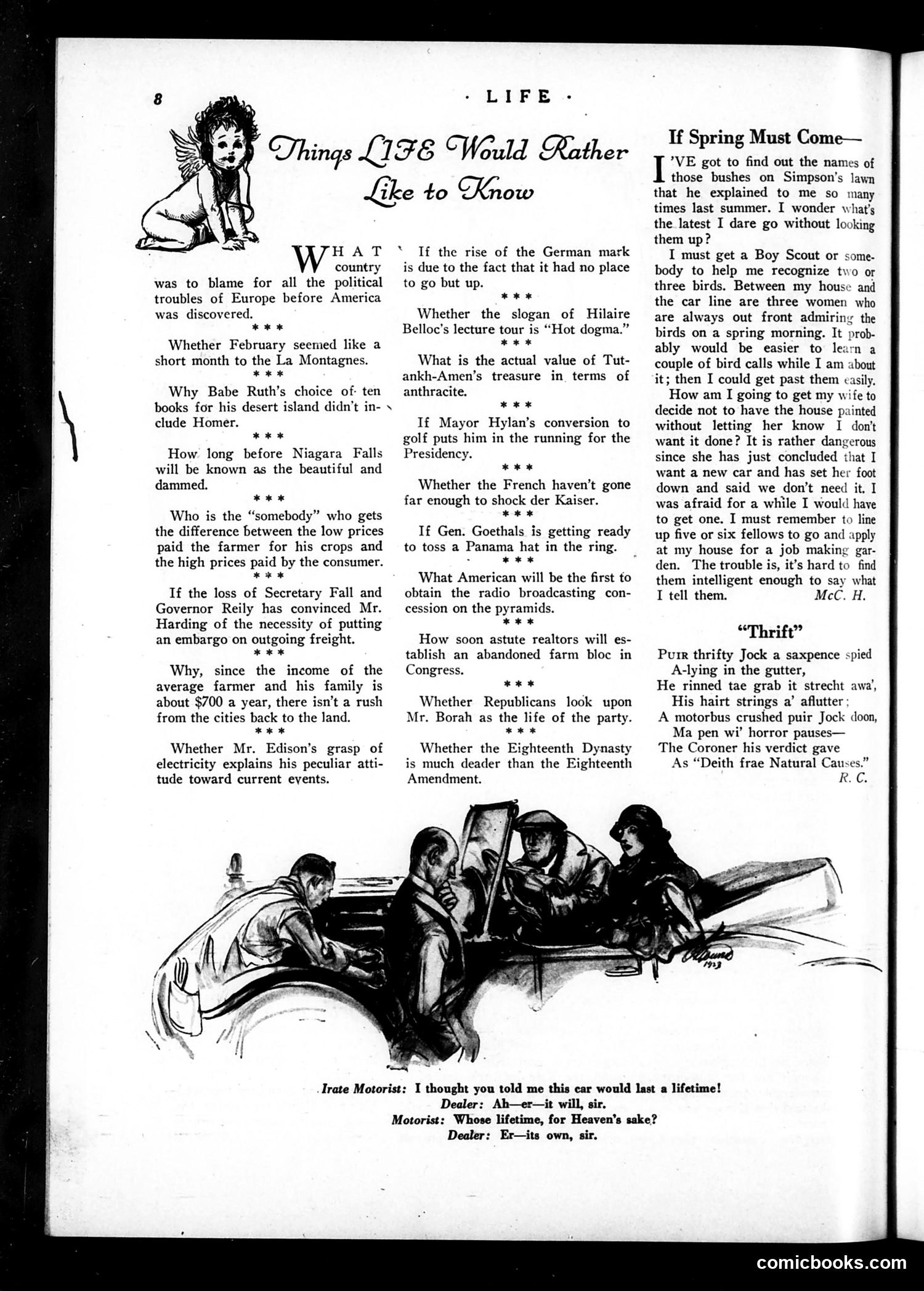
This page presents satirical questions about early 1920s politics and society. The left column lists rhetorical queries mocking contemporary figures and events—including references to Babe Ruth's reading habits, Niagara Falls, Secretary Fall (likely Albert Fall of Teapot Dome scandal notoriety), Edison's theories, and political figures like Mayor Hylan and Mr. Borah. The bottom cartoon depicts a car dealer and motorist in a transaction. The motorist asks the dealer about the car's lifetime; the dealer claims it will last "a lifetime," but when pressed whose lifetime, admits "its own, sir"—a joke about the vehicle's unreliability or short functional lifespan. The "Thrift" poem (right) humorously describes a poor man's misfortune using colloquial dialect, ending with a Coroner's verdict of natural causes.
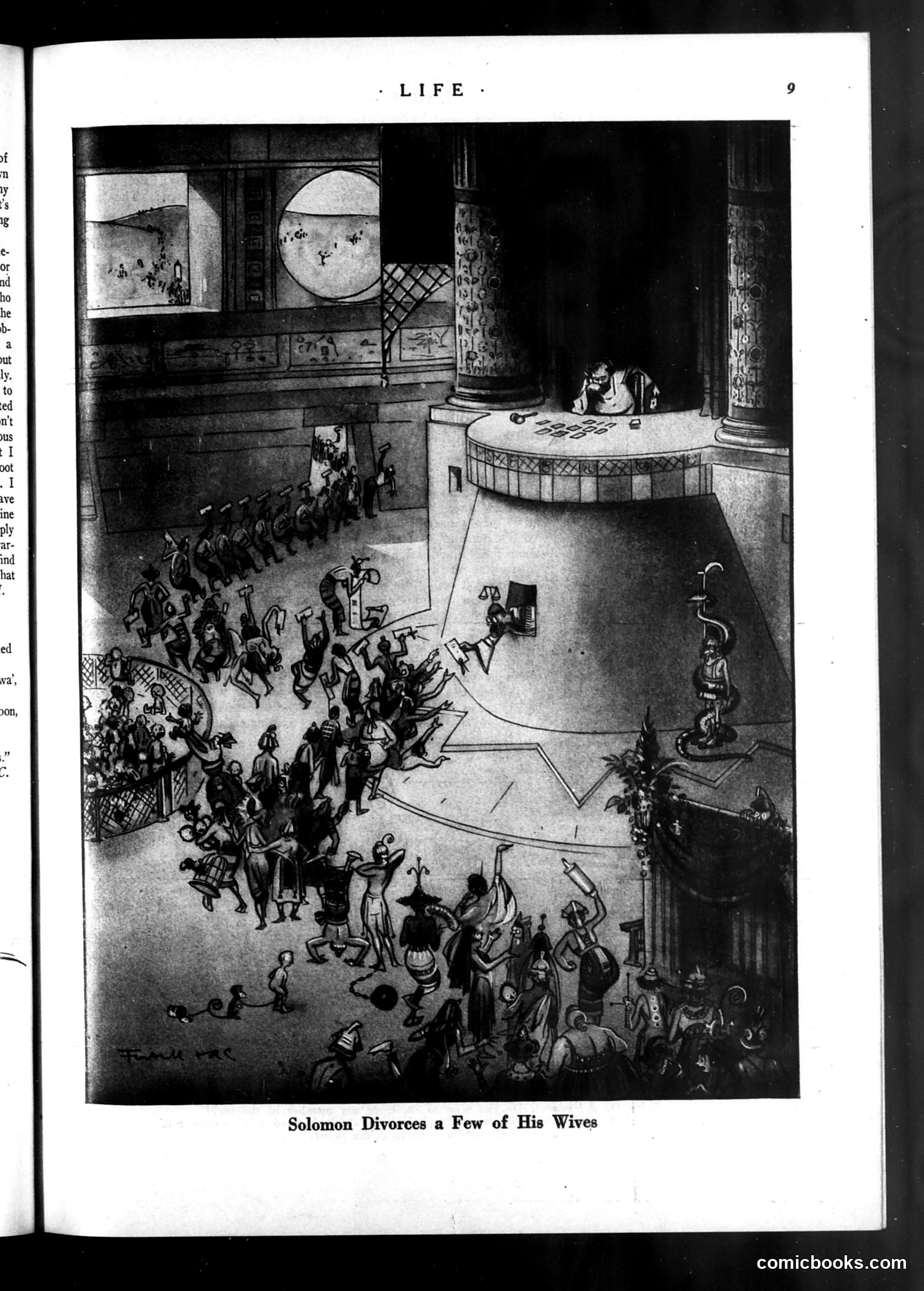
This satirical illustration depicts the biblical King Solomon, famous for his numerous wives, conducting mass divorces in his palace. The image shows Solomon seated in judgment on an elevated platform while crowds of women and attendants gather below, apparently waiting to be divorced. The satire likely mocks either: - Solomon's legendary polygamy (he reportedly had hundreds of wives) - Contemporary divorce proceedings and their chaotic nature - Social commentary on marital instability The architectural setting evokes an ancient palace with ornamental details. The crowded, somewhat chaotic scene below emphasizes the sheer volume of divorces occurring, turning a biblical narrative into a commentary on modern social customs. The humor derives from the absurdity of applying modern divorce practices to a historical/religious figure.
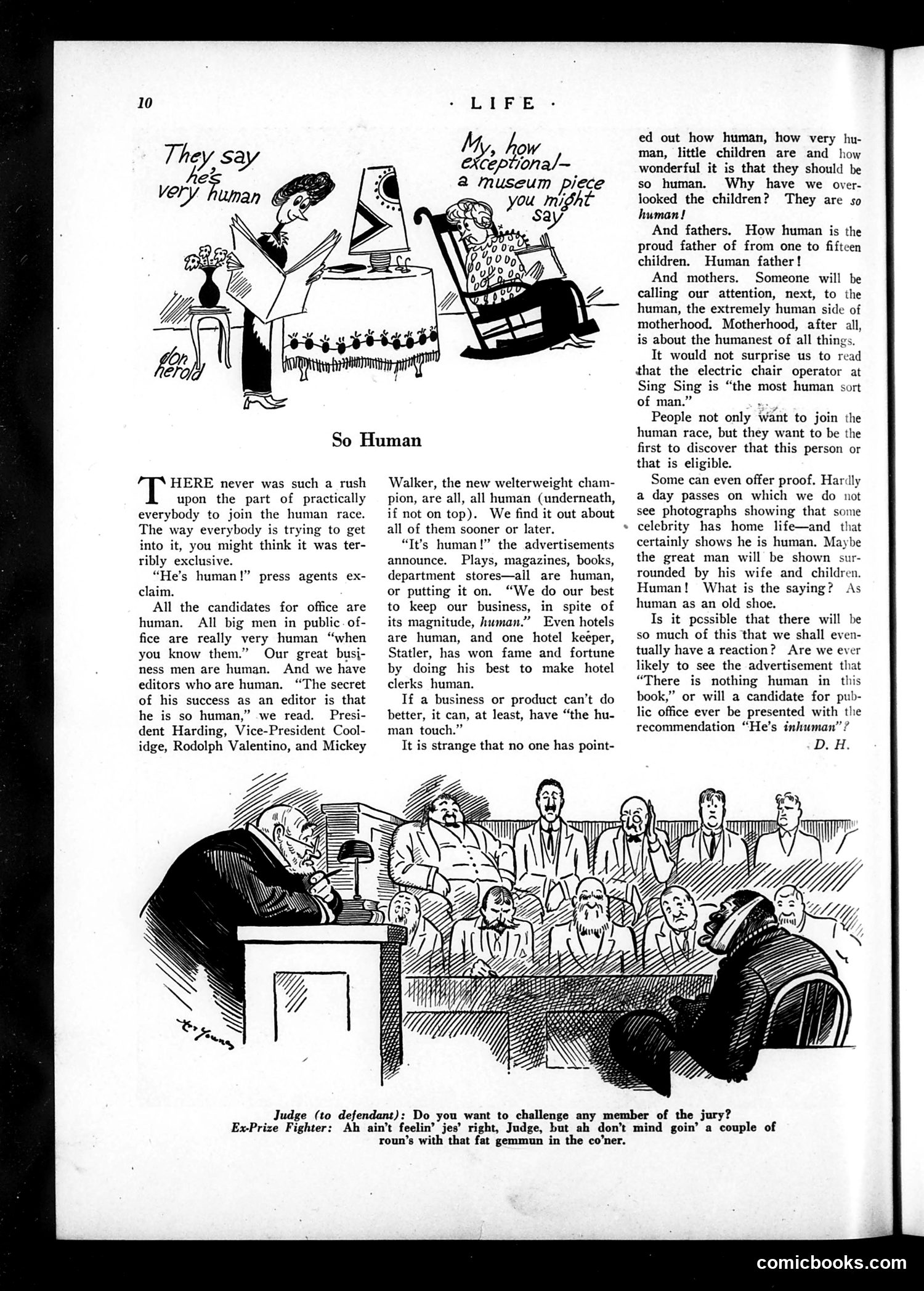
This satirical article mocks the obsession with proving one's humanity and credentials. The text argues that in early 20th-century America, everyone claims to be "human"—from politicians to businessmen to hotel clerks—using it as a marketing tool. The article suggests absurdly that even an electric chair operator might claim to be "the most human sort of man." The cartoon at bottom depicts a courtroom scene where an ex-prize fighter (boxer) is being jury-challenged. He dismissively tells the judge he doesn't mind fighting "a couple rounds" with "that fat gemmun in the co'ner," suggesting crude physicality as proof of his humanity. The overall satire critiques how meaningless the word "human" has become as a commercial and social claim.
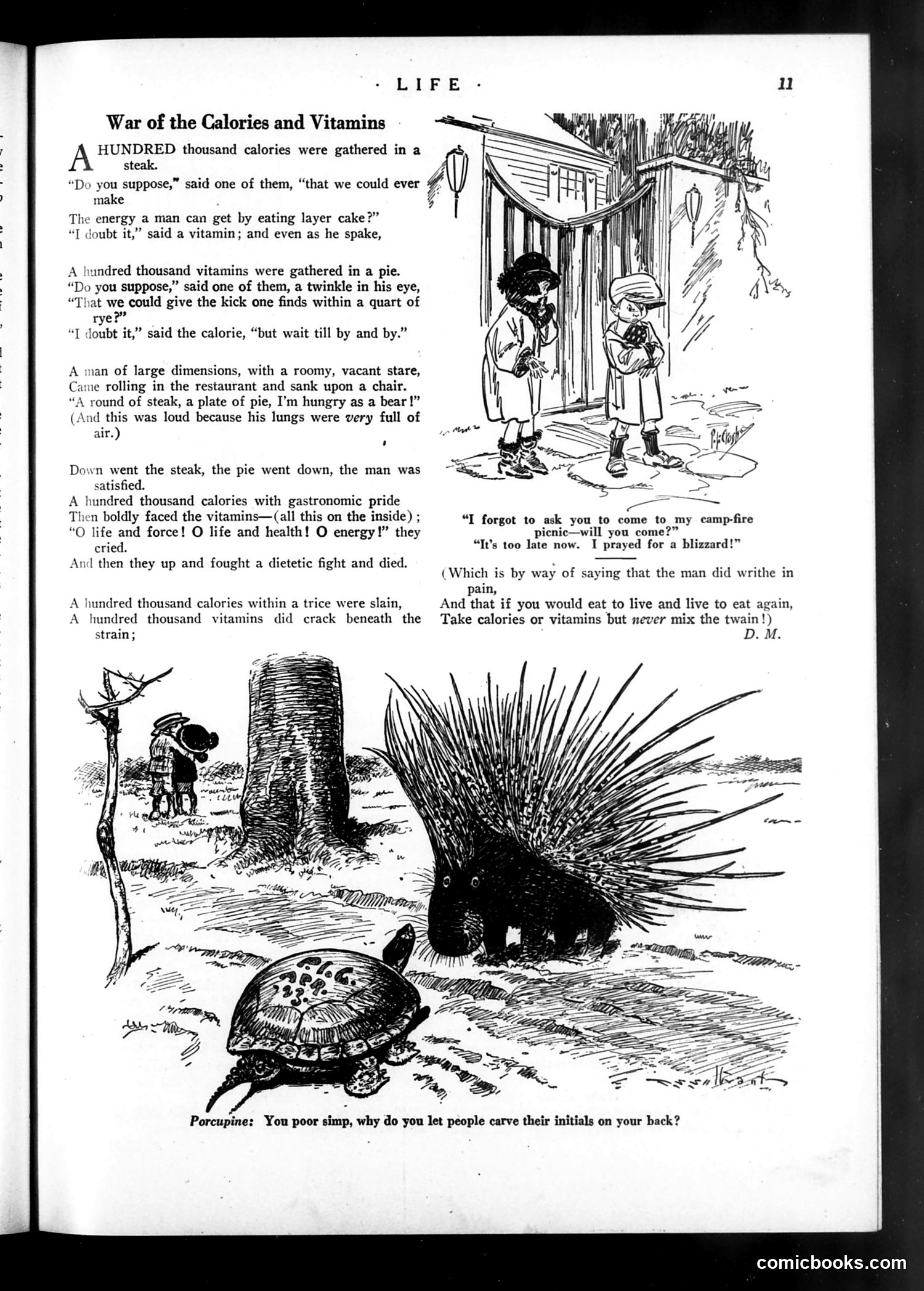
This satirical piece mocks the early 20th-century health fad of calorie and vitamin counting. The poem depicts personified calories and vitamins as competing entities in an absurd "war," arguing over which provides better nutrition. A large man overeats ("a round of steak, a plate of pie"), then the calories and vitamins "fought a dietetic fight and died"—satirizing the contemporary obsession with nutritional science. The joke targets trendy health debates of the era, when newly-discovered vitamins were revolutionizing nutrition theory. The punchline warns against obsessing over either calories *or* vitamins alone, suggesting people should simply eat sensibly rather than get caught up in pseudo-scientific dietary fads. The animal illustrations below appear decorative rather than integral to the satire.
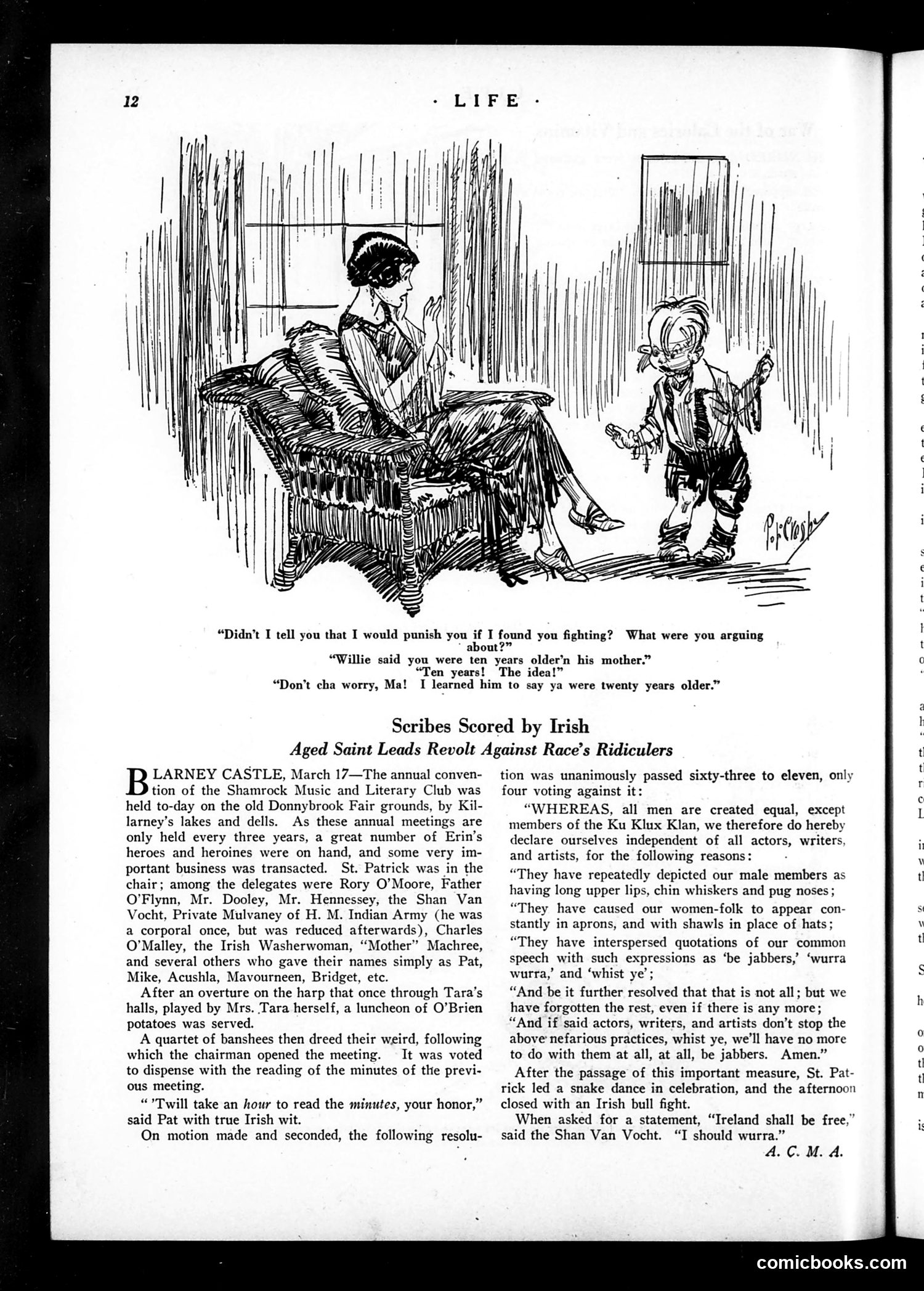
The cartoon depicts a mother seated while a young boy stands before her. The mother threatens to punish the boy for fighting, referencing that "Willie said you were ten years older." The boy responds that he was actually "twenty years older," implying his opponent was a much larger, older child—making his fighting defensible. The satire targets **Irish-American cultural attitudes** toward fighting and masculine honor. The boy's logic—that fighting someone significantly larger makes the act more justifiable rather than less—reflects stereotypical perceptions of Irish culture valuing scrappy toughness and honor over practical judgment. The accompanying article discusses Irish cultural organizations critiquing negative male stereotypes in literature and theater, suggesting this cartoon ironically perpetuates those very stereotypes the organizations protested against.
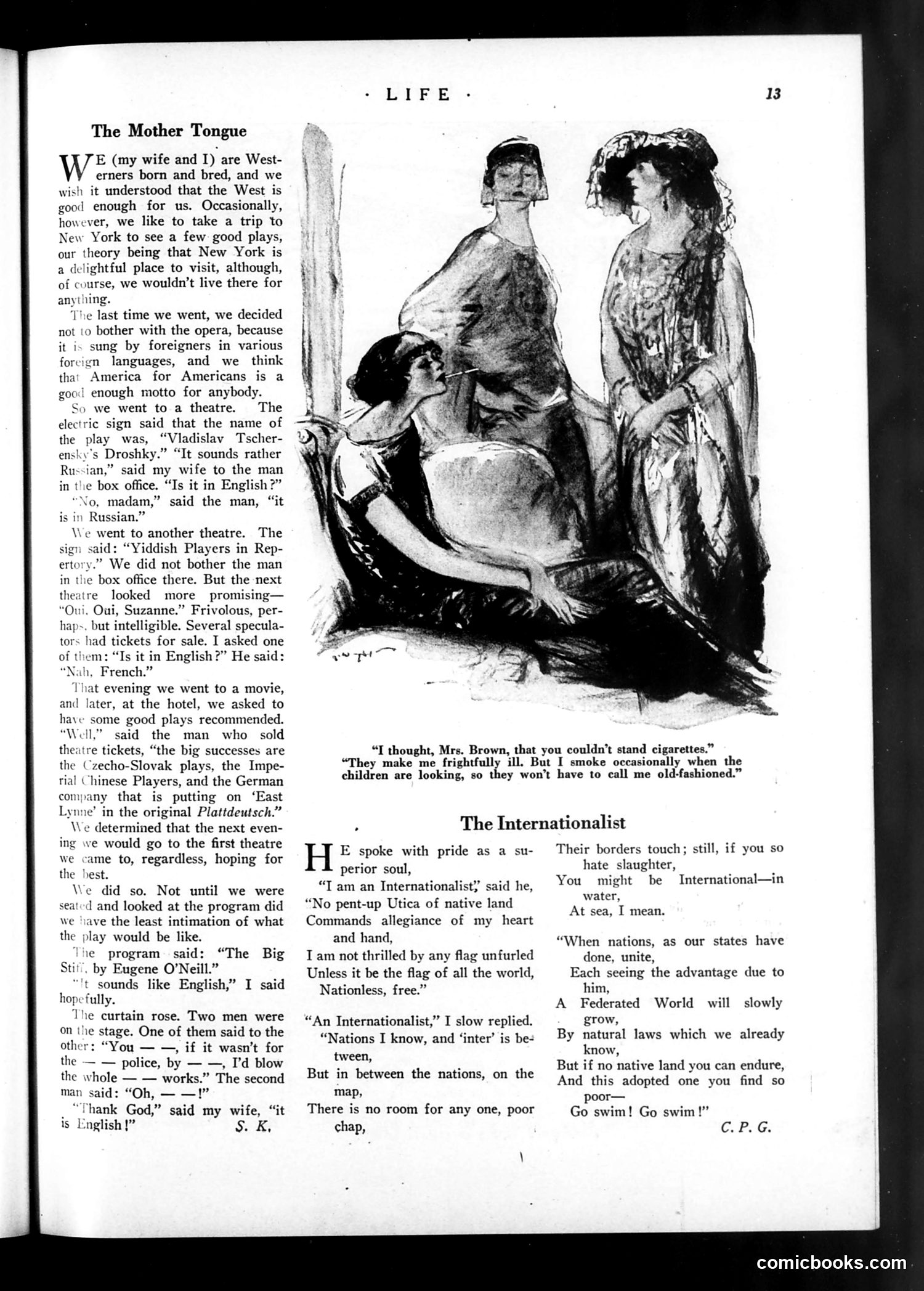
This page contains two satirical pieces: **"The Mother Tongue"** (left) mocks Western theater-goers' dismissive attitudes toward foreign-language productions. The author describes visiting New York theaters showing Russian and Yiddish plays, discovering audiences assume non-English performances are inherently less worthwhile. The humor lies in exposing provincial American attitudes—the assumption that "America for Americans" extends to entertainment language preferences. **The cartoon** depicts a woman smoking while two others look disapprovingly. The caption suggests she smokes secretly "when the children are looking" to maintain respectability—satirizing Victorian-era hypocrisy about women's behavior and social propriety. **"The Internationalist"** (right) is a poem mocking naive cosmopolitanism, suggesting romantic internationalism ignores practical borders and national interests.
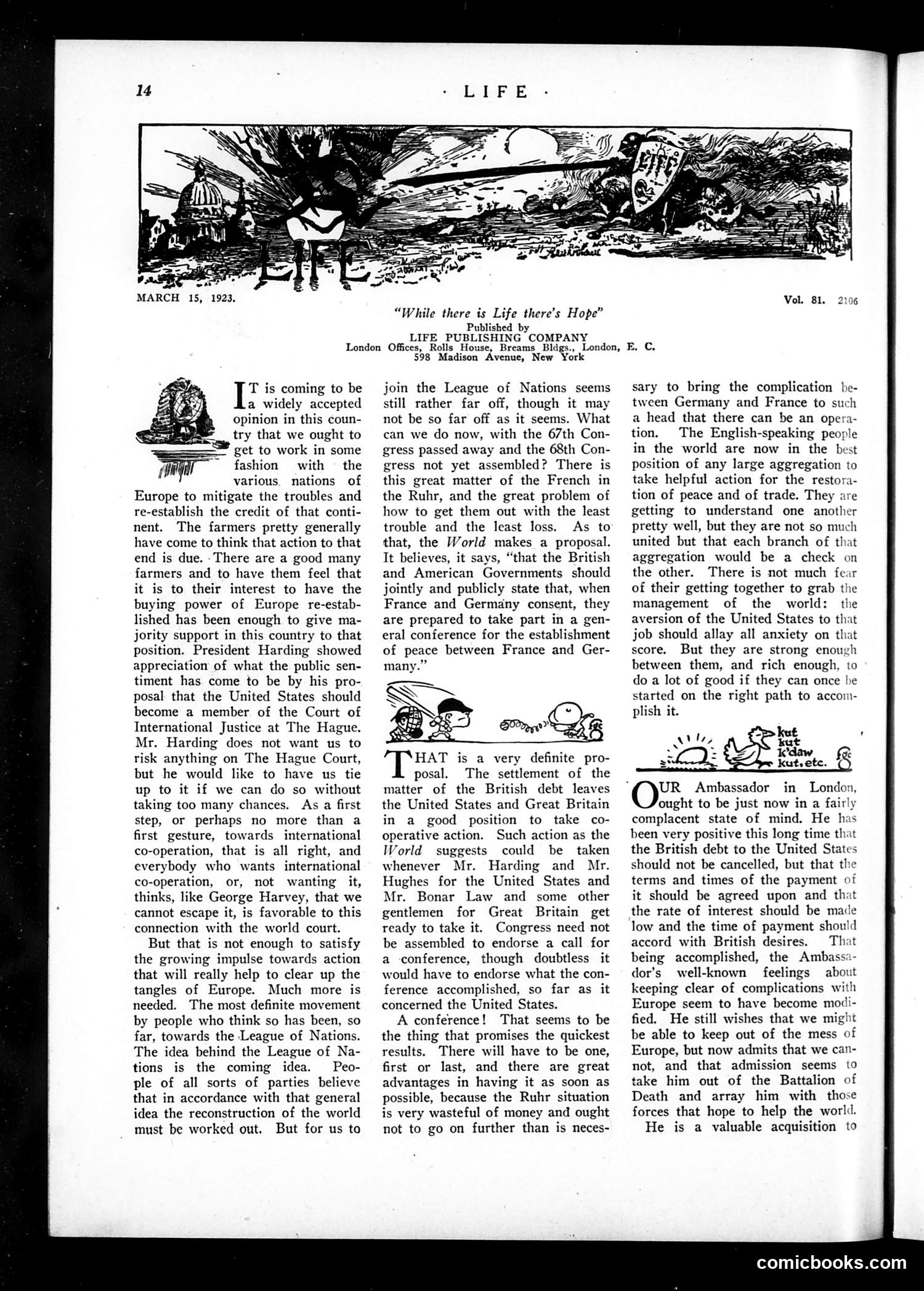
This page discusses post-World War I international relations, focusing on whether the United States should join the League of Nations and participate in settling Franco-German disputes over war debts and reparations. The small cartoons show anthropomorphized figures (appearing to represent nations or political entities) in conversation—likely depicting diplomatic negotiations. The text references President Harding's reluctance to commit to international courts or the League, while advocating for American involvement in resolving European financial entanglements. The article proposes that Britain and America jointly pressure France and Germany toward peaceful settlement, arguing this would benefit American interests and world stability. The satirical point appears to be the tension between American isolationism and the practical necessity of engagement in post-war European reconstruction.
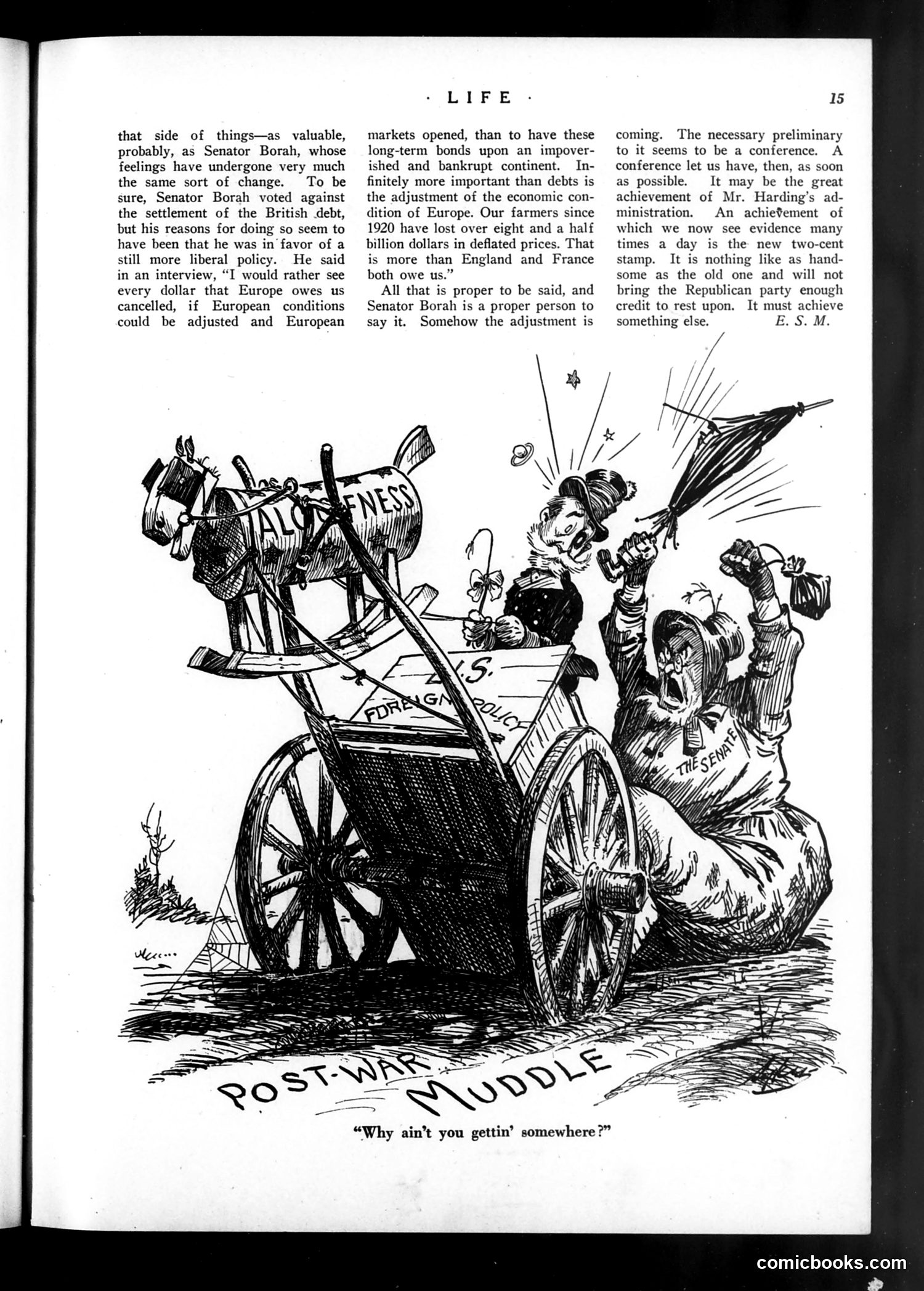
This cartoon satirizes America's struggle with post-WWI economic recovery and foreign debt policy. The image depicts a cart labeled "Foreign Policy" stuck in mud labeled "Post-War Muddle," pulled by a confused horse labeled "Falseness" while figures (likely representing the Harding administration and Congress) struggle ineffectually around it. The accompanying text discusses Senator Borah's position on European war debts—he advocated canceling obligations owed by impoverished European nations rather than imposing long-term bonds, arguing economic reconstruction mattered more than debt collection. American farmers had lost billions since 1920. The cartoon's caption—"Why ain't you gettin' somewhere?"—mocks the administration's inability to resolve these tensions. The satire suggests that despite talk of conferences and policy adjustments, the government remains paralyzed by competing interests, unable to move forward on either debt relief or economic recovery.
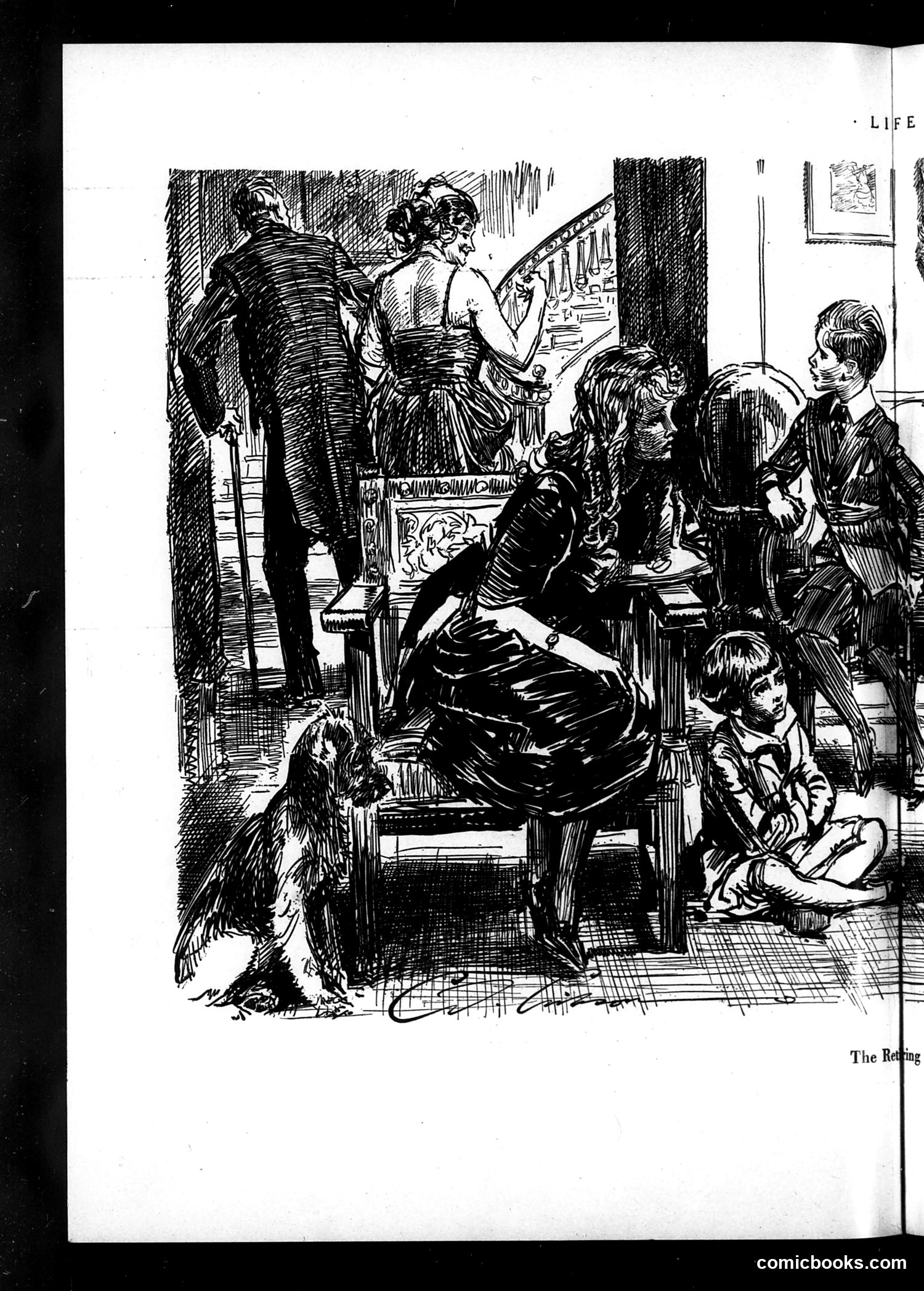
This satirical illustration depicts a domestic scene of social upheaval, likely from the early 20th century. A woman sits prominently in the center, appearing to be a servant or domestic worker who is departing her employer's household—hence "the retiring." The composition shows her surrounded by family members, including children and what appears to be disapproving adults, with a dog present. The sketch emphasizes class tension around domestic labor: the woman's central positioning and composed demeanor contrast with the apparent distress or concern of those around her. The satire likely critiques either the difficulty households faced replacing domestic staff during a labor shortage, or comments on changing social attitudes toward domestic service during this period of industrial and social transformation.
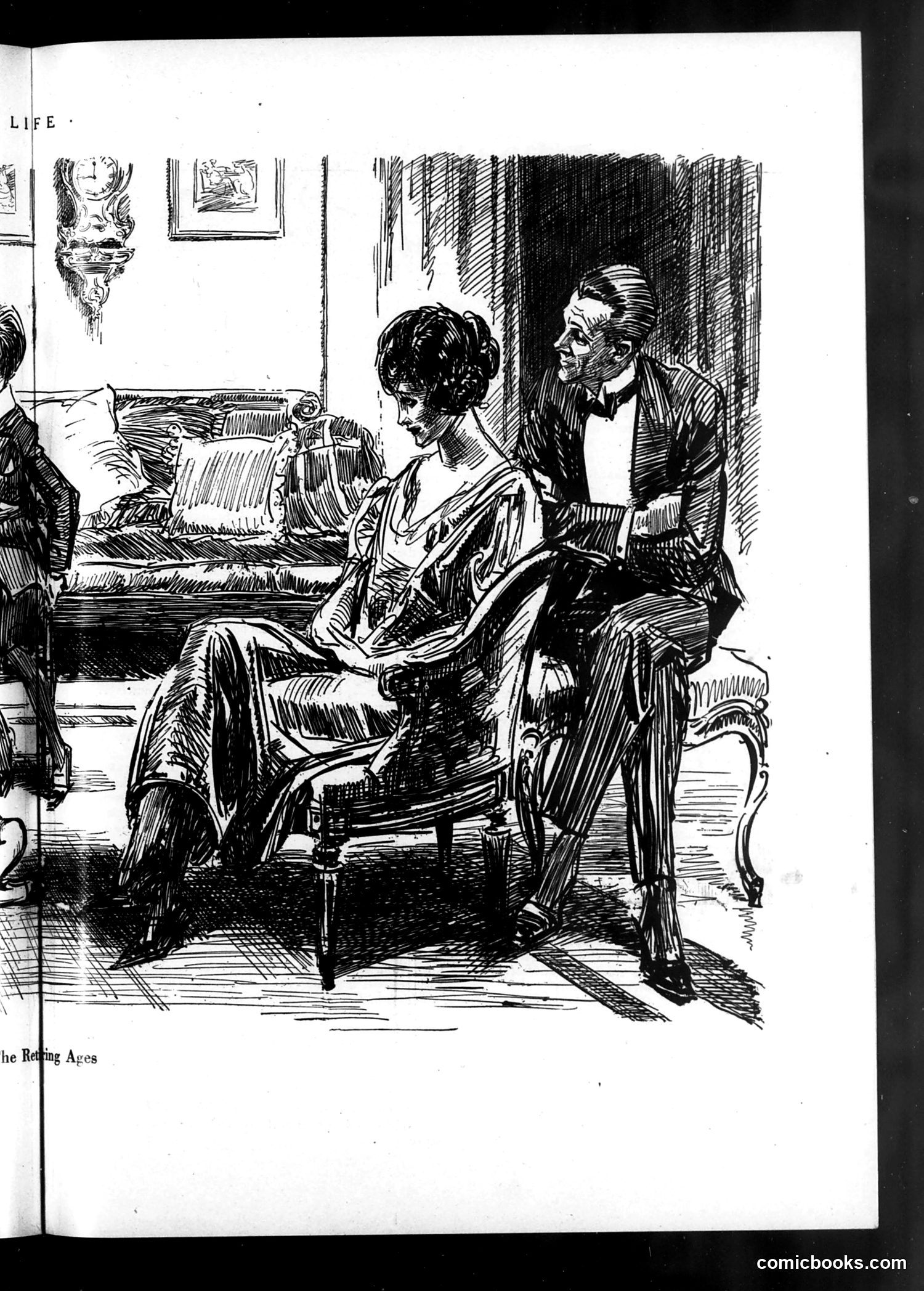
This page from *Life* magazine shows a drawing-room scene with a well-dressed couple conversing in an elegant interior. The woman is seated while a man stands nearby, with a sofa and framed pictures visible in the background. The OCR text provides only a website reference ("comicbooks.com") and partial text reading "he Racing Ages" at the bottom left—likely a caption fragment that's unclear in meaning. Without complete caption or article text visible, I cannot definitively identify the specific figures, historical event, or satirical point being made. The scene appears to depict upper-class social interaction, but the particular social commentary or joke remains uncertain from the image alone. More context—the full caption or accompanying article—would be needed for accurate interpretation.
This Life magazine drama column reviews three contemporary Broadway plays, emphasizing that **good acting can elevate mediocre scripts**. The critic discusses: 1. **"Anything Might Happen"** — A "medium-grade farce" saved by its cast of Roland Young, Estelle Winwood, and Leslie Howard, praised for their skillful comic delivery. 2. **"You and I"** — A Harvard-produced play (referencing Professor Baker's famous playwriting course) featuring H.B. Warner and Lucile Watson. The critic jokes that young playwright Philip Barry's overly clever, slangy dialogue would be unbearable without strong actors to naturalize it through hesitations and stumbling delivery. 3. **"Rita Coventry"** — Praising director Brock Pemberton for casting genuine musician-actors (Dwight Frye) rather than faking it with offstage sound effects. **The satire's point**: Exceptional acting can make weak plays succeed, while poorly-cast excellent scripts fail. The column humorously suggests the author would pray to secure Young and Howard for any play they write.
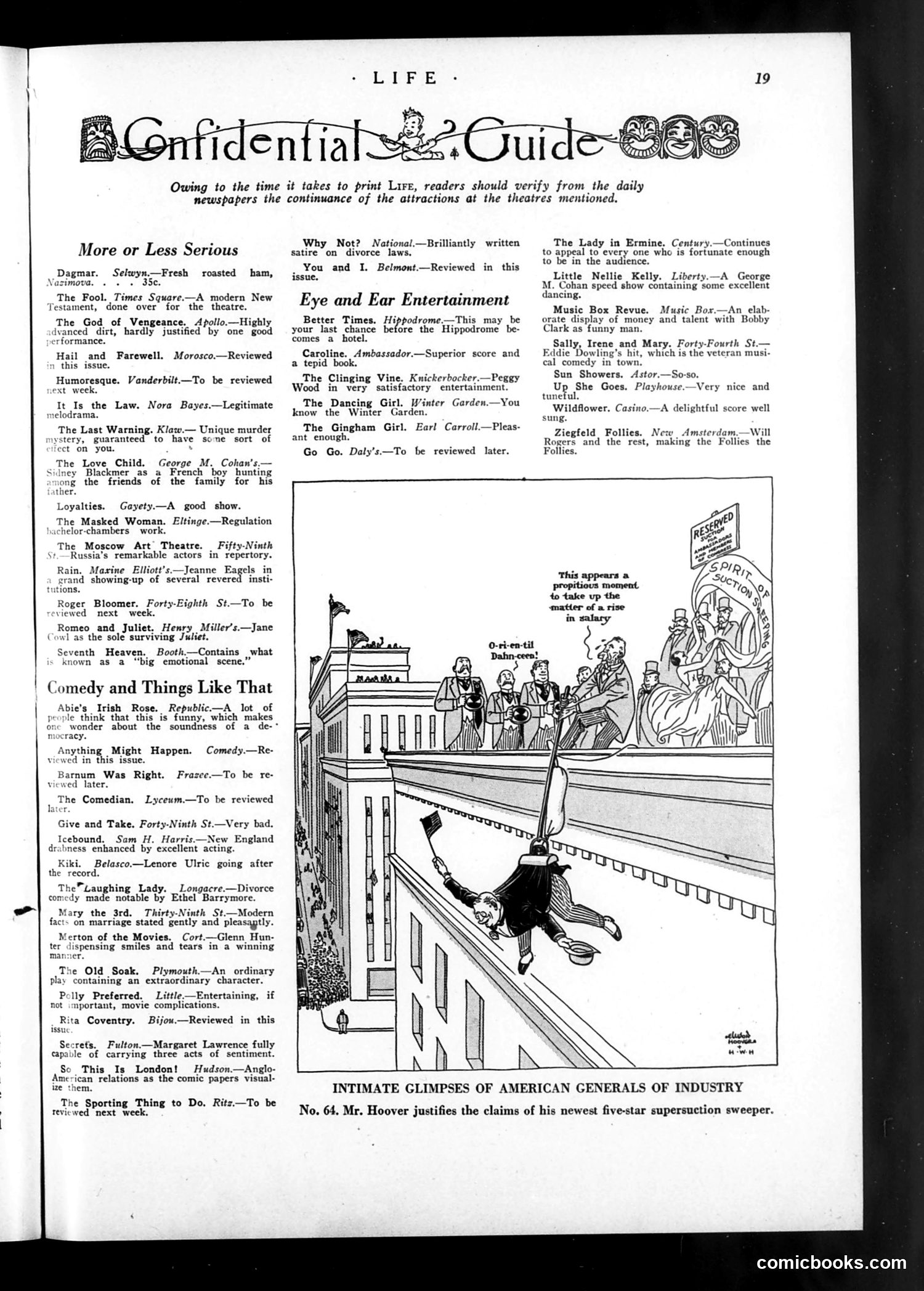
This cartoon satirizes wealthy industrialists' disconnection from ordinary workers. The illustration shows a well-dressed man falling from a tall building while workers on scaffolding above watch indifferently. The caption references "Mr. Hoover" justifying a "five-star supersweeper"—likely mocking Herbert Hoover's management philosophy or a corporate executive's absurd claims about labor-saving devices. The joke appears to critique how industrial leaders prioritize trivial gadgetry and cost-cutting measures while ignoring workers' actual welfare and safety. The falling figure suggests the human cost of such indifference. This reflects 1920s labor tensions and class criticism, when Life magazine frequently satirized wealthy businessmen's callousness toward working conditions and employee well-being.
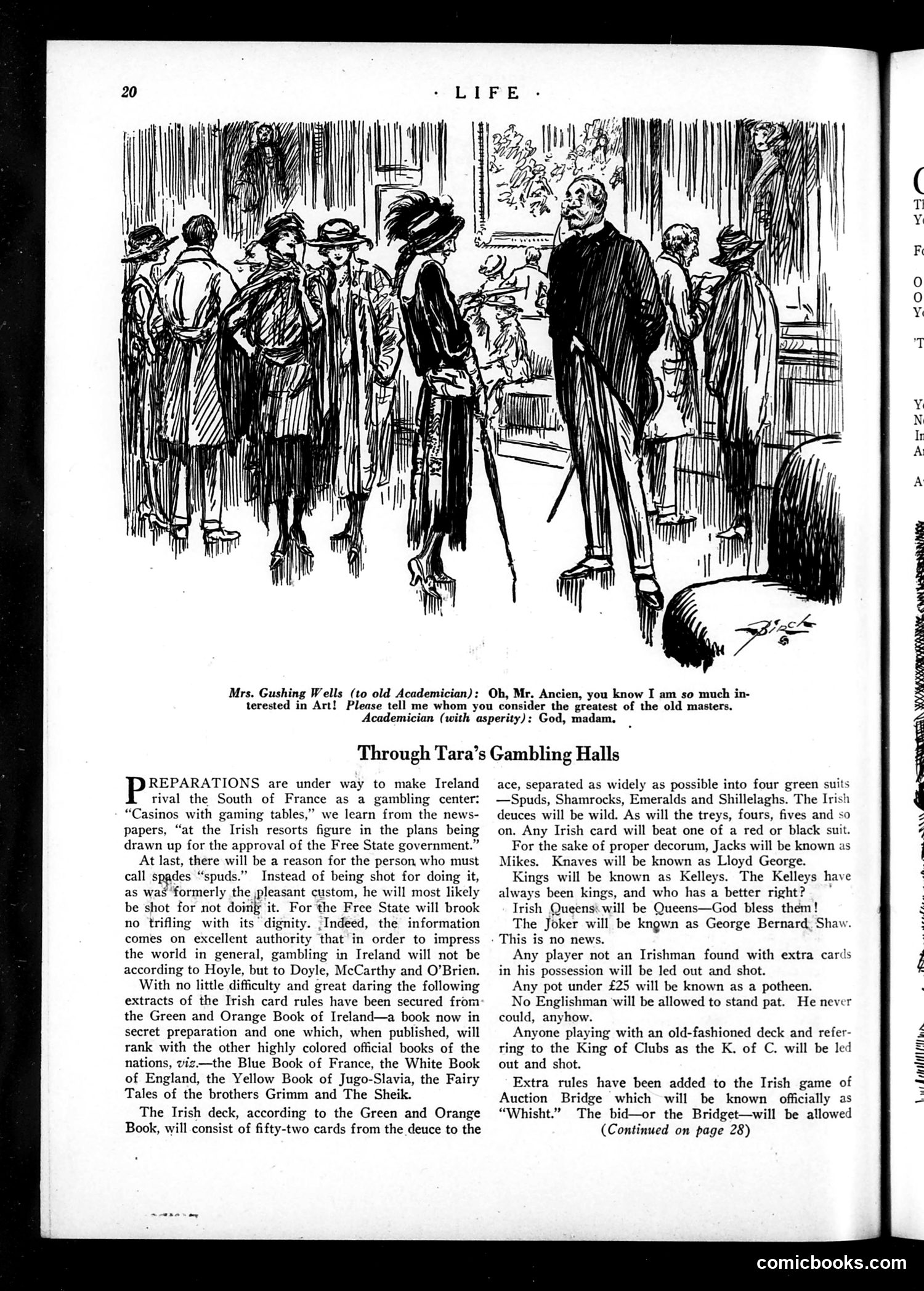
This page contains two satirical pieces about Ireland following its independence (the "Free State" reference dates this to the 1920s). **Top Cartoon:** A society woman (Mrs. Cushing Wells) asks an elderly academician about the greatest old masters. His tart reply—"God, madam"—mocks her pretentious interest in art while suggesting the greatest artist is divine, not human. The satire targets affected wealthy Americans claiming cultural sophistication. **Main Article:** "Through Tara's Gambling Halls" humorously attacks Ireland's plans to establish casinos. The satire ridicules Irish identity through absurdist "official rules": card suits renamed as Irish stereotypes (Spuds, Shamrocks, Shillelaghs); face cards humorously renamed after Irish/political figures (Lloyd George as "Knaves"); and comically strict Irish-only gaming laws with execution threatened for cheating or using English customs. The humor depends on recognizing contemporary references to Irish independence politics and playing on American stereotypes about Irish identity, while mocking the Irish Free State's self-conscious nation-building efforts.
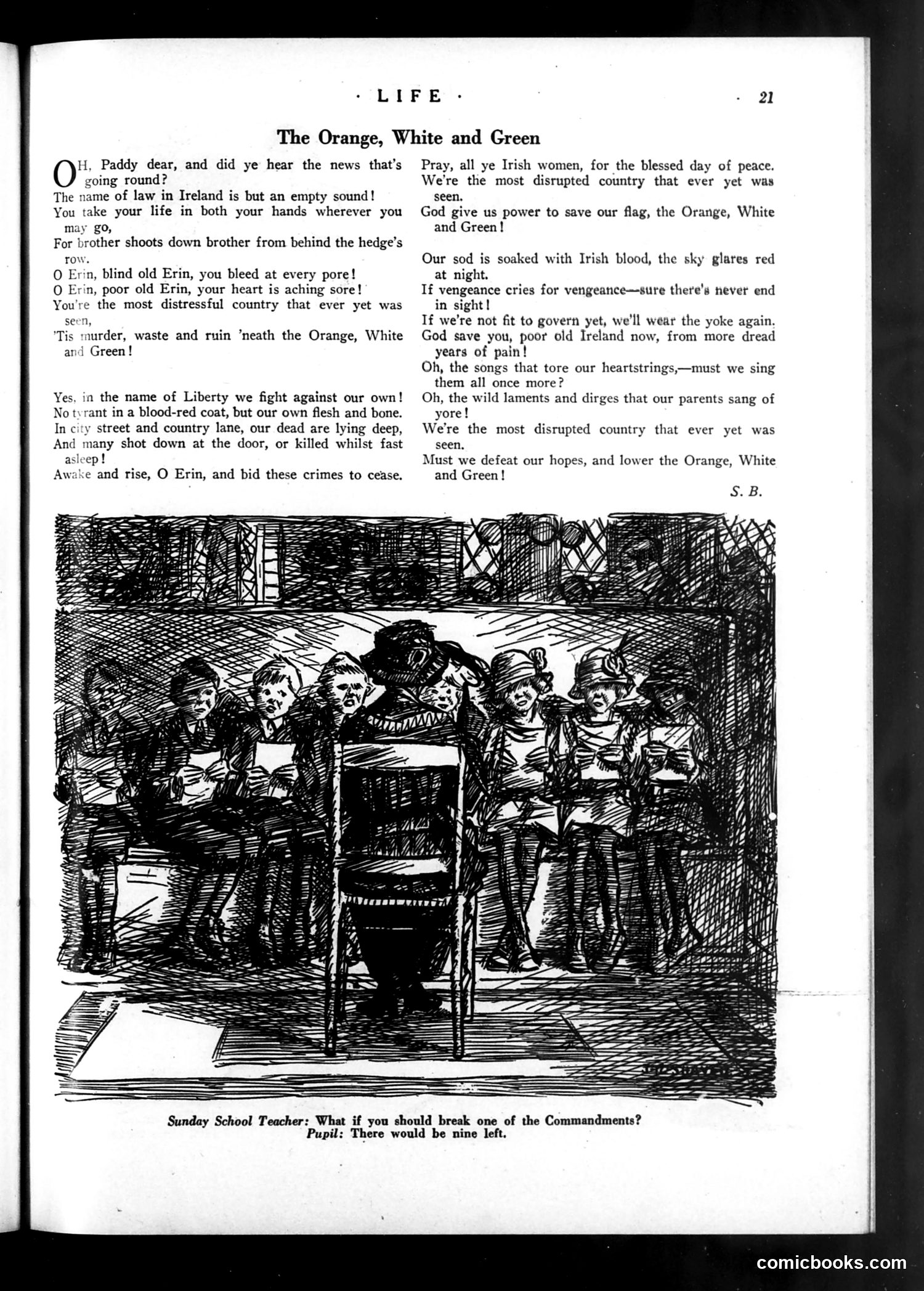
This page presents an Irish nationalist poem lamenting internal conflict during Ireland's struggle for independence (likely early 1920s, during the Irish Civil War). The poem, signed "S.B.," uses the Irish tricolor flag colors to symbolize Ireland itself, depicting it as a nation suffering from fratricidal violence—"brother shoots down brother"—rather than external oppression. The accompanying sketch shows soldiers or armed men in what appears to be a prison or confined space, visually reinforcing the poem's theme of internal strife and captivity. Below is a separate joke: a Sunday School teacher asks a pupil what happens if one breaks the Commandments; the pupil quips "there would be nine left"—dark humor suggesting many commandments are already broken, likely referencing the violence described above. The satire critiques both the violence plaguing Ireland and, implicitly, religious hypocrisy amid such bloodshed.
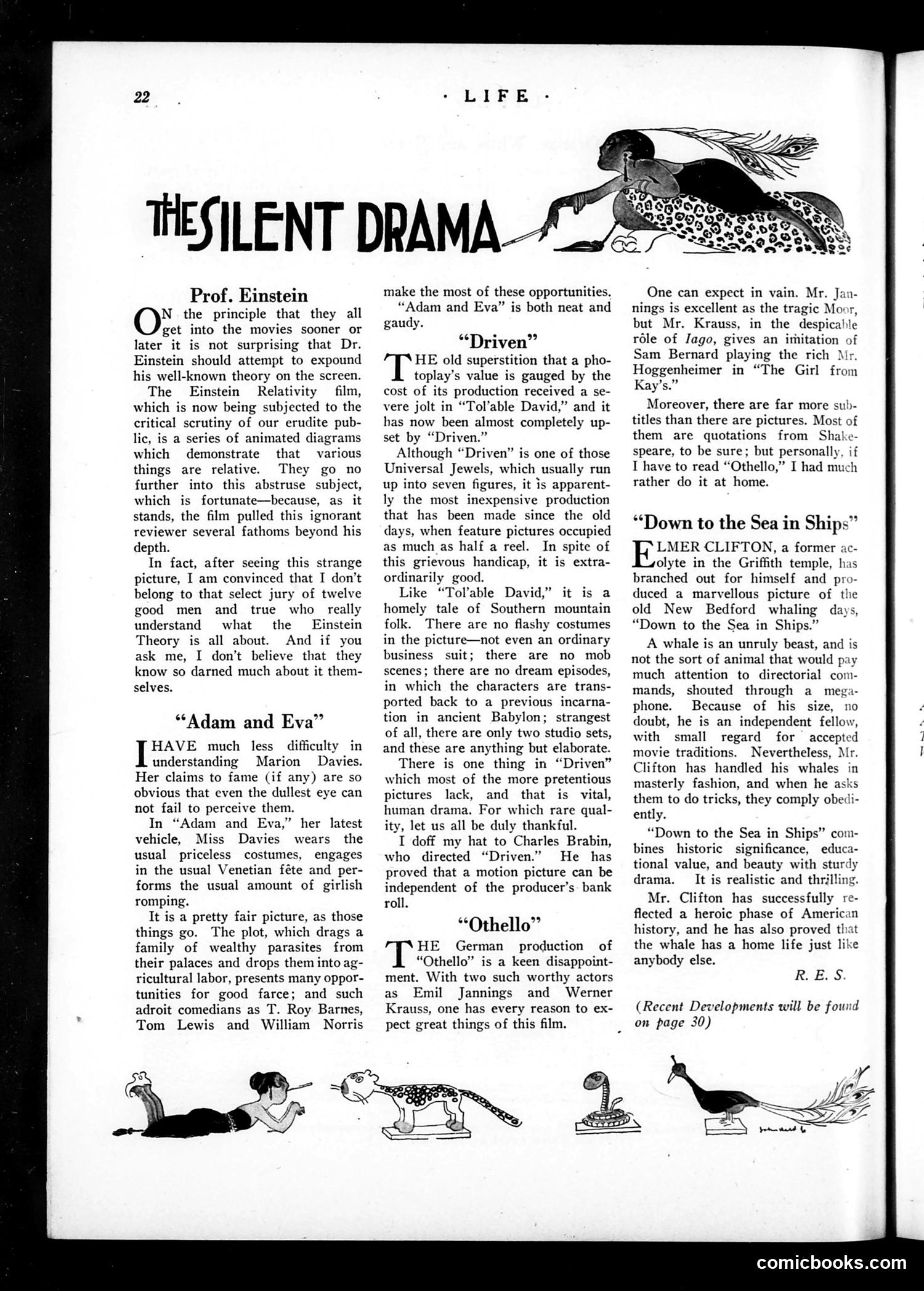
This Life magazine film review page critiques several silent films, using humor to highlight how different movies succeed or fail despite their budgets and prestige. The opening section mocks **Einstein's relativity film**, sarcastically suggesting that even the "select jury" claiming to understand Einstein's theory probably doesn't. The joke: Einstein's abstract scientific concepts don't translate well to visual media. Reviews of **"Adam and Eva"** (starring Marion Davies) are gentle—acknowledging her appeal lies in costumes and "girlish romping" rather than acting depth. The **"Driven"** section celebrates a Universal production that proves expensive budgets aren't necessary for quality cinema, contradicting the superstition that production cost equals value. Regarding the **German "Othello"** with Emil Jannings and Werner Krauss: the reviewer praises Jannings but mocks Krauss's lago performance as mimicking a comedic character ("Sam Bernard") rather than delivering Shakespearean tragedy. The complaint about excessive subtitles quoting Shakespeare suggests the film relies too heavily on text rather than visual storytelling—a fundamental problem in silent cinema. The decorative footer illustrations appear unrelated to the reviews.
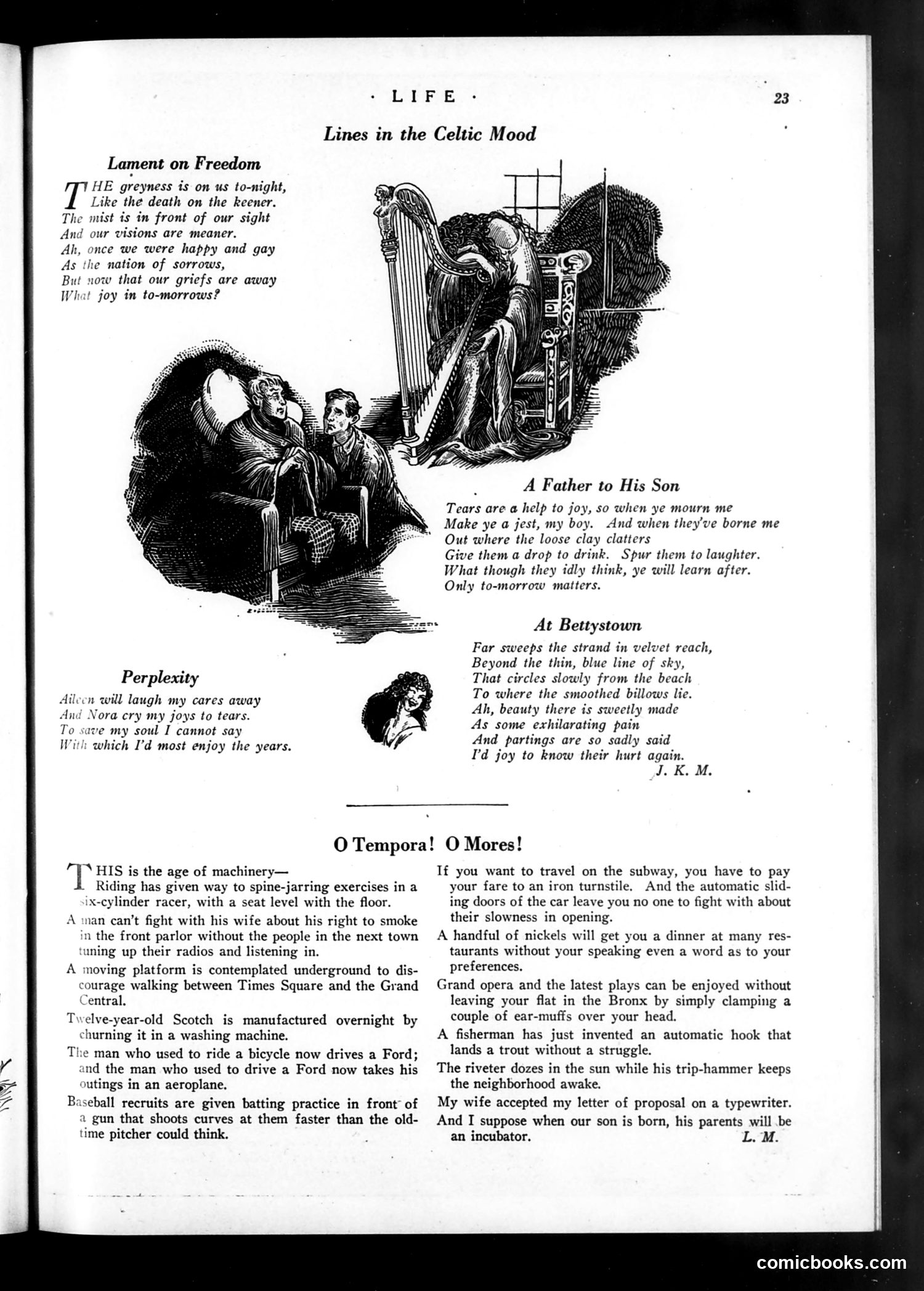
This page contains **Irish nationalist poetry** and **satirical humor** about modern technology's absurdities. The "Lines in the Celtic Mood" section features melancholic poems with Irish themes—references to Irish keening (funeral wailing), Irish names (Aileen, Nora), and the beach at Bettystown (a real Irish location). These reflect early 20th-century romanticization of Celtic identity and Irish independence sentiment. The main satire, "O Tempora! O Mores!" ("Oh the Times! Oh the Customs!"), mocks rapid technological advancement through exaggerated complaints: subway automation removing human interaction, radio broadcasts penetrating homes, machines manufacturing whiskey overnight, and courtship conducted via typewriter. The humor relies on depicting modernity as alienating and ridiculous—cars replacing bicycles, airplanes replacing cars, automatic fishing hooks eliminating struggle. The satirical point: **rapid industrialization and automation are dehumanizing**, stripping away traditional courtesies, labor, and human connection. For 1920s readers, this technology felt invasively modern; today, it reads as quaint nostalgia for a pre-digital era.
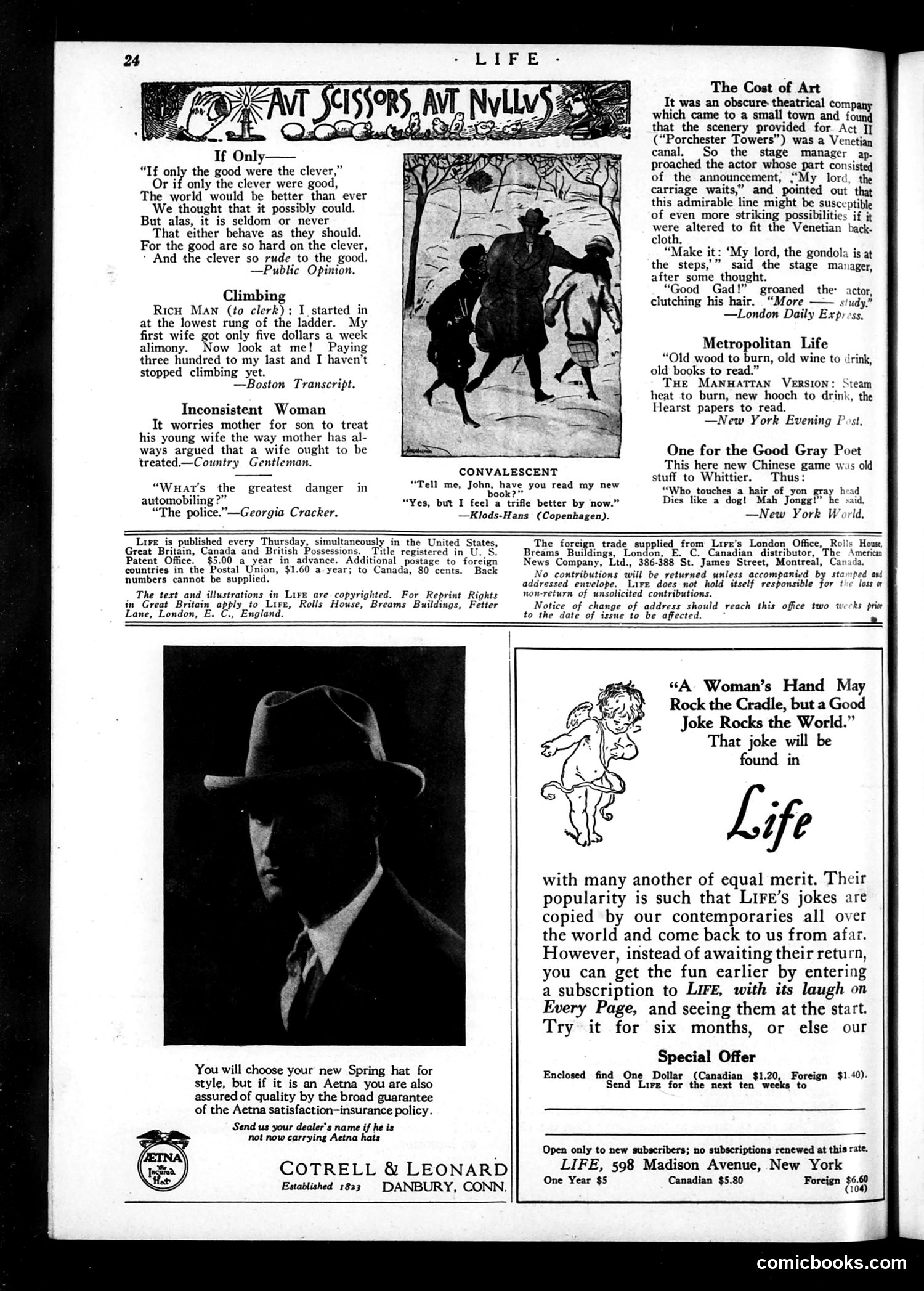
This page from *Life* magazine presents several short satirical pieces typical of early 20th-century American humor journalism: **"If Only"** and **"Climbing"** mock social contradictions—the first, a philosophical poem about virtuous people being harsh and clever people being rude; the second, a rich man bragging that his escalating alimony payments prove his success. **"Inconsistent Woman"** and **"Convalescent"** are brief domestic jokes about wives and reading. **"The Cost of Art"** satirizes theatrical penny-pinching: a stage manager asks an actor to change "carriage waits" to "gondola is at the steps" to match Venetian scenery, but the actor refuses because it requires memorizing new blocking—prioritizing laziness over artistic integrity. **"Metropolitan Life"** contrasts refined old-world pleasures with modern equivalents (Hearst tabloids replacing literature). **"One for the Good Gray Poet"** makes a topical reference to Whittier applying Mah-Jongg (the newly fashionable Chinese game) to his famous poem. The page is primarily advertising and subscription promotion for *Life* itself.
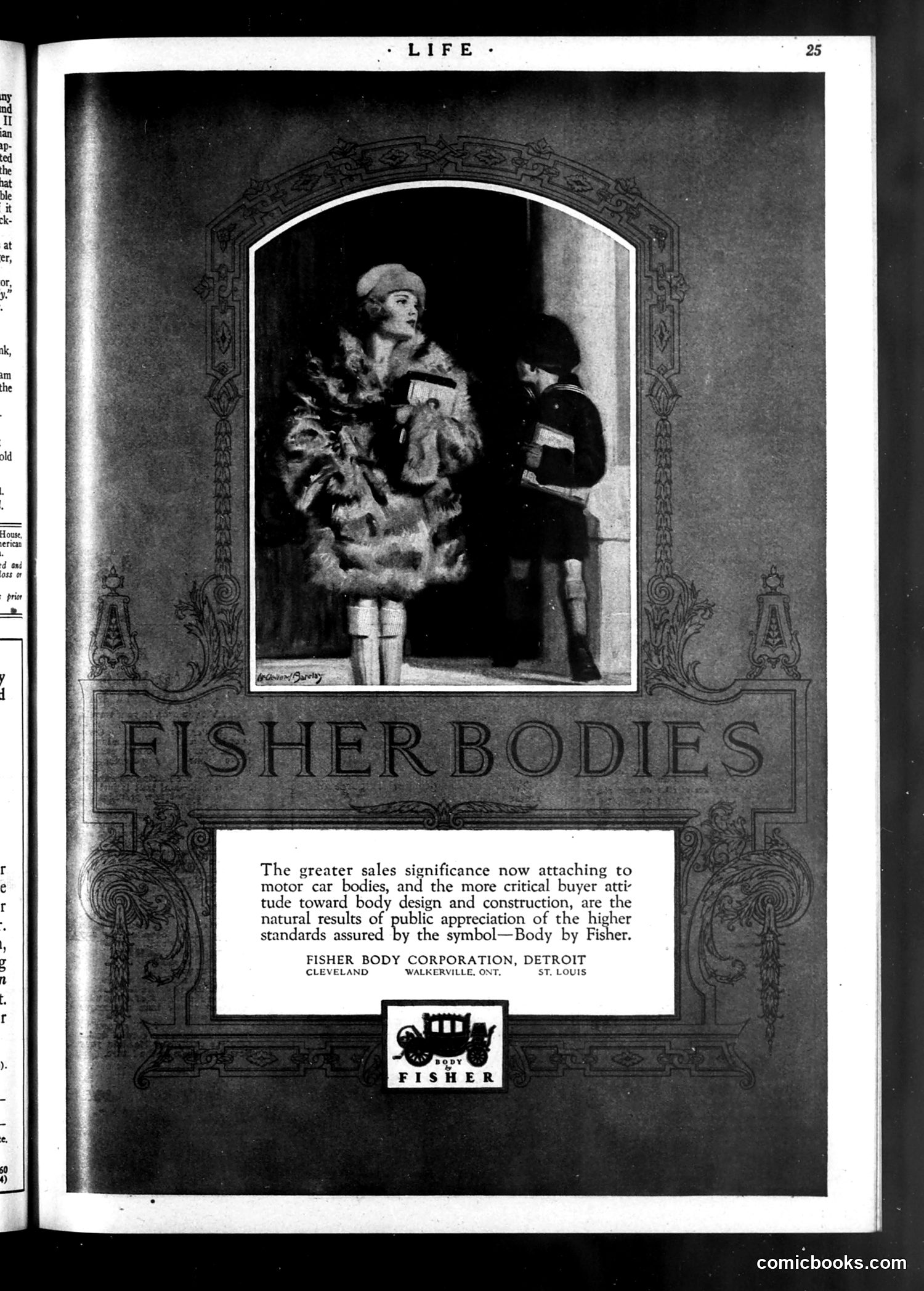
This is a **Fisher Body Corporation advertisement**, not satirical content. The page features a photograph of two elegantly dressed women in 1920s fashion examining an automobile, framed within decorative art deco borders. The text promotes Fisher Body as a premium automobile body manufacturer, arguing that consumers now recognize quality craftsmanship in car construction—the "Body by Fisher" brand symbolizes superior design standards. The advertisement emphasizes that discriminating buyers appreciate fine body engineering as much as mechanical performance. This represents early automotive marketing strategy, positioning Fisher Body as a luxury component maker whose name alone conveys quality to potential car purchasers.
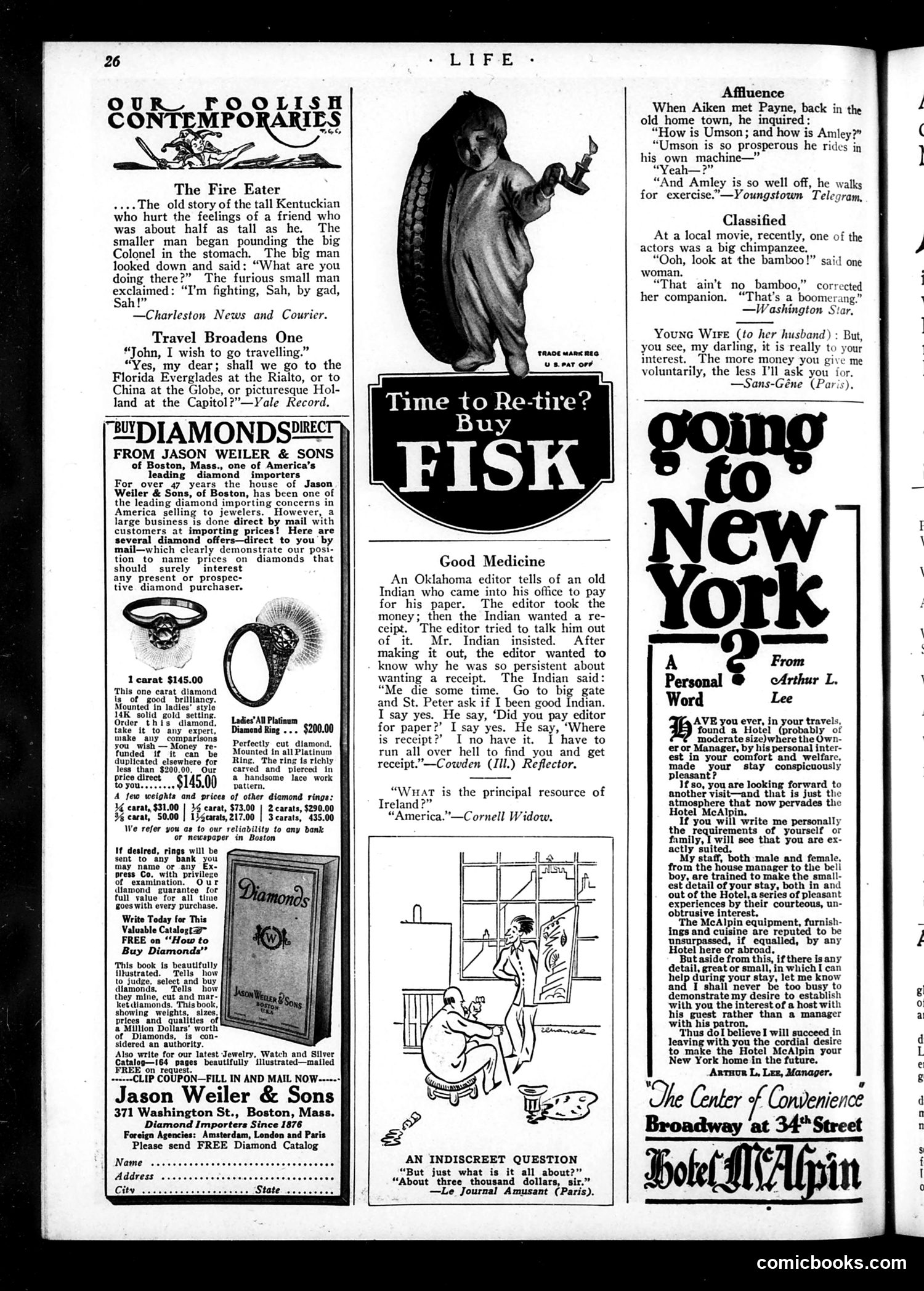
This page from *Life* magazine contains primarily **humorous anecdotes and advertisements** rather than political cartoons requiring historical context. The main content includes: **Humor Sections** ("Our Foolish Contemporaries"): - "The Fire Eater": A Kentucky tall-tale joke about a large man being punched in the stomach by a smaller man - "Travel Broadens One": A Yale Record quip about theatrical tourism - "Good Medicine": An anecdote about an Oklahoma editor and a Native American customer wanting a receipt for St. Peter at heaven's gate - Various other brief jokes **Advertisements**: - Jason Weiler & Sons diamonds (Boston importer) - Fisk tires ("Time to Re-tire?") - Hotel McAlpin in New York The cartoon visible shows a man sitting uncomfortably on what appears to be a chair or bench, illustrating the "Time to Re-tire?" tire advertisement. The page is essentially a collection of lightweight satirical humor and commercial content typical of early 20th-century *Life* magazine—more focused on entertainment than political commentary.
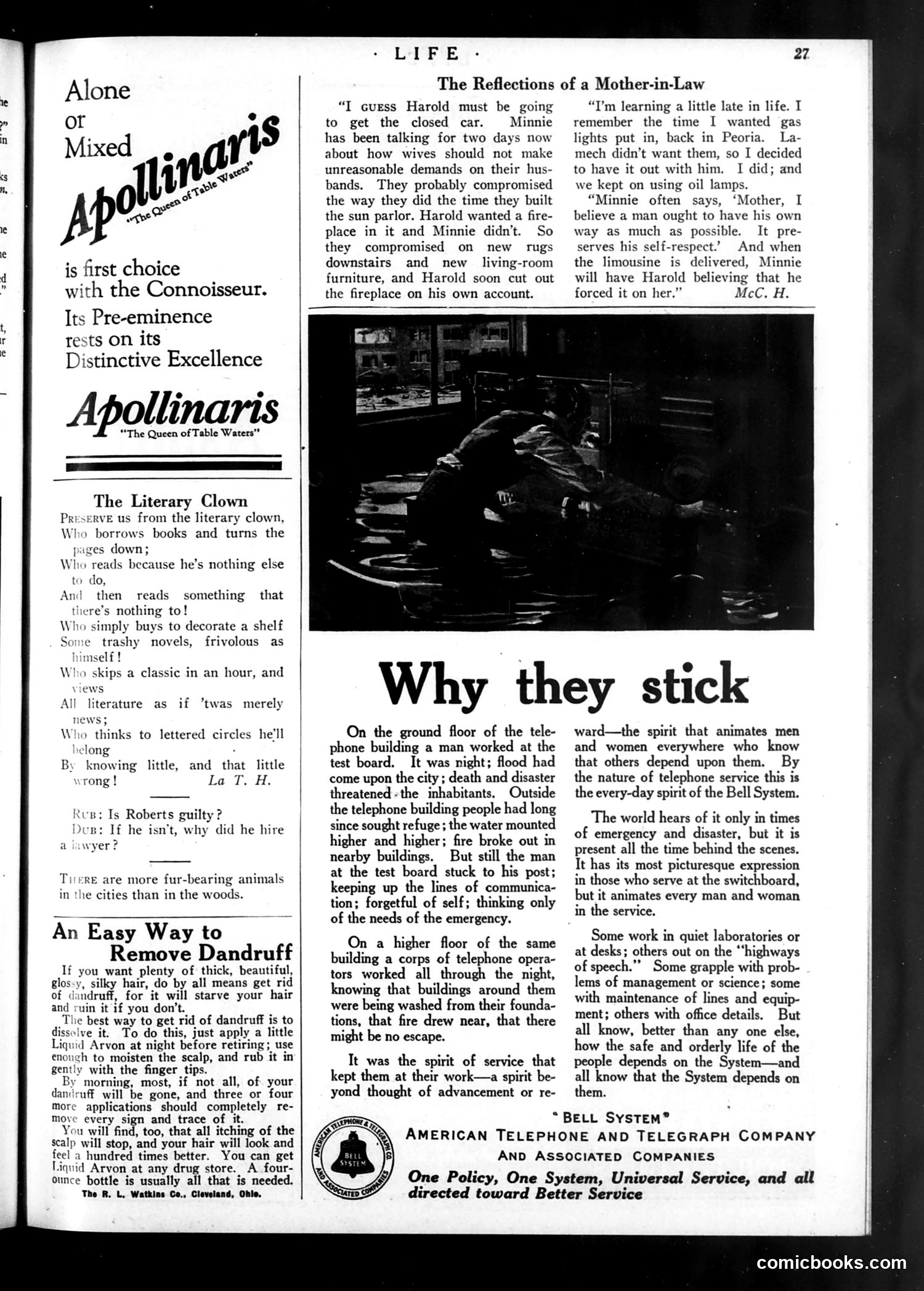
This page contains three distinct pieces of satirical/humorous content: **"The Literary Clown"** — A poem mocking pretentious readers who borrow books without care, read frivolous novels to appear cultured, skip classics, and treat literature as mere decoration or gossip fodder. The satire targets social climbers who feign intellectual sophistication. **"The Reflections of a Mother-in-Law"** — A humorous anecdote about marital compromise. A mother-in-law observes her daughter Minnie's "compromise" tactics with her husband Harold actually being manipulation—she claims to want his independence while engineering outcomes favoring her desires (the limousine purchase). The joke is on wives' strategic negotiation skills. **"Why They Stick"** — A lengthy advertisement for Bell Telephone System praising employees' dedication during a flood emergency. It describes telephone operators and maintenance workers remaining at their posts despite danger, framing this as exemplifying selfless "spirit of service." The page mixes genuine satire (literary pretension, marital dynamics) with corporate propaganda advertising commitment to public service.
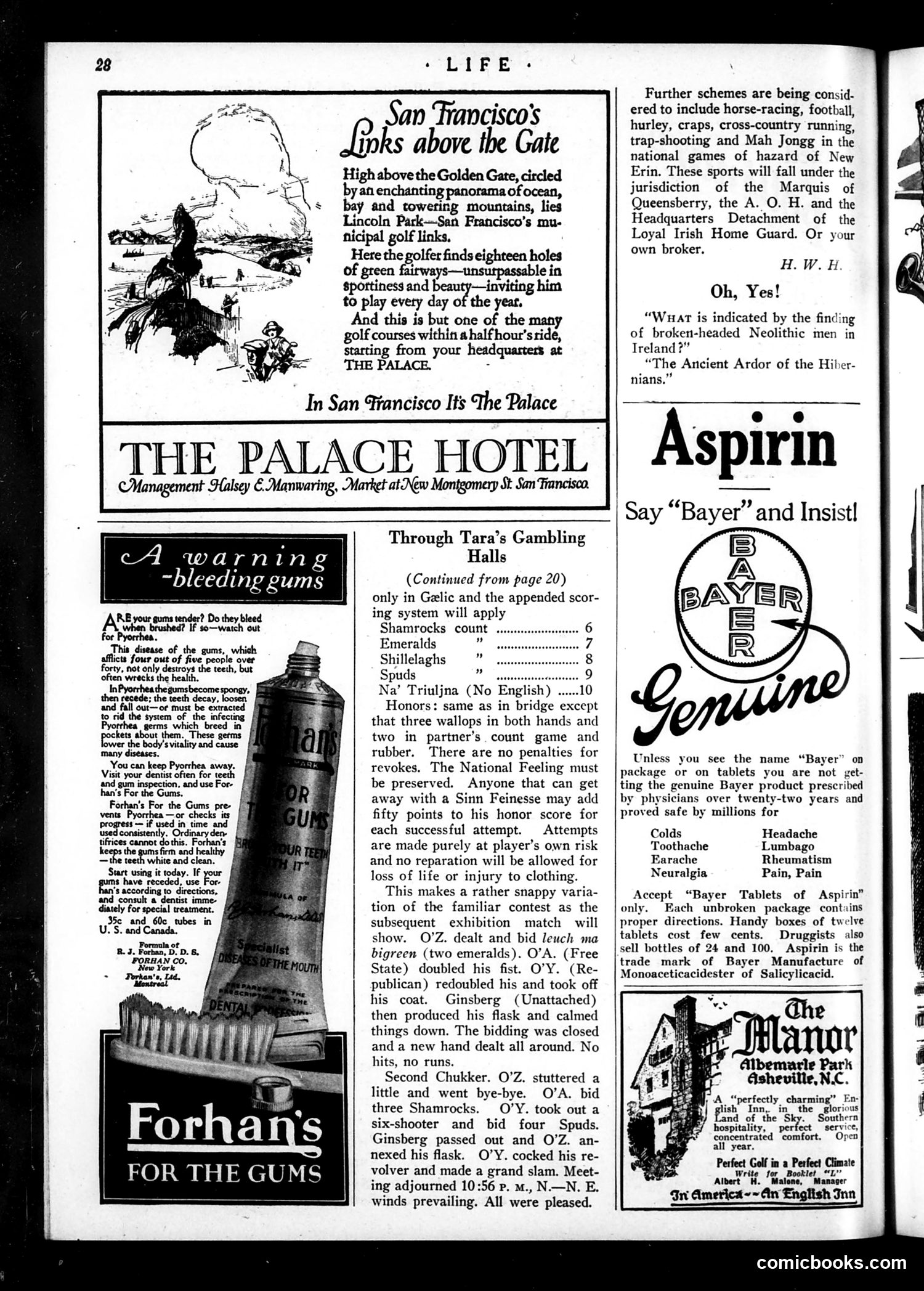
This page contains mostly **advertisements and humor pieces**, not political cartoons requiring historical context. The main content includes: 1. **Palace Hotel advertisement** — a San Francisco luxury hotel promoting nearby golf courses 2. **Forhan's toothpaste ad** — warns of pyorrhea (gum disease), a common early 20th-century health concern 3. **Bayer Aspirin ad** — emphasizing the importance of the brand name, reflecting post-WWI trademark awareness 4. **"Through Tara's Gambling Halls"** — a humorous fictional card game mixing Irish cultural references (shamrocks, shillelaghs, "Sinn Féin") with bridge rules and comic violence. This appears to satirize Irish identity stereotypes of the era—particularly the association with drinking, fighting, and gambling—through absurdist exaggeration. References to "Free State" and "Republican" suggest post-Irish Civil War (1922-23) tensions used for comedic effect. The page is primarily commercial rather than satirical. The Irish humor relies on period ethnic stereotypes now considered offensive.
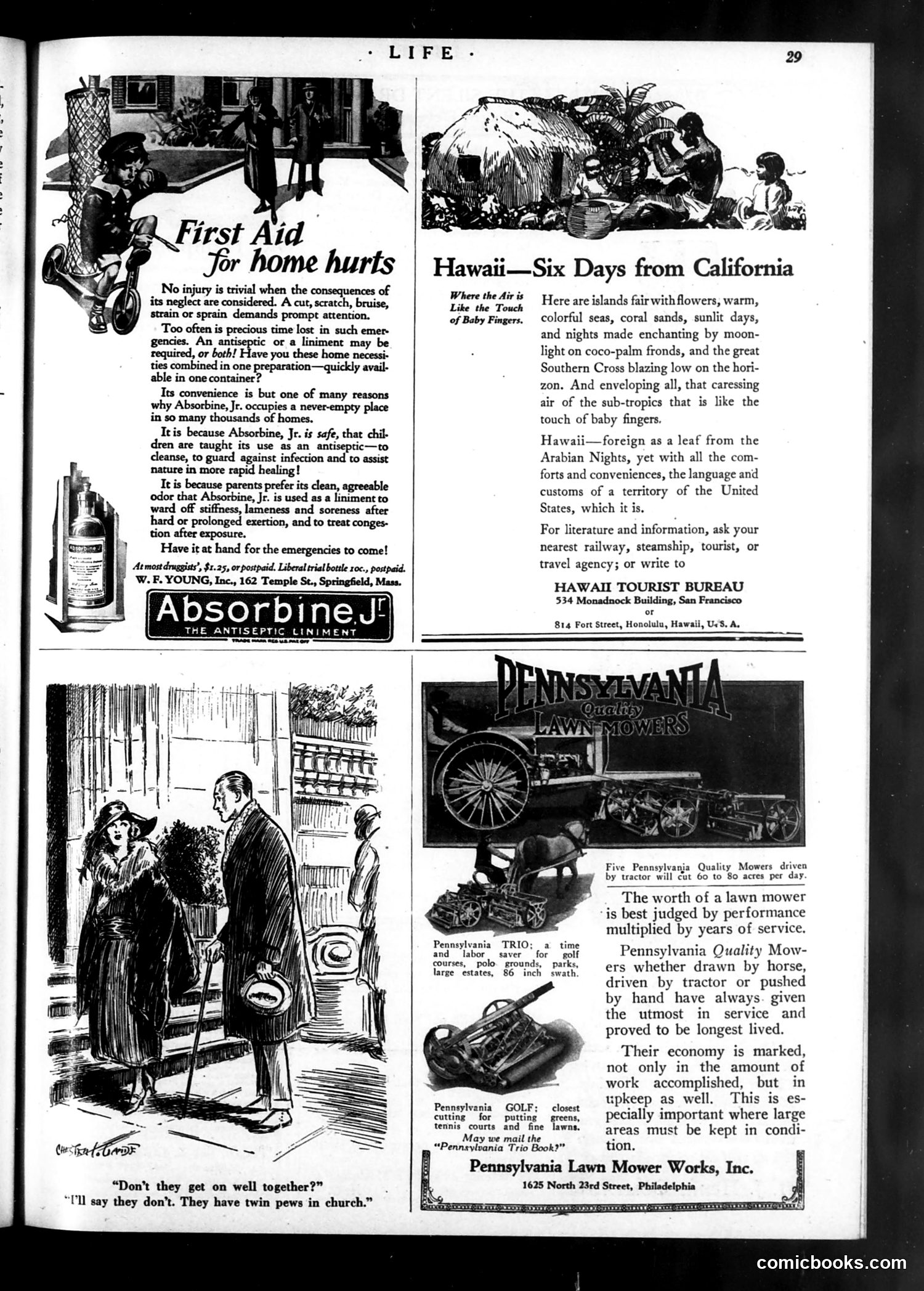
This page is primarily **advertising**, with one small cartoon at the bottom. The main cartoon depicts a man and woman in church, with the caption: "Don't they get on well together?" / "I'll say they don't. They have twin pews in church." The joke plays on "pews" (church benches) sounding like "pews" as a homophone, but the humor derives from suggesting that sitting in *separate* pews indicates marital discord—implying they deliberately distance themselves during worship. It's a gentle domestic satire common to Life magazine's humor section. The page otherwise contains three product advertisements: **Absorbine Jr.** (antiseptic liniment for home first aid), a **Hawaii Tourist Bureau** travel ad emphasizing tropical beauty and accessibility from California, and **Pennsylvania Lawn Mower Works**, advertising their durable equipment for grounds maintenance.
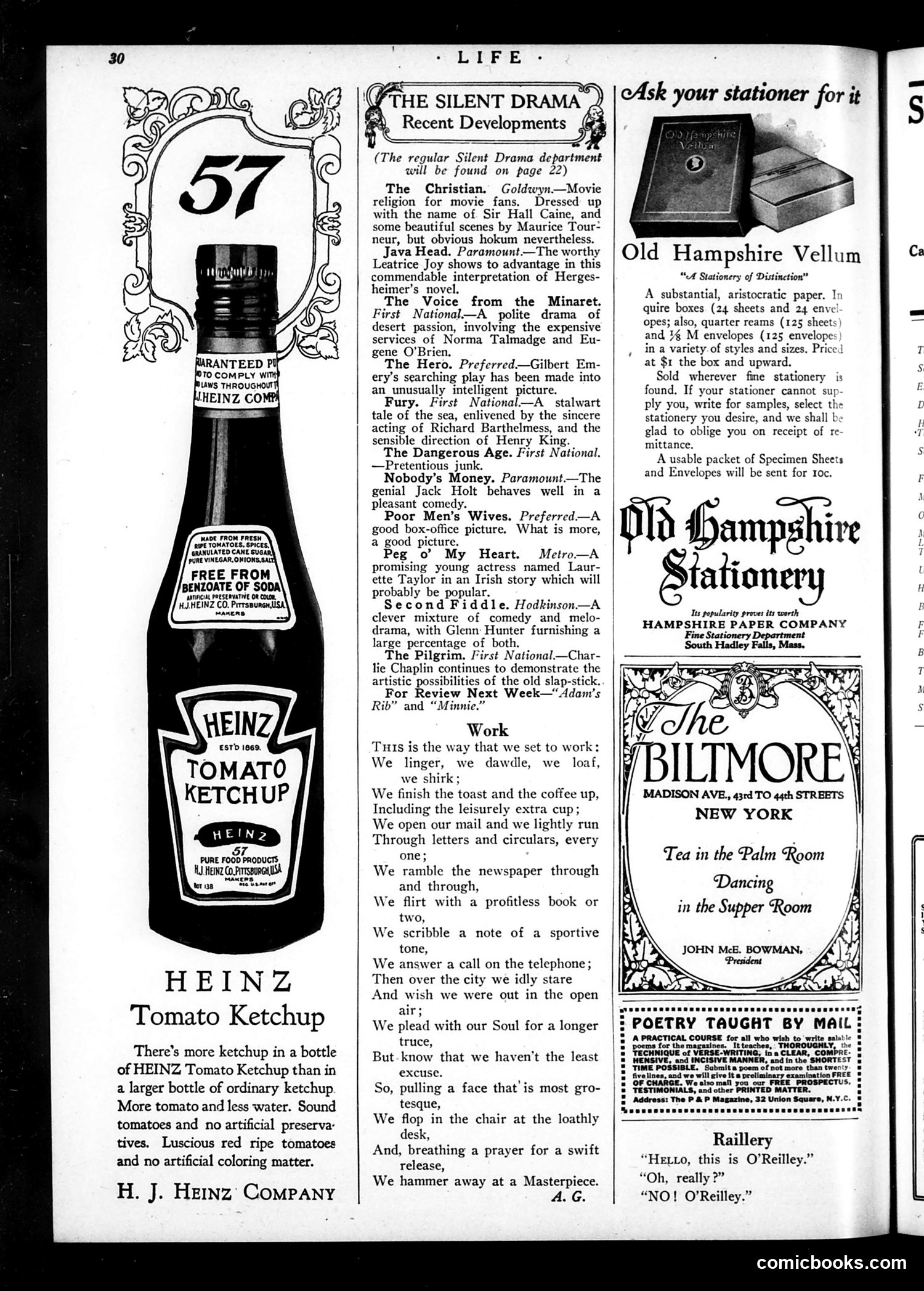
This page is primarily **advertising and content**, not political satire. The main visual element is a **Heinz Tomato Ketchup advertisement** featuring a large bottle illustration. The ad emphasizes product quality—more tomato, less water, no artificial preservatives or coloring—positioning Heinz as superior to competitors. The page also includes: - **"The Silent Drama" section**: Movie reviews of contemporary films (The Christian, Java Head, The Hero, etc.), typical of Life magazine's entertainment coverage. - **"Work"**: A humorous poem by A.G. about office procrastination—dawdling, reading newspapers, answering phones—before finally forcing oneself to work on "a Masterpiece." This is gentle satire on workplace laziness, relatable to office workers of the era. - **Advertisements** for Old Hampshire Vellum stationery, The Biltmore hotel in New York, and a mail-order poetry course. No political figures or pointed social commentary are present—this is a straightforward magazine page mixing consumer advertising with entertainment and light humor typical of 1920s Life magazine content.
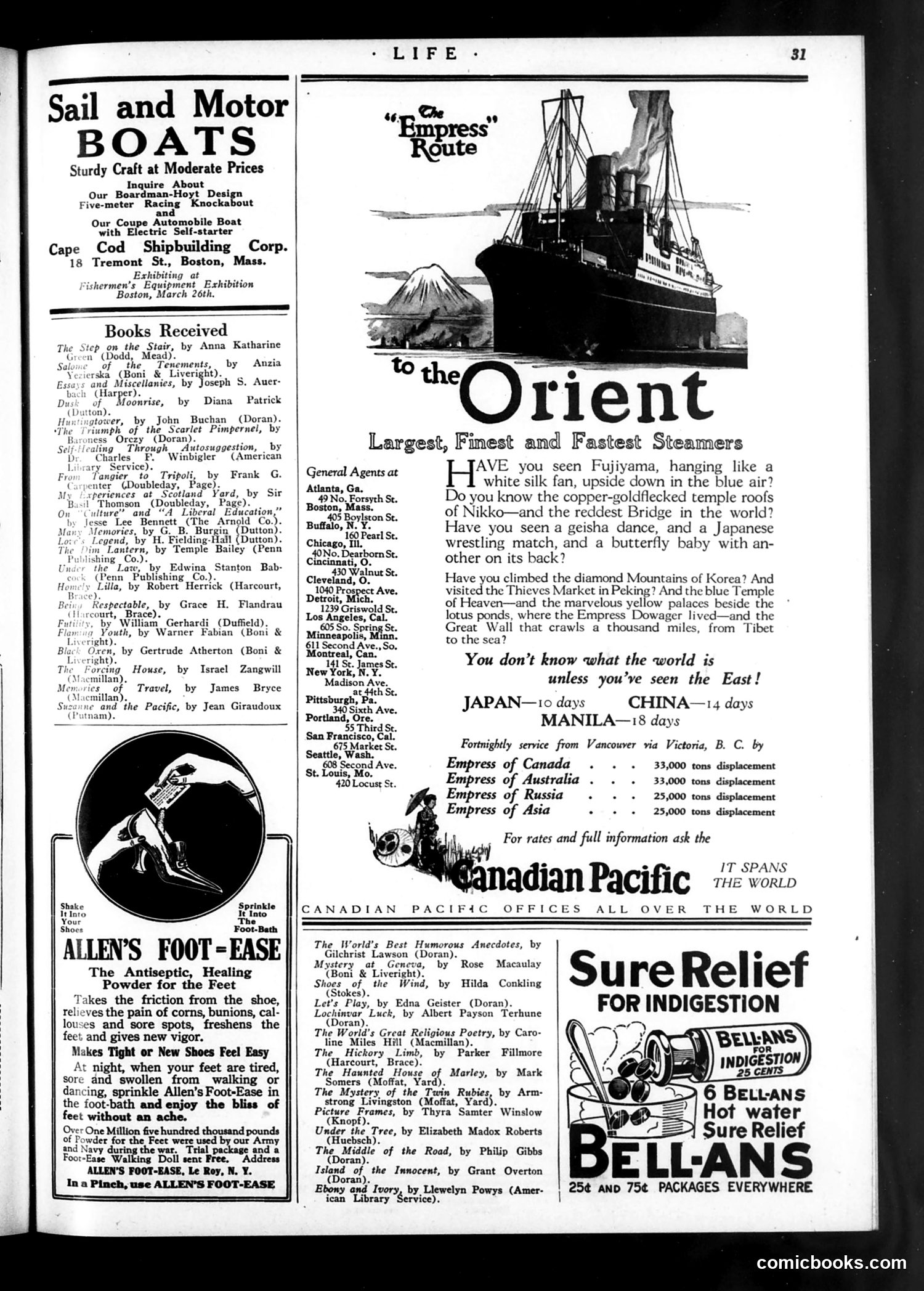
This page is primarily **advertising** rather than satirical content. The main feature is a Canadian Pacific Railway ad promoting luxury steamship travel to Asia ("the Orient"). The ad uses **orientalist rhetoric** common to the 1920s—romanticizing Japan, Korea, and China through exotic imagery (Fujiyama, geishas, the Great Wall). It appeals to wealthy travelers by listing four large steamships and departure points across North America, emphasizing speed and comfort ("Largest, Finest and Fastest Steamers"). Surrounding this are conventional commercial advertisements for boats, books, and Allen's Foot-Ease powder—typical Life magazine filler. The book list reflects early 1920s literary titles. **Historical context**: This reflects an era when Asian travel was a luxury experience marketed to affluent Western audiences, with language that exoticizes rather than respectfully describes these cultures. The ad's appeal relies on Western fascination with "the East" as mysterious and alluring.
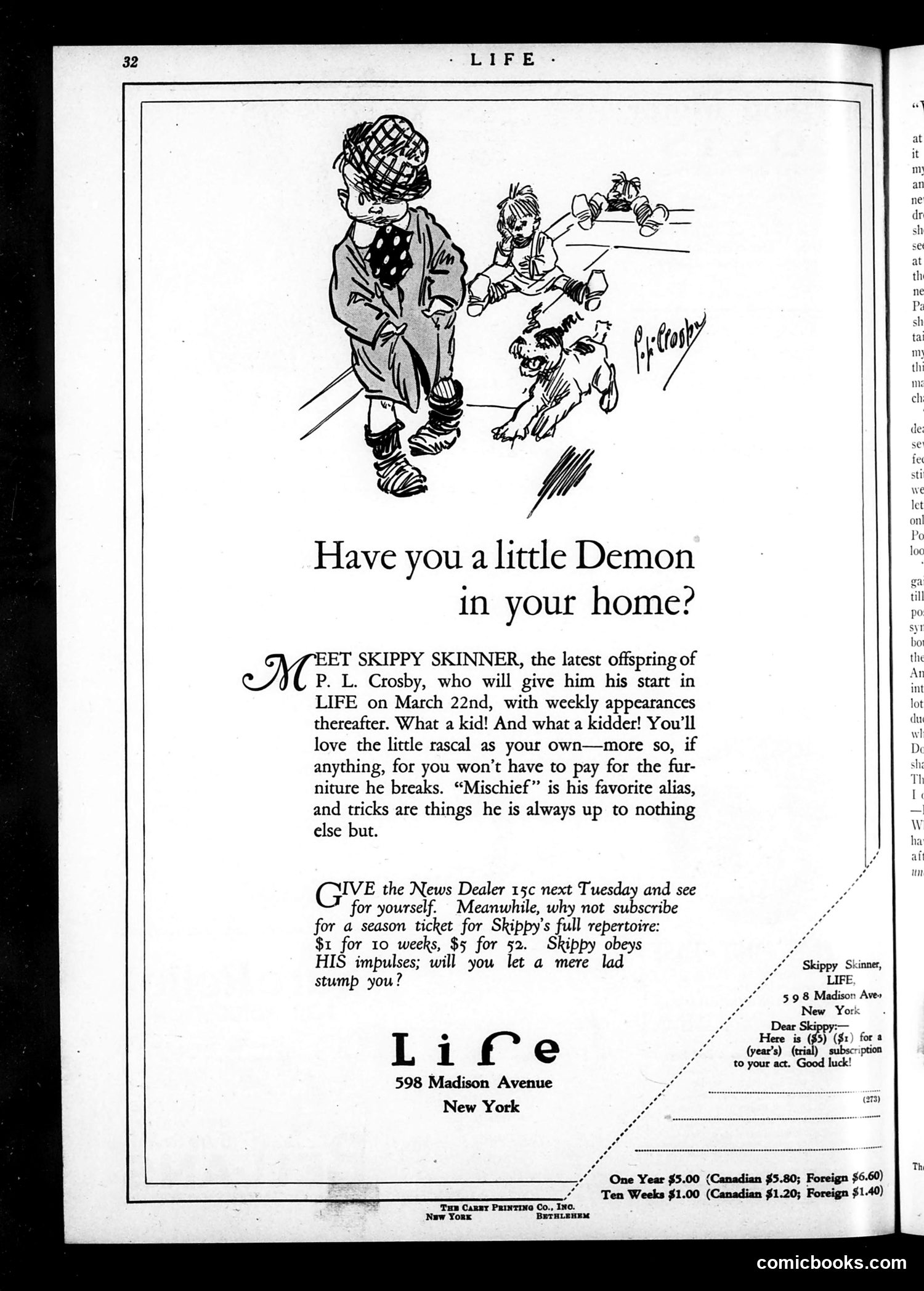
This is primarily an **advertisement** for a new comic strip called "Skippy," created by P.L. Crosby, debuting in *Life* magazine on March 22nd with weekly episodes thereafter. The cartoon depicts **Skippy Skinner**, a mischievous young boy character who causes household chaos—breaking furniture and playing pranks. The advertisement's humor plays on the relatable frustration parents experience with rambunctious children: you'll enjoy Skippy's antics *more* because you won't have to pay for the damage he causes. The "little Demon" framing is tongue-in-cheek—Skippy represents the archetypal naughty child whose impulsive behavior drives adults to distraction. The ad encourages readers to buy the newspaper (15¢) or subscribe to follow Skippy's "full repertoire" of mischief. This reflects early 20th-century comic strip culture, when serialized comics were major entertainment draws that drove magazine and newspaper subscriptions.
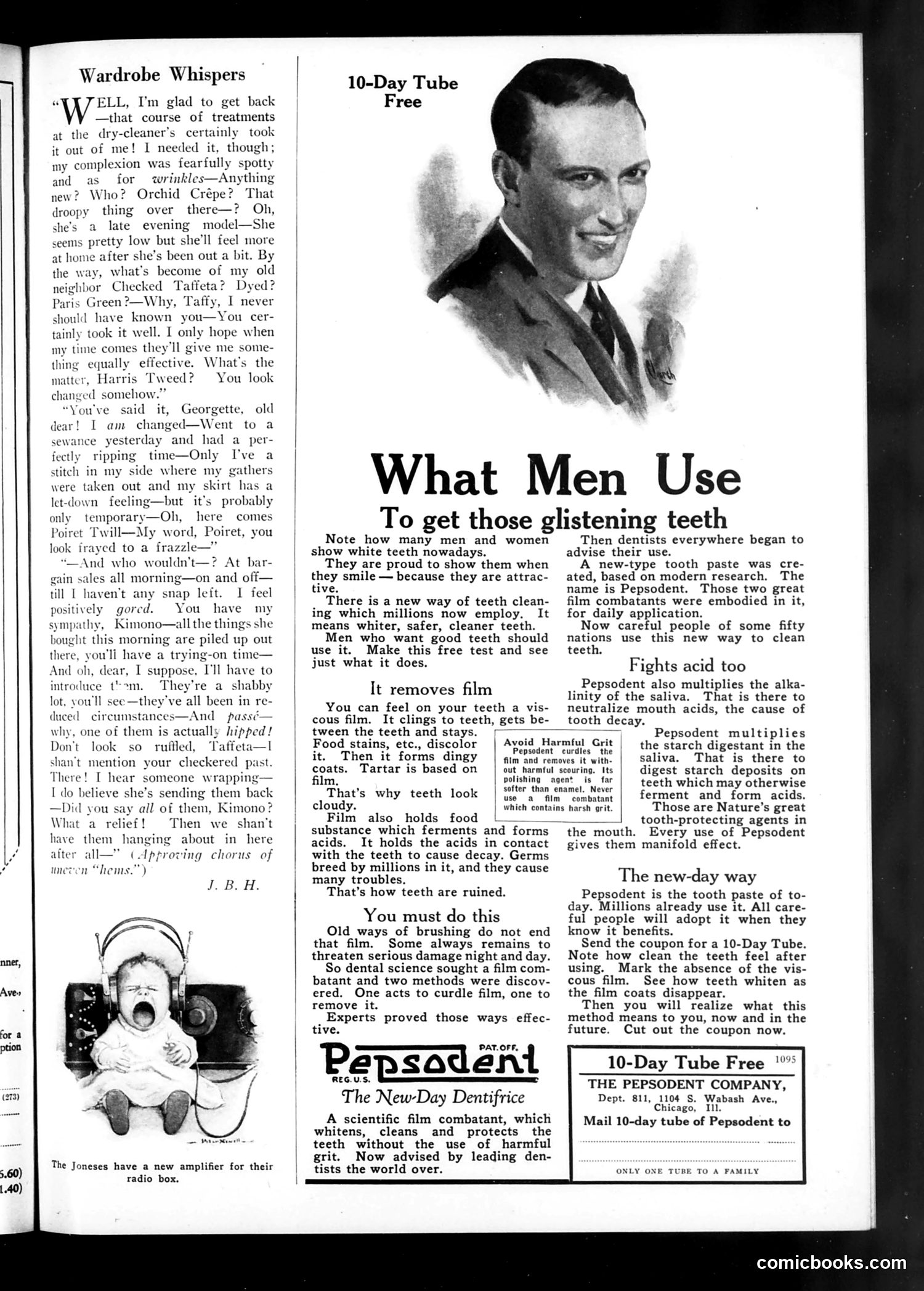
This page contains two distinct elements: **Left Side - "Wardrobe Whispers":** A satirical humor column personifying fabrics and clothing as gossiping women. Names like "Georgette" (georgette fabric), "Orchid Crepe," "Harris Tweed," "Poiret Twill," and "Kimono" are puns on actual textile types. The joke anthropomorphizes materials discussing their treatments (dry-cleaning, alterations, wear). This reflects 1920s-30s sophistication—readers familiar with fabric names would appreciate the wit. The humor targets fashion-conscious ladies and their frivolous concerns. **Right Side - "Pepsodent" Advertisement:** A full-page toothpaste ad claiming the product removes "film" from teeth through two chemical methods. It presents this as modern scientific advancement ("new-day" dentifrice), contrasting old brushing methods with new chemical solutions. The ad offers a free 10-day trial tube. This represents early 20th-century advertising's characteristic blend of pseudo-scientific language and consumerist appeals to health and attractiveness.
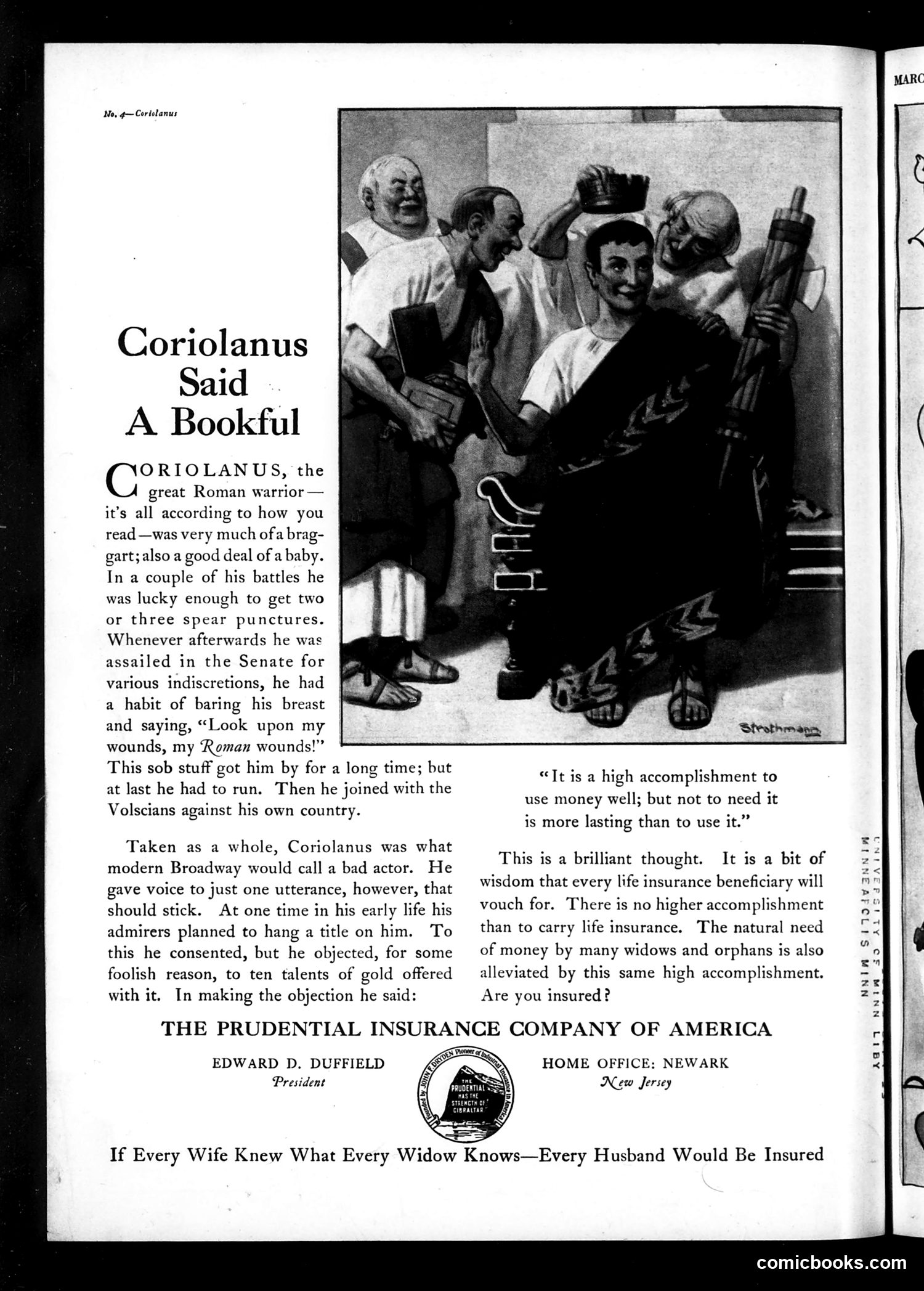
This is a Life magazine advertisement disguised as literary satire. The piece mocks the Roman general Coriolanus (from Shakespeare's play) as a self-pitying braggart who constantly displayed his war wounds to escape political accountability—then betrayed Rome itself when criticized. The satire's point: Coriolanus represents someone who talks endlessly about past accomplishments while avoiding real responsibility. The punchline pivots to life insurance. The text quotes Coriolanus rejecting payment (refusing ten talents of gold), reframing this as wisdom about financial independence. The ad then co-opts this to argue that *carrying* life insurance—not avoiding it—is the true accomplishment, because it protects widows and orphans. The closing tagline drives home the message: husbands should insure themselves so their wives understand insurance's necessity. It's clever advertising that uses classical literature and moral philosophy to sell Prudential Insurance through emotional appeal and gentle social pressure.