
Life, 1923-03-15 · page 20 of 36
Life — March 15, 1923 — page 20: what you’re looking at
What you’re looking at
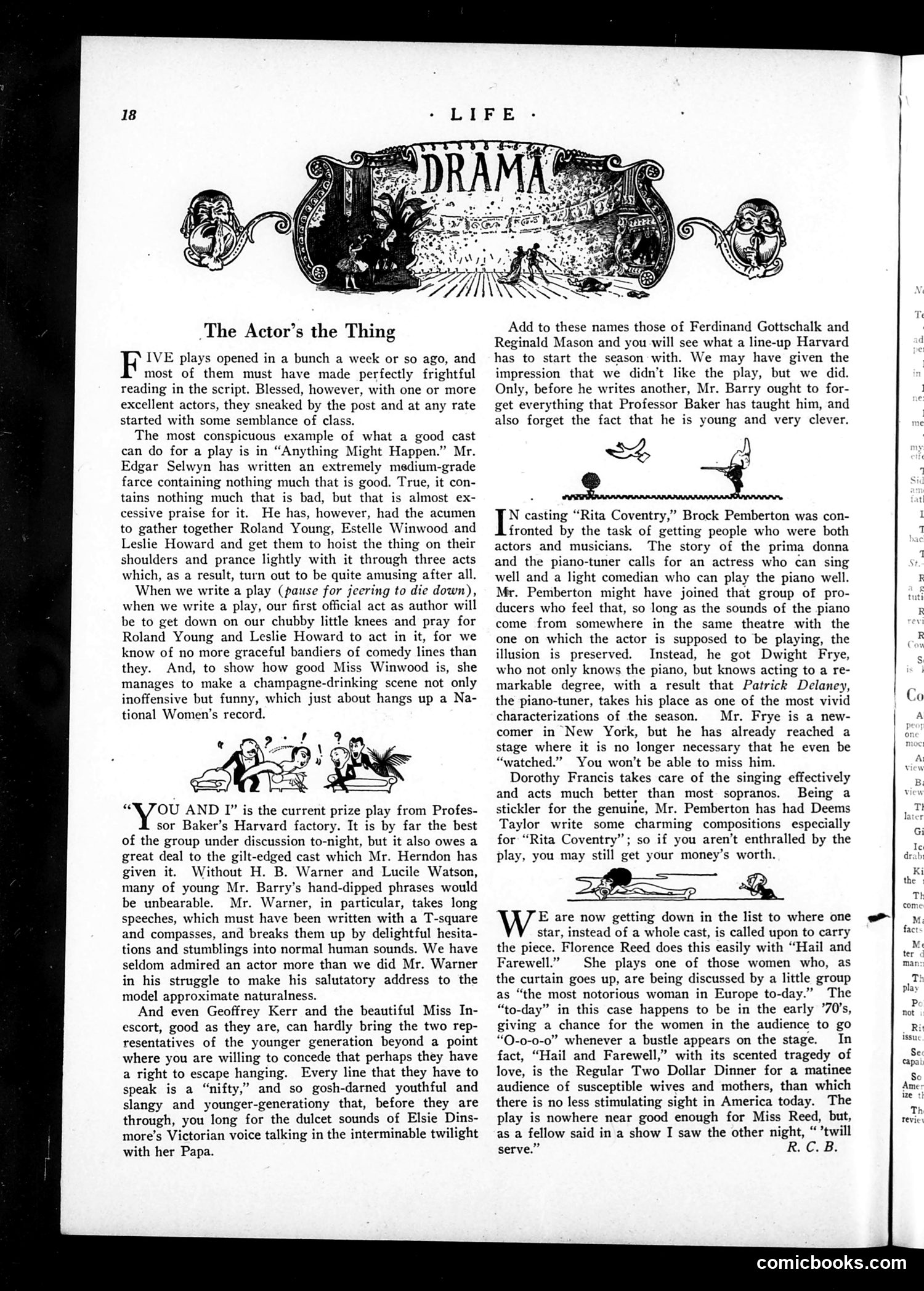
This Life magazine drama column reviews three contemporary Broadway plays, emphasizing that **good acting can elevate mediocre scripts**. The critic discusses: 1. **"Anything Might Happen"** — A "medium-grade farce" saved by its cast of Roland Young, Estelle Winwood, and Leslie Howard, praised for their skillful comic delivery. 2. **"You and I"** — A Harvard-produced play (referencing Professor Baker's famous playwriting course) featuring H.B. Warner and Lucile Watson. The critic jokes that young playwright Philip Barry's overly clever, slangy dialogue would be unbearable without strong actors to naturalize it through hesitations and stumbling delivery. 3. **"Rita Coventry"** — Praising director Brock Pemberton for casting genuine musician-actors (Dwight Frye) rather than faking it with offstage sound effects. **The satire's point**: Exceptional acting can make weak plays succeed, while poorly-cast excellent scripts fail. The column humorously suggests the author would pray to secure Young and Howard for any play they write.
📄 Transcribed text from this page (OCR, searchable)
Machine-transcribed from the original scan — historical spelling and the odd misread are preserved.
The Actor’s the Thing IVE plays opened in a bunch a week or so ago, and most of them must have made perfectly frightful reading in the script. Blessed, however, with one or more excellent actors, they sneaked by the post and at any rate started with some semblance of class. The most conspicuous example of what a good cast can do for a play is in “Anything Might Happen.” Mr. Edgar Selwyn has written an extremely medium-grade farce containing nothing much that is good. True, it con- tains nothing much that is bad, but that is almost ex- cessive praise for it. He has, however, had the acumen to gather together Roland Young, Estelle Winwood and Leslie Howard and get them to hoist the thing on their shoulders and prance lightly with it through three acts which, as a result, turn out to be quite amusing after all. When we write a play (pause for jeering to die down), when we write a play, our first official act as author will be to get down on our chubby little knees and pray for Roland Young and Leslie Howard to act in it, for we know of no more graceful bandiers of comedy lines than they. And, to show how good Miss Winwood is, she manages to make a champagne-drinking scene not only inoffensive but funny, which just about hangs up a Na- tional Women’s record. 2 “S7OU AND I” is the current prize play from Profes- sor Baker’s Harvard factory. It is by far the best of the group under discussion to-night, but it also owes a great deal to the gilt-edged cast which Mr. Herndon has given it. Without H. B. Warner and Lucile Watson, many of young Mr. Barry’s hand-dipped phrases would be unbearable. Mr. Warner, in particular, takes long speeches, which must have been written with a T-square and compasses, and breaks them up by delightful hesita- tions and stumblings into normal human sounds. We have seldom admired an actor more than we did Mr. Warner in his struggle to make his salutatory address to the model approximate naturalness. And even Geoffrey Kerr and the beautiful Miss In- escort, good as they are, can hardly bring the two rep- resentatives of the younger generation beyond a point where you are willing to concede that perhaps they have a right to escape hanging. Every line that they have to speak is a “nifty,” and so gosh-darned youthful and slangy and younger-generationy that, before they are through, you long for the dulcet sounds of Elsie Dins- more’s Victorian voice talking in the interminable twilight with her Papa. Add to these names those of Ferdinand Gottschalk and Reginald Mason and you will see what a line-up Harvard has to start the season with. We may have given the impression that we didn’t like the play, but we did. Only, before he writes another, Mr. Barry ought to for- get everything that Professor Baker has taught him, and also forget the fact that he is young and very clever. =% 3 N casting “Rita Coventry,” Brock Pemberton was con- fronted by the task of getting people who were both actors and musicians. The story of the prima donna and the piano-tuner calls for an actress who can sing well and a light comedian who can play the piano well. Mr. Pemberton might have joined that group of pro- ducers who feel that, so long as the sounds of the piano come from somewhere in the same theatre with the one on which the actor is supposed to be playing, the illusion is preserved. Instead, he got Dwight Frye, who not only knows the piano, but knows acting to a re- markable degree, with a result that Patrick Delaney, the piano-tuner, takes his place as one of the most vivid characterizations of the season. Mr. Frye is a new- comer in New York, but he has already reached a stage where it is no longer necessary that he even be “watched.” You won't be able to miss him. Dorothy Francis takes care of the singing effectively and acts much better than most sopranos. Being a stickler for the genuine, Mr. Pemberton has had Deems Taylor write some charming compositions especially for “Rita Coventry”; so if you aren’t enthralled by the play, you may still get your money’s worth. 2 Be E are now getting down in the list to where one star, instead of a whole cast, is called upon to carry the piece. Florence Reed does this easily with “Hail and Farewell.” She plays one of those women who, as the curtain goes up, are being discussed by a little group as “the most notorious woman in Europe to-day.” The “to-day” in this case happens to be in the early ’70’s, giving a chance for the women in the audience to go “Q-o-0-0” whenever a bustle appears on the stage. In fact, “Hail and Farewell,” with its scented tragedy of love, is the Regular Two Dollar Dinner for a matinee audience of susceptible wives and mothers, than which there is no less stimulating sight in America today. The play is nowhere near good enough for Miss Reed, but, as a fellow said in a show I saw the other night, “ ’twill serve.” R.C.B. comicbooks.com