
Life, 1923-03-15 · page 16 of 36
Life — March 15, 1923 — page 16: what you’re looking at
What you’re looking at
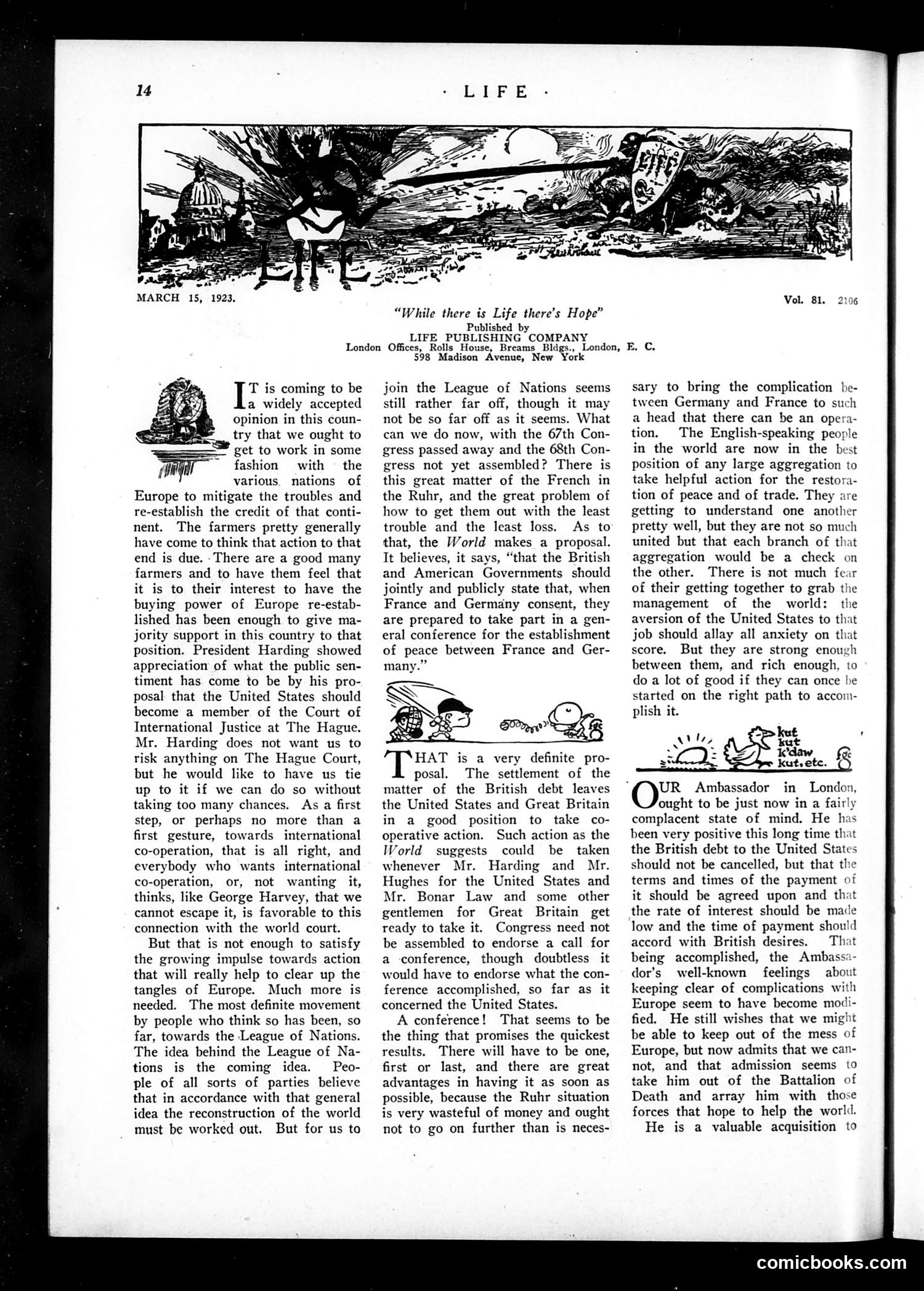
This page discusses post-World War I international relations, focusing on whether the United States should join the League of Nations and participate in settling Franco-German disputes over war debts and reparations. The small cartoons show anthropomorphized figures (appearing to represent nations or political entities) in conversation—likely depicting diplomatic negotiations. The text references President Harding's reluctance to commit to international courts or the League, while advocating for American involvement in resolving European financial entanglements. The article proposes that Britain and America jointly pressure France and Germany toward peaceful settlement, arguing this would benefit American interests and world stability. The satirical point appears to be the tension between American isolationism and the practical necessity of engagement in post-war European reconstruction.
📄 Transcribed text from this page (OCR, searchable)
Machine-transcribed from the original scan — historical spelling and the odd misread are preserved.
MARCH 15, “While there is Life there’s Hope” Published by LIFE PUBLISHING COMPANY London Offices, Rolls House, Breams Bldgs., London, E. C. T is coming to be a widely accepted opinion in this coun- ; try that we ought to ———— get to work in some ea fashion with the various. nations of Europe to mitigate the troubles and re-establish the credit of that conti- nent. The farmers pretty generally have come to think that action to that end is due. -There are a good many farmers and to have them feel that it is to their interest to have the buying power of Europe re-estab- lished has been enough to give ma- jority support in this country to that position. President Harding showed appreciation of what the public sen- timent has come to be by his pro- posal that the United States should become a member of the Court of International Justice at The Hague. Mr. Harding does not want us to risk anything on The Hague Court, but he would like to have us tie up to it if we can do so without taking too many chances. As a first step, or perhaps no more than a first gesture, towards international co-operation, that is all right, and everybody who wants international co-operation, or, not wanting it, thinks, like George Harvey, that we cannot escape it, is favorable to this connection with the world court. But that is not enough to satisfy the growing impulse towards action that will really help to clear up the tangles of Europe. Much more is needed. The most definite movement by people who think so has been, so far, towards the League of Nations. The idea behind the League of Na- tions is the coming idea. Peo- ple of all sorts of parties believe that in accordance with that general idea the reconstruction of the world must be worked out. But for us to 598 Madison Avenue, New York join the League of Nations seems still rather far off, though it may not be so far off as it seems. What can we do now, with the 67th Con- gress passed away and the 68th Con- gress not yet assembled? There is this great matter of the French in the Ruhr, and the great problem of how to get them out with the least trouble and the least loss. As to that, the World makes a proposal. It believes, it says, “that the British and American Governments should jointly and publicly state that, when France and Germany consent, they are prepared to take part in a gen- eral conference for the establishment of peace between France and Ger- HAT is a very definite pro- posal. The settlement of the matter of the British debt leaves the United States and Great Britain in a good position to take co- operative action. Such action as the World suggests could be taken whenever Mr. Harding and Mr. Hughes for the United States and Mr. Bonar Law and some other gentlemen for Great Britain get ready to take it. Congress need not be assembled to endorse a call for a conference, though doubtless it would have to endorse what the con- ference accomplished, so far as it concerned the United States. A conference! That seems to be the thing that promises the quickest results. There will have to be one, first or last, and there are great advantages in having it as soon as possible, because the Ruhr situation is very wasteful of money and ought not to go on further than is neces- sary to bring the complication be- tween Germany and France to such a head that there can be an opera- tion. The English-speaking people in the world are now in the best position of any large aggregation to take helpful action for the restora- tion of peace and of trade. They are getting to understand one another pretty well, but they are not so much united but that each branch of that aggregation would be a check on the other. There is not much fear of their getting together to grab the management of the world: the aversion of the United States to that job should allay all anxiety on that score. But they are strong enough between them, and rich enough, to do a lot of good if they can once be started on the right path to accom- plish it. UR Ambassador in London, ‘ought to be just now in a fairly complacent state of mind. He has been very positive this long time that the British debt to the United States should not be cancelled, but that the terms and times of the payment of it should be agreed upon and that the rate of interest should be made low and the time of payment should accord with British desires. That being accomplished, the Ambassa- dor’s well-known feelings about keeping clear of complications with Europe seem to have become modi- fied. He still wishes that we might be able to keep out of the mess of Europe, but now admits that we can- not, and that admission seems to take him out of the Battalion of Death and array him with those forces that hope to help the world. He is a valuable acquisition to comicbooks.com