
Life, 1923-03-15 · page 25 of 36
Life — March 15, 1923 — page 25: what you’re looking at
What you’re looking at
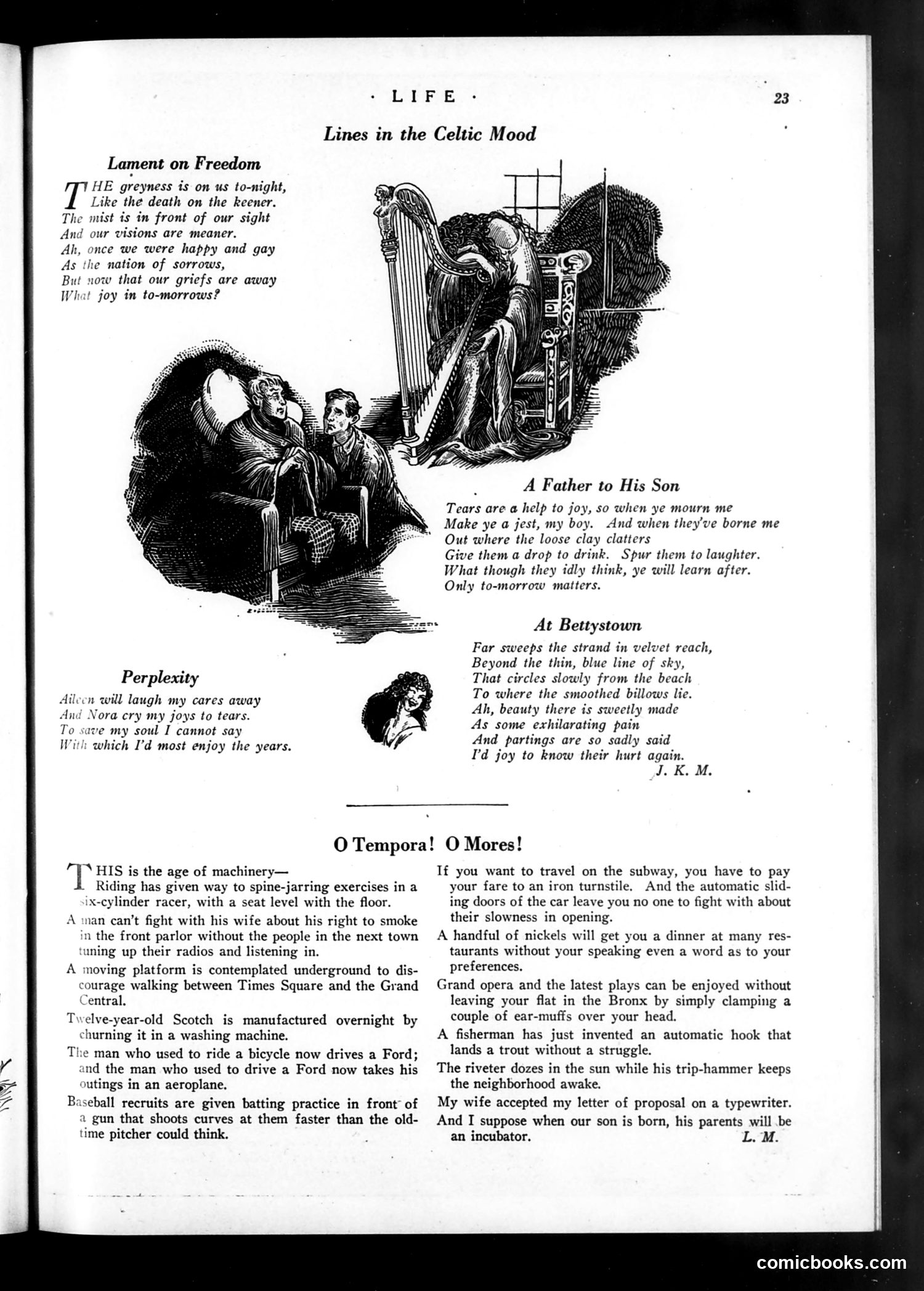
This page contains **Irish nationalist poetry** and **satirical humor** about modern technology's absurdities. The "Lines in the Celtic Mood" section features melancholic poems with Irish themes—references to Irish keening (funeral wailing), Irish names (Aileen, Nora), and the beach at Bettystown (a real Irish location). These reflect early 20th-century romanticization of Celtic identity and Irish independence sentiment. The main satire, "O Tempora! O Mores!" ("Oh the Times! Oh the Customs!"), mocks rapid technological advancement through exaggerated complaints: subway automation removing human interaction, radio broadcasts penetrating homes, machines manufacturing whiskey overnight, and courtship conducted via typewriter. The humor relies on depicting modernity as alienating and ridiculous—cars replacing bicycles, airplanes replacing cars, automatic fishing hooks eliminating struggle. The satirical point: **rapid industrialization and automation are dehumanizing**, stripping away traditional courtesies, labor, and human connection. For 1920s readers, this technology felt invasively modern; today, it reads as quaint nostalgia for a pre-digital era.
📄 Transcribed text from this page (OCR, searchable)
Machine-transcribed from the original scan — historical spelling and the odd misread are preserved.
- WEVFGE.. < Lines in the Celtic Mood Lament on Freedom HE greyness is on us to-night, Like the death on the keener. The mist is in front of our sight And our visions are meaner. Ah, once we were happy and gay As the nation of sorrows, But now that our griefs are away What joy in to-morrows? Perplexity Aileen will laugh my cares away And Nora cry my joys to tears. To save my soul I cannot say With which I’d most enjoy the years. A Father to His Son Tears are a help to joy, so when ye mourn me Make ye a jest, my boy. And when they've borne me Out where the loose clay clatters Give them a drop to drink. Spur them to laughter. What though they idly think, ye will learn after. Only to-morrow matters. At Bettystown Far sweeps the strand in velvet reach, Beyond the thin, blue line of sky, That circles slowly from the beach To where the smoothed billows lie. Ah, beauty there is sweetly made As some exhilarating pain And partings are so sadly said I'd joy to know their hurt again. J. K. M. O Tempora! O Mores! If you want to travel on the subway, you have to pay HIS is the age of machinery— Riding has given way to spine-jarring exercises in a ix-cylinder racer, with a seat level with the floor. A tnan can’t fight with his wife about his right to smoke in the front parlor without the people in the next town uning up their radios and listening in. A moving platform is contemplated underground to dis- courage walking between Times Square and the Grand Central. Twelve-year-old Scotch is manufactured overnight by churning it in a washing machine. The man who used to ride a bicycle now drives a Ford; and the man who used to drive a Ford now takes his outings in an aeroplane, Baseball recruits are given batting practice in front of 1 gun that shoots curves at them faster than the old- time pitcher could think. your fare to an iron turnstile. And the automatic slid- ing doors of the car leave you no one to fight with about their slowness in opening. A handful of nickels will get you a dinner at many res- taurants without your speaking even a word as to your preferences. Grand opera and the latest plays can be enjoyed without leaving your flat in the Bronx by simply clamping a couple of ear-muffs over your head. A fisherman has just invented an automatic hook that lands a trout without a struggle. The riveter dozes in the sun while his trip-hammer keeps the neighborhood awake. My wife accepted my letter of proposal on a typewriter. And I suppose when our son is born, his parents will .be an incubator. L.M. comicbooks.com