
Life, 1923-03-15 · page 24 of 36
Life — March 15, 1923 — page 24: what you’re looking at
What you’re looking at
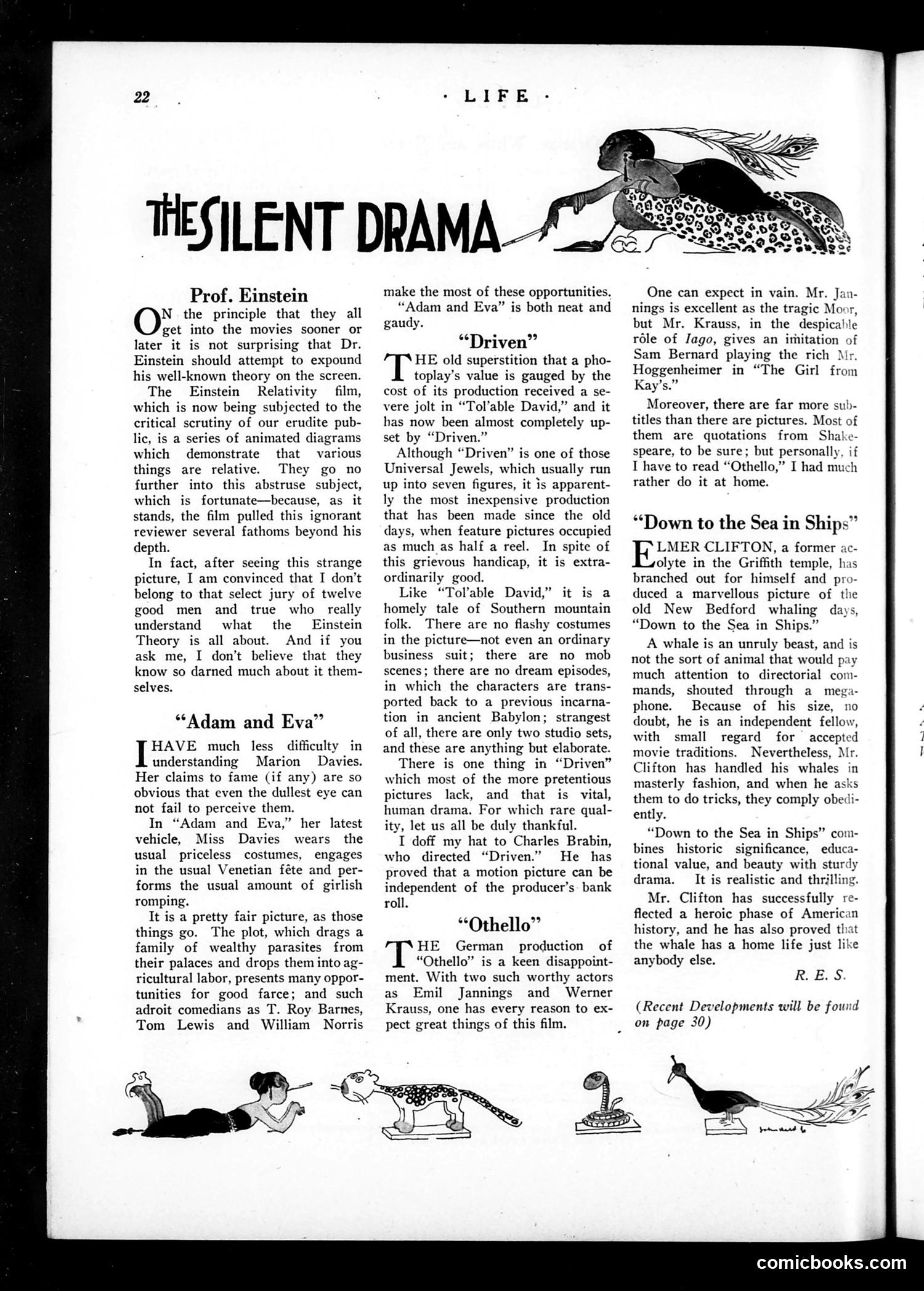
This Life magazine film review page critiques several silent films, using humor to highlight how different movies succeed or fail despite their budgets and prestige. The opening section mocks **Einstein's relativity film**, sarcastically suggesting that even the "select jury" claiming to understand Einstein's theory probably doesn't. The joke: Einstein's abstract scientific concepts don't translate well to visual media. Reviews of **"Adam and Eva"** (starring Marion Davies) are gentle—acknowledging her appeal lies in costumes and "girlish romping" rather than acting depth. The **"Driven"** section celebrates a Universal production that proves expensive budgets aren't necessary for quality cinema, contradicting the superstition that production cost equals value. Regarding the **German "Othello"** with Emil Jannings and Werner Krauss: the reviewer praises Jannings but mocks Krauss's lago performance as mimicking a comedic character ("Sam Bernard") rather than delivering Shakespearean tragedy. The complaint about excessive subtitles quoting Shakespeare suggests the film relies too heavily on text rather than visual storytelling—a fundamental problem in silent cinema. The decorative footer illustrations appear unrelated to the reviews.
📄 Transcribed text from this page (OCR, searchable)
Machine-transcribed from the original scan — historical spelling and the odd misread are preserved.
THES|LENT DRAMA. Prof. Einstein N the principle that they all get into the movies sooner or later it is not surprising that Dr. Einstein should attempt to expound his well-known theory on the screen. The Einstein Relativity film, which is now being subjected to the critical scrutiny of our erudite pub- lic, is a series of animated diagrams which demonstrate that various things are relative. They go no further into this abstruse subject, which is fortunate—because, as it stands, the film pulled this ignorant reviewer several fathoms beyond his depth. In fact, after seeing this strange picture, I am convinced that I don’t belong to that select jury of twelve good men and true who really understand what the Einstein Theory is all about. And if you ask me, I don’t believe that they know so darned much about it them- selves. “Adam and Eva” HAVE much less difficulty in understanding Marion Davies. Her claims to fame (if any) are so obvious that even the dullest eye can not fail to perceive them. In “Adam and Eva,” her latest vehicle, Miss Davies wears the usual priceless costumes, engages in the usual Venetian féte and per- forms the usual amount of girlish romping. It is a pretty fair picture, as those things go. The plot, which drags a family of wealthy parasites from their palaces and drops them into ag- ricultural labor, presents many oppor- tunities for good farce; and such adroit comedians as T. Roy Barnes, Tom Lewis and William Norris ag AI d make the most of these opportunities. “Adam and Eva” is both neat and gaudy. “Driven” HE old superstition that a pho- toplay’s value is gauged by the cost of its production received a se- vere jolt in “Tol’able David,” and it has now been almost completely up- set by “Driven.” Although “Driven” is one of those Universal Jewels, which usually run up into seven figures, it is apparent- ly the most inexpensive production that has been made since the old days, when feature pictures occupied as much as half a reel. In spite of this grievous handicap, it is extra- ordinarily good. Like “Tol’able David,” it is a homely tale of Southern mountain folk. There are no flashy costumes in the picture—not even an ordinary business suit; there are no mob scenes; there are no dream episodes, in which the characters are trans- ported back to a previous incarna- tion in ancient Babylon; strangest of all, there are only two studio sets, and these are anything but elaborate. There is one thing in “Driven” which most of the more pretentious pictures lack, and that is vital, human drama. For which rare qual- ity, let us all be duly thankful. I doff my hat to Charles Brabin, who directed “Driven.” He has proved that a motion picture can be independent of the producer’s. bank roll. “Othello” HE German production of “Othello” is a keen disappoint- ment. With two such worthy actors as Emil Jannings and Werner Krauss, one has every reason to ex- pect great things of this film. One can expect in vain. Mr. Ja nings is excellent as the tragic Moor, but Mr. Krauss, in the despicable rdle of Jago, gives an imitation of Sam Bernard playing the rich Mr. Hoggenheimer in “The Girl from Kay’s.” Moreover, there are far more sub- titles than there are pictures. Most of them are quotations from Shake- speare, to be sure; but personally, if I have to read “Othello,” I had much rather do it at home. “Down to the Sea in Ships” LMER CLIFTON, a former ac- olyte in the Griffith temple, has branched out for himself and pro- duced a marvellous picture of the old New Bedford whaling days, “Down to the Sea in Ships.” A whale is an unruly beast, and is not the sort of animal that would pay much attention to directorial com- mands, shouted through a mega- phone. Because of his size, no doubt, he is an independent fellow, with small regard for accepted movie traditions. Nevertheless, Mr. Clifton has handled his whales in masterly fashion, and when he asks them to do tricks, they comply obedi- ently. “Down to the Sea in Ships” com- bines historic significance, educa- tional value, and beauty with sturdy drama. It is realistic and thrilling. Mr. Clifton has successfully re- flected a heroic phase of American history, and he has also proved that the whale has a home life just like anybody else. RE. S. (Recent Developments will be found on page 30) comicbooks.com