
A complete issue · 36 pages · 1922
Life — December 14, 1922
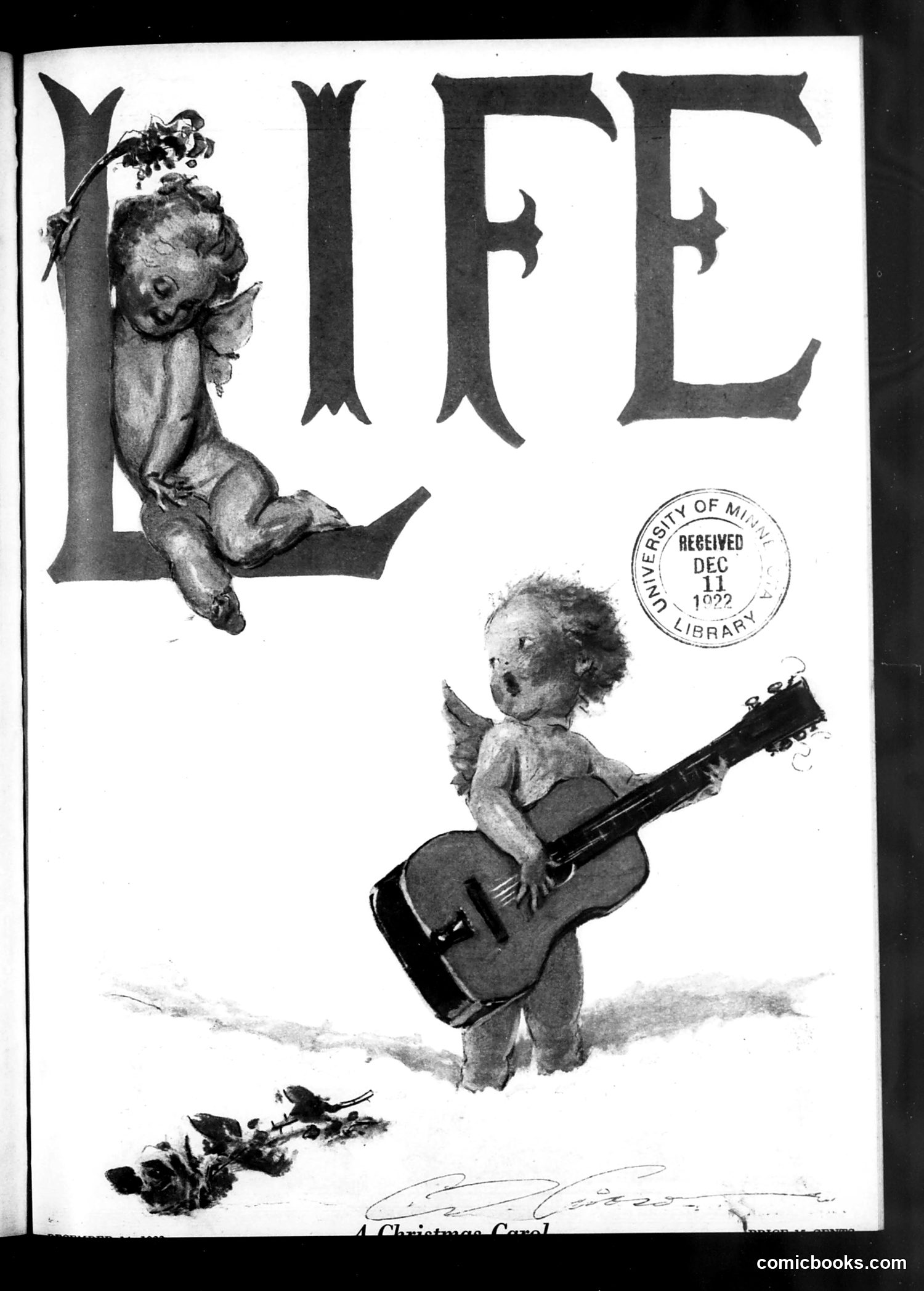
This appears to be a *Life* magazine cover (received December 1, 1922) featuring cherubic figures in a Christmas-themed illustration. The large decorative letter "L" frames one cherub holding greenery, while a second cherub below plays an acoustic guitar. The text at bottom reads "A Christmas Carol," indicating this is seasonal holiday content rather than political satire. The imagery—winged cherubs, festive greenery, musical performance—represents traditional Christmas iconography and religious themes associated with nativity scenes and holiday celebrations. This appears to be decorative cover art celebrating Christmas rather than political or social commentary. The humor likely derives from the playful, innocent depictions of the cherubic figures in domestic, musical contexts rather than satirical critique.
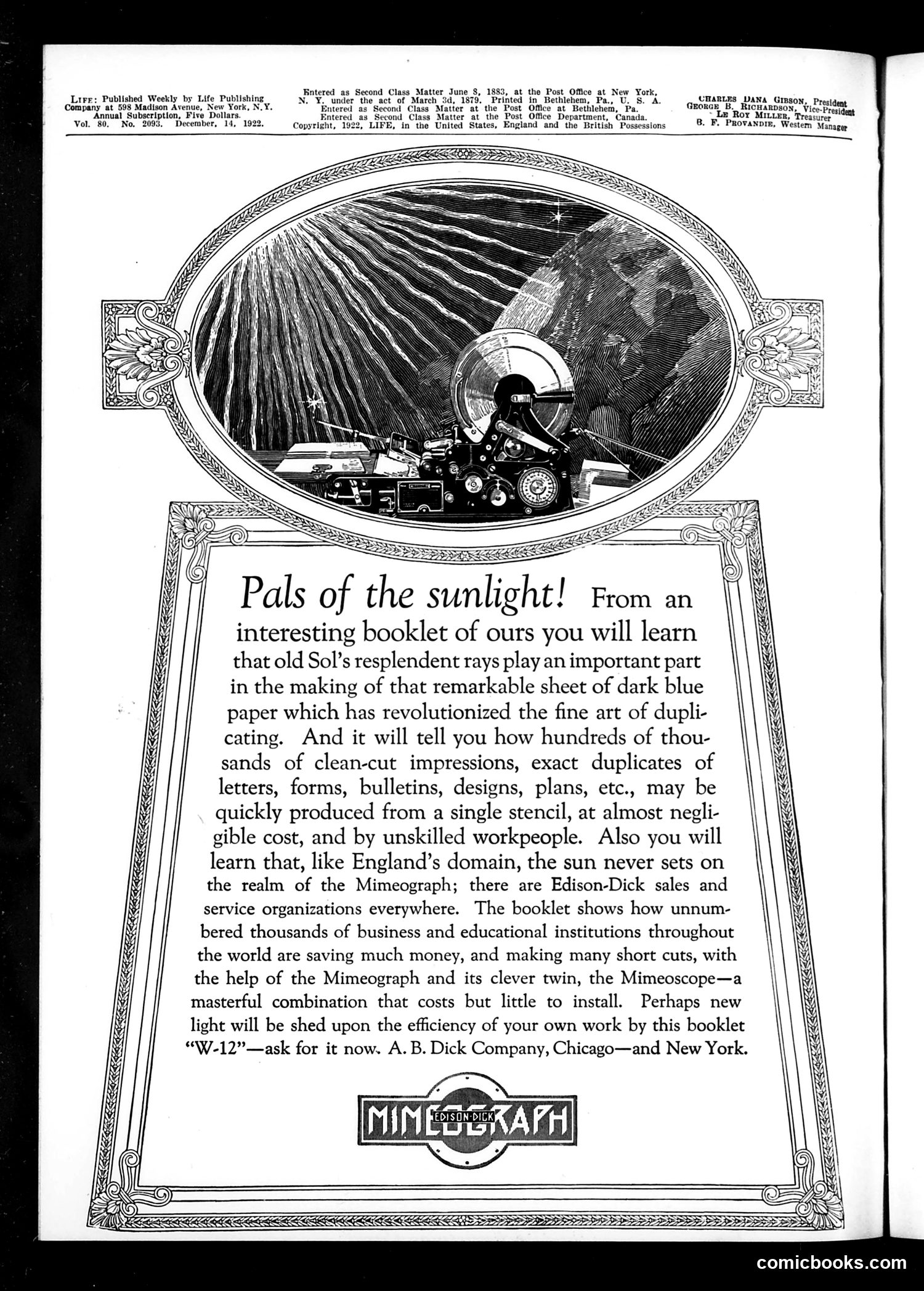
This is primarily **advertising content**, not political satire. The page features a full-page ad for the Mimeograph, a duplicating machine made by A. B. Dick Company of Chicago and New York. The advertisement uses poetic language ("Pals of the sunlight!") to promote the mimeograph's capabilities: producing clean copies on dark blue paper quickly and inexpensively. The illustration shows a mimeograph machine with sun imagery, metaphorically suggesting the machine works like sunlight to "illuminate" business efficiency. The ad claims the mimeograph enables organizations to save money and produce duplicates without skilled labor, positioning it as a revolutionary business tool. This reflects early-20th-century enthusiasm for labor-saving office technology. There is no political cartoon or satire present on this page.
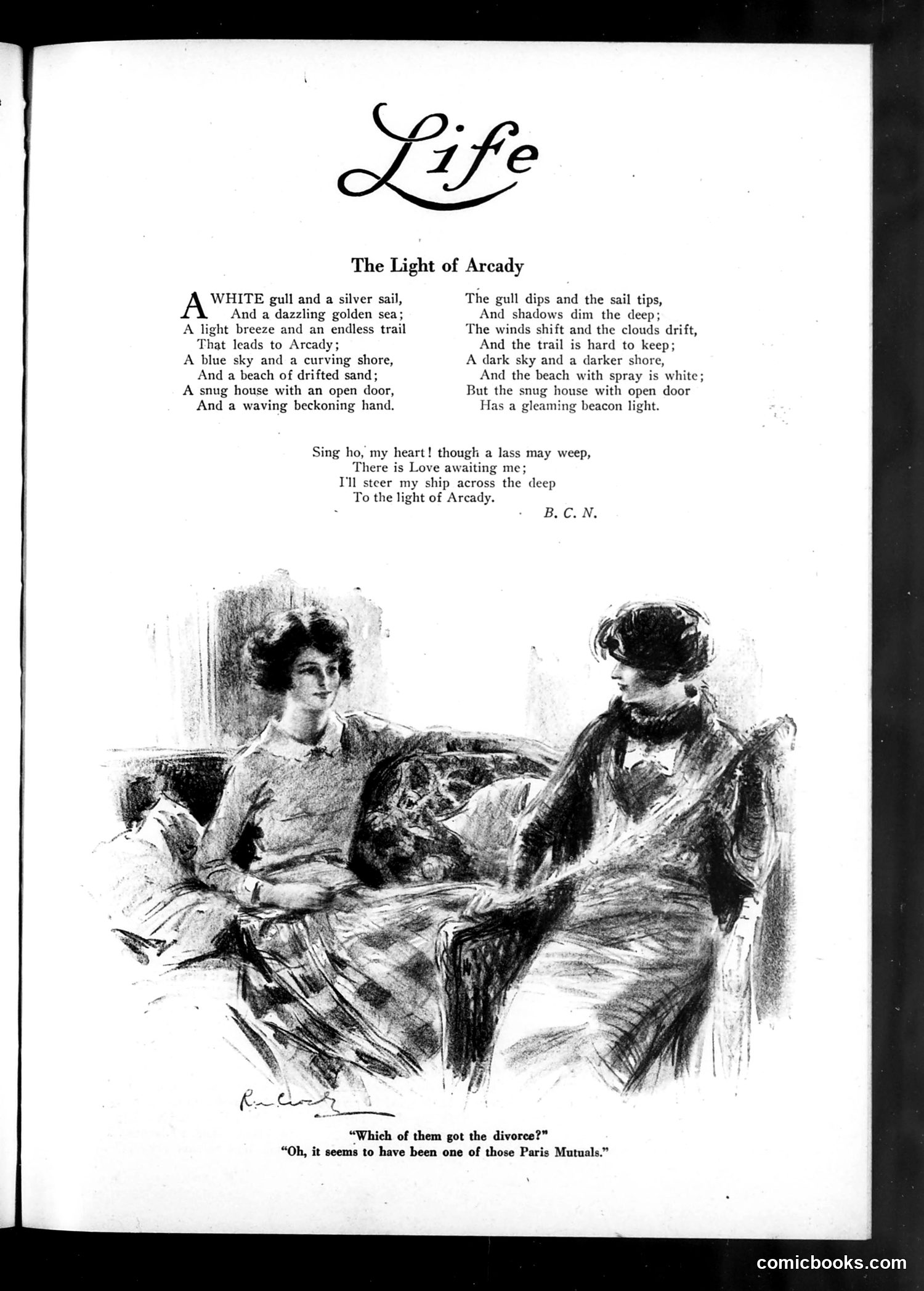
This page contains a poem titled "The Light of Arcady" (credited B.C.N.) about maritime romance and longing, paired with an illustration showing two women in conversation on a couch with a small dog. The cartoon's humor derives from the dialogue caption: "Which of them got the divorce?" / "Oh, it seems to have been one of those Paris Mutuals." The joke references "Paris Mutual" divorce procedures—likely referring to the ease of obtaining divorces in Paris, which made it a destination for Americans seeking separations during an era of stricter divorce laws in the U.S. The satirical point mocks fashionable society women casually discussing divorce as a mundane social occurrence, treating a legal separation as merely another aspect of their privileged lifestyle.
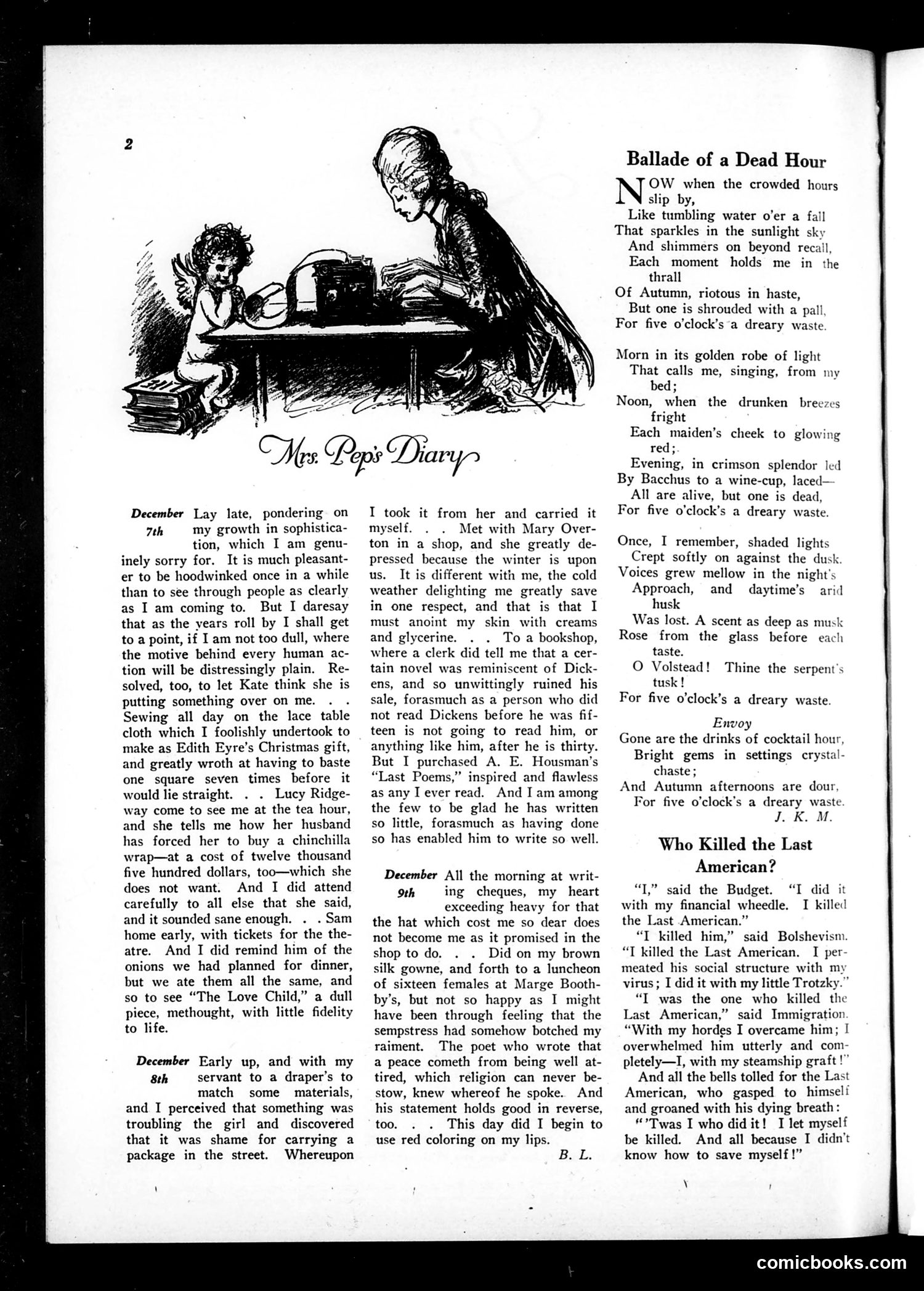
This page contains three distinct literary pieces rather than political cartoons: 1. **"Mrs. Peps Diary"** (with accompanying illustration): A domestic humor column describing a woman's December activities—shopping, attending theater, and social obligations. The tone is gently satirical about upper-middle-class women's busy social schedules. 2. **"Ballade of a Dead Hour"** (poem): A melancholic verse about the five o'clock hour, personified as a "dreary waste" in autumn. It reflects fin-de-siècle aesthetic sensibilities popular in early 20th-century literary magazines. 3. **"Who Killed the Last American?"**: A satirical piece where various figures (Budget, Bolshevism, Immigration, etc.) humorously claim responsibility for killing "the Last American," each representing contemporary social anxieties about American identity and modernization. The page reflects Life's role as a literary and social satire publication rather than purely visual humor.
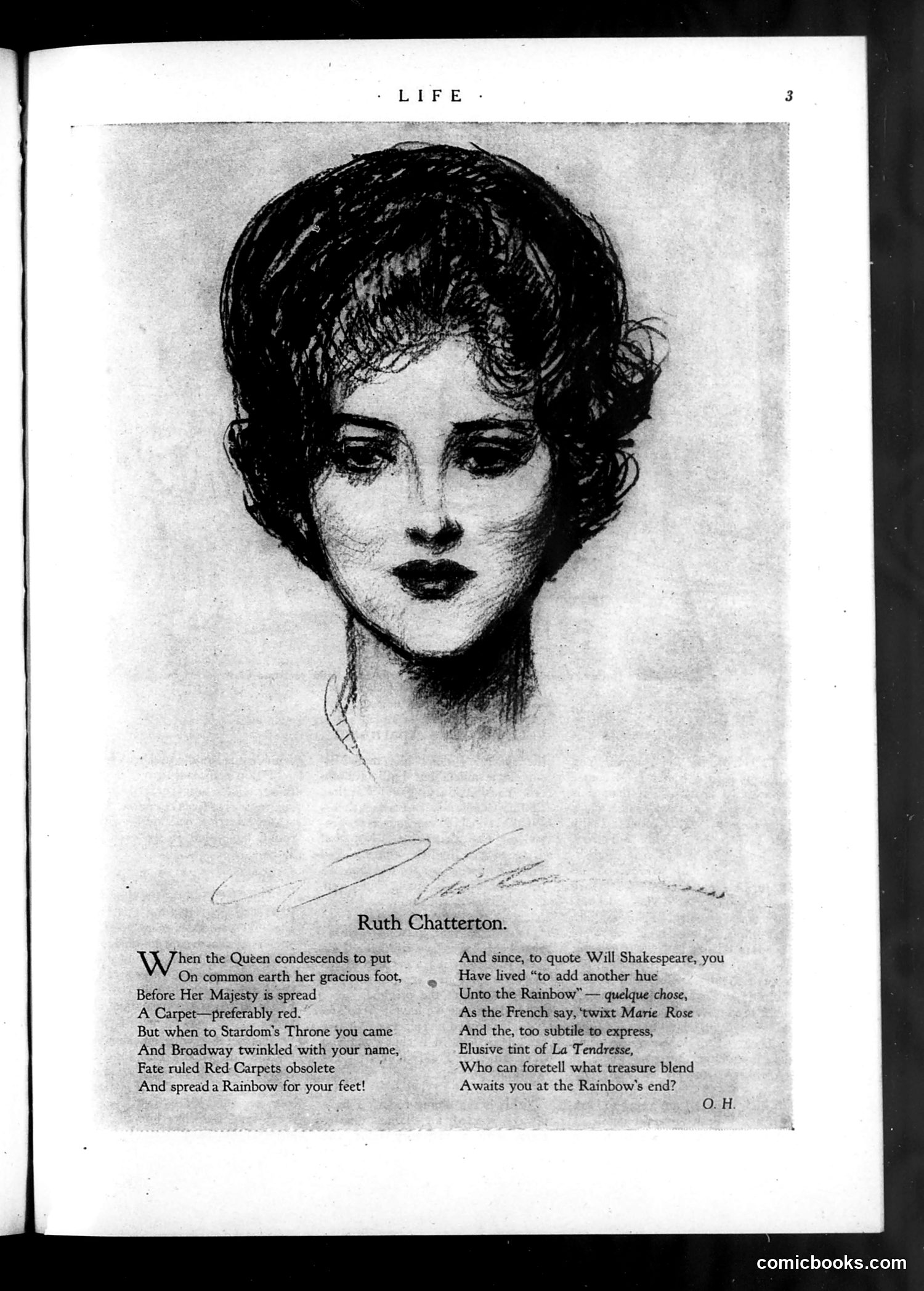
This page features a portrait and tribute to **Ruth Chatterton**, an actress of the 1920s-30s era. The accompanying poem by "O.H." celebrates her theatrical success, using the metaphor of "red carpets" and "rainbows" to represent her rise to prominence. The verse references Shakespeare and French theatrical tradition, positioning Chatterton within a lineage of celebrated performers. The poem's tone suggests she achieved notable status—the "Queen" reference in the opening couplet indicates she was considered a major star of her era. This appears to be a straightforward celebrity tribute page rather than political satire. It documents the cultural prominence of stage actresses during the interwar period and *Life* magazine's practice of honoring entertainment figures through illustrated profiles.
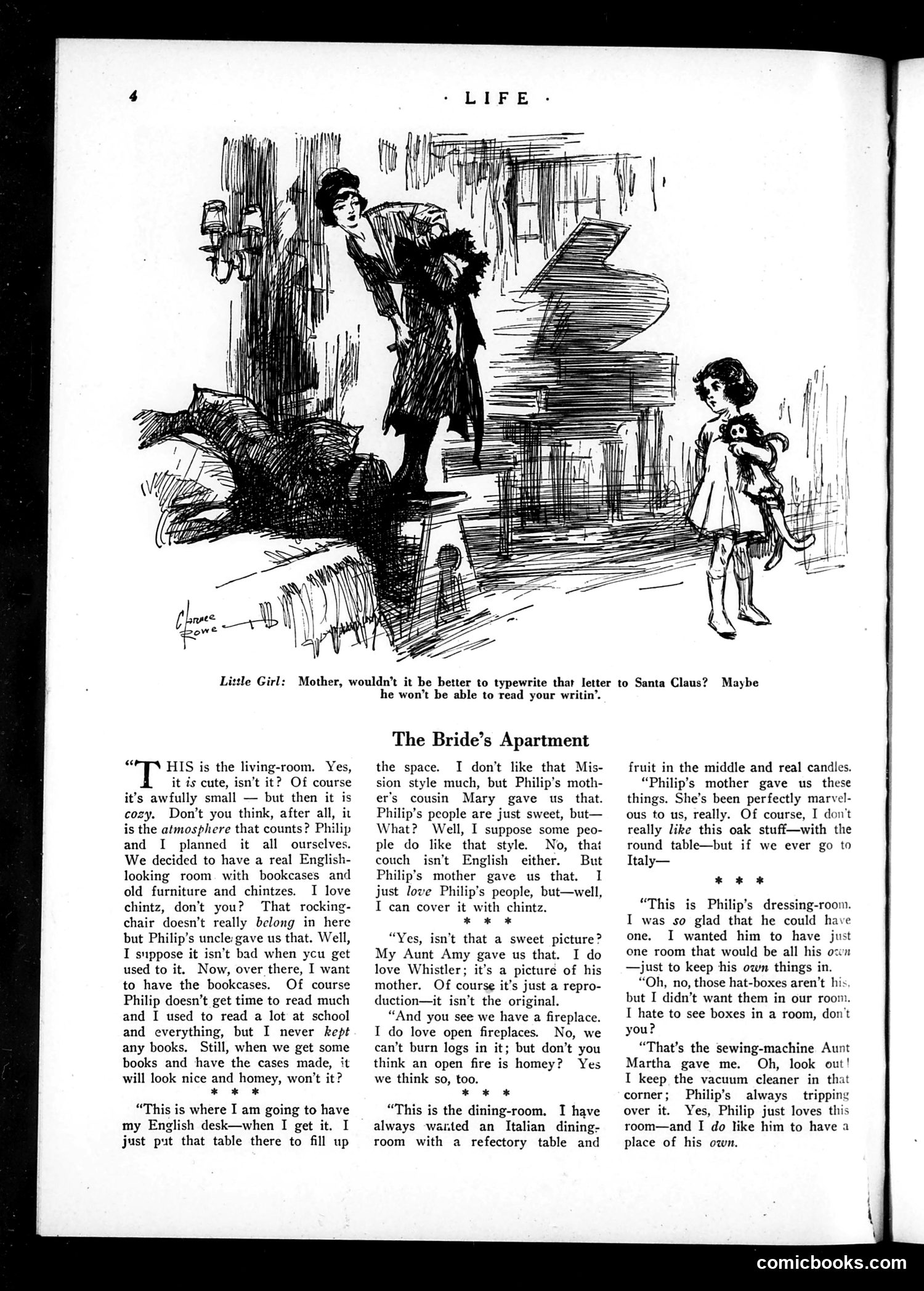
The cartoon at top shows a small girl suggesting her mother typewrite a letter to Santa Claus instead of handwriting it, joking that Santa "won't be able to read your writin'." This is simple domestic humor about illegible handwriting—a relatable problem for the era. The bulk of the page is an article titled "The Bride's Apartment," featuring a newlywed woman describing her furnished home room-by-room. She discusses decorating choices, gifts from relatives, and her husband Philip's preferences. The accompanying illustration shows a man and woman with stacked furniture and household items. This isn't political satire but rather light social commentary on 1920s marriage, domesticity, and consumer goods—reflecting contemporary interests in interior design and newlywed life.
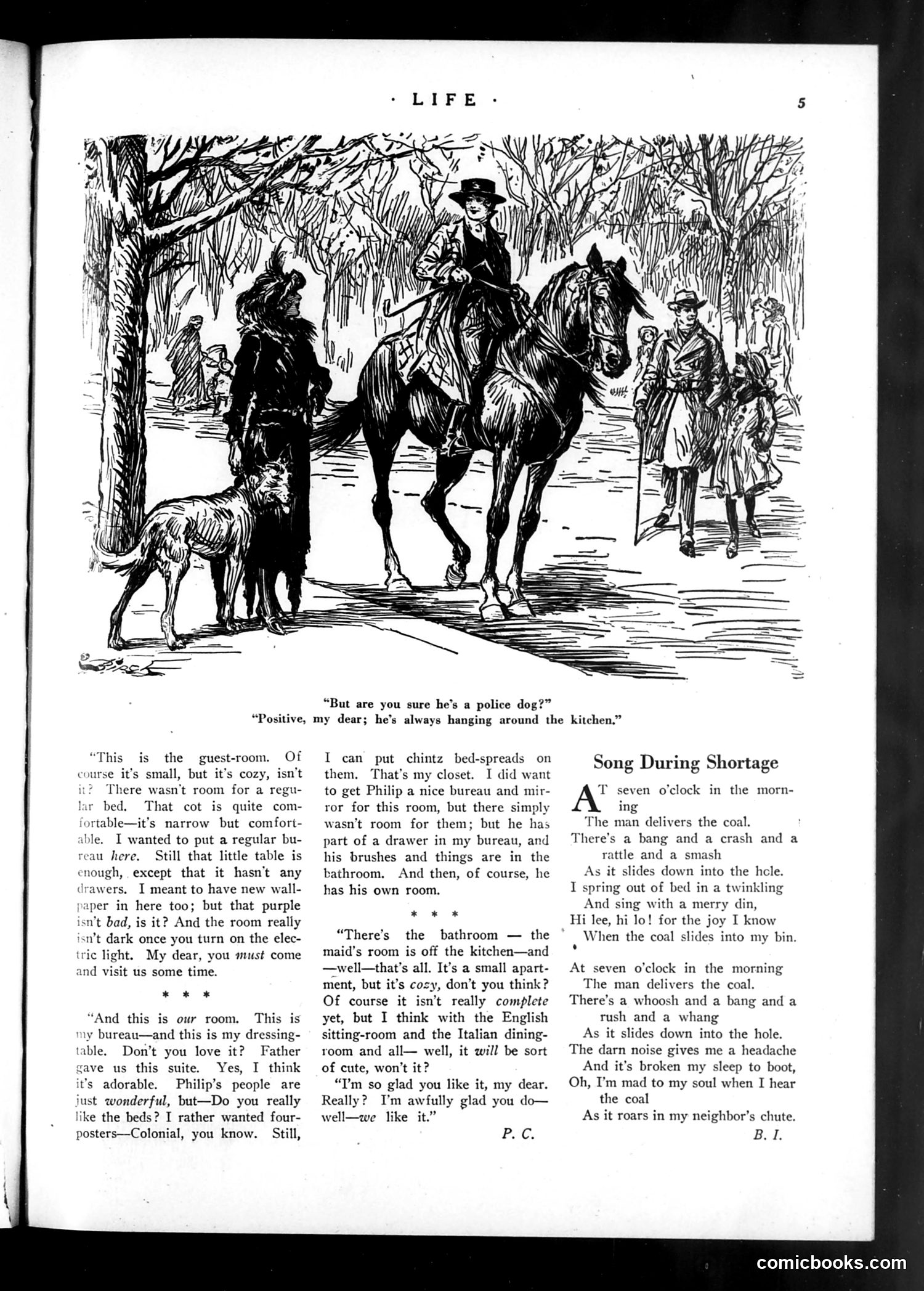
This page contains a single cartoon and accompanying prose dialogue, not political commentary. The cartoon depicts a woman on horseback in a tree-lined avenue, accompanied by a dog and various pedestrians. The caption reads: "But are you sure he's a police dog?" with the reply: "Positive, my dear; he's always hanging around the kitchen." This is a gentle domestic humor joke playing on the term "police dog" (a trained law-enforcement canine). The joke suggests the dog in question is not an actual police dog but rather a common kitchen scavenger—dogs known for loitering near kitchens seeking food scraps. The satire targets neither politics nor social issues, but simply exploits wordplay for humorous effect, typical of *Life* magazine's lighter content.
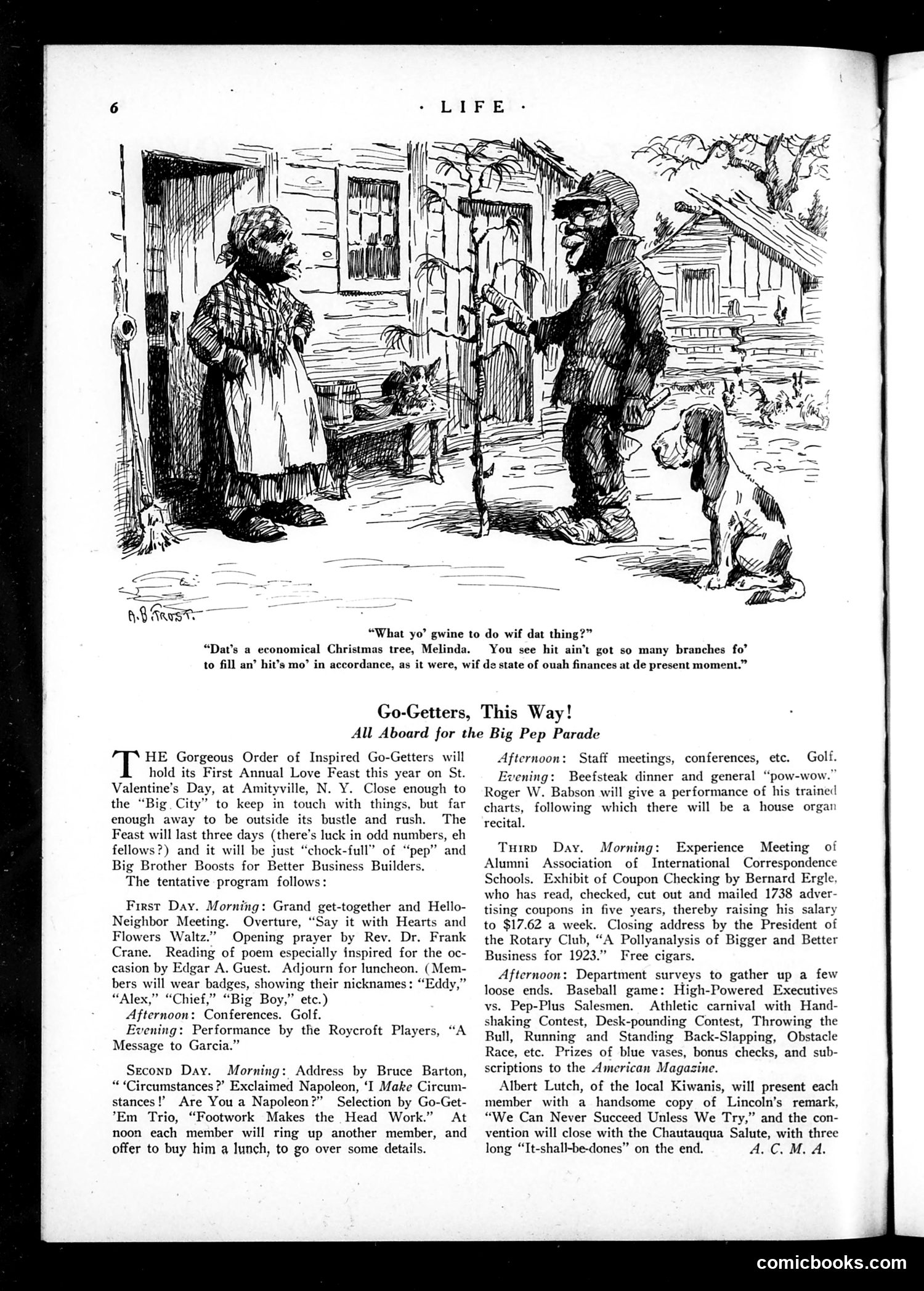
The cartoon depicts a conversation between two working-class figures (appearing to be a woman and a man) discussing a sparse Christmas tree. The dialogue satirizes economic hardship: one character defends the meager tree as "economical," explaining its lack of branches reflects their poor financial situation. The cartoon critiques Depression-era poverty by using the Christmas tree as a symbol of diminished resources and lowered expectations. The humor derives from the frank acknowledgment of financial struggle dressed up as practicality. Below this is an announcement for a "Go-Getters" organization's three-day social event in Amityville, New York, listing various business-networking activities and entertainment—representing the aspirational, organization-focused culture of 1920s-30s American civic life.
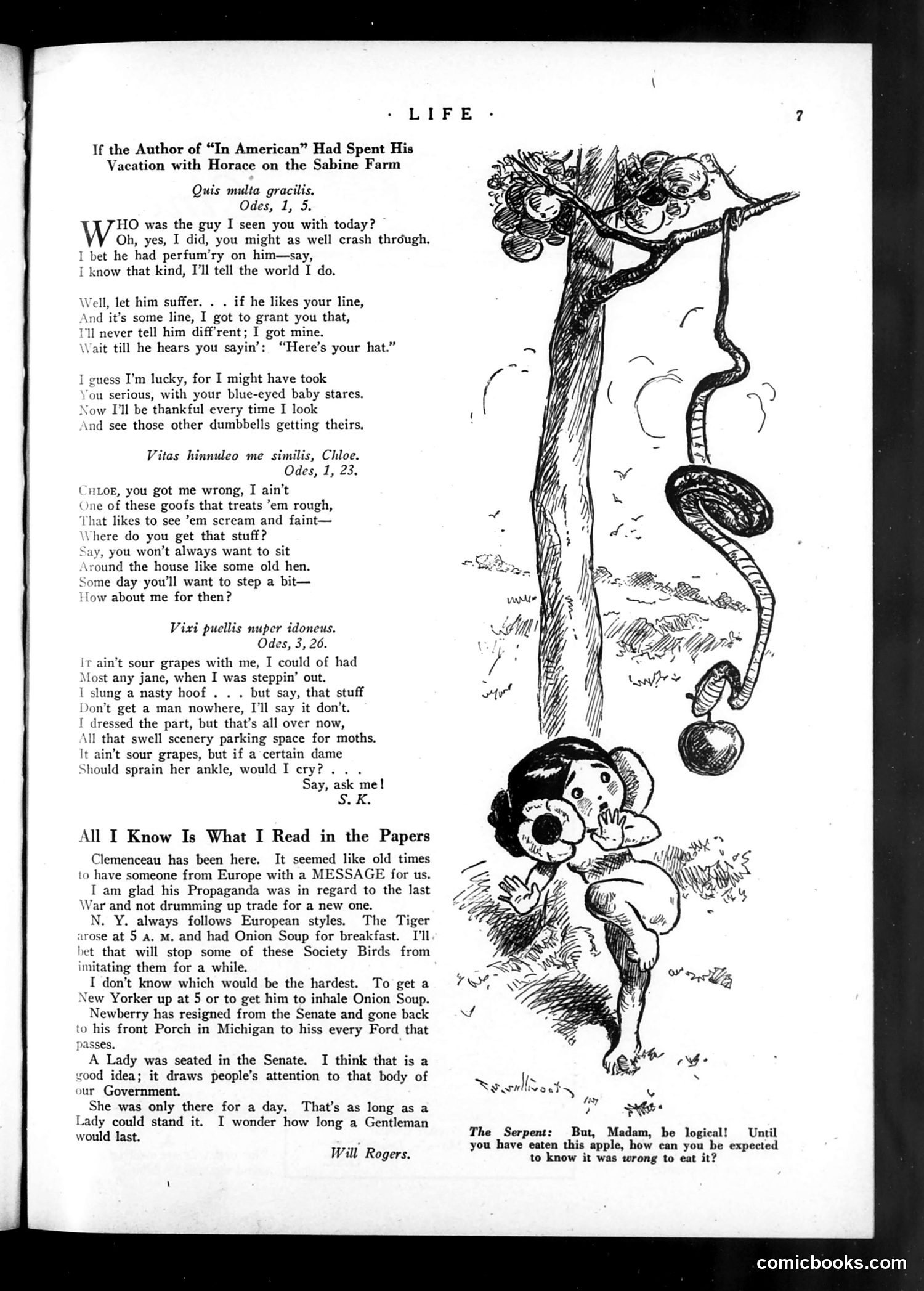
This page contains humorous verse and a cartoon satirizing early 20th-century American social life. The poems mock various social types—a perfume-wearing man, demanding women, and European pretensions among New York society. The cartoon depicts a woman and a serpent coiled around a tree. The serpent says: "But, Madam, he logical! Until you have eaten this apple, how can you be expected to know it was wrong to eat it?" This references the biblical Garden of Eden story, satirizing female curiosity and temptation. The joke appears to critique women's rationalization of forbidden behavior—suggesting that women use logic to justify transgressions. The cartoon likely reflects contemporary anxieties about changing women's roles and increased female independence in the 1920s-30s era.
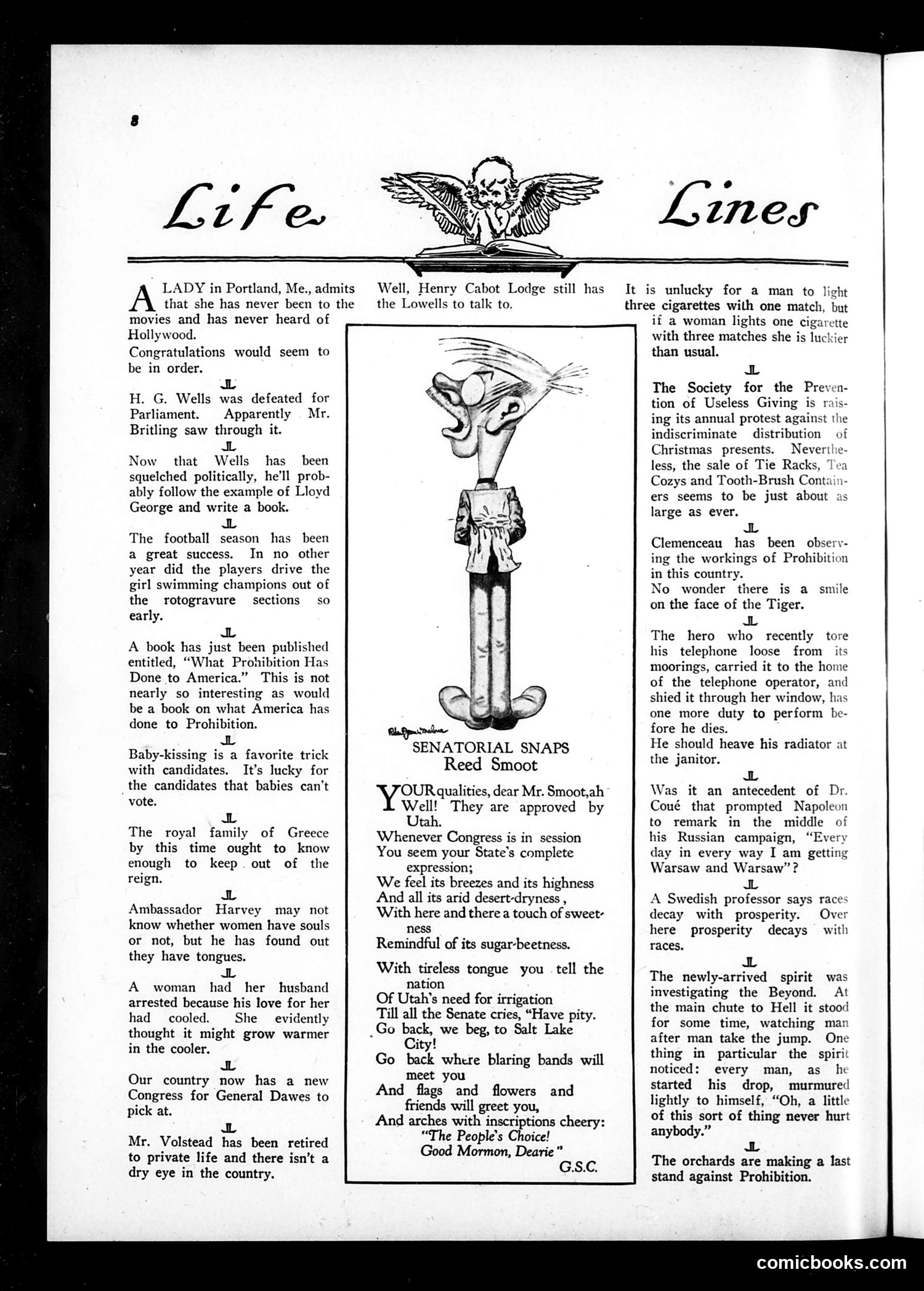
This satirical column page features "Senatorial Snaps" by Reed Smoot, a Utah senator. The cartoon depicts an exaggerated figure with an elongated body and small head, likely mocking Smoot's political pomposity. The accompanying poem addresses Utah's congressional representatives, praising their approved "qualities" while sarcastically critiquing their "tireless tongue" and empty rhetoric. References to "Utah's need for irrigation" and Salt Lake City suggest regional political concerns. The left column contains typical Life magazine satirical observations about contemporary politics, including H.G. Wells defeating for Parliament, Prohibition enforcement, and social customs—all characteristic early 20th-century American political commentary. The satire targets political grandstanding and the disconnect between senators' flowery language and actual legislative accomplishment.
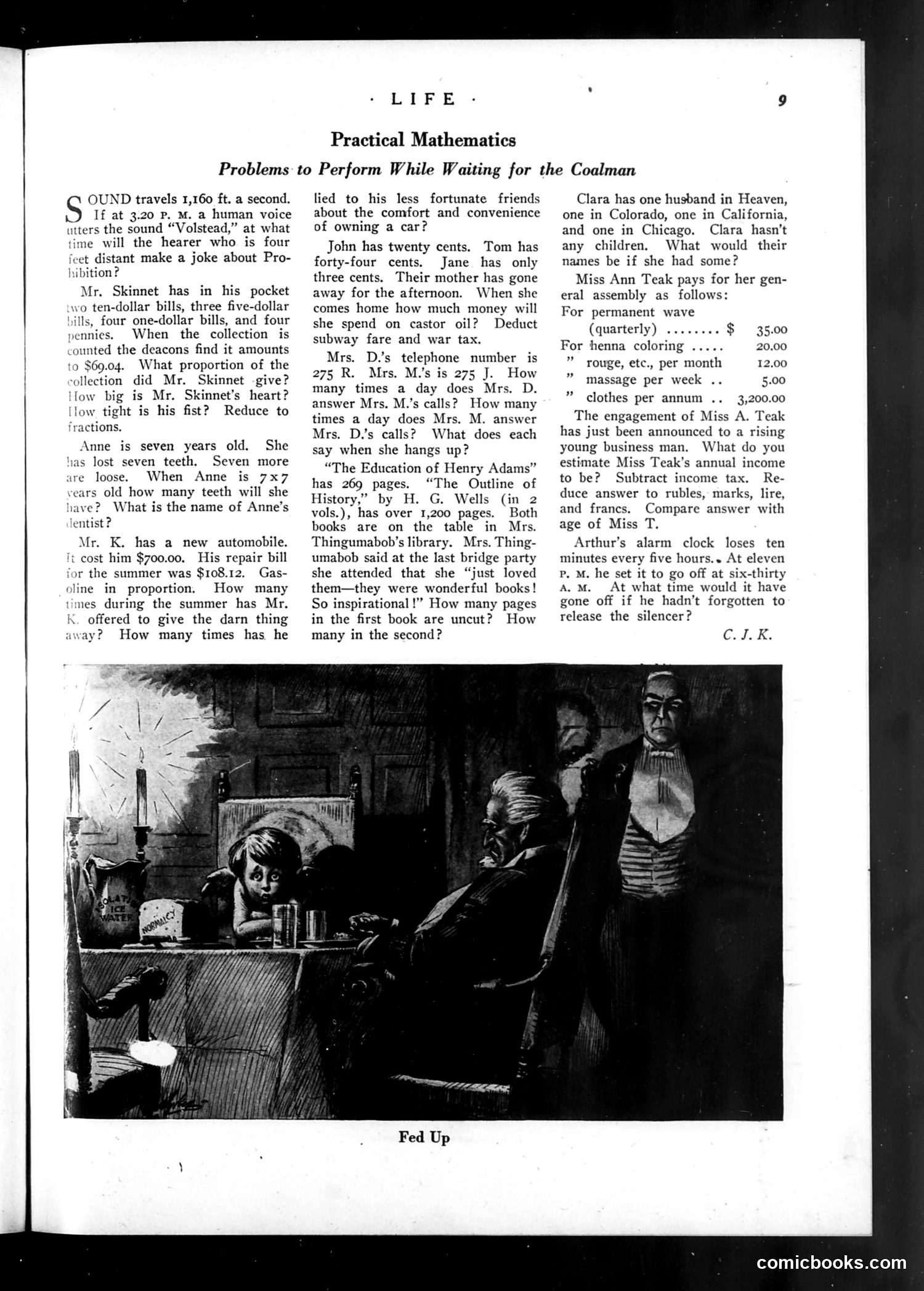
This cartoon illustrates a working-class domestic scene where a frustrated woman serves dinner to three men at a modest table. The title "Fed Up" suggests the woman's exhaustion with her household duties and dependents. The accompanying text consists of practical math problems for readers—including scenarios about sound travel, Mr. Skinnet's coin collection, and a mother calculating castor oil expenses. These problems reflect Depression-era concerns: budgeting, childcare costs, and family finances. The cartoon satirizes the burden of domestic labor and economic hardship on women, particularly mothers managing limited household resources. The juxtaposition of math problems emphasizing financial strain reinforces how women bore responsibility for making ends meet during economically difficult times.
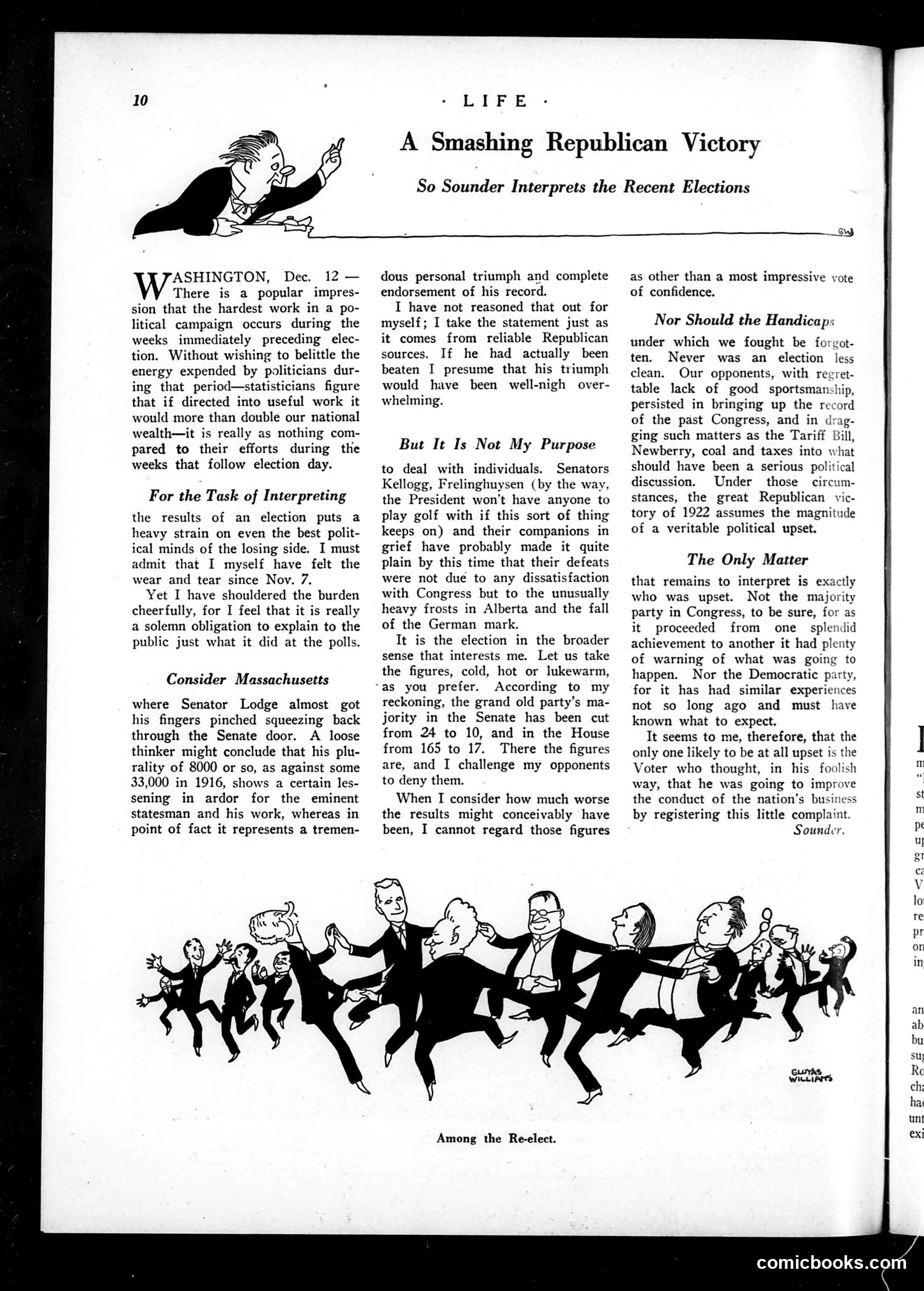
This Life magazine article (dated December 12) celebrates recent Republican electoral gains. The author discusses the 1922 midterm elections, noting Republicans gained Senate seats (24 to 10) and House seats (165 to 17). The cartoon below shows celebrating politicians dancing jubilantly, captioned "Among the Re-elect." The piece mentions Senator Lodge nearly winning in Massachusetts and references President Harding favorably by name. The author argues Republicans shouldn't be complacent about their victory margin, cautioning that the election represented voter dissatisfaction with Democrats rather than wholehearted Republican endorsement. The satire gently mocks Republican triumphalism while acknowledging genuine electoral success.
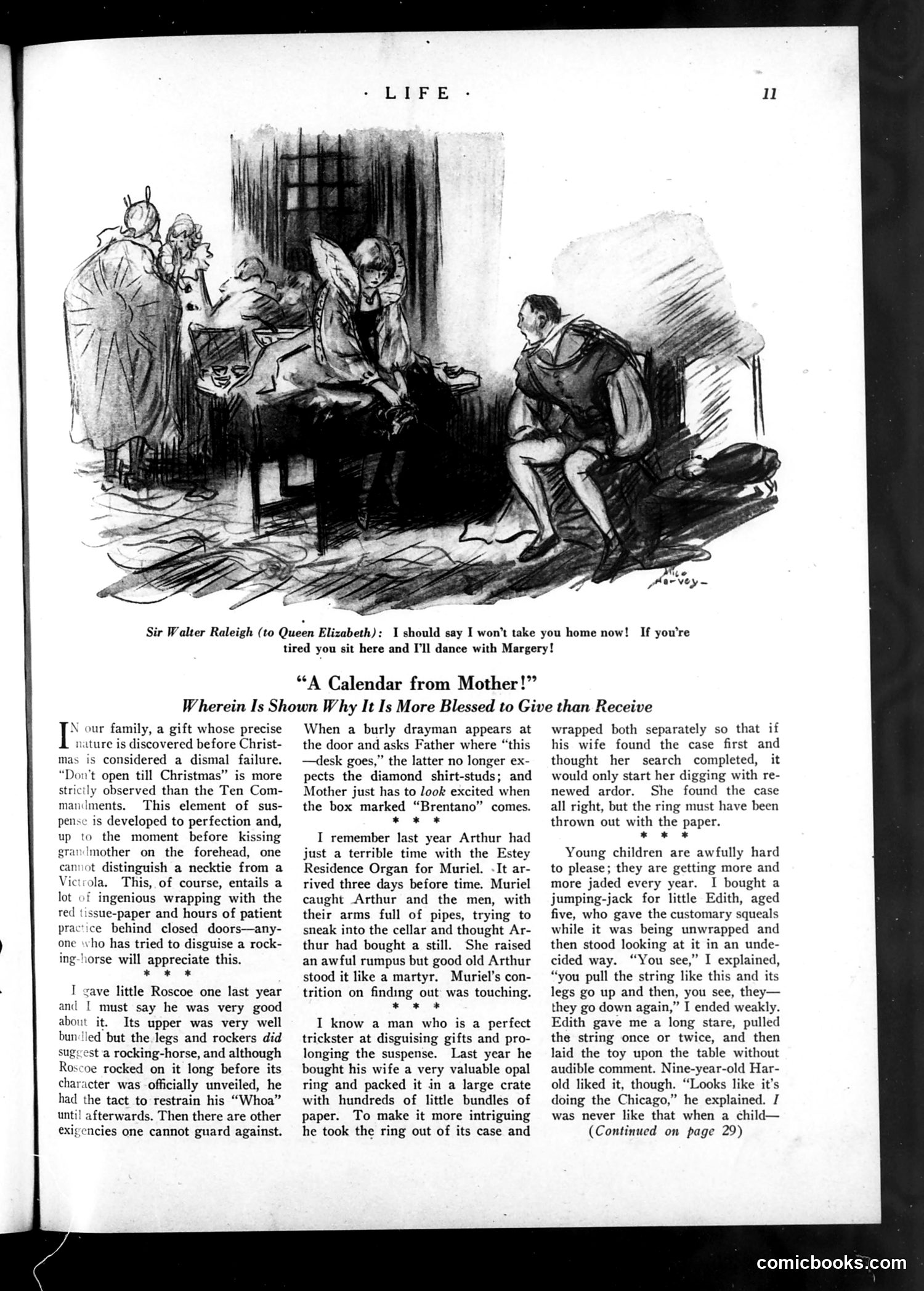
The cartoon depicts **Sir Walter Raleigh** addressing **Queen Elizabeth I**, with the caption showing him refusing to escort her home, offering to "dance with Margery" instead—a humorous inversion of the famous historical legend where Raleigh gallantly laid his cloak for the Queen. The accompanying article, "A Calendar from Mother!," discusses gift-giving etiquette, particularly the social awkwardness of unwrapping presents. The author describes various gifting mishaps—including a draysman's confusion over a "desk goes" gift, and an anecdote about a man who ingeniously packaged an opal ring in a large crate with hundreds of paper bundles to obscure its true contents. The satire targets the pretense and social conventions surrounding gift-giving and politeness in upper-class society.
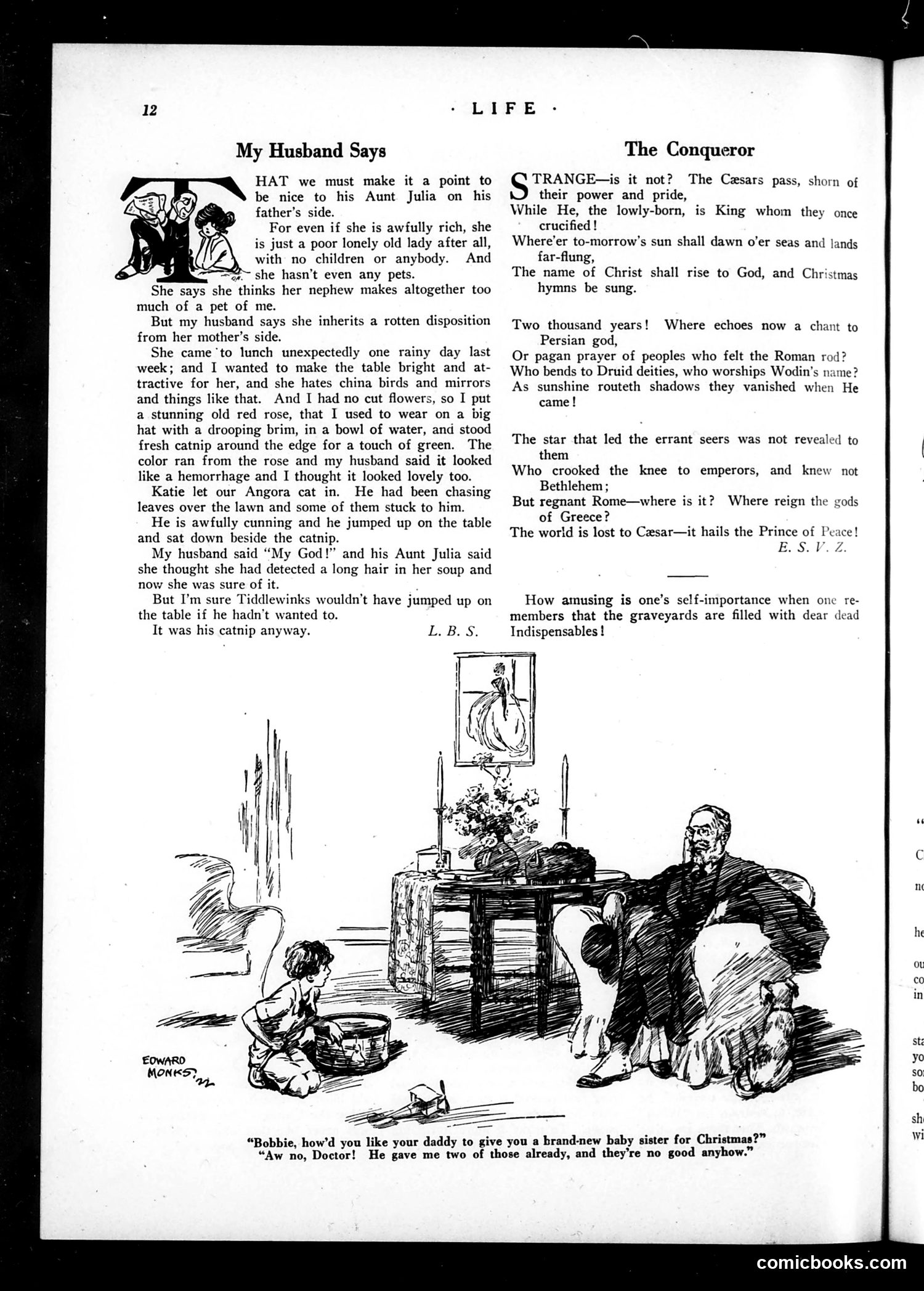
This page contains two distinct pieces: **"My Husband Says"** (L.B.S.): A domestic humor column about a wife's attempt to brighten a rainy day by decorating with a red rose and catnip. The joke relies on the husband's indifference to her efforts and his cat's enthusiasm—satirizing how men supposedly ignore their wives' attempts at home beautification while pets respond immediately. **"The Conqueror"** (E.S.V.Z.): A poem reflecting on Christianity's historical triumph over pagan Rome and earlier religions, celebrating Christ's victory where emperors and gods once ruled. It's presented as philosophical commentary on religious and historical progress. **Bottom cartoon** (Edward Monkres, signed): A domestic scene where a child asks his father for a "brand-new baby sister for Christmas," and the father replies he's already given two—implying they're unwanted. This satirizes large families and suggests children as burdensome.
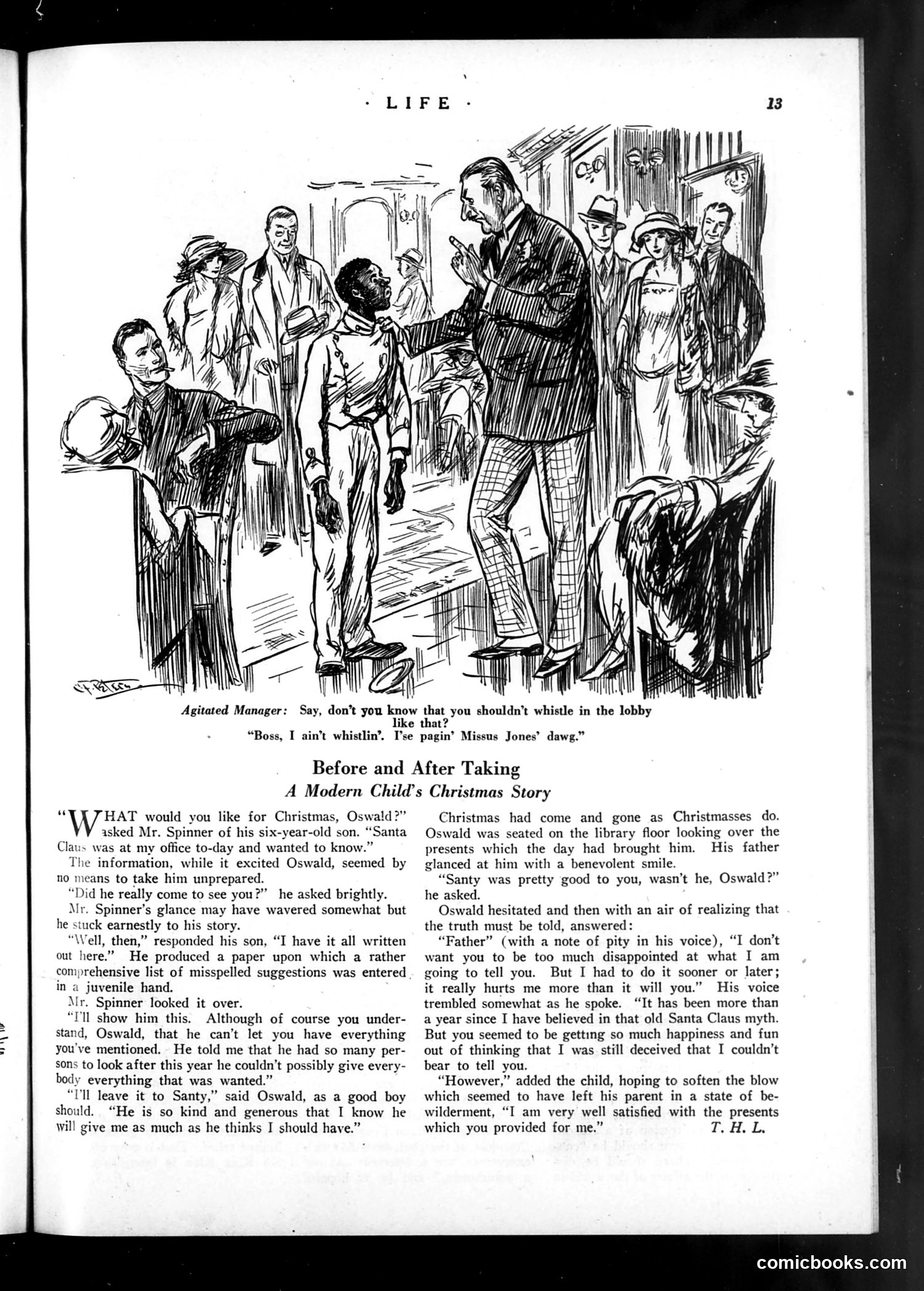
This page contains a satirical cartoon and accompanying story about childhood materialism and parental disappointment. The cartoon depicts a theater lobby scene where a young boy (Oswald) is being scolded by an agitated manager for whistling loudly—a violation of public decorum. The accompanying story reveals the satirical point: Oswald's father gave him experiences (theater tickets) rather than material gifts for Christmas, hoping to teach him appreciation. However, the boy's behavior demonstrates the lesson backfired—he's already ungrateful and disruptive despite receiving what the father considered a generous, educational present. The satire targets early-20th-century anxieties about modern children's ingratitude and materialism, suggesting that even "improving" gifts cannot combat contemporary youth's unruly nature.
The page contains two editorial pieces discussing international affairs rather than a political cartoon. The main article critiques Old Doctor Sabertooth (likely a metaphorical figure representing European militarism or imperial powers) for proposing to cure Europe's disorders. The author argues this approach is unacceptable to American sensibilities, which favor peace through alliances rather than armed conflict. The second article addresses Ireland's suffering and turmoil, criticizing both English colonial methods and Irish republican violence. It also comments on Senator Walsh of Massachusetts advocating for prosecution of the Ku Klux Klan, noting the irony that Irish people—themselves victims of persecution—should be cautious about supporting such organizations. The pieces reflect 1920s American isolationism and domestic civil rights concerns.
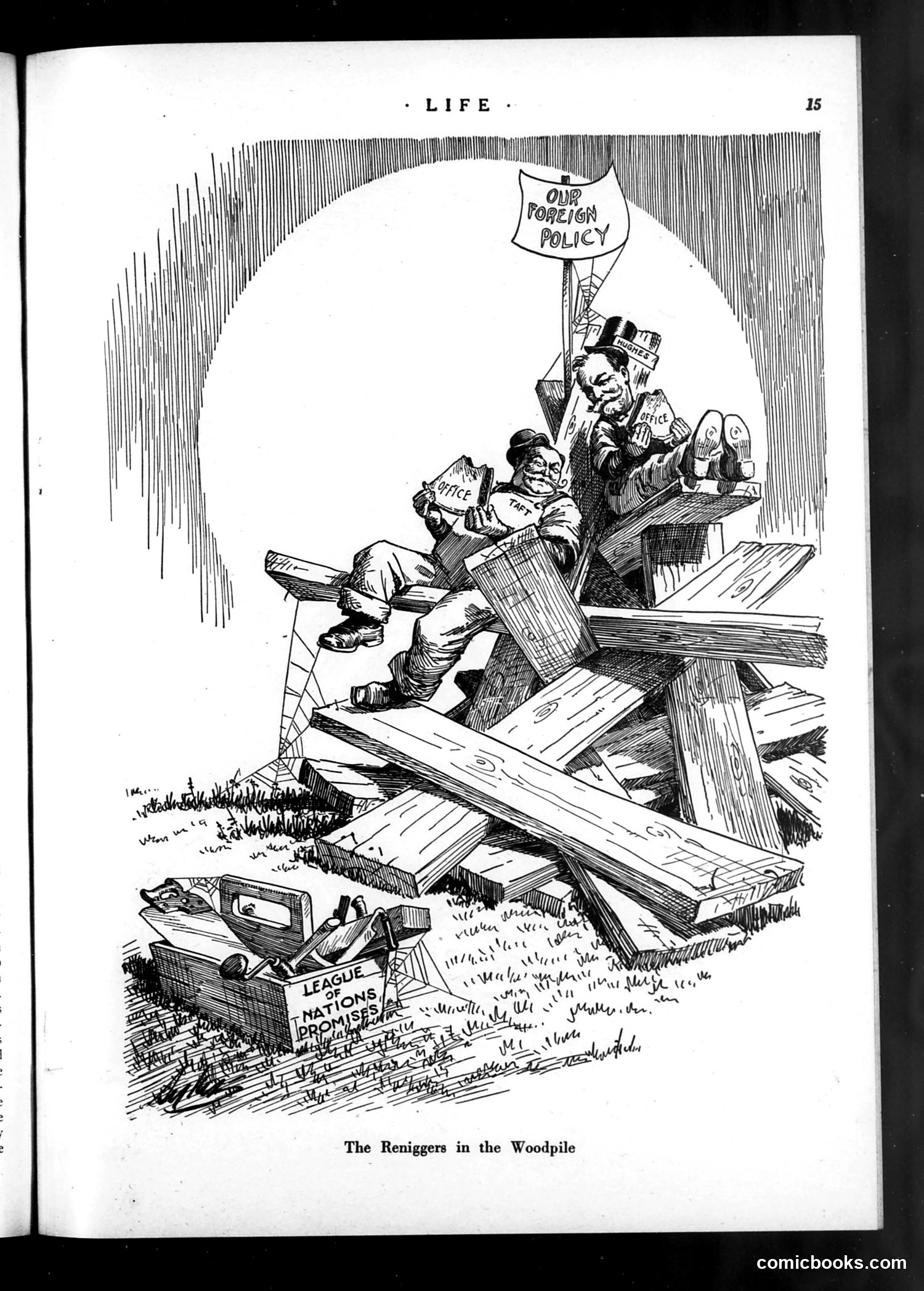
This political cartoon satirizes failures of foreign policy through the metaphor of an unstable woodpile. Two figures perch atop precarious wooden beams—one labeled "Office" appears to represent a government official, while the other holds a banner reading "Our Foreign Policy." Below them sits a container marked "League of Nations Promises," surrounded by scattered, collapsing wood. The satire critiques how foreign policy commitments (the woodpile structure) are unstable and poorly constructed, threatening to collapse. The "reneggers" (renegers—those who break promises) suggests criticism of broken international commitments, likely referencing post-WWI League of Nations failures or unfulfilled diplomatic pledges. The cartoon mocks the precarious state of America's foreign relations and the gap between stated policies and actual follow-through.
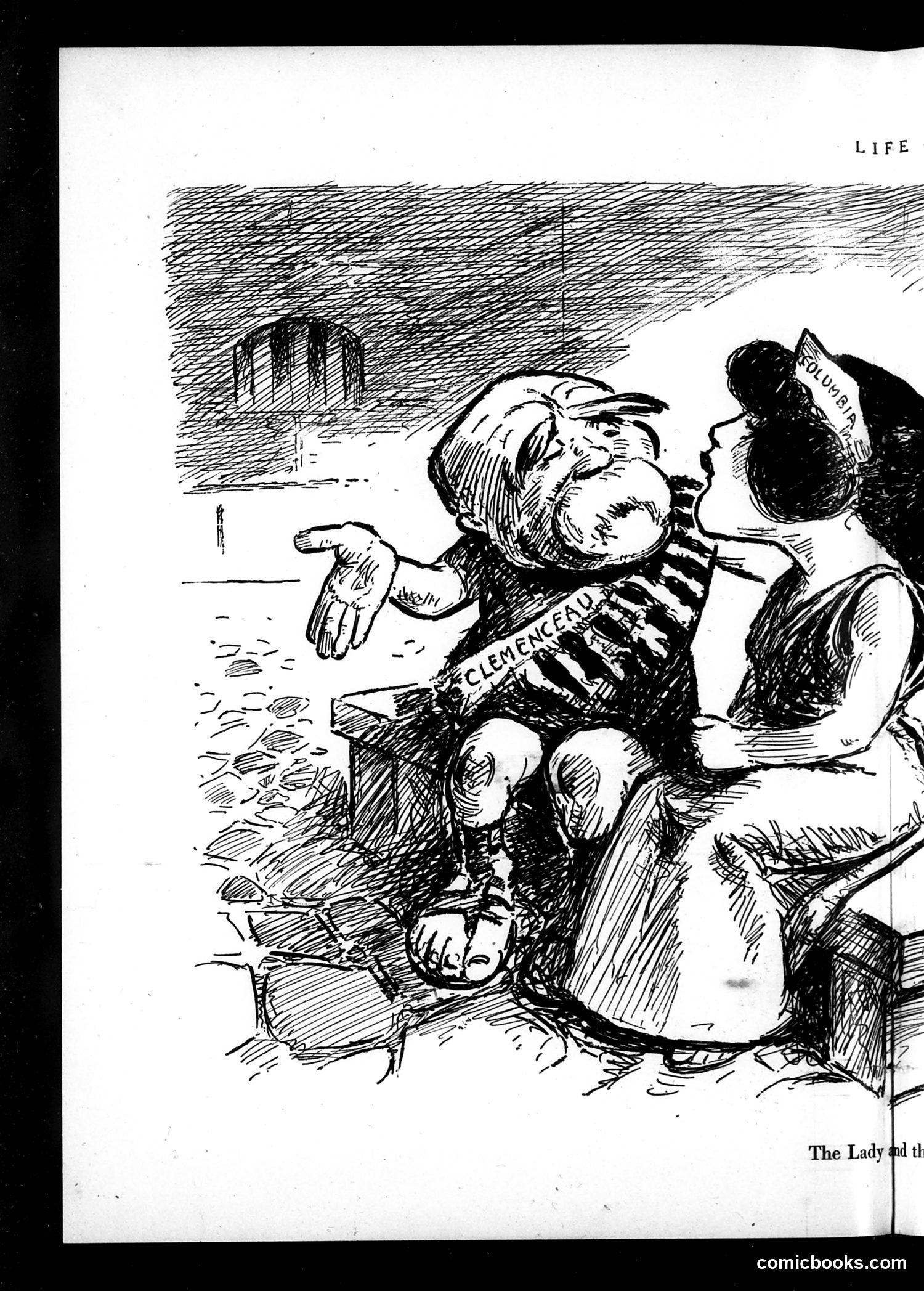
This appears to be a satirical cartoon from *Life* magazine featuring a portly figure labeled "CLEMENCEAU" (visible on his clothing). The character is depicted in an exaggerated, caricatured style typical of early 20th-century political satire. A woman on the right appears to be confronting or addressing him. Georges Clemenceau was French Premier during and after World War I, known for his hardline stance in peace negotiations. The cartoon likely satirizes his political position or personality during this period. The exact nature of the satire—whether mocking his appearance, his policies, or a specific incident—requires additional context the OCR text doesn't provide. The partially visible caption "The Lady ad th[e]..." is cut off, preventing full interpretation of the joke's specific target.
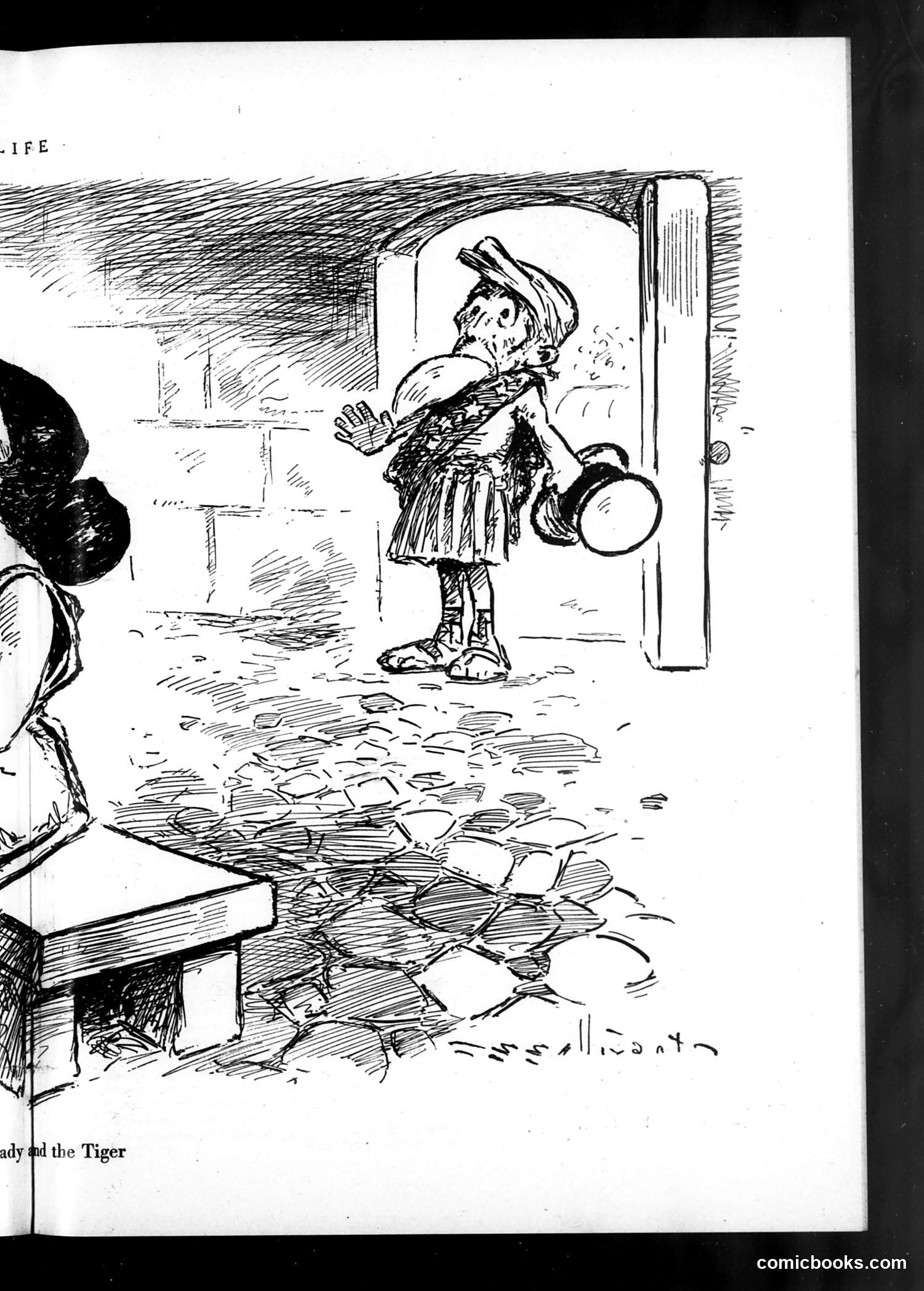
This appears to be an illustration from Life magazine accompanying a story titled "Lady and the Tiger" (likely a reference to Frank Stockton's famous 1882 short story). The sketch shows a figure in classical or period costume standing at a doorway, gesturing dramatically with what appears to be a pot or vessel. The character wears a hat and draped clothing. The ground is covered with scattered objects, possibly coins or debris. Without additional context from the full article, the specific satirical meaning is unclear. However, given the "Lady and the Tiger" reference—a story about choosing between two doors with unknown consequences—this likely depicts a moment of dramatic decision or suspense. The scattered objects and the character's animated pose suggest some form of predicament or chaos, but the exact social or political commentary cannot be determined from the image alone.
This page reviews three theatrical productions by A.A. Milne, the British playwright and author. The critic discusses Milne's reputation for whimsical writing and how audiences struggle to take his serious dramatic work seriously. The main critique concerns "The Lucky One," which the reviewer argues is a straightforward drama undermined by Milne's reputation—audiences expecting whimsy keep searching for it even when it isn't there. The critic finds the play's central idea compelling (that popularity doesn't guarantee decency of character) but the execution merely adequate for a Theatre Guild production. "The Romantic Age" receives gentler treatment as pleasant but insubstantial—the reviewer coins "gossamer" to describe its ethereal emptiness, noting it costs $2.75 regardless. Actors Margalo Gillmore and Leslie Howard are praised for their performances. The page also briefly mentions "The Texas Nightingale," crediting actress Jobyna Howland for generating laughs.
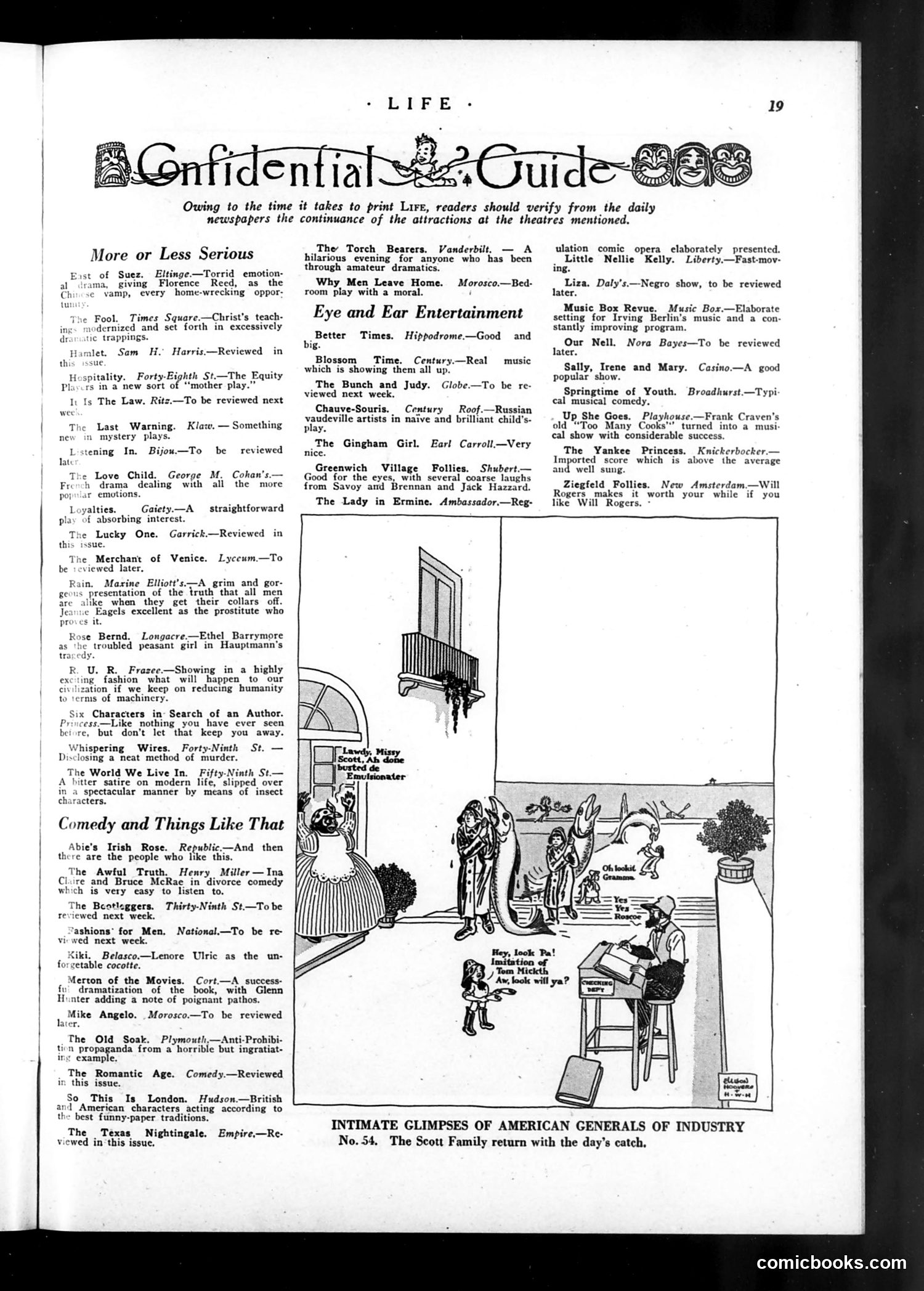
This page is a **theatre review section** from Life magazine listing Broadway shows and their quality. The OCR'd text consists entirely of brief critical notices of plays and musicals—there is no political cartoon or satire to analyze. The accompanying illustration labeled "Intimate Glimpses of American Generals of Industry" (No. 54) depicts **the Scott Family return with the day's catch**—a domestic scene showing a wealthy family arriving home with fish from fishing. This appears to be a humorous social commentary on industrialists' leisure activities, presenting them in an ordinary domestic moment rather than as powerful business figures. The reviews themselves use wit to evaluate shows: "Rain" is praised for revealing "all men are alike when they get their collars off"; "R.U.R." warns about mechanizing humanity; and several comedies are noted for addressing divorce and domestic themes popular in 1920s theatre. The page reflects postwar entertainment tastes rather than political satire.
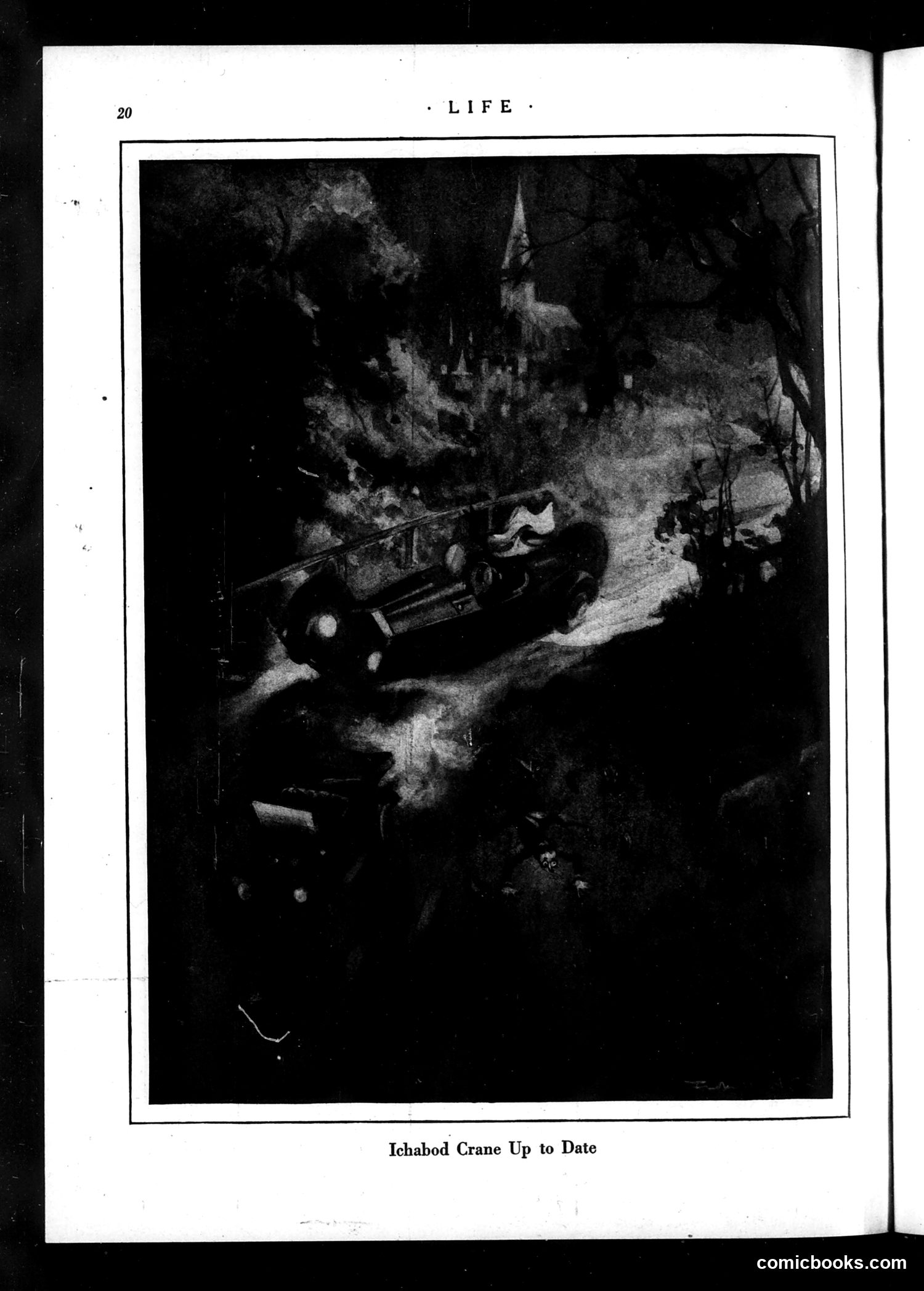
This appears to be a satirical illustration updating Washington Irving's famous literary character Ichabod Crane for a contemporary (early 20th century) audience. The image shows a figure in a car—a then-modern automobile—set against a spooky nighttime landscape with a church steeple visible in the background, evoking the original story's setting. The satire likely comments on how modern technology and automobiles were changing American life and culture, replacing older modes of travel. By placing the cowardly, superstitious Ichabod Crane in a modern vehicle rather than on horseback, the cartoon makes a social joke about contemporary anxieties or the contrast between traditional American folklore and rapid technological progress in the industrial age.
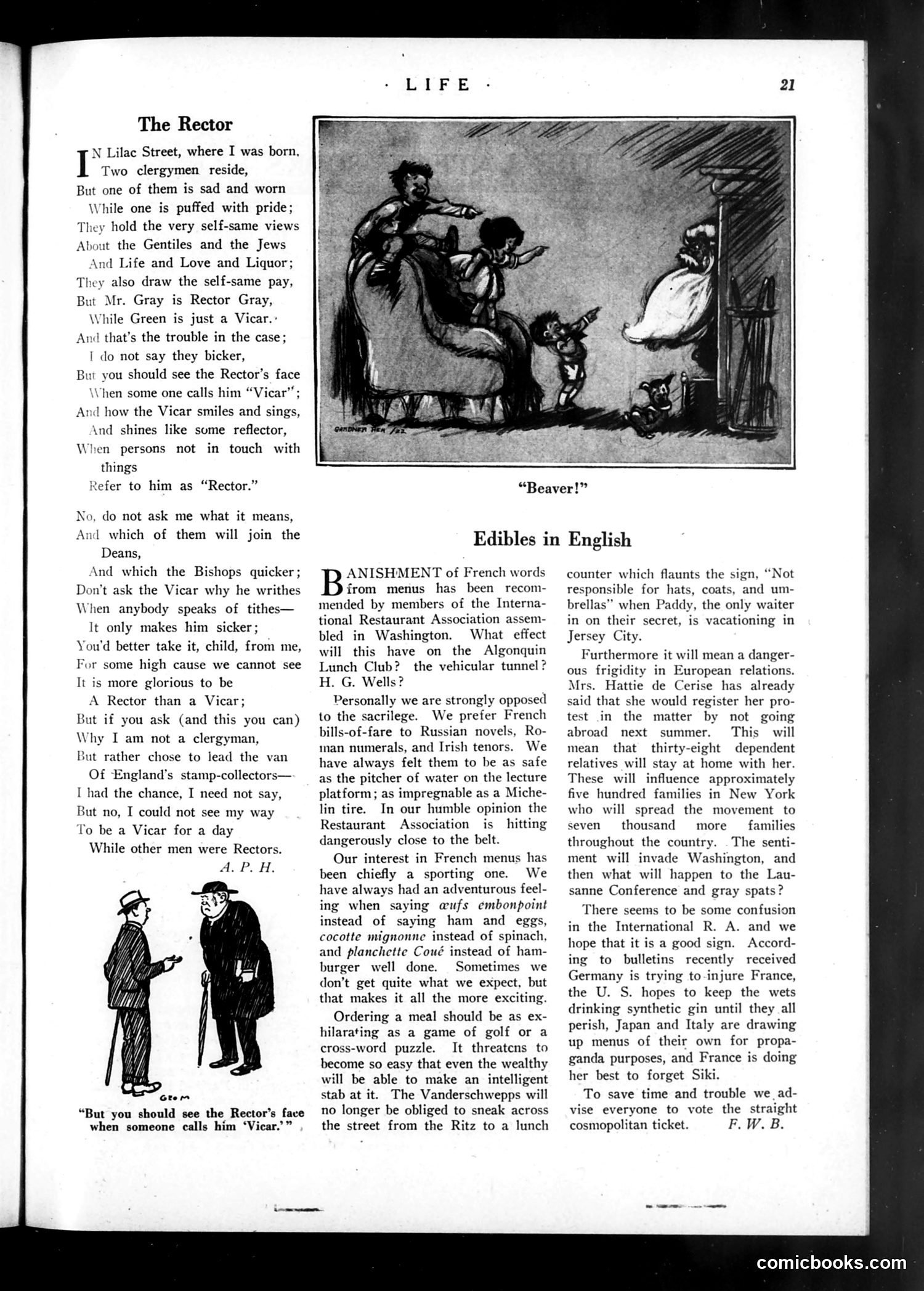
**"The Rector"** is a humorous poem about ecclesiastical snobbery. Two clergymen on Lilac Street—Mr. Gray (Rector) and Mr. Green (Vicar)—hold identical views and draw equal pay, yet occupy different ranks in the Church of England hierarchy. The satire mocks their petty status anxiety: Gray bristles when mistakenly called "Vicar," while Green beams when incorrectly addressed as "Rector." The author notes this irrational pride is inexplicable ("I do not say what it means"), yet admits he himself couldn't abandon stamp-collecting to become a mere Vicar when others were Rectors—revealing how such meaningless hierarchies infect even those who recognize their absurdity. **"Edibles in English"** satirizes a proposed ban on French menu terminology by the International Restaurant Association. The writer opposes replacing French culinary terms with English equivalents, arguing this would: - Eliminate exciting guesswork from dining - Strip restaurants of mystique - Damage European diplomatic relations (claiming Mrs. Hattie de Cerise will protest by staying home, influencing hundreds of families) - Create international chaos affecting the Lausanne Conference The piece mocks both pretentious French-menu culture *and* the Association's crusade with deadpan absurdity.
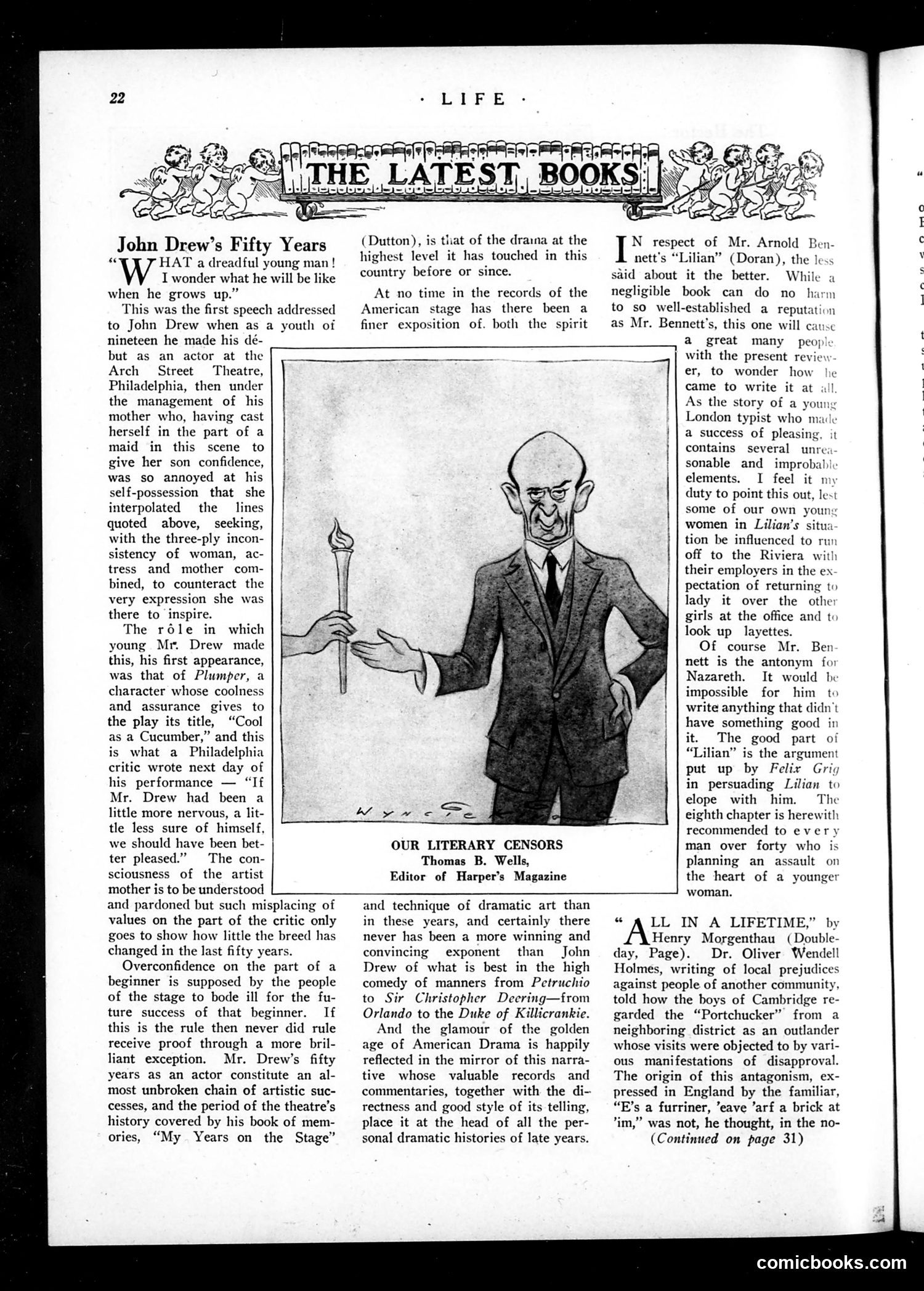
The cartoon depicts Thomas B. Wells, editor of Harper's Magazine, portrayed as a stern censor wielding what appears to be a censorious implement. The accompanying article reviews Arnold Bennett's novel "Lilian," criticizing it for potentially corrupting young women by depicting a typist who runs away with her employer to the Riviera, then returns to lord it over her coworkers. Wells objects to the book's "unreasonable and improbable elements" as dangerous moral influence. The satire targets Wells's self-appointed role as moral gatekeeper—ironically, he praises Bennett's writing quality while warning against its corrupting influence on female readers. The piece exemplifies early 20th-century literary censorship attitudes, where magazine editors positioned themselves as protectors of public morality, particularly regarding women's behavior and aspirations.
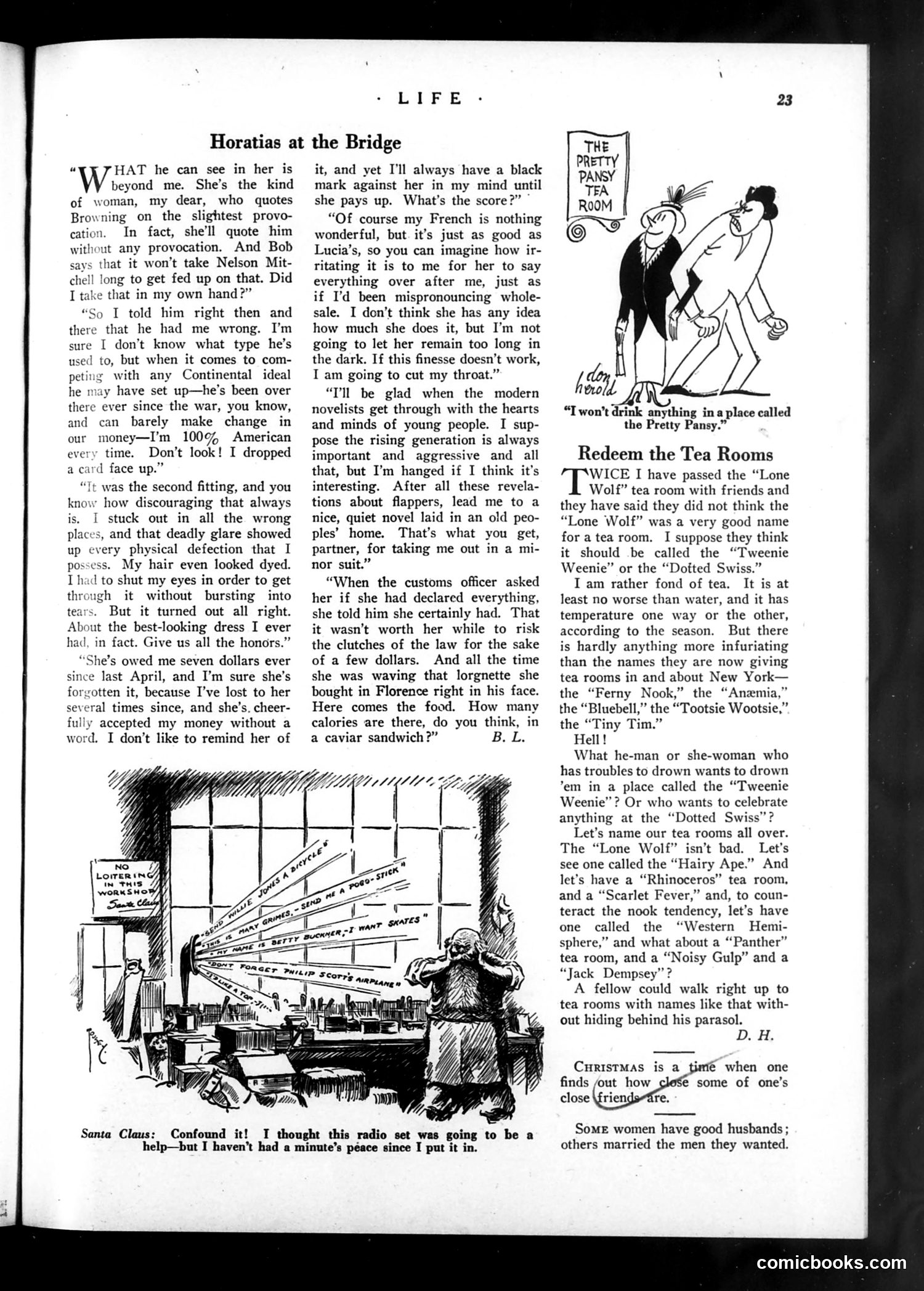
This page presents satirical commentary on upper-class women's social behavior in the 1920s. **"Horatias at the Bridge"** (left) mocks wealthy women's constant gossiping and petty grievances. Through overlapping monologues, women complain about trivial slights—a friend's mispronounced French, unpaid debts, borrowed dresses—while holding grudges indefinitely. The title references Horatius defending a bridge, suggesting these women wage similarly intense battles over minor social transgressions. The illustration shows women at what appears to be a tea room or social gathering, emphasizing this is where such complaints are aired. **"Redeem the Tea Rooms"** (right) critiques the proliferation of cutesy-named tea rooms around New York—"Tweenie Weenie," "Dotted Swiss," "Tiny Tim." The author argues these saccharine names are unsuitable for establishments where people seek respite from troubles. The piece humorously suggests masculine alternatives like "Rhinoceros" and "Scarlet Fever" to counter the feminized, precious naming trends. The broader satire targets the commercialization of leisure spaces catering to leisured women.
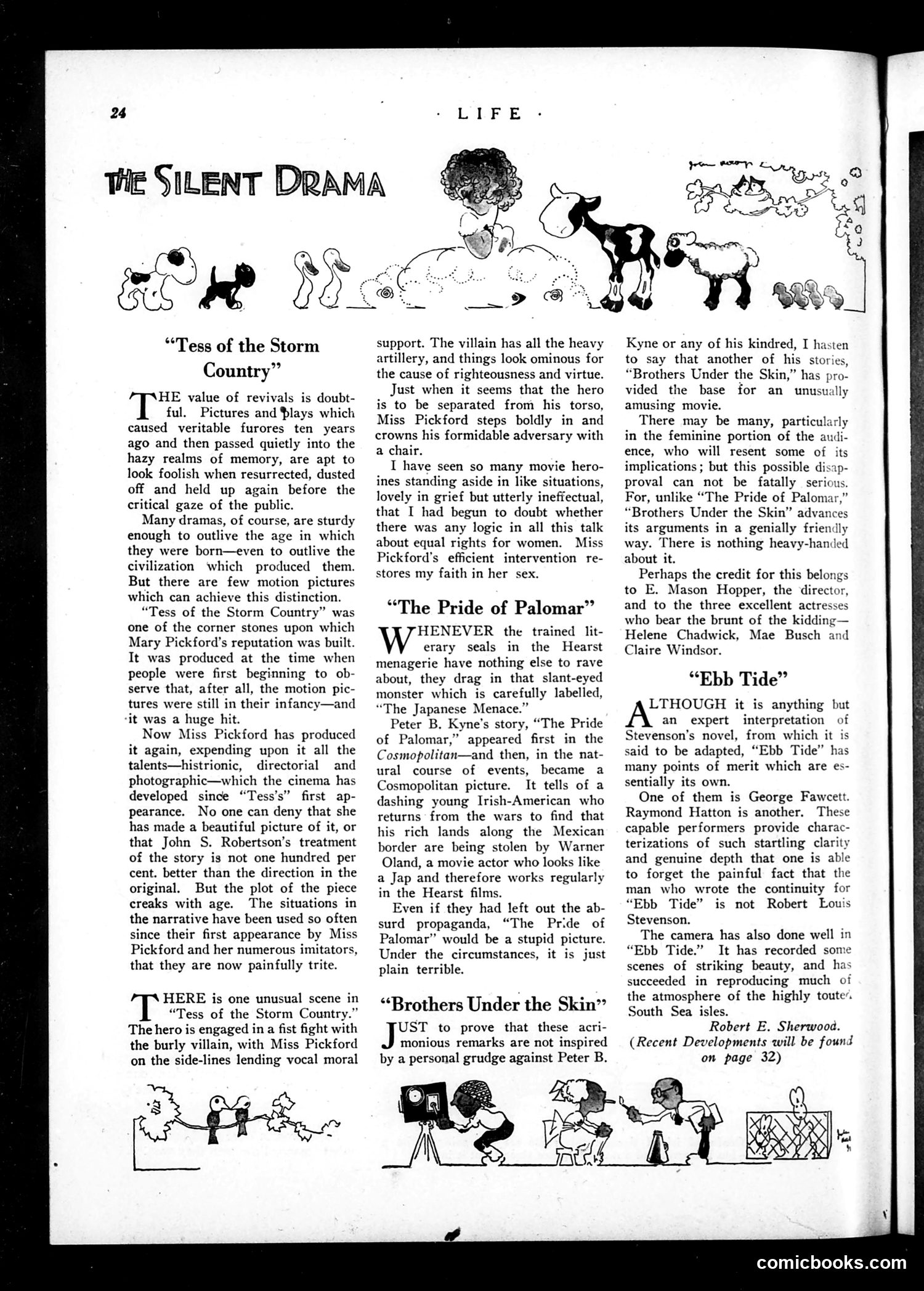
This page reviews three contemporary silent films, critiquing both their artistic merit and social messaging. **"Tess of the Storm Country"**: A Mary Pickford remake. The reviewer praises the updated production values but notes the plot feels dated from overuse. He surprisingly commends Pickford for having her character *actively intervene* in a fight scene—physically attacking the villain with a chair rather than standing passively by. He sarcastically suggests this restores his "faith" in women's equality, implying that most movie heroines were depicted as helpless. **"The Pride of Palomar"**: The reviewer harshly dismisses this as propaganda-laden drivel. It features Warner Oland (appearing "Japanese") as a villain stealing lands from an Irish-American hero. The critic mocks *Hearst menagerie* publications for constantly invoking "The Japanese Menace"—a contemporary xenophobic trope—to sell stories. **"Brothers Under the Skin"**: Also by Kyne, but the reviewer finds it genuinely amusing and good-natured, though it may offend some audience members with its implications about race or class. The page satirizes how films weaponize propaganda while praising those offering entertainment without malice.
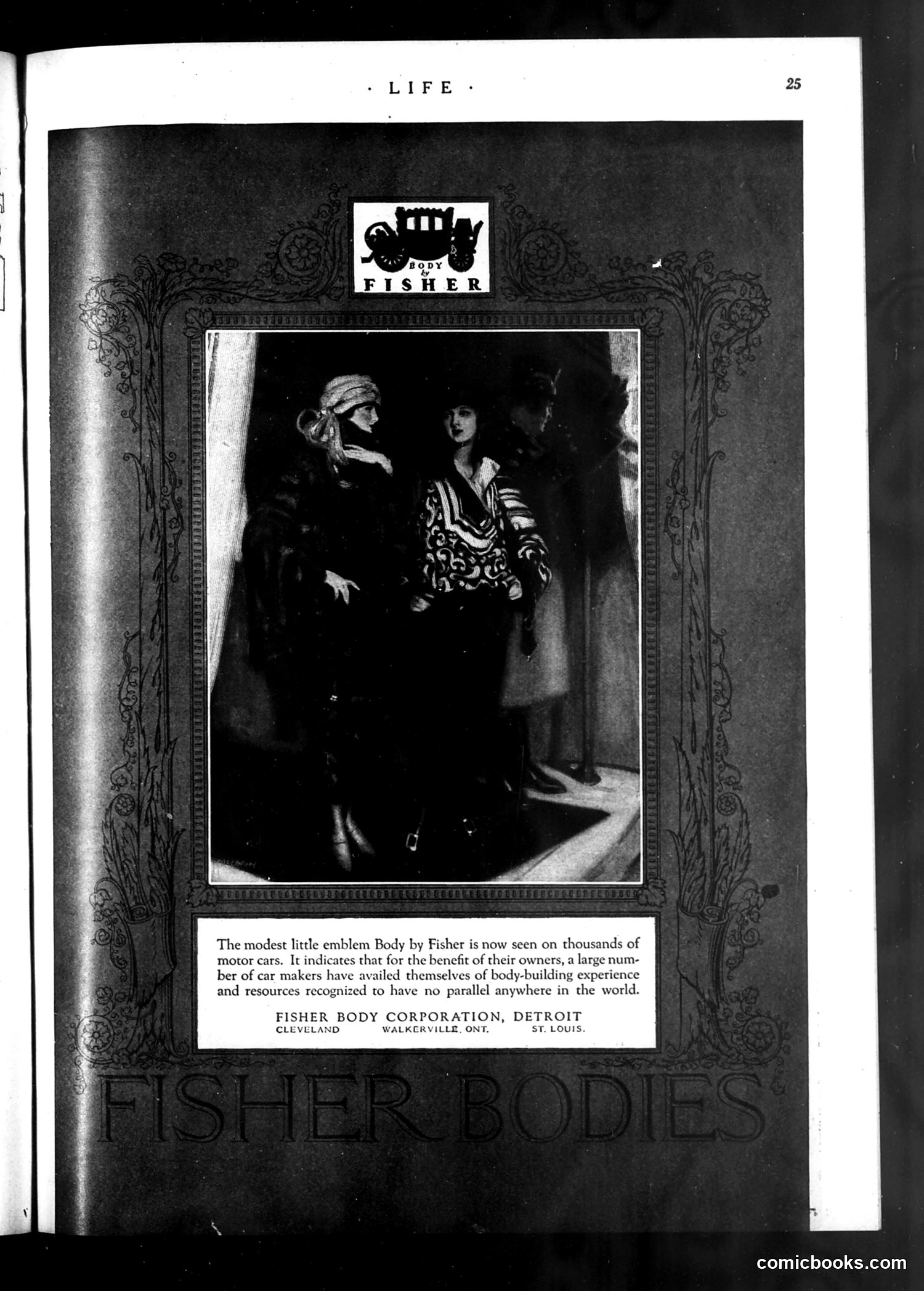
This is primarily **advertising, not satire or political commentary**. It's a Fisher Body Corporation advertisement promoting their automobile body manufacturing services. The page features a photograph of what appears to be three figures in 1920s attire examining or discussing a vehicle—likely meant to convey professional expertise and quality craftsmanship. The accompanying text emphasizes Fisher Body's widespread adoption ("thousands of motor cars") and claims their unparalleled experience in body-building. The "modest little emblem" referenced is the Fisher Body logo visible at the top of the page. This appears in a *Life* magazine advertisement section, using the publication's platform to establish Fisher Body as the premier automotive body manufacturer of its era, with facilities in Detroit, Cleveland, Walkerville (Ontario), and St. Louis.
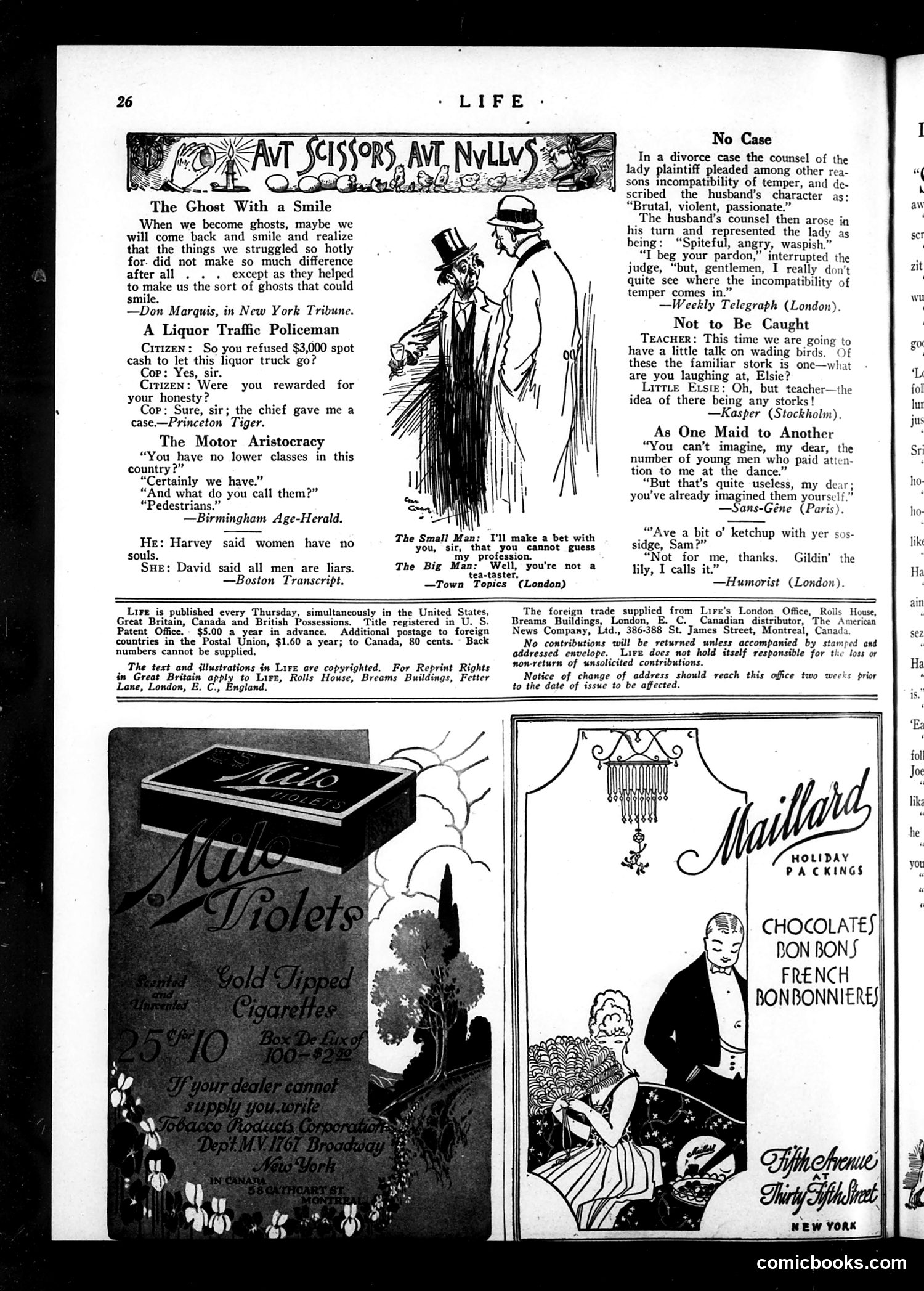
This page from *Life* magazine contains multiple short satirical jokes and social commentary typical of early 20th-century American humor: **Main cartoons:** - "The Ghost With a Smile" (Don Marquis quote): Philosophical reflection on life's struggles becoming insignificant after death - "A Liquor Traffic Policeman": Corruption joke—a cop refuses a $3,000 bribe but accepts a case of liquor instead, satirizing selective morality during Prohibition era - "The Motor Aristocracy": Social satire on automobiles creating a new class divide; pedestrians are the "lower classes" **Brief jokes** cover marital discord, gender stereotypes ("women have no souls"), class pretension, and misunderstandings about storks (implying the birds' role in birth narratives). The page also includes period advertisements for Mail Violet cigarettes and Maillard chocolates, typical of *Life's* revenue model. The humor relies on situational irony and social observation rather than political figures or specific events.
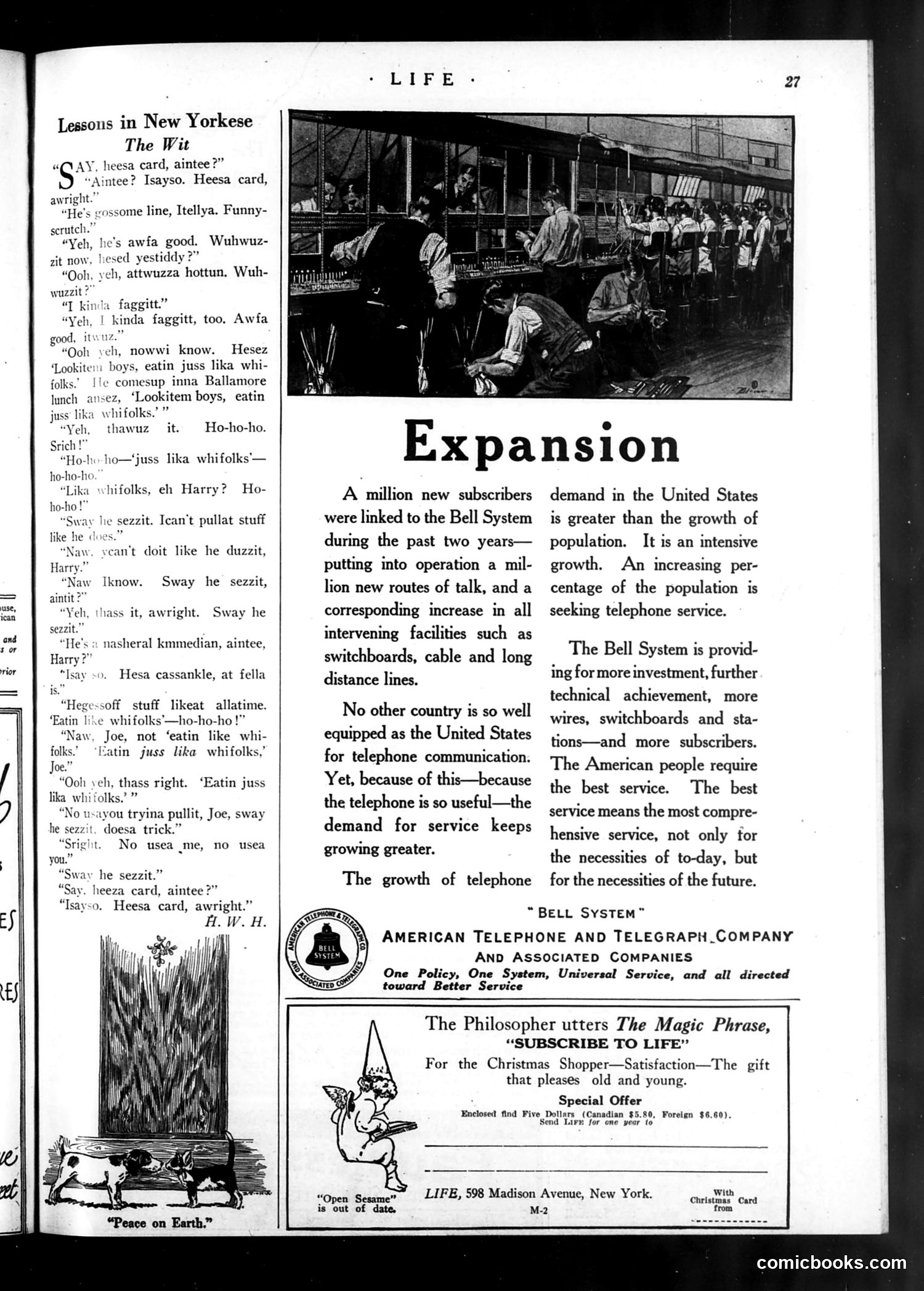
## "Lessons in New Yorkese: The Wit" This satirical piece mocks working-class New York immigrant dialect and speech patterns. The dialogue depicts characters—likely Italian or Eastern European immigrants—mangling English grammar and pronunciation ("heesa card, aintee?" for "isn't he a card?"). The humor relies on ethnic stereotyping, portraying these speakers as comically unintelligent through phonetic misspellings and malapropisms. The repeated joke involves a comedian's routine about Black Americans ("Lookitem boys, eatin juss lika whifolks"), which the characters struggle to remember and retell correctly. The satire works on multiple levels: mocking both immigrant speech and the content of racist humor itself. The accompanying cartoon titled "Peace on Earth" shows figures around a fire—its meaning unclear from the image alone. ## Bell System Advertisement The remaining page is dominated by a corporate advertisement for American Telephone and Telegraph promoting telephone system expansion, targeting middle-class consumers with promises of modern infrastructure and reliable service.
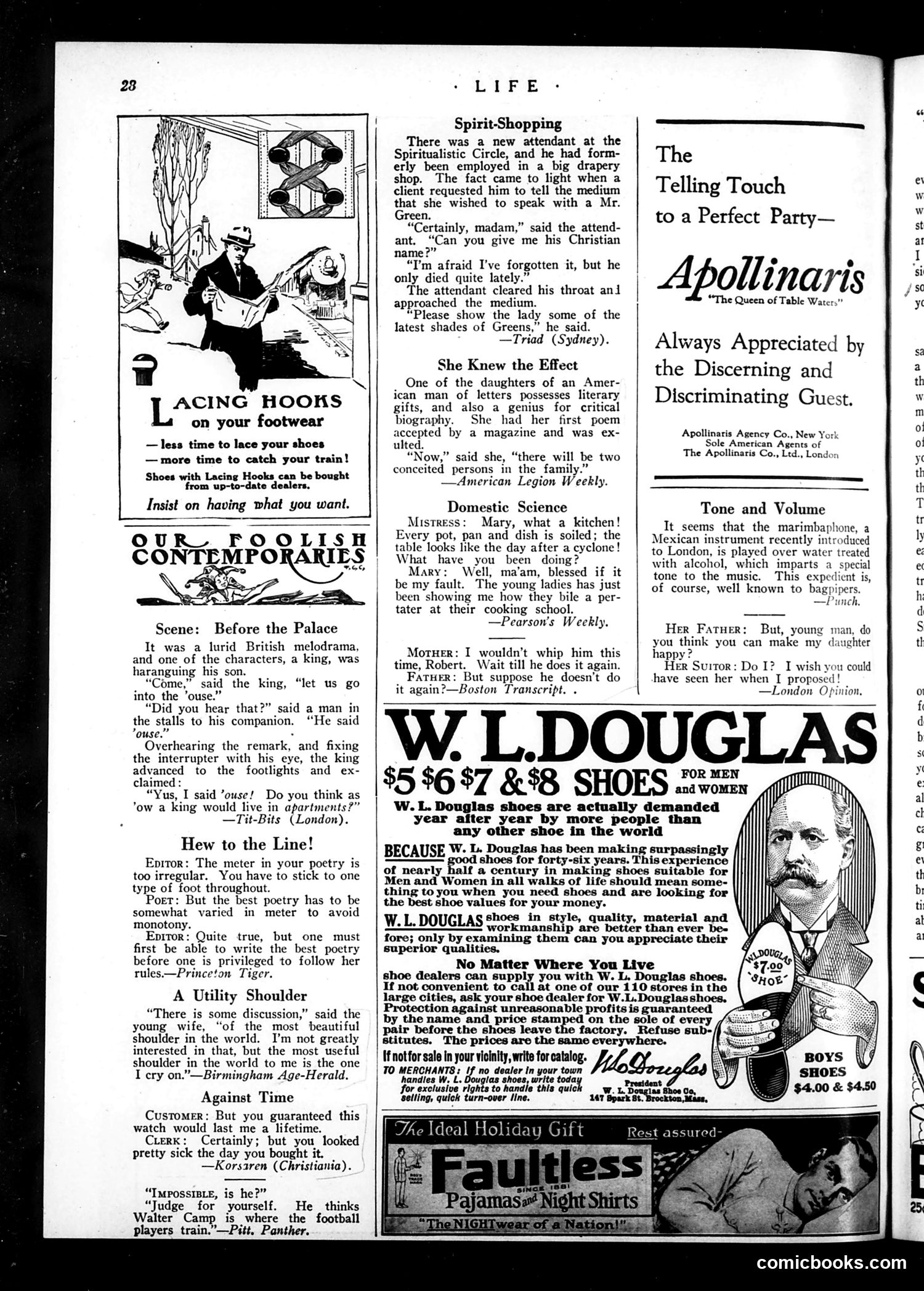
This page contains multiple brief satirical anecdotes ("Our Foolish Contemporaries"), each mocking contemporary social absurdities: **"Before the Palace"** ridicules class pretense: an actor playing a king uses dropped g's ("'ouse" instead of "house"), then defensively justifies it by claiming kings wouldn't live in fancy apartments—inverting logic to defend bad acting. **"Spirit-Shopping"** jokes about a spiritualist medium's new attendant who, fresh from working retail, treats contacting the dead like selling fabric—asking for "the Christian name" of Mr. Green and offering "the latest shades of Greens," confusing commercial sales patter with séance protocol. **"Domestic Science"** mocks culinary education when a servant blames cooking school instruction for kitchen chaos, suggesting upper-class girls are taught impractically. Other brief jokes ridicule poetry editors, romantic proposals, and watches. The page is primarily **advertising**: large ads for lacing hooks, W.L. Douglas shoes, and Apollinaris mineral water dominate the layout. The satirical content serves as editorial filler between advertisements—typical Life magazine format of the era.
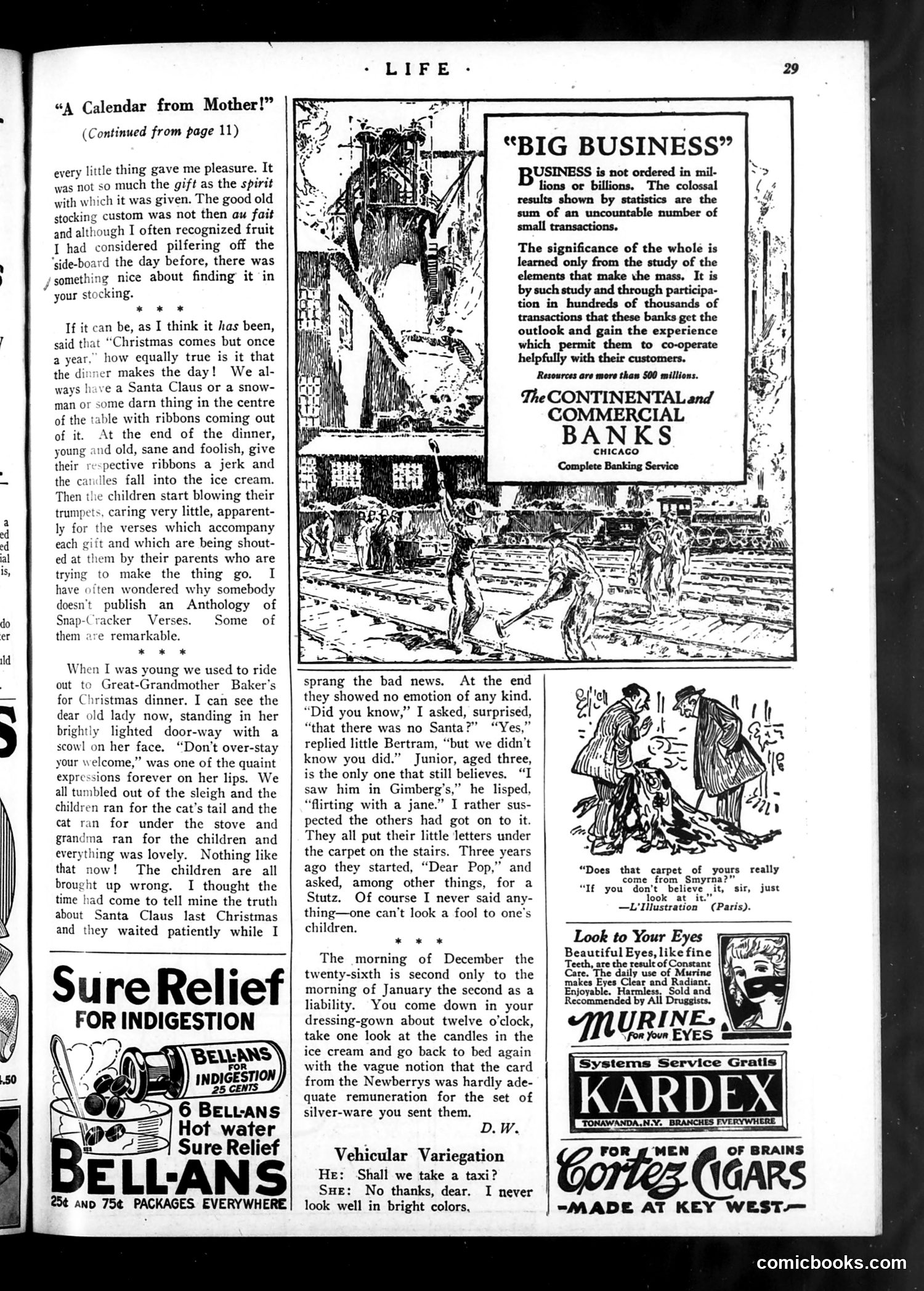
This page combines a nostalgic personal essay with period advertisements. The main text, "A Calendar from Mother," is a sentimental piece recounting the author's Christmas memories—childhood stockings, family dinners with table decorations, and the moment of telling his children Santa Claus doesn't exist. The anecdotes emphasize how children today are "brought up wrong" compared to earlier generations, a common refrain in early 20th-century writing. The cartoons are minimal; a small illustration accompanies a brief "Vehicular Variegation" dialogue joke about taxi colors. The page is primarily filled with advertisements: Bell-ans indigestion remedy, Continental and Commercial Banks (emphasizing small transactions), Murine eye drops, Kardex filing systems, and Cortez cigars. These ads target the magazine's middle-class readership with products addressing everyday concerns—digestive health, clear eyes, business organization, and masculine leisure.
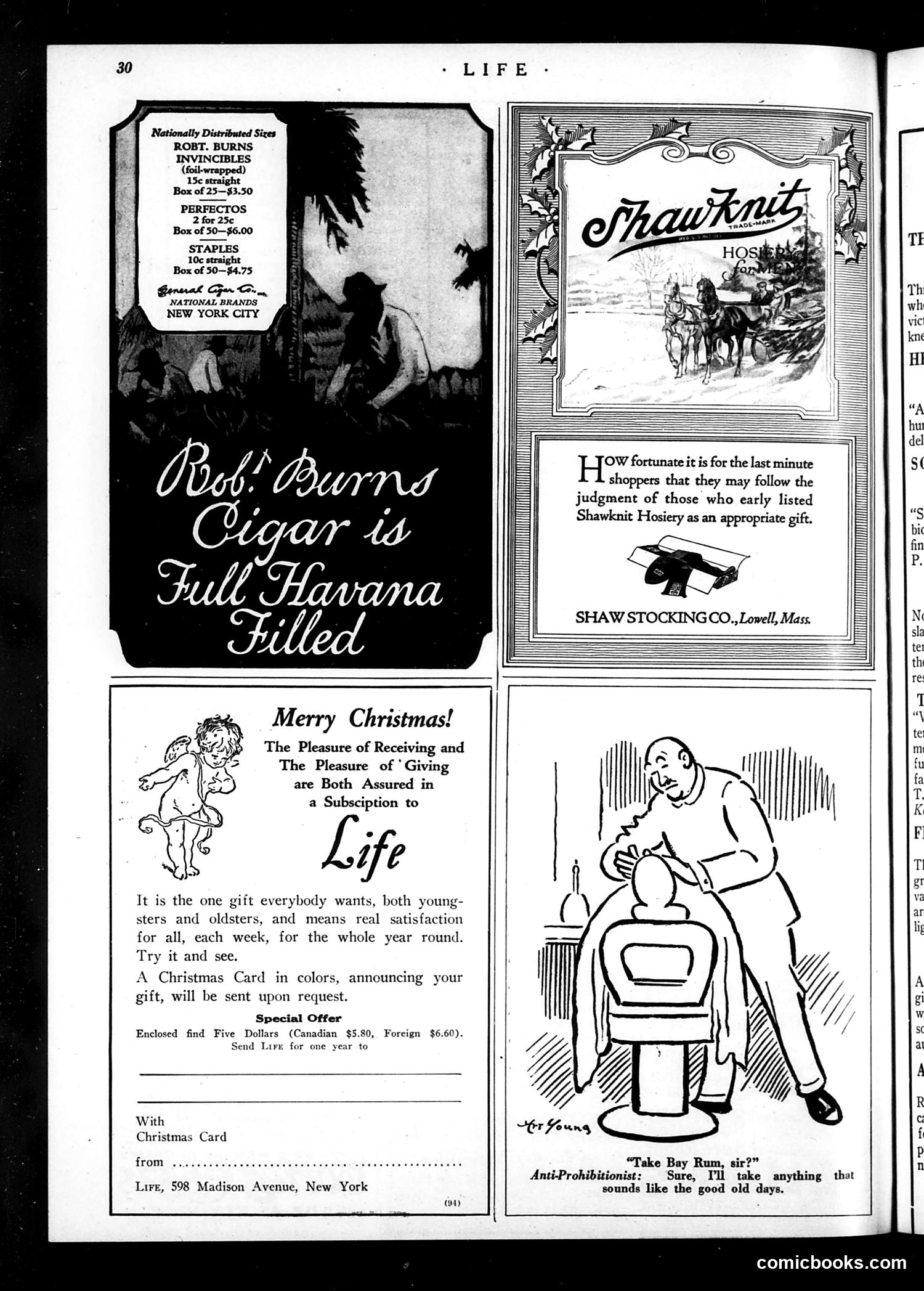
This page contains **advertisements and a political cartoon** from Life magazine's Christmas issue. The main cartoon (bottom right) satirizes **Prohibition**, the 1920-1933 ban on alcohol. A barber offers "Bay Rum" (a legitimate hair tonic) to a customer labeled "Anti-Prohibitionist," who eagerly accepts *anything* with a name suggesting alcohol—because actual liquor is now illegal. The joke: desperate people seeking ways around Prohibition's restrictions, and how even innocent products get coded as substitutes for banned drinks. The other content is straightforward advertising: cigars (Robert Burns brand), hosiery (Shawknit), and a subscription offer for Life magazine itself as a Christmas gift. The cartoon reflects the social tension of the Prohibition era, when Americans divided sharply over the alcohol ban, and when people sought creative—sometimes comical—workarounds to federal law.
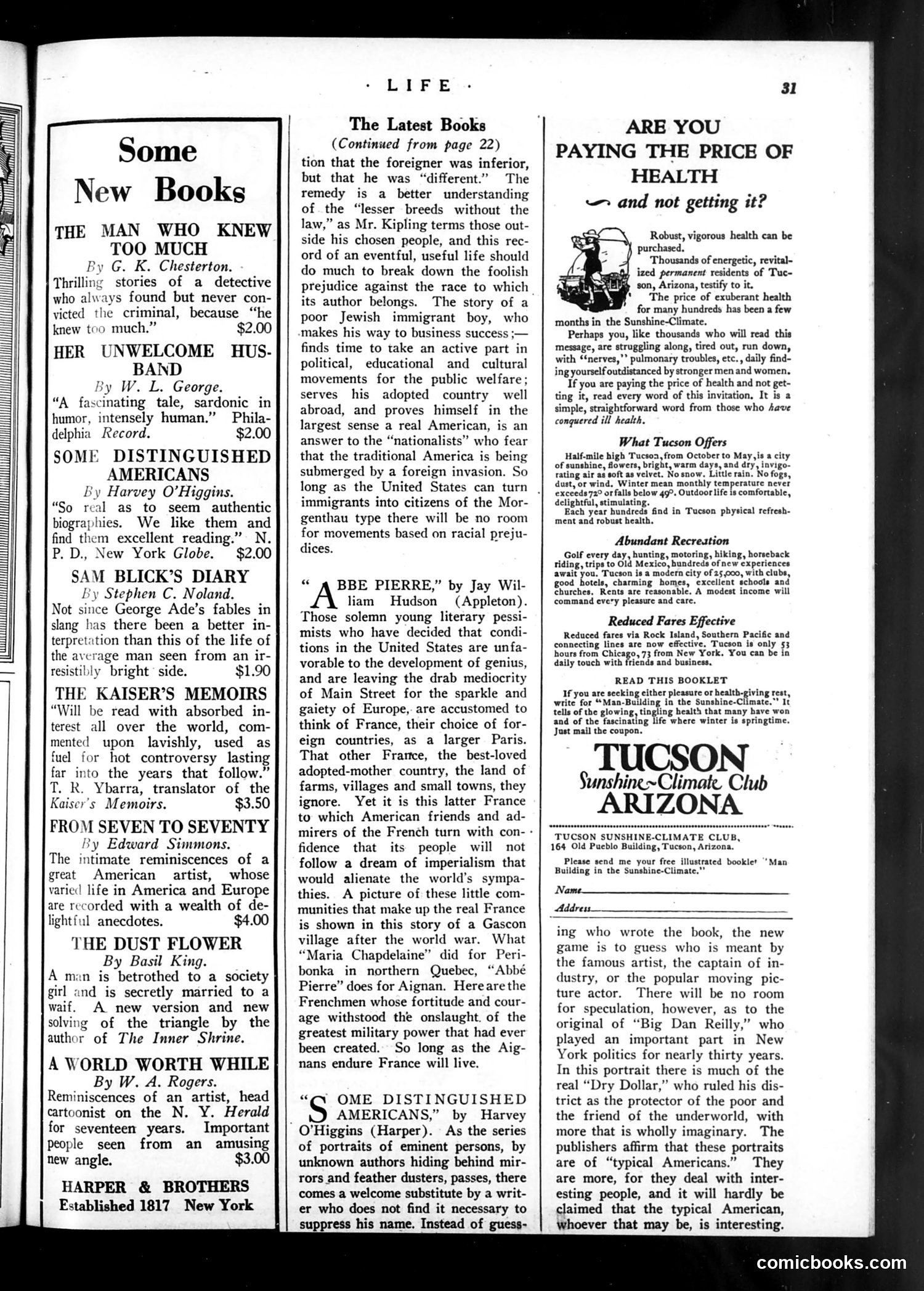
This page presents book advertisements and reviews, not political cartoons. The content reflects post-WWI American concerns circa early 1920s. Key topics include: **Immigration and Assimilation**: A review praises a book about a Jewish immigrant's success, directly countering "nationalist" fears that America is being "submerged by foreign invasion." This addresses 1920s nativist anxieties about immigrants diluting American identity. **European Disillusionment**: Reviews mock young American literary pessimists fleeing to Europe, suggesting they romanticize Paris while ignoring rural France's authentic character. This reflects post-war American ambivalence about European culture. **The Kaiser's Memoirs**: Advertised as generating "hot controversy," likely referencing contemporary debates about Germany's wartime leadership and responsibility. The page reflects 1920s anxieties: immigration restriction movements, disenchanted expatriate writers, and lingering WWI tensions—all mainstream discussion topics of the era.
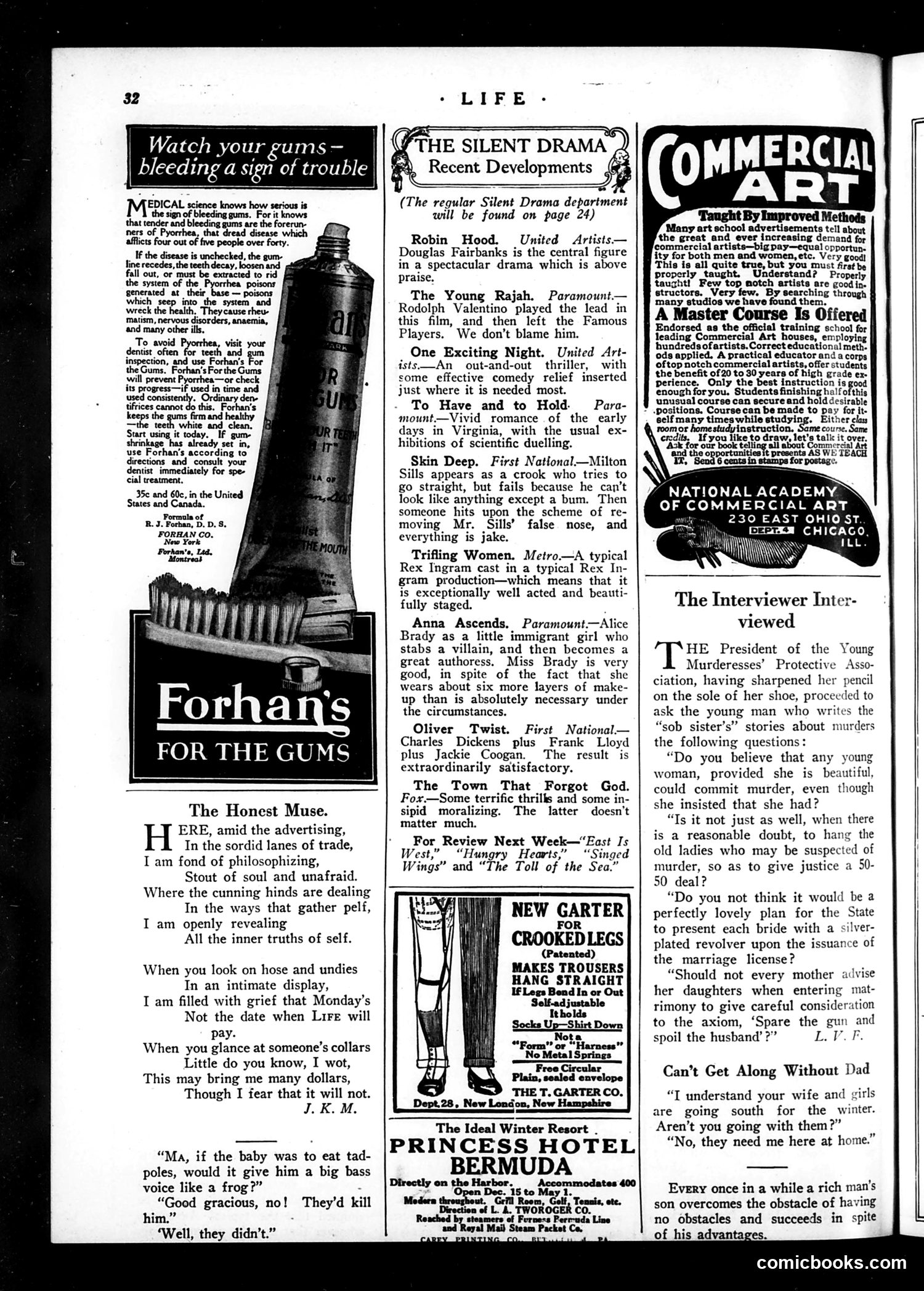
This page contains commercial advertisements mixed with editorial content typical of Life magazine. The main left-side advertisement is for Forhan's toothpaste, warning readers that bleeding gums signal serious health problems and promoting their product as a remedy. The middle section reviews recent silent films (Robin Hood, The Young Rajah, Skin Deep, etc.), using brief, witty dismissals—praising Fairbanks's Robin Hood while bluntly stating the reviewer "doesn't blame" Valentino for leaving after The Young Rajah, a backhanded insult suggesting the film was poor. On the right are ads for a commercial art school and other products. "The Honest Muse" poem in the lower left is self-aware satire about advertising's pervasiveness in the magazine itself—the poet complains that Life delays paying him despite advertisements for mundane items (hosiery, collars) filling the pages. The entire page reflects early 1920s American consumer culture and cinema, with advertising thoroughly integrated into editorial space.
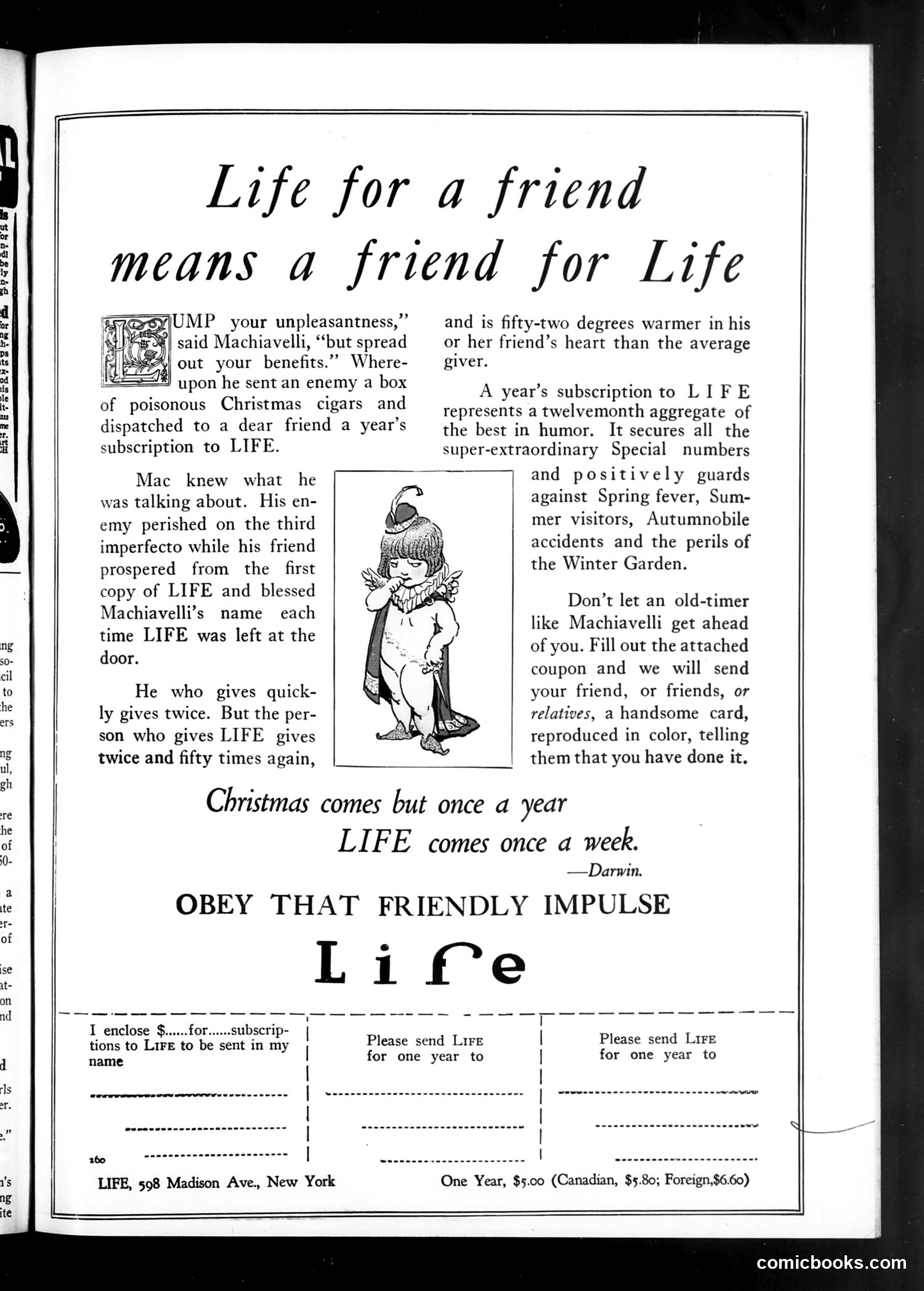
This is a **subscription advertisement**, not political satire. It promotes *Life* magazine as a gift by invoking Machiavelli's famous principle: spreading benefits to others while keeping enemies at a distance. The ad uses a humorous premise: a man sent poisoned cigars to his enemy, who died, while simultaneously gifting *Life* magazine to a friend, who thrived. The joke contrasts harmful and beneficial gifts. The copy argues *Life* subscriptions are superior Christmas gifts because the magazine arrives **weekly** (versus Christmas's once-yearly occurrence), providing year-round entertainment. It humorously claims the subscription protects recipients against various misfortunes: spring fever, summer visitors, automobile accidents, and theatrical scandals. The cherub illustration represents innocent friendship. The coupon at bottom allows readers to send subscriptions to friends or relatives, with a decorative card announcing the gift. This is straightforward **magazine marketing** dressed in clever wordplay—no political reference or hidden satire intended.
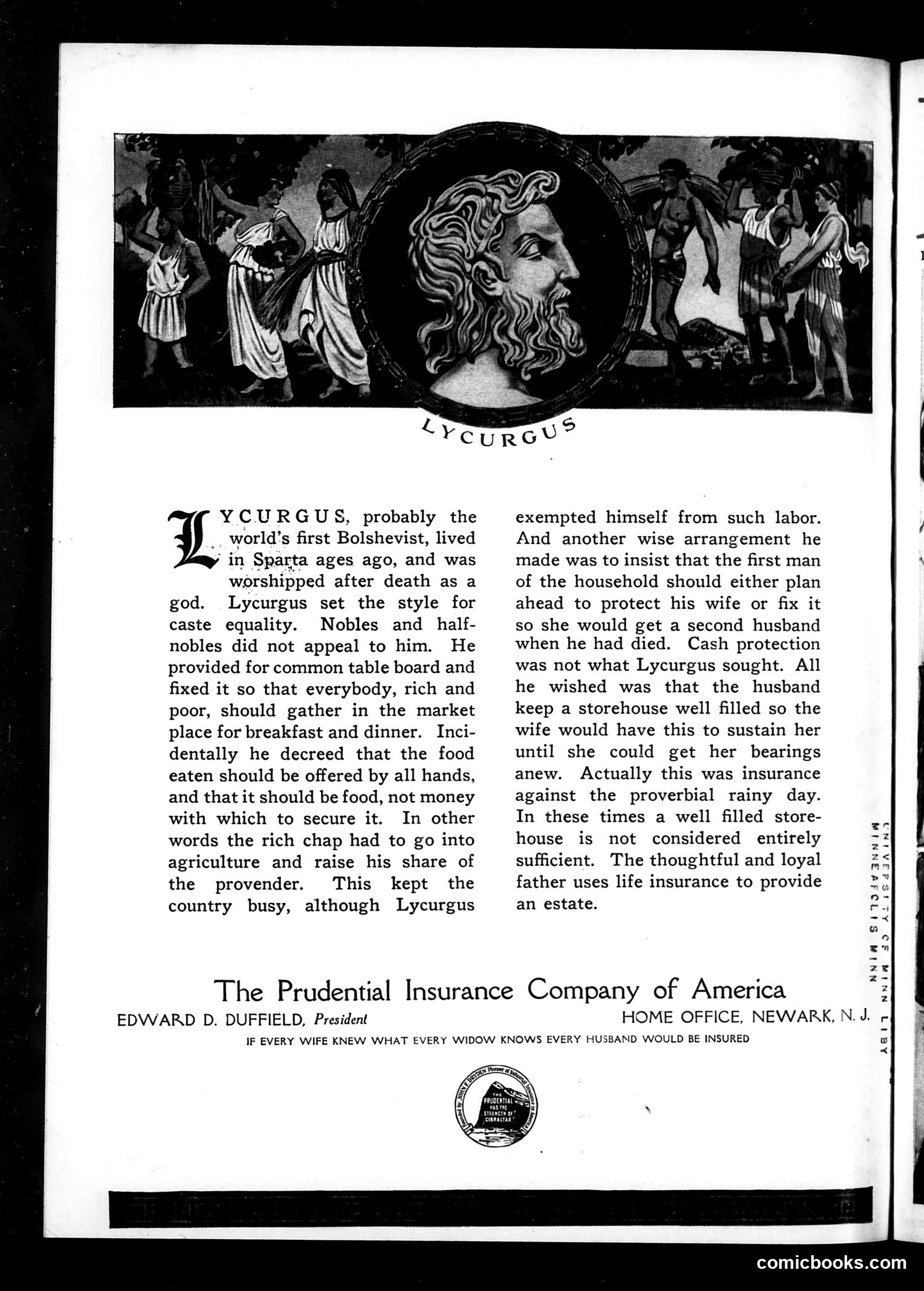
This is a **Prudential Insurance advertisement disguised as satire**. The page uses the ancient Spartan lawgiver Lycurgus as an extended metaphor for life insurance planning. The text compares Lycurgus's requirement that Spartan husbands maintain well-stocked storehouses for their widows to modern life insurance. The joke: ancient Sparta achieved widow protection through forced savings; modern America achieves it through insurance policies. The advertisement's final tagline—"If every wife knew what every widow knows, every husband would be insured"—implies that widows who faced financial hardship wish their husbands had purchased life insurance. The circular portrait shows Lycurgus in classical style; flanking scenes depict Spartans in period dress, visually reinforcing the historical comparison. This appears designed to appeal to husbands' sense of responsibility toward their wives by framing insurance as both ancient wisdom and modern necessity.