
Life, 1922-12-14 · page 12 of 36
Life — December 14, 1922 — page 12: what you’re looking at
What you’re looking at
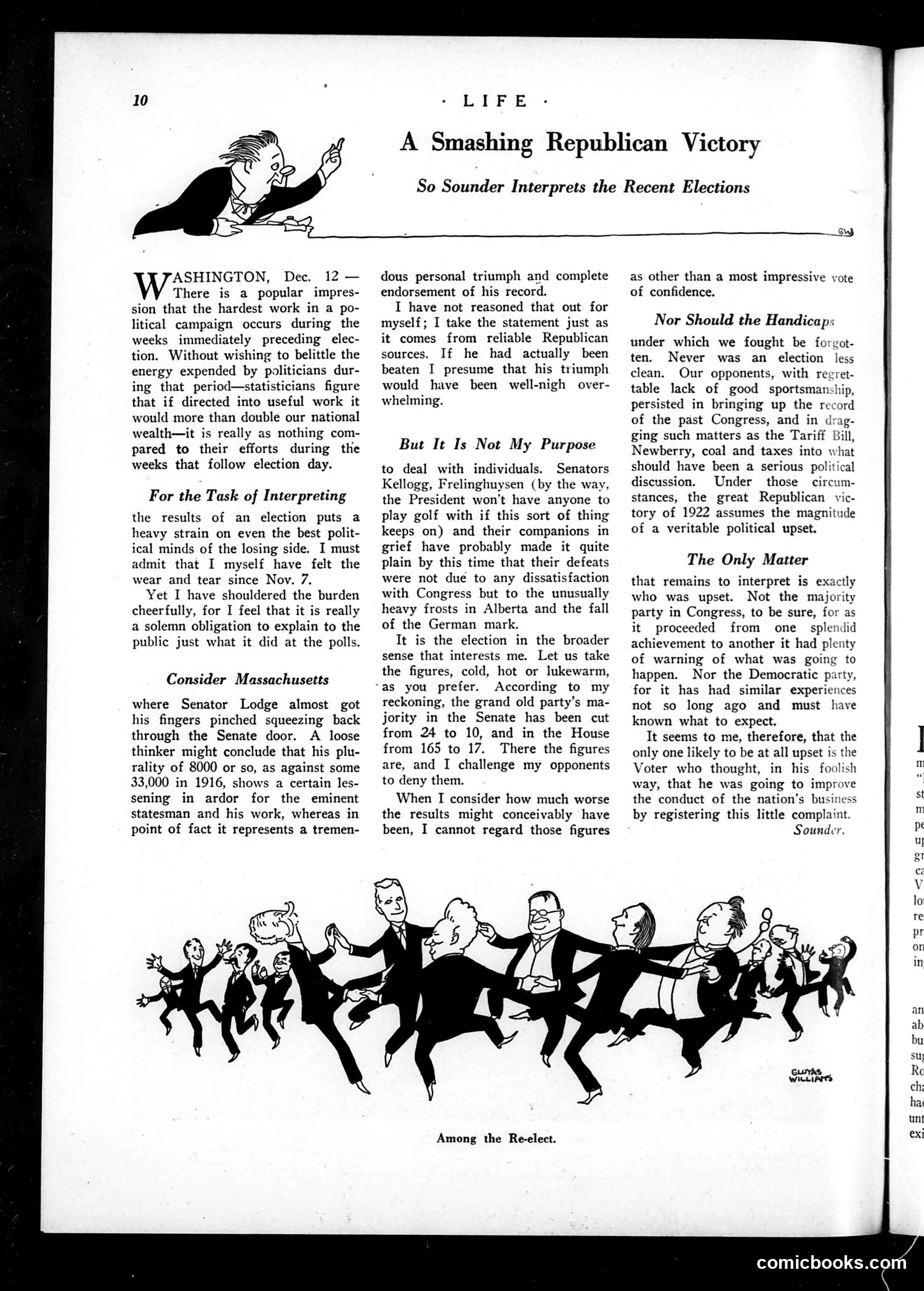
This Life magazine article (dated December 12) celebrates recent Republican electoral gains. The author discusses the 1922 midterm elections, noting Republicans gained Senate seats (24 to 10) and House seats (165 to 17). The cartoon below shows celebrating politicians dancing jubilantly, captioned "Among the Re-elect." The piece mentions Senator Lodge nearly winning in Massachusetts and references President Harding favorably by name. The author argues Republicans shouldn't be complacent about their victory margin, cautioning that the election represented voter dissatisfaction with Democrats rather than wholehearted Republican endorsement. The satire gently mocks Republican triumphalism while acknowledging genuine electoral success.
📄 Transcribed text from this page (OCR, searchable)
Machine-transcribed from the original scan — historical spelling and the odd misread are preserved.
ASHINGTON, Dec. 12 — There is a popular impres- sion that the hardest work in a po- litical campaign occurs during the weeks immediately preceding elec- tion. Without wishing to belittle the energy expended by politicians dur- ing that period—statisticians figure that if directed into useful work it would more than double our national wealth—it is really as nothing com- pared to their efforts during the weeks that follow election day. For the Task of Interpreting the results of an election puts a heavy strain on even the best polit- ical minds of the losing side. I must admit that I myself have felt the wear and tear since Nov. 7. Yet I have shouldered the burden cheerfully, for I feel that it is really a solemn obligation to explain to the public just what it did at the polls. Consider Massachusetts where Senator Lodge almost got his fingers pinched squeezing back through the Senate door. A loose thinker might conclude that his plu- rality of 8000 or so, as against some 33,000 in 1916, shows a certain les- sening in ardor for the eminent statesman and his work, whereas in point of fact it represents a tremen- ‘as you prefer. - LIFE A Smashing Republican Victory So Sounder Interprets the Recent Elections Sa dous personal triumph and complete endorsement of his record. I have not reasoned that out for myself; I take the statement just as it comes from reliable Republican sources. If he had actually been beaten I presume that his triumph would have been well-nigh over- whelming. But It Is Not My Purpose to deal with individuals. Senators Kellogg, Frelinghuysen (by the way, the President won't have anyone to play golf with if this sort of thing keeps on) and their companions in grief have probably made it quite plain by this time that their defeats were not due to any dissatisfaction with Congress but to the unusually heavy frosts in Alberta and the fall of the German mark. It is the election in the broader sense that interests me. Let us take the figures, cold, hot or lukewarm, According to my reckoning, the grand old party’s ma- jority in the Senate has been cut from 24 to 10, and in the House from 165 to 17. There the figures are, and I challenge my opponents to deny them. When I consider how much worse the results might conceivably have been, I cannot regard those figures Among the Re-elect. as other than a most impressive vote of confidence. Nor Should the Handicaps under which we fought be forgot- ten. Never was an election less clean. Our opponents, with regret- table lack of good sportsmanship, persisted in bringing up the record of the past Congress, and in ging such matters as the Tariff Newberry, coal and taxes into what should have been a serious political discussion. Under those circum- stances, the great Republican vic- tory of 1922 assumes the magnitude of a veritable political upset. The Only Matter that remains to interpret is exactly who was upset. Not the majority party in Congress, to be sure, for as it proceeded from one splendid achievement to another it had plenty of warning of what was going to happen. Nor the Democratic party, for it has had similar experiences not so long ago and must have known what to expect. It seems to me, therefore, that the only one likely to be at all upset is the Voter who thought, in his foolish way, that he was going to improve the conduct of the nation’s business by registering this little complaint. Sounder. comicbooks.com an ab bu su; Rc ch: ha unt exi